Latest News and Comment from Education

Friday, August 21, 2020

Level Up – Life In A Post Pandemic Video Game – Wrench in the Gears

Level Up – Life In A Post Pandemic Video Game – Wrench in the Gears

Level Up – Life In A Post Pandemic Video Game


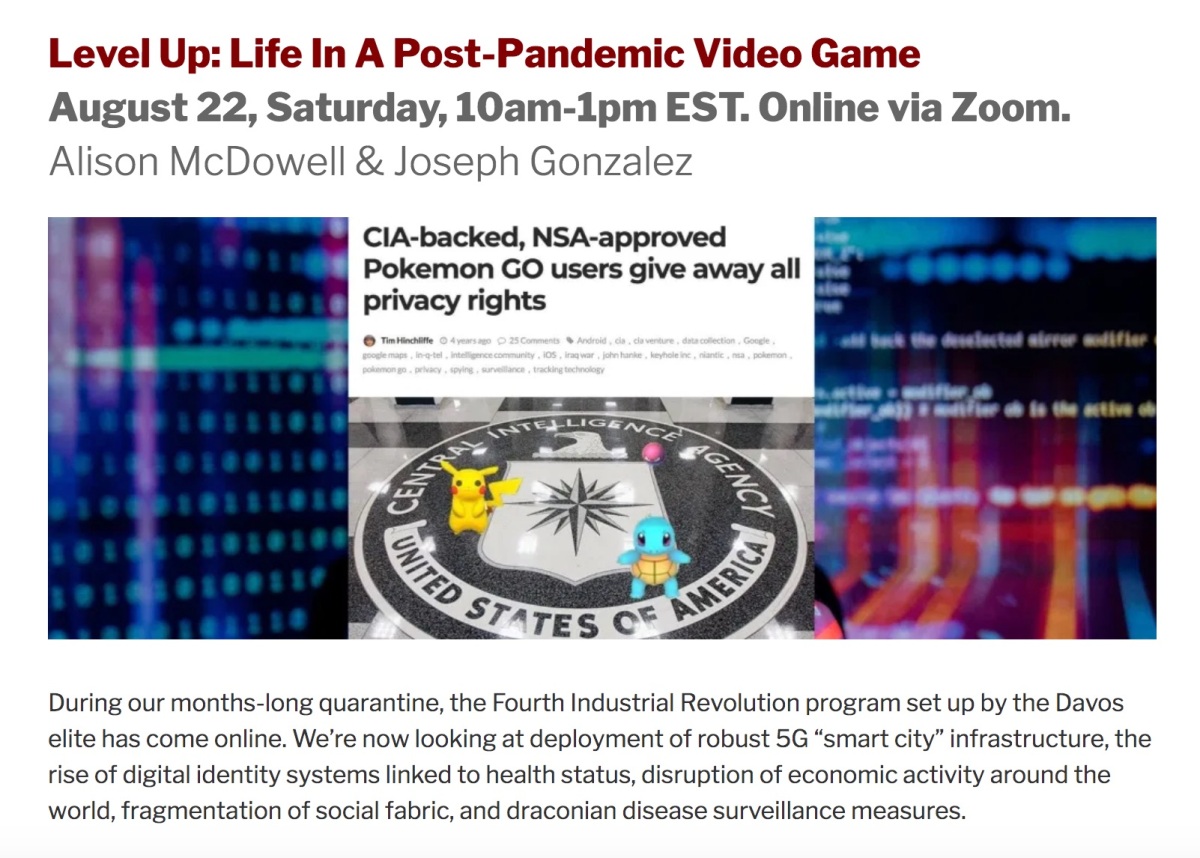
This Saturday August 22, 2020 from 10am to 1pm EST, Joseph Gonzalez and I will host a three-hour program through Incite Seminars exploring what it would mean to live in an augmented reality gamified police state. Capitalism isn’t dying. It has, in fact, jumped into the virtual world. A predatory digital infrastructure of surveillance and value extraction is being rolled out now in response to Covid-19. Very few people are aware of the bigger picture. This isn’t about a single outbreak, but rather the coercive normalization of technocracy using ongoing biosecurity threats as a mechanism of global domination. It is the billionaire oligarchs who will be controlling the data dashboard panopticon.
Pre-registration for the seminar is required. Sign up here. We’re asking for a donation in an amount that feels right to you. Joseph and I are volunteering our services, but it takes resources to run the platform we’re using, and we’re also hoping to direct some funding towards Lakota food growing efforts described in my prior post,  Timpsila, Medicine for Tech-No-Logic. Proceeds from the seminar will be split between the two. I know folks found a lot of comfort in the Timpsila post, so if you’re in a position to lend support directly, I know Chas Jewett (Venmo @chas-jewett-1) will definitely put a gift in any amount to good use.
My understanding is that this seminar will be recorded, and I plan to post a link once I get it. For those of who’d  like to start wrapping your head around what we’re planning to talk about, I’ve posted a glossary of terms. I invite you to consider them in relation to this short video about a poor family’s involvement with a “community care coordinator” named Kathy.
Given what I know is coming, I’ll take the liberty to read between the lines and offer my take on this video. The entire family is under state supervision CONTINUE READING: 

Can Schools Deliver Services To Students With Disabilities This Fall? : NPR

Can Schools Deliver Services To Students With Disabilities This Fall? : NPR

Schools Say They Have To Do Better For Students With Disabilities This Fall


For Sarah McLaren, who lives in a suburb of Minneapolis, talking about the spring is painful. Her daughter, a rising fourth-grader, struggles with auditory processing and receives special education services. But McLaren says her daughter had trouble keeping up with teachers on an iPad because the instruction was almost all talk.
"They'd tell her, 'Look at this problem, look at that problem. No, show me your worksheet,' " McLaren remembers. "The teachers were doing the best they could, but all those rapid verbal directions just overwhelmed her."
McLaren says her daughter went from loving school to dreading it. "[She] would literally run away from the iPad and hide in the closet or under the bed."
More than 7 million schoolchildren receive special education services in the U.S. But this spring, when the nation's schools were forced to teach remotely, many of those children were left behind, and some vital services — including physical, occupational and speech therapies — simply stopped. With many districts planning to continue remote learning in the fall, parents and caregivers expect better this school year. And school leaders know: They've got to do better.
Special education teacher Nikki Allinson, in Washington, D.C., says one of the greatest challenges she faced trying to teach remotely was that many of her students learn with the help of tactile, classroom-based tools — like laminated cards or magnetic letters for word decoding. But, in the spring, kids weren't given those tools for use at home. Allinson says that also made it "nearly impossible" to teach abstract math concepts. "I recorded so many videos of me with Legos, you know, trying to find things that they CONTINUE READING: Can Schools Deliver Services To Students With Disabilities This Fall? : NPR

NYC Educator: De Blasio's Circus

NYC Educator: De Blasio's Circus

De Blasio's Circus


I've got an inbox full of worry, and I'm as worried as anyone. Full disclosure--I've asked for and received an accommodation to teach from home. I've encouraged everyone I know to do the same. If you have applied and been denied, or ignored, here's a form you can fill out to get help from the UFT. 


Meanwhile, we're facing de Blasio's plan, which relies heavily on teachers who don't actually exist. We'll cross that bridge when we come to it, says the mayor. Can you imagine making such nonsensical arguments at work? At your home?

Here's a story about a teacher who's going to go in, but also live in a tent in her backyard so as not to infect her family. I know people who are planning to live in hotels rather than risk hurting family members. I know people who will take unpaid leaves rather than potentially sicken or kill their elderly or immuno-compromised relatives. 

When you look at his actual plan, it's really hard to figure how it works. I know of one school in which students will attend once every four days. That means they will mostly be in once a week. The other days, they will get asynchronous instruction. It's hard for me to imagine teaching like that, but it's good enough for Mayor de Blasio. And what will happen on day five, when students are actually in the building?

Well, everyone will be socially distanced, as mandated by the state, except when they aren't. Kids tend to move, you know, and not always when you ask them to. Mayor de Blasio may not be aware. The teacher desk and student desks will all face in the same direction, as per the state directive. Perish forbid we should face CONTINUE READING: NYC Educator: De Blasio's Circus


How to Assess Digital Literacy for Students (and Educators!) - NEA Today

How to Assess Digital Literacy for Students (and Educators!) - NEA Today

How to Assess Digital Literacy for Students (and Educators!)


For years, educators have been buzzing about the importance of “digital literacy.” But what do those words really mean? According to the American Library Association, digital literacy is “the ability to use information and communication technologies to find, evaluate, create, and communicate information, requiring both cognitive and technical skills.” A growing reliance on web-based testing has forced many schools to confront the lack of digital literacy among their students and staff. And, as the COVID-19 outbreak showed us, assessing digital literacy is more important than ever—for students and for educators.

What Students Need to Know

So what kind of tech savvy do students need to succeed? Beyond the rudimentary skills needed to answer online test questions, students must understand how to do online research and use a wide array of digital tools. They should know how to create video and audio, participate in video conferencing, share and collaborate remotely, and use slideshows and online posters.
And, as the COVID-19 pandemic has made painfully clear, remote learning skills are essential today. Even before the pandemic, the popularity of online classes had been growing exponentially as a complement to classroom learning. This includes taking online college-level classes and enriching learning through webinars. Both require the ability to manage audio and video on digital devices, submit homework and classwork online, communicate with the teacher and classmates remotely, and stay on top of grades.
We can also start preparing students now for college and career tasks, such as writing resumes, preparing an online curriculum vitae, connecting digital devices to local area networks (LANs) and Wi-Fi, and managing the security of their personal device and information.

How to Determine Your Assessment Needs

Before you can choose an assessment tool, it’s important to figure out your goals. Consider the following questions:
How comprehensive should the tool be? Do you want a tool that’s diagnostic, CONTINUE READING: How to Assess Digital Literacy for Students (and Educators!) - NEA Today

How America's Broken Education System Perpetuates Social Injustice | Dissident Voice

How America's Broken Education System Perpetuates Social Injustice | Dissident Voice

How America’s Broken Education System Perpetuates Social Injustice


Any conditions that compel the teacher to take note of failures rather than of healthy growth give false standards and result in distortion and perversion.— John Dewey,1
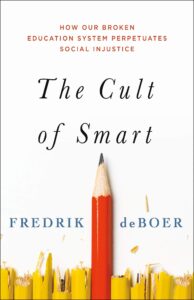
Academic Fredrik deBoer has written a book, The Cult of Smart: How Our Broken Education System Perpetuates Social Injustice (All Points Books, 2020), that questions the enormous value attached to people based on their academic talent. The author defines the Cult of Smart thus: “It is the notion that academic value is the only value, and intelligence is the only true measure of human worth. (p 5-6)
I am of the mind that if the average person puts in sufficient effort and the environment is not prohibitive, then such a person can attain her academic goals. I have never thought that the degree of difficulty or ease of learning would be the same for each person. I considered this to be the case in most fields of endeavor be it sports, art, writing, music, etc. However, the truly elite levels would favor those who had the predilection, natural gifts, and put in the effort to succeed in a chosen field.
DeBoer departs from the convention thought that holds academic success is tied to effort; he acknowledges that there is inequality on academic aptitude.
DeBoer does not refrain from emphasizing that there is a strong genetic component to intelligence, but he also acknowledges the role of the environment, even stating, “Profoundly unequal environments for children can drown out genetic effects. (p 23) He downplays group genetic differences and focuses on individual genetic differences. Intelligence is not attributed to CONTINUE READING: How America's Broken Education System Perpetuates Social Injustice | Dissident Voice

Carol Burris: For-Profit Charter Aims to Take Control of Entire District in Pennsylvania | Diane Ravitch's blog

Carol Burris: For-Profit Charter Aims to Take Control of Entire District in Pennsylvania | Diane Ravitch's blog

Carol Burris: For-Profit Charter Aims to Take Control of Entire District in Pennsylvania


Carol Burris writes in Valerie Strauss’s “Answer Sheet” blog about a for-profit charter corporation that about to take over the entire Chester-Upland school district in Pennsylvania. This district is one of the poorest in the state.
Burris writes:
Chester Community Charter School (CCCS) first opened its doors in 1998, just a few years after the school district found itself in financial distress. Vahan Gureghian, a Pennsylvania lawyer who runs a billboard company and is one of the state’s top Republican donors, owns CSMI, the for-profit management company that helped open Chester Community Charter School.
Although the charter school began small, it now educates about half of the district’s students. Despite its growth, its academic record is dismal.
CCCS students perform worse on standardized tests than students at several of the Chester Upland public schools. “This is the charter whose test scores have been below those of several district-run schools, ever since it was cited for cheating on said test scores,” said Chester resident Will Richan, “[cheating] not by one or two rogue teachers but across CONTINUE READING: Carol Burris: For-Profit Charter Aims to Take Control of Entire District in Pennsylvania | Diane Ravitch's blog

Restorative circles, online wellness rooms and grief training: How schools are preparing for the Covid mental health crisis - The Hechinger Report

Restorative circles, online wellness rooms and grief training: How schools are preparing for the Covid mental health crisis - The Hechinger Report

Restorative circles, online wellness rooms and grief training: How schools are preparing for the Covid mental health crisis
More students are experiencing anxiety and depression, forcing schools to prioritize mental health needs over academic work


The calls started at 6 a.m., and Patrick McCauley was ready, having retreated to the privacy of his garage where he sat waiting for Angelenos to share how they’re coping with the stresses of the coronavirus pandemic.
For the last 14 years, McCauley has worked as a mental health counselor and consultant in the Los Angeles Unified School District. In April, he began staffing a new hotline the district created to reach students, parents and teachers in need of mental health supports and other services as the virus forced people into isolation and cost jobs and lives.
One day he heard from a fifth grader who was terrified that her parents would catch the illness. Another day, a mother wanted advice on her once mild-mannered daughter, who had started throwing tantrums and yelling profanities after the quarantine began. Teachers wanted to know how to respond to students who appeared distraught during Zoom lessons, or what to do about the kids who didn’t log on at all.
McCauley, who has a soothing voice and a surfer’s unruffled mien, listened carefully and reassured the callers that they were experiencing understandable reactions to highly abnormal circumstances. Their testimony amounted to a warning, though, of what schools may face when they restart this fall: kids with a history of mental health problems whose symptoms have worsened, students who maybe experiencing anxiety or anger for the first time, children in households that have become CONTINUE READING: Restorative circles, online wellness rooms and grief training: How schools are preparing for the Covid mental health crisis - The Hechinger Report

“Confessions of a School Reformer” (Part 3) | Larry Cuban on School Reform and Classroom Practice

“Confessions of a School Reformer” (Part 3) | Larry Cuban on School Reform and Classroom Practice

“Confessions of a School Reformer” (Part 3)


Continuing story of my teaching history at Glenville High School in Cleveland (OH), 1956-1963
Then I got married in 1958.  Evenings which I had used for grading homework and preparing lessons and weekends for completing graduate papers were no longer as available as when I was single. Fatigue and the growing awareness that I could have a life outside of Glenville brought me face-to-face with choosing how to combine the demands of work and being with Barbara and eventually my two daughters, Sondra and Janice. Threading that needle was never easy for me as a teacher and later, as an administrator.
In seven years of teaching, I had created in fits and starts, with many stumbles, a home-grown history course than I had neither expected when I arrived at Glenville in 1956.  I was an unheralded, unknown classroom reformer creating a different American history course in a de facto segregated school.
I came to believe that any teacher could adopt and adapt lessons tailored to their students, especially economically disadvantaged students in segregated schools. My belief in engaging classroom materials turning around such students and schools grew out of those lessons I had created. If more teachers and schools did what I did, I believed, then urban schools would improve. Although my reform-driven belief turned out to be too narrow and too demanding of teachers given the working conditions they faced, the ideas I offered and practiced in my classrooms of getting students to connect the racial-inflected past to the present, I hoped would help my students understand what was happening in the South with Freedom Riders and student sit-ins in segregated restaurants and bus boycotts. Without fully knowing it myself, my belief in the power of education to reform society, as Dewey put it, lay behind the materials I developed and classroom activities I managed.  That is my small part in the civil rights movement.
In the next decade working in Washington, D.C. my work as a classroom CONTINUE READING: “Confessions of a School Reformer” (Part 3) | Larry Cuban on School Reform and Classroom Practice

Democrats Recognize Essential Role of Public Schools, Whose Needs Trump and DeVos Don’t Bother to Notice | janresseger

Democrats Recognize Essential Role of Public Schools, Whose Needs Trump and DeVos Don’t Bother to Notice | janresseger

Democrats Recognize Essential Role of Public Schools, Whose Needs Trump and DeVos Don’t Bother to Notice


In a refreshing development this week, as Democrats held their convention to nominate Joe Biden as the Democratic candidate for President and Kamala Harris for Vice President, public education was made visible again as an institution of vital importance to American life.
For President Donald Trump, opening schools matters only to enable parents to go to work.  I have never heard Trump or his education secretary, Betsy DeVos, speak about the needs of children or acknowledge the importance of our nation’s system of universally available public schools in cities, towns, rural areas and suburbs across America.
If you watched the Democrats on Tuesday night, however, you know that Jill Biden spoke from the Brandywine High School classroom where she once taught in Wilmington, Delaware. Education Week‘s Andrew Ujifusa reports her remarks: “You can hear the anxiety that echoes down empty hallways. There’s no scent of new notebooks or freshly waxed floors… The rooms are dark as the bright young faces that should fill them are now confined to boxes on a computer screen… I hear it from so many of you: the frustration of parents juggling work while they support their children’s learning—or are afraid that their kids might get sick from school. The concern of every person working without enough protection. The despair in the lines that stretch out before food banks.” Ujifusa continues: “Joe Biden appeared at the end of her video segment to underscore his wife’s role in schools: ‘Just think of your favorite educator who gave you the confidence to believe in yourself.'”
And you may also remember that, as she announced Arizona’s votes in the nomination Roll Call, Marisol Garcia, a public middle school teacher and the vice president of the Arizona Education Association, wore a “Red4Ed” t-shirt and spoke about the needs of her state’s public schools.
On Tuesday, the delegates passed a strong, pro-public schools platform that reflects Joe Biden’s priorities. As Education Week’s Andrew Ujifusa reports, the Democratic Platform supports CONTINUE READING: Democrats Recognize Essential Role of Public Schools, Whose Needs Trump and DeVos Don’t Bother to Notice | janresseger

Joe Biden: The Right Man for the Moment | Diane Ravitch's blog

Joe Biden: The Right Man for the Moment | Diane Ravitch's blog

Joe Biden: The Right Man for the Moment


Joe Biden gave a wonderful speech last night. He was sharp, hopeful, eloquent, compassionate, determined, visionary.
If you missed it, watch it now. He was superb.
He laid out a vision of a renewed America, united to conquer the virus, rebuild our infrastructure, bring people together, and heal the deep wounds inflicted on us during the past four years.
After his speech, Republican consultant Rick Wilson—active in the Lincoln Project—said on Brian Williams’ MSNBC show that the choice in the election is stark. He said, “it’s a choice between a good man and a very bad man; between a decent man and an indecent man; between a moral man and a deeply immoral man.”
After listening to Biden lay out an inspiring call to rebuild and uplift our nation, I saw clips of Trump speaking spitefully in Scranton, Biden’s hometown. Trump was vicious, ridiculing Biden and accusing him of abandoning Scranton 70 years ago! Same old, same old: mean-spirited, nasty, divisive, sowing hatred and chaos. Again, he broke a norm of American politics in which each party goes silent while the other convenes. Not Trump. He was desperate to rain on Biden’s big night, but his me-me-me failed. It was Biden’s night.
Dana Milbank of the Washington Post said that Biden spoke from a place unknown to Trump: the heart.

Why We Need to Call for “All-Remote” Now | JD2718

Why We Need to Call for “All-Remote” Now | JD2718

Why We Need to Call for “All-Remote” Now


Mulgrew sounded militant Wednesday. Talked about a strike. Made demands about safety. But the message was wrong. By continuing to fight to open schools safely (which might seem reasonable) the UFT leadership is diverting us. We should be leaning, as hard as we can, on de Blasio to open remotely. Everyone, including de Blasio, notices that the UFT has not called for “All-Remote.”
1a. Parents need to know what their schedules will be, where their children will be, and when. A million parents being forced to make personal decisions (remote vs hybrid) is unfair. The City should be creating solutions for New York City’s parents.
1b. Parents need this now, not three weeks from now. The City needs time to create arrangements and options, and time to meet the needs of families.
2a. Teachers need to create plans for their classes. While some schools have managed to create a hybrid plan that makes sense, they are in a tiny minority. Most teachers in the city either do not have a set-up for their class schedule, or have one that does not make sense.
2b. Teachers need to know this now, to allow us three weeks to at least mentally prepare for fully remote planning.
3. In particular, “blended learning” in high schools is a mess; it is an idea conceived (poorly) for elementary schools. It was never going to work in high schools. We don’t need three more weeks to figure that out. We knew it in June. If I teach part of my class Monday, another part Tuesday, another on Wednesday, and the last group on Thursday, what are the kids who are not in class doing while I am teaching? What, am I saying “read section 3.4 and do all the odd numbered CONTINUE READING: Why We Need to Call for “All-Remote” Now | JD2718

Thursday, August 20, 2020

Setting America’s Schools Up To Fail - PopularResistance Org

Setting America’s Schools Up To Fail - PopularResistance.Org

SETTING AMERICA’S SCHOOLS UP TO FAIL


Seventeen years ago, against the advice of my parents, I decided to become a public school teacher. Once I did, both my mother and father, educators themselves, warned me that choosing to teach was to invite attacks from those who viewed the profession with derision and contempt. They advised me to stay strong and push through when budgets were cut, my intellect questioned, or my dedication to my students exploited. Nobody, however, warned me that someday I might have to defend myself against those who asked me to step back into my classroom and risk my own life, the lives of my students and their families, of my friends, my husband, and my child in the middle of a global pandemic. And nobody told me that I’d be worrying about whether or not our nation’s public schools, already under siege, would survive the chaos of Covid-19.
Pushing students back into school buildings right now simply telegraphs an even larger desire in this society to return to business as usual. We want our schools to open because we want a sense of normalcy in a time of the deepest uncertainty. We want to pretend that schools (like bars) will deliver us from the stresses created by a massive public health crisis. We want to believe that if we simply put our children back in their classrooms, the economy will recover and life as we used to know it will resume.
In reality, the coronavirus is — or at least should be — teaching us that there can be no going back to that past. As the first students and teachers start to return to school buildings, images of crowded hallways, unmasked kids, and reports of school-induced Covid-19 outbreaks have already revealed the depths to which we seem willing to plunge when it comes to the safety and well-being of our children.
So let’s just call the situation what it is: a misguided attempt to prop up an economy failing at near Great Depression levels because federal, state, and local governments have been remarkably unwilling to make public policy grounded in evidence-based science. In other words, we’re living in a nation CONTINUE READING: Setting America’s Schools Up To Fail - PopularResistance.Org

Gene V Glass: Education in Two Worlds: Why Bother Testing in 2021?

Gene V Glass: Education in Two Worlds: Why Bother Testing in 2021?

Why Bother Testing in 2021?


At a recent Education Writers Association seminar, Jim Blew, an assistant to Betsy DeVos at the Department of Education, opined that the Department is inclined not to grant waivers to states seeking exemptions from the federally mandated annual standardized achievement testing. States like Michigan, Georgia, and South Carolina were seeking a one year moratorium. Blew insisted that “even during a pandemic [tests] serve as an important tool in our education system.” He said that the Department’s “instinct” was to grant no waivers. What system he was referring to and important to whom are two questions we seek to unravel here.

​Without question, the “system” of the U.S. Department of Education has a huge stake in enforcing annual achievement testing. It’s not just that the Department’s relationship is at stake with Pearson Education, the U.K. corporation that is the major contractor for state testing, with annual revenues of nearly $5 billion. The Department’s image as a “get tough” defender of high standards is also at stake. Pandemic be damned! We can’t let those weak kneed blue states get away with covering up the incompetence of those teacher unions.​

To whom are the results of these annual testings important? Governors? District superintendents? Teachers?​

How the governors feel about the test results depends entirely on where they stand on the political spectrum. Blue state governors praise the findings when they are above the national average, and they call for increased funding when they are below. Red state governors, whose state’s scores are generally below average, insist that the results are a clear call for vouchers and more charter CONTINUE READING: Gene V Glass: Education in Two Worlds: Why Bother Testing in 2021?


Special Ed Students at Risk - LA Progressive

Special Ed Students at Risk - LA Progressive

Special Ed Students at Risk


education
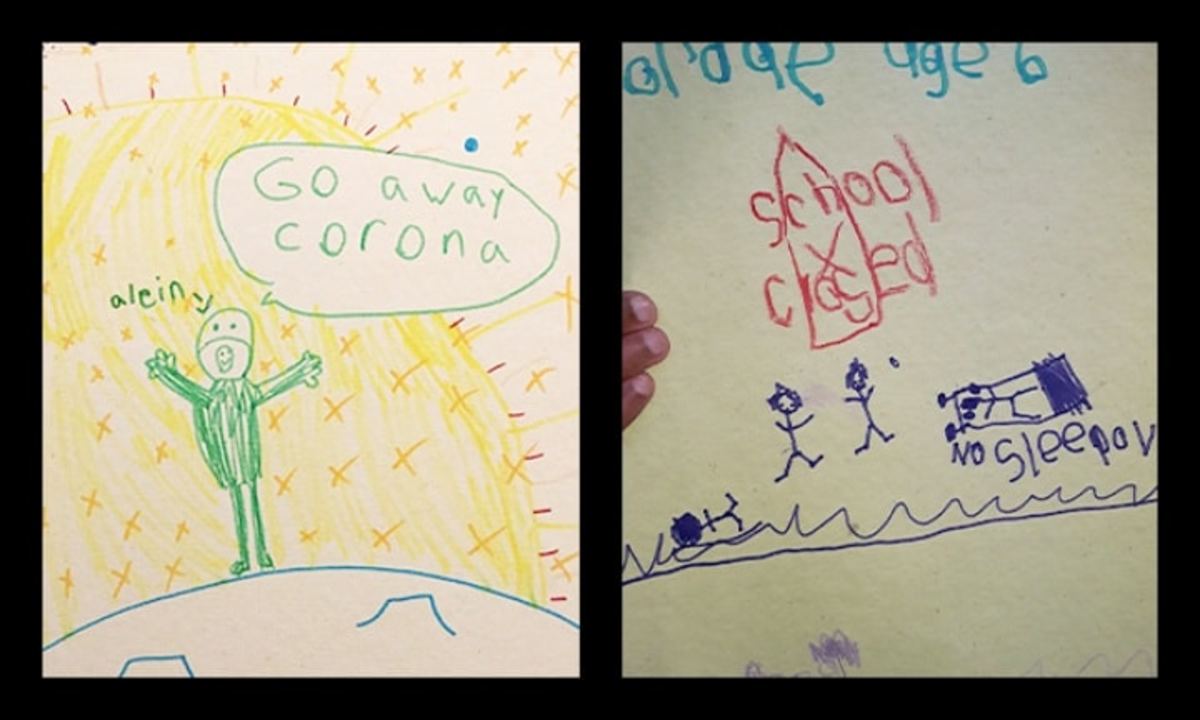
Pieces in a ParentsTogether’s art installation in August at the U.S. Capitol, which showed the anxieties and hopes of children during the pandemic. The picture on the right was created by Ellery, 7, from Cincinnati, while the other was drawn by 6-year-old Coredae Schmidt of Kansas. Images courtesy of ParentsTogether

Special Education Students Still Waiting for Help as New School Year Starts

Like many parents, Lynn Gabriel of Los Angeles has found keeping her 6-year-old son on track with school to be a grueling endeavor during the pandemic. Last spring, between the two half-hour classes a week and worksheets exchanged on Google Classroom, Gabriel struggled to keep Benjamin engaged.
He missed his friends and basketball games at the park, but there were even more challenges. Unlike most kids, Benjamin struggles with recall, and one of his eyes has trouble focusing. That has made learning how to read frustrating for him as well as for his mother.
“I’ll tell him to sound it out,” Gabriel said. “I say, ‘Look at the word.’ But I don’t know what he sees. He learns differently, and I have no tools to figure it out.”
But over the past five months the single mom has been unable to get help from her local school district.

Many districts up and down California have not assessed students with disabilities in months, preventing them from obtaining services they need during the destabilizing times of the pandemic.

Prompted by stay-at-home orders and a hastily passed state law in March, many districts up and down California have not assessed students with disabilities in months, preventing them from obtaining services they need during the destabilizing times of the pandemic. Benjamin, a Los Angeles boy who will start first grade on Tuesday, is facing another year of distance learning.
As a result, although students like Benjamin and thousands like him start school remotely in Los Angeles County on Tuesday, educational CONTINUE READING: Special Ed Students at Risk - LA Progressive

Where Is the Bailout for Parents? - The Atlantic

Where Is the Bailout for Parents? - The Atlantic

Bail Out Parents
A child allowance is the Easy button for pandemic solutions.


If parenting were an industry, America’s moms and dads would all be filing for bankruptcy. First came the closures of schools and child-care programs in the spring, followed by many summer camps and pools never opening, and now a fall during which huge swaths of the country will have all-virtual schooling. Many parents are completely depleted—mentally and financially. Typically, politicians of both parties revel in rhetoric about families being the bedrock of society. Well, if businesses get a Paycheck Protection Program, families deserve a Parent Protection Program. That starts with the United States adopting a long-overdue child allowance.
Bailouts are a recognition that certain sectors are so vital to the American economy that the government has a compelling interest in keeping them afloat. This is why, in the CARES Act, airlines got $50 billion and hospitals $150 billion. The centerpiece of that bill, of course, was the $660 billion Paycheck Protection Program, which offered largely forgivable loans to businesses. This had the effect of keeping many workers—including parents—on payroll, although the nation still suffers from brutal unemployment and the economic recovery appears to be flagging.

Parents, taken collectively, are an underrecognized yet vital economic interest. According to the Brookings Institution, 41.2 million workers, a third of the entire workforce, have a child under age 18. Nearly 34 million have a child under age 14 who is likely to require some kind of supervision during virtual schooling, a task that disproportionately falls on mothers’ shoulders. COVID-19, unsurprisingly and infuriatingly, is already driving women out of the workforce. According to a recent Census Bureau report, “Around one in five (18.2%) of working-age adults said the reason they were not working was because COVID-19 disrupted their childcare arrangements,” with women three times as likely as men to report this barrier.
Of course, parents’ benefits to society go far beyond their external labor, and stay-at-home parents are also vital. Families with children are the elemental unit of a society, the reproductive cell; without healthy families, the entire enterprise unravels. And that is happening now, on a mass scale: Parents are suffering, and no relief is in sight. Researchers at the University of Oregon have warned that with the expiration of enhanced unemployment benefits, “vast numbers” of families with young children—who bear the highest child-rearing costs—may “end up having power and water turned off, running out of funds to purchase food, diapers, and other necessities, and struggling to pay for childcare or health care.”
On top of this, many parents of older children are now being forced to pay for care and learning support. According to the Urban Institute, parents who cannot work remotely CONTINUE READING: Where Is the Bailout for Parents? - The Atlantic

Contract Talk: New Research on Teachers Unions – Have You Heard

Contract Talk: New Research on Teachers Unions – Have You Heard

Contract Talk: New Research on Teachers Unions


Teachers unions are the biggest impediments to fixing schools and improving student achievement. That mantra has been at the heart of school reform efforts for more than a decade – but is it true? Education researchers Adam Kirk Edgerton and Mimi Lyon both started their teaching careers at a time of peak hostility to unions (remember Waiting for Superman?). When they left the classroom to go back to school, both were intent on researching unionization in order to better understand its impact—on teachers, students, and on progressive policies in states where unionization has been hindered. Oh, and did we mention that Adam and Mimi are the runners up in the 2020 Have You Heard Graduate Student Research Contest? 
Complete transcript of the episode is here. The financial support of listeners like you keeps this podcast going. Subscribe on Patreon or donate on PayPal.


Contract Talk: New Research on Teachers Unions – Have You Heard