Latest News and Comment from Education

Showing posts with label reform. Show all posts

Sunday, May 23, 2021

“I have nothing to offer but blood, toil, tears and sweat.” – Grumpy Old Teacher

“I have nothing to offer but blood, toil, tears and sweat.” – Grumpy Old Teacher
“I have nothing to offer but blood, toil, tears and sweat.”


Blood, Toil, Tears and Sweat T-Shirt - America's National Churchill Museum  Store
And a #2 pencil.

The quote is attributed to Winston Churchill as he received the King’s appointment to be Prime MInister in May 1940 to form a new government and prosecute the war with Nazi Germany. However, for the last 20 years, it is the plaintive cry of every American school child in grades 3 through 10 taking numerous state tests because we must have data to measure … it used to be student learning, but now takes in school quality, teacher accomplishments, administrative worthiness, and district whatever … Grumpy Old Teacher (GOT) supposes that in the year of 2021, school testing is used to measure everything but the level of water in the kitchen sink.

It is 2021 and the ‘compassion and grace’ of the previous year has been replaced by the driving need, which rhymes with greed, of the Testing-Reform Complex to measure learning loss, a dubious concept at best that actually means how much worse will kids score on the tests this year.

Yes, we are testing this year and doing our best to intimidate parents and children who opted to continue their learning in their bedrooms to come onto our campuses because the test must be taken. CONTINUE READING“I have nothing to offer but blood, toil, tears and sweat.” – Grumpy Old Teacher

Sunday, April 18, 2021

Laura Chapman on Michael Fullan | Diane Ravitch's blog

Laura Chapman on Michael Fullan | Diane Ravitch's blog
Laura Chapman on Michael Fullan


I recently posted a long article by Michael Fullan that proposed a new paradigm for education reform. I found Fullan’s dismissal of the status quo persuasive, as well as his description of a forward-looking approach.

Laura Chapman, inveterate researcher and loyal reader, reviewed Fullan’s recent work and was disappointed with what she found:

If ever any paper needed close reading this is it, especially Fullan’s discussion of the 6C’s, 21st Century Skills, and vague references to some ancillary research in California and Australia.

I am working on learning more about at least one of Fullan’s California projects. Unfortunately there are no peer-reviewed summary of accomplishments.

Here is a link if you also want to see what assessment looked like in one Fullan project, a three-year $10 million effort to improve the performance of English Learners including long-term English Learners, funded by the California School Boards Association and several non-profits.  https://michaelfullan.ca/wp-content/uploads/2017/11/The-Coherence-Framework-in-Action.pdf

You will see that the main measures of accomplishment CONTINUE READING: Laura Chapman on Michael Fullan | Diane Ravitch's blog

Friday, April 9, 2021

To Redesign Our Schools, Post-Pandemic, We Need to Remove Some Sacred Cows – Sam Chaltain

To Redesign Our Schools, Post-Pandemic, We Need to Remove Some Sacred Cows – Sam Chaltain
TO REDESIGN OUR SCHOOLS, POST-PANDEMIC, WE NEED TO REMOVE SOME SACRED COWS


Watch this video. What do you see?

Video Player
00:00
00:31


Literally, of course, it’s a sacred cow. And what strikes me is how everyone around it unconsciously adjusts what they do, to the point that the cow has become all but invisible to the chaos of a morning commute.

We have sacred cows here, too — but whereas in Nepal they literally block traffic, in America they block our ability to think in new ways. And I can think of no aspect of our shared public life with more sacred cows than America’s schools:

Grades. Bells. Schedules. Credit Hours. Classrooms. Tests. Transcripts. Homework. 180 days. Age-based cohorts.

And the list could go on.

For this reason, we produced a short film series that looks at a few of these structures, and how and why they need to change. Here’s one of them: CONTINUE READING: To Redesign Our Schools, Post-Pandemic, We Need to Remove Some Sacred Cows – Sam Chaltain

Saturday, December 26, 2020

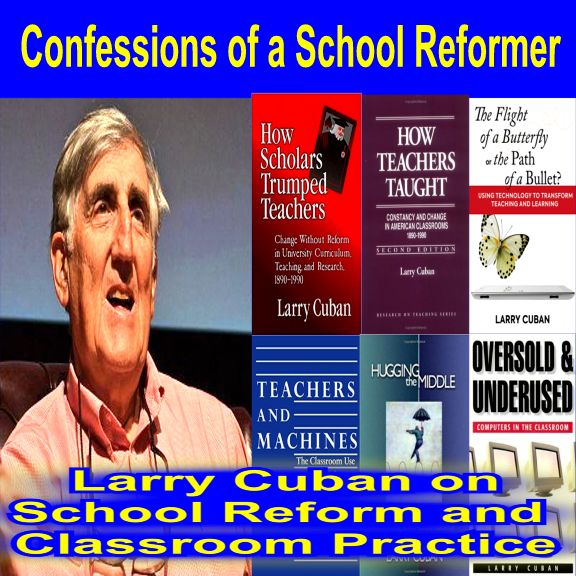
How Beliefs in School Reform Evolve Over Time | Larry Cuban on School Reform and Classroom Practice

How Beliefs in School Reform Evolve Over Time | Larry Cuban on School Reform and Classroom Practice
How Beliefs in School Reform Evolve Over Time


School reform is steady work. As a teacher, administrator, superintendent, and university researcher for over six decades in working to reform classrooms, schools, and districts, it should come as no surprise to readers that what I thought about reform in the mid-1950s as a teacher, what I believed school reform was when I ran a district in the 1970s and 1980s, and how I conceptualize reform today as a retired professor has changed. Looking back at my strongly held beliefs on reforming schools then and how, I can see how they have morphed into quite different views about school reform today.

There may be wisdom in this “confession” about evolving beliefs about school reform. And even if some readers were to think so, I am well aware that wisdom cannot be told to others because reflecting on one’s direct experience more often than not trumps others’ advice. So I offer these reflections on how one educator’s beliefs about reform changed over time to get readers to ponder what their beliefs once were and are now about teaching, learning, and, yes, of course–reforming schools.

Changes in reform beliefs over time is surely common especially as educators accumulate different experiences over time. What may be uncommon is to document those changes and then reflect on those changes in beliefs.

And that is what I have done in the final chapter of my next book. What I present below is a draft–not a final version so I am open to CONTINUE READING: How Beliefs in School Reform Evolve Over Time | Larry Cuban on School Reform and Classroom Practice

Sunday, September 6, 2020

How Covid-19 Froze School Reform (Part 2) | Larry Cuban on School Reform and Classroom Practice

How Covid-19 Froze School Reform (Part 2) | Larry Cuban on School Reform and Classroom Practice

How Covid-19 Froze School Reform (Part 2)


What was school reform like before Covid-19 ( BC)?
Since the mid-1980s, U.S. public schools had been enthralled with and institutionalized a series of reforms that are now called the “standards, testing, and accountability movement.” It is nearly three decades long.
Recall that the Progressive movement began in the 1890s and, depending upon the historian one reads, lasted until the 1920s or through World War II. The other reform movement that flowed across the schools had a shorter life-span. The civil rights movement spilling over public schools is usually dated by the 1954 Brown decision and peters out by the mid-1970s. Soon to be overtaken by the “standards, testing, and accountability” reforms that readers know so well.
Civic and corporate leaders allied with enthusiastic donors turned public schools in the 1980s to building human capital essential to fostering economic growth and stronger competition for global markets. Their overall strategy was (and still is) to apply a business model of competitiveness, innovation, and efficiency to public schools that fixed attention on the bottom line of test scores and return-on-investment in high school graduates entering and completing college.[i]
These leaders and foundation officials over the past three decades have created beefy portfolios of reform ventures including changes in funding and structural innovations such as vouchers, charter schools, common curriculum standards, testing and accountability including using student scores to determine district CONTINUE READING: How Covid-19 Froze School Reform (Part 2) | Larry Cuban on School Reform and Classroom Practice

Friday, August 28, 2020

Confessions of a School Reformer (Part 6) | Larry Cuban on School Reform and Classroom Practice

Confessions of a School Reformer (Part 6) | Larry Cuban on School Reform and Classroom Practice

Confessions of a School Reformer (Part 6)


This is the last post of a series drawn from “Confessions of a School Reformer,” a book I am now writing. Parts 123, 4, and describe my entry into classroom teaching beginning in 1955 and ending in 1972.
In August 1968, no longer teaching at Roosevelt High School, I resigned from the full-time job I had at federal Commission on Civil Rights (CCR). No job did I have for 1968-1969.
Treading water
For the next few months, I was at home. With no more salary checks from either the DC schools or CCR, Barbara found a job as an administrative aide to a Rabbi at a nearby congregation. I stayed home with Sondra and Janice, walking them to school in the mornings, writing, doing household chores and making occasional dinners. I thought that with my name as an urban educator, an expert on multiethnic instructional materials, and author I could drum up sufficient business as a consultant to provide enough cash to cover monthly mortgage payments and expenses. I was wrong.
After sending out many letters advertising my talents and experiences, few requests dribbled in. Of those that came in, most asked me to speak or consult for free. My work on Scott Foresman textbooks brought in a few advances from the publisher. Between my paltry earnings and Barbara’s job we were just barely covering monthly expenses. Apart from worrying about money, I was thoroughly enjoying the time I spent with Barbara and my daughters.
Then in December, I heard from Associate Superintendent of Instruction, Norman Nickens of the DC schools that he wanted to see me. I had gotten to know Nickens when I directed the Cardozo Project and he headed the Model CONTINUE READING: Confessions of a School Reformer (Part 6) | Larry Cuban on School Reform and Classroom Practice

Wednesday, August 26, 2020

Confessions of a Reformer (Part 5) | Larry Cuban on School Reform and Classroom Practice

Confessions of a Reformer (Part 5) | Larry Cuban on School Reform and Classroom Practice

Confessions of a Reformer (Part 5)


This series of posts is called “Confessions of a School Reformer,” a book I am now writing. Parts 123, and 4 describe my entry into classroom teaching beginning in 1955 and ending in 1972. So this post continues Part 4.
The King assassination
On April 4th, the murder of Martin Luther King, Jr. in Memphis (TN) where he was supporting sanitation workers’ demands for higher wages and better working conditions triggered explosive anger across the country. Civil unrest broke out in over 100 cities across the U.S. Protests, looting, fires swept the nation.
In Washington, D.C., the 14th St. business corridor, a few blocks from Roosevelt High School where I taught, was picked clean and burnt.  A news article described the scene.
As night fell, angry people began to pour from their houses into the streets. Headed by the black activist Stokely Carmichael, crowds surged along 14th Street, ordering businesses to close. Carmichael tried to keep control, but things quickly got out of hand. A rock was thrown through a store window. Then a trash can was hurled. Someone used lighter fluid to start a small fire in a tree. As firefighters doused it, someone in the crowd yelled, “We’ll just light it again!”[i]
Over four days of violent disturbances, 13 people died and damages or destruction occurred to nearly 1200 residential and commercial buildings. The President called in the National Guard. Just barely a 100 yards from our house, CONTINUE READING: Confessions of a Reformer (Part 5) | Larry Cuban on School Reform and Classroom Practice

Friday, August 21, 2020

“Confessions of a School Reformer” (Part 3) | Larry Cuban on School Reform and Classroom Practice

“Confessions of a School Reformer” (Part 3) | Larry Cuban on School Reform and Classroom Practice

“Confessions of a School Reformer” (Part 3)


Continuing story of my teaching history at Glenville High School in Cleveland (OH), 1956-1963
Then I got married in 1958.  Evenings which I had used for grading homework and preparing lessons and weekends for completing graduate papers were no longer as available as when I was single. Fatigue and the growing awareness that I could have a life outside of Glenville brought me face-to-face with choosing how to combine the demands of work and being with Barbara and eventually my two daughters, Sondra and Janice. Threading that needle was never easy for me as a teacher and later, as an administrator.
In seven years of teaching, I had created in fits and starts, with many stumbles, a home-grown history course than I had neither expected when I arrived at Glenville in 1956.  I was an unheralded, unknown classroom reformer creating a different American history course in a de facto segregated school.
I came to believe that any teacher could adopt and adapt lessons tailored to their students, especially economically disadvantaged students in segregated schools. My belief in engaging classroom materials turning around such students and schools grew out of those lessons I had created. If more teachers and schools did what I did, I believed, then urban schools would improve. Although my reform-driven belief turned out to be too narrow and too demanding of teachers given the working conditions they faced, the ideas I offered and practiced in my classrooms of getting students to connect the racial-inflected past to the present, I hoped would help my students understand what was happening in the South with Freedom Riders and student sit-ins in segregated restaurants and bus boycotts. Without fully knowing it myself, my belief in the power of education to reform society, as Dewey put it, lay behind the materials I developed and classroom activities I managed.  That is my small part in the civil rights movement.
In the next decade working in Washington, D.C. my work as a classroom CONTINUE READING: “Confessions of a School Reformer” (Part 3) | Larry Cuban on School Reform and Classroom Practice

Tuesday, August 18, 2020

“Confessions of a School Reformer” (Part 2) | Larry Cuban on School Reform and Classroom Practice

“Confessions of a School Reformer” (Part 2) | Larry Cuban on School Reform and Classroom Practice

“Confessions of a School Reformer” (Part 2)


Glenville High School, 1956-1963
My memory of teaching over a half-century ago is filled with holes. In thinking back to the time when I began teaching at Glenville High School in Cleveland (OH), I can remember some events, some students, some teachers, and my first principal but there is much I cannot recall. Slivers of memory remind me of what I did daily in my five U.S. and world history classes over the seven years that I taught there. And even those fragments are disconnected.  What helps me from sentimentalizing my memories are yellowed copies of actual lessons I taught, student papers with my comments on them, old spiral-ringed gradebooks listing students and their marks, occasional articles about one or more classes of mine in the student newspaper, and photos of me teaching in the annual yearbook. That’s it.
I do recall my shock when I had lunch with Glenville principal Oliver Deex just before I had to report for teaching in September 1956. I was startled to find out that Glenville’s student body was over 90 percent Black—the word then was Negro. He gave me a once-over-lightly account of segregated schools in Cleveland, the differences between the increasingly Black East Side and the all-white West Side, separated by the Cuyahoga River. He began my education in Cleveland’s residential segregation and the growth of ethnic and racial ghettos.[i]
Segregated Cleveland
Patterns of ethnic and racial segregation in Cleveland had developed early in the twentieth century, when neighborhoods became easily identifiable as Italian, German, Polish, Jewish, and Black. In the late nineteenth and early twentieth CONTINUE READING: “Confessions of a School Reformer” (Part 2) | Larry Cuban on School Reform and Classroom Practice

Saturday, August 15, 2020

“Confessions of a School Reformer”(Part 1) | Larry Cuban on School Reform and Classroom Practice

“Confessions of a School Reformer”(Part 1) | Larry Cuban on School Reform and Classroom Practice

“Confessions of a School Reformer”(Part 1)


I am drafting chapters for my next book with the above title. I described the idea of the book and my experiences in the Pittsburgh schools during the Progressive reform era (see the five-part series “We Are All Reformers”on this blog).
In alternating chapters, the book will describe and analyze each of three reform movements during my lifetime and then trace my life in and out of school as a student, teacher, administrator and researcher who experienced these reforms for over three-quarters of a century.
Since 1939 when I entered first grade until 2020, three major reform efforts have swept across American public schools: the Progressive movement (1890s-1940s); Civil Rights movement (1950s-1970s), and business-inspired standards, testing, and accountability movement (1970s-present).
I have completed a draft chapter of my years as a teacher (1955-1972) in three school districts during the Civil Rights movement. I begin the multi-part series with this post. Comments appreciated.
As a teacher I was not a civil rights activist. While I did participate in a few marches, I was never arrested at a demonstration. Nor did I join any organizations at the forefront of the movement. I did work, however, for a few months at the U.S. Commission on Civil Rights, a federal agency committed to desegregated schools in the 1960s. It was a disaster (see below).
While my wife Barbara and I contributed to civil rights groups and moved our family into an integrated Washington, D.C. neighborhood, my public CONTINUE READING: “Confessions of a School Reformer”(Part 1) | Larry Cuban on School Reform and Classroom Practice

Monday, July 20, 2020

Introduction To My Next Book (Part 4) | Larry Cuban on School Reform and Classroom Practice

Introduction To My Next Book (Part 4) | Larry Cuban on School Reform and Classroom Practice

Introduction To My Next Book (Part 4)


This is the final part of my draft Introduction to “Confessions of a School Reformer.”
The research literature on children’s academic performance has shown time and again that anywhere from over half to two-thirds of minority and white students’ test scores—lower, middle, and upper class–can be attributed to family’s socioeconomic background.
Yet many educators in public traditional and charter schools in poor neighborhoods either ignore or dispute those research findings. These educators see such research as an incentive to prove scholars wrong. Such educators continue to operate on the principle that engaged and committed staff unaccepting of  “excuses” (e.g., low-income family, all minority enrollment, neighborhood crime) could lift students out of poverty through helping students become academic achievers, entering college, and securing well-paid jobs.  And the evidence of such positive outcomes is both available and rich.
The issue, then, of the degree to which family background and ethnic/racial school demography affect student achievement rubs against not only this body of evidence that there are schools graduating low-income minority students who enter higher education but also a discomforting and inescapable fact:  Formal schooling  occupies only a small portion of a child’s day. Consider that children and youth attend public schools about 1100 hours a year for 13 years (or just under 15,000 hours.  That time represents less than 20 percent of a child’s and teenagers waking time for all of those years in school.  Hence, most of student’s CONTINUE READING: Introduction To My Next Book (Part 4) | Larry Cuban on School Reform and Classroom Practice

Saturday, June 20, 2020

Police Reform and School Reform (Part 3) | Larry Cuban on School Reform and Classroom Practice

Police Reform and School Reform (Part 3) | Larry Cuban on School Reform and Classroom Practice

Police Reform and School Reform (Part 3)


Just as a half-century ago when the Kerner Commission Report laid out a series of police reforms, cities were also in turmoil over low academic performance of minority students, traditional curricula, mostly white staffs and insensitive superintendents. Urban disturbances in 1967-1970, for example, caused school closures and rapid turnover of school chiefs then and since.
Consider New York City since 1960. Between that year and 2020, there have been 23 superintendents (later called chancellors) for an average tenure of 2.6 years. NYC might be an outlier, however. Using other major cities the Broad Foundation reported in 2018 that tenure was longer, around five years in districts with over three-quarters of student enrollment poor and minority (2018). Somewhere between three to five years has been the average term appointed superintendents have served in big cities (see here and here).
Such turnstile superintendencies, like urban police chiefs have experienced then and now, disrupt continuity in implementing reforms begun by a predecessor and depress morale of district office administrators, principals, and teachers who do the daily work of schooling.
Not only moving school chiefs in and out of the superintendent’s suite but local school boards, states, and the federal government have also legislated changes during crises that reformers believed would improve schooling for all children CONTINUE READING: Police Reform and School Reform (Part 3) | Larry Cuban on School Reform and Classroom Practice

Wednesday, June 10, 2020

Teach for America’s 2020 Trainees to Enter the Classroom with Only Tutoring Experience | deutsch29

Teach for America’s 2020 Trainees to Enter the Classroom with Only Tutoring Experience | deutsch29

Teach for America’s 2020 Trainees to Enter the Classroom with Only Tutoring Experience


In this time of school closures and social distancing, teacher temp agency, Teach for America (TFA), has decided to “train” its 2020 corps members online.
As former TFAer-gone-career teacher, Gary Rubinstein, writes, pre-COVID, TFA trainees actually teach on average one hour per day over the course of four weeks during the summer, in classrooms which they share with four other TFA trainees.
As such, TFA trainees have no experience teaching even one entire school day in a classroom in which the trainee is responsible for all instruction.
And now, with the social restrictions and classroom complexities introduced by the coronavirus, TFA’s 2020 trainees will have no experience being in charge of a classroom– not even an entire classroom online.
Their big exposure to students will come in the form of online tutoring via a summer reading program offered by Springboard Collective, a nonprofit started by TFA alum Alejandro Gibes de Gac (Springboard Collective derives from an entrepreneurial pitch at TFA’s 20th Anniversary Summit in 2010. TFA offered Gibes de Gac $5,000 in seed money to fund the pilot in 2011.)
Springboard Collaborative is excited to announce a joint partnership CONTINUE READING: Teach for America’s 2020 Trainees to Enter the Classroom with Only Tutoring Experience | deutsch29


Tuesday, June 2, 2020

Thurmond Calls for Action to Address Racism - Year 2020 (CA Dept of Education)

Thurmond Calls for Action to Address Racism - Year 2020 (CA Dept of Education)

State Superintendent Tony Thurmond Calls on Schools and Communities to Take Action to Address Institutional Racism and Educational Inequities


SACRAMENTO—State Superintendent of Public Instruction Tony Thurmond today responded to the death of George Floyd by calling on communities across the state and nation to take action to dismantle institutional racism and inequities in public schools. He also invited students, educators, families, and partners to participate in an upcoming series of honest, courageous conversations that can help inform the work ahead.
“Given the gravity of what has happened, it is important to me to take some time to talk about the important need for us to have racial justice in California and in this country,” said Thurmond. “It has been difficult for me to make sense of how a man can beg and plead for his life and still have his life snuffed out. It has been hard for me, as a black man, who every day thinks about the impact of race. It has been difficult for me, as a parent raising African American children, to know what to say, how to answer their questions when they ask me, ’Dad, why did this happen?’ And to know that I have to confront my own vulnerability: that when they ask me, ‘Could this happen to them?’ that I might not be able to keep them safe.”
To the loved ones of George Floyd, Thurmond addressed them directly: “I believe that you deserve more than condolences and prayers. I believe that you deserve action that leads to racial justice.”
“We know that bias exists in every sector of society,” Thurmond added. “Now is our time to speak, and to address racism and implicit bias in education.”
An archived video broadcast of the State Superintendent’s full remarks can be found on the California Department of Education (CDE) Facebook page.
In his remarks, the State Superintendent noted that public education can play an important role in better exploring the connection between issues of educational equity and implicit bias in the classroom and the systemic racism that persists throughout society. Black and brown students are more likely to be suspended and expelled and fall behind academically, for example, and schools that serve communities of color are often the most under-resourced.
The State Superintendent announced that he and the CDE will be launching a series of discussions that will include superintendents and educational leaders from across California, students, teachers, school support staff, parents, and caregivers. Thurmond also intends to convene stakeholders in discussions of implicit bias beyond schools to include leaders of statewide and national law enforcement organizations, elected officials, civic community leaders, and more. Details of these gatherings and how to participate will be forthcoming.
Thurmond also announced that he has created an outlet—createracialjustice@gmail.com—that will allow for additional voices and ideas to be heard. CDE will use this collected feedback to develop a new online resource that will be an extension of these conversations. More details will come later.
# # # #
Tony Thurmond — State Superintendent of Public Instruction
Communications Division, Room 5602, 916-319-0818, Fax 916-319-0100
Thurmond Calls for Action to Address Racism - Year 2020 (CA Dept of Education)

Who will be selected as the next NYS Commissioner of Education? From within NYS? The acting Commissioner? A National Leader?  Will Principals/Teachers/Parents be part of the search process? | Ed In The Apple

Who will be selected as the next NYS Commissioner of Education? From within NYS? The acting Commissioner? A National Leader?  Will Principals/Teachers/Parents be part of the search process? | Ed In The Apple

Who will be selected as the next NYS Commissioner of Education? From within NYS? The acting Commissioner? A National Leader?  Will Principals/Teachers/Parents be part of the search process?


At the July Regents Meeting Commissioner Elia announced she is resigning her position as state commissioner  effective August 31st.
The only shock about the resignation Monday of state Education Commissioner MaryEllen Elia is that it came so soon. 
Tension between Elia and the Regents that had been building for more than a year hit a new peak at the board’s June monthly meetings.


The Board of Regents appointed Beth Berlin, a highly effective deputy as acting commissioner. A few months later Berlin left the Department for a job as COO at SUNY Empire College; somewhat surprisingly the Board appointed Shannon Tahoe, the Board attorney as acting commissioner.
On Thursday, May 28th, the position was posted  with a quick return date of Monday, June 8th.
The Board seeks an individual who will bring visionary, transformative, inclusive, equitable, and decisive leadership to the position as the Board’s chief executive officer.

Thursday, May 21, 2020

CURMUDGUCATION: Betsy DeVos Has, In Fact, Become Arne Duncan 2.0

CURMUDGUCATION: Betsy DeVos Has, In Fact, Become Arne Duncan 2.0

Betsy DeVos Has, In Fact, Become Arne Duncan 2.0

When this originally ran at Forbes.com, there was still some qujestion about the premise. Since then I've updated it with new info from DeVos herself.
For many conservatives, one of the greatest sins perpetrated by Obama’s secretary of education was using the powers of his office to bypass the legislature. Arne Duncan oversaw Race to the Top, which was instrumental in pushing Common Core and other preferred policies into schools across the country. Now Betsy DeVos is using nearly identical tactics to push for her own favorite educational ideas.
Race to the Top was a $4.5 billion program that was part of the American Recovery and Reinvestment Act of 2009, a stimulus package meant to help reverse some of the effects of the Great Recession. States would have the opportunity to get education grants, but they would have to compete for the money by showing how closely they could adhere to the administration’s goals of college- and career-ready standards, high stakes testing, teacher evaluation, and data collection. The administration had tried and failed to get these goals passed into law through Congress. The financial pressure of the Great Recession and the looming penalties for the unachievable goals of No Child Left Behind (100% of students scoring above average on the Big Standardized Test) gave Duncan leverage to bypass Congress entirely. And rather than providing funding for all schools in all states, the program picked winners and losers.

Many conservative critics argued that RTTT and the waivers that followed were illegal. The backlash CONTINUE READING: 
CURMUDGUCATION: Betsy DeVos Has, In Fact, Become Arne Duncan 2.0