Latest News and Comment from Education

Showing posts with label STANDARDIZED TEST. Show all posts

Monday, May 24, 2021

As US schools resume testing, large numbers are opting out - AP THE ASSOCIATED PRESS

As US schools resume testing, large numbers are opting out


Standardized tests are returning to the nation’s schools this spring, but millions of students will face shorter exams that carry lower stakes, and most families are being given the option to forgo testing entirely.

With new flexibility from the Biden administration, states are adopting a patchwork of testing plans that aim to curb the stress of exams while still capturing some data on student learning. The lenient approach means large swaths of students will go untested, shattering hopes for a full picture of how much learning has been set back by the pandemic.

“We will end up with a highly imperfect set of data,” said Robin Lake, director of the Center on Reinventing Public Education at the University of Washington. “This is something our country will have to commit to tracking and learning about for at least the next few years, and maybe the next decade.”

Some of the nation’s largest districts plan to test only a fraction of their students as many continue to learn remotely. In New York City, students must opt in to be tested this year. In Los Angeles, most students are not being asked to take state exams this year. Other districts are scaling back questions or testing in fewer subjects.

It’s the latest episode in a long-fought battle over school testing and, as in the past, parents are polarized. Some are demanding tests to get a sense of their children’s progress. Others see no need to put their children through that kind of stress.

As a teacher, Jay Wamsted believes there’s value in testing. But when his sixth-grade daughter Kira asked to opt out this year, he saw no reason to object. He already knows she needs to catch up on math after months of remote learning. And as a teacher at her school, he knew that many CONTINUE READING: As US schools resume testing, large numbers are opting out

Thursday, May 20, 2021

A Memo from the Superintendent | The Merrow Report

A Memo from the Superintendent | The Merrow Report
A Memo from the Superintendent


To: Our teachers and other educators

From: Your Superintendent

May 18, 2021

As a lifelong public educator, I pride myself for having learned from the greatest educators in the history of civilization: John Dewey, Maria Montessori, Aristotle, Jean Piaget, Plato, and Sam Hinkie.  

For this particular testing season, I suggest that we rely on the wisdom of Sam Hinkie.

Many of you fear that remote learning has hurt our neediest students, making it all but certain that they won’t perform well on the forthcoming standardized tests. However, the tests are the law, and we all should agree on a strategy that will help our students, our district, and our teachers. 

There are two options.  One is to begin intense ‘drill and kill’ test practice right away.  While this is monotonous and boring, D&K often produces quick upticks in scores, which leads to positive coverage in the media.  

(Of course, the steep ‘learning curve’ is ephemeral, and the “forgetting curve” that CONTINUE READING: A Memo from the Superintendent | The Merrow Report

Thursday, May 13, 2021

Testing Industry Scores Big in California | tultican

Testing Industry Scores Big in California | tultican
Testing Industry Scores Big in California


By Thomas Ultican 5/13/2021

At 1:45 PM this Wednesday, the California State Board of Education (SBE) adopted a “student growth model” to evaluate student learning. It is a method fans of standardized test based accountability have been trumpeting. The big winner here is the testing giant Education Testing Services (ETS) who created the model to be used.

Board member Sue Burr who was appointed to the board by then Governor Jerry Brown made the motion for using the growth model. She carefully presented her motion directly from the state’s California Department of Education (CDE) staff report which recommended:

“The student growth model methodology, which includes using RG [residual growth] scores and the EBLP [Empirical Best Linear Prediction] hybrid approach to report aggregated student growth, and that the following score reporting be adopted:

“1.        Report the EBLP weighted average for:

  1. Schools
  2. Student groups in a school
  3. The “All” student group in an County or District
  4. Student groups in a district with 500 or fewer students (with test scores)

“2.       At the Local Education Agency level, report the simple average for all race/ethnicity and program participation student groups with more than 500 scores.”

Board member Patricia Ann Rucker seconded the motion. She is a legislative CONTINUE READING: Testing Industry Scores Big in California | tultican

Friday, May 7, 2021

The Testing Game, Louisiana-style | deutsch29: Mercedes Schneider's Blog

The Testing Game, Louisiana-style | deutsch29: Mercedes Schneider's Blog
The Testing Game, Louisiana-style


Let’s say that I am at the end of my freshman year of high school in Louisiana. I must take two Louisiana Educational Assessment Program (LEAP) exams: English I and Algebra I. So long as I minimally pass these exams (“approaching basic”), I am good for graduation three years from now. Furthermore, my state exam score counts as my final exam in the class (between 15 and 30 percent of my fourth quarter grade, according to state specifications; see below).

If I score the highest level on my LEAP exams (“advanced”), then I get an A as an exam grade. If I score the second highest level (“mastery”), I get a B. The third level, “basic,” gets me a C, and the fourth (and lowest passing) level, “approaching basic,” earns a D.

Given that the state exams last between 225 and 260 minutes each, I might zoom through my LEAP test, aiming, if you will, for  CONTINUE READING: The Testing Game, Louisiana-style | deutsch29: Mercedes Schneider's Blog

Saturday, April 24, 2021

A CORE PROBLEM – Dad Gone Wild

A CORE PROBLEM – Dad Gone Wild
A CORE PROBLEM


“Our values are the same. We disagree on policy, but we don’t disagree on humanity, we don’t disagree about love and compassion. I think that’s true for all of us — it’s just that we get lost in our fear of what’s different.” Michelle Obama speaking on her friendship with George Bush

It’s 9 AM on Friday morning, the second day of TCAP testing for MNPS students, and my fifth grader and sixth-grader are holed up in the TV room watching Fairly Odd Parents on the tube. As I’ve written before, we are a family that has elected to remain remote for the entire school year. A decision based on a desire to establish as much stability as possible. A decision that has been continually validated.

Everyone in our household knows their responsibilities and schedule. Expectations are clear. Earlier in the year, there were some…shall we say…adjustments that needed to be made, but just like in any other year we got there. Both kids received all A’s and high one high B, on their last report card. Wednesday we received a progress report in the mail that showed similar grades.

To be fair, my son has struggled with the drawing part of models in math. He can calculate the problem but has difficulty drawing out the models. His teacher has worked with him and he’s getting it. Like I said, none of it’s perfect, but continually improving.

This week, Schoology went down. I emailed my wife about it and she responded, “Bet they are CONTINUE READING: A CORE PROBLEM – Dad Gone Wild

Friday, April 23, 2021

Louisiana Standardized Testing 2020-21: Maybe We Grade Your School, Maybe Not. | deutsch29: Mercedes Schneider's Blog

Louisiana Standardized Testing 2020-21: Maybe We Grade Your School, Maybe Not. | deutsch29: Mercedes Schneider's Blog
Louisiana Standardized Testing 2020-21: Maybe We Grade Your School, Maybe Not.


Standardized testing is set to commence in schools and districts across the state of Louisiana.

What does this mean regarding the now-common misuse of scores for grading teachers and schools and for student placement decisions?

Some answers can be found in two pieces of legislation passed in the Louisiana legislature’s 2020 Special Extraordinary Session (September 28, 2020 to October 23, 2020): Act 53 and Act 47. However, some of those “some answers” are better defined than others.

Below is the heart of Act 53:

Notwithstanding any provision of law to the contrary, for the2020-2021 school year, the board (Louisiana Board of Elementary and Secondary Education, or BESE) shall examine the results from student assessments and school-level test data but shall not use such assessments and data for purposes of evaluating teacher performance or making placement decisions for fourth and eighth grade students.

And lest anyone should miss the “shall not use assessments and data for purposes of evaluating teacher performance,” language is included specific to VAM (so-called “value-added” modeling) (and subsequently repeated in the section pertaining to charter school employees):

Notwithstanding any provision of law to the contrary, for the 2020-2021 school year, value-added data shall not be used to evaluate teacher performance or effectiveness.

As for the grading of schools and districts using test scores from 2020-21, the CONTINUE READING: Louisiana Standardized Testing 2020-21: Maybe We Grade Your School, Maybe Not. | deutsch29: Mercedes Schneider's Blog

Monday, April 19, 2021

Outrage Continues as Standardized Testing Moves Forward in this COVID-19 School Year | janresseger

Outrage Continues as Standardized Testing Moves Forward in this COVID-19 School Year | janresseger
Outrage Continues as Standardized Testing Moves Forward in this COVID-19 School Year


Standardized testing—required this school year by Education Secretary Miguel Cardona’s U.S. Department of Education despite the disruption of COVID-19—is now happening in many public schools across the United States. But even as the tests are being administered, the anger and protests against this expensive, time consuming, and, many believe, harmful routine are not abating.

Last week, the Washington Post‘s Valerie Strauss reported: “The Biden administration is facing growing backlash from state education chiefs, Republican senators, teachers unions and others who say that its insistence that schools give standardized tests to students this year is unfair, and that it is being inconsistent in how it awards testing flexibility to states. Michigan State Superintendent Michael Rice has slammed the U.S. Education Department for its ‘indefensible’ logic in rejecting the state’s request for a testing waiver while granting one to the Washington, D.C., school system—the only waiver that has been given. Montana Superintendent of Public Instruction Elsie Arntzen, whose state was also denied a waiver, said testing this year ‘isn’t going to show any data that is going to be meaningful for learning moving forward… The controversy represents the newest chapter in a long-running national debate about the value of high-stakes standardized tests. Since 2002, the federal government has mandated schools give most students ELA and math standardized tests every year for the purposes of holding schools accountable for student progress. The scores are also used to rank schools, evaluate teachers, make grade promotion decisions and other purposes.”

The Journey for Justice Alliance (J4J) describes itself as a nationwide multi-racial coalition of CONTINUE READING: Outrage Continues as Standardized Testing Moves Forward in this COVID-19 School Year | janresseger

Saturday, April 17, 2021

Ohio: Voucher Students Are Not Required to Take State Exams | Diane Ravitch's blog

Ohio: Voucher Students Are Not Required to Take State Exams | Diane Ravitch's blog
Ohio: Voucher Students Are Not Required to Take State Exams


Apparently, the voucher schools were embarrassed by the Ohio study showing that kids who use vouchers lose ground academically.

There were two ways to respond to that finding: 1) improve instruction in the voucher schools by requiring them to hire certified teachers; 2) obscure the data.

The voucher lobby chose the second route.

The Republican-dominated legislature is now vastly expanding the state’s failing voucher program. But a few years ago, it decided that voucher schools would no longer be required to give the same exams that students in public schools are required to take. The conservative Thomas B. Fordham Institute worried about the change, because it makes it difficult, if not impossible, to draw comparisons between students in public schools and their peers in private and religious schools.

That’s the goal.

Many other states that offer vouchers allow those schools CONTINUE READING: Ohio: Voucher Students Are Not Required to Take State Exams | Diane Ravitch's blog

USDOE Wants “Educator Stability.” It Also Wants Test Scores. | deutsch29: Mercedes Schneider's Blog

USDOE Wants “Educator Stability.” It Also Wants Test Scores. | deutsch29: Mercedes Schneider's Blog
USDOE Wants “Educator Stability.” It Also Wants Test Scores


On April 09, 2021, the US Department of Education (USDOE) released its COVID-19 Handbook, Volume 2.

In perusing its table of contents, I noticed one section in particular: ” Supporting Educator and Staff Stability and Well-being: Stabilizing a Diverse and Qualified Educator Workforce.”

Educator stability now appears to be a focus of USDOE attention.

It took a pandemic.

For the past two decades, USDOE leadership, in concert with the two Elementary and Secondary Education Act of 1965 (ESEA) reauthorizations produced by Congress, have done nothing to “stabilize” the educator workforce. On the contrary, the 2001 ESEA reauthorization, No Child Left Behind (NCLB), introduced the oppressive, test-and-punish course that threatened school stability by its abuse of student test scores being used to grade schools and teachers, all in the name of accountability to the never-realistic goal of 100 percent of students be proficient in math and reading by 2014.

In 2007, when NCLB was up for reauthorization and its 100-percent-proficiency farce looming, Congress wouldn’t touch it. However, former US secretary of education Arne Duncan used his NCLB waivers to coerce states into adopting “college and career ready” standards (that would be the controversial Common Core State Standards) and related assessments, as in his federally-funded, consortium assessments. And so the testing oppression continued. No talk of educator stability. No, no. In fact, destabilization was the name of the game. Competition, Race for the (test-idolizing) Top— and a CCSS sales job reinforcing the NCLB-enabled, hand-over-fist revenue for testing companies capable of grabbing the gold.

Meanwhile, USDOE has for years doled out charter school funding without CONTINUE READING: USDOE Wants “Educator Stability.” It Also Wants Test Scores. | deutsch29: Mercedes Schneider's Blog

Friday, April 16, 2021

The Country Moves Forward, Education Falls Back - Counter Punch org

The Country Moves Forward, Education Falls Back - CounterPunch.org
The Country Moves Forward, Education Falls Back


There’s hope in the air, a scent of spring, anticipation of change, democracy may pull through. Why, then, with K-12 public schools, the broken promise, the dismay?

Biden raised hopes when he promised, Dec 16, 2019, that he’d “commit to ending the use of standardized testing in public schools,” saying (rightly) that “teaching to a test underestimates and discounts the things that are most important for students to know.” Yet on Feb 22, his Department of Education did an about-face, announcing, “we need to understand the impact COVID-19 has had on learning …parents need information on how their children are doing.”

How the children are doing? They’re struggling, that’s how, doing their best, and so are teachers and parents. And it’s the least advantaged who are struggling the most, who, in the transition to online teaching, are likeliest to be without access to the internet, whose families are most vulnerable to loss of jobs, health care, lives. Now this? It costs $1.7 billion to administer these tests, but the toll on kids— the tears, terrors, alienation— is incalculable.

Most people have no idea what a blight these exams are, how they’ve stripped K-12 curricula of civics, history, literature, the arts, languages, even the sciences. Since schools live or die on the basis of test scores, what does not get tested does not get taught, and education is reduced to CONTINUE READING: The Country Moves Forward, Education Falls Back - CounterPunch.org

Thursday, April 15, 2021

NANCY BAILEY: Acceleration: The Meaning Behind the Buzzword

Acceleration: The Meaning Behind the Buzzword


Acceleration is the new pandemic buzzword brought to you by pro-privatization school reformers. Students may have missed some in-person schooling, even though most learned remotely or in person. Still, the frenzy surrounding learning loss is mounting.

The pandemic has given rise to a new way to reframe the old learning gap talk, with new terminology, acceleration. If students have missed out on schoolwork, they’re told they need to accelerate and catch up if they’ve fallen behind.

The fear is that the pandemic will be used as an excuse to push students harder. Poor students will bear the brunt of this, a doubling down on strictness.

But all students are affected when advanced learning disregards a child’s development.

This message has festered for years, starting with No Child Left Behind. Failure was not an option, we were told, as they continually raised the ante. If students did well, the test CONTINUE READING: Acceleration: The Meaning Behind the Buzzword

Wednesday, April 14, 2021

CURMUDGUCATION: Don't Forget--No Nation's Report Card NAEP Test This Year

CURMUDGUCATION: Don't Forget--No Nation's Report Card NAEP Test This Year
Don't Forget--No Nation's Report Card NAEP Test This Year


You may have forgotten, or just not noticed at the time, but I want to remind you that last November, the National Center for Education Statistics pulled the plug on the 2021 NAEP, the Big Standardized Test that is supposed to measure the nation's progress in math and reading. Betsy DeVos asked for cancellation. The National Assessment Governing Board, chaired by Haley Barbour agreed with it. The CCSSO exec director said she believed it was the right decision.

The NAGB felt that it was best to put off the test until 2022 "when it should be feasible to collect and report valid and reliable data." (In other words, that's not possible this year.)

James Woodworth, head of NCES, said in part

Due to the impact of the COVID pandemic on school operations, it will not be possible for NCES to conduct the National Assessment of Educational Progress (NAEP) assessments in accordance with the statutory requirements defined by the Education Sciences Reform Act (ESRA) which requires NAEP to be conducted in a valid and reliable manner every 2 years (20 U.S.C. 9622(b)(2)(B)).

Also

The change in operations and lack of access to students to be assessed means that NAEP will not be CONTINUE READING: 
CURMUDGUCATION: Don't Forget--No Nation's Report Card NAEP Test This Year

Tuesday, April 13, 2021

The Year Without Standardized Testing | gadflyonthewallblog

The Year Without Standardized Testing | gadflyonthewallblog
The Year Without Standardized Testing


Last year was the first in nearly two decades that the US did not give standardized tests to virtually every student in public school.

Think about that.

Since 2001 almost every child took the tests unless their parents explicitly demanded they be opted out.

For 19 years almost every child in grades 3-8 and once in high school took standardized assessments.

And then came 2019-20 and – nothing.

No multiple guess fill-in the bubble questions.

No sorting students into classes based on the results.

No evaluating teachers and schools based on the poverty, race and ethnicities of the children they serve.

And all it took to make us stop was a global pandemic.

What are the results of that discontinuity?

We may never really know.

There are so  CONTINUE READING: The Year Without Standardized Testing | gadflyonthewallblog

Monday, April 12, 2021

Cardona’s Flexibility on Standardized Testing Creates Confusion and Rancor | janresseger

Cardona’s Flexibility on Standardized Testing Creates Confusion and Rancor | janresseger
Cardona’s Flexibility on Standardized Testing Creates Confusion and Rancor


After a chaotic schoolyear including remote learning and sometimes complicated hybrid schedules of in-person and remote learning, students are returning to full-time school to face the annual standardized tests. These are the tests that Congress requires under the Every Student Succeeds Act, the tests first required by No Child Left Behind (NCLB). They are the foundation of a two-decade-old scheme to hold schools accountable. Betsy DeVos cancelled required standardized testing last spring after schools shut down as the pandemic struck the Unites States.

The U.S. Department of Education announced in late February, before Education Secretary Miguel Cardona was even confirmed, that it is requiring standardized testing this spring. There is a whole lot of confusion between the federal government and the states right now because the federal guidance about testing this year features “flexibility.”

Here is some of the letter, dated February 22, 2021, from acting assistant secretary of education, Ian Rosenblum, a letter which informed states they must test students this year: “We remain committed to supporting all states in assessing the learning of all students. The Department is, therefore, offering the following flexibility with respect to your assessment, accountability, and reporting systems for the 2020-2021 school year… We are inviting states to request a waiver for the 2020-2021 school year of the accountability and school identification requirements… A state receiving this waiver would not be required to implement and report the results of its accountability system, including calculating progress toward long-term goals and measurements of interim progress or indicators, or to annually meaningfully CONTINUE READING: Cardona’s Flexibility on Standardized Testing Creates Confusion and Rancor | janresseger

Sunday, April 11, 2021

Yong Zhao and William McDiarmid: Time to Rethink Standardized Testing | Diane Ravitch's blog

Yong Zhao and William McDiarmid: Time to Rethink Standardized Testing | Diane Ravitch's blog
Yong Zhao and William McDiarmid: Time to Rethink Standardized Testing


Two friends got together to address an important topic for readers of the blog. Yong Zhao is a much-published international scholar based at the University of Kansas. Bill McDiarmid is Dean Emeritus of the College of Education at the University of North Carolina at Chapel Hill.

They write:

COVID-19 has disrupted schooling in its traditional sense. It has also disrupted other school related activities such as state standardized testing. As schools return to “normal” thanks to vaccination, many states are already pushing to resume standardized testing as part of the “normal” operations of formal education and to assess the so-called “learning loss” (Zhao, 2021). Resuming standardized testing is perhaps one of the worst things that can happen to children, especially after more than a year of social isolation and unprecedented disruption.

Standardized testing in schools has been criticized repeatedly for multiple reasons. A decade and a half ago CONTINUE READING: Yong Zhao and William McDiarmid: Time to Rethink Standardized Testing | Diane Ravitch's blog

Thursday, April 8, 2021

Legislation to Diversify the Teaching Workforce + U.S. DOE Approves California’s Assessments Plan - Year 2021 (CA Dept of Education)

Legislation to Diversify the Teaching Workforce - Year 2021 (CA Dept of Education)
First-of-its-Kind Legislation to Diversify the Teaching Workforce Advances with Unanimous Assembly Education Committee Support
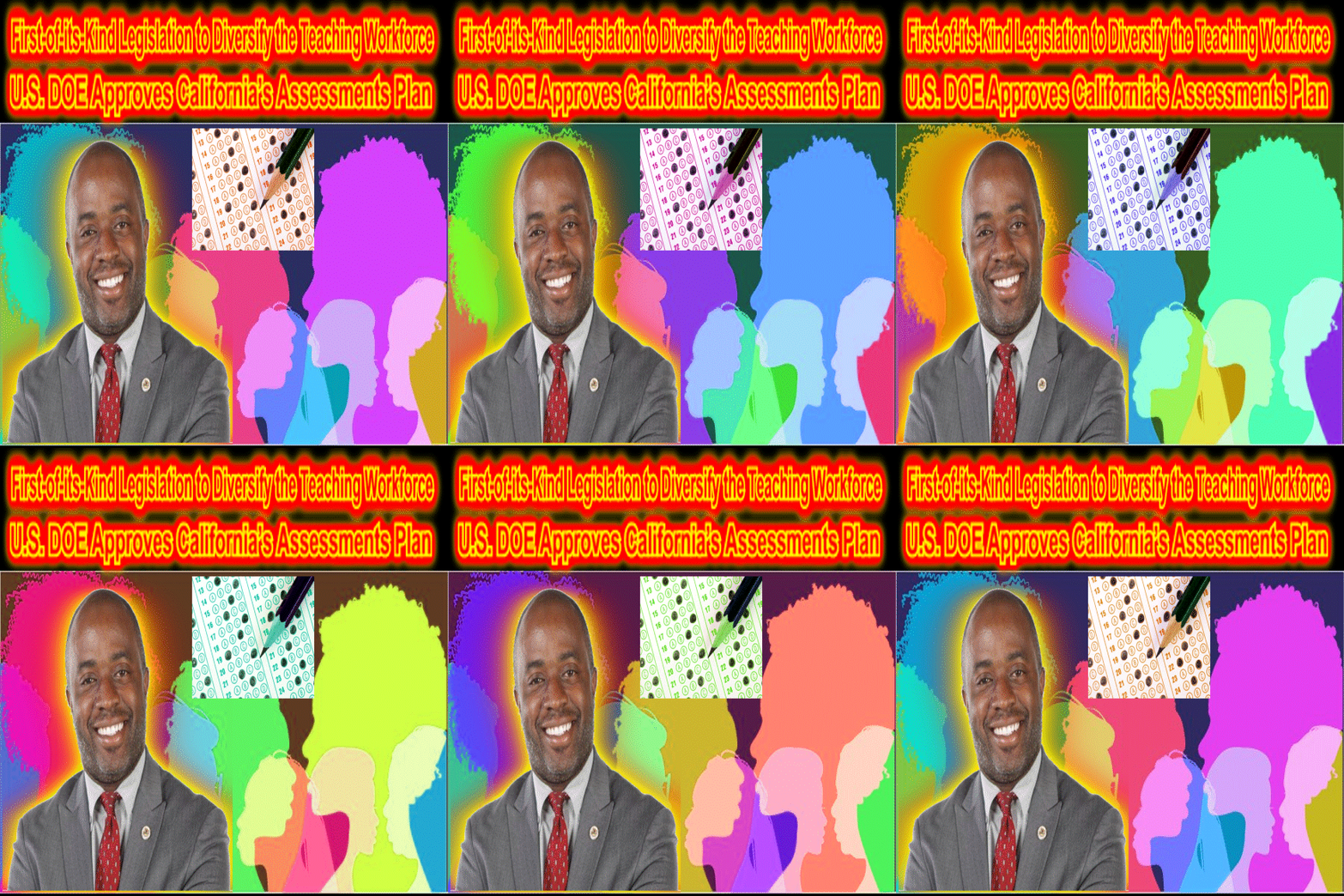


SACRAMENTO—New legislation designed to help support male educators of color and diversify the teaching workforce—sponsored by State Superintendent of Public Instruction Tony Thurmond and authored by Assemblymember Mike A. Gipson (D-Carson)—received unanimous approval from the California State Assembly Committee on Education today, accelerating efforts to create an educator workforce to better reflect the students it serves.

Assembly Bill (AB) 520, which will head to the Appropriations Committee next Wednesday, will establish the California Diversifying Teacher Grant Program, awarding $15 million in grants for school districts to provide one-time competitive grants that develop and implement new (or expand existing) programs that address a local need to develop the teacher workforce while emphasizing the retention of male teachers of color.

“When I talk to students, they tell me they want to learn from adults who look like them and have shared their life experiences. There is mounting research that tells us that teachers of color boost the academic performance of all students—but especially students of color. This includes improved reading and math test scores, improved graduation rates, and increases in aspirations to attend college,” Thurmond said. “We've long known that having teachers of color matters for students of color—but our public schools do not reflect this. We can and must do better if we want to dismantle the historic educational inequities in ways that can level the playing field for all students.”

“Student success is amplified when they are taught by teachers who reflect the diversity of those students. In addition to academic benefits, students of color experience social-emotional gains to having teachers who look like them, also lessening the likelihood of chronic absenteeism and suspension," Gipson said. "Assembly Bill 520 seeks to create a program that will prepare and invest in the recruitment and retention of a larger and diverse pool of teachers. It will assist California with addressing the racial and ethnic disparities that exist throughout the state, helping to reduce the equity gap.”

Men of color comprise less than 10 percent of California’s teaching force, with Black and Latinx men making up 1 percent and 2 percent of their peers. Data show that only one-third of teachers are non-white, even though students of color make up about three-quarters of California’s student population.

Statistics show that male teachers are leaving high-need schools when they do not have the support strategies in place to help develop their teaching skills. These strategies can include, but are not limited to, social and emotional learning, school climate, trauma support, and restorative justice.

Additionally, research shows that Black and Latinx educators feel that they're not valued and feel frustration at being expected to take on extra duties without compensation or even the necessary support systems. As a result, teachers of color give up their careers more often than white teachers do.

AB 520 will address retention problems by enhancing a school district’s ability to equip, cultivate, and bolster male teachers of color within its schools to effectively preserve teachers. Schools that foster an environment of professional learning are more likely to attract and retain teachers in high-need schools.

Schools that invest in retention strategies that cultivate success and professional learning are more likely to retain male teachers of color. By concentrating on the investment of teachers of color, California will address the racial and ethnic disparities that exist throughout the state, helping to reduce the equity gap.

More information on AB 520 can be found in the bill analysisExternal link opens in new window or tab..

# # # #

Tony Thurmond — State Superintendent of Public Instruction
Communications Division, Room 5602, 916-319-0818, Fax 916-319-0100

SACRAMENTO—The U.S. Department of Education notified California this week that the state’s request for relief from certain federal testing, accountability, and reporting requirements has been granted.

In a letter to State Superintendent Tony Thurmond and State Board President Linda Darling-Hammond, Deputy Assistant Secretary for Policy and Programs Ian Rosenblum said he was “pleased to approve” California’s request. “The intent of these accountability waivers is to focus on assessments to provide information to parents, educators, and the public about student performance and to help target resources and supports,” Rosenblum wrote. “This is particularly crucial this year, due to the COVID pandemic.”

In February, the State Board of Education voted to seek a waiver that would give schools the means to account for the impact of the COVID-19 pandemic in their ability to assess students. The Board’s action was in response to federal guidanceExternal link opens in new window or tab. allowing states to seek flexibility given that most students have yet to return to in-person instruction either part- or full-time.

The state also discussed its plan to give schools permission to report data from standards-aligned interim or diagnostic tests they have been using where it is not viable to administer the state summative assessments due to the impact of the COVID-19 pandemic.

Unlike last year, the U.S. Department of Education did not invite states to apply for blanket waivers that would allow states to opt-out of annual testing altogether, citing the role testing data plays in supporting students.

As granted, California’s waiver:

  • Decouples state assessments from federal accountability requirements, as applicable. Instead, any data collected will be used to inform local educators, parents, and the public and align resources to student supports.
  • Waives federal penalties for student testing participation rates of less than 95 percent on the state’s Smarter Balanced English language arts and math. Under the Every Student Succeeds Act, all states that receive federal funds for low-income students and English learners must assess annual learning progress in math, language arts, science, and English learner language proficiency, as applicable.

At its November meeting, the State Board voted to approve shortened blueprints of the Smarter Balanced assessments in English language arts and math in order to administer shorter tests in these subjects during the 2020–21 school year.

The Board also extended the window by which schools must complete test administration to July 30 for the California Assessment of Student Performance and Progress (CAASPP), the English Language Assessments for California (ELPAC), which measures English learners’ progress toward language proficiency, and the California Science Test (CAST).

In a separate letter received this week, Rosenblum said California need not apply for another waiver, which the Board contemplated, because California is administering all of its required assessments and expecting they will be used except in cases where local conditions make the administration of the tests not viable.

With many of the state’s students still engaged in distance learning, both CDE and State Board staff have advised districts—as the federal guidance states—that students should not be brought back to in-person instruction solely for the purpose of standardized testing.

And in some cases, students still in remote learning may not be able to access the state’s summative tests because they lack secure browsers on their computers or sufficient bandwidth to meet the demands of the tests. In such a case, student assessment data could be provided through a high-quality interim or diagnostic test that meets Board-approved criteria.

“We remain committed to supporting all States in assessing the learning of all students,” Rosenblum wrote. “Obtaining data on student learning includes high-quality statewide assessments, which can help identify where opportunity gaps are persistent and have been exacerbated—particularly during the pandemic—and, along with other data, can help States direct resources and support to close those gaps.

“At the same time,” he continued, “we must also recognize that we are in the midst of a pandemic that requires real flexibility...(I)n cases where students are unable to take the statewide summative assessment, we hope that States and districts use other assessments to measure student learning and progress and to provide information to parents and educators. These interim, diagnostic, or formative assessments do not replace statewide summative assessments, but they can serve to provide valuable information to meet our goal of maximizing the number of students for whom we have quality data this year.”

# # # #

Tony Thurmond — State Superintendent of Public Instruction
Communications Division, Room 5602, 916-319-0818, Fax 916-319-0100