Latest News and Comment from Education

Showing posts with label A.I. ARTIFICIAL INTELLIGENCE. Show all posts

Friday, October 30, 2020

CURMUDGUCATION: Psychic AI and Plagiarism Detection

CURMUDGUCATION: Psychic AI and Plagiarism Detection
Psychic AI and Plagiarism Detection


Artificial Intelligence is used to sell a lot of baloney. It would be bad enough it were used only to teach badly and provide poor assessments of student work, but AI is also being hawked as a means of rooting out plagiarism. For an example of this phenomenon at its worst, let's check in on a little webcast from Mark Boothe at Canvas Learning Management System. He's talking to Shouvik Paul at Copyleaks, a plagiarism checking company and partner of Canvas. I'm going to watch this so you don't have to--and you shouldn't. But you should remember the names just in case somebody at your place of work suggests actually using these products.

We start with a quick intro emphasizing Copyleaks' awesomeness. And then Boothe hands it over to Paul, the Chief Revenue Officer at Copyleaks, because when you want to talk about a product, you definitely want to talk to the revenue people at the company. Incidentally, sales and marketing has been Paul's entire career--no computer or education background anywhere in sight. But this is going to be a sales pitch for thirty-some minutes. Great.

First, Paul offers general background on Copyleaks. An AI company, building "very cool" stuff. That includes a product that does grading of essays on standardized tests. It takes humans hours, but their Ai can grade those papers "within seconds" within 1% accuracy of a human grader. Spoiler alert: no, it can't. They have offices around the world. 

So they were working on ed tech, and "as we all know" everyone from universities through k-12 is using some kind of plagiarism detection (oh my lord-- does that mean there are first grade teachers out there running student paragraphs through turnitin?). Paul says they found that some of the technology out there was outdated, meaning that when you're out there in education dealing with students, "it's such a cat and mouse game--they're always looking for new ways to beat the system." So we're going to adopt a cynical premise about those awful students as a starting point. Great. 

"Let's face it. What's the first thing a student's going to do? They're going to youtube, and they're going to type in something like 'how to cheat plagiarism check' Right?" And he is showing us on CONTINUE READING: CURMUDGUCATION: Psychic AI and Plagiarism Detection

Tuesday, September 29, 2020

CURMUDGUCATION: AI: Still Not Ready for Prime Time

CURMUDGUCATION: AI: Still Not Ready for Prime Time

AI: Still Not Ready for Prime Time


You may recall that Betsy DeVos sued to say, often, that education should be like hailing a Uber (by which she presumably didn't intend to say "available to only a small portion of the population at large). You may also recall that when the awesomeness of Artificial Intelligence is brought up, sometimes in conjunction with how great an AI computer would be at educating children.

Yes, this much salt
Well, here comes reminder #4,756,339 that this kind of talk should be taken with an acre of salt. This time it's an article in The Information by Amir Efrati, and it starts out like this:

After five years and an investment of around $2.5 billion, Uber’s effort to build a self-driving car has produced this: a car that can’t drive more than half a mile without encountering a problem.


We're talking $2.5 billion-with-a-B dollars spent with nothing usable to show for it. Unfortunate for something that has been deemed for Uber as "key to its path to profitability." Meanwhile, corporations gotta corporate-- a "self-driving" Uber killed a pedestrian in Temp, Arizona back in 2018, and the court has just ruled that while Uber itself is off the hook, the "safety driver" will be charged with negligent homicide. She mad the not-very-bright assumption that the car could do what its backers said it could do.

Meanwhile, Microsoft has absorbed partnered with OpenAI, the folks whose GPT-3 language emulator program is giving everyone except actual English speakers chills of excitement. Not CONTINUE READING: CURMUDGUCATION: AI: Still Not Ready for Prime Time

Thursday, September 10, 2020

CURMUDGUCATION: A Robot Wrote An Article. I'm Not Concerned Yet.

CURMUDGUCATION: A Robot Wrote An Article. I'm Not Concerned Yet.

A Robot Wrote An Article. I'm Not Concerned Yet.


The tech world continues its attempts to build a computer that can do language. It's not easy, as witnessed by the fact that they still haven't succeeded. But then, we don't really know how the human brain does language, either.

The current leading construct for computer-generated English is GPT-3. It can do 175 billion parameters (its predecessor had 1.5 billion). It uses deep learning. It is the product of OpenAI, a for-profit outfit in San Francisco co-founded by Elon Musk. It "premiered" in May of this year and really hit the world in July. It is a third generation "language prediction model,: and you want to remember that phrase. And you can watch this video for a "layperson's explanation,"

People have been impressed. Here's a couple of paragraphs from a gushing Farhad Manjoo  review in the New York Times

I’ve never really worried that a computer might take my job because it’s never seemed remotely possible. Not infrequently, my phone thinks I meant to write the word “ducking.” A computer writing a newspaper column? That’ll be the day.

Well, writer friends, the day is nigh. This month, OpenAI, an artificial-intelligence research lab CONTINUE READING: 
CURMUDGUCATION: A Robot Wrote An Article. I'm Not Concerned Yet.

Friday, September 4, 2020

A Seventh Grader Kicks Edgenuity's Dumb Robograding Butt

 A Seventh Grader Kicks Edgenuity's Dumb Robograding Butt

A Seventh Grader Kicks Edgenuity's Dumb Robograding Butt


The story comes to us from Francesca Paris at NPR's Here and Now, and it can serve as our sixty-gazillionth reminder that computer algorithms-- even ones that are marketed as Artificial Intelligence-- cannot grade student work to save their cybernetic lives.

A student in LAUSD's virtual school was dismayed when his first history assignment came back an F. It was short written responses, and the score came back instantly, so his mother figured out that it had been graded by the software and not a human being. But we just saw here a short time ago, computer algorithms can't really read, and they don't understand content--which would seem to be a real drawback when scoring history assignments.

This particular virtual school product is from Edgenuity, one of the more widely used school-in-a-can computer products. Its CEO won recognition at the EdTech Awards last year, and the company is in something like 20,000 schools. But it gets plenty of criticism for being standardized to death. It doesn't appear to have a great deal of bench strength when it comes to questions; users talk about how easy it is to just google answers while taking assessments, and Slate discovered that students can do well by just repeatedly taking tests, which turn out to ask mostly the same CONTINUE READING: 
 A Seventh Grader Kicks Edgenuity's Dumb Robograding Butt


Tuesday, August 25, 2020

CURMUDGUCATION: How Bad Is This Gates-Funded Essay Cyber-Scorer? This Bad.

CURMUDGUCATION: How Bad Is This Gates-Funded Essay Cyber-Scorer? This Bad.

How Bad Is This Gates-Funded Essay Cyber-Scorer? This Bad.


Software that can grade an essay is the great white whale of automating education. If software could actually score an essay effectively, data-mining personalized [sic] algorithm-delivered edu-product could work with more than just multiple choice and true or false questions. I've written a plenty about why this great white whale is not going to be landed any time soon. But let me give you a specific example of how bad one product really is, even though it's getting funding from the Gates Foundation.


Ecree was founded in 2014 and promises to use "artificial intelligence to replicate teacher-quality feedback on written assignments." It was founded by Jamey Holt and Robin Donaldson. Holt used to do a little college teaching, then became COO of Phronesis Health, Inc, a healthcare data mulching outfit. Donaldson is the computer guy.

The Gates Foundation is a big fan of this kind of software-driven edu-product, and have given  something like $3 million to companies working on the problem, including ETS, Vantage Learning, Measurement Incorporated, and the University of Michigan. Plus our new friends at Ecree. All five grants are "to validate the efficacy of Automated Essay Scoring software in improving the student outcomes in argumentative writing for students who are Black, Latino, and/or experiencing poverty."

First, I'm looking askance at the word "validate," which is a lot like "prove that this works" when it CONTINUE READING: 
CURMUDGUCATION: How Bad Is This Gates-Funded Essay Cyber-Scorer? This Bad.

Friday, August 21, 2020

Level Up – Life In A Post Pandemic Video Game – Wrench in the Gears

Level Up – Life In A Post Pandemic Video Game – Wrench in the Gears

Level Up – Life In A Post Pandemic Video Game


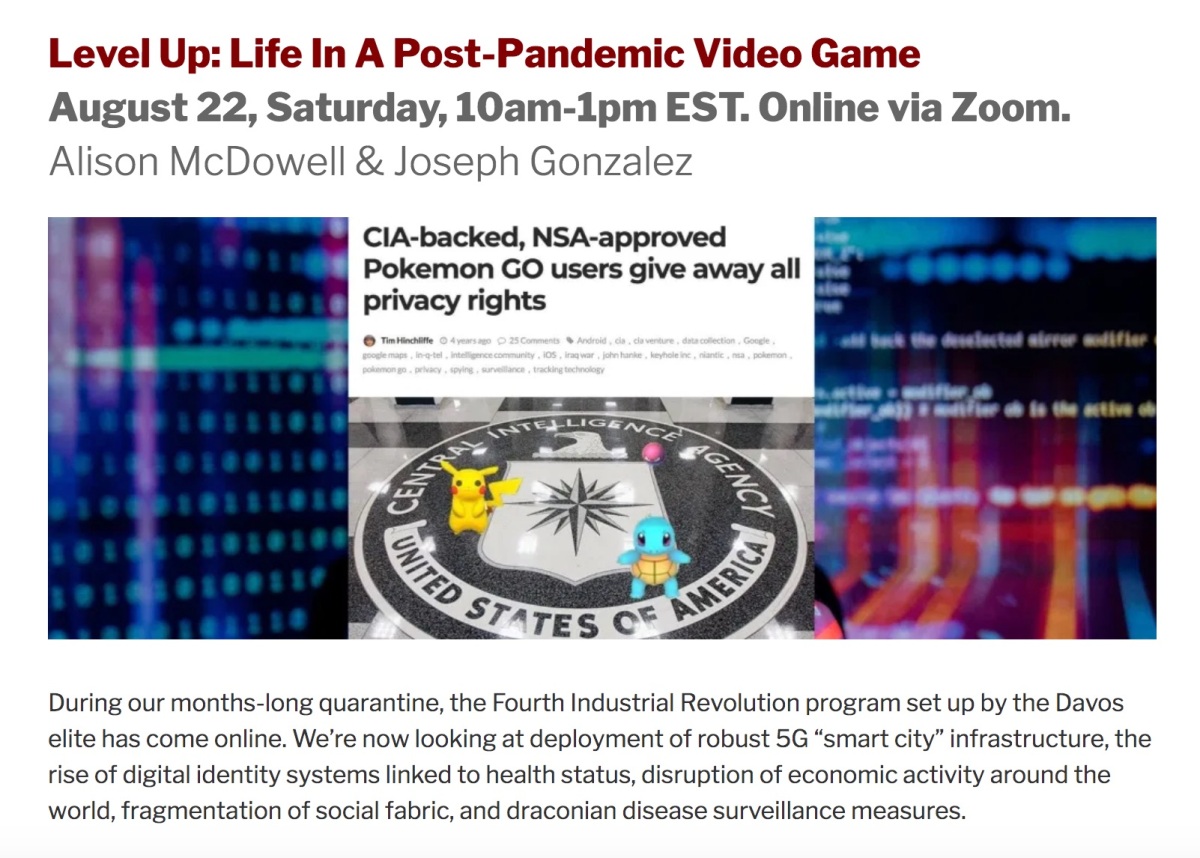
This Saturday August 22, 2020 from 10am to 1pm EST, Joseph Gonzalez and I will host a three-hour program through Incite Seminars exploring what it would mean to live in an augmented reality gamified police state. Capitalism isn’t dying. It has, in fact, jumped into the virtual world. A predatory digital infrastructure of surveillance and value extraction is being rolled out now in response to Covid-19. Very few people are aware of the bigger picture. This isn’t about a single outbreak, but rather the coercive normalization of technocracy using ongoing biosecurity threats as a mechanism of global domination. It is the billionaire oligarchs who will be controlling the data dashboard panopticon.
Pre-registration for the seminar is required. Sign up here. We’re asking for a donation in an amount that feels right to you. Joseph and I are volunteering our services, but it takes resources to run the platform we’re using, and we’re also hoping to direct some funding towards Lakota food growing efforts described in my prior post,  Timpsila, Medicine for Tech-No-Logic. Proceeds from the seminar will be split between the two. I know folks found a lot of comfort in the Timpsila post, so if you’re in a position to lend support directly, I know Chas Jewett (Venmo @chas-jewett-1) will definitely put a gift in any amount to good use.
My understanding is that this seminar will be recorded, and I plan to post a link once I get it. For those of who’d  like to start wrapping your head around what we’re planning to talk about, I’ve posted a glossary of terms. I invite you to consider them in relation to this short video about a poor family’s involvement with a “community care coordinator” named Kathy.
Given what I know is coming, I’ll take the liberty to read between the lines and offer my take on this video. The entire family is under state supervision CONTINUE READING: 

Friday, August 14, 2020

How schools reopening use AI and other tech for surveillance - Vox

How schools reopening use AI and other tech for surveillance - Vox

The dystopian tech that companies are selling to help schools reopen sooner
This fall, AI could be watching students social distance and checking their masks


Thousands of schools nationwide will not be reopening this fall. But in Las Vegas, the private K-12 Meadows School plans to use an artificial intelligence-powered thermal screening system to keep students safe as they return to classes.
The system will scan for signs that students have elevated temperatures — an indication they might have Covid-19 — as they enter buildings for their classes. If they’re flagged, the students will be asked to wait separately for about 10 minutes, and then get their temperature taken again. If the result is within a normal range, they’re cleared to start their day. If not, they’ll be sent home.
“Things are strange enough. Kids are going to be coming to school with masks. They’re going to be meeting friends with masks,” Jeremy Gregersen, the head of school at Meadows, told Recode. “They’re going to be meeting their teachers for the first time in person in strange new ways, and what we want is for kids to feel welcome and to normalize their arrival at school as early as possible.”
Supplying the technology is an artificial intelligence company called Remark Holdings. The company, which also sells facial recognition systems, has been providing a thermal scanning system — which also takes attendance — to more than 100 schools in China for over a year and is now repurposing its tech to assist semi-public places reopening amid the pandemic.
Remark Holdings is not the only company doing so. A slew of firms, many of which already sold surveillance products, are adjusting their technology to the pandemic. The suite of CONTINUE READING: How schools reopening use AI and other tech for surveillance - Vox

Monday, August 10, 2020

CURMUDGUCATION: Why Isn't AI More Widely Used?

 CURMUDGUCATION: Why Isn't AI More Widely Used?

Why Isn't AI More Widely Used?


That's the question that Wired asked last month, and it's important to consider because even as a truckload of ed tech folks are "predicting" (aka "marketing") a future in which ed tech is awash in shiny Artificial Intelligence features that read students minds and develop instantaneous perfectly personalized instructional materials. Why is it, do you supposed, that AI is being thrust at education even as private industry is slow to embrace it?

The article looks at a study of data from a 2018 US Census survey. What they found was that only 2.8% of companies had adopted any form of "machine learning," the magical AI process by which computers are supposed to be able to teach themselves. The big advanced tech winner was touchscreens, which are considerably more friendly than AI, and even those only clocked in at 5.9%, so I suspect that schools are ahead of the game on that one. Total share of companies using any kind of AI (which included voice recognition and self-driving vehicles) was a mere 8.9%.

Adoption was heavily tilted toward big companies, aka companies that can afford to buy shiny things that may or may not actually work, aka companies where the distance between those who buy the stuff and those who use the stuff is the greatest.

Another finding of the study is that, shockingly, that many previous "estimates" of AI use were seriously overstated. For instance, consulting giant McKinsey (a company that has steamy dreams CONTINUE READING: 
 CURMUDGUCATION: Why Isn't AI More Widely Used?

Saturday, June 20, 2020

CURMUDGUCATION: No, Software Still Can't Grade Student Essays

CURMUDGUCATION: No, Software Still Can't Grade Student Essays

No, Software Still Can't Grade Student Essays


One of the great white whales of computer-managed education and testing is the dream of robo-scoring, software that can grade a piece of writing as easily and efficiently as software can score multiple choice questions. Robo-grading would be swift, cheap, and consistent. The only problem after all these years is that it still can’t be done.
Still, ed tech companies keep making claims that they have finally cracked the code. One of the people at the forefront of debunking these claims is Les Perelman. Perelman was, among other things, the Director of Writing Across the Curriculum at MIT before he retired in 2012. He has long been a critic of standardized writing testing; he has demonstrated his ability to predict the score for an essay by looking at the essay from across the room (spoiler alert: it’s all about the length of the essay). In 2007, he gamed the SAT essay portion with an essay about how “American president Franklin Delenor Roosevelt advocated for civil unity despite the communist threat of success.”
He’s been a particularly staunch critic of robo-grading, debunking studies and defending the very nature of writing itself. In 2017, at the invitation of the nation’s teachers union, Perelman highlighted the problems with a plan to robo-grade Australia’s already-faulty national writing exam. This has annoyed some proponents of robo-grading (said one writer whose study Perelman debunked, “I’ll never read anything Les Perelman ever writes”). But perhaps nothing that Perelman has done has more thoroughly embarrassed robo-graders than his creation of BABEL.
All robo-grading software starts out with one fundamental limitation—computers cannot read or CONTINUE READING: CURMUDGUCATION: No, Software Still Can't Grade Student Essays