Latest News and Comment from Education

Showing posts with label PRIVACY. Show all posts

Wednesday, March 31, 2021

In the wake of man bringing live bombs, zip gun to Sac elementary school, major leap announced in campus protection tech • Sacramento News & Review

In the wake of man bringing live bombs, zip gun to Sac elementary school, major leap announced in campus protection tech • Sacramento News & Review
In the wake of man bringing live bombs, zip gun to Sac elementary school, major leap announced in campus protection tech


Authorities are being tight-lipped about what might have motivated Gustavo Aguilar, the 57-year-old man arrested last week for allegedly bringing two improvised, working bombs and a loaded homemade gun to Ethel Baker Elementary School in South Sacramento. Meanwhile, on the global front, a Canadian company confirmed that it’s racing ahead with a novel technology designed to stop such threats to school campuses.   

The investigation into Aguilar began shortly after 8 a.m. on March 2, after a program manager working at Ethel Baker noticed two suspicious devices resting on a sidewalk near one of the entrances.

Children were due to arrive at the school that morning. Even with COVID-19 restrictions, Ethel Baker has been one of the Sacramento City Unified School District’s learning hubs, a place where community groups partner with school staff to offer distance-learning support to students. This generally involves providing computer access to roughly 40 kids at a time, with an adult supervising as they log-in for classes.  

According to SCUSD Chief Communications Officer Tara Gallegos, the students hadn’t arrived on campus when the first menacing devices were uncovered.

“Our principal was able to get ahold of the students quickly, and made sure they knew to stay home,” Gallegos told SN&R. “Because this happened so early, most of the staff hadn’t arrived yet, either.”

Sacramento Sheriff’s personnel converged on Laurine Way. An Explosive Ordnance Disposal Team soon approached the devices. Sheriff’s Sergeant Rod Grassmann said that one was a 2.5-inch diameter steel pipe, sealed at both ends, with an improvised fuse on it. It was packed with metal shrapnel, clay putty, firecrackers and gasoline.

The other device was a “zip gun” made from a steel pipe. It had a spring-loaded cap that could fire a 12-gauge shotgun round. The zip gun was loaded.

No one was harmed as the Sheriff’s team neutralized both devices.

Another live pipe bomb was found on the campus on March 19.

Five days later, Sheriff’s detectives arrested Aguilar.  He was booked into the Sacramento County Main Jail on CONTINUE READING: In the wake of man bringing live bombs, zip gun to Sac elementary school, major leap announced in campus protection tech • Sacramento News & Review

Monday, February 22, 2021

CURMUDGUCATION: Big Brother Knows What's In Your Heart

CURMUDGUCATION: Big Brother Knows What's In Your Heart
Big Brother Knows What's In Your Heart


Well, this is creepy.

Before the pandemic, Ka Tim Chu, teacher and vice principal of Hong Kong's True Light College, looked at his students' faces to gauge how they were responding to classwork. Now, with most of his lessons online, technology is helping Chu to read the room. An AI-powered learning platform monitors his students' emotions as they study at home.

The software is called 4 Little Trees, and the CNN article only scratches the surface of how creepy it is. So let's work our way down through the levels of creepiness.

4 Little Trees is a product of Find Solution AI, a company founded in 2016. This product appears to be the heart and soul of their company. Though their "about us" mission statement is "FSAI consistent vision is to solve the difficulties that the society has been encountered with technology." They might want to look at their placement of "with technology" in that sentence. Anyway, on to 4 Little Trees.

It uses the computer webcam to track the movement of muscles on the student face to "assess emotions." With magical AI, which means it's a good time for everyone to remember that AI is some version of a pattern-seeking algorithm. AI doesn't grok emotions any more than it actually thinks-- in this case it compares the points it spots on the student's face and compares it to a library of samples. And as with all AI libraries of samples, this one has issues--mainly, racial ones. 4 Little Trees has been "trained" with a library of Chinese faces. The company's founder, Viola Lam, is aware "that more ethnically-mixed communities could be a bigger challenge for the software." 

But aren't emotions complicated? The sample image shows the software gets to choose from varying amounts of anger, disgust, fear, happiness, sadness, surprise and neutral. The company calls these CONTINUE READING: CURMUDGUCATION: Big Brother Knows What's In Your Heart

Thursday, January 28, 2021

CURMUDGUCATION: New Horizons in Workplace Surveillance

CURMUDGUCATION: New Horizons in Workplace Surveillance
New Horizons in Workplace Surveillance


Work-from-home has triggered an explosion in Surveil-from-the-office features and products. There has certainly been a boom in programs specifically for surveillance of employees who are at home. These are creepy, with a reported 81% of the top programs logging keystrokes-- so that the boss can see exactly what you've been typing.

But there's something even more insidious about regular old productivity software being tweaked so that it can do the surveilling as well.

As you might expect, Microsoft has been all over this trend, with fun things like a "productivity score" built into Microsoft 365. And they have friends, like Shield, a product that promises, proudly and without any hint of irony or shame, 

We are proud to announce the launch of our integration with Microsoft Teams. The Shield platform is one of the first compliance platforms to provide full surveillance as well as record and search of Microsoft Teams interactions, providing the ability to extract, review and analyze specific conversations to assist with any investigation process.

Reddit thread from six months ago asked "Could my boss be using teams for surveillance?" and the answer is, "of course." This month a ZDNet article looked at some of the "features" available now for CONTINUE READING: CURMUDGUCATION: New Horizons in Workplace Surveillance

Friday, December 18, 2020

How students should be protected from surveillance during remote learning | Parent Coalition for Student Privacy

How students should be protected from surveillance during remote learning | Parent Coalition for Student Privacy
HOW STUDENTS SHOULD BE PROTECTED FROM SURVEILLANCE DURING REMOTE LEARNING


December 2020

Endorsed by Access Living, ACLU of Illinois, Brighton Park Neighborhood Council, Chicago Lawyers’ Committee for Civil Rights, Children’s Screen Time Action Network, Civitas ChildLaw Center, Hartlieb & Horste, LLC, Illinois Families for Public Schools, Parent Coalition for Student Privacy, Raise Your Hand for Illinois Public EducationDownloadable as a Full document | or a one-page Summary

Many US public schools have been operating remotely since March, either full-time or part-time as a result of the Covid pandemic.  And with infection rates steeply increasing in the US, the timing of any return to fully in-person schooling remains uncertain.

The use of technology was widespread even before this spring. Now its use is nearly universal. But tech use should not impinge on students’ right to privacy and access to schooling.

In a recent national survey, 60% of educators said students would face negative consequences for having cameras off.   However, students should never be forced to choose between maintaining their privacy and receiving an education .  Moreover, surveillance does not equal safety.

Surveillance can be especially stressful for disadvantaged students, CONTINUE READING: How students should be protected from surveillance during remote learning | Parent Coalition for Student Privacy

Friday, December 11, 2020

Liability, Thy Name Is Google Meet | deutsch29: Mercedes Schneider's Blog

Liability, Thy Name Is Google Meet | deutsch29: Mercedes Schneider's Blog
Liability, Thy Name Is Google Meet


In order to educate students in quarantine, our school district is now using the video conferencing tool, Google Meet, which is part of the Google Classroom portfolio of online education products.

Google Meet has been billed as “a game changer.”

Indeed.

The idea of viewing the interior of my students’ homes while teaching them using Google Meet immediately brings to mind one word:

Liability.

In requiring teachers to use video conferencing for quarantined students, my school district has extended the classroom of all of its teachers into students’ homes. We can see into those homes as we conference. It makes me uncomfortable because I do not want to witness something I might be held legally responsible to report even as I feel I am invading student privacy via my official, school presence viewing that private space.

What if I see drugs or drug paraphenalia laying on a table?

What if I witness what appears to be the planning or execution of some other illegal activity?

What if I view or hear evidence of abuse or neglect?

What is my professional liability for  CONTINUE READING: Liability, Thy Name Is Google Meet | deutsch29: Mercedes Schneider's Blog

Monday, November 9, 2020

What happens when there are school data breaches?

What happens when there are school data breaches?
What happens when private student information leaks
Congressional watchdog report counts breaches of Social Security numbers and health records at schools


ow vulnerable is student data at U.S. public schools? That’s a critical question now that many, if not most, of the nation’s 51 million students are learning online at least some of the time.

Congressional watchdogs recently attempted to get a handle on the cyber security problem in schools. In a report publicly released in October 2020, the Government Accountability Office (GAO) counted 99 school data breaches over the past four years, from July 2016 to May 2020, that compromised the personal information of thousands of students in kindergarten through high school.

Attacks by cyber criminals were rare, the GAO found. More common were unintentional leaks in which private information, such as health records and telephone numbers, were accidentally made public. Students were responsible for more than a quarter of the breaches; their most frequent motive was changing grades.

The GAO relied on a private database of cyber attacks and leaks collected by Doug Levin of EdTech Strategies, a consulting firm. That’s because there’s no federal requirement for school districts to report data breaches. Most states have data breach notification laws but they vary a lot and there’s no obligation for state agencies to disclose them publicly. So the GAO turned to Levin’s K-12 Cybersecurity Resource Center, which has been collecting press clips about school data breaches from around the country and monitoring the states that do publicly report, such as Texas.

However, Levin’s own analysis of the data he shared with the GAO arrived at different totals. He counted 458 data breaches in school districts; 315 involved the unauthorized release of student data. That’s more than four times greater. Levin documented that more than a million student records CONTINUE READING: What happens when there are school data breaches?

Tuesday, October 27, 2020

When it Comes to Cameras in Virtual Classrooms, Compromise Over Compliance - Philly's 7th Ward

When it Comes to Cameras in Virtual Classrooms, Compromise Over Compliance - Philly's 7th Ward
WHEN IT COMES TO CAMERAS IN VIRTUAL CLASSROOMS, COMPROMISE OVER COMPLIANCE


For me, my home is a sacred place; not only because I am a person of faith but also because my home is an intimate and safe space where my relationships, culture and humanity is nurtured, affirmed and celebrated. I like to believe that my wife and children think the same thing.

Generally speaking, I never invite strangers into my home, but there are times when doing so was necessary. Usually, those times involved a broken appliance that needed to either be repaired or delivered. What is important to note is that I had to invite them to my home; they couldn’t come in without my permission. However, due to the Coronavirus pandemic, my children’s classmates and teachers are guests in my home each day via classroom zoom meetings… and I didn’t invite them.

The pandemic has pushed educators and families to innovate and adapt; this includes turning homes into educational spaces for remote or hybrid synchronous learning. Whether teachers are using zoom or google classroom, video conferencing is the new classroom and many districts require that students keep their cameras on. This means that classmates and teachers have a window into your home.

As I said earlier, I don’t invite everyone into my home. Yet my wife and I have agreed to the reality of uninvited guest for the sake of our children’s safety. Their cameras are on; it is the policy of the school district that they’re CONTINUE READING: When it Comes to Cameras in Virtual Classrooms, Compromise Over Compliance - Philly's 7th Ward

Saturday, October 24, 2020

NYC Public School Parents: Do you know where your child's personal data is? Please fill out our survey on your school's use of digital apps -

NYC Public School Parents: Do you know where your child's personal data is? Please fill out our survey on your school's use of digital apps -
Do you know where your child's personal data is?
Please fill out our survey on your school's use of digital apps


Class Size Matters, NY Allies for Public Education, and the Parent Coalition for Student Privacy would like to know which online apps or programs are being employed by schools throughout New York state, and whether they are sufficiently protective of children's privacy. We are asking parents and teachers to take our survey here, to let us know what apps or programs your schools are using.

Since the pandemic hit, districts across New York State have purchased many commercially-produced online apps and digital programs to implement remote learning. Even before last spring, schools had been using a large number of programs, many of which collect and use personal student information. In NYC alone, more than 75 commercially available online programs have been acquired for teachers to assign to their students, and "The DOE has informed schools that for SY 2020-21, they must have a shared, inclusive and digital curriculum in all core subject areas," according to the UFT.

Many of these digital apps collect and use personal student data in ways we do not understand. In some cases, the publicly available privacy policies of these vendors are NOT sufficiently protective and do not comply with the NY state student privacy law, Education Law 2D, which was passed in 2014.  

Among other things, this law and its regulations adopted in Jan. 2020 require that every contract with a vendor with access to personal student data must have a separate Parent Bill of Rights [PBOR], which specifies how the data will be protected and how parents can access the data and challenge it if necessary.

Each of these separate Parent Bill of Rights are supposed to be posted on the district website, along with other important information, including your district’s overall data privacy protection policy, and how you can contact the district data privacy officer in charge of ensuring these protections. Links to the Education Law 2D, the regulations, and a summary of some of the other most important provisions are here.

Please take a few minutes to fill out our online survey to let us know what online apps and/or digital programs are being used in your schools, and whether the district has provided the necessary information about the ways in which that data is being protected from breach and abuse.

Thanks!

Leonie Haimson, Class Size Matters and Parent Coalition for Student Privacy

Lisa Rudley and Jeanette Deutermann, NY State Allies for Public Education


Monday, October 19, 2020

Data breaches hit thousands of K-12 students, federal watchdog reports - POLITICO

Data breaches hit thousands of K-12 students, federal watchdog reports - POLITICO
Data breaches hit thousands of K-12 students, federal watchdog reports
Student academic records were most commonly compromised, including assessment scores and special education records.


Thousands of K-12 students were affected by 99 reported data breaches in the United States over the last four years, according to a Government Accountability Office analysis published this week.

U.S. GAO - Data Security: Recent K-12 Data Breaches Show That Students Are Vulnerable to Harm - https://www.gao.gov/products/GAO-20-644 via @USGAO

Student academic records were most commonly compromised, including assessment scores and special education records. Coming in second were records with personally identifiable information, such as student Social Security numbers, according to the analysis of data from July 2016 to May 2020.

Key findings: Wealthier, larger and suburban districts were more likely to report a breach, the report says, citing information from the Cybersecurity Resource Center.

“Breaches were either accidental or intentional, although sometimes the intent was unknown, with school staff, students, and cybercriminals among those responsible,” the GAO report said. “Reports of breaches by cybercriminals were rare but included attempts to steal [personally identifiable information].”

Background: As schools rely more on information technology systems, they collect more student data electronically that can put student information at risk of disclosure, the report warns. Distance learning during the pandemic has put a spotlight on K-12 cybersecurity issues.

This summer, the FBI alerted private industry that new cyberattacks were likely ahead as schools began virtual learning. Following that warning, districts like the Fairfax County school system near Washington, D.C., fell victim to ransomware attacks, and a Miami-area teenager blocked thousands of students and staff from classes during their first week of online learning. READ MORE: Data breaches hit thousands of K-12 students, federal watchdog reports - POLITICO

Thursday, October 15, 2020

glen brown: "Neither FERPA or HIPAA prevents schools from sharing non-identifiable information with the media and the general public"

glen brown: "Neither FERPA or HIPAA prevents schools from sharing non-identifiable information with the media and the general public"

"Neither FERPA or HIPAA prevents schools from sharing non-identifiable information with the media and the general public"


“…Legal experts and government transparency advocates say schools, as a whole, have a long track record of abusing privacy laws to keep information secret and force the public to enter costly lawsuits to gain access to records. Justin Silverman, who leads the New England First Amendment Coalition, said several states also had cited HIPAA as a reason for withholding coronavirus case counts at nursing homes, although many later reversed course and released that information.
“Although there’s a fine balance between the public’s right to know and personal privacy, many health experts said clear and consistent disclosure of even basic case numbers is essential for sound decision-making. 
“Dr. Nathaniel Beers, who serves on the American Academy of Pediatrics Council on School Health, suggested school districts should have a tiered communication approach: providing the most detailed information to people with direct exposure; a more generic notification with health screening guidance for others in the school; and basic information on case counts and response for the general community. ‘For schools to be open, you need staff to feel like safety is first. You need students, [teachers and staff] and parents to feel safety is first. You need the broader community to feel like the school is taking care of business and not putting everyone else in harm’s way,’ said Beers, who also is president of the HSC Health Care System in Washington, D.C. ‘That’s where the broader communication is really critical.’ 
Standing guidance from the U.S. Department of Health and Human Services says that HIPAA does not apply to elementary and secondary schools. 
“In particular, the agency notes they are ‘not a HIPAA covered entity,’ which CONTINUE READING: glen brown: "Neither FERPA or HIPAA prevents schools from sharing non-identifiable information with the media and the general public"

Friday, October 2, 2020

The State of Online Safety for Kids | Dissident Voice

The State of Online Safety for Kids | Dissident Voice

The State of Online Safety for Kids


There’s no doubt that the resources of our digital age are valuable. They provide us with new development opportunities and help us to build meaningful connections with a diverse range of global communities. The past couple of decades have seen our adoption of tech grow, and as such we are seeing the first generations of digital natives. Kids are surrounded by technology from an early age and are more comfortable with its use. They continue to use it in creative ways, not least of which is organizing themselves for ecological and political activism.
That’s not to say that there aren’t significant challenges. We have become cognizant of the various dangers the online environment presents. We must do what we can to protect children from the potential for harm. But we also need to go further; preparing them to be aware of the issues, and giving them tools to navigate the more treacherous waters.
Restricting Content
Particularly when it comes to younger children, there’s a need to reduce the risk of exposure to harmful or unsuitable content. There are certain regulations and legislation in place designed to protect them. The Children’s Online Privacy Protection Act (COPPA) has been in place since April 2000 and requires operators of websites aimed at children to obtain parental consent for those under the age of 13. But, let’s face it, it can be too easy for kids to wander off into areas not designed for them, and potentially interact with those who don’t have their best interests in mind. This is where technology can be CONTINUE READING: The State of Online Safety for Kids | Dissident Voice

Tuesday, September 22, 2020

Cybercriminals Strike Schools Amid Pandemic | The Pew Charitable Trusts

Cybercriminals Strike Schools Amid Pandemic | The Pew Charitable Trusts

Cybercriminals Strike Schools Amid Pandemic


Just days before the Aug. 3 scheduled start of school, officials at the Athens Independent School District in East Texas received a shock.
Cybercriminals had attacked the district’s entire computer network, encrypting all the data and demanding $50,000 in ransom for its release. Access to everything from teacher communications to student assignments was blocked.
“It was terribly disruptive, to put it mildly,” said Toni Clay, the district’s spokesperson. “We no longer had access to any student information, such as schedules, email addresses, anything that would be stored. Internally, we had no staff information. It was all frozen.”
The plan had been to begin school online for three weeks and then transition to a hybrid model of both virtual and in-person classes. Instead, officials ended up delaying the start of school completely for a week.
Athens is one of at least 16 school districts, from California to New Jersey, that have been victimized in a rash of ransomware attacks since the end of July.
Some have been forced to push back school reopening dates. Others that already started school have had to cancel classes for a day or more.
The attacks have placed a heavy burden on school administrators as they grapple with whether it’s safe for students and teachers to return in person and whether schools are prepared to handle social distancing and other requirements.
School information technology staffs, meanwhile, have been consumed with the transition to CONTINUE READING; Cybercriminals Strike Schools Amid Pandemic | The Pew Charitable Trusts

Wednesday, September 2, 2020

Education apps are sending your location data and personal info to advertisers - CNET

Education apps are sending your location data and personal info to advertisers - CNET

Education apps are sending your location data and personal info to advertisers
It's a back-to-school sale on your data.


With the coronavirus pandemic pushing schools online out of public health concerns, parents and teachers are turning to digital alternatives like apps to bridge the virtual gap. While kids can learn via these apps, hundreds of advertisers are learning about them, too. 
Researchers from the International Digital Accountability Council looked at 496 education apps across 22 countries, finding privacy issues with many of these services. Several apps were providing location data to third-party advertisers, and also collected device identifiers that can't be reset unless you buy a new phone. 
While the majority of apps examined in the report met privacy standards, the scale of data collection discovered raised alarms about the nature of education apps. 
Researchers found that 79 out of 123 apps manually tested were sharing user data with third parties. That data going to advertisers could include your name, email address, location data and device ID. The study also found that more than 140 third-party companies were getting data from ed tech apps, the majority of which went to Facebook, followed by Google. 
Security researchers often find privacy issues with apps, many of which harvest data from devices even when you don't give consent. 
Even if you do give permission, the data is often shared with multiple third parties that use the data in their own ways. You may allow your weather app to get your location for accurate forecasts, but that app's data partners can use it for advertising or law enforcement purposes
App creators often also use software development kits, or SDKs, as shortcuts rather than making their software from scratch, which can also lead to data-stealing schemes
Security researchers will analyze network traffic and examine code on apps to figure out where the data is going, but the average person shouldn't be expected to learn this skill to protect their privacy. 
These privacy concerns are common across apps, but it's a bigger issue among education apps since the majority of people using them are children. Education apps CONTINUE READING: Education apps are sending your location data and personal info to advertisers - CNET

Friday, August 21, 2020

Level Up – Life In A Post Pandemic Video Game – Wrench in the Gears

Level Up – Life In A Post Pandemic Video Game – Wrench in the Gears

Level Up – Life In A Post Pandemic Video Game


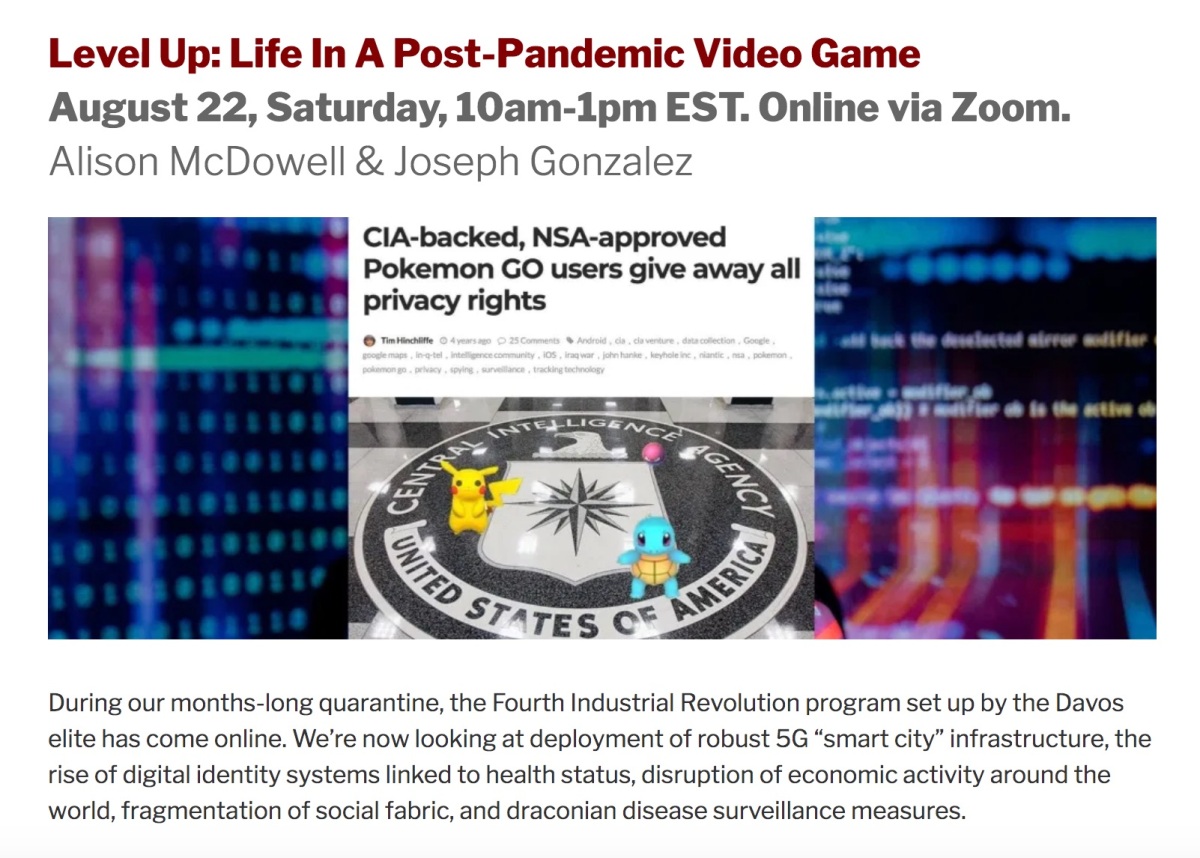
This Saturday August 22, 2020 from 10am to 1pm EST, Joseph Gonzalez and I will host a three-hour program through Incite Seminars exploring what it would mean to live in an augmented reality gamified police state. Capitalism isn’t dying. It has, in fact, jumped into the virtual world. A predatory digital infrastructure of surveillance and value extraction is being rolled out now in response to Covid-19. Very few people are aware of the bigger picture. This isn’t about a single outbreak, but rather the coercive normalization of technocracy using ongoing biosecurity threats as a mechanism of global domination. It is the billionaire oligarchs who will be controlling the data dashboard panopticon.
Pre-registration for the seminar is required. Sign up here. We’re asking for a donation in an amount that feels right to you. Joseph and I are volunteering our services, but it takes resources to run the platform we’re using, and we’re also hoping to direct some funding towards Lakota food growing efforts described in my prior post,  Timpsila, Medicine for Tech-No-Logic. Proceeds from the seminar will be split between the two. I know folks found a lot of comfort in the Timpsila post, so if you’re in a position to lend support directly, I know Chas Jewett (Venmo @chas-jewett-1) will definitely put a gift in any amount to good use.
My understanding is that this seminar will be recorded, and I plan to post a link once I get it. For those of who’d  like to start wrapping your head around what we’re planning to talk about, I’ve posted a glossary of terms. I invite you to consider them in relation to this short video about a poor family’s involvement with a “community care coordinator” named Kathy.
Given what I know is coming, I’ll take the liberty to read between the lines and offer my take on this video. The entire family is under state supervision CONTINUE READING: 

Thursday, August 20, 2020

Audrey Watters: Hack Education: Building Anti-Surveillance Ed-Tech | National Education Policy Center

Hack Education: Building Anti-Surveillance Ed-Tech | National Education Policy Center

Hack Education: Building Anti-Surveillance Ed-Tech


These are the slides and transcript from my conversation this morning with Paul Prinsloo — a webinar sponsored by Contact North
Pardon me if I just rant a little. Pardon my language. Pardon my anger and my grief. Or don’t. Let us sit with our anger and our grief a little.
We are living in terrible, terrible times — a global pandemic, economic inequality exacerbated by economic depression, dramatic and worsening climate change, rampant police violence, and creeping fascism and ethno-nationalism. And in the midst of all this danger and uncertainty, we have to navigate both old institutions and practices — may of which are faltering under a regime of austerity and anti-expertise — and new(ish) technology corporations — many of which are more than happy to work with authoritarians and libertarians.
Education technology — as a field, an ideology — sits right at that overlap but appears to be mostly unwilling to recognize its role in the devastation. It prefers to be heralded as a savior. Too many of its advocates refuse to truly examine the ways in which ed-tech makes things worse or admit that the utopia they've long peddled has become a hellscape of exploitation and control for a great deal of the people laboring in, with, under its systems. 
Ed-tech may not be the solution; in fact, ed-tech may be the problem — or at the very least, a symptom of such.
Back in February — phew, remember February? — Jeffrey Moro, a PhD candidate in English at the University of Maryland, wrote a very astute blog post "Against Cop Shit" in the classroom.
"For the purposes of this post," Moro wrote, "I define 'cop shit' as 'any pedagogical technique or technology that presumes an adversarial relationship between students and teachers.' Here are some examples:
  • ed-tech that tracks our students' every move
  • plagiarism detection software
  • militant tardy or absence policies, particularly ones that involve embarrassing our students, e.g. locking them out of the classroom after class has begun
  • assignments that require copying out honor code statements
  • 'rigor,' 'grit,' and 'discipline'
  • any interface with actual cops, such as reporting students' immigration status to ICE and calling cops on students sitting in classrooms.
The title of this webinar is "Building Anti-Surveillance Ed-Tech," but that's a bit of a misnomer as I'm less interested in either "building" or in "ed-tech." Before we build, we need to dismantle the surveillance ed-tech that already permeates our schools. And we need to dismantle the CONTINUE READING: Hack Education: Building Anti-Surveillance Ed-Tech | National Education Policy Center

Tuesday, August 18, 2020

CURMUDGUCATION: Silicon Valley and the Surveillance State

 CURMUDGUCATION: Silicon Valley and the Surveillance State

Silicon Valley and the Surveillance State


Peter Schwartz is an American futurist, innovator, author, and co-founder of the Global Business Network, a corporate strategy firm. He's done sexy things like consult for futury movies, including WarGames (ew), Minority Report, and Sneakers (an under-appreciated gem). He's written an assortment of books; he also wrote the 2004 climate change report that predicted that England would be a frozen wasteland by, well, right now. (This Peter Schwartz should not be confused with this Peter Schwartz, Ayn Rand-loving writer. )

Schwartz was the subject of an interview in yesterday's San Francisco Chronicle, reminding us that there's an entire sector of future-looking tech-loving folks who think the advent of the surveillance state is pretty swell.

Schwartz is not in Silicon Valley-- he's a Beverly Hills guy. And not everything he says is alarming. For instance:

Every single time, with no exceptions, that I’ve gotten the future wrong, it’s because there was an inadequate diversity of people in the room. It was not that it couldn’t be seen; it was that we were just talking to ourselves.

Technocrats desperately need to hear that, but the prevailing ethos is the idea of a single visionary CEO without other voices to hold him back. As in Zuckerberg's unwillingness to let go of control of CONTINUE READING: 
 CURMUDGUCATION: Silicon Valley and the Surveillance State