Latest News and Comment from Education

Showing posts with label FAPE FREE AND APPROPRIATE EDUCATION. Show all posts

Sunday, November 8, 2020

Education in a Biden Presidency in a Deeply Divided Nation: What Can We Expect? | Ed In The Apple

Education in a Biden Presidency in a Deeply Divided Nation: What Can We Expect? | Ed In The Apple
Education in a Biden Presidency in a Deeply Divided Nation: What Can We Expect?


On November 2nd, the day before Election Day pollsters and talking heads were predicting a blue wave, a Biden presidency, a Democratic Senate and House and a long list of “progressive” initiatives.

Five days later the networks are predicting a thin, an incredibly thin Biden victory, although it might be weeks until states certify election results. Ask I peck away on Saturday at noon CNN and MSNBC are calling Pennsylvania putting Biden over the top.

Horns blowing, dancing in the streets, Joe Biden will be the 46th President of the United States.

President Trump has been tweeting all day charging fraud and filing law suits.

On December 14th electors will cast virtual ballots and on January 6th the Congress will open the ballots and certify the election of the next president.

The Constitution states the “Times, Places and Manner of holding Elections …. shall be proscribed in each State by the Legislature thereof …” it is highly CONTINUE READING: Education in a Biden Presidency in a Deeply Divided Nation: What Can We Expect? | Ed In The Apple

Friday, August 21, 2020

Can Schools Deliver Services To Students With Disabilities This Fall? : NPR

Can Schools Deliver Services To Students With Disabilities This Fall? : NPR

Schools Say They Have To Do Better For Students With Disabilities This Fall


For Sarah McLaren, who lives in a suburb of Minneapolis, talking about the spring is painful. Her daughter, a rising fourth-grader, struggles with auditory processing and receives special education services. But McLaren says her daughter had trouble keeping up with teachers on an iPad because the instruction was almost all talk.
"They'd tell her, 'Look at this problem, look at that problem. No, show me your worksheet,' " McLaren remembers. "The teachers were doing the best they could, but all those rapid verbal directions just overwhelmed her."
McLaren says her daughter went from loving school to dreading it. "[She] would literally run away from the iPad and hide in the closet or under the bed."
More than 7 million schoolchildren receive special education services in the U.S. But this spring, when the nation's schools were forced to teach remotely, many of those children were left behind, and some vital services — including physical, occupational and speech therapies — simply stopped. With many districts planning to continue remote learning in the fall, parents and caregivers expect better this school year. And school leaders know: They've got to do better.
Special education teacher Nikki Allinson, in Washington, D.C., says one of the greatest challenges she faced trying to teach remotely was that many of her students learn with the help of tactile, classroom-based tools — like laminated cards or magnetic letters for word decoding. But, in the spring, kids weren't given those tools for use at home. Allinson says that also made it "nearly impossible" to teach abstract math concepts. "I recorded so many videos of me with Legos, you know, trying to find things that they CONTINUE READING: Can Schools Deliver Services To Students With Disabilities This Fall? : NPR

Thursday, August 20, 2020

Special Ed Students at Risk - LA Progressive

Special Ed Students at Risk - LA Progressive

Special Ed Students at Risk


education
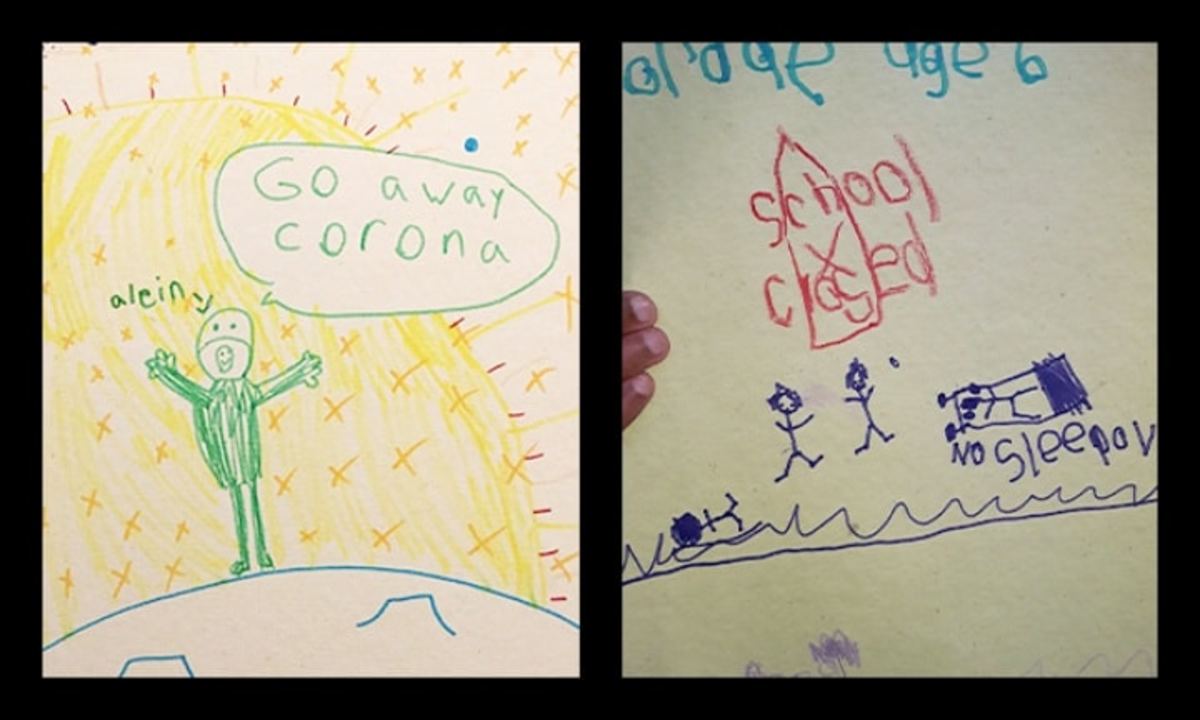
Pieces in a ParentsTogether’s art installation in August at the U.S. Capitol, which showed the anxieties and hopes of children during the pandemic. The picture on the right was created by Ellery, 7, from Cincinnati, while the other was drawn by 6-year-old Coredae Schmidt of Kansas. Images courtesy of ParentsTogether

Special Education Students Still Waiting for Help as New School Year Starts

Like many parents, Lynn Gabriel of Los Angeles has found keeping her 6-year-old son on track with school to be a grueling endeavor during the pandemic. Last spring, between the two half-hour classes a week and worksheets exchanged on Google Classroom, Gabriel struggled to keep Benjamin engaged.
He missed his friends and basketball games at the park, but there were even more challenges. Unlike most kids, Benjamin struggles with recall, and one of his eyes has trouble focusing. That has made learning how to read frustrating for him as well as for his mother.
“I’ll tell him to sound it out,” Gabriel said. “I say, ‘Look at the word.’ But I don’t know what he sees. He learns differently, and I have no tools to figure it out.”
But over the past five months the single mom has been unable to get help from her local school district.

Many districts up and down California have not assessed students with disabilities in months, preventing them from obtaining services they need during the destabilizing times of the pandemic.

Prompted by stay-at-home orders and a hastily passed state law in March, many districts up and down California have not assessed students with disabilities in months, preventing them from obtaining services they need during the destabilizing times of the pandemic. Benjamin, a Los Angeles boy who will start first grade on Tuesday, is facing another year of distance learning.
As a result, although students like Benjamin and thousands like him start school remotely in Los Angeles County on Tuesday, educational CONTINUE READING: Special Ed Students at Risk - LA Progressive

Thursday, August 13, 2020

Ed Department Accused Of Diverting Funds From Students With Disabilities - Disability Scoop

Ed Department Accused Of Diverting Funds From Students With Disabilities - Disability Scoop

Ed Department Accused Of Diverting Funds From Students With Disabilities


lawsuit filed this week accuses the U.S. Department of Education of jeopardizing students with disabilities by misdirecting funds meant to help schools deal with fallout from the pandemic.
Earlier this year, Congress included billions of dollars in funding for schools in the Coronavirus Aid, Relief and Economic Security, or CARES, Act. But rules issued by the Education Department this summer about how that money should be allocated allow a good chunk of the money to be shared with private schools.
Steering the much-needed funds away from public schools is especially problematic for students with disabilities, according to the Council of Parent Attorneys and Advocates, or COPAA, the nonprofit that filed the suit and works to advocate for the rights of students with disabilities and their families. Unlike private schools, public schools are legally required to serve students with disabilities.
“It is reprehensible that this administration is pressuring schools to open quickly while simultaneously taking away the very resources that would allow them to do so safely and effectively,” said Selene Almazan, legal director for COPAA. “As America’s schools, communities and families are in the midst of an economic and health crisis, now is not the time to deprive millions of public school children the education services they need — including students with disabilities, a population that Congress specifically intended the CARES Act funds to benefit.”
According to COPAA, as much as $1.5 billion could be diverted away from public schools under the rule just as these schools are dealing with higher costs for distance learning, changes to how they serve students with disabilities and other needs. Meanwhile, the state tax revenues that fund public schools have declined.
“At a time when students with disabilities are likely to have an CONTINUE READING: Ed Department Accused Of Diverting Funds From Students With Disabilities - Disability Scoop

Thursday, August 6, 2020

Covid school closures: what they mean for kids with disabilities - Vox

Covid school closures: what they mean for kids with disabilities - Vox

We need to talk about what school closures mean for kids with disabilities
As schools prepare for fall, students in special education are being left out of the conversation.
When Simon’s school in Maryland closed this spring due to the pandemic, his family didn’t know what to expect.
“Like every family who has a kid in school, there was a lot of uncertainty,” Simon’s mom, Laura LeBrun Hatcher, told Vox. “Everybody was in a ‘what’s going to happen’ moment.”
But for Simon, that uncertainty also included what would happen to the one-on-one support that he needs to learn effectively, as well as the occupational and physical therapy he gets at school. Simon, who just turned 14, has complex medical needs and disabilities, including hydrocephalus, epilepsy, and autism. As the director of design and communications for the group Little Lobbyists, which works on behalf of kids with disabilities, Hatcher has been involved in advocacy for a long time. But, she said, “I’m not a trained therapist” — and providing everything at home that Simon used to get at school has been very challenging.
While Simon’s school has “been great in trying to walk us through stuff and do things remotely, the quality of the therapy is just not there,” Hatcher said. And “Simon’s attention just isn’t there for it,” she added. “He’s not in the environment that he is used to, where he has the structure that he’s used to.”
And compared with other kids with disabilities around the country, “Simon was one of the lucky ones,” Hatcher said.
When schools closed their physical buildings due to the pandemic, some made an effort to continue the services and therapies that help students with disabilities access their education — even if those services had to be remote. But other schools did little or nothing to CONTINUE READING: Covid school closures: what they mean for kids with disabilities - Vox

Wednesday, July 15, 2020

Mom: Virtual education was ‘a disaster’ for my son with Down syndrome - The Washington Post

Mom: Virtual education was ‘a disaster’ for my son with Down syndrome - The Washington Post

Virtual education was ‘a disaster’ for my son with Down syndrome. Here’s what students with disabilities really need


When covid-19 began to spread in the United States this past spring, schools closed around the country and most of them stayed that way through the end of the 2019-20 academic year.
Districts had hoped that remote learning could replace in some measure the learning that students would be missing while not in school. In some places it was enough, but in many it wasn’t — especially for students with special needs.
Special education students were stuck at home, most of them without the full array, or any, of the special services they get in school as required in their federally mandated Individualized Education Programs. And in many districts, remote learning will be the order of the day again when the 2020-21 academic year begins this fall, as covid-19 rates are spiking in many states. Several districts have announced that they are going to all-remote learning for the start of the school year, including Los Angeles, the second-largest in the country.
Allison Wohl’s son, Julian, is a rising fifth-grader in Montgomery County Public Schools in Maryland, and virtual learning was “a disaster” for him, she said. In this post, she explains what happened to him and sets out exactly what schools need to do now to help students with special needs.
By Allison Wohl
The covid-19 pandemic has laid bare deep inequities in our society, particularly in access to quality education. While some students benefited from the makeshift distance learning program that schools put in place, many more, including students with disabilities, were frustrated and left even further behind.
For our son Julian, who recently finished fourth grade, and who has Down syndrome, distance learning CONTINUE READING: Mom: Virtual education was ‘a disaster’ for my son with Down syndrome - The Washington Post