Latest News and Comment from Education

Showing posts with label NEPC NATIONAL EDUCATION POLICY CENTER. Show all posts

Friday, May 14, 2021

David Labaree on Schooling, History, and Writing: When Is School the Answer to Social Problems? | National Education Policy Center

David Labaree on Schooling, History, and Writing: When Is School the Answer to Social Problems? | National Education Policy Center
David Labaree on Schooling, History, and Writing: When Is School the Answer to Social Problems?


This post is a lecture I gave at University of Luxembourg in 2011, which was published in a book, edited by Daniel Tröhler and Ragnhild Barbu,  Education Systems in Historical, Cultural, and Sociological Perspectives.   To save you the trouble of buying the book on Amazon for $200, I’m reproducing it here.  This piece draws on material from my 2010 book, Someone Has to Fail.

Schools have long been asked to solve myriad social problems, but 

Daniel Ragnhild Book Cover

WHEN IS SCHOOL AN ANSWER TO WHAT SOCIAL PROBLEMS?

Lessons from the Early American Republic

In modern societies, we ask schools to fix an enormous variety of social problems, both large and small.  We ask them to reduce social inequality and increase social mobility.  We ask them to provide the economy with job skills that will increase productivity, enhance economic growth, and strengthen the nation.  We ask them to promote democracy, improve health, save the environment, and empty our prisons.  And at the same time we also assign schools smaller missions, such as improving driver safety, reducing tooth decay, fighting obesity, and deterring teenage pregnancy.

We ask schools to solve all of these problems even though they have demonstrated time and time again that they are unable to do so.  Increasing educational attainment has proven to have no effect on the rates of social equality and social mobility, and its impact on economic growth has proven at best to be indirect and limited and at worst counterproductive.  So why do we keep turning to schools for answers they cannot provide?  One reason is that they are available.  Schools are publicly controlled, located in every community, and willing if not able to take on new public missions.  Another is that asking schools to fix problems is a lot easier than trying to address the problem directly through the political system. 

If schools are a weak mechanism for solving social problems, however, then the topic of chapter – the movement that established the American common school system – was the exception that CONTINUE READING: David Labaree on Schooling, History, and Writing: When Is School the Answer to Social Problems? | National Education Policy Center

Code Acts in Education: Valuing Futures | National Education Policy Center

Code Acts in Education: Valuing Futures | National Education Policy Center
Code Acts in Education: Valuing Futures


The future of education in universities is currently being reimagined by a range of organizations including businesses, technology startups, sector agencies, and financial firms. In particular, new ways of imagining the future of education are now tangled up with financial investments in education technology markets. Speculative visions and valuations of a particular ‘desirable’ form of education in the future are being pursued and coordinated across both policy and finance.

Visions and valuations

Edtech investing has grown enormously over the last year or so of the pandemic. This funding, as Janja Komljenovic argues, is based on hopes of prospective returns from the asset value of edtech, and also determines what kinds of educational programs and approaches are made possible. It funds unique digital forms of education, investing speculatively in new models of teaching and learning to enable them to become durable and, ideally, profitable for both the investor and investee.

We’ve recently seen, for instance, the online learning platform Coursera go public and reach a multibillion dollar valuation based on its reach to tens of millions of students online. New kinds of investment funds have emerged to accelerate edtech market growth, such as special purpose acquisition companies (SPACs) that exist to raise funds to purchase edtech companies, scale them up quick and return value to both the SPAC and its investor, plus new kinds of education-focused equity funds and portfolio-based edtech index investing that select a ‘basket’ of high-value edtech companies for investors to invest in.

The result of all this investment activity has been the production of some spectacular valuation claims about the returns available from edtech. The global edtech market intelligence agency HolonIQ calculated venture capital investment in edtech at $16bn last year alone, predicting a total edtech market worth $400bn by 2025.

But, HolonIQ said, this isn’t just funding seeking a financial return—it’s ‘funding backing a vision to transform how the world learns’. These edtech investments tend to centre on a particular shared CONTINUE READING: Code Acts in Education: Valuing Futures | National Education Policy Center

Wednesday, May 12, 2021

Alfie Kohn: The Progressive Teacher’s Role in the Classroom: What Active Adult Involvement Does and Doesn’t Entail | National Education Policy Center

Alfie Kohn: The Progressive Teacher’s Role in the Classroom: What Active Adult Involvement Does and Doesn’t Entail | National Education Policy Center
Alfie Kohn: The Progressive Teacher’s Role in the Classroom: What Active Adult Involvement Does and Doesn’t Entail


According to Michael Harrington and many other scholars, a careful reading of Marx’s work makes it clear that he “regarded democracy as the essence of socialism.” Soviet-style Communism, by contrast, corrupted socialism “by equating it with a totalitarian denial of freedom.”1 But, as Noam Chomsky has often pointed out, it served the interests of both the U.S.S.R. and the United States to pretend otherwise — that is, to equate the Soviet system with socialism, as if it represented the very apotheosis of Marx’s vision rather than a cynical misuse of it. The Soviets wanted to bask in the glory of Marx’s vision of bottom-up control and liberation from oppression, while the Americans wanted to make capitalism seem more appealing by linking the alternative of socialism to the tyranny of Lenin and Stalin.

I was fascinated by this paradox when I first encountered it — the idea that two diametrically opposed belief systems might embrace the same (faulty) conclusion for entirely different reasons. And I recognized it again years later when I saw something similar playing out in the field of education.

Traditionalists believe that teachers should have absolute control over a classroom: Adults know more than children do and therefore ought to make all the important decisions — setting and enforcing the rules, managing students’ behavior, planning the curriculum, dispensing knowledge, and so on. Groovy alternative educators, meanwhile, believe that children can be trusted to learn and grow and solve their problems essentially on their own, without outside interference.

Their prescriptions are utterly opposed. But both sides — direct-instruction behaviorists and Our Lady of the Fiercely Snapping Ruler, on the one hand; unschoolers and proponents of “free” CONTINUE READING: Alfie Kohn: The Progressive Teacher’s Role in the Classroom: What Active Adult Involvement Does and Doesn’t Entail | National Education Policy Center

Tuesday, May 11, 2021

Shanker Blog: The Great Divergence In State Education Spending | National Education Policy Center

Shanker Blog: The Great Divergence In State Education Spending | National Education Policy Center
Shanker Blog: The Great Divergence In State Education Spending


When we talk about K-12 education spending inequality, we're usually talking about differences in resources between high- and low-poverty districts within states. But spending levels also vary between states, and that too matters for overall spending inequality in the U.S. How has this changed over the past 25 years? In other words, does K-12 spending vary more between states than it did a quarter century ago?

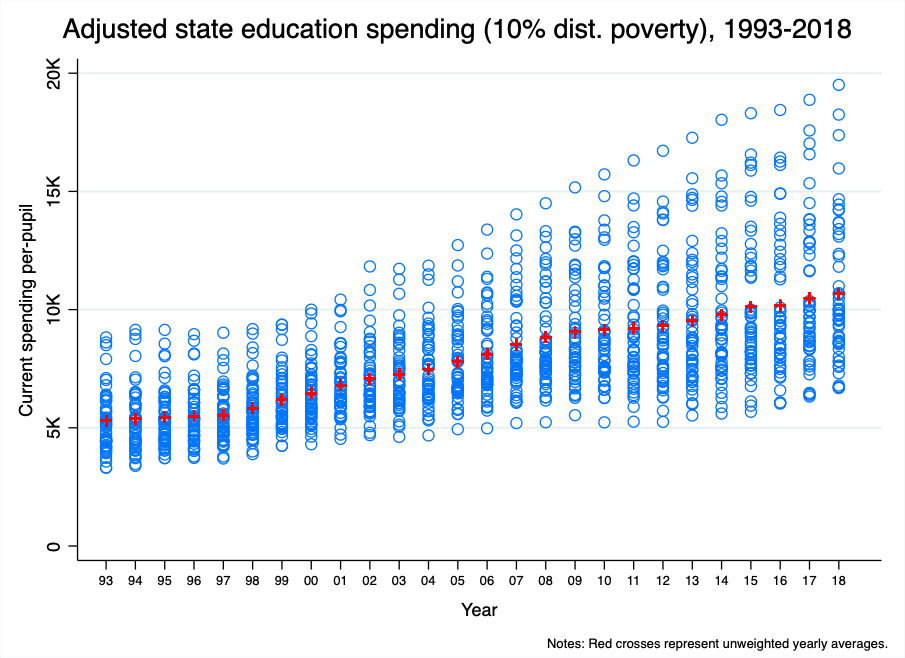
Let’s take a look at one simple way to visualize this trend. In the graph below, each blue circle is a state, and there one set of 51 states (including D.C.) for each year between 1993 and 2018 (the horizontal axis). On the vertical axis is total current spending in each state, predicted for a district in each state with a 10 percent Census child poverty rate (the graph is very similar regardless of poverty level). These spending levels also control for regional wage variation, district size, and population density, all of which affect the “value of the education dollar.” This allows for a better comparison between states (e.g., it costs more, on average, to hire teachers in Connecticut than in Alabama). The red plus signs within each year represent the unweighted average spending level across all states. These data are from the School Finance Indicators Database.

Our focus here is on the “spread” of states (blue circles) within each column (i.e., within each year). A larger spread, of course, represents greater variation (and, roughly speaking, more interstate inequality). The trend over time is a bit striking.

Throughout most of the 1990s and the first half of the 2000s, all but a small handful of states were clustered within the $3,000 to $8,000 range, a spread of about $5,000 per-pupil. Now, to be clear, this is a big span (particularly in these earlier years, when spending was lower), and it represents substantial interstate variation in spending. Even controlling for factors that affect costs, such as poverty and regional wage variation, some states spend a lot more than others.

Starting in the mid-2000s, however, a group of about 5-10 states start to break away from the CONTINUE READING: Shanker Blog: The Great Divergence In State Education Spending | National Education Policy Center

Friday, April 23, 2021

10th Period: Let's Talk Charter Schools | National Education Policy Center

10th Period: Let's Talk Charter Schools | National Education Policy Center
10th Period: Let's Talk Charter Schools


Let's discuss charter schools -- a topic you've seen a lot of on this blog over the years, but has kind of gone away recently for obvious (COVID) and non-obvious (Vouchers/School Funding) reasons.

Despite House Bill 2, which was supposed to slim down our notoriously poor-performing charter school sector and the closure of the nation's largest online school -- ECOT -- which closed because the school literally stole hundreds of millions of tax dollars to educate kids they never educated, we are currently spending more on charter schools than any other year on record. 

By a mile.

According to the latest Charter School funding report from the Ohio Department of Education, we are set to spend $999.7 million. The previous record was $955 million from the 2015-2016 school year -- the high-point of the ECOT years.

Despite this massive recent increase (an extraordinary $111 million jump ... over two years), it's not because we've had more students attending charters than ever. 

No. That record remains the 2013-2014 school year when 122,130 students attended charters. 

It's because Ohio politicians have continued bumping up the per pupil amounts flowing to charters. So now kids in Ohio charters, on average, get nearly $8,500 per pupil in state aid -- about double what that same kid would receive in a local public school.

As I've recounted for more than a decade, because of the way we fund charters, that means that local property taxes have to subsidize charter school kids.

It doesn't take a Ph.D. in Rocket Science to understand that if you're removing $8,500 in state aid from a district for a kid the district was only getting about half of that from the state to educate that the difference has to come from somewhere.

This year, that subsidy is slated to be $148 million. And in some districts, it's really high. Like in CONTINUE READING: 10th Period: Let's Talk Charter Schools | National Education Policy Center

Wednesday, April 21, 2021

School Finance 101: Filling our Nation’s Funding Gaps | National Education Policy Center

School Finance 101: Filling our Nation’s Funding Gaps | National Education Policy Center
School Finance 101: Filling our Nation’s Funding Gaps


Big Education Ape: Getting School Finance Indicators Right – School Finance 101 - https://bigeducationape.blogspot.com/2021/01/getting-school-finance-indicators-right.html
.


Big Education Ape: The Adequacy and Fairness of State School Finance Systems (second edition) | School Finance Indicators Database - https://bigeducationape.blogspot.com/2020/02/the-adequacy-and-fairness-of-state.html


Mark Weber, Matt Di Carlo and I have a new report, with data and visualizations available over at schoolfinancedata.org. For that project, we take advantage of two major data sources to estimate a “cost model” for public school districts in the United States – specifically with the goal of estimating the per pupil costs (spending, controlling for differences in efficiency) to achieve a common outcome goal. We set that common outcome goal at the very modest level of existing national average outcomes on state assessments of reading and math achievement, grades 3 to 8. Yes, these are limited outcomes. Yes, this is a low bar. But, our main point here is to evaluate the disparities that exist across states and districts in the funding available, relative to the predicted costs, of achieving this modest target. Education cost analyses of this type have helped us better understand two things:

  1. It costs more to achieve higher outcomes than lower ones; and
  2. It costs more to achieve any given level of outcomes in some settings, with some children, than others!

State school finance systems state accountability systems for schools have historically been disjoint. On the one hand, we use state assessment data and other outcome measures to declare schools or districts good or bad – exceptional or failing. But rarely do we design and implement school funding systems that are actually built upon estimates of a) the costs of achieving the desired outcome levels, on average, or b) how those costs vary from one setting and child to the next. That is, we don’t design state school finance systems to deliver the funding that would provide each school or district with equal opportunity to hit the targets we set in state accountability policies. Thus, we necessarily create an unfair playing field. This is true in every state, though some more than others. We’ve rarely even considered how these disparities play out across states. That is, whether children in Mississippi should have equal opportunity to achieve outcomes similar to children in Massachusetts, and what that might cost.

Here’s what those funding gaps look like with respect to costs to achieve national average CONTINUE READING: School Finance 101: Filling our Nation’s Funding Gaps | National Education Policy Center

Friday, April 9, 2021

Code Acts in Education: Edtech Sci-Fi | National Education Policy Center

Code Acts in Education: Edtech Sci-Fi | National Education Policy Center
Code Acts in Education: Edtech Sci-Fi


Before making a career out of studying education technology, I was a student of literature. As an undergraduate student of English Lit at Cardiff University, we were taught it was possible to critique the canon, analyze cultural objects as mundane as cereal packets, and engage with ‘genre’ fiction such as crime, horror and sci-fi. Later, as a part-time PhD literature student working full-time for an edtech ‘futurelab’, I read Neal Stephenson’s 1995 sci-fi novel The Diamond Age; among many elements, it features an edtech device called the Primer. It was a strange moment as my PhD, partly about Stephenson’s novels, came into contact with my edtech day-job.

The idea of exploring edtech in sci-fi has remained in the background of my work ever since, but I’ve never properly figured out what to do about it or even if it was too niche an area of literary interest.

Doing something about edtech sci-fi came up again during a recent workshop to develop a new taught course. Might edtech sci-fi open up students to critical perspectives on current edtech issues such as datafication, inequalities, commercialization and so forth?

As a way of finding out, on Twitter, I asked “Anyone got good examples of education technologies in sci-fi, text or film? Got the Primer in the Diamond Age, roboteachers in Class of 1999, but what else? Possibly for a course #edtechscifi”. Below I’m listing all the responses I received, partly for my own benefit but hopefully in case others are interested too. But first a quick discussion of why studying edtech in sci-fi may be a useful way of approaching a range of critical current issues in research on education.

Science fiction has, for well over a century, provided authors with a way of speculating about the CONTINUE READING: Code Acts in Education: Edtech Sci-Fi | National Education Policy Center

Thursday, April 1, 2021

Alfie Kohn: Dewey, Piaget, and Frosted Mini Wheats | National Education Policy Center

Alfie Kohn: Dewey, Piaget, and Frosted Mini Wheats | National Education Policy Center
Alfie Kohn: Dewey, Piaget, and Frosted Mini Wheats


In case you are not familiar with the cereal called Shredded Wheat, it is basically hay. Many of us who are members of the species Homo sapiens, rather than, say, Equus ferus, do not find hay appetizing, even when it is pressed into small packets and sold in a brightly colored box. This may explain why, in 1969, Kellogg’s introduced a variant called Frosted Mini Wheats, which made the hay somewhat more palatable by coating it with 11 grams of sugar per serving. (For purposes of comparison, Shredded Wheat has -5 grams of sugar per serving. Attempting to chew it actually extracts sugar from your body.) More than 70 million boxes of Frosted Mini Wheats are sold every year.

I would argue, however, that the relevant contrast to Frosted Mini Wheats is not Shredded Wheat but Cheerios. I love Cheerios. For many years I have patiently endured teasing — from my children and, before them, a series of roommates — about my prodigious consumption of, enthusiasm for, and loyalty to Cheerios.1 Cheerios are simple, nutritious, and extremely tasty without the need to add anything other than milk, and even that isn’t entirely necessary.

I mention all of this because it recently occurred to me that the adjective “sugarcoated” appears in not one but two important books about education. Moral Classrooms, Moral Children was written by Rheta DeVries (who studied with Jean Piaget and, along with Constance Kamii and Eleanor Duckworth, was one of the key thinkers who worked out the educational implications of his theories) and Betty Zan. The book draws from Piaget’s distinction between “autonomous” relationships between adults and children, which are defined by mutual respect and cooperation in order to promote children’s independent thinking and moral growth, on the one hand, and CONTINUE READING: Alfie Kohn: Dewey, Piaget, and Frosted Mini Wheats | National Education Policy Center

Monday, March 22, 2021

NEPC: Another Useless Report from NCTQ | Diane Ravitch's blog

NEPC: Another Useless Report from NCTQ | Diane Ravitch's blog
NEPC: Another Useless Report from NCTQ


The National Education Policy Center frequently engages independent scholars to review think tank reports, which are often advocacy reports.

In this report, the NEPC scholars review the latest report from the National Center on Teacher Quality, which was formed about 20 years ago to take down teachers’ colleges. See this post.

NEPC Review: 2020 Teacher Prep Review: Clinical Practice and Classroom Management (October 2020)

Reviewers: Jamy Stillman and  Katherine Schultz March 16, 2021

NCTQ’s 2020 Teacher Prep Review focuses on two areas of teacher preparation: clinical practice and classroom management. The report uses an approach that is now familiar to readers of NCTQ publications: asserting a set of preferred practices and then applying those criteria to teacher education programs. Although NCTQ reports have been critiqued for their limited use of research and highly questionable research methodology, this report employs the same approaches as earlier NCTQ reports. Rather than analyzing the characteristics of successful programs preparing teachers for a wide range of contexts, the report is based exclusively on adherence to or compliance with NCTQ internal standards that are neither widely accepted nor evidence-based. Thus, the report’s value is diminished and is unlikely to transform teacher preparation


Friday, March 12, 2021

Code Acts in Education: Pandemic Privatization and Digitalization in Higher Education | National Education Policy Center
Code Acts in Education: Pandemic Privatization and Digitalization in Higher Education | National Education Policy Center
Code Acts in Education: Pandemic Privatization and Digitalization in Higher Education


The state of emergency in higher education systems around the world during the Covid-19 pandemic has opened up the sector to an expanding range of education technologies, commercial companies, and private sector ambitions. In our new report commissioned by Education International (the global federation of teacher unions), entitled ‘Pandemic Privatisation in Higher Education: Edtech and University Reform’, we examine various ways commercialization and privatization of higher education have been pursued and advanced through the promotion of edtech and ‘digital transformation’ agendas during campus closures and disruptions over the last year. Although we recognize that digital technologies and private or commercial organizations can bring many benefits to HE, they also raise significant challenges with long-term implications for HE staff, students and institutions. Many of these challenges are long-term political and economic matters as much as they are short-term practical matters of online teaching.

The report is detailed and long enough, but even since we finished it in late 2020, the developments we identified have accelerated and expanded. These include investors seeking to capitalize on new visions of teaching and learning, and multisector coalitions coming together to reimagine the future of HE through digital infrastructure and platform-based transformations — ultimately ‘re-infrastructuring’ and ‘platformizing’ universities to operate according to design principles imported by the digital tech industry. These are profoundly political issues about control, power, influence and governance in HE, mirrored by similar shifts of control to technology in the health sector.

Maybe most of the proposed changes associated with so-called digital transformation won’t work CONTINUE READING: Code Acts in Education: Pandemic Privatization and Digitalization in Higher Education | National Education Policy Center

Tuesday, March 2, 2021

Sherman Dorn: What Ed Policy Wonks Might Want to Know About the CDC School Advice, February 2021 | National Education Policy Center

Sherman Dorn: What Ed Policy Wonks Might Want to Know About the CDC School Advice, February 2021 | National Education Policy Center
Sherman Dorn: What Ed Policy Wonks Might Want to Know About the CDC School Advice, February 2021


Three and a half weeks into the new administration, the director of the Centers for Disease Control and Prevention has released a new set of guidelines for K-12 schools. The general features of the guidelines have been well-covered in the press (with some minor mistakes–it’s complicated!), and some public-health researchers have started to weigh in as well (also with some mistakes–it’s complicated!).1 To me, the key operative expression is three and a half weeks into the new administration; the timing reflects both political needs of the Biden administration as it pushes through its COVID relief package,2 and also professional needs of the public-health community to return to ordinary public-health politics after the sheer awfulness of the Trump administration response to the pandemic. 

The result is the closest thing to a consensus I would expect at this point, among public-health professionals who disagree on some important things. It’s probably a misnomer to think that a public-health consensus on all important issues are possible, and as a layperson I see significant public disagreements about transmission risks related to school reopening. In CONTINUE READING: Sherman Dorn: What Ed Policy Wonks Might Want to Know About the CDC School Advice, February 2021 | National Education Policy Center

Thursday, February 25, 2021

Stories from School AZ: Platforms Vs. Foundations. Pre- and Post- Pandemic Metaphors | National Education Policy Center

Stories from School AZ: Platforms Vs. Foundations. Pre- and Post- Pandemic Metaphors | National Education Policy Center
Stories from School AZ: Platforms Vs. Foundations. Pre- and Post- Pandemic Metaphors


Lately I have been considering the term “learning platform.” If you are a teacher, you have likely been expected to utilize multiple learning platforms over the past decade. If you have been avoiding digital learning platforms, then you certainly have been forced onto them in the past year of pandemic teaching.

Some digital learning platforms allow for great teacher creativity and agency, depending on how districts utilize them (think: Canvas); others include pre-made curriculum, but strive to incorporate effective teaching practices and teacher decision-making (think: Summit Learning); and still others are basically pre-packaged curriculum with very little room for teachers to creatively differentiate for student needs, or to create experiential learning or inquiry-based activities (think: Gradpoint or other credit recovery programs, Florida Virtual, many reading intervention programs such as Lexia.) They all have their appropriate uses within a learning community.

A platform can be defined as a “raised level surface on which people can stand” (Oxford Languages via Google). At first glance, that metaphor seems to describe these learning tools: A place where students can stand and encounter the learning, or a place to stack content or assessments, like palleted goods on a loading dock.

The risk we take using the metaphor of a learning platform is this: When I think of the image of a platform, I think of a train station or a subway stop. People standing on a level surface, waiting to board the train, or stepping out of the train. So in this metaphor, I suppose the CONTINUE READING: Stories from School AZ: Platforms Vs. Foundations. Pre- and Post- Pandemic Metaphors | National Education Policy Center

Friday, February 19, 2021

National Education Policy Center Criticizes RAND for Overstating Results of Study of Online Learning | Diane Ravitch's blog

National Education Policy Center Criticizes RAND for Overstating Results of Study of Online Learning

National Education Policy Center Criticizes RAND for Overstating Results of Study of Online Learning


The National Education Policy Center frequently engages researchers to review studies, reports, and evaluations. NEPC recently released a review of a RAND study that looks at online learning and whether it deserves federal funding. The title of the RAND report is “Remote Learning is Here to Stay,” but the body of the report does not support that conclusion, according to reviewer David R. Garcia of Arizona State University.

Garcia summarizes his review:

The RAND Corporation recently released a report based on a national survey of school district superintendents and charter management organization (CMO) directors (or their designees) about their experiences navigating the COVID-19 pandemic. The survey asks non-biased questions about how school districts and charter schools have responded to the pandemic and about their greatest educational needs. But some issues arise with the report’s reporting of results and with one of its two recommendations. The report is curiously titled, Remote Learning is Here to Stay, but that headline is surprisingly unsupported by the sur- vey responses. In fact, the CONTINUE READING: National Education Policy Center Criticizes RAND for Overstating Results of Study of Online Learning

Monday, February 8, 2021

Shanker Blog: Re-Imagining School Discipline: A Plea To Education Leaders | National Education Policy Center

Shanker Blog: Re-Imagining School Discipline: A Plea To Education Leaders | National Education Policy Center
Shanker Blog: Re-Imagining School Discipline: A Plea To Education Leaders


In many large urban school districts, there are more security employees than counselors. In the District of Columbia Public Schools (DCPS) system, for example there is one security guard for every 147 students, while the counselor-to-student ratio is 1:217. In addition, based on 2015-16 data, Groeger et al. (2018) found that Black students in DCPS were 15 times more likely to be suspended than their white peers (nationally, Black students were four times more likely to be suspended). In short, many students are not getting the emotional and mental support they need as they go through our schools. Instead, as exemplified by these staffing ratios, too many students are affected by punitive, militaristic methods of discipline, which may not only have negative consequences for the students who are disciplined, but for their peers as well (Perry and Morris 2014).  

A commonly used discipline approach, which used to be known as “zero tolerance,” was to discipline all students who didn’t follow the expected “rules.” Zero tolerance policies proliferated in public schools as a reform to help manage student behavior, using a “quick fix” method. Weaver and Swank (2020) define zero tolerance as “policies…[that] include exclusionary practices (i.e., office referral, suspension, expulsion) that involve the removal of the offender from the context of the incident and isolating the student from others involved and their school community.”

Unfortunately, as Skiba et al. (2011) show, these policies have created negative experiences for students and have disproportionately affected Black and brown students. Because they are CONTINUE READING: Shanker Blog: Re-Imagining School Discipline: A Plea To Education Leaders | National Education Policy Center

Thursday, February 4, 2021

Black & Smart: Stop Using Black Children as an Excuse to Open Your Schools | National Education Policy Center

Black & Smart: Stop Using Black Children as an Excuse to Open Your Schools | National Education Policy Center
Black & Smart: Stop Using Black Children as an Excuse to Open Your Schools


It’s been a while since I’ve written a blog. The Corona Virus has forced me to address so many things virtually, that the last thing I’ve had the energy for was sitting down in front of the computer for yet another thing. I didn’t even want to think about an Op-Ed. However, the current chatter about returning to schools has me thinking about how Black children are once again being used to serve the needs of Whites. This is not a new slight-of- hand—claim something serves the needs of “the least of these” but in reality, the rich continue to get richer.

The current conversation regarding re-opening school is all about how closed schools are hurting the most vulnerable students—Black students, Latinx students, English Language Learners, poor students, and students with disabilities. But, in truth the parents clamoring the most about opening schools are the parents of the most privileged children. They are concerned that their children’s resumes are being tarnished by missing all of this school. They are comparing their children’s progress with that of their private school peers who they perceive to be moving ahead of them. They are concerned that their kids’ inability to participate in varsity sports and athletics may be hurting their scholarship chances. They are recognizing that having their kids at home and having to plan for each and every hour of their school day or perhaps having to sit beside them and assist with their virtual learning does not help one climb the corporate ladder. Actually, none of these reasons for wanting schools to be opened is a bad one. Just say that’s why you want schools to open!

Don’t pretend you have some deep conviction to the education of Black children. If that’s your motivation, where was it last year when school was in session? Weren’t Black children struggling then? Weren’t they over identified for special education placement? Weren’t they more likely to be suspended and expelled? Weren’t they least likely to be placed in honors or Advanced CONTINUE READING: Black & Smart: Stop Using Black Children as an Excuse to Open Your Schools | National Education Policy Center