Latest News and Comment from Education

Showing posts with label FUTURE. Show all posts

Friday, May 14, 2021

Code Acts in Education: Valuing Futures | National Education Policy Center

Code Acts in Education: Valuing Futures | National Education Policy Center
Code Acts in Education: Valuing Futures


The future of education in universities is currently being reimagined by a range of organizations including businesses, technology startups, sector agencies, and financial firms. In particular, new ways of imagining the future of education are now tangled up with financial investments in education technology markets. Speculative visions and valuations of a particular ‘desirable’ form of education in the future are being pursued and coordinated across both policy and finance.

Visions and valuations

Edtech investing has grown enormously over the last year or so of the pandemic. This funding, as Janja Komljenovic argues, is based on hopes of prospective returns from the asset value of edtech, and also determines what kinds of educational programs and approaches are made possible. It funds unique digital forms of education, investing speculatively in new models of teaching and learning to enable them to become durable and, ideally, profitable for both the investor and investee.

We’ve recently seen, for instance, the online learning platform Coursera go public and reach a multibillion dollar valuation based on its reach to tens of millions of students online. New kinds of investment funds have emerged to accelerate edtech market growth, such as special purpose acquisition companies (SPACs) that exist to raise funds to purchase edtech companies, scale them up quick and return value to both the SPAC and its investor, plus new kinds of education-focused equity funds and portfolio-based edtech index investing that select a ‘basket’ of high-value edtech companies for investors to invest in.

The result of all this investment activity has been the production of some spectacular valuation claims about the returns available from edtech. The global edtech market intelligence agency HolonIQ calculated venture capital investment in edtech at $16bn last year alone, predicting a total edtech market worth $400bn by 2025.

But, HolonIQ said, this isn’t just funding seeking a financial return—it’s ‘funding backing a vision to transform how the world learns’. These edtech investments tend to centre on a particular shared CONTINUE READING: Code Acts in Education: Valuing Futures | National Education Policy Center

Friday, April 30, 2021

NANCY BAILEY: We Need Clarity and Consistency From the President When it Comes to Democratic Public Schools

We Need Clarity and Consistency From the President When it Comes to Democratic Public Schools


President Biden has accomplished much in his first 100 days. He’s a caring President when this is especially needed. There’s much to like about the President’s ideas and, here, for education, but his speech did not highlight some major concerns. He talked strongly about democracy, but he missed the chance to make important points about democratic public schools and teachers.

Here is the transcript of the President’s speech.

Why are clarity and consistency about schools so important?

The President once told educators and parents that he would end high-stakes testing, teaching to the test. However, earlier this year, the Biden administration said states must still test even after a year of disruption due to the pandemic.

Also, preschool is important, but in his speech, President Biden emphasized competition and the workforce. Most teachers and parents dislike connecting the economy, the workforce to children, especially using preschool.

This is the same old talk of previous Presidents, pandering to business. It doesn’t solve the nitty-gritty problems facing schools and teachers, difficulties that need to be fixed if CONTINUE READING: We Need Clarity and Consistency From the President When it Comes to Democratic Public Schools

Wednesday, April 21, 2021

What's ahead for teachers? | Cornell Chronicle

What's ahead for teachers? | Cornell Chronicle
What's ahead for teachers?


One of the nation’s most influential labor leaders, American Federation of Teachers President Randi Weingarten ’80, meets Thursday with ILR Dean Alex Colvin to discuss “One Year Later, What’s Ahead for Teachers?”

Part of ILR’s eCornell series entitled “The Future of Work: Labor in America,” the event is free and open to the public.

Register here for “One Year Later, What’s Ahead for Teachers,” which will be held from 3:30 to 4:30 ET on Thursday.

The first in the ILR “Future of Work” series was “Unionization in Big Tech: Why Now?” and is accessible by completing the form in this link.

After this Thursday’s event, the next in the series will be a May 10 keynote with Colvin, Thomas Perez, labor secretary in the Obama administration and former Democratic National Committee chair, and Cathy Creighton, director of ILR’s Buffalo Co-Lab. The keynote begins at 2:30 p.m. ET.

On Thursday, Weingarten and Colvin will discuss three areas:

  • the pandemic’s impact on K-12 learning and teaching, this fall and beyond
  • how the Amazon union vote is affecting labor
  • how the Biden administration will impact teaching.

Weingarten is the president of the American Federation of Teachers, AFL-CIO, a union of 1.7 million teachers; paraprofessionals and school-related personnel; higher education faculty and staff; nurses and other healthcare CONTINUE READING: What's ahead for teachers? | Cornell Chronicle

Teacher Tom: I Will Not Prepare Children for The "Jobs of Tomorrow"

Teacher Tom: I Will Not Prepare Children for The "Jobs of Tomorrow"
I Will Not Prepare Children for The "Jobs of Tomorrow"


I've spent most of my professional career railing against the widely held belief that our schools exist for the purpose of vocational training. Those "jobs of tomorrow" our policymakers are always going on about? "Out educating the Chinese?" Getting the kids "college and career ready?" What a crock. First of all, no one knows what those jobs of tomorrow might be, no matter how authoritatively they speak of the future. The jobs that today's five-year-olds will be applying for 20 years from now are unimaginable to us. Indeed, it will be the children of today who invent the jobs of tomorrow. And this has always been true, going back at least to the Industrial Revolution when policymakers were certain that we would all move to the cities to take our place along an assembly line. My own high school career counselor got it wrong. Most of the jobs our daughter is applying for today didn't exist when she was a preschooler. As for competing with the Chinese, that's a dubious and mercenary adult concern, one that is a cruelty when inflicted on innocent children.

No, the proper "career" aspiration for a preschooler is princess. 

The role of education (not necessarily school) in a self-governing society is to produce good citizens, critical thinkers CONTINUE READING: Teacher Tom: I Will Not Prepare Children for The "Jobs of Tomorrow"

Monday, April 19, 2021

Future-focused Education, Future-focused World | Teacher in a strange land

Future-focused Education, Future-focused World | Teacher in a strange land
Future-focused Education, Future-focused World


I’ve just spent a couple of weeks in Arizona, a first-flight of the fully immunized, and a chance to warm up, eat incredible takeout and be somewhere other than home. A vacation, to see our first-born, in a city that has hundreds of gorgeous outdoor dining patios.

I took along a book—The Ministry for the Future by Kim Stanley Robinson. I’ve been saving it for this vacation, when I could sit on a shaded patio, uninterrupted, and read. Friends recommended it. And it kind of rocked my world.

I don’t read lots of sci-fi, so Robinson’s name wasn’t familiar to me, but I can understand why he has plenty of fans. As dystopian/utopian fiction, the story was pretty good, but what made it unforgettable was the other stuff that Robinson tucks in around the narrative: Observations, testimonies, riddles and mini-lectures on an array of systems impacting the way the world operates, now and possibly in the next few decades.

It’s a series of enlightenments on practices that must become habit before we all think and act globally: economics, politics, health, equity, and above all, the imminent threat of climate catastrophe.

You would think living through a global pandemic would be the kind of event to jump- CONTINUE READING: Future-focused Education, Future-focused World | Teacher in a strange land

Monday, April 12, 2021

Fewer new teachers in the pipeline. – Fred Klonsky

Fewer new teachers in the pipeline. – Fred Klonsky
Fewer new teachers in the pipeline


Over Spring break I had lunch with an old teaching buddy of mine.

It has been nearly a decade since I retired from teaching but we keep in touch.

Not as often because of the pandemic. But, we are both vaccinated now. I wanted to share a Little Village bodega/restaurant with him and catch up.

The tacos de canasta were, as usual, fantastic. And I had one taco with sweetbread. I grant you it is an acquired taste.

I have acquired it a long time ago.

He loved the place, as I knew he would.

He told me about the number of teachers from our school who were planning to retire this year and in the next couple of years.

It is a lot of people.

It’s not just about the pandemic. In fact, while the pandemic has been the cause of CONTINUE READING: Fewer new teachers in the pipeline. – Fred Klonsky

Friday, April 9, 2021

Code Acts in Education: Edtech Sci-Fi | National Education Policy Center

Code Acts in Education: Edtech Sci-Fi | National Education Policy Center
Code Acts in Education: Edtech Sci-Fi


Before making a career out of studying education technology, I was a student of literature. As an undergraduate student of English Lit at Cardiff University, we were taught it was possible to critique the canon, analyze cultural objects as mundane as cereal packets, and engage with ‘genre’ fiction such as crime, horror and sci-fi. Later, as a part-time PhD literature student working full-time for an edtech ‘futurelab’, I read Neal Stephenson’s 1995 sci-fi novel The Diamond Age; among many elements, it features an edtech device called the Primer. It was a strange moment as my PhD, partly about Stephenson’s novels, came into contact with my edtech day-job.

The idea of exploring edtech in sci-fi has remained in the background of my work ever since, but I’ve never properly figured out what to do about it or even if it was too niche an area of literary interest.

Doing something about edtech sci-fi came up again during a recent workshop to develop a new taught course. Might edtech sci-fi open up students to critical perspectives on current edtech issues such as datafication, inequalities, commercialization and so forth?

As a way of finding out, on Twitter, I asked “Anyone got good examples of education technologies in sci-fi, text or film? Got the Primer in the Diamond Age, roboteachers in Class of 1999, but what else? Possibly for a course #edtechscifi”. Below I’m listing all the responses I received, partly for my own benefit but hopefully in case others are interested too. But first a quick discussion of why studying edtech in sci-fi may be a useful way of approaching a range of critical current issues in research on education.

Science fiction has, for well over a century, provided authors with a way of speculating about the CONTINUE READING: Code Acts in Education: Edtech Sci-Fi | National Education Policy Center

Monday, March 29, 2021

The History of the Future of Education (Audrey Watters) | Larry Cuban on School Reform and Classroom Practice

The History of the Future of Education (Audrey Watters) | Larry Cuban on School Reform and Classroom Practice
The History of the Future of Education (Audrey Watters)


From Audrey Watters’s self-description:

I am an education writer, an independent scholar, a serial dropout, a rabble-rouser, and ed-tech’s Cassandra.

“It’s a long story,” I often say. You can catch snippets of it, if you pay attention. I’ve got a CV if you care about such formalities. And I wrote an FAQ if that helps.

I love science fiction, tattoos, and, some days, computer technologies. I loathe mushy foods and romantic comedies. I’m not ashamed to admit I like ABBA and dislike Tolkien. I am somewhat ashamed to admit I’ve not finished Ulysses, and I’ve never even started Infinite Jest. I prefer cake to pie, unless we’re talking pastry projectiles. I pick fights on the Internet. I’m a high school dropout and a PhD dropout. I have a Master’s degree in Folklore and was once considered the academic expert on political pie-throwing. I was (I am?) a widow. I’m a mom. I have a hard stare that I like to imagine is much like Paddington Bear’s and a smirk much like the Cheshire Cat’s. I am not afraid.

I travel as much as I possibly can. “Home,” at least according to my driver’s license, is Seattle, Washington.

My essays have appeared in multiple places, but mostly I write on my blog Hack Education. I’ve published four collections of my public talks, The Monsters CONTINUE READING: The History of the Future of Education (Audrey Watters) | Larry Cuban on School Reform and Classroom Practice

Wednesday, January 20, 2021

NYC Public School Parents: The impact of Covid on NYC schools and class size & critique of DOE's plans for next year

NYC Public School Parents: The impact of Covid on NYC schools and class size & critique of DOE's plans for next year

The impact of Covid on NYC schools and class size & critique of DOE's plans for next year


My testimony at the City Council hearings on the impact of Covid on education and class size. This exchange already occurred this morning:

Of course, they know very well how many students are in classes over 30, but prefer not to answer and have repeatedly delayed releasing any class size data as legally required by Nov. 15.  

On Oct. 26, at the Mayor's press conference, Chancellor Carranza reported that the DOE has been collecting attendance data and thus class size in "literally three buckets of attendance every single day": in-person classes, remote blended learning classes and full-time remote.

See my testimony below, which includes class size data from a parent survey undertaken by survey undertaken by Special Support Services LLC.  My testimony also critiques the administration's plans to double down on online learning next year. 

Monday, January 4, 2021

NANCY BAILEY: Guarded Hope and 7 Concerns for Public Education this New Year

Guarded Hope and 7 Concerns for Public Education this New Year


We have a new President and a new education secretary and hope for the future of public education.

Hope doesn’t come easy because schools face what appear to be insurmountable difficulties due to Covid-19. Also, wealthy individuals and groups who want school privatization are established in the system, mostly in dozens of anti-public school nonprofits, foundations, and think tanks.

We’ll be watching to see who Education Secretary Miguel Cardona chooses to work in the U.S. Department of Education and watch what happens to public schools at the State and local levels.

Here are some concerns.

1. Covid-19

Covid-19 dominates the education discussion. Governors and school officials must take the virus and school openings seriously without caving to political pressure to open schools when it’s dangerous. The virus doesn’t care what school students attend. Some CONTINUE READING: Guarded Hope and 7 Concerns for Public Education this New Year

Friday, December 18, 2020

CURMUDGUCATION: Children are not our future

CURMUDGUCATION: Children are not our future
Children are not our future


There are plenty of warm fuzzy teacher sayings that I could well do without, emphasizing as they do that teachers are too noble to ever want to do things like, say, insist on being paid a decent wage or have control over their working conditions. But there's a child-focused saying that I would like to banish to the Island of Misfit Cliches--

Children are our future. Or, sometimes, children are the future.

The first is worse, carrying with it the notion children belong to us--and not just now, but in perpetuity, as if their adult selves will exist only to take care of the rest of us. "Shut up, kid, and get back to work. Grampa is going to need a new pair of shoes!"

But I object to both for other reasons.

I hear in this cliche the echoes of a notion that children are empty vessels just waiting for Wise Adults to fill them up with knowledge and thoughts and values and all the other stuff that makes a person an actual person. Because, yeah, if they're empty vessels, they're not exactly persons, are they.

The modern version of this is to view them as a sort of empty hard drive, just waiting for programming to be added. I think this is part of the reason that the "science of reading" moniker rubs me the wrong way--the implication that one simply plugs or pours in this scientific programmy stuff, and that will result in every single child being filled up with proper reading stuff.

And, of course, if the child is an empty lot, we needn't look inside to see what's already there--we CONTINUE READING: CURMUDGUCATION: Children are not our future


Another “School” of the Future | Larry Cuban on School Reform and Classroom Practice

Another “School” of the Future | Larry Cuban on School Reform and Classroom Practice
Another “School” of the Future


Steve Davis, a reader of the blog, told me of this Isaac Asimov story published in 1951 about teaching and learning in 2155. I thought readers who saw the previous post on “Schools of the Future” would enjoy this as much as I did.

Margie even wrote about it that night in her diary. On the page headed May 17, 2155, she wrote, Today Tommy found a real book!

It was a very old book. Margie’s grandfather once said that when he was a little boy his grandfather told him that there was a time when all stories were printed on paper.

They turned the pages, which were yellow and crankily, and it was awfully funny to read words that stood still instead of moving the way they were supposed to – on a screen, you know. And then, when they turned back to the page before, it had the same words on it that it had had when they read it the first time.

Gee, said Tommy, what a waste. When you’re though with the book, you just throw it away, I guess. Our television screen must have had a million books on it and it’s good for plenty more. I wouldn’t throw it away.

Same with mine, said Margie. She was eleven and hadn’t seen as many telebooks CONTINUE READING: Another “School” of the Future | Larry Cuban on School Reform and Classroom Practice

Tuesday, December 15, 2020

Classrooms of the Future? | Larry Cuban on School Reform and Classroom Practice

Classrooms of the Future? | Larry Cuban on School Reform and Classroom Practice
Classrooms of the Future?


Technological fantasies of the future school have been around for decades. Here’s one from 1910. Note all of the information going into students’ heads comes from textbooks fed into a wood chipper.

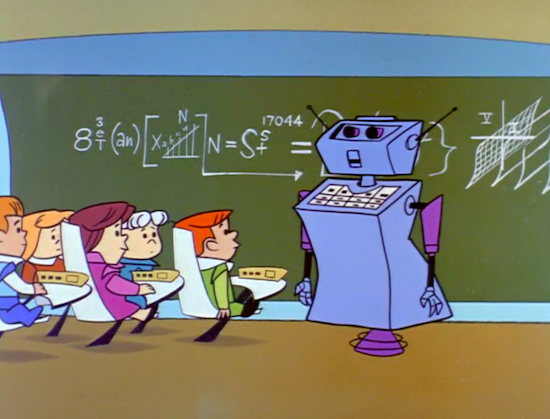
  Or another from 1963 cartoon called “The Jetsons.”

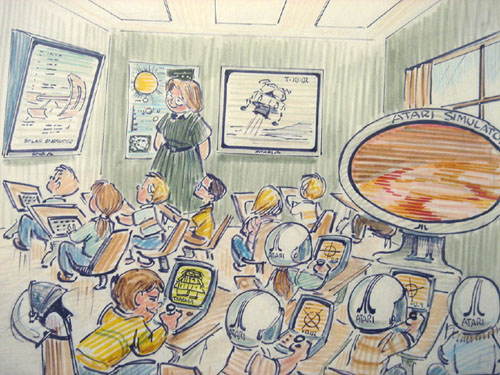
 Or this one in 1982 predicting that the future school will be monopolized by the then dominant company Atari.

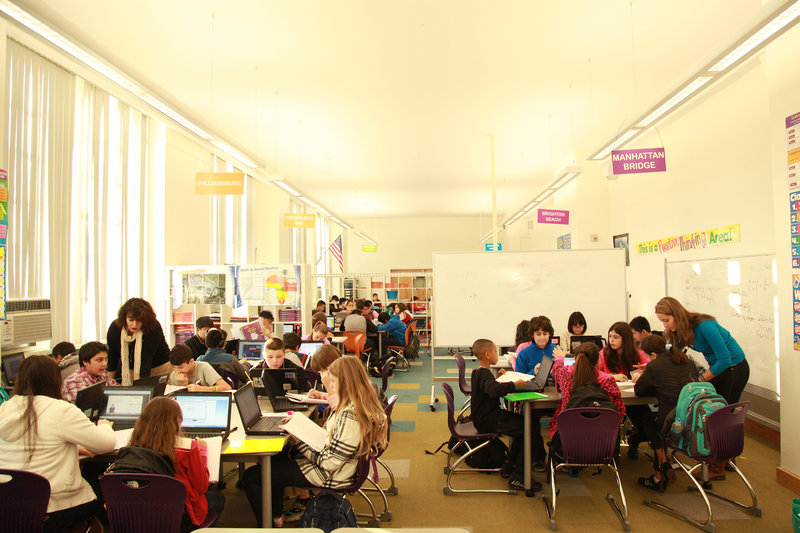
And then “Meet The Classroom of the Future” in 2015 at David Boody Intermediate School (IS 228) in New York City.

 Modeled after the School of One, an  innovative program that began in New York City a few years ago, sixth-to-eighth grade students work at their individual skill levels based on data collected from state and  school tests, diagnostic assessments, and past performance. From this data bank, software installed on laptops presents individual lessons tailored for each student to work through on the screen daily. These individual lessons become the day-to-day “playlist” for each student in various subjects. Teachers monitor, adapt, and enrich  lessons for each student.  The blended learning program at IS 228 touts “personalized instruction” for  over 800 students (2012) who apply to its varied magnet programs.

The journalist who described his visit to IS 228 began the article by saying: “The classroom of the future probably won’t be led by a robot with arms and legs, but it may be guided by a digital brain.” Describing a sixth grade math class at David Boody Intermediate School,  the classroom of the future  “may look like this: one room, about the size of a basketball court; more than 100 students, all plugged CONTINUE READING: Classrooms of the Future? | Larry Cuban on School Reform and Classroom Practice

Monday, November 23, 2020

Teacher Tom: The Skills That Will Make Tomorrow

Teacher Tom: The Skills That Will Make Tomorrow
The Skills That Will Make Tomorrow


"Let's play Tiger Babies."

"I want to be a polar bear baby."

"You can't because tiger babies would eat polar bear babies."

"That's not true! Polar bear babies eat tiger babies!"

"That's not true!"

I stepped closer because it was the sort of argument that could escalate, which is always the case when "truth" is at stake. And truth is always at stake when children are engaged in dramatic play.

Of course, by definition, dramatic play, like all fiction, is about the imagination, a place where "truth" is, at best, subjective. Indeed, the children were engaged in a counterfactual game, one in which they were asserting something that is objectively not true: that they, human children, were in fact animal babies. In that context, it seems absurd to be arguing CONTINUE READING: Teacher Tom: The Skills That Will Make Tomorrow

Thursday, November 12, 2020

NPE Action Congratulates Joe Biden and Kamala Harris - NPE Action

NPE Action Congratulates Joe Biden and Kamala Harris - NPE Action
NPE Action Congratulates Joe Biden and Kamala Harris
The Network for Public Education Action congratulates President-elect, Joe Biden, and Vice President-elect, Kamala Harris, on their historic victory. We look forward to working with them as they fulfill their promised commitment to our nation’s public schools.


The promises made during the campaign drew support from public education advocates across the nation. With those promises in mind, we hope they keep the following five K-12 priorities at the forefront as they govern.

Rebuild our nation’s public schools, which have battered by the pandemic, two decades of failed federal policy, and years of financial neglect.

With state revenues declining, the federal government will have to provide the needed funds to protect the health of students and staff to safely re-open schools. That means funding to enable educators to catch students up academically and meet the social and emotional needs of students, many of whom will be traumatized by their experiences during the pandemic. The financial support dedicated to these efforts must provide flexibility for schools to decide how that money is best spent. 

That is where we begin, but it should not be where we end. The new Administration must keep its promise to dramatically increase funding to eliminate the funding gaps between white and non-white districts and well-funded and poor districts. And it must meet its pledge to fully fund IDEA during the next decade.

Reject efforts to privatize public schools, whether those efforts be via vouchers or charter schools.

Neighborhood public schools governed by their communities are essential to the health of our democracy and the well-being of children. We need a public education champion in the Department of Education who rejects efforts to privatize public schools, whether those efforts be via vouchers or charter schools. Retreads like Arne Duncan and John King are not acceptable.

With so to be done to rebuild our public schools when COVID subsides, our country cannot afford to subsidize private school tuition. The Biden Administration must oppose any Congressional attempts to institute tax credit programs designed to subsidize private and religious school tuition.

The Administration must keep its promise to make charter schools subject to the same transparency, accountability, and equity policies as public schools. It must fulfill its campaign promise of no federal assistance to charters that operate for profit or are managed by for-profit entities. The new Secretary, we hope, will institute a moratorium on new grants from the federal Charter Schools Program at least until those promised reforms are enacted.  

End the era of high-stakes standardized testing–in both the immediate future and beyond. 

After two decades of school accountability measures based on high-stakes testing, it is clear that these policies are ineffective levers for improving schools. The use of test results to evaluate teachers and put sanctions on schools has correlated with a decline in student performance on NAEP tests, which are independent audits of student performance. The rapid and ill-advised implementation of the Common Core and its tests furthered that decline. This Administration must focus on opportunity gaps, not test score gaps. 

Promote diversity, desegregation (both among and within schools), and commit to eliminating institutional racism in school policy and practices.

It is imperative that the new Administration promote diversity, desegregation (both among and within schools) and commit to eliminating institutional racism in school policy and practices. Diverse public schools break down social barriers, improve academic performance, and increase tolerance. As promised, President Biden must reinstate the Department of Education guidance in legally pursuing desegregation strategies and provide the promised grants to districts to diversify their schools. The new Administration must continue the Obama Administration’s work in identifying and reducing racial disparities in school suspensions and expulsions.  

Promote educational practices that are child-centered, inquiry-based, intellectually challenging, culturally responsive, and respectful of all students’ innate capacities and potential to thrive.

The Secretary must reject the overemphasis on basic skills coupled with teach-to-the test pedagogy. As important as literacy and numeracy are, there must be space for the arts, civics, history, second languages, and science–all of which have been sorely neglected since NCLB. Children, especially our youngest learners, deserve active learning experiences that enhance their social-emotional, cognitive, and physical development. It is not enough to simply expand pre-school. The President must ensure that all pre-schools follow the research practices that benefit the whole child. 

We stand ready, willing and able to support and heal public education. Let us now join together for a better future for our nation’s public schools and the children they serve. 

With hope, Carol Burris 

Executive Director of the Network for Public Education Action. 

Donations to NPE Action (a 501(c)(4)) are not tax deductible, but they are needed to lobby and educate the public about the issues and candidates we support.
Please make a donation today.