Latest News and Comment from Education

Showing posts with label ALBERT SHANKER INSTITUTE. Show all posts

Tuesday, May 11, 2021

Shanker Blog: The Great Divergence In State Education Spending | National Education Policy Center

Shanker Blog: The Great Divergence In State Education Spending | National Education Policy Center
Shanker Blog: The Great Divergence In State Education Spending


When we talk about K-12 education spending inequality, we're usually talking about differences in resources between high- and low-poverty districts within states. But spending levels also vary between states, and that too matters for overall spending inequality in the U.S. How has this changed over the past 25 years? In other words, does K-12 spending vary more between states than it did a quarter century ago?

Let’s take a look at one simple way to visualize this trend. In the graph below, each blue circle is a state, and there one set of 51 states (including D.C.) for each year between 1993 and 2018 (the horizontal axis). On the vertical axis is total current spending in each state, predicted for a district in each state with a 10 percent Census child poverty rate (the graph is very similar regardless of poverty level). These spending levels also control for regional wage variation, district size, and population density, all of which affect the “value of the education dollar.” This allows for a better comparison between states (e.g., it costs more, on average, to hire teachers in Connecticut than in Alabama). The red plus signs within each year represent the unweighted average spending level across all states. These data are from the School Finance Indicators Database.

Our focus here is on the “spread” of states (blue circles) within each column (i.e., within each year). A larger spread, of course, represents greater variation (and, roughly speaking, more interstate inequality). The trend over time is a bit striking.
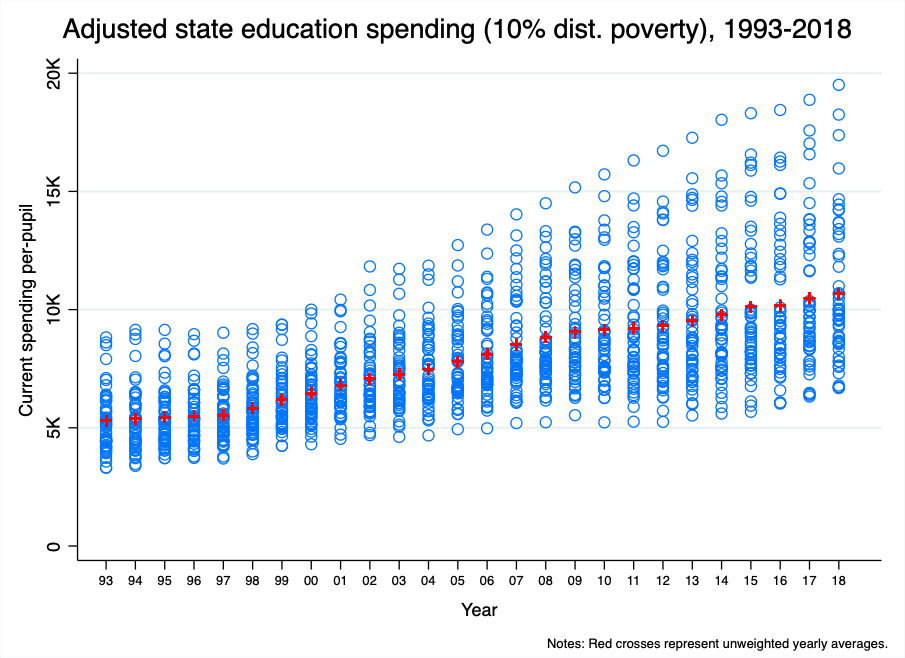
Throughout most of the 1990s and the first half of the 2000s, all but a small handful of states were clustered within the $3,000 to $8,000 range, a spread of about $5,000 per-pupil. Now, to be clear, this is a big span (particularly in these earlier years, when spending was lower), and it represents substantial interstate variation in spending. Even controlling for factors that affect costs, such as poverty and regional wage variation, some states spend a lot more than others.

Starting in the mid-2000s, however, a group of about 5-10 states start to break away from the CONTINUE READING: Shanker Blog: The Great Divergence In State Education Spending | National Education Policy Center

Monday, April 26, 2021

A Closer Look at Teacher Insurgency with Dr. Leo Casey - Trending in Education

A Closer Look at Teacher Insurgency with Dr. Leo Casey - Trending in Education
A Closer Look at Teacher Insurgency with Dr. Leo Casey


Mike welcomes Dr. Leo Casey, the Executive Director of the Albert Shanker Institute who has written a book called The Teacher Insurgency: A Strategic and Organizing Perspective. They begin with Leo’s upbringing by two New York City teachers, how he abandoned his dissertation to teach in Crown Heights, and how he began working with the union when his school shut down.

Leo then began to head the Albert Shanker Institute, a strategic think tank within the American Federation of Teachers which examines labor history, especially for teachers. Leo explains the origins of the 2018 and 2019 teacher strikes: theJanus case, post-2008 austerity, deprofessionalization, and movements like the Women’s March on Washington. Teachers saw both their compensation as well as their position in the classroom undergoing rapid decline.

The first teacher’s strikes were held in West Virginia, which had a history labor movement–both within education and beyond. From here the strikes spread, and ultimately the movement was successful in protecting teachers during COVID-19 times (in this context, MIke mentions Leo’s article on Black Lives Matter and the NBA.)  

Leo notes his concern about both the early retirement of teachers and the paucity in the pipeline for new teachers. Leo also expresses optimism for the Biden-Harris administration, notably President Biden’s support of unions. Leo finishes up by discussing the discourses around how teachers see themselves, and the need for true civics teaching.

If you like what you’re hearing, tell a friend and subscribe wherever you get your podcasts. Visit us at TrendinginEducation.com.


Trending in Education - Palmer Media - https://trendingineducation.com/ on @trendingined


Monday, February 8, 2021

Shanker Blog: Re-Imagining School Discipline: A Plea To Education Leaders | National Education Policy Center

Shanker Blog: Re-Imagining School Discipline: A Plea To Education Leaders | National Education Policy Center
Shanker Blog: Re-Imagining School Discipline: A Plea To Education Leaders


In many large urban school districts, there are more security employees than counselors. In the District of Columbia Public Schools (DCPS) system, for example there is one security guard for every 147 students, while the counselor-to-student ratio is 1:217. In addition, based on 2015-16 data, Groeger et al. (2018) found that Black students in DCPS were 15 times more likely to be suspended than their white peers (nationally, Black students were four times more likely to be suspended). In short, many students are not getting the emotional and mental support they need as they go through our schools. Instead, as exemplified by these staffing ratios, too many students are affected by punitive, militaristic methods of discipline, which may not only have negative consequences for the students who are disciplined, but for their peers as well (Perry and Morris 2014).  

A commonly used discipline approach, which used to be known as “zero tolerance,” was to discipline all students who didn’t follow the expected “rules.” Zero tolerance policies proliferated in public schools as a reform to help manage student behavior, using a “quick fix” method. Weaver and Swank (2020) define zero tolerance as “policies…[that] include exclusionary practices (i.e., office referral, suspension, expulsion) that involve the removal of the offender from the context of the incident and isolating the student from others involved and their school community.”

Unfortunately, as Skiba et al. (2011) show, these policies have created negative experiences for students and have disproportionately affected Black and brown students. Because they are CONTINUE READING: Shanker Blog: Re-Imagining School Discipline: A Plea To Education Leaders | National Education Policy Center

Tuesday, December 15, 2020

Paul Peterson: “No, Al Shanker Did Not Invent the Charter School” | Diane Ravitch's blog

Paul Peterson: “No, Al Shanker Did Not Invent the Charter School” | Diane Ravitch's blog
Paul Peterson: “No, Al Shanker Did Not Invent the Charter School”


This is a fascinating article written by Paul Peterson of Harvard University about the origin of the charter school idea.

Many people credit the idea to Al Shanker and Ray Budde of the University of Massachusetts, but Peterson sets them straight.

Peterson is the foremost proponent of school choice, charters and vouchers, in the academic world. He has trained many of the other prominent academics who support school choice, such as Jay Greene and Patrick Wolf, both at the University of Arkansas’ Department of Educational Reform (sic).

Peterson writes about the original proposals by Budde and Shanker but then notes that their ideas were fundamentally transformed by Minnesota reformers Ted Kolderie and Joe Nathan. Budde and Shanker wanted the charters to be district-controlled and friendly to unions.

Peterson writes:

Even though it is fashionable enough to credit Shanker for jump-starting the charter movement that even the Wall Street Journal is joining in, there is only a glimmer of truth to that urban legend. In actuality, Shanker did more to CONTINUE READING: Paul Peterson: “No, Al Shanker Did Not Invent the Charter School” | Diane Ravitch's blog 

Wednesday, December 9, 2020

DUANE CAMPBELL Choosing Democracy: Teachers’ Strikes -Conditions for Success

Choosing Democracy: Teachers’ Strikes -Conditions for Success
Teachers’ Strikes -Conditions for Success


Teachers’ Strikes -Conditions for Success


At the center of the recent teacher insurgency is one particular form of direct action—the strike. The strike occupies a distinctive place in the popular consciousness of teachers and working people more generally, primarily because of its extraordinary visibility, leverage, and power as a tactic but also because of the mythology and romance that is often associated with it. Despite their success in establishing public-sector unionism and collective bargaining (including teacher unionism) in the 1960s, teacher strikes became increasingly ineffective by the mid-1970s and 1980s and had dwindled to a mere handful by the start of the twenty-first century. The success of the teacher insurgency in reestablishing the strike as a powerful tactic is a welcome development, but to maintain and build on that success, we need to be acutely aware of the approaches that best situate teacher strikes to win.


Far too much of what passes for thinking about strikes in the United States— including teacher strikes—rests on a “field of dreams” theory: Call it, and they will come. We must go beyond such romantic notions, which are recipes for disaster, and consider the different conditions and approaches that have led teacher strikes to victory and defeat, to find a way forward that will continue the success of the strikes of the teacher insurgency.

Complete chapter at 

https://www.dissentmagazine.org/online_articles/the-teacher-strike-conditions-for-success


Leo Casey is Executive Director of the Albert Shanker Institute, a think talk affiliated with the American Federation of Teachers. Over the course of a forty-year career, he has been a rank and file public school teacher, the leader of the union at his school and a Vice President of New York City’s United Federation of Teachers.

This text was adapted from Leo Casey’s book The Teacher Insurgency: A Strategic and Organizing Perspectiveout now from Harvard Education Press. 

Choosing Democracy: Teachers’ Strikes -Conditions for Success