Latest News and Comment from Education

Monday, May 10, 2021

Welcome to the Charter Party – Tennessee Education Report

Welcome to the Charter Party – Tennessee Education Report
WELCOME TO THE CHARTER PARTY


On Friday afternoon before Mother’s Day weekend and just after the Tennessee General Assembly had adjourned, the Tennessee Department of Education announced 15 grants for charter school applicants – including grants for charter applications in several districts that do not currently authorize any charter schools – Rutherford County, Montgomery County, Millington Municipal, Fayette County, and Williamson County. The grants would allow applicants to plan and design their applications, and the applicants could ultimately bypass local school districts and receive charter authorization from Gov. Lee’s “Super Charter Commission.” The grants could also result in usurping the authority of elected school boards in Shelby, Hamilton, and Davidson counties.

Here’s more from a TNDOE press release:

Today, the Tennessee Department of Education announced that 15 applicants have been awarded subgrants under the Charter School Expansion Grant. These funds are intended to support sponsors throughout the planning, design, application, and potential launch of new charter schools in the state.

These subgrants will fund up to 8,800 new high-quality charter school seats that, subject to authorizer approval, will be available to students in five districts that CONTINUE READING: Welcome to the Charter Party – Tennessee Education Report

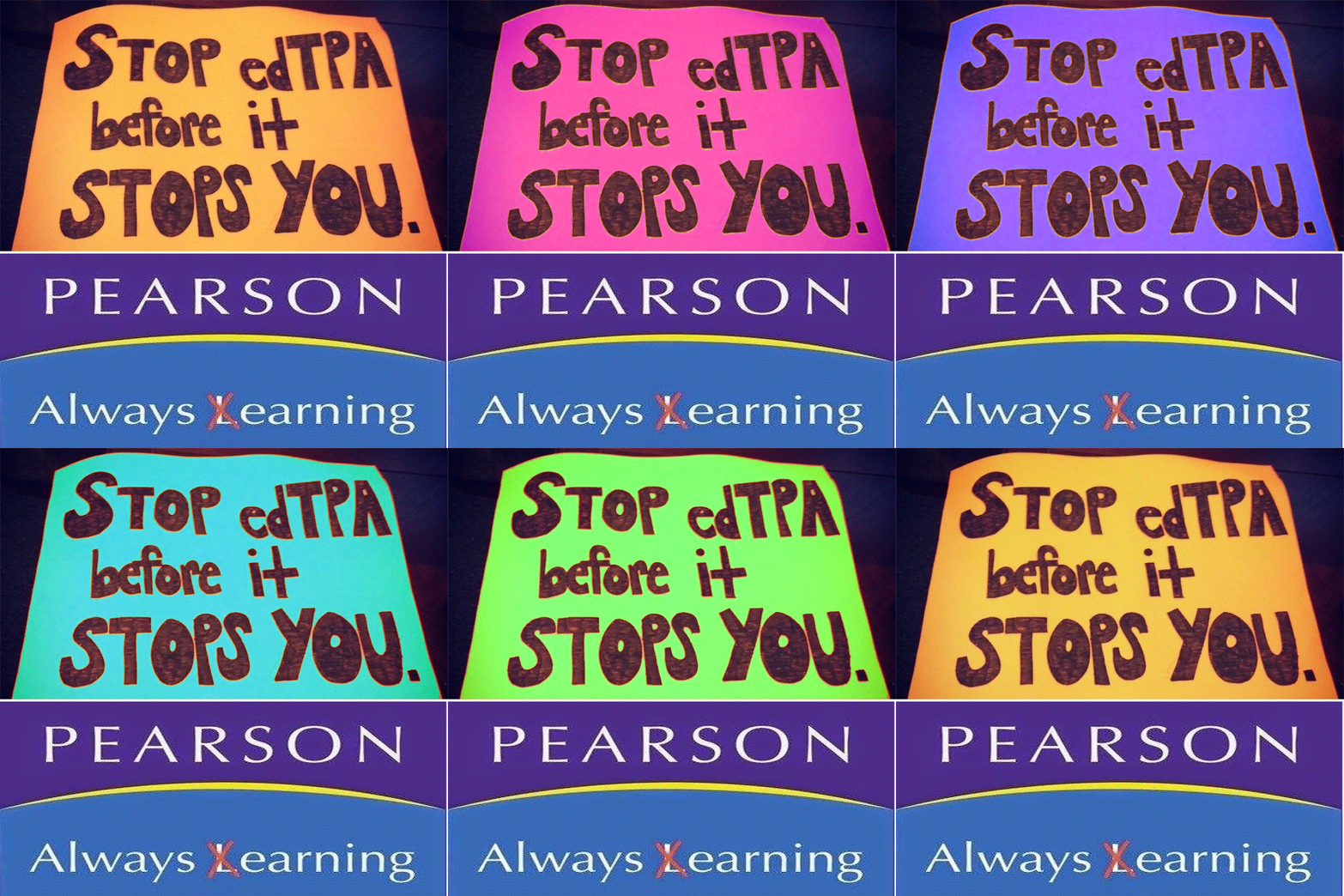
Support Illinois SB 808. Oppose edTPA and teacher prep privatization. Is the IEA really lobbying against this bill? – Fred Klonsky

Support Illinois SB 808. Oppose edTPA and teacher prep privatization. Is the IEA really lobbying against this bill? – Fred Klonsky
SUPPORT ILLINOIS SB 808. OPPOSE EDTPA AND TEACHER PREP PRIVATIZATION. IS THE IEA REALLY LOBBYING AGAINST THIS BILL?


Senate Bill 808 has passed the Illinois Senate and has gone on to the House where State Representative Will Guzzardi from my 39th district is the chief House sponsor.

It appears that SB 808, which would end the video taping and the violation of student privacy rights has the support of most legislators.

House Ed Committee members are Sue Scherer, Fred Crespo, Thomas Morrison*, Avery Bourne, Eva Dina Delgado, Anne Moeller, Delia Ramirez, Joe Sosnowski*.

*Republicans who have CONTINUE READING: Support Illinois SB 808. Oppose edTPA and teacher prep privatization. Is the IEA really lobbying against this bill? – Fred Klonsky

EPI: If You Appreciate Teachers, Pay Them More | Diane Ravitch's blog

EPI: If You Appreciate Teachers, Pay Them More | Diane Ravitch's blog
EPI: If You Appreciate Teachers, Pay Them More


The following post was published by the Economic Policy Institute, which is pro-worker, pro-union, and not funded by free-market billionaires.

As we near the end of #TeacherAppreciationWeek, it is worth remembering that one of the ways we can show our appreciation for teachers is to pay them a living salary.

EPI has been tracking trends in teacher pay for over a decade and a half. Our most recent report finds that, on average, teachers earn nearly 20 percent less than similar workers in other occupations. The size of the gap also varies across by state and can be as large as 32.7% less than other comparable college-educated workers.

Teachers typically have better benefits packages, but CONTINUE READING: 
EPI: If You Appreciate Teachers, Pay Them More | Diane Ravitch's blog

Schott Foundation Announces Diana Tate Vermeire as SVP of Strategy | Schott Foundation for Public Education

Schott Foundation Announces Diana Tate Vermeire as SVP of Strategy | Schott Foundation for Public Education
Schott Foundation Announces Diana Tate Vermeire as SVP of Strategy


The Schott Foundation for Public Education is pleased to announce that Diana Tate Vermeire is joining Schott as Senior Vice President of Strategy. In this position, Diana will help lead Schott’s organization-wide strategies to generate resources, strategically invest and develop partnerships to support national and local movement builders advancing racial equity and justice campaigns.

“We are very pleased to welcome Diana, who brings a rich background and experience in social justice, civil rights litigation as well as policy advocacy to the Schott team,” said John H. Jackson, Schott President and CEO. “Her passion to address systemic racism and her deep experience leading diversity, equity and inclusion efforts will be a tremendous asset to Schott, our partners, and the philanthropy sector.” 

Diana comes to Schott from serving as a University Diversity Officer and the Vice President for Inclusive Excellence at California State University-Sacramento. Throughout her career, Diana has worked to safeguard civil rights with a focus on racial justice, particularly as it relates to access to education, criminal justice reform, and removal of barriers to civic engagement.

Prior to joining Sacramento State, Diana engaged in civil rights policy and legislative advocacy as well as litigation supporting community advocates and organizers. She served as Director of the Racial Justice Initiative at the ACLU of Northern California, managing campaigns related to voting rights, K-12 education, the school-to-prison pipeline, and policing on campuses. While a staff attorney for the Lawyers’ Committee for Civil Rights of the San Francisco Bay Area, Diana supervised their Education Equity Project. 

Diana has a B.A in Sociology from the University of Southern California and a Juris Doctor from Georgetown University Law Center. She will begin working at Schott on June 3rd, 2021. 

Student Agency and Responsibilities when Learning to Write: More on the Failure of SETs – radical eyes for equity

Student Agency and Responsibilities when Learning to Write: More on the Failure of SETs – radical eyes for equity
Student Agency and Responsibilities when Learning to Write: More on the Failure of SETs


As anticipated and predicted, my student evaluations of teaching (SET) included what has become a classic contradiction; in my first-year writing seminar, I received strong praise for my feedback and diligent support for students revising their writing along side a student who proclaimed that I provided no valuable feedback.

I typically share this recurring evidence that SETs are deeply flawed on social media, and I also reached out to students in my upper-level writing/research course since the SETs from that course had a much higher number of negative comments than is typical (again including contradictory responses about my feedback and support for revising).

Several comments on social media—including those by former high school students from decades ago and current colleagues—helped me work past the frustration of anonymous and misguided comments. In short, I want to stress that while SET data lack validity, student comments may offer more insight CONTINUE READING: Student Agency and Responsibilities when Learning to Write: More on the Failure of SETs – radical eyes for equity

Russ on Reading: Defeating the Science of Reading Narrative, Part 2: Talking to a Parent

Russ on Reading: Defeating the Science of Reading Narrative, Part 2: Talking to a Parent
Defeating the Science of Reading Narrative, Part 2: Talking to a Parent


In my first post in this series on how teachers and literacy specialists can push back at the Science of Reading (SOR) narrative currently dominating reading instruction conversation and legislation, I leaned on the work of Peter Johnston and Deborah Scanlon in their report An Examination of Dyslexia Research and Instruction to argue that dyslexia is not a useful term, and that the SOR narrative, with its focus on word level instruction, casts literacy learning in too narrow a light. In the second post, I posited that a focus on getting to know the individual child as a learner immediately makes clear that each reader is unique, and that each reader's needs must be viewed from a broader lens than is suggested by SOR. In this post I would like to suggest a way of communicating with a concerned parent, who has read and bought into the SOR narrative, about CONTINUE READING: Russ on Reading: Defeating the Science of Reading Narrative, Part 2: Talking to a Parent

Teacher Tom: Making Irrevocable Decisions with Insufficient Information

Teacher Tom: Making Irrevocable Decisions with Insufficient Information
Making Irrevocable Decisions with Insufficient Information


As a 24-year-old married man, I was certain that I didn't want to be a parent. My wife felt the same way. We had lives to live, after all. We were the kind of people with places to go, things to do, adventures to have, and none of them involved being parents. I once found myself being harangued (or so it felt) by a colleague, himself a new father, "Until you have children, you're just scratching around on the surface of life. I want to go deeper." And I replied, "You're just digging the same hole everyone else is digging. I'd rather at least try digging somewhere else."

He wasn't the last one to suggest that I would be missing out were I not to have children, my mother being prominent among them. I pretended to listen, but with my mind made up against their evangelism. They were all so earnest, so sincere, so sure of their decision, but, I reasoned, they had no other choice but to be that way: they had made an irrevocable decision and to behave otherwise would be a kind of cruelty to these new lives to which they were now committed. Of course, they had to adopt the position that parenthood was a transformative experience. What repelled me in particular, however, was their condescension that no one could fully appreciate it until they were likewise CONTINUE READING: 
Teacher Tom: Making Irrevocable Decisions with Insufficient Information

Leslie T. Fenwick: All Students, Especially The Most Vulnerable, Need Certified, Well-Prepared Teachers | Diane Ravitch's blog

Leslie T. Fenwick: All Students, Especially The Most Vulnerable, Need Certified, Well-Prepared Teachers | Diane Ravitch's blog
Leslie T. Fenwick: All Students, Especially The Most Vulnerable, Need Certified, Well-Prepared Teachers


Leslie T. Fenwick is Dean emerita of the Howard University School of Education. She is an eloquent critic of efforts to deprofessionalize teaching. She believes that teachers need more, not less, preparation for the classroom. This post appeared in Politico.

The Covid-19 pandemic has exacerbated harmful educational inequalities in the preK-12 public education system. The nation’s poorest students, Black and Latino students, and our disabled students have been the most negatively impacted by school closings necessitated by the pandemic. Black students in high poverty schools have been especially hard hit because of the racialized, historic and ongoing disinvestment in the education of Black children and youth.

One of the most obvious — and dangerous — ways this inequality shows up is by channeling a proportionally larger share of less qualified or alternatively credentialed teachers to schools with higher percentages of Black, Latino and disabled students. Black and Latino students are more likely than their white peers to be taught by CONTINUE READING: Leslie T. Fenwick: All Students, Especially The Most Vulnerable, Need Certified, Well-Prepared Teachers | Diane Ravitch's blog

TODAY'S Education Research Report: School reopening alongside high community spread, Exposure to Lead of Some Affects Everyone in the Classroom, The Long-Term Effects of Universal Preschool

Education Research Report
TODAY'S Education Research Report


Exposure to Lead of Some Affects Everyone in the Classroom

Children exposed to pollutants like lead are more disruptive and have lower achievement. However, little is known about whether lead-exposed children affect the long-run outcomes of their peers. 

The Role of Universities in Attracting Immigrant Entrepreneurs

Immigrant founders of venture capital-backed companies have been critical to the entrepreneurial ecosystem. This study documents the channels through which immigrant founders find their way to the United States and how those channels have changed over time. Immigrants have been an important source of founders for venture capital-backed startups accounting for roughly 20% of all founders over the past 30 years. 

School reopenings alongside high community spread and at near capacity

 This paper examines the effect of fall 2020 school reopenings in Texas on county-level COVID-19 cases and fatalities. Previous evidence suggests that schools can be reopened safely if community spread is low and public health guidelines are followed. However, in Texas, reopenings often occurred alongside high community spread and at near capacity, making it difficult to meet social distancing recommendations. Using event-study models and hand-collected instruction modality and start dates for all school districts, we find robust

The Long-Term Effects of Universal Preschool

This study uses admissions lotteries to estimate the effects of large-scale public preschool in Boston on college-going, college preparation, standardized test scores, and behavioral outcomes. 

Virtual Schools in the U.S. 2021

Virtual Schools in the U.S. 2021 provides vital scholarly analyses of virtual schools at a time of increased enthusiasm for moving schooling online, nationally and internationally. The report examines the characteristics and performance of full-time, publicly funded K-12 virtual schools. It also reviews the relevant available research related to virtual school practices, provides an overview of recent state legislative efforts to craft virtual school policy, and offers policy recommendations based on the available evidence.


Bill and Melinda Will Divorce, but the Gates Brand of Venture Philanthropy Will Continue On | janresseger

Bill and Melinda Will Divorce, but the Gates Brand of Venture Philanthropy Will Continue On | janresseger
Bill and Melinda Will Divorce, but the Gates Brand of Venture Philanthropy Will Continue On


A month ago, this blog suggested that hubris is at the heart of today’s billionaire philanthropy but noted that Bill and Melinda Gates have so much power that, despite the tragic blindness of their privilege, there will be no tragic fall and no consequences. Now, with Bill and Melinda announcing their divorce, we continue to learn even more about how privilege in an unequal America insulates the super-rich who have the power to drive the public policy that shapes the institutions on which we all depend

The Washington Post‘s Valerie Strauss seized the occasion of the Gates’ pending divorce as an opportunity to review the ways Bill and Melinda have used their influence and their money to shape public education policy at the federal level and across the states: “The Bill & Melinda Gates Foundation has spent billions of dollars on numerous education projects—such as creating small high schools, writing and implementing the Common Core State Standards, evaluating teachers by standardized test scores—and the couple has had enormous influence on what happened in classrooms across the country. Their philanthropy, especially in the school reform area, has been at the center of a national debate about whether it serves democracy when wealthy people can use their own money to drive public policy and fund their pet education projects. The foundation’s financial backing of some of the controversial priorities of the Obama administration’s Education Department put the couple at the center of this national conversation. Critics have said that many of the foundation’s key education CONTINUE READING: Bill and Melinda Will Divorce, but the Gates Brand of Venture Philanthropy Will Continue On | janresseger

Life in Classrooms and Philip Jackson | Larry Cuban on School Reform and Classroom Practice

Life in Classrooms and Philip Jackson | Larry Cuban on School Reform and Classroom Practice
Life in Classrooms and Philip Jackson


In searching for my next project, I surrounded myself with books on teaching, teachers, and classroom life. Many of these books I had read more than once and each time in the re-reading, I learned something new. I re-learned not because I was dense the first time I read the book but simply because I had accumulated experiences since the first time I picked up the book. And that is what happened in re-reading Philip Jackson’s Life in Classrooms (1968). Rethinking my experiences over decades in classrooms pushed me again to learn anew as I read those gracefully written chapters–beginning with the “Daily Grind”–into further reflection.

Like myself, Stanford University professor, Elliot Eisner, former student and colleague of Jackson at the University of Chicago said about that initial chapter: “Who can forget ‘the daily grind’? Who can forget the importance of students learning how to delay gratification? Who can forget the aroma, or should I say odor, of a place that smells of stale milk and that leaves chalk dust on your sleeves?”* I certainly have not.

In just 177 pages of text, Jackson took what he had seen in a handful of elementary schools and blazed a trail for subsequent generations of school and CONTINUE READING: Life in Classrooms and Philip Jackson | Larry Cuban on School Reform and Classroom Practice

Education Matters: The district's actions, speak louder than their words... and a pin.

Education Matters: The district's actions, speak louder than their words... and a pin.
The district's actions, speak louder than their words... and a pin


During teacher appreciation week, DCPS had their faculty meet and watch a video where Greene thanked them for their hard work. The schools, I imagine at the behest of the district, then gave newer teachers blankets and senior teachers pins with years of service broken into five-year increments.

Some of my colleagues, people I respect and appreciate, were quite taken with the gesture. I do not want to diminish how they felt, but I think teachers are worth more than this tiny gesture, and I think it is safe to say more than a few teachers were insulted.   

The district has had numerous chances to show they appreciate teachers all year long, and they passed at every opportunity.

If the district truly appreciated teachers, you would have thought they would have wanted to keep them safe, but all year long, teachers risked their health and worse, because of the woeful contact tracing and the lack of social distancing, which never occurred.

When the state passed its terrible teacher raise bill, which will actually see many veteran teachers lose CONTINUE READING: Education Matters: The district's actions, speak louder than their words... and a pin.

A state legislator is howling indoctrination because my 7th graders are learning the ocean is polluted - Notes from the ChalkboardNotes from the Chalkboard

A state legislator is howling indoctrination because my 7th graders are learning the ocean is polluted - Notes from the ChalkboardNotes from the Chalkboard
A state legislator is howling indoctrination because my 7th graders are learning the ocean is polluted


A member of the North Carolina House of Representatives held up my teaching as an example of harmful indoctrination of children this week as state legislators met to discuss a new bill which would require teachers to post their lesson plans online for public review.

The K-12 Education Committee approved HB 755, also known as “An Act to Ensure Academic Transparency.” It passed the House by a vote of 66-50 and now moves on to the Senate.  

The legislation mandates that all lesson plans, including information about any supporting instructional materials as well as procedures for how an in-person review of lesson materials may be requested, be “prominently displayed” on school websites.  

Iredell County Republican Representative Jeffrey McNeely gave the bill two enthusiastic thumbs up, pointing to my teaching as an example of the hidden indoctrination that will be exposed if the bill is passed into law:

We tend to come to teach our kids with everything with a twist to it.  And I think transparency is one of the most important things we can do, and maybe what we’ve learned from this pandemic, through virtual, some of the parents actually seeing what their children are taught and how they’re taught. 

I saw in the Charlotte Observer the other week a English teacher was complaining because he had to do remote learning and in-person learning at the same time and it caused him to shorten his English class on environmental pollution. 

What you think about that? 

So I think this putting out to me this will help the parents going to the next grade be able to look and see what that teacher taught the year before, and hopefully we’re just gonna teach the kids, we’re not gonna try to indoctrinate ’em or teach ’em in a certain way to make ’em believe something other than the facts, the knowledge, the ability to write the ability to read.

McNeely is referring to an editorial I published in the Charlotte Observer last week CONTINUE READING: A state legislator is howling indoctrination because my 7th graders are learning the ocean is polluted - Notes from the ChalkboardNotes from the Chalkboard

CURMUDGUCATION: The Anti-Education Economy

CURMUDGUCATION: The Anti-Education Economy
The Anti-Education Economy


A recent article in the Chronicle of Higher Education asks "Our blind faith in the transformative power of higher ed is slipping. What now?" 

The article looks at the long-time US love affair with higher education, an affair that is one part long-standing respect (of some folks) for more and more education and one part the relentless drumbeat of articles pointing out that college graduates make more money. The favored government fantasy is that more education will result in a better economy, the dream of Smarten Up economics that seems as potent for some folks as the dream of a Trickle Down economy is for others. 

Get an education, get a better career, make more money, lift the economy of the whole nation. Education opens doors, lift boats, leaps tall buildings in a single well-funded bound. 

But for decades, that push has existed in tension with another push--the push to hire people with no more education than is necessary for the least amount of money we can get away with. "It's great that people are getting all this education and training," says business. "But we are working hard to avoid paying for it."

We've seen a steady push to break jobs into small. cheap pieces. Hiring a chef is expensive; let's break food production into simple bits so that we can just hire minimum-wage workers to drop the fry basket and wrap the burger. Craftsmen get a great deal of training and develop a lot of skill and are therefor expensive; let's break the production of this product into assembly-line bits, so that we CONTINUE READING: CURMUDGUCATION: The Anti-Education Economy

School spending matters - American Economic Association

American Economic Association
School spending matters


Plunging home prices and massive job losses are often mentioned in discussions of the Great Recession, but the effects of the recession stretched far beyond the housing and job markets.

Public schools were hit hard as well.

paper in the American Economic Journal: Economic Policy examines the impacts of state spending cuts on the educational outcomes for students in K–12 public schools. Authors C. Kirabo JacksonCora Wigger, and Heyu Xiong found lasting ill-effects on test scores and college enrollment, particularly in states where schools rely more heavily on state aid.  


Figure 4 from Jackson et al. (2021)


Figure 4 from their paper shows the effect that the recession had on per-pupil K–12 spending in thousands (2015 dollars), test scores (NAEP), and college-going rates by states’ reliance on state revenue. The lines with the diamond markers represent the per-year effect on schools that had an above-average reliance on state revenue. The dashed lines are the linear fit that shows the smoothed pattern pre- and post-recession, and the shaded areas are 95 percent confidence intervals of the individual year effects.

Prior to the Great Recession, outcomes in public schools that relied more heavily on state revenue sources were on a trajectory similar to schools in states that were less reliant. But that changed when the economy nose-dived in 2007. Reductions in per-pupil spending in those states most reliant on state aid during the Great Recession (top left panel) coincided with declines in NAEP scores (top right) and college-going rates (lower left). 

The bottom right panel shows the impact on test score gaps by district-level poverty in states where public schools were heavily reliant on state revenues. While there was little evidence of a pre-existing trend prior to 2007, the slope turned downward in the years following the recession. 

The findings highlight the consequences of shifting the responsibility for funding public education toward state budgets and how sustained spending cuts can impact educational equity.

“Do School Spending Cuts Matter? Evidence from The Great Recession” appears in the May 2021 issue of the American Economic Journal: Economic Policy

NewBlackMan (in Exile) TODAY #BLM #BLACKLIVESMATTER

 NewBlackMan (in Exile)


NewBlackMan (in Exile) TODAY


Big Education Ape: THIS WEEK WITH NEWBLACKMAN (IN EXILE) -

http://bigeducationape.blogspot.com/2021/05/this-week-with-newblackman-in-exile-blm_8.html


'Chauvin Is Guilty and Our Work Is Still Cut Out for Us' by Ben Jealous
Chauvin Is Guilty and Our Work Is Still Cut Out for Us by Ben Jealous | @BenJealous | special to NewBlackMan (in Exile) Though time has passed since Derek Chauvin’s conviction in the murder of George Floyd. But the images from that moment are seared in our memories forever: the murderer, led away in handcuffs. The Floyd family, Philonise Floyd speaking through tears, at the microphones after the
Black Americans And The Racist Architecture Of Homeownership
'Owning a home is a part of the American dream. It's also the key to building intergenerational wealth. But Black Americans continue to face discrimination in housing, including through higher costs.'-- Code Switch

 NewBlackMan (in Exile)