Latest News and Comment from Education

Showing posts with label SCHOOL REFORM AND CLASSROOM PRACTICE. Show all posts

Tuesday, May 25, 2021

There’s No Erasing the Chalkboard (Kim Kankiewicz) | Larry Cuban on School Reform and Classroom Practice

There’s No Erasing the Chalkboard (Kim Kankiewicz) | Larry Cuban on School Reform and Classroom Practice
There’s No Erasing the Chalkboard (Kim Kankiewicz)


There are critics who maintain that teaching has hardly changed over the past century. Such critics know little of the history of schooling, particularly how teachers have taught. Teaching requires tools just as learning does. As long as there have been age-graded schools with one teacher and and a group of students distributed through a building, teachers and students needs tools, i.e., technologies, to instruct and learn. Enter the slate blackboard in the early 19th century. Classroom technologies from the slate blackboard to present-day student-held computer devices have altered incrementally, not fundamentally, how teachers teach. This guest post documents the changes that have occurred in a historic and basic classroom tool, one that long ago went by the name: blackboardAnd do not forget chalk and erasers accompanying this ubiquitous technology.

Kim Kankiewicz is a Seattle-based writer who has published articles in Pacific StandardSalonThe Washington Post, and McSweeney’s. This piece appeared in The Atlantic, October 13, 2016.

In 2015, the construction crew renovating an Oklahoma high school uncovered an unusual time capsule. Beneath newer wall coverings, the workers discovered slate blackboards marked with schoolwork and colorful chalk drawings from 1917. Multiplication problems appeared beside a treble staff denoting an A-major CONTINUE READING: There’s No Erasing the Chalkboard (Kim Kankiewicz) | Larry Cuban on School Reform and Classroom Practice

Sunday, May 23, 2021

Why Our Many Big Plans to Raise Educational Standards Will Never Work (Jay Mathews) | Larry Cuban on School Reform and Classroom Practice

Why Our Many Big Plans to Raise Educational Standards Will Never Work (Jay Mathews) | Larry Cuban on School Reform and Classroom Practice
Why Our Many Big Plans to Raise Educational Standards Will Never Work (Jay Mathews)


Jay Mathews is a veteran journalist for The Washington Post who has covered education for more than three decades. He has written books on Jaime Escalante, a Los Angeles high school math teacher and KIPP charter schools. This article appeared in the Post April 17, 2021.

As one of our most celebrated education reforms — the Common Core State Standards — sinks into oblivion, will we finally give up on big-time top-down plans to save our schools?

I bet we won’t. We can’t help ourselves, even with convincing proof from an intriguing new book that any further outsized attempts to raise achievement with better standards will fail, as all the others have.You can feel the exasperation in every word as Tom Loveless, a former senior fellow at the Brookings Institution, sums up his main conclusion in “Between the State and the Schoolhouse: Understanding the Failure of Common Core.”

“The idea of standards-based reform should be abandoned. It doesn’t work,” he wrote.

Those of us who put our faith in bottom-up reforms, with individual teachers raising standards for each child, can find some hope here. “It could be that CONTINUE READING: Why Our Many Big Plans to Raise Educational Standards Will Never Work (Jay Mathews) | Larry Cuban on School Reform and Classroom Practice

Tuesday, May 18, 2021

The Complexity of Daily Principal Decision-making | Larry Cuban on School Reform and Classroom Practice

The Complexity of Daily Principal Decision-making | Larry Cuban on School Reform and Classroom Practice
The Complexity of Daily Principal Decision-making


Just as the classroom teacher is in charge of the students but wholly dependent upon them to respond, interact, and learn, so too are principals dependent upon their teachers to adhere to district policies, create classrooms where students absorb lessons, and collaborate with peers and school staff. After all there is only one principal (maybe an assistant if enrollment is large enough) and there are, depending on school size anywhere from 10 to 30 teachers in elementary schools and up to 100 in larger secondary ones.The principal is a manager, the staff’s instructional leader, and politician in dealing with student rancor, parental disaffection, teacher squabbles, and district office directives.

An earlier post dealt with teacher decision-to make the simple–actually not so simple–point that teachers engage in daily decision-making before, during, and after a lesson. That engagement is a complex process that spans monitoring the classroom teaching of content and skills, managing behaviors of individual and group of students, and frequent improvising as the unexpected pops up–inevitably, I might add–during lessons.

Although the content of lessons in science or math, or English, or French or U.S. history differ, they have in common a massive CONTINUE READING: The Complexity of Daily Principal Decision-making | Larry Cuban on School Reform and Classroom Practice

Saturday, May 15, 2021

Let’s Review How Bill and Melinda Gates Spent Billions of Dollars To Change Public Education (Valerie Strauss) | Larry Cuban on School Reform and Classroom Practice

Let’s Review How Bill and Melinda Gates Spent Billions of Dollars To Change Public Education (Valerie Strauss) | Larry Cuban on School Reform and Classroom Practice
Let’s Review How Bill and Melinda Gates Spent Billions of Dollars To Change Public Education (Valerie Strauss)


Valerie Strauss is a reporter and op-ed writer for the Washington Post. This opinion piece appeared on May 6, 2021.

Now that the philanthropic Bill and Melinda Gates have announced they are divorcing after 27 years of marriage, let’s look at the controversial investments they made together to reform K-12 public education — and how well those worked out.

Together, the two have been among the most generous philanthropists on the planet, spending more over the past few decades on global health than many countries do and more on U.S. education reform than any of the other wealthy Americans who have tried to impact K-12 education with their personal fortunes.The Bill & Melinda Gates Foundation has spent billions of dollars on numerous education projections — such as creating small high schools, writing and implementing the Common Core State Standards, evaluating teachers by standardized test scores — and the couple has had enormous influence on what happened in classrooms across the country. Their philanthropy, especially in the school reform area, has been at the center of a national debate about whether it serves democracy when wealthy people can use their own money to drive public policy and fund their pet education projects. The foundation’s financial backing of some controversial priorities of the Obama administration’s Education Department put the couple at the center of this national conversation.

Critics have said that many of the foundation’s key education projects have harmed public schools because they were unworkable from the start and CONTINUE READING: Let’s Review How Bill and Melinda Gates Spent Billions of Dollars To Change Public Education (Valerie Strauss) | Larry Cuban on School Reform and Classroom Practice

Monday, May 10, 2021

Life in Classrooms and Philip Jackson | Larry Cuban on School Reform and Classroom Practice

Life in Classrooms and Philip Jackson | Larry Cuban on School Reform and Classroom Practice
Life in Classrooms and Philip Jackson


In searching for my next project, I surrounded myself with books on teaching, teachers, and classroom life. Many of these books I had read more than once and each time in the re-reading, I learned something new. I re-learned not because I was dense the first time I read the book but simply because I had accumulated experiences since the first time I picked up the book. And that is what happened in re-reading Philip Jackson’s Life in Classrooms (1968). Rethinking my experiences over decades in classrooms pushed me again to learn anew as I read those gracefully written chapters–beginning with the “Daily Grind”–into further reflection.

Like myself, Stanford University professor, Elliot Eisner, former student and colleague of Jackson at the University of Chicago said about that initial chapter: “Who can forget ‘the daily grind’? Who can forget the importance of students learning how to delay gratification? Who can forget the aroma, or should I say odor, of a place that smells of stale milk and that leaves chalk dust on your sleeves?”* I certainly have not.

In just 177 pages of text, Jackson took what he had seen in a handful of elementary schools and blazed a trail for subsequent generations of school and CONTINUE READING: Life in Classrooms and Philip Jackson | Larry Cuban on School Reform and Classroom Practice

Friday, May 7, 2021

How Professors Teach | Larry Cuban on School Reform and Classroom Practice
How Professors Teach | Larry Cuban on School Reform and Classroom Practice
How Professors Teach


Jonathan Zimmerman’s Amateur Hour (a great title) documents how college professors have taught over the past two centuries. It is a worthwhile read for those who have experienced the full range of university teaching from packed lecture halls to wood-paneled seminar rooms. And it got me thinking of my experiences in college and university classrooms over many years. I have forgotten most of my professors’s names as I collected degrees except for a handful who have had a large influence upon me as both a student and human being.

Since I was a high school history teacher for many years before becoming a professor, I prized teaching before scholarship. Sure both are important, but my previous experiences as a graduate student made me very aware of the startling variation in university teaching as I stumbled through a Masters degree and CONTINUE READING: How Professors Teach | Larry Cuban on School Reform and Classroom Practice

Tuesday, May 4, 2021

The Classroom as a “Gritty” Place for Engineers and Plumbers (Matthew Evans) | Larry Cuban on School Reform and Classroom Practice

The Classroom as a “Gritty” Place for Engineers and Plumbers (Matthew Evans) | Larry Cuban on School Reform and Classroom Practice
The Classroom as a “Gritty” Place for Engineers and Plumbers (Matthew Evans)


Matthews Evans is headteacher of a Gloucestershire secondary school in southwest England and author of Leaders with Substance: An Antidote to Leadership. The issue of researchers–engineers who study and design projects to solve schooling problems–having a difficult time in getting practitioners–plumbers who get in and around pipes and drains–to put their findings into daily practice has been a perennial issue in the U.S. Many U.S. policymakers call it an “implementation” problem. According to Evans it is more complicated than just “implementation” as he describes the divide between teachers and researchers in the United Kingdom.

This post comes from his blog, theeducontrarian. It appeared April 25, 2021. I have lightly edited Evans’ post For the full text and references please go to the above link.

I’m going to go out on a limb here and say that cognitive science has, and will continue to have, a fairly limited impact on educational standards.

It is not that I reject the findings of this branch of psychology (although many of the studies, we are beginning to realise, may fail to replicate), or that I think we should turn our backs on the discipline. On the contrary: we should glean all we can from this, and other disciplines, which offer something to our understanding of education. My concern is that the implementation of cognitive science – or indeed any research in social psychology – is problematic.

There are many reasons why the application of knowledge from research, or theory, to the classroom is difficult. I will explore just one of these reasons here, which is the problem of the particular.

Access to water

The economist Esther Deflo tells the story of the effort to bring clean water to homes in Tangier in 2007. The firm responsible for this effort spent considerable amounts of money building a large network of pipes and installing taps and CONTINUE READING: The Classroom as a “Gritty” Place for Engineers and Plumbers (Matthew Evans) | Larry Cuban on School Reform and Classroom Practice

Saturday, May 1, 2021

Nested Organizations: Public Schooling Is Complex | Larry Cuban on School Reform and Classroom Practice

Nested Organizations: Public Schooling Is Complex | Larry Cuban on School Reform and Classroom Practice
Nested Organizations: Public Schooling Is Complex


In the previous post on the complexity of teacher decision-making, I mentioned that not every teacher or parent knows that classrooms are embedded in complex organizations that affect what teachers do daily. This post tries to get at that organizational and political (yes, political) complexity that colors both how and what teachers teach and their relationships with students.

Many readers are familiar with wooden dolls made in Russia that fit one atop another. As one loosens the largest doll, the next one that appear get smaller and ditto for each one taken out. These dolls are nested in another.

The system of schooling in the U.S. is also nested. The largest organization–“doll” to stretch the analogy– that runs the nation’s schools,however, is not the federal government as it is in those nations that have centralized education as a national responsibility such as Japan, France, China, and Russia.In the U.S., it is each of the 50 states.

Because the U.S. has a decentralized system where the federal responsibility for CONTINUE READING: Nested Organizations: Public Schooling Is Complex | Larry Cuban on School Reform and Classroom Practice

Wednesday, April 28, 2021

The Complexity of Teacher Decision-making | Larry Cuban on School Reform and Classroom Practice

The Complexity of Teacher Decision-making | Larry Cuban on School Reform and Classroom Practice
The Complexity of Teacher Decision-making


In the previous two posts (see here and here), I have argued that parents as well as grandparents, uncles and aunts who became home-bound teachers during pandemic-driven closures of schools have come to both appreciate and understand teaching as never before.

Sitting with a 10 or 14 year-old at the kitchen table figuring out how to answer the math word problems or parsing teacher-assigned paragraphs in a U.S. history text were generally unfamiliar tasks that stay-at-home parents had to do regularly when schools shut down. Parents pleading with or ordering their children to complete their homework before the home-bound children sat down at the screen to begin the next session of remote instruction is not what many felt they had to do once their children were of age to traipse off to the schoolhouse. But now they do. And many, if not most, parents see teaching hardly like what they had recalled from their own years in school but far more difficult than they had anticipated.

At-home teaching with one or more kids for maybe two hours a day parents have discovered, is hard work involving many decisions. Yet parents do not face, for example,a third grade classroom filled with 30 eight year-olds for six hours a day for thirty-six weeks.

But most parents, grand-parents, uncles, and aunts are not teachers and their only memories of being a student were when they attended school decades CONTINUE READING: The Complexity of Teacher Decision-making | Larry Cuban on School Reform and Classroom Practice


Sunday, April 25, 2021

During Pandemic, More Parents Come To Appreciate Teachers and Understand Teaching | Larry Cuban on School Reform and Classroom Practice

During Pandemic, More Parents Come To Appreciate Teachers and Understand Teaching | Larry Cuban on School Reform and Classroom Practice
During Pandemic, More Parents Come To Appreciate Teachers and Understand Teaching


Teacher Appreciation Week begins May 3rd. With school closures over a year ago and the onslaught of remote instruction, many parents have come to appreciate not only what teachers do in classrooms (and now on screens) than ever before (see here) but also how complex the act of teaching is.

Celebrities sport T-shirts asking that teacher should have higher salaries. Actor Ron Farrell who has three children being home schooled was seen in his neighborhood picking up garbage.

Celebrity parents calling for higher salaries only mirrors now more than ever that Moms and Dads sitting in kitchens and bedrooms hovering over their children have a deeper understanding (and appreciation) about teaching being not only a complex activity but also a relationship built on trust and respect.

That appreciation and understanding were too often unconsidered by many CONTINUE READING: During Pandemic, More Parents Come To Appreciate Teachers and Understand Teaching | Larry Cuban on School Reform and Classroom Practice

Friday, April 23, 2021

Cartoons about Life during Covid | Larry Cuban on School Reform and Classroom Practice

Cartoons about Life during Covid | Larry Cuban on School Reform and Classroom Practice
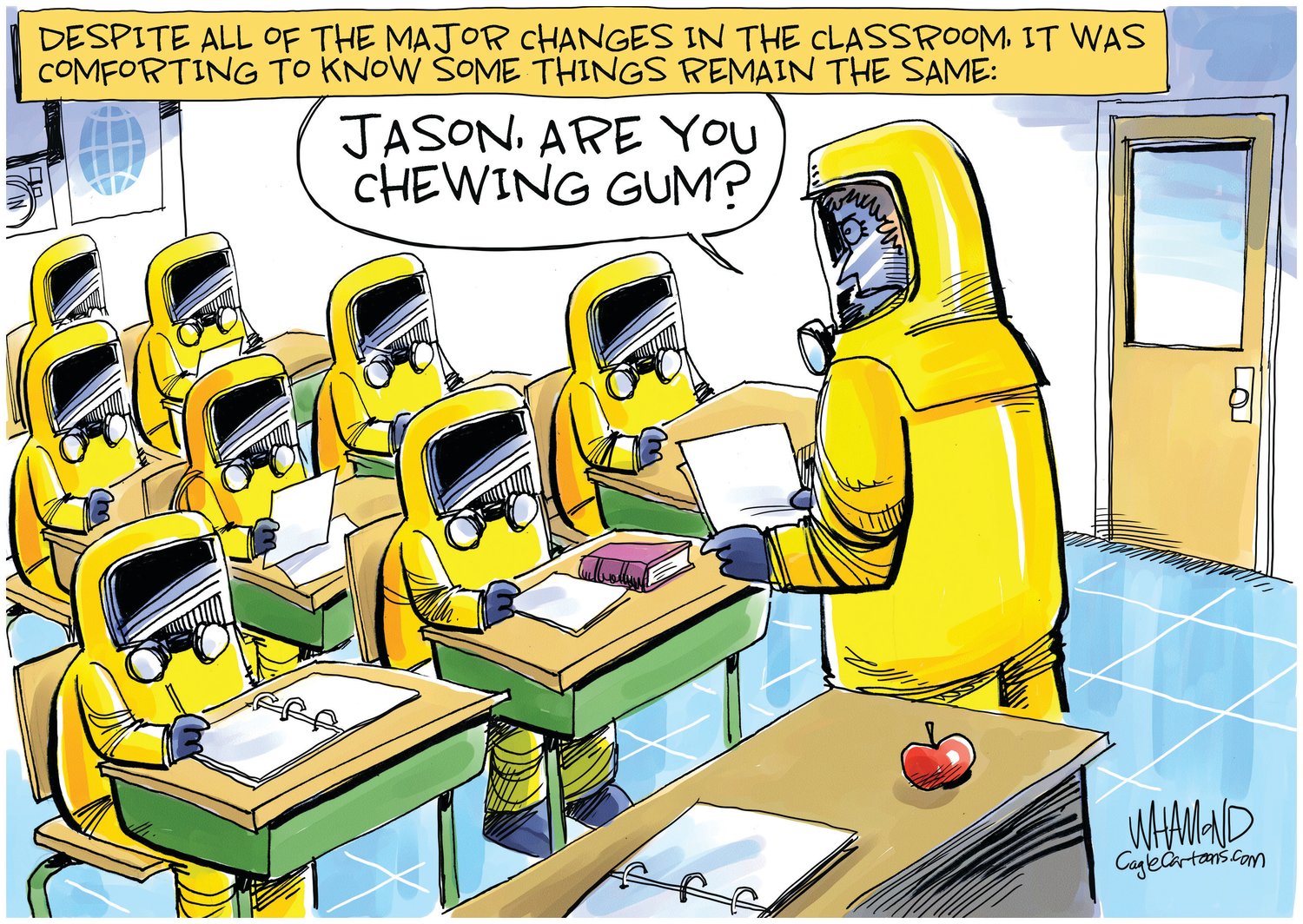
Cartoons about Life during Covid


Vaccinations against Covid-19 have picked up, infections were down then plateaued, and now have risen a tad but the outlook is far more positive than it was in January. So this monthly feature of cartoons will look at life during Covid. It will be the last set of stabs at humor about the year of the plague and the gradual resumption of “normal” activities. Enjoy!


Wednesday, April 21, 2021

Parent as Teacher during the Pandemic | Larry Cuban on School Reform and Classroom Practice

Parent as Teacher during the Pandemic | Larry Cuban on School Reform and Classroom Practice
Parent as Teacher during the Pandemic


Renee Enyart, 28, was across the room from her sixth-grader when it happened. She glanced over and saw her daughter Emi, who was virtually attending science class at their home in Winter Haven, Fla., reaching for her laptop’s power cable. Suddenly, a sharp voice rang out from the speakers. “It was just an instant scolding: ‘I told you to look at the screen. You know what you’re supposed to be doing. I shouldn’t have to tell you guys,’ ” Enyart recalled.

Tears sprang into Emi’s eyes. “I didn’t know she was unmuted, and I just told her, ‘Go ahead and let it die.’ Because it just annoyed me — she was still paying attention. She was grabbing our charger, trying to be present in the class,” Enyart said. “I was actually kind of glad that the teacher did hear it, because for a second it was like, ‘Oh, wow.’ She instantly apologized.”

From a survey of parents six months after schools closed:

*In the early days of the pandemic, the majority of parents (78%) were educating their child at home.

Only about half (55%) of parents felt prepared to educate their child at home and 50% of parents felt overwhelmed by responsibilities to educate their child CONTINUE READING: Parent as Teacher during the Pandemic | Larry Cuban on School Reform and Classroom Practice

Monday, April 19, 2021

Can Educators Teach Students To Spot Fake News (Frederick Hess) | Larry Cuban on School Reform and Classroom Practice

Can Educators Teach Students To Spot Fake News (Frederick Hess) | Larry Cuban on School Reform and Classroom Practice
Can Educators Teach Students To Spot Fake News (Frederick Hess)


Following up on my recent post, Whatever Happened to Current Events, this op-ed by Frederick Hess who interviewed Stanford University Professor, Sam Wineburg, goes to the crucial intersection of children and youth learning how to sort accurate from inaccurate information. Digital literacy in dealing with mainstream and social media, according to Wineburg, spans all academic subjects that children and youth take during their student careers of 13-plus years in schools.

Frederick Hess is director of education policy studies at the American Enterprise Institute, where he studies and writes about K-12 and higher education. This article appeared in Forbes magazine April 13, 2021.

One of the great educational conundrums of the moment is how to help Americans navigate a digital landscape filled with fake news, dubious claims, and rank disinformation. Educators, like the rest of us, are searching for practical strategies. That’s what makes Stanford University’s Sam Wineburg so interesting.

Wineburg, Stanford’s Margaret Jacks Professor of Education, studies how people judge the credibility of digital content. A former history teacher with a PhD in CONTINUE READING: Can Educators Teach Students To Spot Fake News (Frederick Hess) | Larry Cuban on School Reform and Classroom Practice

Friday, April 16, 2021

My Next Book | Larry Cuban on School Reform and Classroom Practice

My Next Book | Larry Cuban on School Reform and Classroom Practice
My Next Book


I will have a new book published by the end of this year called Confessions of a School Reformer. How an idea becomes a book even after all I have written, remains mysterious to me. In reconstructing the process which often means demystifying what occurs and making it appear linear and logical, I remain uncertain of exactly how I got the idea and how that idea morphed into a book proposal and then a contract with a publisher and voila!, the book appearing on my doorstep.

Here is what I believe occurred.

I had finished Chasing Success and Confronting Failure in American Schools (2020) and was thinking of my next project (yes, I need to have projects to look forward to). The theme of Chasing Success was how ideas of success and failure in public schools have a long history in American life and showed up repeatedly during three major reform movements that blanketed the 20th and 21st centuries. I wrote the book but I could not get these surges of reform that roiled the nation and schools, and to my surprise, my entire life, out of my head.

A century ago, the Progressive movement swept across the nation’s schools and faded away by the 1950s only to be followed by the widespread quest for equality central to the civil rights movement that then gave way in the late-1970s to business-inspired reforms tying school improvement to the nation’s changing CONTINUE READING: My Next Book | Larry Cuban on School Reform and Classroom Practice

Wednesday, April 14, 2021

Whatever Happened To Current Events Lessons? | Larry Cuban on School Reform and Classroom Practice

Whatever Happened To Current Events Lessons? | Larry Cuban on School Reform and Classroom Practice
Whatever Happened To Current Events Lessons?


Nearly all social studies lessons that I taught between the 1950s and 1970s contained at least one weekly lesson on “current events.” In these lessons, I tried to connect contemporary happenings to past events I was covering in my U.S. history and world history classes. Moreover, for at least five years, I used cut outs from Time magazine covers portraying world leaders in the 1950s–China’s Mao, Ghana’s Nkrumah, France’s De Gaulle–positioned on a wall ledge to link a particular event that occurred that week to those faces on Time covers.

By the mid-1960s, I had learned to incorporate national events (e.g., civil rights movement and protests against the Vietnam War) into U.S. historical topics such as slavery and Reconstruction and anti-war activism during the Mexican and Civil Wars. Even with those linkages, I still would set aside at least one weekly lesson to connect the past to the present by focusing on “current events” through newspaper articles, political cartoons, and local events in the city. And throughout those years, most other social studies teachers maintained a current events lesson (see here and here)

Looks like those kind of lessons, however, are waning. Except for those instances where national attention is riveted such as the Minneapolis police officer who killed George Floyd, or sexual harassment allegations against men in powerful positions as New York Governor Andrew Cuomo, current events (data are scant on social studies and other subject matter teachers teaching such lessons) appear fleetingly in classrooms except in traditional Civics and Government courses required for high school graduation.

When did current events lessons begin in social studies classrooms and why?

The Progressive school reforms of the early 20th century including the teaching CONTINUE READING: Whatever Happened To Current Events Lessons? | Larry Cuban on School Reform and Classroom Practice