Latest News and Comment from Education

Showing posts with label ECONOMY. Show all posts

Monday, May 10, 2021

CURMUDGUCATION: The Anti-Education Economy

CURMUDGUCATION: The Anti-Education Economy
The Anti-Education Economy


A recent article in the Chronicle of Higher Education asks "Our blind faith in the transformative power of higher ed is slipping. What now?" 

The article looks at the long-time US love affair with higher education, an affair that is one part long-standing respect (of some folks) for more and more education and one part the relentless drumbeat of articles pointing out that college graduates make more money. The favored government fantasy is that more education will result in a better economy, the dream of Smarten Up economics that seems as potent for some folks as the dream of a Trickle Down economy is for others. 

Get an education, get a better career, make more money, lift the economy of the whole nation. Education opens doors, lift boats, leaps tall buildings in a single well-funded bound. 

But for decades, that push has existed in tension with another push--the push to hire people with no more education than is necessary for the least amount of money we can get away with. "It's great that people are getting all this education and training," says business. "But we are working hard to avoid paying for it."

We've seen a steady push to break jobs into small. cheap pieces. Hiring a chef is expensive; let's break food production into simple bits so that we can just hire minimum-wage workers to drop the fry basket and wrap the burger. Craftsmen get a great deal of training and develop a lot of skill and are therefor expensive; let's break the production of this product into assembly-line bits, so that we CONTINUE READING: CURMUDGUCATION: The Anti-Education Economy

Saturday, April 24, 2021

Shawgi Tell: Economic Collapse Continues Uninterrupted | Dissident Voice

Economic Collapse Continues Uninterrupted | Dissident Voice
Economic Collapse Continues Uninterrupted


To conceal the economic and social decline that continues to unfold at home and abroad, major newspapers are working overtime to promote happy economic news. Many headlines are irrational and out of touch. They make no sense. Desperation to convince everyone that all is well or all will soon be great is very high. The assault on economic science and coherence is intense. Working in concert, and contrary to the lived experience of millions of people, many newspapers are declaring miraculous “economic growth rates” for country after country. According to the rich and their media, numerous countries are experiencing or are on the cusp of experiencing very strong “come-backs” or “complete recoveries.” Very high rates of annual economic growth, generally not found in any prior period, are being floated regularly. The numbers defy common sense.

In reality, economic and social problems are getting worse nationally and internationally.

“Getting back to the pre-Covid standard will take time,” said Carmen Reinhart, the World Bank’s chief economist. “The aftermath of Covid isn’t going to reverse for a lot of countries. Far from it.” Even this recent statement is misleading because it implies that pre-Covid economic conditions were somehow good or acceptable when things have actually been going downhill for decades. Most economies never really “recovered” from the economic collapse of 2008. Most countries are still running on gas fumes while poverty, unemployment, under-employment, inequality, debt, food insecurity, CONTINUE READING: Economic Collapse Continues Uninterrupted | Dissident Voice

Friday, March 5, 2021

Cancelling State Tests Could Cause a Recession | The Merrow Report

Cancelling State Tests Could Cause a Recession | The Merrow Report
Cancelling State Tests Could Cause a Recession


Many on the left are raising a stink about the US Department of Education’s insistence on having states give their annual tests. Critics say it’s unfair because most students haven’t been in physical schools for about a year.  These critics maintain that it’s unnecessarily stressful to test students now. However, their hysterical objections only serve to demonstrate that they fail to understand that standardized testing is one of the main drivers of the US economy.

Please consider these economic consequences of cancelling machine-scored tests.  (I am certain that Treasury Secretary Janet Yellen could enumerate others.)

  1. Cancelling standardized tests will endanger the health of students and teachers.  Both test-prep and testing are natural environments for social distancing; students who are required to stay at their desks all day long are not at risk of either passing on or catching COVID.  That’s a win-win that would be a loss if tests were cancelled.
  2. Not testing will unsettle students, endangering their already shaky mental health. The rhythm of test-prep and testing is well-known and familiar to students.  What could be better for students who have been trapped on Zoom for months than to have the familiar Zen-like peace-and-quiet of test prep and testing?  
  3. The companies that create, administer and process these tests are a vital CONTINUE READING: Cancelling State Tests Could Cause a Recession | The Merrow Report

Monday, November 23, 2020

Schools and the Economy–Not Yet a Faddish Idea | Larry Cuban on School Reform and Classroom Practice

Schools and the Economy–Not Yet a Faddish Idea | Larry Cuban on School Reform and Classroom Practice
Schools and the Economy–Not Yet a Faddish Idea


Fashions in ideas, like clothes, change with the times.

But when they are in fashion, they become the wisdom of the moment.  Supply-side economics, embraced by the Republicans during the Reagan  presidency, cut taxes and ran up unparalleled deficits. It was group-think wisdom. Sure there were critics but GOP champions called them nail-biting nay-sayers who had no entree to top policy makers or a tuxedo for White House dinners. Within a few years, supply-side economics–or what Reagan’s success George H.W. Bush called “voodoo economics“–rested in a dumpster. Donald Trump gave much visibility to conspiracy theories (e.g., QAnon) and the “deep state”. Prominent in the President’s daily twitter stream, they are the meat-and-potatoes of social and mainstream media now. After Trump vacates the White House, the next Administration will empty these conspiratorial ideas into the ideological trash-bin.

Ditto for fashionable educational ideas. When I was a graduate student four decades ago, I  took notes about the dominant ideas that my professors said drove federal and state policy making in the early 1970s: School do not make a difference in children’s lives; socioeconomic status does. Improving schools may be worthwhile work but it is as ineffectual in altering larger society as building CONTINUE READING: Schools and the Economy–Not Yet a Faddish Idea | Larry Cuban on School Reform and Classroom Practice

Wednesday, September 30, 2020

Parents Who've Lost Jobs Struggle To Manage Their Own Stress — And Their Kids' : Shots - Health News : NPR

Parents Who've Lost Jobs Struggle To Manage Their Own Stress — And Their Kids' : Shots - Health News : NPR

Juggling Financial Stress And Caregiving, Parents Are 'Very Not OK' In The Pandemic


Back in early spring, Khristan Yates worked as a quality assurance analyst at a marketing company and loved her job. "I had one of the best jobs of my career," recalls Yates, 31, a resident of Chicago.
Yates, who's a mother of two children, had moved into a bigger apartment just before the pandemic hit because she wanted to give her kids more space. At the time, she felt like she was "at the top of her world."
But as the economic effects of the pandemic hit the marketing industry among others, she lost her job in May.
Yates is among the 60% of households with children across the country that have lost jobs, or businesses, or have had wages reduced during the pandemic, according to a poll released Wednesday by NPR, the Robert Wood Johnson Foundation and the Harvard T.H. Chan School of Public Health.
The poll also found 74% of households with children that made less than $100,000 report facing serious financial problems.
"We're seeing skyrocketing rates of job losses and food insecurity and stress," says Anna Johnson, a developmental psychologist at Georgetown University. "I think it will be very hard for these families who've lost income and jobs to get back to where they CONTINUE READING: Parents Who've Lost Jobs Struggle To Manage Their Own Stress — And Their Kids' : Shots - Health News : NPR

Saturday, September 26, 2020

Kendall Deas: Good Schools are the Basis of Economic Success | Diane Ravitch's blog

Kendall Deas: Good Schools are the Basis of Economic Success | Diane Ravitch's blog

Kendall Deas: Good Schools are the Basis of Economic Success


Kendall Deas, a political scientist at the Kendall Deas is a political science professor specializing in education policy and law in the College of Charleston’s Department of Political Science and Honors College of Charleston in South Carolina and has worked in the field of economic development. In a recent article, he warned the leaders of the state that investing in food schools will do more for the state than corporate tax breaks.
He is responding to a recent study by @GoodJobsFirst showing that South Carolina had cut education by $423 million to subsidize corporations.
Deas begins:
When I was in graduate school I worked for an economic development group that recruited companies to the metro Atlanta area. And time and again when executives would visit, this question would be among the first they’d ask:
“How good are the schools?”
It was very clear to me then that the quality of schools matters a great deal when it comes to attracting investment and jobs.
I’m now back in my native South Carolina where I am an educator and advocate for public education. And I am CONTINUE READING: Kendall Deas: Good Schools are the Basis of Economic Success | Diane Ravitch's blog

Wednesday, August 26, 2020

The devaluation of assets in black neighborhoods

The devaluation of assets in black neighborhoods

The devaluation of assets in black neighborhoods
The case of residential property


Homeownership lies at the heart of the American Dream, representing success, opportunity, and wealth. However, for many of its citizens, America deferred that dream. For much of the 20th century, the devaluing of black lives led to segregation and racist federal housing policy through redlining that shut out chances for black people to purchase homes and build wealth, making it more difficult to start and invest in businesses and afford college tuition. Still, homeownership remains a beacon of hope for all people to gain access to the middle class. Though homeownership rates vary considerably between whites and people of color, it’s typically the largest asset among all people who hold it.


If we can detect how much racism depletes wealth from black homeowners, we can begin to address bigotry principally by giving black homeowners and policymakers a target price for redress. Laws have changed, but the value of assets—buildings, schools, leadership, and land itself—are inextricably linked to the perceptions of black people. And those negative perceptions persist.
Through the prism of the real estate market and homeownership in black neighborhoods, this report attempts to address the question: What is the cost of racial bias? This report seeks to understand how much money majority-black communities are losing in the housing market stemming from racial bias, finding that owner-occupied homes in black neighborhoods are undervalued by $48,000 per home on average, amounting to $156 billion in cumulative losses.
In analyzing the devaluation of black homeownership, this report finds:
devaluation icon 1
Majority-black neighborhoods hold $609 billion in owner-occupied housing assets and are home to approximately 10,000 public schools and over 3 million businesses. We find that in the average U.S. metropolitan area, homes in neighborhoods where the share of the population is 50 percent black are valued at roughly half the price as homes in neighborhoods with no black residents.
devaluation icon 2
According to our analysis, differences in home and neighborhood quality do not fully explain the devaluation of homes in black neighborhoods. Homes of similar quality in neighborhoods with similar amenities are worth 23 percent less ($48,000 per home on average, amounting to $156 billion in cumulative losses) in majority black neighborhoods, compared to those with very few or no black residents.
devaluation icon 3
In U.S. metropolitan areas, 10 percent of neighborhoods are majority black, and they are home to 41 percent of the black population living in metropolitan areas and 37 percent of the U.S. black population. Though most residents are black (14.4 million non-Hispanic blacks) by definition, approximately 5 million non-black Americans live in majority black neighborhoods.
devaluation icon 4
Metropolitan areas with greater devaluation of black neighborhoods are more segregated and produce less upward mobility for the black children who grow up in those communities. This analysis finds a positive and statistically significant correlation between the devaluation of homes in black neighborhoods and upward mobility of black children in metropolitan areas with majority black neighborhoods.
CONTINUE READINGThe devaluation of assets in black neighborhoods

Monday, August 3, 2020

Congressional Failure to Provide Relief for State Budgets and Public Schools Will Launch Spiraling Educational Inequality | janresseger

Congressional Failure to Provide Relief for State Budgets and Public Schools Will Launch Spiraling Educational Inequality | janresseger

Congressional Failure to Provide Relief for State Budgets and Public Schools Will Launch Spiraling Educational Inequality


As school districts move closer to the date when they had expected to open, more and more  districts are falling back on distance learning for all or part of the first semester. Public education is the primary American social institution which supports children and their families: Why are our political leaders so oblivious?  Why does the President refuse to take sufficient steps to control the transmission of COVID-19? And how, in early August, can the U.S. Senate fail to make safely reopening public schools a top priority?
On Saturday, the NY Times reported: “(H)undreds of districts across the country that were once planning to reopen their classrooms, many on a part-time basis, have reversed course in recent weeks as infections have spiked in many states… Of the nation’s 25 largest school districts, all but six have announced they will start remotely….”  Two essential conditions for starting in-person school are missing. The pandemic is raging out of control; no school district can reopen in locations with uncontrolled infection rates.  And even in places where the coronavirus has been contained, schools must be able to take steps to protect students, teachers, bus drivers, and other staff.
We are now seeing reports that expose the complexity of school reopening—something perhaps the President and Mitch McConnell have never really thought about.  In a NY Times column last week, three doctors set out to clarify the risks and challenges. The article features a table with colored boxes categorizing the risk of various ways to cope with the essentials that must be present in every school district. The first set of boxes considers the risks involved in just getting kids to and from school. In the box marked “low risk,” the doctors suggest walking or riding a bicycle or riding in a car with household members only.  The second category is “medium risk,” and in this box the doctors suggest carpooling including non-household members. The third category is “high risk.” Here the doctors warn about CONTINUE READING: Congressional Failure to Provide Relief for State Budgets and Public Schools Will Launch Spiraling Educational Inequality | janresseger

Wednesday, July 29, 2020

The 'she-cession': Teachers, a majority-female workforce, grapple with what's next

The 'she-cession': Teachers, a majority-female workforce, grapple with what's next

The 'she-cession': Teachers, a majority-female workforce, grapple with what's next
More than 3.5 million Americans are full, or part-time, public school teachers— and 76 percent of that workforce is female.


By Ali Vitali and Molly Roecker
There are no good options, and no playbook.
Across the country, schools are grappling with what “back to school” looks like in the time of a pandemic. And pressure from the White House and President Donald Trump to send kids back into classrooms, comes with questions from educators about how best to do that while keeping everyone — including themselves and their loved ones — safe.
“I want to be with my kids,” Stephanie Viramontes, a 57-year old high school teacher in Santa Clarita, California told NBC News. “I don’t want to affect my family.”
It’s just one of the concerns rippling through one of the nation’s largest workforces. More than 3.5 million Americans are full, or part-time, public school teachers— and 76 percent of that workforce is female.
Some teachers who spoke with NBC News said they felt left out of the discussions about reopening, or that the debate leaves out the realities of the classroom that they know well. For instance, how kids, especially younger ones, will likely need frequent reminders to not touch their face, their mask, or their classmates. Or, as Laura Hammock, an elementary school teacher in Jacksonville, Florida, already foresees, there could be difficulty social distancing because of space constraints in classrooms.
“It’s gonna be hard to put … 20 kids in a classroom with desks six feet apart,” she said. “You know, it’s not like we have extra money to add on to our classrooms.”
Other educators, like Amanda Lukesh, a middle school teacher in Lincoln, Nebraska, fear that by going back “it's not if you get COVID, it's when. When am I going to get it?” She has even discussed the possibility with her husband of drafting a will before going back to school. CONTINUE READING: The 'she-cession': Teachers, a majority-female workforce, grapple with what's next

Sunday, July 26, 2020

Introduction to the Fourth Industrial Revolution & The Covid Economic Reset – Wrench in the Gears

Introduction to the Fourth Industrial Revolution & The Covid Economic Reset – Wrench in the Gears

Introduction to the Fourth Industrial Revolution & The Covid Economic Reset


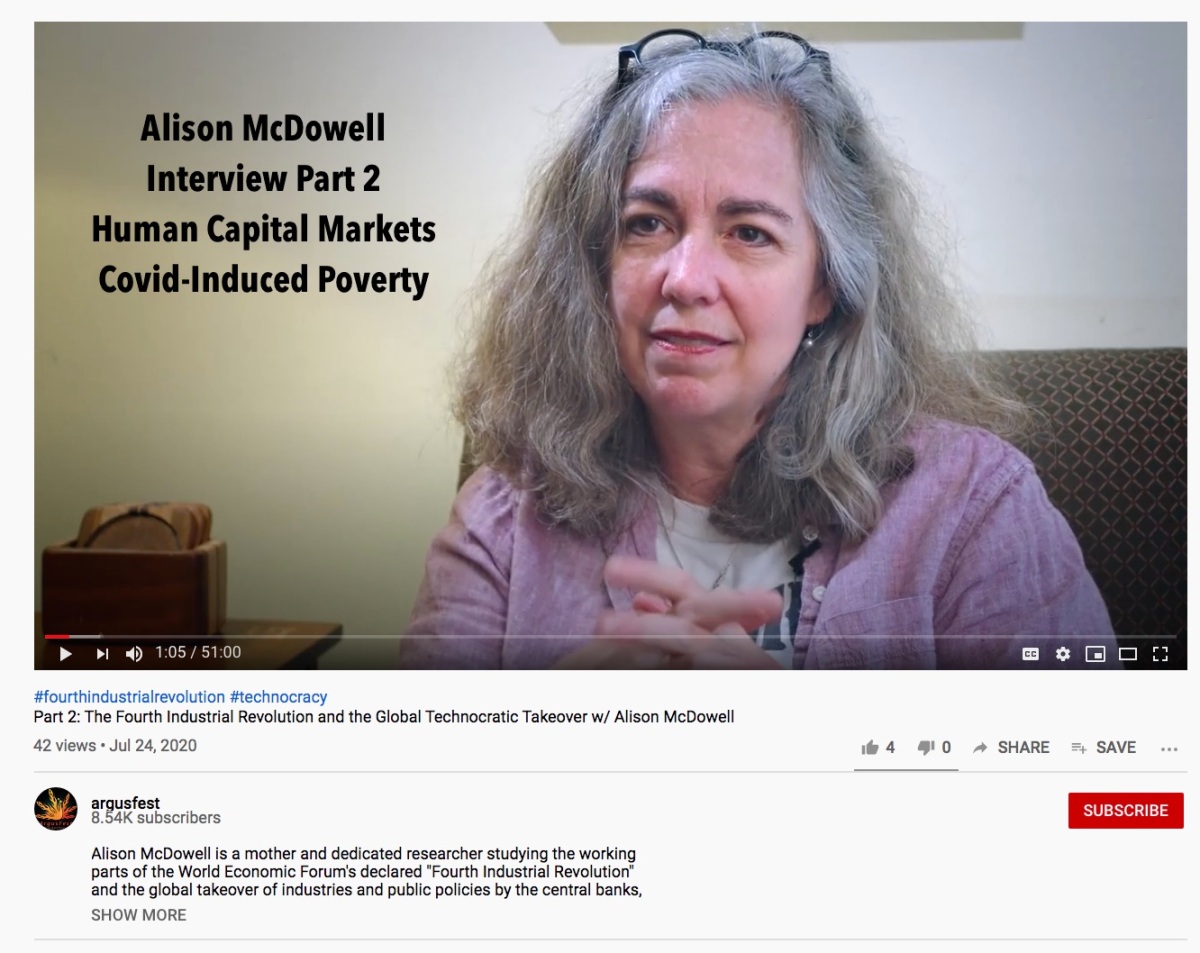
In mid-May 2020,  Jason Bosch, documentary filmmaker and activist from Denver, came to Philadelphia to pick my brain about the things I’ve been researching for the past five years. He’s in the process of editing that footage into a series of videos covering  issues related to racialized technology, global finance, the Covid lockdowns, digital identity, and the rise of human capital data markets.
Below are the first two installments in this series. A lot of this is ground I have covered in previous posts, but I sense the conversational nature of this exchange may make some of this information more approachable.
Very grateful to Jason for sharing his talents. Phone videos can only take you so far.

Part One

Part Two