Latest News and Comment from Education

Friday, May 7, 2021

The American Rescue Plan is a chance for a new beginning in education and teaching children, especially those with special needs | Eclectablog

The American Rescue Plan is a chance for a new beginning in education and teaching children, especially those with special needs | Eclectablog
The American Rescue Plan is a chance for a new beginning in education and teaching children, especially those with special needs


The following essay was written by Trina Tocco. She is a resident of Royal Oak and has two amazing children who attend Ferndale Public Schools.


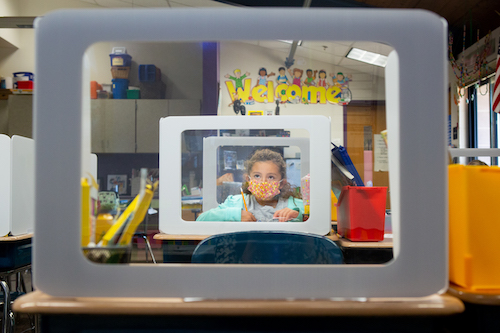
When the pandemic hit, I had to make a choice – either one of my children wouldn’t be able to participate in virtual school because of mental illness or I would have to put my family at risk by bringing additional caregivers who I didn’t know into my home to help with my children so that I could work. I chose to open my home because the risks of an unsafe home with no one to really turn to didn’t seem like an option.

As a single mom trying to work and homeschool my children, it has often felt like I wouldn’t make it through the day. Emergency services like the Oakland County Mobile Youth Crisis line haven’t been available to go into homes since the start of the pandemic. The pediatric mental health hospitals are at full capacity and families are having to wait weeks in hospital waiting rooms for placements to ensure safety for their children and families. What were gaps in supports and services before the pandemic are now gaping holes.

During this pandemic, families like mine with special needs children have needed an adult from the school to be physically present. Unfortunately, given the lack of school staff, the limitations created by social distancing, and the outdated separation of services that are provided by schools versus community mental health agencies, this just wasn’t possible. Instead, I have had to CONTINUE READING: The American Rescue Plan is a chance for a new beginning in education and teaching children, especially those with special needs | Eclectablog


Nicholas Tampio: How the Feds Can Kill the Liberal Arts and Humanities | Diane Ravitch's blog

Nicholas Tampio: How the Feds Can Kill the Liberal Arts and Humanities | Diane Ravitch's blog
Nicholas Tampio: How the Feds Can Kill the Liberal Arts and Humanities


Nicholas Tampio is a professor of political science at Fordham University. In this post, he demonstrates how a proposed federal program could crush the liberal arts and humanities.

He writes in the Boston Globe:

A bipartisan group of senators, including Elizabeth Warren of Massachusetts and Sheldon Whitehouse of Rhode Island, are backing a bill called the College Transparency Act. It would require public and private colleges around the country to report how many students enroll, transfer, drop out, and complete various programs. Then that information would be combined with inputs from other federal agencies, including the Internal Revenue Service, so that the “labor market outcomes” of former students could be tracked.

In other words, the act would create a system that publicizes how much money students make, on average, after going through particular colleges, programs, and majors.

According to Senator Whitehouse, “Choosing a college is a big decision, and yet too often families can’t get the information to make apples-to-apples comparisons of the costs and benefits of attending different schools.” The CONTINUE READING: Nicholas Tampio: How the Feds Can Kill the Liberal Arts and Humanities | Diane Ravitch's blog

A Letter to America’s Teachers - ED.gov Blog

A Letter to America’s Teachers - ED.gov Blog
A Letter to America’s Teachers


I never could predict what might happen in Mr. O’Neil’s art classes; I just knew I couldn’t wait for the next assignment.  Back then I didn’t realize all the ways this dynamic educator, a rare man of color leading our diverse classroom of second graders, was serving as a pioneer and role model for me and my peers in John Barry Elementary School.  But I’ll never forget how his teaching made me feel.  As a second grader, I remember looking up — watching him encourage, challenge and guide us – and thinking: “I want to be like him.”

In the years since embracing that calling and starting my career as a classroom teacher, I’ve kept that sense of purpose and wonder.  And my goal in all the administrative roles I’ve held is to facilitate great teaching and learning: to support and expand the transformative impact that skilled, caring classroom teachers have for students, schools, and communities.

Every day America’s teachers change lives, and every day those lives change the world.

Now, this truth can seem to recede as you rush to keep up with the day’s intense pace, and your students’ needs and opportunities. Yet, from the first bell on the first day of the school year, you build a relationship with each of them. You learn their strengths and struggles, laugh with them, cry with them, worry over them, cheer for them – and at the end of the school year, help them transition to their next grade level adventure. You know all those experiences – both the academic and life lessons – have changed both you and them for the better.  You empower them to grow in skill and character — expand their understanding of the world and how to shape it — explore their interests and decide where to make their mark.

Teaching is not a job anyone just falls into. It is mastery of a craft: in fact, the craft that enables all the others. In my experience, great teachers are also quintessential lifelong learners. You use your command of learning science, your insights into your students’ unique needs and aptitudes, as well as the lessons of the past, the realities of the present and the inspiration, innovation and ingenuity of the future to help each new generation become leaders for today and tomorrow. Throughout the year you support your fellow educators, add to your tools through professional development, provide feedback on assignments, sponsor sports, service learning, clubs and other extracurricular activities, collaborate with parents –in addition to everything you pour into your students during class.

Even in this unprecedented year, you rallied, finding new ways to engage with students. In the face of tragedy, you learned new technologies and built virtual classroom communities, all while caring for yourselves and your own families.  As we heal, recover, and rebuild, this pandemic presents a chance to forge opportunity from crisis and reimagine education on every level. We will use this time to address inequities in our education system, and your contributions will be invaluable.  The work won’t be easy, but the impact of your success will be profound, for students and communities. I urge state, local, and elected officials to make sure classroom teachers have a voice in your plans and efforts to reimagine education; second to parents, they know our students best.

I look forward to learning and listening from you in the days ahead.  And, from all of us at the Department of Education: Happy Teacher Appreciation Week. There’s a reason teacher like Mr. O’Neil – and all of you – are memorable.  There’s a reason student in America’s classrooms watch you share your curiosity, energy and passion for ideas and think, “I want to be like them.”

You are embodiments of possibility, champions of your students’ potential and stewards of their success.

Dr. Miguel A. Cardona, U.S. Secretary of Education.

Teacher Tom: If Our Goal is to Help Our Fellow Humans Rather Than Merely Control Them

Teacher Tom: If Our Goal is to Help Our Fellow Humans Rather Than Merely Control Them
If Our Goal is to Help Our Fellow Humans Rather Than Merely Control Them


Yesterday, I arrived home from walking the dog, to find police cars, fire trucks, and an ambulance filling the city block just below my apartment window. Last weekend, the seven square blocks just north of the building were completely shut down for an entire morning due to a gas leak and I wondered if it had something to do with that. In recent years, I've taken it on as a civic duty to get nosy about anything involving police activity, so instead of just staying out of the way, I got out my phone and got it ready to record. As I waited to cross Westlake Avenue, a young man excitedly told me that there was someone on the roof of my building, eleven stories up, threatening to "start a fire and jump." 

My first thought is to wonder if it was was someone from the building I know. One would need to gain access to the building and then use an elevator code to get up there, so it was likely that it was one of the 300 or so people who live in the building. 

I did what we all do, I think, when we consider suicide. I recognized how small my problems were compared to what this person was going through, I despaired about the tragedy of mental illness, I wondered if there was something I should be doing to help. I finally decided that the best thing I could CONTINUE READING: Teacher Tom: If Our Goal is to Help Our Fellow Humans Rather Than Merely Control Them

CURMUDGUCATION: Accountability Whiplash

CURMUDGUCATION: Accountability Whiplash
Accountability Whiplash


It's one of the little inconsistencies in the reformster movement. 

Some will point at charts showing that spending on public education has increased steadily (in constant dollars) and ask, "What have we gotten for it?" 

There are answers to that question, including but not limited to A) more education for special ed students previously warehoused in some back room, B) better funding for previously marginalized students and C) more administrators, in part, to deal with increased gummint paperwork. The other part of the answer is that any taxpayer can demand a peek at the school district budget; you can find out where those dollars have gone. 

I've only ever had one beef with accountability hawks. I believe taxpayers are absolutely entitled to accountability by their local school district. My argument is with the instruments used to assess what districts are doing (spoiler alert: the Big Standardized Test is a spectacularly bad accountability instrument). 

But the real whiplash begins when some accountability hawks then stump for school choice and CONTINUE READING: CURMUDGUCATION: Accountability Whiplash


Ohio Legislature Heats Up Controversy by Making New Public School Funding Plan and Method of Funding School Vouchers All Part of the Budget | janresseger

Ohio Legislature Heats Up Controversy by Making New Public School Funding Plan and Method of Funding School Vouchers All Part of the Budget | janresseger
Ohio Legislature Heats Up Controversy by Making New Public School Funding Plan and Method of Funding School Vouchers All Part of the Budget


This week in my school district in Cleveland Heights-University Heights, Ohio, parents and public school supporters are going through a quiet ritual. People have been scrambling to write and submit legislative testimony. Some people are submitting written testimony; others are driving two and a half hours to Columbus, sitting in the hearing room and driving home in the dark. The Ohio Senate Primary and Secondary Education Committee is holding hearings on the state’s next biennial budget and considering a new—desperately needed—school funding plan that has now been folded into the budget bill, which must be passed by June 30.

What is happening is a big deal.  Last fall, a new $2 billion school funding plan was passed by the Ohio House by a vote of 87-9, but the Ohio Senate let the bill die at the end of the session. Now that plan has been folded into the state budget. The House has already passed the budget—including the Fair School Funding Plan—but the Senate is just now holding hearings. If you read some of the testimony being submitted, you might imagine what’s going on in Ohio would get coverage in the state’s big newspapers, but most of them have been bought out by Gannett-Gatehouse Media or Advance Media, companies that have reduced the number of reporters.  Right now not enough people are paying attention to a debate about whether the Legislature will repair the services our state is currently failing to provide for 1.6 million students in Ohio’s 610 public school districts at the same time the state continues to expand school vouchers at public schools’ expense.

I am going to share some of my own testimony and the testimony from others who are members of the Heights Coalition for Public Education. You can find copies of each of these documents in the Ohio Senate Education Committee’s document archive for May 4, 5, and 6.  I will date each reference.

My own testimony (May 6) summarizes the issues at stake in this particular Ohio budget CONTINUE READING: Ohio Legislature Heats Up Controversy by Making New Public School Funding Plan and Method of Funding School Vouchers All Part of the Budget | janresseger

Authentic Education Reform Based on Diversity Research | tultican

Authentic Education Reform Based on Diversity Research | tultican
Authentic Education Reform Based on Diversity Research


By Thomas Ultican 5/7/2021

“Dedicated with admiration and respect to public school teachers who opt-out of commercial standardized tests.”

These are the words of dedication for Garn Press’s new book in their “Woman Scholars Series,” Diversity Research in Action. In this book, lengthy excerpts from published research by three PhD’s in education Anne Haas Dyson, Denny Taylor and Catherine Compton-Lilly are introduced and woven together by a forth doctorate of education Bobbie Kabuto. It seems like decades since this kind of authentic thinking about how to improve education and equity in our schools has been widely shared.

On a personal note, I began my masters of education program in 2001 and found the kind of pedagogy being advocated by these women very appealing. Unfortunately, that was precisely at the time when Ted Kennedy and George Bush teamed up to smoother it. It was obvious to me that we needed to meet our students at whatever attainment level they had and begin there. Students are not standard so it made no sense to follow some standards arrangement when teaching them.

Most educators found teaching to the standards and administering testing mandated by the No Child Left Behind act – the 2002 rewrite of the US federal education law – heartbreaking. In my remedial high school algebra classes, students were learning but just not fast enough. Instead of being encouraged to continue growing, they were labeled failures.

Building Biographic Literature Profiles

At a time when the president of the United States, George H. W. Bush, and the governor of Arkansas, Bill Clinton, joined with CEO’s like IBM’s Louis Gerstner CONTINUE READING: Authentic Education Reform Based on Diversity Research | tultican

How Professors Teach | Larry Cuban on School Reform and Classroom Practice

How Professors Teach | Larry Cuban on School Reform and Classroom Practice
How Professors Teach


Jonathan Zimmerman’s Amateur Hour (a great title) documents how college professors have taught over the past two centuries. It is a worthwhile read for those who have experienced the full range of university teaching from packed lecture halls to wood-paneled seminar rooms. And it got me thinking of my experiences in college and university classrooms over many years. I have forgotten most of my professors’s names as I collected degrees except for a handful who have had a large influence upon me as both a student and human being.

Since I was a high school history teacher for many years before becoming a professor, I prized teaching before scholarship. Sure both are important, but my previous experiences as a graduate student made me very aware of the startling variation in university teaching as I stumbled through a Masters degree and CONTINUE READING: How Professors Teach | Larry Cuban on School Reform and Classroom Practice

The Testing Game, Louisiana-style | deutsch29: Mercedes Schneider's Blog

The Testing Game, Louisiana-style | deutsch29: Mercedes Schneider's Blog
The Testing Game, Louisiana-style


Let’s say that I am at the end of my freshman year of high school in Louisiana. I must take two Louisiana Educational Assessment Program (LEAP) exams: English I and Algebra I. So long as I minimally pass these exams (“approaching basic”), I am good for graduation three years from now. Furthermore, my state exam score counts as my final exam in the class (between 15 and 30 percent of my fourth quarter grade, according to state specifications; see below).

If I score the highest level on my LEAP exams (“advanced”), then I get an A as an exam grade. If I score the second highest level (“mastery”), I get a B. The third level, “basic,” gets me a C, and the fourth (and lowest passing) level, “approaching basic,” earns a D.

Given that the state exams last between 225 and 260 minutes each, I might zoom through my LEAP test, aiming, if you will, for  CONTINUE READING: The Testing Game, Louisiana-style | deutsch29: Mercedes Schneider's Blog

Welcome to South Carolina: A State of Denial – radical eyes for equity

Welcome to South Carolina: A State of Denial – radical eyes for equity
Welcome to South Carolina: A State of Denial


In the United States of America, the stated law of the land is “innocent until proven guilty.”

However, police in the U.S. shoot and kill about 1000 people a year, denying them due process, acting as judge, jury, and executioner instead of the claimed role of “protect and serve.”

The U.S. is experiencing a mild reckoning, specifically linked to the killing of George Floyd but broadly connected to how policing and the legal system continue to be racially inequitable—or as many conservatives and the media refuse to state, racist.

A vocal and likely substantial portion of the U.S.—mostly white and often white men with power—have decided that naming racism is more harmful and offensive than actual racism.

Police killing citizens must also be put in the context that the U.S. stands out among peer nations in terms of gun violence.

It is mid-2021, and the world is suffering more than a year in a global pandemic.

It is mid-2021, and the guilty verdict of Minneapolis police Officer Derek CONTINUE READING: Welcome to South Carolina: A State of Denial – radical eyes for equity

September 21 School Opening and Unanswered Questions: Requiring Vaccinations, Remote Instruction, Teacher Accommodations, Summer School and “Catching Up” | Ed In The Apple

September 21 School Opening and Unanswered Questions: Requiring Vaccinations, Remote Instruction, Teacher Accommodations, Summer School and “Catching Up” | Ed In The Apple
September 21 School Opening and Unanswered Questions: Requiring Vaccinations, Remote Instruction, Teacher Accommodations, Summer School and “Catching Up”


As the COVID positive rates continue to spiral downwards and the vaccination numbers increase the State is moving towards a full school opening. Broadway can reopen on September 14th, large sports venues allowing larger and larger crowds and school districts are planning full reopening: with a host of issues to be resolved.

Will school districts retain a remote instruction option?

In NYC, for a subset of medically fragile children: maybe. It is highly unlikely that individual schools will operate in-person and remote; it is too complicated and there are other options. For example, children seeking remote option can be clustered in a district-wide remote school. The Department and the Union will partner in an in-person school initiative.

Can COVID vaccinations be required for students?

The NYS Department of Health currently requires vaccinations for school enrollment. See details here

Across the nation many states have vaccination requirements, and, in some states there is virulent opposition by anti-vaxxer parents. Some states have religious and medical exemptions. The decision would be made at the state level and it is highly unlikely for this September; a year or so down the road when vaccinations for children are available the state may develop policies..

 Can COVID vaccinations be required for CONTINUE READING: September 21 School Opening and Unanswered Questions: Requiring Vaccinations, Remote Instruction, Teacher Accommodations, Summer School and “Catching Up” | Ed In The Apple

Jesse Hagopian Joins CBS News to Counter GOP Bills Outlawing The Teaching of Structural Racism: “I will not lie to kids” – I AM AN EDUCATOR

Jesse Hagopian Joins CBS News to Counter GOP Bills Outlawing The Teaching of Structural Racism: “I will not lie to kids” – I AM AN EDUCATOR
Jesse Hagopian Joins CBS News to Counter GOP Bills Outlawing The Teaching of Structural Racism: “I will not lie to kids”


Ijoined CBS News anchor Tanya Rivero on her program to discuss the request from Republican lawmakers to rescind any support of the 1619 Project and to talk about the proliferation of bills in state legislatures around the country that would ban teaching about structural racism. In the interview I called on educators to sign the new petition from the Zinn Education Project that calls on teachers to pledge that they will teach about the long legacy of structural racism, sexism, heterosexism, and other forms of oppression–regardless of the law.

It’s time to begin preparing for civil disobedience and for teachers to openly defy these neo-McCarthyist laws that would have educators lie to students about the fact that our country was founded on the genocide of Native Americans and African peoples and that structural racism and other forms of oppression persists in many ways today.

Visit the links to the Zinn Education Project below to sign the pledge! #TeachTheTruth

Onward,

Jesse Hagopian

Trump Attacks Howard Zinn and the Zinn Education Project — Defend Teaching  People's History Today! – I AM AN EDUCATOR
Virtual Offering Plate – Unitarian Universalist Congregation in Andover

CPAC: Why next year will be our best opportunity to lower class size in our schools | Class Size Matters

CPAC: Why next year will be our best opportunity to lower class size in our schools | Class Size Matters  | A clearinghouse for information on class size & the proven benefits of smaller classes
CPAC: Why next year will be our best opportunity to lower class size in our schools


We gave this power point presentation to the Chancellor’s Parent Advisory Council on 5.6.21 on why next year, because of the big increase in state and federal funding, we will have the best opportunity to lower class size, at a time  when students will need smaller classes more than ever before.

Here it is a pdf below.

Pledge to Teach the Truth, Despite New State Bills Against It (Tennessee bans public schools from teaching critical race theory) | Zinn Education Project

Pledge to Teach the Truth, Despite New State Bills Against It | Zinn Education Project
Pledge to Teach the Truth, Despite New State Bills Against It


Tennessee bans public schools from teaching critical race theory amid national debate


Lawmakers in at least 12 states are attempting to pass legislation that would require teachers to lie to students about the role of racism, sexism, heterosexism, and oppression throughout U.S. history.

A recent bill introduced in the Missouri legislature exemplifies a rash of similar bills — in Texas, Idaho, Arkansas, Iowa, Louisiana, New Hampshire, Oklahoma, Rhode Island, West Virginia, Arizona, and North Carolina — that aim to prohibit teachers from teaching the truth about this country: It was founded on dispossession of Native Americans, slavery, structural racism and oppression; and structural racism is a defining characteristic of our society today.

Specifically, the Missouri bill bans teaching that:

identifies people or groups of people, entities, or institutions in the United States as inherently, immutably, or systemically sexist, racist, anti-LGBT, bigoted, biased, privileged, or oppressed.

But how can one teach honestly about the nature of our society without examining how today’s racial inequality is a systemic legacy of this country’s history?

From police violence, to the prison system, to the wealth gap, to maternal mortality rates, to housing, to education and beyond, the major institutions and systems of our country are deeply infected with anti-Blackness and its intersection with other forms of oppression. To not acknowledge this and help students understand the roots of U.S. racism is to deceive them — not educate them. This history helps students understand the roots of inequality today and gives them the tools to shape a just future. It is not just a history of oppression, but also a history of how people have organized and created coalitions across race, class, and gender.

The Missouri bill names these leading social justice education groups as those whose curricula would be banned:

1619 Project initiative of the New York Times, the Learning for Justice Curriculum of the Southern Poverty Law Center, We Stories, programs of Educational Equity Consultants, BLM at School, Teaching for Change, Zinn Education Project, and any other similar, predecessor, or successor curricula.

The proposed legislation fails to name a single lesson that is inaccurate or that misleads CONTINUE READING: Pledge to Teach the Truth, Despite New State Bills Against It | Zinn Education Project

‘Ripe for fraud’: Multicounty Grand Jury releases interim report on Epic Charter Schools investigation | KFOR com Oklahoma City

‘Ripe for fraud’: Multicounty Grand Jury releases interim report on Epic Charter Schools investigation | KFOR.com Oklahoma City
‘Ripe for fraud’: Multicounty Grand Jury releases interim report on Epic Charter Schools investigation


OKLAHOMA CITY (KFOR) – The multicounty grand jury investigating Epic Charter Schools has released a scathing interim report of its findings following the state’s audit report against the school.

According to the report, “Due to the lack of transparency in accounting for the funds, intentional avoidance of disclosure of information by a private entity, and lack of cooperation; the investigation is unable to be completed at this time.”

The concerns from the Audit Report and the subsequent investigation by the Multicounty Grand Jury can be summarized as:

  • Lack of oversight
  • Lack of transparency in operations
  • Lack of accountability by for-profit company Epic Youth Services

By failing to provide appropriate oversight, the entities responsible have allowed significant public funds to be diverted into private accounts without transparency. The public has not been served by the incestuous relationship between the for-profit vendor, Epic Youth Services, and the governing board Community Strategies. The system has failed to provide accountability and allowed a company to take advantage and generate a substantial personal profit on the backs of Oklahoma students. This is especially offensive at a time when Oklahoma students and parents are struggling with the weight of the pandemic and its effects on our students’ education and wellbeing.

This interim report focuses on the for-profit vender, Epic Youth Services LLC (EYS).

“The incestuous relationship between the board and a private vendor has resulted in a lack of independent oversight,” the report states. “As designed, this system is ripe for fraud.”

From 2015 to 2020, Epic Charter Schools received more than $458 million in state and federal funds as a  CONTINUE READING: ‘Ripe for fraud’: Multicounty Grand Jury releases interim report on Epic Charter Schools investigation | KFOR.com Oklahoma City