Latest News and Comment from Education

Tuesday, March 2, 2021

LA teachers union slams California schools plan as 'propagating structural racism' - POLITICO

LA teachers union slams California schools plan as 'propagating structural racism'


SACRAMENTO — California's largest local teachers union on Monday slammed the state's new school reopening plan as "a recipe for propagating structural racism" hours after Gov. Gavin Newsom and Democratic lawmakers unveiled their compromise proposal.

The United Teachers of Los Angeles' strong condemnation is a bad sign for Newsom and Democrats who spent months working to strike a deal on legislation they believe will spur districts to reopen. Los Angeles Unified is the second largest district in the nation with about 600,000 students — and by far the largest in the state with roughly 10 percent of California's public schoolchildren.

"We are being unfairly targeted by people who are not experiencing this disease in the same ways as students and families are in our communities. If this was a rich person's disease, we would've seen a very different response. We would not have the high rates of infections and deaths," UTLA President Cecily Myart-Cruz said at a news conference Monday. "Now educators are asked instead to sacrifice ourselves, the safety of our students and the safety of our schools."

Most of California's schools have now been closed for a year as districts have struggled to negotiate reopening terms with the state's powerful unions. The California Teachers Association praised parts of the plan on Monday, but made clear that local unions have negotiating rights.

UTLA is one of three large city teachers unions that went on strike in 2019 over pre-pandemic working conditions, along with those in Sacramento and Oakland. Its position could sway union members elsewhere — particularly those serving CONTINUE READING: LA teachers union slams California schools plan as 'propagating structural racism'

Lifelong Educator, Miguel Cardona, Confirmed As Education Secretary | 89.3 KPCC

Lifelong Educator, Miguel Cardona, Confirmed As Education Secretary | 89.3 KPCC
Lifelong Educator, Miguel Cardona, Confirmed As Education Secretary


The U.S. Department of Education will have a new leader. Late Monday, in a 64 to 33 vote, the U.S. Senate confirmed Miguel Cardona to be the next Secretary of Education.

Before being nominated by President Biden, Cardona served as Connecticut's education commissioner for the past year and a half, arguing forcefully that schools should reopen during the COVID-19 crisis in order to keep equity gaps from growing ever wider. Before that, he spent his entire career working for the public school system that helped raise him — as a fourth grade teacher, principal and assistant superintendent in the old factory town of Meriden, Conn.

Cardona assumes the Education Department's top job as the debate around how to safely reopen schools has grown increasingly bitter, with many parents clamoring for children to be able to return to classrooms and with many teachers resisting a return before all educators have been vaccinated. That has forced Biden to walk a political tightrope, reassuring teachers they should be prioritized for the vaccine while new guidance from The Centers for Disease Control and Prevention makes clear that vaccinations should not be a prerequisite for reopening schools.

The school tracking website, Burbio, suggests schools have been gradually reopening. According to its tracker, 27.5% of students still attend virtual-only schools — down from 31% the week before. An additional 28% attend schools offering CONTINUE READING: Lifelong Educator, Miguel Cardona, Confirmed As Education Secretary | 89.3 KPCC

American Federation of Teachers president reacts to changes in educational assessment requirements for 2020-21 school year - The Highland County Press

American Federation of Teachers president reacts to changes in educational assessment requirements for 2020-21 school year - The Highland County Press
American Federation of Teachers president reacts to changes in educational assessment requirements for 2020-21 school year


American Federation of Teachers President Randi Weingarten issued the following statement in response to the Biden administration’s announcement of changes to assessment and accountability requirements for the 2020-2021 school year:
 
“Nothing is ideal during a pandemic, especially when it comes to navigating how best to educate our nation’s students. The Biden administration took office at a critical moment and was left to clean up myriad messes left by its predecessors, including addressing the difficult reality of how to support children and their educators and how to monitor their safety as well as their academic, social and emotional development and progress.

“It has done admirable work amid this chaos, so it is a frustrating turn to see the administration ask states to continue requiring assessments during this tumultuous school year. While its plan does offer the option for testing modifications and waivers for accountability requirements, which is a start, it misses a huge opportunity to really help our students by allowing the waiver of assessments and the substitution, instead of locally developed, authentic assessments that could be used by educators and parents as a baseline for work this summer and next year. 
 
“As the educators in the classroom, we have always known that standardized tests are not the best way to measure a child’s development, nor do they particularly help kids or inform best practices for teaching and learning. That is especially true in these unprecedented times, when students and teachers alike are remaking the school experience in the most unlikely of circumstances.  CONTINUE READING: 
American Federation of Teachers president reacts to changes in educational assessment requirements for 2020-21 school year - The Highland County Press

Voucher Vultures Continue to Lose in Court + Tylor Talks Teaching – Tennessee Education Report

Voucher Vultures Continue to Lose in Court – Tennessee Education Report
VOUCHER VULTURES CONTINUE TO LOSE IN COURT


Parent advocacy group Public Funds for Public Schools notes that the Tennessee Supreme Court denied a motion by school privatization advocates to allow implementation of Gov. Lee’s voucher scheme while the issue of the constitutionality of the program is sorted out.

Here’s more from a press release:

On February 22, the Tennessee Supreme Court denied a motion by pro-voucher groups to lift a lower court’s permanent injunction barring implementation of Tennessee’s 2019 “education savings account” voucher law. In May 2020, the Davidson County Chancery Court ruled the voucher law is unconstitutional because it violates the Home Rule provision of the Tennessee Constitution. In August 2020, the Tennessee Court of Appeals affirmed the Chancery Court’s decision. The case is now before the Tennessee Supreme Court.

The voucher law, which passed by only one vote in the State Legislature, illegally targeted just two Tennessee counties, Davidson and Shelby, which are home to the Nashville and Memphis public schools. Legislators from the two counties overwhelmingly opposed the voucher law, which would have drained millions of dollars from two school districts that are severely underfunded by the State.

The law was challenged in court by the two counties in Metropolitan Government of Nashville & Davidson County v. Tennessee Department of Education, and by public CONTINUE READING: Voucher Vultures Continue to Lose in Court – Tennessee Education Report

Tylor Talks Teaching – Tennessee Education Report - http://tnedreport.com/?p=5192 via @TNEdReport

Resilient Public Schools: Bright and Dark Sides (Part 4) | Larry Cuban on School Reform and Classroom Practice

Resilient Public Schools: Bright and Dark Sides (Part 4) | Larry Cuban on School Reform and Classroom Practice
Resilient Public Schools: Bright and Dark Sides (Part 4)


Why have U.S. public schools rebounded from natural disasters like Covid-19?

Answer: Americans’ social beliefs both in the importance of schooling, what a “real” school looks like, and the long-term efficiency of the age-graded school organization with its “grammar of schooling” explain why public schools gradually reopened its doors.

American confidence in tax-supported schools giving all children an equal shot at getting educated (albeit marred by continuing inequalities), receiving a diploma, and entering the labor market has been sustained through economic booms and busts, through war and peace, through closures from disasters and reopenings. [1]

While public support for tax-supported schools has wavered over the decades, it remains a trusted institution that a majority of parents support. In answer to the question: How satisfied are you with the quality of education your oldest child is receiving? Since 1999, the percentage ranged from a low of 68 percent to a high of 82 percent in 2019 saying they were “completely” or “Somewhat Satisfied.” Parents registered a drop from 2019 to 2020—the poll was done during the pandemic—of 10 points, from 82 to 72 percent satisfied.[2]

Public confidence in schools is embedded in the common picture held by most Americans of what a “real” school is like. A “real” elementary school, for CONTINUE READING: Resilient Public Schools: Bright and Dark Sides (Part 4) | Larry Cuban on School Reform and Classroom Practice

Six Dr. Seuss books to stop being published over ‘hurtful and wrong’ racial portrayals - Raw Story - Celebrating 16 Years of Independent Journalism

Six Dr. Seuss books to stop being published over ‘hurtful and wrong’ racial portrayals - Raw Story - Celebrating 16 Years of Independent Journalism
Six Dr. Seuss books to stop being published over ‘hurtful and wrong’ racial portrayals


Six Dr. Seuss books are being retired after decades of criticism over racist imagery in the illustrated children’s stories. Dr. Seuss Enterprises, the organization that carries on the author’s legacy, announced Tuesday that it will stop publishing and licensing “And to Think That I Saw It on Mulberry Street,” “If I Ran the Zoo,” “McElligot’s Pool,” “On Beyond Zebra!,” “Scrambled Eggs Super!” and “The Cat’s Quizzer.” “These books portray people in ways that are hurtful and wrong,” the organization said in a statement Tuesday morning, adding that the decision was made last year with a panel of e...

Read More Six Dr. Seuss books to stop being published over ‘hurtful and wrong’ racial portrayals - Raw Story - Celebrating 16 Years of Independent Journalism


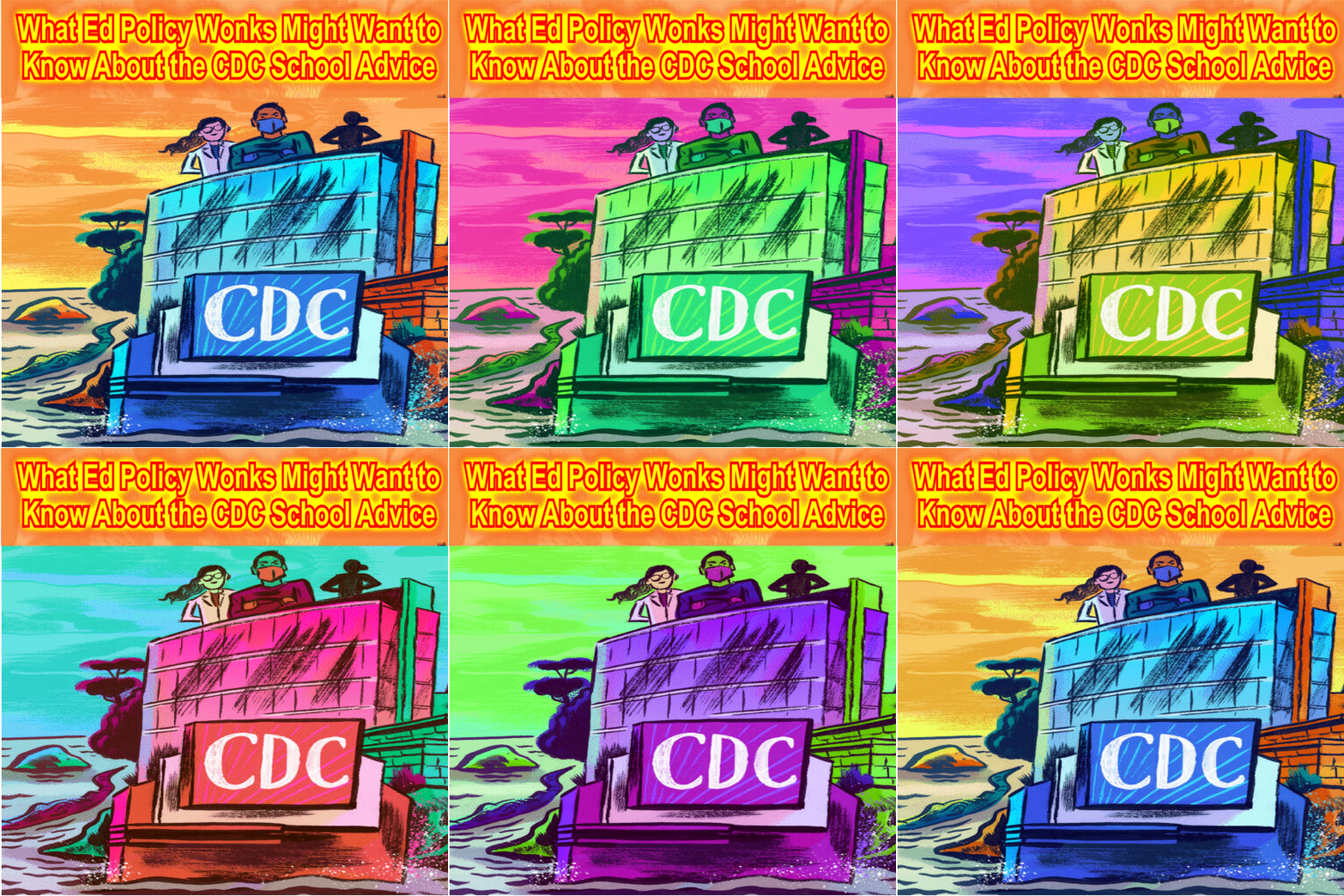
Sherman Dorn: What Ed Policy Wonks Might Want to Know About the CDC School Advice, February 2021 | National Education Policy Center

Sherman Dorn: What Ed Policy Wonks Might Want to Know About the CDC School Advice, February 2021 | National Education Policy Center
Sherman Dorn: What Ed Policy Wonks Might Want to Know About the CDC School Advice, February 2021


Three and a half weeks into the new administration, the director of the Centers for Disease Control and Prevention has released a new set of guidelines for K-12 schools. The general features of the guidelines have been well-covered in the press (with some minor mistakes–it’s complicated!), and some public-health researchers have started to weigh in as well (also with some mistakes–it’s complicated!).1 To me, the key operative expression is three and a half weeks into the new administration; the timing reflects both political needs of the Biden administration as it pushes through its COVID relief package,2 and also professional needs of the public-health community to return to ordinary public-health politics after the sheer awfulness of the Trump administration response to the pandemic. 

The result is the closest thing to a consensus I would expect at this point, among public-health professionals who disagree on some important things. It’s probably a misnomer to think that a public-health consensus on all important issues are possible, and as a layperson I see significant public disagreements about transmission risks related to school reopening. In CONTINUE READING: Sherman Dorn: What Ed Policy Wonks Might Want to Know About the CDC School Advice, February 2021 | National Education Policy Center

Grassroots Education Network- February 2021 Newsletter - Network For Public Education

Grassroots Education Network- February 2021 Newsletter - Network For Public Education
Grassroots Education Network- February 2021 Newsletter


The NPE Grassroots Education Network is a network of over 160 grassroots organizations nationwide who have joined together to preserve, promote, improve, and strengthen our public schools. If you know of a group that would like to join this powerful network, please go here to sign on. 

If you have any questions about the NPE Grassroots Education Network please contact Marla Kilfoyle, NPE Grassroots Education Network Liaison at marlakilfoyle@networkforpubliceducation.org

Notes from Marla

February ushered in like a lion on the education front.  As I sat down to put together our February newsletter, action alerts were happening all over the country against new school choice legislation.  At a time when lawmakers should be focused on supporting families and children, they decided to focus on defunding the bedrock of our communities….public schools.  As you read through this newsletter, you will see state after state fighting school choice legislation (vouchers and charter expansion).  If you know anyone living in states fighting school choice legislation, please pick up the phone, or send them an email, so they can connect with the organization in their state fighting for our kids to have well funded public schools.  

National Organizing CONTINUE READING: Grassroots Education Network- February 2021 Newsletter - Network For Public Education

Teacher Tom: The Strongest Kids in the World

Teacher Tom: The Strongest Kids in the World
The Strongest Kids in the World


We were talking about how strong we are, children taking turns sharing feats of strength they had or could perform. It had started with a boy boasting that he was the strongest kid in the world. Others had challenged his assertion, offering as proof stories of other kids they knew who were very strong, the superior strength of big kids, the unbelievable strength of parents, and the superpower strength of fictional characters.

It was a fun conversation, full of exaggeration, hyperbole, and a lot of self-aggrandizement. As we rambled, we created a kind of collective spoken word poem about strength as defined by the ability to lift heavy things off the ground. Most of the kids knew it was a game, but a few stuck with the reality before them, chiming in with "No, you can't!" and "Nobody can lift the whole school!" They were in the minority, but their doubts required defending and eventually we were taking turns lifting chairs and the corners of tables and pretty much anything else wasn't nailed down to demonstrate our actual strength in that real world.

"I can lift the whole loft!" One girl declared, standing with a hand on one of the legs of the two-level structure that CONTINUE READING: Teacher Tom: The Strongest Kids in the World

The Talk – radical eyes for equity

The Talk – radical eyes for equity
The Talk


Yesterday I had The Talk with two of my classes—my first-year writing seminar and my upper-level writing/research course.

Doing so proved to me once again that you can’t have The Talk too often with young people. Students were under-informed, misinformed, and worst of all, filled with fear.

The Talk, of course, for these classes was about plagiarism.

Two students in separate classes shared what I think is far too common with the emphasis on what to avoid, plagiarism, (a deficit perspective) instead of what to do and why, scholarly/academic citation—one having been “terrified” by a seminar on plagiarism when they were first-year students and the other struggling to express their concern about teachers being too “harsh” (a recognition that their experience with citation was mostly about avoiding punishment).

Despite the differences in class levels, these students were equally hesitant to answer basic questions about the purposes of citation and what constitutes plagiarism; they offered tentative and incomplete answers when I persisted in CONTINUE READING: The Talk – radical eyes for equity

NYC Public School Parents: Council Members Dromm and Treyger urge Congress to make sure while funding schools, NYS and NYC can't pull back their support at the same time

NYC Public School Parents: Council Members Dromm and Treyger urge Congress to make sure while funding schools, NYS and NYC can't pull back their support at the same time
Council Members Dromm and Treyger urge Congress to make sure while funding schools, NYS and NYC can't pull back their support at the same time


See the letter below, sent late last week from Council Members Danny Dromm and Mark Treyger, chairs of the Council Finance and Education Committees to New York Senators and our Congressional delegation, urging them to provide the additional funding our schools will need next fall to reopen safely and well, with the enhanced in-person support that students will require to recover from the huge losses they've suffered this year.

The letter also points out that the federal aid should be structured so that the state cannot simply cut education funding in the same amount as the additional aid districts receive from the federal government, as Governor Cuomo did last year with his "pandemic adjustment", cutting NYC's aid by nearly a billion dollars.

 As the Education Law Center and AQE point out in a new analysis, Cuomo threatened to do this again in his new Executive Budget, by slashing state aid by over half of the $3.85 billion in federal emergency relief funds in the previous funding passed by Congress, the Coronavirus Response and Relief Supplemental Appropriations (CRRSA) Act, funding that was meant to respond to the ongoing impacts of COVID-19, not to plug holes in state education budgets. 

At the same time, CM Dromm and CM Treyger also urged the Congress to make sure the city doesn't use these funds by withdrawing its support for schools as well:

" At the same time, include rigorous maintenance of effort provisions in the law, so that the city does not cut back on its own funding, as it is threatening to do with significant CONTINUE READING: NYC Public School Parents: Council Members Dromm and Treyger urge Congress to make sure while funding schools, NYS and NYC can't pull back their support at the same time

Urgent: Tell President Biden to Stop the Tests - Network For Public Education

Urgent: Tell President Biden to Stop the Tests - Network For Public Education
Urgent: Tell President Biden to Stop the Tests


In December of 2019, candidate Joe Biden promised that if elected, he would stop standardized testing. Yet the U.S. Department of Education has announced that states must test students in the midst of the pandemic.  That is a wrongheaded policy that puts data first and children last. Write Joe Biden. Tell him to step in and cancel the tests.

1. Please call the White House switchboard at 202-456-1414.

Here is a suggested script.

“My name is (name) from (state). I am calling to ask the President to keep his promise about eliminating standardized testing. Forcing schools to administer annual tests undermines the administration’s call to support our students’ social-emotional and mental health in this time of crisis. The tests must be canceled. Period.”

2. Then call the U.S. Department of Education at this number 800-872-5327. Press 3.

Here is a suggested script.

“My name is (name) from (state). I strongly oppose Mr. Rosenblum’s recent letter that forces schools to administer annual tests this year. All of our schools’ efforts must be used to support our students’ social-emotional and mental health in this time of crisis.  Test results will be meaningless. Please tell Dr. Cardona that tests must be canceled. Period.”

3. Finally, send an email to the White House by clicking here (letter prepared by our friends at NYC Opt Out).


Shame on the Thomas B. Fordham Institute for deliberately misleading the public.

A recent study published by the Thomas B. Fordham Institute was sent to policymakers across the country.  When the Fordham Institute sent out its mass email, its subject line read: “New report finds charter schools pose no fiscal threat to local districts.” That subject line is a blatant falsehood unsupported even by its own deeply flawed study. The Walton Foundation and The Fordham Foundation, the Fordham Institute’s related organization, funded the study. The Fordham Foundation sponsors eleven charter schools in Ohio, for which it receives administrative fees.

Read my analysis of the study on Valerie Strauss Answer Sheet here.

You can find and share my complete analysis on our website here​.

Fordham’s distribution of the report to State Boards of Education, Commissioners, and other policymakers with a deliberately misleading headline does a serious disservice to public schools and taxpayers alike.


We are delighted to announce that Peter Greene will now be curating a blog for the Network for Public Education.

Diane Ravitch will no longer be re-blogging the blogger community’s excellent work but will concentrate on her own commentary instead.  As she announced on her blog, while the direction will shift, and she will slow down a bit, she loves this community and wants to keep us all in her living room. In the days ahead, we will be adding new features such as automatic subscriptions to the blog. For now, you can find us re-blogging your great work at: https://networkforpubliceducation.org/best-posts/.

Now get to work making those calls!

And thank you for all that you do.


Send your Email to the White House: Stop the Tests!

In order to email the White House, you must fill out a short form with your message. You will find that form here.

Here is a message you can cut and paste and bring with you to that form, or create your own.

Dear President Biden,

I am writing today to ask that you do everything in your power to reverse the February 22, 2021 guidance on testing waivers sent by Ian Rosenblum (USDE) to chief state school officers.

I join many, many other parents/guardians, students, educators, and concerned citizens who adamantly reject the idea that ESSA’s decree of annual standardized testing should stand in a year that has been anything but standard.

Forcing schools to administer the tests, which is the gist of Mr. Rosenblum’s guidance, undermines your administration’s call to support our students’ social-emotional and mental health in this time of crisis. Rosenblum’s offer of a “flexible” testing window would not mitigate the impacts of the tests. The tests must be canceled. Period.

In a good year, standardized, one-size-fits-all tests do little more than show us where resources are lacking and where affluence congregates. This year, the global pandemic illuminates these systemic inequities in broad relief. By releasing states from the mandate to implement the tests, you will enable teachers to draw on their expertise to assess their students and allow the funds attached to the tests to be redirected to services needed most immediately on the ground in communities now.

Why was Mr. Rosenblum allowed to issue guidance that runs contrary to the promises you made regarding standardized testing? It is not too late to pull back Mr. Rosenblum’s guidance.

Can I count on you to bring your influence to bear, so that happens?

Thank you.
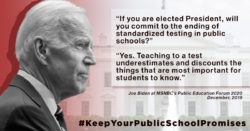
https://networkforpubliceducation.org/send-your-email-to-the-white-house-stop-the-tests/

CURMUDGUCATION: I've Got A New Blogging Job

CURMUDGUCATION: I've Got A New Blogging Job
I've Got A New Blogging Job


For many years, Diane Ravitch has taken on the task of maintaining a sort of town square for folks who care about the health and future of public education. Most of us who are part of this blogosphere owe her a heap of thanks for helping us find our audiences and for amplifying our voices. 

But right now, Diane is scaling back (so, only 50 posts a week instead of 600) by concentrating on her own original content. The new blog will be a sort of spin-off, a place to keep making available a cross-section of the many, many, many voices lifted in concern about and support for public education. It's fitting that the Network for Public Education do the hosting and managing of the keep-the-lights-on portion of the work; I will be taking on the task of curating the content. 

The goal is to provide a steady, daily sampling of the best of what's out there in the blogging world (which I loosely define to include substacks and op-eds). The pieces will appear here either in their entirety or with a brief excerpt and a link to the full piece. Which format will be up to the original creator. For me, it's a chance to extend the work I've done with the weekly ICYMI collection. 

I have some things to learn about the tech side of wordpress sites, and advice is always welcome. When I first started this blog years ago, I thought it would be cool to use white lettering on a black background--thank God some readers disabused me of that notion. 

If you have content you want to submit for use here, the email address to use is

npeblog@outlook.com

I can't promise that I'll get to each and every thing sent to me, but I expect to be deeply indebted to people who try to keep me supplied with material. 

The link to share is 

https://networkforpubliceducation.org/best-posts/

This morning Diane called me "estimable and tireless." I'll do my best to live up to that. 

In the meantime, life will continue as usual here at the Mother Ship, though my productivity here may take a dip or two while I'm working out a new rhythm for my own work. As I used to tell my students, "It'll be an adventure."

Bill Gates Invites You to Learn About “The State of Education” | Diane Ravitch's blog

Bill Gates Invites You to Learn About “The State of Education” | Diane Ravitch's blog
Bill Gates Invites You to Learn About “The State of Education”


Let’s just say it upfront. If you wanted to know more about “The State of Education,” and how to “rebuild a more equitable system,” the last person you would ask is a billionaire. Right? Specifically Bill Gates, who has spent billions over the past 20 years promoting high-stakes testing, charter schools, merit pay, value-added measurement of teachers, the Common Core, test-based accountability, and every failed reform I can think of. The media think he is the world’s leading expert on everything, but we know from experience with his crackpot theories and ideas that none of them has made education better, and all of them have demoralized teachers and harmed students and public schools. What hubris to have foisted one failed idea after another and then to convene a summit on how to fix the mess you made, probably by doing the same failed things you already sponsored.

So how can we build a “more equitable system”? Well, one way would be to have higher taxes for people in Bill Gates’ economic bracket. He lives in a state with no income tax. That’s not fair. He should pay his fair share–to his local community, to the state, and to the federal government. So should every other billionaire. I don’t CONTINUE READING: Bill Gates Invites You to Learn About “The State of Education” | Diane Ravitch's blog

Response to Legislative Deal on School Reopening - Year 2021 (CA Dept of Education)

Response to Legislative Deal on School Reopening - Year 2021 (CA Dept of Education)
Response to Legislative Deal on School Reopening 


SACRAMENTO—State Superintendent of Public Instruction Tony Thurmond today issued the following statement in response to a legislative deal announced by Governor Gavin Newsom and lawmakers that is designed to help more schools open classrooms for in-person learning:

“There is no question that students learn best when they are together with their peers and educators in a physically and emotionally safe school environment. Our schools need every resource possible to implement the layered safety measures that will facilitate a safe return to in-person learning for students, school staff, teachers, and their families.

“I want to thank Governor Gavin Newsom and our leaders in the Legislature for crafting a proposal that will provide our school districts and educators additional resources to help resume safe in-person learning and invest in expanded learning and academic interventions to help students accelerate learning and recover from the impacts of this pandemic.

“Vaccines offer more schools their best chance at accelerating a return to in-person learning, so I am especially encouraged to see this proposal cements the Governor’s announcement that a portion of doses will be set aside for the education workforce. Until more people are vaccinated, I urge our school districts to continue to pursue and invest in rapid, robust coronavirus testing of asymptomatic school staff and students as a key safety measure to reducing potential spread.

“As larger numbers of students return to school campuses, the California Department of Education (CDE) will continue collaborating with equity leaders, practitioners, and educational stakeholders to design and expand strategies for supporting our state’s highest-need students, accelerating academic growth, and addressing learning gaps experienced during this public health crisis. My team looks forward to continuing to build out programs and professional development to support educators, expanding effective family engagement practices across the state, and developing tutoring, expanded learning, and other academic intervention strategies for students. In the coming days the CDE will be announcing the school district recipients of our latest round of mini-grants to target equity gaps in education, and we also will be opening up the submission process in our $1 million California Digital Divide Innovation Challenge to turn bold ideas into action that can ensure all California students have access to high speed internet once and for all.

“In the last few weeks we have seen more and more school districts across California announce plans and timelines to reopen their campuses as COVID-19 case rates fall and more people are vaccinated. While we are making encouraging progress, we have to heed the advice of public health leaders who say we cannot get complacent: as communities, we must continue to practice common sense safety measures such as wearing face coverings and physical distancing so that we can keep infections low enough to return as many students as possible to the classroom.”

# # # #

Tony Thurmond — State Superintendent of Public Instruction
Communications Division, Room 5602, 916-319-0818, Fax 916-319-0100

Diane Ravitch: Twenty Years of Failing the Schools - Progressive.org

Twenty Years of Failing the Schools - Progressive.org
Twenty Years of Failing the Schools
To fix education, Biden must not only undo Trump’s legacy but reverse two decades of a disastrous ‘reform’ movement


President Joe Biden will have his work cut out in repairing the damage done to U.S. education caused by Donald Trump and his one-time Secretary of Education, Betsy DeVos. But Biden and his Secretary of Education nominee, Miguel Cardona, must also reverse at least twenty years of federal education policy, starting over with measures that allow teachers to teach and children to learn without fear of federal sanctions.

Since the enactment of George W. Bush’s No Child Left Behind (NCLB) Act in 2002, the nation’s public schools have been required to administer standardized tests in reading and mathematics to every student in grades three through eight, a practice unknown in any high-performing nation. These tests have high stakes for students (who might fail to be promoted), teachers (who might be fired if their students’ test scores don’t rise), and schools (which might be closed if test scores don’t go up).

In addition, three successive presidential administrations—Bush, Obama, and Trump—have pressured school districts to accept privately managed charter schools. Educators and parents have tried to fend off a powerful and well-funded privatization movement that promotes privately managed charter schools and vouchers as the cure for low test scores (which they are not). This so-called reform movement has paid little attention to the need for adequate and equitable resources.

U.S. education began a long slide into an abyss of testing and privatization in 1983, when the administration of Ronald Reagan issued a sensationalized report called “A Nation at Risk.” The report asserted that U.S. education was experiencing a “rising tide of mediocrity” and blamed the public schools for the loss of industries to Japan, South Korea, and Germany. The report relied on cherry-picked data to create a false sense of crisis that demanded solutions.

Governors across the nation met with business leaders and decided that education was too important to leave to educators. What was needed, instead, was corporate thinking. And the remedies they came up with were standards CONTINUE READING: