Latest News and Comment from Education

Wednesday, March 17, 2021

Classroom Teaching Then and Now | Larry Cuban on School Reform and Classroom Practice

Classroom Teaching Then and Now | Larry Cuban on School Reform and Classroom Practice
Classroom Teaching Then and Now


Most policymakers, researchers, and parents believe that good teachers and teaching are the keys to school improvement yet these very same folks know little about how teachers teach daily. And that is the rub. Good teachers and teaching are the agreed-upon policy solutions to both high- and low-performing students yet reliable knowledge of how most teachers teach and what are the best ways of teaching in either affluent or low-income, minority schools are absent among policymakers, researchers, and parents.

At a time when remote instruction has dominated the practice of teaching during the pandemic year, it is useful to take a moment to consider how teachers have taught for the past century and the traditions of teaching that teachers have straddled since the first age-graded school opened in the mid-19th century.

So how have most teachers taught and teach today?

The long answer can be found in many books such as Mary Kennedy, Inside Teaching (2005), Dan Lortie, Schoolteacher (1975), Philip Jackson, The Practice of Teaching (1986), and Larry Cuban, How Teachers Taught (1984).

The short answer is that teachers today draw from two traditions of teaching.

From the early 19th century, teacher-centered and student-centered traditions have dominated classroom instruction (see photo below of a classroom taught within this tradition a century ago).

The teacher-centered tradition refers to teachers controlling what is taught, when, and under what conditions. Were you to sit for a few minutes in such a CONTINUE READING: Classroom Teaching Then and Now | Larry Cuban on School Reform and Classroom Practice

Tulsa, Okla., Schools Plan To Use Latest Stimulus To Expand Learning Opportunities : NPR

Tulsa, Okla., Schools Plan To Use Latest Stimulus To Expand Learning Opportunities : NPR
Tulsa, Okla., Schools Plan To Use Latest Stimulus To Expand Learning Opportunities


NPR's Ailsa Chang speaks with Jorge Robles, chief financial officer for Tulsa Public Schools about plans for using the latest stimulus funding for expanded learning opportunities.

AILSA CHANG, HOST:

Schools around the country are about to get a massive infusion of funds. The coronavirus relief package signed into law late last week will pump nearly $130 billion into K-12 schools across the country. And there's additional money for state governments, which will also help many of these struggling school districts. Twenty percent of the money that school districts receive is targeted at addressing what's called learning loss, and that's where Jorge Robles comes in. He's the CFO of Tulsa Public Schools, where the district has already announced a host of new programs aimed at helping students regain some of the learning that was lost during the pandemic.

Welcome.

JORGE ROBLES: Thank you for having me.

CHANG: Well, as we mentioned, your district has announced a lot of new programs. Can you just give us an idea of what's being offered?

ROBLES: Some of the things that we're offering are - for our high school students, we're having - we're setting up a series of programs that go from one-on-one tutoring to boot camps as well as a - we call it the Twilight Academy. So we're - students have flexible evening learning options so that our students who are in secondary can actually have an opportunity to work with teachers and counselors on catching up on learning and work to make sure that they're graduating on time and they're meeting all the graduation requirements.

And then we're also planning for next school year to make accessible our before and after care for all of our families that we know are very important opportunities for families to access enrichment programs and supports before and after school. And it's a great support for families overall and allows their - our students to continue to engage and learn in safe, joyous environments where they can engage with others and adults.

CHANG: I mean, it sounds like it could be very expensive. And I understand that these one-on-one tutoring plans were announced even before the relief package was signed into law in Washington. I mean, would you have even been able to do this one-on-one tutoring program without this extra funding from the federal government, you think?

ROBLES: It would be extremely hard to do those. So we would have - probably have to change the scale of which we could have been doing them. Having a stimulus package of the size that was authorized, it allows us to essentially put these programs in place for a longer period of time and then have a better degree of success on supporting our CONTINUE READING: Tulsa, Okla., Schools Plan To Use Latest Stimulus To Expand Learning Opportunities : NPR

Three Feet or Six? Distancing Guideline for Schools Stirs Debate - The New York Times

Three Feet or Six? Distancing Guideline for Schools Stirs Debate - The New York Times
Three Feet or Six? Distancing Guideline for Schools Stirs Debate
Some public health officials say it’s time for the C.D.C. to loosen its social distancing guidelines for classrooms, but the idea has detractors.


The Centers for Disease Control and Prevention is clear and consistent in its social distancing recommendation: To reduce the risk of contracting the coronavirus, people should remain at least six feet away from others who are not in their households. The guideline holds whether you are eating in a restaurant, lifting weights at a gym or learning long division in a fourth-grade classroom.

The guideline has been especially consequential for schools, many of which have not fully reopened because they do not have enough space to keep students six feet apart.

Now, spurred by a better understanding of how the virus spreads and a growing concern about the harms of keeping children out of school, some public health experts are calling on the agency to reduce the recommended distance in schools from six feet to three.

“It never struck me that six feet was particularly sensical in the context of mitigation,” said Dr. Ashish Jha, dean of the Brown University School of Public Health. “I wish the C.D.C. would just come out and say this is not a major issue.”

On Sunday, Dr. Anthony S. Fauci, the director of the National Institute of Allergy and Infectious Diseases, said on CNN that the C.D.C. was reviewing the matter.

The idea remains contentious, in part because few studies have directly compared different distancing strategies. But the issue also boils down to a devilishly difficult and often personal question: How safe is safe enough?

“There’s no magic threshold for any distance,” said Dr. Benjamin Linas, a specialist in infectious diseases at Boston University. “There’s risk at six feet, there’s risk at three feet, there’s risk at nine feet. There’s risk always.” He added, “The question is just how much of a risk? And what do you give up in exchange?”

The origins of six feet CONTINUE READING: Three Feet or Six? Distancing Guideline for Schools Stirs Debate - The New York Times

THOMAS ULTICAN: MAGA Politics Have Arrived at a San Diego School District - OB Rag

MAGA Politics Have Arrived at a San Diego School District


Election of Mike Allman to San Dieuito Union High School Board Achieves MAGA Majority

By Thomas Ultican / Tultican / March 15, 2021

One of America’s wealthiest public school districts typifies the damage MAGA Republicans are doing to public schools.

San Diego County’s San Dieguito Union High School District (SDUHSD) serves just over 13,000 students in five middle schools and five high schools. With former Republican congressional candidate Mike Allman’s narrow school board victory, a MAGA coalition has achieved a 3 to 2 majority.

This election result advances using school reopening as a political wedge issue. Normally nonpartisan school board elections have been turned into partisan political battle grounds.

May 25, 2020, the former President Tweeted,

“Schools in our country should be opened ASAP. Much very good information now available. @SteveHiltonx @FoxNews

— Donald J. Trump (@realDonaldTrump) May 25, 2020”

In July, the former Secretary of Education declared,

“School leaders across the country need to be making plans’ to have students in the classroom. There will be exceptions to the rule, but the rule should be kids go back to school this fall. And where there are little flare-ups or hot spots, that can be dealt with school by school or a case-by-case basis. There’s ample opportunity to have kids in school.”

Carl Hulse’s Feb. 12, 2021 New York Times article ran under the banner, “Republicans Seize on Shuttered Schools as a Political Rallying Cry” with a subtitle stating, “As President Biden struggles to keep his CONTINUE READING: MAGA Politics Have Arrived at a San Diego School District

Parents want to be more involved in SCUSD decisions | abc10 com

Parents want to be more involved in SCUSD decisions | abc10.com
Sacramento Unified School District parents say they want to be more involved in district decisions
SCUSD Parents came together today to voice their frustrations with the school district’s lack of support when it comes disadvantage students


SACRAMENTO COUNTY, Calif. — Elvia Vasquez has three children that attended Sacramento City Unified School district schools and says she feels the district is not doing enough to include parents in the daily decisions made about their students.

“I wanted to be involved at McClatchy and they didn’t know what to do with me they said they didn’t have anything to do for me. I know there are many things to do there, but I guess it’s a culture where parents are not involved,” Vasquez said.

This is why Vasquez says she joined Parents Advocating for Student Success also known as The PASS Program

“I’m hoping a lot of parents, especially in low-income communities, get involved because we assume the school is doing everything, we trust the administrators are doing what they are supposed to, and a lot of times they are not,” Vasquez said.

Chett Hewit is the President of the Sierra Health Foundation which developed The Pass Program. Hewit says students from low-income families were not given the resources needed from the district to help their students succeed during the pandemic. Hewit blames the district's inability to come to a distance learning plan with the teacher's union.

“Those agreements are what stands up the rules of engagement for teachers as it relates to how they engage students those things are important," Hewit said.

According to a report by Capital of School Suspensions. Black boys are five times more likely to be suspended from SCUSD. That is the highest suspension rate in California.

Hewit says parents are also demanding more be done to help Black children who have fallen victim to suspensions.

“Making sure kids have the tools that they need to fully participate, to better understand the rules of engagement, and to make sure as we think about reentering school that the behavioral health issues that we know are going to present themselves aren’t going to make the disaster around expulsions even worse,” Hewit said.

In response to The PASS Programs concern, Sacramento City Unified says in a statement: 


 “We are grateful for the work of these community leaders and community-based organizations for helping to empower and engage our families through the PASS Project. We welcome this advocacy effort on behalf of our families, especially those who may not have an understanding of how to navigate our K-12 system. These families deserve a strong voice when it comes to the future of their students and our district."

An Unattainable Burden – Tennessee Education Report

An Unattainable Burden – Tennessee Education Report
AN UNATTAINABLE BURDEN


The current state of Tennessee’s school funding formula (the BEP) places an “unattainable burden” on local school districts, according to Katie Cour of the Nashville Public Education Foundation (NPEF).

The Foundation released a policy brief highlighting the shortcomings of the BEP this week.

Here’s more from the Tennessean:

The Nashville Public Education Foundation is renewing the long-time argument of many school districts, including Metro Nashville Public Schools, that the state’s Basic Education Program, or the BEP funding formula, is not adequate.

“Bottom line, the BEP consistently underestimates what it takes to run schools and places an unattainable burden on local districts to pick up the difference,” said Katie Cour, president and CEO of the Nashville Public Education Foundation, in a statement.

“Too often people feel relieved when they hear the state has ‘fully funded the BEP,’ but this statement is essentially meaningless. Tennessee is grossly underfunding schools that serve one million students each year – more than 82,000 just in Nashville,” she said.

Cour’s argument is supported by findings from the Tennessee Advisory Commission on Intergovernmental Relations (TACIR) which found that the state underfunds CONTINUE READING: An Unattainable Burden – Tennessee Education Report

Don’t Believe the “Learning Loss” Hoax | Diane Ravitch's blog

Don’t Believe the “Learning Loss” Hoax | Diane Ravitch's blog
Don’t Believe the “Learning Loss” Hoax


The mainstream media are filled with warnings about “learning loss” and how we must measure it and why students should go to summer school to make up for what they have “lost.” If we can’t quantify it, they say, how can we know which students are behind? This is silly. There was no “pre-test,” so there can’t be a “post-test.” A test that students take this spring can’t possibly demonstrate “learning loss,” since they can’t be compared to anything else. If you want to know where students are in their learning, ask their teacher.

Here are some good readings on “learning loss.”

Peter Greene gathered some and calls his post a “learning loss debunkery reader.” And don’t miss Peter’s personal tale of his own “learning loss.” It began right after high school graduation, when he realized he had forgotten algebra!

Russ on Reading turned “learning loss” into a Henny Penny fable, in which the wolves are trying to get into the henhouse.

“Wait a minute. Are we sure our children have lost their CONTINUE READING: Don’t Believe the “Learning Loss” Hoax | Diane Ravitch's blog

Teacher Tom: Thinking, Learning, and the Having of Wonderful Ideas

Teacher Tom: Thinking, Learning, and the Having of Wonderful Ideas
Thinking, Learning, and the Having of Wonderful Ideas


The word "education" has two Latin roots: educare and educereEducare means to train or mold someone and specifically refers to a processes of passing along knowledge from one generation to the next, with the goal of shaping youth in the image of their parents through rote learning and future employment in the economy. Educere, in contrast, means to "lead out," in the sense that we are preparing youth for an unknown future, which calls for thinking, questioning, and creating. The modern word "education" didn't appear in the English language until the tail end of the Middle Ages and was used primarily in the sense of educare, and was largely applied, often brutally, to making peasant youth into compliant workers. By the Enlightenment, however, the word had taken on a meaning more in keeping with educere. And here we are today, arguing over what we want from education.

The lazy answer is to say we want to find a balance, but from where I sit there is no way to balance concepts that cancel one another out. To be well-trained means to be obedient and compliant, which requires the suppression thinking, questioning, and creating. Thinking, questioning, and creating, in turn, leads to individuals inclined to upset the status quo, which stands in direct opposition to the goal of CONTINUE READING: Teacher Tom: Thinking, Learning, and the Having of Wonderful Ideas

Disciplining Ourselves to Stay On Message and Make a Difference for Our Children and Their Public Schools | janresseger

Disciplining Ourselves to Stay On Message and Make a Difference for Our Children and Their Public Schools | janresseger
Disciplining Ourselves to Stay On Message and Make a Difference for Our Children and Their Public Schools


Over 50 million children and adolescents attend public schools in the United States. Our public schools are spread across every city, town, suburb and rural area. And because they are established and regulated by laws, they embody a promise to protect the rights and serve the needs of all children. The protections embodied in our laws have expanded over more than two centuries as our society’s understanding of children’s rights and needs has grown.

In his new book, Schoolhouse Burning, Derek Black reminds readers about the history and significance of our public system of education along with the protection of voting rights as the two central guarantees of our democracy: “This book has told the story of a nation founded on the idea of a self-governing citizenry, bound together by public education.” (Schoolhouse Burning, p. 225) “Public education represents a commitment to a nation in which a day laborer’s son can go to college, own a business, maybe even become president. It represents a nation in which every person has a stake in setting the rules by which society will govern itself, where the waitress’s children learn alongside of and break bread with the senator’s and CEO’s children. Public education represents a nation where people from many different countries, religions, and ethnic backgrounds come together as one for a common purpose around common values.” (Schoolhouse Burning, p. 250)

Here in Ohio, we’ve been discussing Derek Black’s new book—about 80 of us gathered on ZOOM. Despite the awkwardness of being together CONTINUE READING: Disciplining Ourselves to Stay On Message and Make a Difference for Our Children and Their Public Schools | janresseger

NYC Educator: The Myth of Learning Loss

NYC Educator: The Myth of Learning Loss
The Myth of Learning Loss


Life is simple for people like Bill Gates. Everything has a formula. You and I are no different from computer programs. But Bill's brain is also similar to a computer program. You know, garbage in, garbage out.

That's why we keep reading about this "learning loss." The assumption is, when school is stopped, or changed, students lose something. Whatever this is, it's so precious that it must be restored by any means necessary. So maybe we need to send kids to summer school and prepare them for the only important thing in this lifetime--the Big Standardized Test. After all, Bill Gates thinks it's important, and he has All That Money, so he must know.

The thing is, though, that learning is something a lot broader than cramming with that Barron's review book to pass the Living Environment Regents exam. I think Jack Nicholson said, "If you aren't learning, you're dead." I'd broaden that to say if you aren't learning, you're either dead, wearing a MAGA hat, or governor of Texas.

We're all learning from the pandemic. I don't know anyone alive who's been through anything like this, While it's true this won't help me pass the Geometry Regents exam, it's entirely possible I've learned something more valuable. Maybe I've learned that we need to protect ourselves and stay safe, and maybe that's more important than the Big Test.

Nicholas Tampio has a great piece in the Washington Post, suggesting students need a chance to catch up on socialization this summer, as opposed to test prep or homework. I couldn't agree more. I'm a teacher of teenagers, and they're potentially the most social beings on earth.  What exactly are our kids missing while in-person school is on hiatus, or while they're sitting masked, CONTINUE READING: NYC Educator: The Myth of Learning Loss

Guidance on Implementation of CNP Waivers + CEP Application Information - Nutrition (CA Dept of Education)

Guidance on Implementation of CNP Waivers - Nutrition (CA Dept of Education)
Guidance on Implementation of CNP Waivers


On February 19, 2021, the U.S. Department of Agriculture Food and Nutrition Service released memo SP 07-2021 to provide U.S. Department of Education Guidance on Implementation of Child Nutrition Program (CNP) Waivers.

The memo provides guidance developed by the U.S. Department of Education that explains data collection options for programs that would otherwise rely on National School Lunch Program (NSLP) applications, which were not collected this year as a result of the Nationwide Waivers and broad-scale use of the summer meal programs.

The U.S. Department of Education has issued a fact sheet that outlines Elementary and Secondary Education Act of 1965 (ESEA) program requirements and provides alternate options for gathering the data for these programs.The fact sheet can be found on the Office of Elementary and Secondary Education web pageExternal link opens in new window or tab. (PDF) and addresses the following ESEA programs:

  • Title I, Part A – Improving Basic Programs Operated by [LEA] (Title I)
  • Title II, Part A – Supporting Effective Instruction (Title II)
  • Title V, Part B – Rural and Low-income School Program (RLIS)

In many instances, local education agencies can choose to use the best available NSLP data, which may be from School Year (SY) 2019-2020, or NSLP data from SY 2020-2021 that may be accessible. Please consult the policy memo and fact sheet for guidance for each program.

Contact Information

For questions related to Title 1, please contact the California Department of Education Title 1 office by email at Title1@cde.ca.gov.

For questions related to the local control funding formula (LCFF) please contact the LCFF team at LCFF@cde.ca.gov.

Questions:   Nutrition Services Division | 800-952-5609


The Community Eligibility Provision (CEP) is a four-year alternative meal counting and collection procedure included as part of the Healthy, Hunger-Free Kids Act of 2010. The intent of the CEP is to improve student access to free meals in eligible local educational agencies (LEA) and high poverty schools, while eliminating the meal application process. For more information on the CEP, please visit the California Department of Education (CDE) CEP web page.

LEAs may apply for the CEP by individual site(s), by school groups, or by district. To apply for the CEP, the site, group of sites, or district must have an Identified Student Percentage (ISP) of 40 percent or greater. The ISP is determined based on the number of directly certified students in the site, group of sites, or district. For more information on the application process and to calculate your LEA’s ISP, please refer to Management Bulletin SNP-03-2019, which is posted on the CDE CEP Application and Increasing ISP web page. Also included on the CDE CEP web page is a reimbursement estimator created by the U.S. Department of Agriculture (USDA). The CDE recommends that LEAs interested in applying for the CEP predetermine if the CEP is a good financial decision for their agency by completing the USDA reimbursement estimator.

While the USDA has provided nationwide waivers that allow LEAs to provide meals in a more universal setting during COVID-19, these waivers are currently scheduled to expire on September 30, 2021. Participation in the CEP provides LEAs with an opportunity to provide universal meals to students after the USDA COVID-19 waivers expire.

If you are interested in applying for the CEP, please note the following dates:

  • April 1, 2021—extract direct certification and enrollment lists
    (California Longitudinal Pupil Achievement Data System (CALPADS) direct certification data extract for July 1 through March 31 is typically available to LEAs April 7 through 10. Students identified as directly certified on this data extract may be included in the ISP if they were enrolled as of April 1).
  • June 30, 2021—the deadline to apply for the CEP for School Year 2021–22

The following forms are required when applying for the CEP:

  • Form SNP-71, CEP–Application Checklist
  • Form SNP-19, CEP–Implementation Request
  • Form SNP-55, CEP–Identified Students Preapproval Review
  • All source documents used to calculate the ISP

All forms are located in the Download Forms section of the Child Nutrition Information and Payment System (CNIPS)External link opens in new window or tab.. Instructions on how to submit each form and the source documents are included on the SNP-71. Please note that the application process has changed. Instead of mailing documents, LEAs are required to upload all documents into CNIPS.

Contact Information

If you have any questions regarding this subject, please contact your county’s School Nutrition Programs (SNP) Specialist. A list of SNP Specialists is available in the Download Forms section of the CNIPS, Form ID Caseload. You can also contact Jeremy Partsch, SNP Unit Office Technician, by phone at 916-322-3005 or 800-952-5609, Option 2, or by email at jpartsch@cde.ca.gov to be directed to your SNP Specialist.

Questions:   Nutrition Services Division | 800-952-5609

Chartered for Profit: The Hidden World of Charter Schools Operated for Financial Gain - Network For Public Education

Chartered for Profit: The Hidden World of Charter Schools Operated for Financial Gain - Network For Public Education
Chartered for Profit: The Hidden World of Charter Schools Operated for Financial Gain


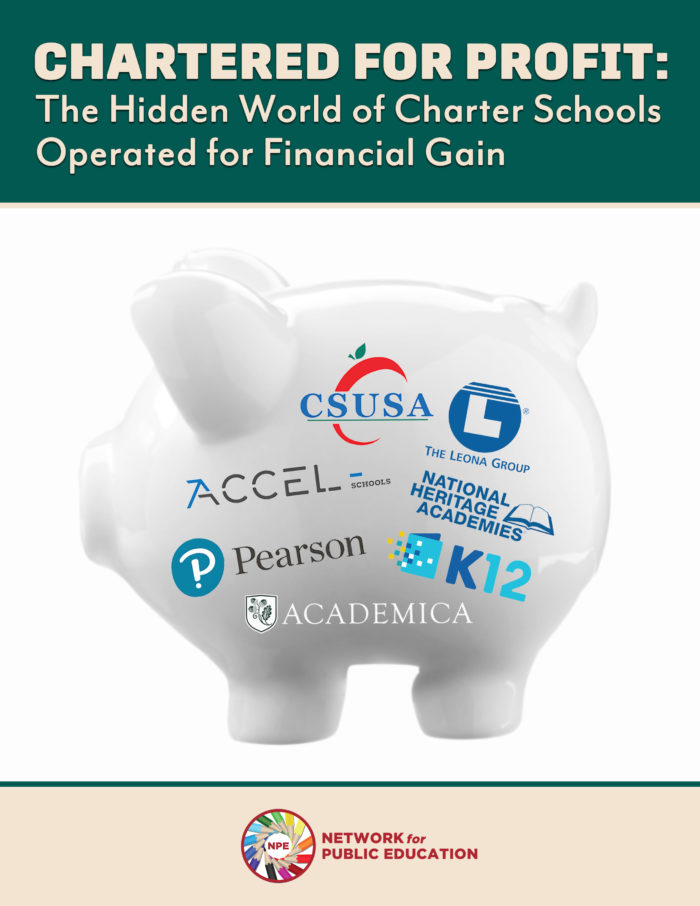
In this report, we focus on the world of charter schools run for profit, a world both hidden and misunderstood. We pull back the veil on tactics and practices designed to reap as many public dollars as possible from charter schools while hiding behind laws designed to keep profit-making hidden from the public’s eyes.  This report exposes how both large and small for-profit companies evade state laws that make for-profit charter schools illegal by the use of related entities and a nonprofit front. We explain and provide examples of how for-profit owners maximize their profits through self-dealing, excessive fees, real estate transactions, and under-serving students who need the most expensive services.

You can view and read the report by clicking the image below.

READ THE COMPLETE  REPORT:  Chartered for Profit: The Hidden World of Charter Schools Operated for Financial Gain - Network For Public Education


CURMUDGUCATION: The Trouble With Data

CURMUDGUCATION: The Trouble With Data
The Trouble With Data


Yesterday the Atlantic published an exceptionally helpful piece in the Science section by Robinson Meyer and Alexis C. Madrigal that offers some excellent explanation of why the nation has dropped the data ball for this pandemic. It's a good read from that perspective. But for education folks, there's more.

In the body of the article, Meyer and Madrigal share some observations about data, and the problems with data-driven anything; these points are important, and should be emblazoned on the office door of every data-driven follow-the-science policy maker and administrator in the country.

1. All data are created; data never simply exist.

Before March 2020, the country had no shortage of pandemic-preparation plans. Many stressed the importance of data-driven decision making. Yet these plans largely assumed that detailed and reliable data would simply … exist. They were less concerned with how those data would actually be made.

Here come the data
Data have to come from somewhere. They have to be created, and then they have to be interpreted. Anyone who assumes that the data are good simply because they exist--well, that's a terrible assumption. Every step pf the data-creation chain, from the testing instrument, to scoring, to score conversion, to interpretation of the score--all of that should be questioned and examined and then questioned again.

But in our high stakes testing era, that has not happened (nor is it happening now). When the state says, "22% of your students are below basic in reading non-fiction," that's not a figure that descended from heaven in a burning memo. It's a number that was created, and everyone ought to be asking how it was created. Starting with a CONTINUE READING: CURMUDGUCATION: The Trouble With Data