Latest News and Comment from Education

Showing posts with label FOR PROFIT SCHOOLS. Show all posts

Saturday, May 22, 2021

Judge: Betsy DeVos Cannot “Quash” Deposition About Her Actions Re: Defrauded Corinthian College Students | deutsch29: Mercedes Schneider's Blog

Judge: Betsy DeVos Cannot “Quash” Deposition About Her Actions Re: Defrauded Corinthian College Students | deutsch29: Mercedes Schneider's Blog
Judge: Betsy DeVos Cannot “Quash” Deposition About Her Actions Re: Defrauded Corinthian College Students


Former US ed sec Betsy DeVos did not want to give a formal, in-person account of her decision to side with defunct, for-profit, California-based Corinthian Colleges by not granting monetary relief to hundreds of thousand of students defrauded by this federal-aid-sucking monster.

However, on May 19, 2021, US District Judge William Alsup refreshingly denied DeVos’ “motion to quash a subpoena for her deposition.”

Alsup’s denial includes the backstory, excerpted here (parenthetical case references omitted for ease of reading; highlights mine):

Former Secretary of the United States Department of Education Elisabeth DeVos moves to quash a subpoena for her deposition, issued in co-pending litigation before the undersigned. Exceptional circumstances warranting the deposition, the motion is DENIED.

Our underlying suit, Sweet v. Cardona, concerns the lawfulness of the Department of Education’s eighteen-month halt in issuing decisions on student-loan borrower-defense applications under Secretary DeVos. Our story began in 1993 when Congress directed the Secretary of Education to specify the sort of school misconduct that borrowers may assert as a defense against repayment of their student loans. This “borrower-defense” apparatus lay dormant for its first several decades until May 2015 when the large for-profit college, Corinthian Colleges, Inc., collapsed. Students submitted a “flood” of borrower-defense applications, so Secretary John B. King appointed a special master in June 2015 to adjudicate claims and then updated the borrower-defense regulations in November 2016. But it remained a game of catch up. By the end of the Obama Administration, the Secretary had approved 31,773 applications and found 245 ineligible, for a 99.2% grant rate. Borrowers, however, had submitted 72,877 applications.

In 2017, newly-installed Secretary DeVos moved to rein in the previous CONTINUE READING: Judge: Betsy DeVos Cannot “Quash” Deposition About Her Actions Re: Defrauded Corinthian College Students | deutsch29: Mercedes Schneider's Blog

Friday, March 26, 2021

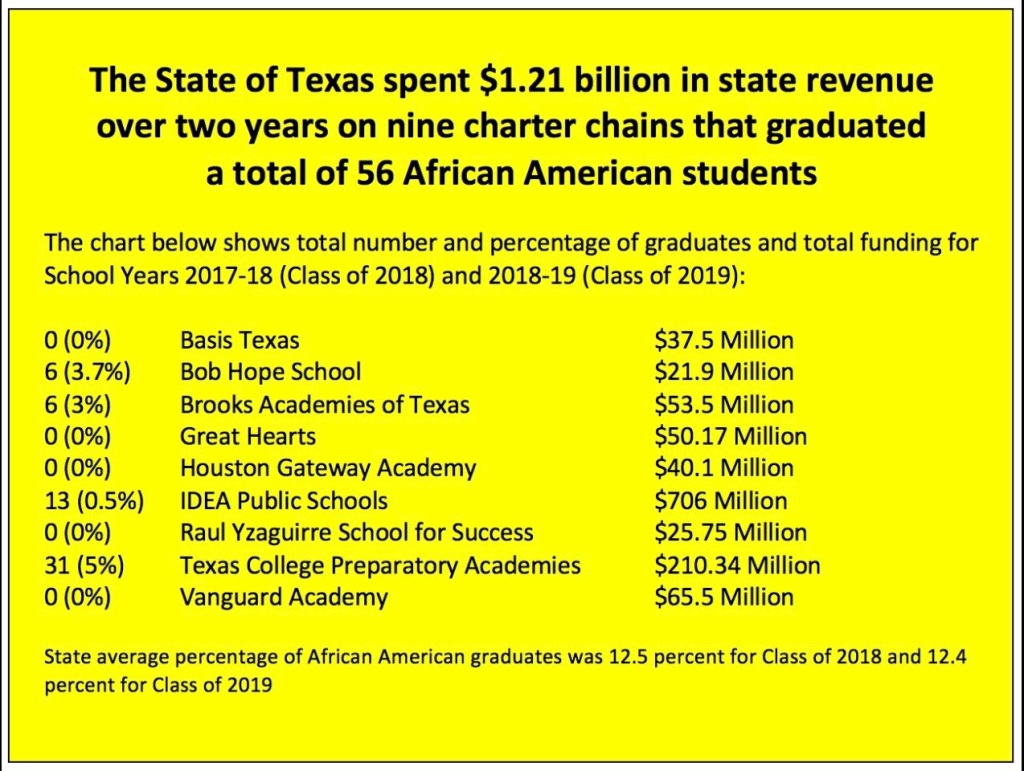
More than $1 billion for 56 Black charter graduates!? | Cloaking Inequity

More than $1 billion for 56 Black charter graduates!? | Cloaking Inequity
MORE THAN $1 BILLION FOR 56 BLACK CHARTER GRADUATES!?


I think this table is very self explanatory. Feel free to spread widely. H/t to my source that passed this along. Stop saying these large charter chains are about Black students. Just stop.

See also the post NEW: DOES THE AFRICAN AMERICAN NEED SEPARATE CHARTER SCHOOLS?

Please Facebook Like, Tweet, etc below and/or reblog to share this discussion with others.

Check out and follow my YouTube channel here.

Twitter: @ProfessorJVH

Click here for Vitae.

Photo credit: IDEA public schools (but no credit because they don’t actually graduate Black students despite their optics and rhetoric)


Sunday, March 21, 2021

Strategies Used to Maximize Profit From Charter Schools: A Reader’s Guide - YouTube

Strategies Used to Maximize Profit From Charter Schools: A Reader’s Guide - YouTube
Strategies Used to Maximize Profit From Charter Schools: A Reader’s Guide 


In this report, we focus on the world of charter schools run for profit, a world both hidden and misunderstood. We pull back the veil on tactics and practices designed to reap as many public dollars as possible from charter schools while hiding behind laws designed to keep profit-making hidden from the public’s eyes.  This report exposes how both large and small for-profit companies evade state laws that make for-profit charter schools illegal by the use of related entities and a nonprofit front. We explain and provide examples of how for-profit owners maximize their profits through self-dealing, excessive fees, real estate transactions, and under-serving students who need the most expensive services.

You can view and read the report by clicking the image below.

READ THE COMPLETE  REPORT:  Chartered for Profit: The Hidden World of Charter Schools Operated for Financial Gain - Network For Public Education

Wednesday, March 17, 2021

Chartered for Profit: The Hidden World of Charter Schools Operated for Financial Gain - Network For Public Education

Chartered for Profit: The Hidden World of Charter Schools Operated for Financial Gain - Network For Public Education
Chartered for Profit: The Hidden World of Charter Schools Operated for Financial Gain


In this report, we focus on the world of charter schools run for profit, a world both hidden and misunderstood. We pull back the veil on tactics and practices designed to reap as many public dollars as possible from charter schools while hiding behind laws designed to keep profit-making hidden from the public’s eyes.  This report exposes how both large and small for-profit companies evade state laws that make for-profit charter schools illegal by the use of related entities and a nonprofit front. We explain and provide examples of how for-profit owners maximize their profits through self-dealing, excessive fees, real estate transactions, and under-serving students who need the most expensive services.

You can view and read the report by clicking the image below.

READ THE COMPLETE  REPORT:  Chartered for Profit: The Hidden World of Charter Schools Operated for Financial Gain - Network For Public Education


Wednesday, December 30, 2020

NANCY BAILEY: Amplify and iReady Claim Kindergarten and First Grade “Reading Loss” to Profit From the Pandemic

Amplify and iReady Claim Kindergarten and First Grade “Reading Loss” to Profit From the Pandemic


Are kindergartners falling behind in reading due to the pandemic? Amplify and iReady want us to think so.

But kindergarten teachers should not be forcing children to learn to read during the pandemic. They shouldn’t have been pushing them to read before Covid-19. Nor should kindergartners be forced to read after the coronavirus becomes a bad memory.

Children always used to begin formal reading instruction during first grade. Expecting kindergartners to read by the time they get to first grade is bizarre. Still, by making children look like they’re falling behind, companies can make money on reading remediation and tutorial programs. During the pandemic it’s called the covid slide. 

Education Week promotes this wrong message in Students’ reading losses could strain schools’ capacity to help them catch up. They say Amplify and iReady claim children fall behind in reading because they are entering first grade not knowing how to read.

It’s going to cost billions, according to iReady, to remediate these so-called reading CONTINUE READING: Amplify and iReady Claim Kindergarten and First Grade “Reading Loss” to Profit From the Pandemic

Monday, December 28, 2020

Learning Pods: Quite the Lesson for Adults | deutsch29: Mercedes Schneider's Blog

Learning Pods: Quite the Lesson for Adults | deutsch29: Mercedes Schneider's Blog
Learning Pods: Quite the Lesson for Adults


As the time approached for the 2020-21 school year to begin, I remember reading about parents of means turning to “learning pods” as an option for creating a sort of one-room schoolhouse experience for a small group of children. Also referred to as “pandemic pods,” the idea is to provide a means for social interaction and face-to-face instruction to supplement the less-desirable online instruction that these children might otherwise be facing during the pandemic.

There are even freshly-created entities such as this one, Learning Pods (a New York- and San Francisco-school “collaboration” that can apparently somehow process contributions from foundations), willing to facilitate a learning pod experience for preschool or K-5 children. Interested in pricing? Use this handy pricing calculator to learn that the estimated cost for a K-5 student who is involved five days a week (where a “day” is 9AM – 2PM for K-5) in a pod of 4 students is $3,320 a month. The cheapest appears to be $893 a month for a preschool pod of 6 kids meeting 3 days a week for under three house a day (9AM – 11:45AM). (Financial aid is available; one can apply for private school financial aid using this application that costs $51 to submit.)

If you have the means and live in SF or NY and have the pod membership all lined up but have no teacher, and Learning Pods has no teacher for your pod, you can fill out this “teacher not found form pod” form, and we’ll see what happens. The form includes the question of who is pod captain, whether the pod is indeed complete (minimum of 3 kids), whether pod has a location, whether pod includes children with “learning differences or CONTINUE READING: Learning Pods: Quite the Lesson for Adults | deutsch29: Mercedes Schneider's Blog

Friday, December 4, 2020

Beware of Fake Colleges. Learn to Recognize Them. | deutsch29: Mercedes Schneider's Blog

Beware of Fake Colleges. Learn to Recognize Them. | deutsch29: Mercedes Schneider's Blog
Beware of Fake Colleges. Learn to Recognize Them.


My seniors are in the process of considering postsecondary education, and given the proliferation of fraudulent sites purporting to offer postsecondary degrees (and the reality that online education is increasingly attractive during a pandemic), it is important for graduates and their parents to know identifiers of potentially fraudulent or otherwise shady online *insitutions of higher learning.*

To that end, I found a listing of fake universities (“degree mills”) on the site, geteducated.com. For each fake or otherwise suspicious school, the site offers a brief explanation of the problems with the school, including important information about accreditation (i.e., the way in which the public can know that a program or institution actually delivers a quality education), cautions about fraudulent operators choosing names that sound similar to respected institutions, and even the web address can be an indicator (ending in .edu is likely legit, but ending in .com is suspect).

Below are a few excerpts from the hundreds of entries on the geteducated.com “Degree Mills” listing:

Abet International University

This online college is not accredited by any agency recognized by the Council of Higher Education Accreditation or the US Department of Education. This college is licensed to operate as an educational business in the State of Michigan.

Abet International posts a telephone contact number in Michigan (USA). No mailing address can be confirmed in the USA. No college accreditation can be confirmed to award degrees. This business has previously advertised as operating from Florida and offering cheap, fast MBA degrees. …

American Capital University (Various Locations)

There is no accreditation status for this school.  It is not recognized by the US CONTINUE READING: Beware of Fake Colleges. Learn to Recognize Them. | deutsch29: Mercedes Schneider's Blog
Monday, October 19, 2020

CURMUDGUCATION: Call Made For DeVos To Cut Off Fraudulent College Chain

CURMUDGUCATION: Call Made For DeVos To Cut Off Fraudulent College Chain
Call Made For DeVos To Cut Off Fraudulent College Chain

Last week, an assortment of organizations signed off on a letter to Education Secretary Betsy DeVos, from the AFT to the Feminists Majority Foundation to the Education Trust to the Young Invincibles

This crew came together to insist that the time has come for the department to finally cut the Center for Excellence in Higher Education (CEHE) off from any federal money. Let me give you the short form explanation of what's going on, because among other things, it's a great demonstration of how the non-profit private school dodge is still a great way for hucksters and grifters to collect a mountain of money, much of it from the taxpayers, and how these profiteers have burrowed into the department of education.

I'm going to lean heavily on the work of one other co-signer-- attorney David Halperin, who has followed this tale for years. And I'll warn you up front--this is a twisty mess.

We can start back in 2012. Carl Barney the owner-operator of several for-profit colleges including Stevens-Haneger, CollegeAmerica, and California College. According to Patricia Cohen in 2015 at the New York Times, in 2012 Barney sold these profit schools to a Denver non-profit, the Center for Excellence in Higher Education. According to court documents, that non-profit consisted entirely of just one guy--Carl Barney. Hold onto your hat for this next part.

Barney has always been a busy guy, but only a few critics have really gone digging as much as this CONTINUE READING: CURMUDGUCATION: Call Made For DeVos To Cut Off Fraudulent College Chain


Thursday, October 8, 2020

Jeff Bryant: How online learning companies are using the pandemic to take over the classroom - Alternet.org

How online learning companies are using the pandemic to take over the classroom - Alternet.org

How online learning companies are using the pandemic to take over the classroom


This article was produced by Our Schools.

Opening schools during a pandemic in an underfunded urban district like Providence, Rhode Island, where buildings are in miserable physical conditions, is already a huge undertaking, but the situation is made worse when district leaders bring in private contractors who know nothing about the community and make no effort to collaborate with public school teachers. That's what's happening in Providence, according to Maribeth Calabro, the president of the Providence Teachers Union, who spoke to me in a Zoom call.

As part of its plan to start the new school year with a gradual opening for in-person learning and an online option for all students, the district announced the creation of a new Virtual Learning Academy operated by Scottsdale, Arizona-based company Edgenuity.

When Calabro looked into Edgenuity, she found out the parent company, Weld North Education, was owned by a private equity firm, which had recently acquired Odysseyware. She recalled that when Providence had used Odysseyware for a high school credit recovery program there were problems with students cheating. "Students were quickly flying through courses that should have taken weeks or months," she remembered.

Calabro is also concerned the Edgenuity platform requires little to no human instruction from Providence teachers and will instead rely on learning coaches, who are expected to be the parent, guardian, or someone else in the household of each child. She feels most parents signing up for the program may not realize this because the district's description of the program largely relegates the complete explanation of the responsibilities of a learning CONTINUE READING: How online learning companies are using the pandemic to take over the classroom - Alternet.org

Sunday, August 30, 2020

CURMUDGUCATION: Brookings Makes A Bad Pro-Charter Argument

CURMUDGUCATION: Brookings Makes A Bad Pro-Charter Argument

Brookings Makes A Bad Pro-Charter Argument


Mona Vakilifathi graduated from the4 University of California, San Diego, with a BS in political science and government back in 2009, and she's been working policy jobs ever since. Over at Brookings, she has some thoughts about Democrats, charter schools, and ed policy, and while she seems to mean well, she has missed a few spots here and there. I've read it so you don't have to.


Let me get the answers from you!
She opens by repeating the reformster narrative that charters divide Democrats along racial lines, citing the "research" from DFER showing that Black voters want charter schools. The poll (from May of 2019) is another one of DFER's attempts to push the narrative in a pro-charter direction. That poll was particularly riddled with questionable technique and spin. And most of the Black Democrats want charters "data" has come from people trying to push charters. So her premise is problematic.

She also offers a quick history of recent "evolving politics"by citing Trump and DeVos as charter supporters, however, DeVos and Trump have left charter schools behind, throwing their weight behind voucher programs like the DeVosian Education Freedom voucher program. This may be CONTINUE READING: 
CURMUDGUCATION: Brookings Makes A Bad Pro-Charter Argument

Monday, August 17, 2020

Public funds should support public schools, right? Trump and DeVos say 'no.'

Public funds should support public schools, right? Trump and DeVos say 'no.'

Public funds should support public schools, right? Trump and DeVos say ‘no.’


This is a guest post by Sharon Krengel, Policy and Outreach Director of Education Law Center. See below for more on the Public Funds Public Schools campaign.
You’ve got to hand it to Education Secretary Betsy DeVos.
Even during a pandemic that’s hitting the U.S. hard and caused every state to physically close schools, she has not wavered from her agenda of using public dollars to subsidize private education. Her boss, President Trump, has spent the past few months trying to help her out, pushing private school voucher policies that have failed for years to gain congressional support.
Now come two federal bills that make no illusions about diverting taxpayer dollars to private schools, even though the nation’s public schools are struggling mightily to reopen their doors while simultaneously improving virtual learning for students who will still be at home.
Senate Republicans recently put forward a stimulus bill that would divert approximately 10 percent of the $70 billion earmarked for K-12 education to private schools. At the same time, Senators Lamar Alexander and Tim Scott have introduced a tax credit voucher bill that would divert $5 billion annually in federal tax reimbursements for contributions to organizations that give out private school vouchers.
Some state leaders aren’t waiting to see if either bill becomes law. The governors of South Carolina, New Hampshire, Oklahoma, and Florida have declared their intention to divert portions of their CARES Act funds—coronavirus relief aid passed by Congress earlier this year—to private school vouchers. In South Carolina, a judge put a temporary hold on Governor McMaster’s decision to use $32 million in pandemic aid for vouchers.
And a recent report showed that private schools across the country received between $2.67 and $6.47 billion from the Paycheck Protection Program, a source of federal pandemic aid under the CARES Act unavailable to traditional public schools.
What does all this mean? Already underfunded public schools, which are open to all and educate 90 CONTINUE READING: Public funds should support public schools, right? Trump and DeVos say 'no.'

Wednesday, August 12, 2020

OPC vs jd – who would you choose? | JD2718

OPC vs jd – who would you choose? | JD2718

OPC vs jd – who would you choose?


So pretend for a moment that you are an NYCDoE principal and that you need to get September ready and you can have an outside helper, and you have it narrowed down to the Overpaid Private Consultant (OPC) that the DoE uses, or me (JD)… and all you have to go on are these little bits that each of us wrote about entry into buildings. Read on, and prepare to make your choice.

Overpaid Private Consultant

Checklist for General Student Entry Procedures

(from the 2020 – 2021 School Year | Reopening Playbook for Principals)

playbook-for-principals-2020-2021-school-reopening – p22

      •   Yes, our school entry procedures align with health and safety measures related to temperature checks. Yes, I have referred to Health Policy for up-to-date guidance on temperature check protocols.
      •   Yes, our school (and campuses if applicable) has assigned sufficient staffing to accommodate multiple points of entry should identify these multiple points of entry, ensure that students report to classrooms, and avoid shared spaces at the beginning of the day.
      •   Yes, sufficient staff to ensure that students are supported in maintaining physical distancing and using PPE supervises each point of entry.
      •   Yes, this includes staff presence outside the school building to support students and families lining up for entry.
      •   Yes, either I, as school principal, and/or the Building Response Team (BRT) Leader in CONTINUE READING: 
      • OPC vs jd – who would you choose? | JD2718


CURMUDGUCATION: AEI: Previewing New Reformy Rhetoric

CURMUDGUCATION: AEI: Previewing New Reformy Rhetoric

AEI: Previewing New Reformy Rhetoric


Over at AEI, Robert C. Enlow and Jason Bedrick have some thoughts for new, improved rhetoric for pushing school choice. It's worth a look to see where the argument is headed in the year ahead.

Enlow is the president/CEO of EdChoice (formerly the Milton Friedman Foundation for Educational Choice). Bedrow is the director of policy at EdChoice, as well as a scholar the Cato Institute.

Given their background and affiliation, there is no surprise with their kick-off premise, which is that conservatives should still keep choice at the heart of their education agenda. This is framed as a resolution to the tension between choice and accountability, which has indeed always been a problem with reformster rhetoric--it's hard to create a world in which schools are held tightly to standards and test-centered accountability but certain schools are also free to do whatever.

Accountability has been doomed as a reformy cause for a while now. For one thing, it has already accomplished the task of cementing the narrative that public schools are "failing," and for another, charters haven't turned out to be any better at the accountability game than public schools. And CONTINUE READING: 
CURMUDGUCATION: AEI: Previewing New Reformy Rhetoric

Sunday, August 2, 2020

solidaridad: Open Letter to LAUSD Board Regarding the Implementation of AB 1505

solidaridad: Open Letter to LAUSD Board Regarding the Implementation of AB 1505

Open Letter to LAUSD Board Regarding the Implementation of AB 1505


A copy of this letter was sent to each individual member via email

August 1, 2020

Dear Members of the Board of Education:

I am an educational rights attorney and law professor here in Los Angeles. I live within the boundaries of the Los Angeles Unified School District (“LAUSD”) and I am a registered voter.

I am writing you regarding the implementation of AB 1505. I’m asking you to vote YES on said implementation this Tuesday, August 4, 2020.

As you know, Assembly Bill No. 1505 went a long way towards reigning in the more egregious excesses of the charter school industry. Most notably, it discouraged the practice of “forum shopping” in which a charter school corporations found to be out of compliance with the law, and thus denied a petition or renewal, could circumvent the law by seeking authorization with another authorizer. Public policy supports placing more oversight and accountability on these private entities that divert funding from our public schools.

Assembly Bill No. 1505 also implemented a number of other student-centered policies that force the charter school industry to be more accountable, transparent, and responsive to the communities from which they draw their funding. A key issue advanced by AB 1505 was in regards to credentialing. Students in our communities deserve instruction from educators with appropriate education in child development and pedagogy.

YES vote on the implementation of AB 1505 provides a path for placing pupils over profits.

Sincerely,

-rds


solidaridad: Open Letter to LAUSD Board Regarding the Implementation of AB 1505

Wednesday, July 29, 2020

NYC Public School Parents: 108 NYC charter schools received a windfall averaging $940,000- $2.2 million each in federal PPP funds; check the list here!

NYC Public School Parents: 108 NYC charter schools received a windfall averaging $940,000- $2.2 million each in federal PPP funds; check the list here!

108 NYC charter schools received a windfall averaging $940,000- $2.2 million each in federal PPP funds; check the list here!


The Network for Public Education sifted through the companies and organizations receiving federal funds through the Paycheck Protection Program, meant to keep small businesses and non-profits afloat.  More than 1,300 charter schools and charter management companies received between $925 million and $2.25 billion from the federal government in the last few months, though public schools are not eligible to receive these grants and charter schools so far have not lost any government funding.  This doesn't count an unknown number of charter schools that may have received less than $150,000 in PPP funds, which have not been identified by the government.
What is particularly ironic is that when it suits them, charter schools call themselves public schools, but when its convenient, they admit they are private corporations and thus eligible for business loans and subsidies.
Meanwhile, in NY State there are 144 charter schools and management organizations that received PPP funding, the vast majority of which are in NYC.  Fully 108 NYC charters and charter management companies received between $102 million and $236 million in these funds, with an average of between $940,000 and $2.2 million each.   
The Charter Management Organization of New Visions and its assorted charters received between $6.7 million and $15 million dollars, despite the fact that they receive public school space free of charge and services from DOE.  In 2018, they also received a $14 million grant from the Gates Foundation to "work with" NYC public schools -- which to this day have not been identified.  Coincidentally or not,  the Gates Foundation director of K12 schools Robert Hughes came to the Gates Foundation from New Visions.
Harlem Children's Zone was awarded between $4 million and $10 million; the Hebrew Language Academies, heavily subsidized by billionaire Michael Steinhardt, between $2.8 million and  $6 million.  KIPP charter and KIPP LLC (which I guess is its Management Organization?)  is getting between $3 million and $5 million, despite also receiving $86 million from a federal charter school grant in 2019, and many millions more previously.  Uncommon Charters, which has been criticized for its abusive disciplinary practices, received between $2 million and $5 million in PPP funds. The full state and city list is below.

NYC Public School Parents: 108 NYC charter schools received a windfall averaging $940,000- $2.2 million each in federal PPP funds; check the list here!