Latest News and Comment from Education

Showing posts with label AMERICAN EDUCATION. Show all posts

Sunday, February 14, 2021

What's In A Blaine? | Blue Cereal Education

What's In A Blaine? | Blue Cereal Education
What's In A Blaine?


I've written about the Blaine Amendment before in the context of Oklahoma GOP shenanigans a few years back. This time around, I'm looking to go a bit 'bigger picture' and give it a brief chapter in "It Followed Her To School One Day," which might actually be finished before summer. Below is the first draft of that chapter.

The final product will be tighter (this one's too long) and less ranty-ravee about things.While I'm not going for detached and boring in the book, I will shoot for something a bit more balanced and accessible to the average reader. This is not an ethical decision so much as capitalistic lust. I mean, let's be honest - conservative dollars spend the same as liberal dollars, and they have WAY more of them, so no sense alientating them right out of the gate. Keep it subtle, so they can be offended and horrified after it's too late to return it.

Here with you, however, my Eleven Faithful Followers, I can share my unfiltered wisdom with spices and color intact. 

What's In A Blaine?

Blaine GatorsWhile it was not always mentioned by name, several major decisions of the Court in the early 21st century very much involved the history and potential future of the “Blaine Amendment.” Blaine is a general label applied to various provisions in 37 different state CONTINUE READING: What's In A Blaine? | Blue Cereal Education

Tuesday, January 12, 2021

As DeVos exits, where does education go next? - CSMonitor.com

As DeVos exits, where does education go next? - CSMonitor.com
As DeVos exits, where does education go next?
WHY WE WROTE THIS
Secretary of education isn’t typically a prominent Cabinet position. But the resignation of Betsy DeVos, whose tenure brought considerable controversy, is prompting discussion about where education should go from here. 


Education Secretary Betsy DeVos is one of the highest profile Cabinet members to resign from President Donald Trump’s administration, writing in the wake of the rampage at the Capitol, “Impressionable children are watching all of this, and they are learning from us.” 

“There is no mistaking the impact your rhetoric had on the situation, and it is the inflection point for me,” she wrote to the president on Jan. 7.

Her departure on Friday was a dramatic finale for one of the longest-serving, and most controversial, members of President Trump’s senior administrative team – ending one of the most highly charged tenures in the history of the Education Department.

For four years, scholars say, Ms. DeVos used the bully pulpit of the department to fundamentally shift the American conversation around schools. In her dogged pursuit of what many saw as a radical, free market approach, she unraveled a decadeslong truce between Republicans and Democrats when it came to education policy. She advocated for school choice, including vouchers for private and parochial schools, and regularly attempted to cut the funding of her own department, saying publicly that she would be happy to work herself out of a job. On her way out the door she made available $2.75 billion in funds earmarked for non-public schools in the relief act signed into law in December.

While many supporters praised her resignation as courageous, and offered glowing reviews of her tenure as secretary, critics called the move “hypocritical.” Her rhetoric, they claimed, had helped fuel the anger and anti-government sentiments that many of the Trump supporters expressed Wednesday. Many on the left also saw Ms. DeVos as undermining what had long been a bipartisan commitment to public schools and also systematically dismantling civil rights protections for students. CONTINUE READING: As DeVos exits, where does education go next? - CSMonitor.com


Thursday, December 10, 2020

Norms, Ethics and Civility. Plus Education. | Teacher in a strange land

Norms, Ethics and Civility. Plus Education. | Teacher in a strange land
Norms, Ethics and Civility. Plus Education.


Early in 2016, when it became apparent that Donald Trump would be the Republican nominee for president, the question emerged: just what percentage of the population actually endorsed his brand of brash white nationalism? It always felt impossible that more than a small sliver of the country would honestly embrace (not just tolerate) his behaviors and proclamations.

A lot of us were counting on norms, ethics and civility—plus our historic institutions—to make a Trump presidency more like All Other Presidencies. Now we’ve seen how that turned out. Do we still get to call for reasonable and ethical behaviors?

There was a gut-wrenching piece in the Washington Post yesterday about a mask mandate in Mitchell, South Dakota. If there ever were a place where neighborly norms and civility ought to reign, where people would be willing to help others, it’s small-town South Dakota. A friend of mine used to live there. Her husband was a Methodist minister. If people in Mitchell were like Donna and Dick, they’d be masked up, washing their hands, and dropping food off on ill neighbor’s porches.

But it turns out that they’re not. In fact, many of them are adamantly anti-mask, anti-science. As beloved coaches and grandmothers are dying, they’re insisting on falsehoods. These people aren’t evil, and it’s wrong to dismiss them as dumb and worthless. They are still following community norms. It seems to me that what’s CONTINUE READING: 
Norms, Ethics and Civility. Plus Education. | Teacher in a strange land

Sunday, November 8, 2020

Education in a Biden Presidency in a Deeply Divided Nation: What Can We Expect? | Ed In The Apple

Education in a Biden Presidency in a Deeply Divided Nation: What Can We Expect? | Ed In The Apple
Education in a Biden Presidency in a Deeply Divided Nation: What Can We Expect?


On November 2nd, the day before Election Day pollsters and talking heads were predicting a blue wave, a Biden presidency, a Democratic Senate and House and a long list of “progressive” initiatives.

Five days later the networks are predicting a thin, an incredibly thin Biden victory, although it might be weeks until states certify election results. Ask I peck away on Saturday at noon CNN and MSNBC are calling Pennsylvania putting Biden over the top.

Horns blowing, dancing in the streets, Joe Biden will be the 46th President of the United States.

President Trump has been tweeting all day charging fraud and filing law suits.

On December 14th electors will cast virtual ballots and on January 6th the Congress will open the ballots and certify the election of the next president.

The Constitution states the “Times, Places and Manner of holding Elections …. shall be proscribed in each State by the Legislature thereof …” it is highly CONTINUE READING: Education in a Biden Presidency in a Deeply Divided Nation: What Can We Expect? | Ed In The Apple

Thursday, October 22, 2020

Parents Are Worried About Schools. Are the Candidates? - The New York Times

Parents Are Worried About Schools. Are the Candidates? - The New York Times
Parents Are Worried About Schools. Are the Candidates?
The pandemic has made education a top issue for many voters. But you wouldn’t know that from the candidates’ stump speeches.


Communities large and small are battling over whether and how to reopen schools closed since March. Superintendents are warning of drastic budget cuts on the horizon, teachers’ unions are calling for standardized tests to be canceled for a second straight year and millions of children are learning remotely, with little evaluation of the impact on their academic growth.

Yet for months now, the extraordinary challenges of schooling during the coronavirus pandemic have not been a dominant campaign theme for either President Trump or his opponent, former Vice President Joseph R. Biden Jr.

That is partly because states and local districts have a larger role than the federal government in funding and running schools. But with so many families deeply affected by the pandemic’s upending of school routines and potentially lasting impact on childhood learning, the lack of thoughtful focus on the issue has frustrated parents and educators alike.

“It should really be a pivotal topic,” said Kisha Hale, principal of the upper grades at Eagle Academy Public Charter School in Washington, which has been providing virtual instruction to its largely low-income students since March. “With Covid-19, there are so many other things taking the focus away from education. But if our future doctors, teachers and lawyers can’t be properly prepared during this time and we’re not talking about it, what is it that we are saying really matters?”


Several recent polls have suggested the issue is a leading concern for many voters. A Politico and Harvard T.H. Chan School of Public Health survey released last month found that schools and education was the second most important issue for likely voters, after the economy and jobs. And a poll conducted this month in Michigan for The Detroit Free Press found that reopening schools and the economy was the top issue concerning voters, followed by the public health crisis posed by the coronavirus.

In his rallies, Mr. Trump reliably mentions that he will fight for school choice and protect charter schools, which is both a pitch to urban Black and Hispanic voters, many of whom split with the Democratic Party on those issues, and a rallying cry for conservatives. And he has consistently called for schools to reopen, threatening at one point to withhold federal funds from those that CONTINUE READING: Parents Are Worried About Schools. Are the Candidates? - The New York Times

Friday, October 16, 2020

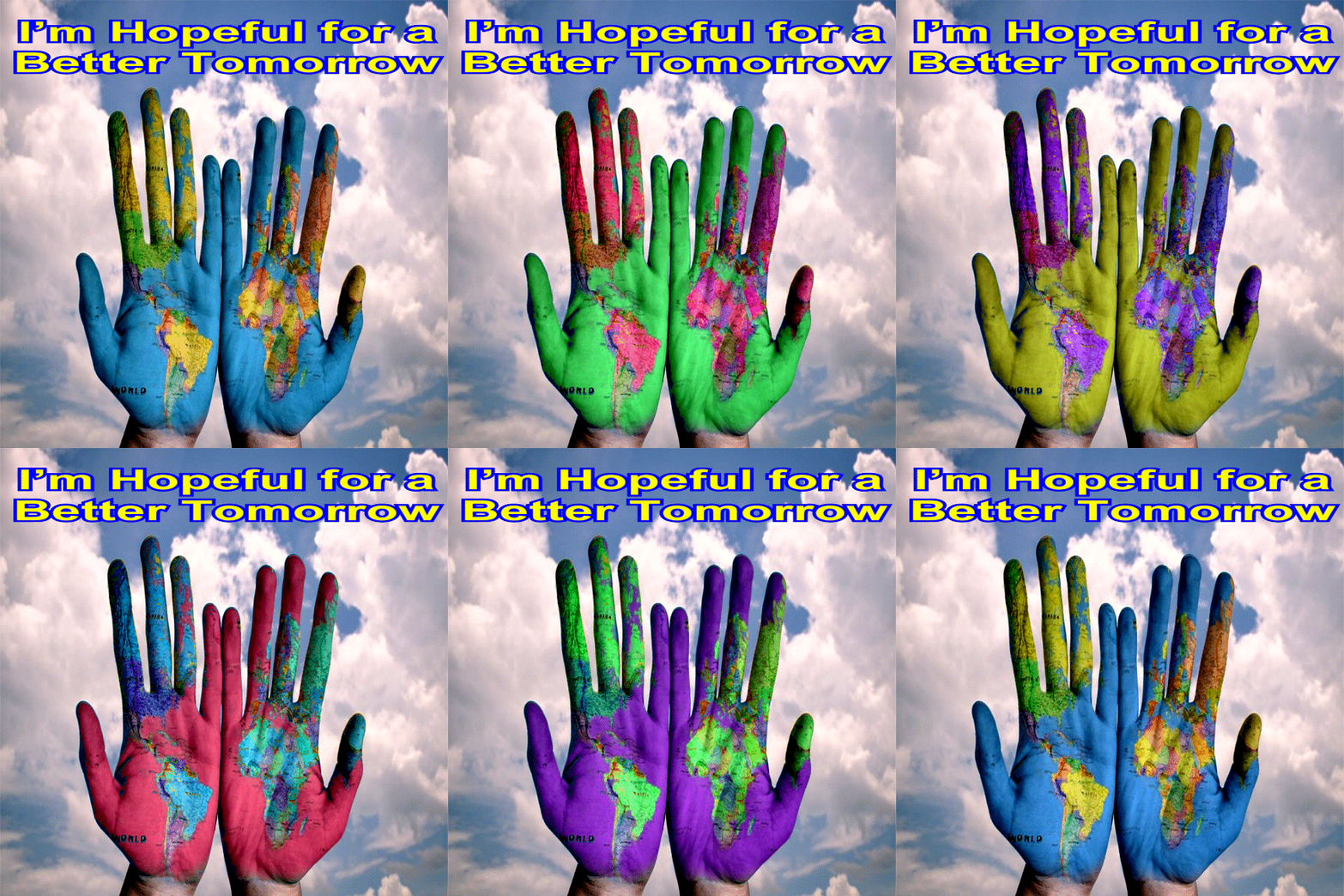
“I’m Hopeful for a Better Tomorrow” (Justin Lopez-Cardoze) | Larry Cuban on School Reform and Classroom Practice

“I’m Hopeful for a Better Tomorrow” (Justin Lopez-Cardoze) | Larry Cuban on School Reform and Classroom Practice

“I’m Hopeful for a Better Tomorrow” (Justin Lopez-Cardoze)


Lopez-Cardoze is a seventh-grade science teacher at Capital City PublicCharter School in Washinton, D.C. He has taught for nine years.
This story appeared in the Washington Post’s online article, October 6, 2020. Lopez-Cardoze is one of nine teachers the newspaper asked to report on their experiences in returning to remote and in-person instruction during the pandemic.
It was the first day of school with students. After eight years of first days, you would think I would feel calm and confident on my ninth. Honestly, each year it gets harder to manage the nerves. You want to do things right; you want your students to like you and say, “This class will be incredible.” On those first days of the last eight years, the moments felt so magical. I would see new faces, bright smiles, goofy personalities and nerves suddenly disappearing. It felt right.
But my ninth first day? I felt uncomfortable. I’m used to hearing and seeing students interacting with each other when I’m presenting on the first day, but in the world of Zoom, all you hear is yourself against multiple tiles on mute — and that day, most of the tiles were blank backgrounds with names. I didn’t hear a laugh. I couldn’t observe body language. What once felt like joy in my classroom CONTINUE READING“I’m Hopeful for a Better Tomorrow” (Justin Lopez-Cardoze) | Larry Cuban on School Reform and Classroom Practice