Latest News and Comment from Education

Friday, March 12, 2021

(Re)Building The Black Teacher Pipeline Is A Component Of Educational Justice - Philly's 7th Ward

(Re)Building The Black Teacher Pipeline Is A Component Of Educational Justice - Philly's 7th Ward
(RE)BUILDING THE BLACK TEACHER PIPELINE IS A COMPONENT OF EDUCATIONAL JUSTICE


Across the entire United States, there aren’t nearly enough Black teachers inside classrooms. 

According to the National Center for Education Statistics, less than 7% of teachers nationwide are Black; only 1.5% of teachers are Black men. That is a problem because Black teachers are a force for equity for all students, especially the Black students who have been historically marginalized. 

Students of all backgrounds who miss out on Black teachers lack exposure to their content knowledge and pedagogical praxis, which is often influenced by their desire to support all students, particularly students they see themselves in. In addition, a 2016 study showed that students perceived Black teachers more favorably than white teachers. When students say that, they are telling us something about the quality of learning and support they are receiving from Black teachers.

BLACK TEACHERS SUPPORT THE ACADEMIC ACHIEVEMENT OF ALL STUDENTS, AND BLACK STUDENTS IN PARTICULAR.

Moreover, Black teachers support the academic achievement of all students, and Black students in particular. Black students who have had at least one Black teacher are more likely to graduate from high school, attend college and are less likely to drop out of school. Black students are also less likely to receive exclusionary discipline at the hands of a Black teacher. 

According to the same 2016 study, students perceived Black teachers (more than their White peers) to hold students to high academic standards, to support their efforts, to help them organize content and to explain ideas CONTINUE READING: (Re)Building The Black Teacher Pipeline Is A Component Of Educational Justice - Philly's 7th Ward

College Deans Speak Out Against High Stakes Testing | Diane Ravitch's blog

College Deans Speak Out Against High Stakes Testing | Diane Ravitch's blog
College Deans Speak Out Against High Stakes Testing


Scores of education deans signed a letter to Rep. Bobby Scott (D-VA), chair of the House Education Committee, in opposition to the recent announcement by the Biden administration that it would not grant waivers to states from the annual testing mandate in the Every Student Succeeds Act, which originated as part of the No Child Left Behind Act of 2002. The letter was written before the confirmation of Secretary of Education Miguel Cardona. The signatures were gathered by Kevin Kumashiro as spokesman for the group.

Dear Chairman Scott,

I am writing as a leader of Education Deans for Justice and Equity (https://educationdeans.org), an alliance of hundreds of education deans across the country with expertise in educational equity and civil rights.

We, in EDJE, are deeply concerned by the recent announcement by the U.S. Department of Education that it will not grant state waivers of ESSA mandates for 2021 student testing, as it did in 2020. Two weeks ago, we sent the attached letter to Secretary-Designate Miguel Cardona, signed by over 200 deans and other leaders, that outlines what we believe the research makes clear, namely, that there are fundamental problems with these tests, that the administration and use of these tests widen CONTINUE READING: College Deans Speak Out Against High Stakes Testing | Diane Ravitch's blog

Newsom’s CA school reopening bill funds extra programs | The Sacramento Bee

Newsom’s CA school reopening bill funds extra programs | The Sacramento Bee
Tutoring, meals and more: What California’s school reopening plan has for families


When Megan Bacigalupi’s sons went to distance learning last March, she knew it wouldn’t be easy.

Now, the two boys who attend kindergarten and second grade in Oakland Unified School District, have been learning through Zoom for more than a year. What was a challenge in 2020 has the potential to impact her sons for years to come.

“Normally they’d be sitting with peers at a table interacting together, learning together, and all of that it’s gone.,” said Bacigalupi, who is part of Open Schools CA, a parent-led push to reopen schools. “So what I have noticed with both my kids is just like the engagement with school, the willingness to do the work. It was hard a year ago, it’s almost impossible now.”

Last week, Gov. Gavin Newsom signed into law a hard-fought funding bill designed to get students back in classrooms this spring. Of the $6.6 billion in state funding for school reopening, $4.6 billion is to be used by schools to mitigate learning loss, aiming to help kids like Bacigalupi’s sons get the supplemental instruction and support they need to catch up from a year of education through screens.

Lawmakers will give schools flexibility in how they want to spend the money, but there are some parameters.

Schools must use at least 85% of the money for in-person instruction, and at least 10% should be used to hire paraprofessionals for supplemental instruction, with a focus on rehiring those who were subject to layoffs.

Otherwise, there’s a wide range of ways schools can use the funds. They can extend the school day or year, launch summer school programs, provide meals to vulnerable students, create extra programming and instruction for students, hire mental health professionals, or create extra training for educators, among other things.

The funds will be portioned out to each school district based on student populations. By June 1, schools must present a plan to use the money. Schools then have until August 2022 to use the learning mitigation funds.

Schools will receive money based on the typical state funding formula, with extra CONTINUE READING: Newsom’s CA school reopening bill funds extra programs | The Sacramento Bee

Biden’s American Rescue Plan is actually a huge new school reform - The Washington Post

Biden’s American Rescue Plan is actually a huge new school reform - The Washington Post
Biden’s American Rescue Plan is actually a huge new school reform


President Biden’s $1.9 trillion American Rescue Plan is aimed at helping the country recover from the coronavirus pandemic — but it is another thing, as well: a major federal school reform unlike those we’ve seen in the past few decades.

While the new law is aimed at helping families get back on their feet and helping businesses and schools reopen after a year of turmoil, it includes measures that together have the potential to slash poverty among the 12 million students who live in low-income households.

Biden himself tweeted recently: “No child should grow up in poverty. The American Rescue Plan will expand the child tax credit and cut the child poverty rate in half.”

Outside estimates on its impact have come to the same conclusion, including one from the nonprofit Center for Budget and Policy Priorities, which said that two key tax credit provisions could “together lift more children above the poverty line, 5.5 million, than any other economic support program.” An Urban Institute analysis of the plan said the child poverty rate in 2021 will fall by more than 52 percent, largely from changes in tax law and the $1,400 stimulus checks that are part of the relief package.


It should be noted that most of the provisions in this new law will remain in effect only for a year or two — and there is no guarantee what will happen beyond then. But directly aiming to reduce child poverty is exactly what many advocates for children have long said is needed.

Policymakers have been focused for decades on improving public schools with a culture based on standardized testing, the expansion of charter schools and other “school choice” measures, and, in some places, the demonization of teachers. Child poverty, they said, was an excuse for poor performance by adults.

But the testing/choice/big data approach has not closed the achievement gap, and on some measures, it has barely moved.

Critics say research clearly shows that standardized test scores are fundamentally a metric of the state of child poverty in America, not of school quality. Students who live in low-income Zip codes virtually CONTINUE READING: Biden’s American Rescue Plan is actually a huge new school reform - The Washington Post

Code Acts in Education: Pandemic Privatization and Digitalization in Higher Education | National Education Policy Center

Code Acts in Education: Pandemic Privatization and Digitalization in Higher Education | National Education Policy Center
Code Acts in Education: Pandemic Privatization and Digitalization in Higher Education


The state of emergency in higher education systems around the world during the Covid-19 pandemic has opened up the sector to an expanding range of education technologies, commercial companies, and private sector ambitions. In our new report commissioned by Education International (the global federation of teacher unions), entitled ‘Pandemic Privatisation in Higher Education: Edtech and University Reform’, we examine various ways commercialization and privatization of higher education have been pursued and advanced through the promotion of edtech and ‘digital transformation’ agendas during campus closures and disruptions over the last year. Although we recognize that digital technologies and private or commercial organizations can bring many benefits to HE, they also raise significant challenges with long-term implications for HE staff, students and institutions. Many of these challenges are long-term political and economic matters as much as they are short-term practical matters of online teaching.

The report is detailed and long enough, but even since we finished it in late 2020, the developments we identified have accelerated and expanded. These include investors seeking to capitalize on new visions of teaching and learning, and multisector coalitions coming together to reimagine the future of HE through digital infrastructure and platform-based transformations — ultimately ‘re-infrastructuring’ and ‘platformizing’ universities to operate according to design principles imported by the digital tech industry. These are profoundly political issues about control, power, influence and governance in HE, mirrored by similar shifts of control to technology in the health sector.

Maybe most of the proposed changes associated with so-called digital transformation won’t work CONTINUE READING: Code Acts in Education: Pandemic Privatization and Digitalization in Higher Education | National Education Policy Center

Bowman and education experts blast Biden admin for mandating standardized tests amid pandemic | Salon com

Bowman and education experts blast Biden admin for mandating standardized tests amid pandemic | Salon.com
Bowman and education experts blast Biden admin for mandating standardized tests amid pandemic
"It's a mistake that reflects a broader problem in American education," Rep. Jamaal Bowman wrote in a statement


Rep. Jamaal Bowman on Tuesday joined progressive education experts in criticizing the Biden administration's decision to mandate standardized testing in schools despite the ongoing coronavirus pandemic. 

Bowman (D-N.Y.)—a former teacher and principal—argued that "prioritizing testing in the middle of the pandemic is a big mistake."

"It's a mistake that reflects a broader problem in American education," the first-term congressman said in a statement. "We have an obsession with arbitrary testing metrics above all else, even in the middle of a pandemic that's dislodged every facet of American life. We've forgotten that testing is one useful tool, and should not be the goal of education in and of itself."

"The pandemic created the world's largest education crisis," asserted Bowman. "All students were impacted, but we know which students took the hardest hit... We must empower educators to provide the best learning environment possible for students. This is not the time to waste time. Let's dive into action to fix the problems we already know exist."

Bowman's statement follows a letter sent Monday by acting Assistant Education Secretary Ian Rosenblum to state school superintendents informing them that the department will not invite state requests for "blanket waivers of assessments" required by the Every Student Succeeds Act, even though such waivers were granted last year CONTINUE READING: Bowman and education experts blast Biden admin for mandating standardized tests amid pandemic | Salon.com


Teacher Tom: Thingmaker Featuring Creepy Crawlers

Teacher Tom: Thingmaker Featuring Creepy Crawlers
Thingmaker Featuring Creepy Crawlers


John Sain was a couple years older than me, which would have made him seven or eight. We always called him by his full name to distinguish him from his next door neighbor who was also named John. John Sain's father, Mr. Sain, had the caché of being retired military and having once killed a rattle snake in his garage with a garden hoe then called us kids in from the street where we were playing so that we could see first hand what these local dangers looked like. He even allowed me the honor of carrying the sack with the corpse around to the back of the house where we buried it. Mr. Sain once sucked blood from a finger I'd cut on a bit of glass while we worked together on a church-organized roadside litter clean-up crew. After spitting the blood onto the pavement, he told me it was to help avoid infection, which sounded both scientific and manly. Having such a father and being older, John Sain stood a little above the rest of us. He went to school during the day and so could only play with us in the evening and on weekends. When he was out there with us, it made our regular games special.

One day, I showed him some small plastic "army men" that I particularly treasured, which prompted him to invite me to his bedroom where he pulled out what he told me was an "army man making set." There was a small heating element, molds portraying the hollows of soldiers in various action poses, and CONTINUE READING: Teacher Tom: Thingmaker Featuring Creepy Crawlers

Pressure on Education Secretary Miguel Cardona Grows: Cancel Standardized Tests in this Crazy COVID-19 School Year | janresseger @teachcardona

Pressure on Education Secretary Miguel Cardona Grows: Cancel Standardized Tests in this Crazy COVID-19 School Year | janresseger
Pressure on Education Secretary Miguel Cardona Grows: Cancel Standardized Tests in this Crazy COVID-19 School Year


There is absolutely no reason why the U.S. Department of Education should refuse to grant states waivers this spring from the federal requirement for standardized testing. Two weeks ago, a Deputy Assistant Secretary in the Department of Education’s Office of Elementary and Secondary Education, Ian Rosenblum released guidance telling states they must test students as required by the Every Student Succeeds Act despite the pandemic. After that, the Senate finally voted to confirm President Biden’s appointment of Miguel Cardona as Secretary of Education.

We all hope that Dr. Cardona will reconsider. And it is becoming clear that the subject is not closed.  Experts, parents, educators, and members of the public continue to press the new Secretary of Education to do the right thing in this year when some students have been in school, many are on hybrid schedules, and many others continue to learn remotely.

Why should Secretary Cardona cancel testing this spring? When Rosenblum announced that he was charging ahead to require testing, he ignored more than a month of informed advocacy by board of education members, education experts, school administrators, schoolteachers and parents—all pushing the Department of Education to grant states waivers to cancel the tests in this COVID-19 year. (See hereherehere, and here.) No one in the Department has provided a convincing justification for requiring that the high-stakes tests be administered this school year.

Opponents of testing this spring have spoken about problems of feasibility when some CONTINUE READING: Pressure on Education Secretary Miguel Cardona Grows: Cancel Standardized Tests in this Crazy COVID-19 School Year | janresseger

10 Year Assessment of Education Reform in DC — a Fraud, says its former director of assessments, Richard Phelps | GFBrandenburg's Blog

10 Year Assessment of Education Reform in DC — a Fraud, says its former director of assessments, Richard Phelps | GFBrandenburg's Blog
10 Year Assessment of Education Reform in DC — a Fraud, says its former director of assessments, Richard Phelps


Stolen from Valerie Jablow:

Looking Back on DC Education Reform 10 Years Later, Part 1: The Grand Tour by Valerie Jablow

[Ed. Note: As DC’s office of the state superintendent of education (OSSE) seeks a waiver of PARCC testing again (recall that OSSE waived PARCC last school year due to the pandemic) and the DC auditor just released a bombshell report of poor stewardship of DC’s education data, it is time to revisit how standardized test data, teacher evaluations, and harsh school penalties were united by ed reformers in DCPS under mayoral control. This first-hand account of what went down in DCPS, the first of two parts by semi-retired educator Richard P. Phelps, appeared in Nonpartisan Education Review in September 2020 and is reprinted here with permission. The author thanks DC budget expert Mary Levy and retired DCPS teacher Erich Martel for their helpful comments in the research of this article.]

By Richard P. Phelps

Ten years ago, I worked as the director of assessments for DCPS. My tenure coincided with Michelle Rhee’s last nine months as chancellor. I departed shortly after Vincent Gray defeated Adrian Fenty in the September 2010 DC mayoral primary.

My primary task was to design an expansion of that testing program that served the IMPACT teacher evaluation system to include all core subjects and all grade levels. Despite its fame (or infamy), the test score aspect of the IMPACT program affected CONTINUE READING: 10 Year Assessment of Education Reform in DC — a Fraud, says its former director of assessments, Richard Phelps | GFBrandenburg's Blog

How My ELL History Students Have Evaluated Our Class – And Me! | Larry Ferlazzo's Websites of the Day...

How My ELL History Students Have Evaluated Our Class – And Me! | Larry Ferlazzo's Websites of the Day...
HOW MY ELL HISTORY STUDENTS HAVE EVALUATED OUR CLASS – AND ME!


As regular readers know, at various times during the school year I have my students complete anonymous evaluations of our classes. I advise them that I always make the results public – to blog readers and to our administrators.

Sometimes that commitment results in unexpected situations, like the year The Washington Post picked up on one of my blog posts and published an article with this headline: NEWS BREAK (not breaking news): Teacher asks students to grade him. One wrote: ‘I give Mr. Ferlazzo an A at being annoying.’

I’ve collected many of those posts, along with other articles about the use of anonymous student surveys, at Best Posts On Students Evaluating Classes (And Teachers).

This post will review the evaluation done my by ELL US History students in our full-time distance learning class (theoretically, we may go to hybrid in May).  It’s the first post about a series of surveys I’ve been doing over the past month.

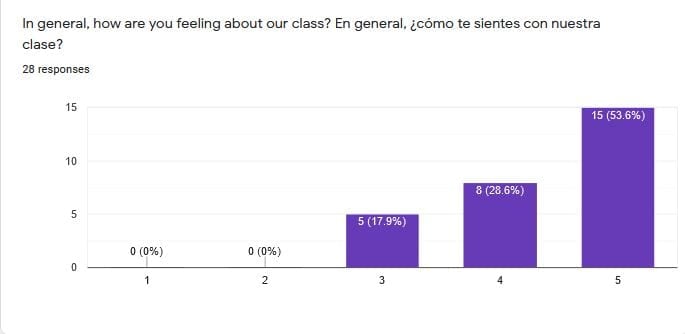
Most of the questions asked students to respond using a linear scale, with 1 being the worst and 5 being the best.

Here’s the first question:

In an ordinary year, I would be disappointed with these results – I’ve usually gotten mostly 5’s.  However, this CONTINUE READING: How My ELL History Students Have Evaluated Our Class – And Me! | Larry Ferlazzo's Websites of the Day...

$240,000 in Mini Grants to Address Education Inequities - Year 2021 (CA Dept of Education)

$240,000 in Grants to Address Education Inequities - Year 2021 (CA Dept of Education)
State Superintendent Tony Thurmond Announces $240,000 in Grants to Address Inequities that Deepened During Pandemic


SACRAMENTO—State Superintendent of Public Instruction Tony Thurmond today announced that the California Department of Education (CDE) has selected 12 recipients of mini grants, totaling more than $240,000, that will fund local efforts across the state to address equity and opportunity gaps through supporting educator and student needs in distance learning, in-person instruction, and hybrid models.

Since the applications were announced in December 2020 as part of CDE’s ongoing efforts to address the COVID-19 pandemic’s continued impact on students, more than 400 schools and districts across California applied for the grants, which are funded by contributions from philanthropic partners. The funds must be used to advance equity and close opportunity and access gaps. The grantees are given discretion to decide how they will address the topic of equity. The list of grantees is at the end of this press release.

“It’s been an unprecedented, unpredictable year for our schools, and California’s educators have been looking for resources and support to ensure that students can still attend class, access a great education, and learn and achieve during the pandemic,” Thurmond said. “Congratulations to these school districts for showing their communities that they’re committed to recognizing and addressing opportunity gaps during the pandemic and providing targeted supports to students and families who have been struggling.”

Issues addressed by the grant funds include transportation, internet connectivity, modifying spaces to serve as family resource centers, one-on-one academic intervention, mentorship for students struggling with distance learning and asynchronous instruction, small group tutoring, home visits, professional development for educators needing assistance with technology, and a variety of other family engagement activities.

Since last spring, the State Superintendent and the CDE have maintained an ongoing and urgent focus on addressing the numerous access and opportunity gaps that impact student learning—gaps that, in many cases, have deepened and become newly exposed during the pandemic. During the past year, the CDE has secured hundreds of thousands of computing devices for students, pressured internet service providers to expand access, bolstered mental health and counseling resources, made it easier for schools to provide meals, and provided guidance and dozens of training opportunities for educators to strengthen distance learning for California’s highest-need students.

As the state continues to battle COVID-19, CDE will continue to support efforts to protect the health and safety of school communities while providing the custom supports needed to ensure learning continues and improves.

The Equity Mini Grant recipients and intended uses of funds are:

  • Antioch Unified School District: $20,000 to implement home-visit teams to gain engagement from students and provide support to students and families that are currently not showing high engagement/attendance.
  • Castaic High School: $20,000 to pay for district buses to pick up students from a central location in an underserved neighborhood.
  • Colusa Unified School District: $20,000 for transitioning the current Colusa High School Library to serve as a student and parent resource center.
  • Imperial Unified School District: $20,000 to support internet connectivity for our students who live in an underserved area.
  • Kern High School District: $20,000 to provide one-to-one academic intervention and support for students with unique needs who have failed multiple classes.
  • Lakeside Union School District: $20,000 to provide mentor support to students who continue to struggle with engagement in asynchronous instruction.
  • Riverside County Special Education: $20,000 to purchase book bags, books (English/Spanish sets), educational materials/manipulatives for arts and crafts, and staff mileage reimbursement for the home delivery of weekly literacy bags.
  • San Ysidro School District: $20,000 to provide support services to students and families to address the academic and technological needs of students and families.
  • Sundale Union Elementary School District: $20,000 to strengthen family connection with parents by having students on campus in small cohorts during non-school days/intercessions.
  • Tehachapi Unified School District: $21,352.32 to provide additional opportunities for credit recovery for seniors who are at risk of not graduating.
  • Twin Rivers Unified School District: $20,000 to train and provide support to teachers displaying the highest needs for support during distance learning.
  • West Contra Costa Unified School District: $20,000 to expand capacity to provide outreach and mentorship to students by hiring a full-time mentor through the Peacemaker program.

# # # #

Tony Thurmond — State Superintendent of Public Instruction
Communications Division, Room 5602, 916-319-0818, Fax 916-319-0100


CURMUDGUCATION: FL: Let's Assess Four Year Olds

CURMUDGUCATION: FL: Let's Assess Four Year Olds
FL: Let's Assess Four Year Olds


We have been down this road before, but I will beat this drum till my knuckles bleed (and the older my children and my grandchildren get, the harder I'll drum). 

Florida is once again reporting that 40% of Florida kindergartners are "not ready for kindergarten." Rep. Erin Grall (R) told a House early learning subcommittee "That's on us," as part of her pitch for HB 419, a bill intended to restructure Florida's early learning "system."

Florida has been spent a few years giving five year olds their own version of the Big Standardized Test to measure kindergarten readiness, and it has consistently found that nearly half of Florida's littles "are not ready" for kindergarten.

Clearly there is a problem, and the Florida legislature has been steadfast about looking for that problem in the wrong place.

If half of your five year olds are "not ready" for kindergarten, the problem is with either A) your instrument for measuring readiness and/or B) your expectations for what "readiness" looks like.

I bolded that because all caps would just be rude. But nobody in power in Florida seems to be looking at this answer.

There's the Children's Movement of Florida that wants to get to 10% kindergarten readiness by 2030. The group is a real cross-section of Florida's education policy-makers. Founded by David Lawrence, a CONTINUE READING: CURMUDGUCATION: FL: Let's Assess Four Year Olds

NewBlackMan (in Exile) TODAY #BLM #BLACKLIVESMATTER

 NewBlackMan (in Exile)


NewBlackMan (in Exile) TODAY


Big Education Ape: THIS WEEK WITH NEWBLACKMAN (IN EXILE) - http://bigeducationape.blogspot.com/2021/03/this-week-with-newblackman-in-exile-blm.html


Sanya N’Kanta On Precious Time With Family
"Jamaican-born, North Carolina-based singer and songwriter Sanya N’Kanta has written songs about race and immigration, but his new EP is about the simple pleasures of family and home. N’Kanta started off in music producing hip hop, but he’s adept at all kinds of styles, with an impressive vocal range. Sanya N’Kanta moved to North Carolina a few years ago from Chicago, after a long bout with illne
Soul to Soul at 50: A Look Back at Ghana’s Legendary Music Festival
"On March 6, 1971, a group of some of the top musicians from the United States -– Ike and Tina Turner, Wilson Pickett, the Staple Singers, and more -– boarded a plane bound for Ghana to perform in a musical celebration that was dubbed the “Soul to Soul Festival.” Thousands of audience members filled Accra’s Black Star Square for a continuous 15 hours of music. The festival was planned in part for
Left of Black S11 · E18 | The Nation of Islam in the Civil Rights Struggle with Garrett Felber
What is the legacy of the Nation of Islam in the struggle for Black equality? The narratives we use to help us look back at the past to celebrate our triumphs over Jim Crow seem to fall short of remembering all that the Nation of Islam did to help lay the foundation. In this episode of Left of Black , host and Duke University Professor Mark Anthony Neal sits down with University of Mississippi of
Lorraine Hansberry and Gwendolyn Brooks: Darlings of the White Liberal Establishment?
"On the 62nd anniversary of the Broadway premiere (March 11, 1959) of Lorraine Hansberry’s A Raisin in the Sun , Tight Rope host Dr. Cornel West and Professor Tricia Rose reflect on the Black literary tradition as they focus on the legacy of both Lorraine Hansberry and Gwendolyn Brooks as revolutionaries and exemplars who are often misunderstood as the “darlings of the white liberal establishment
Invisible Blackness – Double Oppression: the Black Woman, an Interview with Ladybug Mecca
" Digable Planets was the pinnacle of cool for early 1990s hip hop culture. LadyBug Mecca was the sole female voice of this seductive trio of music revolutionaries, waltzing the line between pop crossover culture and conscious hip hop. In this episode of Invisible Blackness , Adrian Younge and LadyBug Mecca discuss the power behind the black female voice in culture's past, present and future."
Soulful Stitching: The Visual Art of The Siddis of Karnataka, India
"The Siddis of Karnataka, India are the descendants of both early African immigrants to South Asia and enslaved Africans brought to Goa on India’s west coast by the Portuguese beginning in the 16th century. Gradually, they escaped slavery and moved southward into the remote Western Ghatt mountains of Northern Karnataka in order to create free, independent African diaspora communities. While they
Perspectives on Anti-Blackness in the Arab World
"Anti-Black racism exists all over the globe, but varies according to the context and society. In Arab societies, anti-black racism is pronounced, widespread, and largely denied by the intelligentsia, the ruling elites and

 NewBlackMan (in Exile)