Latest News and Comment from Education

Saturday, September 26, 2020

I Can’t Shield My Daughter From Both Coronavirus AND Edmentum – Our District’s Crappy On-line Learning Platform | gadflyonthewallblog

I Can’t Shield My Daughter From Both Coronavirus AND Edmentum – Our District’s Crappy On-line Learning Platform | gadflyonthewallblog

I Can’t Shield My Daughter From Both Coronavirus AND Edmentum – Our District’s Crappy On-line Learning Platform


Being a parent during a global pandemic means having to make difficult decisions.
The most pressing of which seems to be: from which Coronavirus spawned horror should I shield my child?
As schools slowly reopened in my neck of the woods, it was basically a choice between in-person instruction or remote learning.
Do I allow my child the benefits of a living, breathing teacher but risk the COVID-19 incubator of a physical classroom environment – or do I keep her safe at home but parked in front of a computer all day?
It’s not an easy call.

CURMUDGUCATION: CT: Another Edu-phauxlanthropist Fails Hard

CURMUDGUCATION: CT: Another Edu-phauxlanthropist Fails Hard

CT: Another Edu-phauxlanthropist Fails Hard


It was just last fall that we were all talking about Ray and Barbara Dalio and their big plans for helping education in Connecticut. Now, less than a year later, the dream is dying an ugly public death.

In many ways, the Dalio's didn't look like the usual phauxlanthropic edu-dabblers.


He is a successful hedge fund manager and the richest guy in Connecticut. She immigrated from Spain fifty-ish years ago and worked at the Whitney before settling into the mom-and-kids track. He has announced that capitalism is not working, and that income gap is a huge national crisis. When she decided she was interested in working on education, she started visiting actual schools. After a start working with charters and Teach for America, she pulled away and started supporting public schools instead through her philanthropies and organizations like Connecticut RISE. Teachers, even union presidents, describe her as humble, a good listener, "truly a partner."

In the spring of 2019, the Dalios offered up $100 million to the public ed system, to be matched by the state and, maybe, other Rich Folks. It was supposeed to be aimed at students in under-resourced communities. Even the state teacher union president said that public-private partnerships usually stink, but this one smells rosy.

But that rosy aroma faded fast. Dalio, for all his noise about the failures of capitalism, still thinks CONTINUE READING: CURMUDGUCATION: CT: Another Edu-phauxlanthropist Fails Hard

NANCY BAILEY: The Longtime Plan for Screens to Replace Teachers: School Choice the Prenda Way

The Longtime Plan for Screens to Replace Teachers: School Choice the Prenda Way

The Longtime Plan for Screens to Replace Teachers: School Choice the Prenda Way


No matter your viewpoint on the coronavirus, for those who care about democratic public schools, our fears merge when it comes to worrying that technology will replace teachers and end those schools. Covid-19 is the perfect storm, and Prenda micro-schools are the prototype. These are schools that focus on commercial tech programs without real teachers. Students learn by screens. Getting rid of teachers is a massive goal of the privatization movement. It’s not a new goal, either.
In 1992, The Nation published a report, “A small circle of friends: Bush’s new American schools.” President H. W. Bush, then Education Secretary Lamar Alexander, and Fortune 500 C.E.O.s launched the New American Schools Development Corporation (NASDC).
The report says, It was the centerpiece of Bush’s education plan and was supposed to mark the emergence of corporate America as the savior of the nation’s schoolchildren.
The NASDC didn’t become the revolution they planned, but it’s easy to see their fingerprints on the corporate push for school privatization today, including the influence of technology.
Here are some excerpts of The Nation’s report.
Perhaps most chilling, many of the plans approved by NASDC use CONTINUE READING: The Longtime Plan for Screens to Replace Teachers: School Choice the Prenda Way

Black Lives Matter When Black Minds Do - Philly's 7th Ward

Black Lives Matter When Black Minds Do - Philly's 7th Ward

BLACK LIVES MATTER WHEN BLACK MINDS DO


By now the names of George Floyd, Breonna Taylor and Rayshard Brooks have permeated our national dialogue. That is to say, most white Americans can identify them as the latest victims of an unjust and violent policing culture in our country.
And while police violence is a daily threat to people of color, it is just one articulation of the deadly inequity of our society. The COVID-19 pandemic is another chilling instance of it. We see it acutely here in Philadelphia. Black residents have been hospitalized more than all other races and ethnicities combined, and they are dying at twice the rate of white Philadelphians.
As a Black man, more generally, I have lived among the fallout of structural racism and institutionalized injustice in my own life. As a Black educator, I have seen its pernicious reach through the lives of my students. I myself have been arrested, assaulted and harassed by police during my time as a teacher and principal.
When I reflect on the sweeping movement now underway, I cannot help but wonder if our newly woke allies sharing out social media solidarity will truly stand with us after their sudden indignation settles. Once corporate America decides this “moment” has passed, will Black Lives (still) Matter? All of which underscores the fundamental question: What would it look like for this CONTINUE READING: Black Lives Matter When Black Minds Do - Philly's 7th Ward

Kendall Deas: Good Schools are the Basis of Economic Success | Diane Ravitch's blog

Kendall Deas: Good Schools are the Basis of Economic Success | Diane Ravitch's blog

Kendall Deas: Good Schools are the Basis of Economic Success


Kendall Deas, a political scientist at the Kendall Deas is a political science professor specializing in education policy and law in the College of Charleston’s Department of Political Science and Honors College of Charleston in South Carolina and has worked in the field of economic development. In a recent article, he warned the leaders of the state that investing in food schools will do more for the state than corporate tax breaks.
He is responding to a recent study by @GoodJobsFirst showing that South Carolina had cut education by $423 million to subsidize corporations.
Deas begins:
When I was in graduate school I worked for an economic development group that recruited companies to the metro Atlanta area. And time and again when executives would visit, this question would be among the first they’d ask:
“How good are the schools?”
It was very clear to me then that the quality of schools matters a great deal when it comes to attracting investment and jobs.
I’m now back in my native South Carolina where I am an educator and advocate for public education. And I am CONTINUE READING: Kendall Deas: Good Schools are the Basis of Economic Success | Diane Ravitch's blog

Mozert v. Hawkins County Public Schools (The Tale of the Troubling Textbook) - Part Four | Blue Cereal Education

Mozert v. Hawkins County Public Schools (The Tale of the Troubling Textbook) - Part Four | Blue Cereal Education

Mozert v. Hawkins County Public Schools (The Tale of the Troubling Textbook) - Part Four


Good Evening, I'm Pierce Lively...

Winter Is ComingIf you’re interested in far more concise case summaries accompanied by pithy-but-97%-sociopolitically-fair-and-balanced insights, check out “Have To” History: Landmark Supreme Court Cases. If you’re specifically interested in the “wall of separation” as applied to public education, well… I’m working on that one. Along the way, however, I’ve indulged myself in the minutiae of a case from Tennessee which took up about half of the 1980s bouncing around the courts. It was called Mozert v. Hawkins Board of Education, and its life ended in the 6th Circuit Court of Appeals in Cincinnati, Ohio, in 1987.
The case centered around the question of whether the district violated the free exercise rights of a small group of fundamentalist parents when they refused to let their children opt out of reading from the same literature textbook as everyone else. The parents found the stories offensive – at least collectively. The textbook’s editors seemed to have intentionally woven a doctrine of tolerance for other cultures and faiths, a belief in imagination and questioning our own assumptions, and getting along with the rest of the world – heresies unacceptable to these devout.
In Part One I covered the origins of the case and the district court’s initial dismissal of CONTINUE READING: Mozert v. Hawkins County Public Schools (The Tale of the Troubling Textbook) - Part Four | Blue Cereal Education

DeVos Loses Fight to Split Public School CARES $$ with Private Schools | Diane Ravitch's blog

DeVos Loses Fight to Split Public School CARES $$ with Private Schools | Diane Ravitch's blog

DeVos Loses Fight to Split Public School CARES $$ with Private Schools


Betsy DeVos lost the biggest fight of her tenure as Secretary of Education. Federal judges consistently rejected her legally binding rule requiring states to give private schools a share of the $13 billion Congress allocated for public schools and for needy students in private schools. DeVos wanted private schools to get a share of the federal money without regard to the need of their students. The judges said no.
After fighting for her position, DeVos admitted defeat and decided not to appeal the court decisions.
Some states have already given federal funds to private schools, using DeVos’ formula, and it is not clear whether that money will be clawed back.
Charter schools also received a share of the $13 billion in CARES funds, which they qualified for as “public schools.” Many charter and private schools also applied for and received millions of dollars from the Paycheck Protection Program (public schools were not eligible for PPP). A study by Good Jobs Inc. determined that charter and private schools obtained SIX TIMES as much federal relief money as public schools.
DeVos Loses Fight to Split Public School CARES $$ with Private Schools | Diane Ravitch's blog


CURMUDGUCATION: GA: State Super Wood Outmaneuvers DeVos

CURMUDGUCATION: GA: State Super Wood Outmaneuvers DeVos

GA: State Super Wood Outmaneuvers DeVos


Richard Woods was elected state superintendent for Georgia in 2014. He's a Republican, but what makes him special among stat education bosses is that prior to his election, he spent twenty-some years as an actual honest-to-God educator. Not some Teach for America insta-expert, but an actual fourteen years in the (rural) classroom (HS social studies) then another decade as an administrator educator. He's even married to a thirty-year veteran teacher. Yes, there's still plenty of charter school foolishness loose in Georgia, and Kemp is still their governor, but when I read what Woods has to say in interviews, I get the impression that he actually remembers what he learned as a teacher. Things like how teachers are the only professionals who have to outfit their own workspace, and what it will take to recruit and retain them.

And testing.

Woods ran, twice, on the idea of radically reducing Georgia's massive testing requirements. He ran literally on "students are more than a score." And he made some real progress. So when the world turned to viral crap last spring, Georgia was first in line to suspend the test, and right there asking the feds for a waiver to excuse them from the Big Standardized Test requirement.

They were already angling for one this year, because it's fairly obvious that 1) this year's results won't mean bupkus and 2) the time spent on test prep could be better spent on life prep. 

But Betsy DeVos has signaled that she's n ot doing that waiver thing again, right after Georgia became the first state to ask for one for 2020-2021. Woods said he was disappointed. Well, actually, he said, "It is disappointing, shows a complete disconnect with the realities of the classroom, and will be a detriment to public education." 

But, he said, nobody needs to worry. He had a workaround.

He announced his plan and it appears on the agenda for the next state board meeting. While CONTINUE READING: CURMUDGUCATION: GA: State Super Wood Outmaneuvers DeVos

NYC Educator: Into the Great Wide Open

NYC Educator: Into the Great Wide Open

Into the Great Wide Open


I'm in the second week of teaching remotely, and I'm flabbergasted by the challenges. I've been teaching over 30 years and there aren't a lot of situations that surprise me. Nonetheless, these are odd times. 

'image.png' failed to upload. RpcError

Most of my students are from Asia, and learning their names is a challenge for me every year. This year, though, it's even more challenging. I have one class with 36 students, and while that won't last forever, it's really hard to keep track of everyone. Today I started taking notes on my class list, but that only makes me recall people at one extreme or another. It's the Great Middle I'm worried about.
As if that's not enough, I'm experimenting with the technology. I've figured out how to use Zoom breakout rooms. They work fairly well when I put students in pairs, but when I tried groupwork today they were a total failure in not one, but two classes. Sometimes I come into a room and see all avatars, with absolutely no one talking to each other. Other times I come in and hear really animated conversation, but in Chinese. 
Now I can't really blame my students. If I were sitting in China and the teacher grouped me with native English speakers, I'd probably lapse into conversation in my native language. In a classroom, if there were a teacher jumping around, I might be more careful. In Zoom, though, you don't actually see the teacher. In fact, you don't even get a warning he's coming. You're just there, having a grand old time, and he appears out of nowhere. That's not really fair, is it?
Last year was quite different. I'd been with the same classes over six months. I knew everyone's names. They all knew just how crazy I was. Now I'm with a bunch of kids who have no idea who I am, and what's more I have no idea who they are either. Will I be able to find out? I'm not sure. For example, I have one student who's heavily into cosplay. You could tell who she was every time she walked into a room. On the computer screen, she looks like you or me. If I hadn't known her previously, I'd be missing out on a huge part of her character.
Today, two students told me they hadn't been in Google classroom. This explained a lot. Now I know why they hadn't done any homework, and now I know why they haven't been participating. What I don't know is how they found my Zoom classroom, because I informed all the students where it was on Google Classroom. The thing is, when you have a class of 36, things like that tend to slip through the cracks. In fact, with a class of 36, a lot of students slip through the cracks, likely more than in an ordinary classroom. 
From everything I hear, conventional live classrooms will be no walk in the park either. Now that the chancellor has backed up on insisting magical teachers would appear out of CONTINUE READING: NYC Educator: Into the Great Wide Open

DOES IT EVER STOP? – Dad Gone Wild

DOES IT EVER STOP? – Dad Gone Wild

DOES IT EVER STOP?


“Make your interactions with people transformational, not just transactional.”
― Patti Smith
One might have thought that three days of posts on education practices and policies in Tennessee would suffice, they would be wrong.
Today I turn away from the Circus of Illusions being crafted by the Tennessee Department of Education and it’s erstwhile leader, Penny Schwinn. The leaving out of the honorary title in front of her name was not an accidental omission. Like most things with our dear leader, there is much confusion and questioning around her educational achievements. She’s either an incredibly dedicated student who is instilled with an incredible ability for work/life balance or … but I digress.
I said today won’t be about the commissioner and it won’t be. Instead, I turn my jaundiced eye back towards Metro Nashville Public Schools in an effort to clarify a number of things that were covered at the last board meeting.
Here is the link to the board meeting, I urge you to not take my word on things but rather to watch and ponder for yourself.
There are many, many areas of contention for me within this 2:40 minute meeting, but in the interest of brevity, I’m only going to hit a few.
First and foremost, why is the board still meeting remotely? If the district is in the process of bringing back students because they feel they can do so in a safe manner, why is the MNPS School Board not reinforcing that belief by meeting in person? Hopefully, this will be the last of the remote meetings going forth.
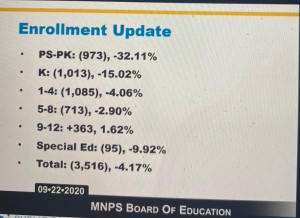
The meeting starts with a presentation that gives an overview of the key factors in the school year to date. In his presentation, Chief Finance Officer Chris Henson confirms what most of us already knew – the district is losing enrollments. He attempts to downplay the numbers by showing that the loss is only slightly less than it was last year.
A breakdown by grade level shows that the decline is mostly derived from the lower grade levels and Special Education Populations. Not included in this presentation is a breakdown by socio-economic status. I’d be interested in what those numbers illuminate.
Henson also provides a breakdown by clusters. This chart seems to indicate the largest loss of enrollment being in clusters that serve large populations CONTINUE READING: DOES IT EVER STOP? – Dad Gone Wild
Broad’s Academy and Residencies Fuel the Destroy Public Education Agenda | tultican - https://wp.me/p2txw0-QM on @wordpressdotcom

SSPI THURMOND STUFF THIS WEEK FROM THE CALIFORNIA DEPARTMENT OF EDUCATION

 California Department of Education


SSPI THURMOND
STUFF THIS WEEK FROM THE
CALIFORNIA DEPARTMENT OF EDUCATION


Verification Process
SFAs operating the NSLP for SY 2020-21, should continue with verification activities as required under Title 7, Code of Federal Regulations 245.6a. The deadline to complete the verification process is November 15, 2020.
July–August 2020 COVID-19 Reimbursement
July–August 2020 application for COVID-19 disaster relief reimbursement to offset fixed expenses, such as salaries and benefits, that continue to accrue during the temporary closure, pursuant to the 2020 Budget Act, Sec 118.
2020 National Blue Ribbon Schools Announced
State Superintendent Tony Thurmond congratulates California schools recognized as 2020 National Blue Ribbon schools.
Mini Grants Available for Anti-Racism Training
State Superintendent Tony Thurmond announces mini grants available to provide anti-racism and anti-bias educator training.

SEP 24

SBE September 2020 Information Memoranda
Background information and updates on issues of interest to the State Board Members.
CAA for Science Item Content Specifications
Item content specifications describe how CAA for Science items are developed to assess the alternate standards derived from the California Next Generation Science Standards (CA NGSS).

SEP 23

Changing Participation Avenue for Receipt of USDA
Participants of the California Department of Education (CDE) Food Distribution Program (FDP) now have the option to change the way they plan to order and receive U.S. Department of Agriculture (USDA) Foods for School Year (SY) 2021–22.

SEP 21

Child and Adult Care Food Programs Online Courses
On May 5, 2020, the CDE NSD sent an email notification to all CACFP Operators explaining the Fresno City College (FCC) California Professional Nutrition Education and Training (Cal-Pro-NET) Center would be closing on June 30, 2020.
SSPI Launches "Education to End Hate" Initiative
State Superintendent Thurmond Launches New "Education to End Hate" Initiative to Combat Bias, Bigotry, and Racism

SEP 18

August 25, 2020 Tuesday at 2 Webinar
The CDE NSD hosted the eighth Tuesday @ 2: School Nutrition Town Hall webinar on August 25, 2020 for school food service operators, chief business officials, and community partners.
COVID 19: FFVP School Year 2020–21 Waivers
Effective immediately, the U.S. Department of Agriculture has granted the California Department of Education (CDE) Nutrition Services Division two waivers for the Fresh Fruit and Vegetable Program (FFVP) for School Year 

 California Department of Education