Latest News and Comment from Education

Tuesday, August 18, 2020

Welcome to School Year 2020–21 - CA Dept of Education

Welcome to School Year 2020–21 - Nutrition (CA Dept of Education)

Welcome to School Year 2020–21 


Dear Superintendent, Chief Business Official, and Food Service Director:

Welcome Back to School

On behalf of the entire California Department of Education (CDE) Nutrition Services Division (NSD) team, I am sending my sincere appreciation and gratitude to each of you as you wrap up your summer meal service operations during COVID-19 and embrace the new 2020–2021 school year. During this past year, you stepped up to the plate in unprecedented times. As we look ahead, I fully realize there is still uncertainty in how COVID-19 will affect schools and meal service operations. However, I am confident that with your “can do” spirit and working together as a school nutrition community, we will overcome the obstacles and figure out solutions so California’s students have access to school meals.
On June 8, 2020, the CDE released Stronger Together: A Guide for Safe Reopening of California's Schools, available on the CDE Stronger Together web page at http://www.cde.ca.gov/ls/he/hn/strongertogether.asp. We encourage you to review Stronger Together with your management and leadership teams for safety considerations and recommended practices in the areas of health and hygiene, cleaning and sanitation, meal preparation, meal service, and communications with students and families.
As state and local mandates resulting from COVID-19 continue to evolve and food service operations are likely to transition to various models during the year, I am continually impressed with your ability to quickly pivot to develop and implement multiple school meals plans. For all student feeding scenarios, there are several critical commonalities:
  • Comply with local, state, and national guidance related to COVID-19, food handling, and food service.
  • Consider designating a COVID-19 Coordinator for Food Service Operations—this position is paramount to ensuring safe practices for hygiene, cleaning and sanitation, food preparation, and food service are followed.
  • Follow the guidance of the National School Lunch Program and School Breakfast Program—count and claim meals based on student eligibility and complete free and reduced-price meal applications (unless operating under one of the provisions); follow the guidance for the respective meal patterns.
  • Maintain confidentiality of participants.
  • Engage both internal and external partners including school, district, and County Office of Education. They can support the success of your school foodservice program in a variety of ways. External partners can help you enhance the services you may provide and assist with communication to families in need.
  • Put safety first in all decisions.
As we learn from each other through our School Town Hall meetings, the CDE continues to pursue waivers and extensions to support your work in adapting to different food service models. We will also continue to provide information and resources as we have heard from many of you that these have been helpful in promoting rapid and successful shifts in your food service operations. We encourage you to bookmark the CDE COVID-19 Guidance for K–12 Schools and Child and Adult Day Care Meals web page at https://www.cde.ca.gov/ls/he/hn/schoolmeals.asp for timely news and links to helpful resources.
Please accept our heartfelt appreciation for your dedication to promoting food security among students, families, and communities impacted by the COVID-19 pandemic. Because of your great work, local educational agencies are now widely identified not only as institutions of learning, but also as critical agents in the fight against hunger.
In the spirit of collaboration, respect, accountability, integrity, and making a positive difference,
Kim Frinzell, Director
Nutrition Services Division
Welcome to School Year 2020–21 - Nutrition (CA Dept of Education)

Charter School Experiment FAILURE Documented Again | tultican

Charter School Experiment FAILURE Documented Again | tultican

Charter School Experiment FAILURE Documented Again


By Thomas Ultican 8/17/2020
Marketing and lack of oversight have obscured the failure of the charter school industry. The latest research reported by Carol Burris and her team at the Network for Public Education (NPE) documents the atrocious closure rate among charter schools.
The United States Education Department (USED) has invested more than $4 billion promoting the industry but has not effectively tracked the associated fraud, waste and failures. After 25-years of charter schooling, Broken Promises is the first comprehensive study of their closure rates.

Charter School Myths and Promises

Former American Federation of Teachers (AFT) union President, Albert Shanker, is often cited as the father of charter schools. His Wikipedia entry says, “In 1988, Shanker was the first to propose charter schools in the U.S.” He was not, nor was he central to charter school development.
Five years before Shanker’s famous 1988 speech in which he mentioned charter schools, the Reagan administration had published the infamous A Nation at Risk. In his speech, Shanker was clearly responding to that report, President Reagan’s call for choice in education and his own belief that American education was not serving the majority of students well.
At the time, Shanker was reading Ray Budde’s book from which he appropriated the terminology “charter.” In his 1988 speech, Shanker proposed,
“The school district and the teacher union would develop a procedure that would encourage any group of six or more teachers to submit a proposal to create a new school.”
“That group of teachers could set up a school within that school which ultimately, if the procedure works and it’s accepted, would be a totally CONTINUE READING: Charter School Experiment FAILURE Documented Again | tultican

Mr. G for District 3: Chris Guerrieri's Education Matters: Richard Corcoran thinks he is king of education

Mr. G for District 3: Chris Guerrieri's Education Matters: Richard Corcoran thinks he is king of education

Richard Corcoran thinks he is king of education


First, Corcoran issues an executive order that flies in the face of the state constitution bullying districts with the threat of losing my money, and now he has told districts before you close a class or a school give him a call so he can decide if it is okay to do so, even giving out his personal number. I want to remind everyone Corcoran is neither a doctor nor an educator or king of education, nope he's a hatchet-man doing the bidding of the governor. 

From the Tampa Times,

“Before you get to the point of closing a classroom, we want to have that conversation with you,” Corcoran told the superintendents, adding that he will provide several top officials’ cell phone numbers for easier contact.

If a child exhibits symptoms, he said, there’s no reason to close the school and clean it. But schools should make sure if someone appears sick, that person should be sent home, and adequate communication should happen with families whose children might have been exposed.

Perhaps an entire class might be sent home for the day. But, without a positive test result or continued symptoms, he said, the students should be allowed back the next day.

The situation might call for even less drastic action, Corcoran added. School officials might want to determine who was within 6 feet of the person showing symptoms for longer than 15 minutes, he said.

https://www.tampabay.com/news/gradebook/2020/08/17/call-before-closing-school-over-covid-19-florida-education-commissioner-says/

You should read the article, it is terrifying.

Corcoran out every district in a hole, and he has now given them a shovel and instructed them to keep CONTINUE READING: 
Mr. G for District 3: Chris Guerrieri's Education Matters: Richard Corcoran thinks he is king of education

CURMUDGUCATION: Silicon Valley and the Surveillance State

 CURMUDGUCATION: Silicon Valley and the Surveillance State

Silicon Valley and the Surveillance State


Peter Schwartz is an American futurist, innovator, author, and co-founder of the Global Business Network, a corporate strategy firm. He's done sexy things like consult for futury movies, including WarGames (ew), Minority Report, and Sneakers (an under-appreciated gem). He's written an assortment of books; he also wrote the 2004 climate change report that predicted that England would be a frozen wasteland by, well, right now. (This Peter Schwartz should not be confused with this Peter Schwartz, Ayn Rand-loving writer. )

Schwartz was the subject of an interview in yesterday's San Francisco Chronicle, reminding us that there's an entire sector of future-looking tech-loving folks who think the advent of the surveillance state is pretty swell.

Schwartz is not in Silicon Valley-- he's a Beverly Hills guy. And not everything he says is alarming. For instance:

Every single time, with no exceptions, that I’ve gotten the future wrong, it’s because there was an inadequate diversity of people in the room. It was not that it couldn’t be seen; it was that we were just talking to ourselves.

Technocrats desperately need to hear that, but the prevailing ethos is the idea of a single visionary CEO without other voices to hold him back. As in Zuckerberg's unwillingness to let go of control of CONTINUE READING: 
 CURMUDGUCATION: Silicon Valley and the Surveillance State


ROUND 3 IS NOW UNDERWAY – Dad Gone Wild

ROUND 3 IS NOW UNDERWAY – Dad Gone Wild

ROUND 3 IS NOW UNDERWAY


“I sometimes think we must be all mad and that we shall wake to sanity in strait-waistcoats.”
― Bram Stoker, Dracula
“If we judge ourselves only by our aspirations and everyone else only their conduct we shall soon reach a very false conclusion.”
― Calvin Coolidge

Two months ago, when the decision to offer a virtual option was made, MNPS signed a 5 million dollar contract with the Florida Virtual School. The thinking was that in these unprecedented times, having a common curriculum would create uniformity across the district. Switching to a canned curriculum was supposed to take the pressure off of teachers and as District Superintendent Dr. Battle told the MNPS School back in June, “It allows teachers to focus on supporting students rather than creating lessons.”
In July the district made the decision to go all virtual. A decision that has been borne out as the right one based on increased cases of COVID across the state. In making the decision, Battle further emphasized the need to engage the Florida Virtual School curriculum, “”We will be utilizing a standard curriculum to be used across the district in all schools, and this is very necessary because we need to provide a continuity of learning plan for consistency for our students.”
Unfortunately, that consistency hasn’t materialized.
MNPS may have acquired a standardized curriculum but they didn’t create a standardized implementation. As a result, virtual schooling looks different at every school in the district. Teachers are scrambling to learn multiple systems while also trying to adapt the curriculum to fit their individual classes. Many elementary teachers did not even get a look at the curriculum until a week before school began, middle school and high school got a look only days before them.
A brief training was given to teachers on technology and the assumption was made that every CONTINUE READING: ROUND 3 IS NOW UNDERWAY – Dad Gone Wild

Monday, August 17, 2020

Russ on Reading: Phonics, Fluency, and Flexibility

Russ on Reading: Phonics, Fluency, and Flexibility

Phonics, Fluency, and Flexibility


If you have ever read one of Peggy Parrish's delightful Amelia Bedelia books to young children, your efforts were no doubt greeted by howls of laughter. Children delight in the word play involved when Amelia "dresses the turkey" in coat and pants, or when she "pitches a tent" by throwing it poles and all, into the bushes. The children's delight comes, of course, from the humor derived from Amelia's totally literal understanding of words and the children's growing knowledge that words can have more than one meaning. If you are reading these books to first and second graders you may also notice that some children are not in on the joke. They may laugh along with others, but they may not yet have the cognitive flexibility to get the joke. 

Cognitive flexibility is defined as the ability to switch between thinking about two different concepts or to think about multiple concepts simultaneously. If you can't switch between two different concepts of "dress" or "pitch" you can't get the humor of Amelia Bedelia. Likewise, if you can't switch between two or more different concepts about how words are constructed, you will have great difficulty becoming a fluent reader. Recent research indicates that cognitive flexibility contributes to beginning reader's fluency, that low achieving readers lack cognitive flexibility, and perhaps, most importantly cognitive flexibility can be taught. (See References Below)

When you think about this it makes good sense. Phonics knowledge can only get us so far in decoding. If children approach every unknown word with CONTINUE READING: Russ on Reading: Phonics, Fluency, and Flexibility

Michael Bloomberg & Bill Gates The Brothers Grim: Bill and Mike’s Pandemic Panopticon – Wrench in the Gears

Michael Bloomberg & Bill Gates Doku: Willkommen in unserer techno-faschistischen Zukunft – Wrench in the Gears

Michael Bloomberg & Bill Gates Doku: Willkommen in unserer techno-faschistischen Zukunft
The Brothers Grim: Bill and Mike’s Pandemic Panopticon


Many thanks to Rudiger Flach for providing the following German translation of The Brothers Grimm: Bill and Mike’s Pandemic Panopticon. English version here.

Bill und Melinda Gates haben Hauptrollen in dem sich entfaltenden Drama Covid-19 zu spielen. Alles scheint entsprechend dem Plan von Davos voranzukommen. Das zukünftige Billionärspaar hat seinen Milliardärskollegen, die hinter der Bühne die Strippen ziehen, um die Kulisse der Vierten Industriellen Revolution für den techno-faschistischen zweiten Akt fallen zu lassen, eine nützliche Tarnung geboten. Schon jetzt versammelt sich in den Kulissen eine Chorus Line von Kontaktverfolgern. In Kürze werden sie im Zentrum der Bühne stehen und neu ausgearbeitete digitale Konformitäts- und Indoktrinationszertifikate Ã¼berreichen.
In diesem Beitrag geht es um einen der Verantwortlichen dieser Produktion, Michael Bloomberg. In Abstimmung mit dem New Yorker Gouverneur Andrew Cuomo bezahlte Bloomberg Johns Hopkins für die Choreographie dieser viralen Überwachungsaktion, bei der die Rockefeller Foundation aus der Königsloge zuschaut.
Die John’s Hopkins School of Public Health hat diese Woche ein digitales Trainingsmodul zur Kontaktverfolgung auf Coursera hochgeladen. Die CONTINUE READING: Michael Bloomberg & Bill Gates Doku: Willkommen in unserer techno-faschistischen Zukunft – Wrench in the Gears

The Coronavirus Thanks You for Reopening Schools: “I Couldn’t Have Done it Better, Myself!” | gadflyonthewallblog

The Coronavirus Thanks You for Reopening Schools: “I Couldn’t Have Done it Better, Myself!” | gadflyonthewallblog

The Coronavirus Thanks You for Reopening Schools: “I Couldn’t Have Done it Better, Myself!”


Hey, American Peeps!
It’s me! Coronavirus!
Technically, the name’s Covid-19, but with you guys, we can cut the formality.
I mean after all, once I latched my spiky surface proteins to your nana’s lungs, we were basically family!
“YAK! COUGH!”
Music to my ears.
So it’s back to school time, and – let me tell you – am I ready to return to the classroom! Actually, I’m just bursting to pop onto campuses for the FIRST time this year.
When I came to these shores way back in March, some spoil sports decided to shut CONTINUE READING: The Coronavirus Thanks You for Reopening Schools: “I Couldn’t Have Done it Better, Myself!” | gadflyonthewallblog

Can Los Angeles Schools Test 700,000 Students and 75,000 Employees? That’s the Plan - The New York Times

Can Los Angeles Schools Test 700,000 Students and 75,000 Employees? That’s the Plan - The New York Times

Can Los Angeles Schools Test 700,000 Students and 75,000 Employees? That’s the Plan
Classes will start remotely. But the nation’s second-largest school district has perhaps the most ambitious plan to test students and employees for the coronavirus.


Amid public alarm over the inadequacy of coronavirus testing across the nation, Los Angeles schools on Monday will begin a sweeping program to test hundreds of thousands of students and teachers as the nation’s second-largest school district goes back to school — online.
The program, which will be rolled out over the next few months by the Los Angeles Unified School District, will administer tests to nearly 700,000 students and 75,000 employees as the district awaits permission from public health authorities to resume in-person instruction, said Austin Beutner, the district’s superintendent.
It appears to be the most ambitious testing initiative so far among major public school districts, most of which are also starting school remotely but have yet to announce detailed testing plans.
New York City, where the virus has been under control, is the only major school district in the country planning to welcome students back into classrooms part time this fall. The city is asking all staff members to be tested before school starts on Sept 10 and has said it will provide expedited results.

Staff members should be tested regularly throughout the school year, New York City has said. It is not yet clear how often students will be tested or whether the city will take random samples from the 1.1 million children at its 1,800 public schools.
Mr. Beutner said that Los Angeles’s program, developed over the past four months, would begin this week, well before schools are expected to let students into classrooms, and that it would augment — and probably far exceed — existing testing efforts run by the city and county of Los Angeles. CONTINUE READING: Can Los Angeles Schools Test 700,000 Students and 75,000 Employees? That’s the Plan - The New York Times

Online School Is Harder Thanks to Unequal Internet Access - The Atlantic

Online School Is Harder Thanks to Unequal Internet Access - The Atlantic

Online School Doesn’t Work When You Can’t Get Online
Why millions of American kids don’t have internet


At 8 a.m. Pacific time last Wednesday, I joined David Anderson’s 12th-grade government class at Live Oak High by clicking on a Zoom link.
Because California suffered a surge in coronavirus cases this summer, students in Live Oak, a town about 50 miles north of Sacramento, will be learning virtually for the foreseeable future. Both Anderson and his students seemed nervous about how it would go. At 8:03, only eight of the 24 students had logged on, despite the fact that Anderson’s “classroom expectations” sheet requested that everyone “log in to class on time and prepared every day.”
It might not have been the kids’ fault. Many students are poor in this rural chunk of the Sacramento Valley. The school ordered Wi-Fi hotspots for the students, but they won’t be available until August 22. In a class Anderson taught that afternoon, one boy’s video kept freezing from a slow connection. At the high point during the class I observed, 20 of 24 students had joined the Zoom session, which, Anderson told me later, is “better than expected.”
Not all distance learning in rural areas is functioning even this smoothly, thanks to America’s notoriously unequal internet access. In the COVID-19 era, life has moved to the internet, but not everyone has it. As many districts start virtually this fall, some teachers say they’re fighting to ensure that all of their students can log into class each day. Their struggles are just one example of the consequences of America’s failure to get all of its citizens online before this uniquely internet-dependent time.

Outside of Fresno, Rachel Cooper estimates that 20 percent of her eighth-grade students don’t have internet at home, and 20 percent have spotty internet. “It’s rough,” she says. Some kids are using their phones to log into class, but the screens are too small to do work on. Some kids’ internet cuts out in the middle of class, and others don’t log on at all.
The school hasn’t been able to provide hotspots to all of its students yet, Cooper says. A Wi-Fi–equipped bus is supposed to drive around to areas where disconnected students live, but social distancing would require that students sit outside of it to do their work. “I’ve had several students already say that they were really nervous they were going to fall farther behind in a specific subject because they think distance learning is going to be really difficult,” Cooper told me.
How did such an advanced country leave so many people technologically behind? Experts and former Federal Communications Commission officials describe a federal government that has neglected to treat broadband as a public utility, instead relying on the largely self-regulated internet industry to provide service wherever it wanted, for the price of its choosing. The United States government has historically not seen fast CONTINUE READING: Online School Is Harder Thanks to Unequal Internet Access - The Atlantic

Teacher Tom: Sitting, Facing Forward, While Muted

Teacher Tom: Sitting, Facing Forward, While Muted

Sitting, Facing Forward, While Muted


As most American schools gear up to start their school year engaged in what is being called "remote learning," educators and parents have been sharing schedules on social media that involve putting elementary school aged children in front of computers for upwards of four hours a day. That's a lot of screen time. That's a lot of sitting. That's a lot of facing forward. That's a lot of being muted.

Of course, it's not like our children weren't already spending most of their school time sitting, facing forward, muted. The only difference is the screen.

I've spent my entire professional life being appalled by the model of education used by most schools, a method that only "works" if children are sitting, facing forward, and being muted. It runs counter to what we know about what young children need and how they learn. Most children learn best when they are free to move their bodies. Most children learn best when they are free to follow their curiosity. Most children learn best when they are free to engage in a community of CONTINUE READING: Teacher Tom: Sitting, Facing Forward, While Muted

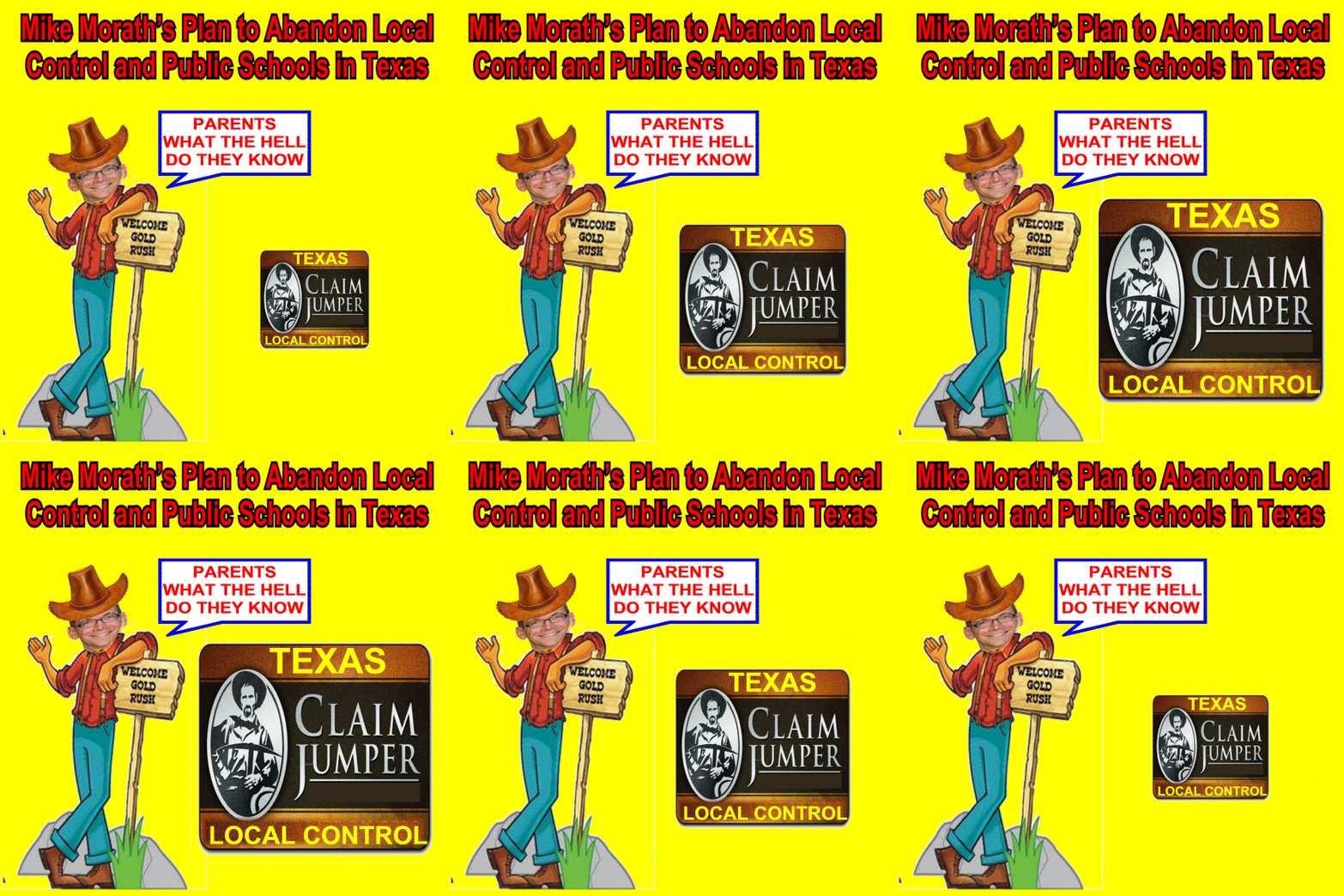
Anette Carlisle: Mike Morath’s Plan to Abandon Local Control and Public Schools in Texas | Diane Ravitch's blog

Anette Carlisle: Mike Morath’s Plan to Abandon Local Control and Public Schools in Texas | Diane Ravitch's blog

Anette Carlisle: Mike Morath’s Plan to Abandon Local Control and Public Schools in Texas


Anette Carlisle, public education advocate in Texas, describes how State Commissioner Mike Morath, a non-educator, bought into the anti-democratic strategy of killing local school boards and privatizing public schools. He swallowed whole the disruption program of the Center for Reinventing Public Education, one of the Gates-funded think tanks that call for the abandonment of public schools.
Despite a full decade of failure, phony “reformers” claim that education will improve if private corporations and entrepreneurs take over from elected school boards. It hasn’t worked anywhere, and it won’t work in Texas.
Carlisle writes:
Texas has chosen to abandon our local public schools, locally elected school boards, superintendents and our 5.4 million schoolchildren in favor of a “my way or the highway” single system directive by Texas Education Agency Commissioner Mike Morath. That’s why I’m standing up to say, “Whoa! Hold your horses, please, Mr. Commissioner.”
It’s an effort that’s been building for years, right under our noses. People said, “Surely not,” but here we are.

The Problems with “Show Me the Research” in Teaching Reading – radical eyes for equity

The Problems with “Show Me the Research” in Teaching Reading – radical eyes for equity

The Problems with “Show Me the Research” in Teaching Reading


I was born in 1961 and entered first grade in 1967, already able to read independently and play sophisticated card and board games.
My mother had taped index cards with words identifying objects all around our house. She had attended one year of junior college, but had no training in how to teach.
None the less, from the first day of school, I excelled in literacy, scoring in the 99th percentile on standardized tests. My learning to read has two important elements; I was of the generation taught by the Dick and Jane basal readers (whole-word focus over discrete phonics), and my learning to read overlapped with one of the most aggressive reading crisis moments in the U.S., spurred by Rudolf Flesch’s Why Johnny Can’t Read, first published in 1955.
To whom and what should we attribute my high-achieving literacy skills? How could research tease out any causal inferences about my reading achievement? I was certainly not a Johnny who couldn’t read even as I had almost no direct phonics instruction, and I am sure the basal readers and my teachers’ instructional methods had only minimal impact on my literacy development (other than that I loved Ms. Landford, my first grade teacher, and wanted desperately to please her).
Many years later, I was a high school English teacher in the rural high school I had attended. One year, a wonderful student whose mother was also an English teacher in the school scored a perfect 800 on the verbal section of the SAT.
People throughout the school and town often congratulated me and praised my role in her perfect score. For many, that student’s success was proof I was CONTINUE READING: The Problems with “Show Me the Research” in Teaching Reading – radical eyes for equity

Public funds should support public schools, right? Trump and DeVos say 'no.'

Public funds should support public schools, right? Trump and DeVos say 'no.'

Public funds should support public schools, right? Trump and DeVos say ‘no.’


This is a guest post by Sharon Krengel, Policy and Outreach Director of Education Law Center. See below for more on the Public Funds Public Schools campaign.
You’ve got to hand it to Education Secretary Betsy DeVos.
Even during a pandemic that’s hitting the U.S. hard and caused every state to physically close schools, she has not wavered from her agenda of using public dollars to subsidize private education. Her boss, President Trump, has spent the past few months trying to help her out, pushing private school voucher policies that have failed for years to gain congressional support.
Now come two federal bills that make no illusions about diverting taxpayer dollars to private schools, even though the nation’s public schools are struggling mightily to reopen their doors while simultaneously improving virtual learning for students who will still be at home.
Senate Republicans recently put forward a stimulus bill that would divert approximately 10 percent of the $70 billion earmarked for K-12 education to private schools. At the same time, Senators Lamar Alexander and Tim Scott have introduced a tax credit voucher bill that would divert $5 billion annually in federal tax reimbursements for contributions to organizations that give out private school vouchers.
Some state leaders aren’t waiting to see if either bill becomes law. The governors of South Carolina, New Hampshire, Oklahoma, and Florida have declared their intention to divert portions of their CARES Act funds—coronavirus relief aid passed by Congress earlier this year—to private school vouchers. In South Carolina, a judge put a temporary hold on Governor McMaster’s decision to use $32 million in pandemic aid for vouchers.
And a recent report showed that private schools across the country received between $2.67 and $6.47 billion from the Paycheck Protection Program, a source of federal pandemic aid under the CARES Act unavailable to traditional public schools.
What does all this mean? Already underfunded public schools, which are open to all and educate 90 CONTINUE READING: Public funds should support public schools, right? Trump and DeVos say 'no.'

I’m a Teacher and I’m Horrified at Schools Reopening During COVID

I’m a Teacher and I’m Horrified at Schools Reopening During COVID

I’m a Teacher and I’m Horrified at Schools Reopening During COVID
Educators took one look at the photos that recently emerged from the crowded, nearly mask-less hallways of a high school in Georgia, and gasped for air.


I keep thinking about a moment in my career in education, when I taught at a small Catholic school for girls in Queens, New York. On one otherwise unmemorable morning, a student in my homeroom slid off her chair and onto the floor, mouth foaming, body convulsing: Something in the pot she’d smoked on the way to school caused her to overdose. I carried her out of the stuffy room and into the hallway, all the while yelling for help. The girls in my homeroom crowded around, fanning us, opening her collar, pulling my hair out of my face as I tried to make sure she was breathing, alternately panicking and calming each other down.
I’ve always thought about this incident as a story of bravery—of teenagers coming together with no warning to help someone in need. But now what I keep thinking is: There were so many of us, sharing so little air.
For me, for most of us in education, this is an ordinary and an extraordinary time. Ordinary, because it’s August and thus time to get ready to go back to school as I have for the last 21 years. Making syllabi, stocking up on pens, and considering a new backpack all feel deeply familiar. But this is an extraordinary time, too, because of the COVID-19 pandemic and the utter chaos it has caused for parents, students, and educators.
The lack of realistic guidance has been shocking, and too many school administrators are apparently unable to think of any plan other than the “normal” beginning they hoped to have. The calendar seems to be pulling us towards a vortex where the ordinary and extraordinary will collide, when we’ll all be sharing too little air. It’s terrifying. Educators took one look at the photos that recently emerged from the crowded, nearly mask-less hallways of a high school in Georgia, CONTINUE READING: I’m a Teacher and I’m Horrified at Schools Reopening During COVID

Trump Brags About Racist Housing and Education Policies and Urges Americans to “Enjoy!” | janresseger

Trump Brags About Racist Housing and Education Policies and Urges Americans to “Enjoy!” | janresseger

Trump Brags About Racist Housing and Education Policies and Urges Americans to “Enjoy!”


In desperation, as polls predict he is likely to lose in the November election, President Donald Trump has not only threatened to defund the post office for the purpose of ensuring that a lot of votes won’t be counted, but he has also, shockingly, been appealing to racism.  He tweeted:
“I am happy to inform all of the people living their Suburban Lifestyle Dream that you will no longer be bothered or financially hurt by having low income housing built in your neighborhood… Your housing prices will go up based on the market, and crime will go down.  I have rescinded the Obama-Biden AFFH Rule. Enjoy!”
Washington Post columnist Eugene Robinson explains the meaning of Trump’s tweet and refreshes our memories about the AFFH Rule: “Trump tweeted what may be the most nakedly racist appeal to White voters that I’ve seen since the days of segregationist state leaders such as Alabama’s George Wallace and Georgia’s Lester Maddox… Many people probably don’t know what the ‘Obama-Biden AFFH Rule’ is, but its roots are in the 1968 Fair Housing Act, specifically its Affirmatively Furthering Fair Housing provision. That section of the law required federal agencies that deal with housing and banking to pursue their missions in a way that would actively desegregate housing.  In 2015, the Obama administration spelled out how communities should measure their progress, or lack thereof, in eliminating housing bias, and tied federal funding for housing and urban development to those measurements. Trump’s tweet is a promise not to actively enforce that provision. And it’s a message to White people that they can go ahead and do whatever they feel is necessary to keep Black people and Latinos from moving into their neighborhoods.”
Of course, Trump does not explicitly name race in his abhorrent tweet and he doesn’t mention segregation in the public schools.  In this one tweet, however, the President is explicitly CONTINUE READING: Trump Brags About Racist Housing and Education Policies and Urges Americans to “Enjoy!” | janresseger