Latest News and Comment from Education

Thursday, June 25, 2020

Sacramento City Schools Consider Ending Police Contract For School Resource Officers - capradio.org

Sacramento City Schools Consider Ending Police Contract For School Resource Officers - capradio.org

Sacramento City Schools Consider Ending Police Contract For School Resource Officers


The Sacramento City Unified School District is considering fully divesting from the Sacramento Police Department. 
The district currently has a contract for a little over $500,000 with the police department, set to expire on June 30. But in light of recent nationwide discussions and the killing of George Floyd by Minneapolis police, advocates and some board members are now calling for the district to not renew this contract. 
“For the entire district, Black students only represent 15% of the student population, but they represent 35% of all arrests,” Carl Pinkston, executive director of the Black Parallel School Board, said. “So once you have one arrest, one traumatized student experience, any interaction with the police, that is your first touch with the school to prison pipeline.” 
The Black Parallel School Board, in conjunction with the Sacramento City Teachers Association, Brown Issues, Sacramento ACT and Hmong Innovating Politics, have renewed efforts to push the district to fully divest from the police department. 
In the past, Sacramento City Unified has had as many as 20 Sacramento police officers on campus, also known as School Resource Officers, or SROs. Recent efforts from community groups have slashed that budget from $1.5 million two years ago to its current contract for $563,097, and taken the number from eight officers to three. But during a board meeting last November when a contract renewal was discussed, school board Vice President Christina Pritchett worried that taking officers out of the district entirely would have a negative impact. 
“SROs on campuses build relationships,” Pritchett said. “It’s not just a cop coming to a school CONTINUE READING: Sacramento City Schools Consider Ending Police Contract For School Resource Officers - capradio.org

Why Sacramento fails California — and itself – Orange County Register

Why Sacramento fails California — and itself – Orange County Register

Why Sacramento fails California — and itself


There may be no better symbol of Sacramento’s failure as California’s capital than the 18-foot -tall stainless-steel sculpture outside the city’s downtown sports arena. The work, by famed contemporary artist Jeff Koons, cost the city and the arena’s tenant, the NBA’s Sacramento Kings, $8 million. Its official name is “Coloring Book #4” but it’s really a representation of the character in Winnie the Pooh named Piglet.
It’s also a symbol of Sacramento’s porcine business model. As our state government hogs ever-greater authority for itself at the expense of California communities, our capital city and its most powerful people control more of our tax dollars, and more of our lives.
We are now living in the fifth decade of California’s great era of centralized power. Back in the 1970s, liberals seeking equality in local school funding and conservatives seeking local tax limits robbed California’s local governments of most of their fiscal and political power—and transferred that power to the state Capitol. In the 40 years since, the single greatest enterprise in Sacramento—pursued by governors, legislators and political interests of various stripes—has been the ever-greater expansion of state government power.
Downtown Sacramento is a living monument to our centralized era. In response to state government’s ever-expanding power, our local governments and other interest groups had to spend more money to influence and elect Sacramento’s power players. This spending built an army of lobbyists, consultants, organizers, party officials, and media mavens, who turned once-sleepy downtown Sacramento into their campus, with office towers, restaurants, snazzy entertainment venues like the arena, and expensive baubles, including Piglet.
This army of statewide influencers also became major powers in the political life of the city — as donors, officeholders, campaign consultants, and lobbyists. Darrell Steinberg, perhaps the most accomplished state legislator of this century, is now mayor.
Understandably, such ambitious people wanted to do big things that would get noticed around the state—hence all the high-profile construction downtown. But as they made Sacramento less sleepy, they too often neglected the less glamorous tasks of meeting neighborhood needs and managing fundamental departments.
That neglect has long left crucial institutions in Sacramento (pop. 509,000) in bad shape. The city government has struggled in bad times (Sacramento was hit especially hard during the Great Recession) and in good (Sacramento has been especially deficient in meeting local housing demands, especially with the arrival of Bay Area refugees). The once-vital daily newspaper, the Bee, self-destructed, and is now bankrupt. Even before COVID-19, the city’s largest school district CONTINUE READING: Why Sacramento fails California — and itself – Orange County Register

David Berliner: The Value of a College Education in the Humanities | Diane Ravitch's blog

David Berliner: The Value of a College Education in the Humanities | Diane Ravitch's blog

David Berliner: The Value of a College Education in the Humanities


David Berliner is one of the nation’s most eminent researchers of education. I am delighted that he sends original posts to me. I have informed him that “mi casa es su casa,” and he is always welcome here.
Why Universities Need Support, Need to Stay Open, and
Need to Have Their Students on Campus
David C. Berliner
Regents Professor Emeritus, Mary Lou Fulton College of Education, Arizona State University, Tempe, AZ
Over the last few years higher education enrollment in the USA has declined. The cost of colleges and universities has certainly been one factor in that small but steady drop in enrollment, particularly when return on investment is added to concerns about costs. The steep rise in tuition in recent years has an explanation: It is largely due to states’ disinvestment in their universities and colleges. From 2008, before the start of our last recession, to 2019, before the pandemic, my state of Arizona cut its contributions to higher education 54.9% (Mitchell, Leachman, & Saenz, 2019). When I first came to my wonderful university, I was impressed that tuition was relatively low, and it still is, but it is also 92.4% higher than it was in 2008! (Mitchell, Leachman, & Saenz, 2019)
So, for many, in the midst of this pandemic, the sacrifices that students and their families once made to obtain college degrees now appear to be less reasonable, perhaps even less possible. And families rightly worry that the rewards of a university degree are less tangible, compared to what they were in my generation. Incurring a CONTINUE READING: David Berliner: The Value of a College Education in the Humanities | Diane Ravitch's blog

Will Schools Reopen in the Fall? - The Atlantic

Will Schools Reopen in the Fall? - The Atlantic

The School Reopeners Think America Is Forgetting About Kids

Jennifer Nuzzo hopes to send her kids to camp this summer, but like many parents, she’s a little worried about it. The camp she selected for her son requires kids to wear masks, and she thinks he might get overheated. Other than that, though, she sees little problem with kids attending an outdoor camp this summer. And the same goes for schools—most districts haven’t yet announced when and how they’ll resume in-person classes, but she thinks they should open up in the fall.
Nuzzo, an epidemiologist at Johns Hopkins University and a leading expert on the coronavirus, is one of a number of scientists vocally advocating for summer camps and schools to reopen, with some precautions, even if there’s no vaccine yet. “The idea of keeping kids at home, and having parents work at home, for however long, until we get a vaccine,” Nuzzo told me, “it seems to me that there are harms that kids are experiencing that we are not accounting for.”
Some public-health experts say that having in-person classes in a few months is still too risky, citing countries like Israel and China that have had to shut down schools after opening them up. The experts who disagree—call them the “reopeners”—aren’t blind to the dangers of the virus, but they believe the hazards should be weighed against the costs of changing children’s lives so dramatically.
This message likely has a friendly ear in many parents, especially those who have been Zooming into meetings while chasing after toddlers. Even parents who have been enjoying the extra family time might be ready for a break. I recently talked  CONTINUE READING: Will Schools Reopen in the Fall? - The Atlantic

CURMUDGUCATION: CA: San Diego Charter Versus The Evil Union

CURMUDGUCATION: CA: San Diego Charter Versus The Evil Union

CA: San Diego Charter Versus The Evil Union


This week you may have run across a piece entitled "How the Union Stopped Innovation at My School." The piece, which has turned up in numerous California outlets, was written by Jessica Chapman, a teacher at Gompers Preparatory Academy. Chapman's story has been steadily promoted by For Kids and Country, the organization run by Rebecca Friedrichs, a former teacher who loves Jesus and America and hates unions.


Chapman leans on an oft-repeated story about Gompers. The school was formerly a middle school in San Diego, and it was universally considered a miserable mess. The school became Gompers Preparatory Academy in 2005, a charter school that focused on college prep, including a partnership with UC San Diego. Chapman paints an inspiring picture of what "innovation" fueled. Soaring test scores, college acceptance, more rigor, and, that classic charter marketing point, 100% graduation rate. This, Chapman says, is what you get when you "remove the constraints of politics."

By that, she appears to mostly mean "getting rid of unions." Unions are why all schools aren't as wonderful as Gompers. Unions are a special interest, set up to grab all the money and deliver crappy educations to students they don't care about. The unions are out to get charters and have advanced a "deceptive" message creating "a campaign of divisiveness between traditional public schools and charter schools." And now they're "scheming to unionize charters" because....? This is CONTINUE READING: 
CURMUDGUCATION: CA: San Diego Charter Versus The Evil Union


The Reality Check: "LET'S HAVE OUR VOICES COUNT!"

The Reality Check: "LET'S HAVE OUR VOICES COUNT!"

"LET'S HAVE OUR VOICES COUNT!"
Black education unionists call for an avalanche of protests for racial justice


Calling for justice in a huge demonstration in the Port of Oakland


For weeks, hundreds of thousands of people have filled the streets of 160 cities across the country, even during the coronavirus pandemic, expressing their outrage and grief at the murder of George Floyd in Minneapolis. Two Black leaders of the CFT, with long histories of fighting for racial equity, say they could not help being profoundly moved by the murder itself, and the outpouring of rage in response.

"We have a basic expectation that we won't be murdered by the police, that we have due process," says Angelo Williams, who's taught sociology at Sacramento City College for 13 years. "But when it comes to Black and Brown people, that's not what we get. Every student knows this. We can't continue this way one more day."

Carl Williams (no relation to Angelo Williams), a Lawndale elementary school custodian and president of the CFT Council of Classified Employees, was so deeply moved that "I haven't watched the whole recording of George Floyd to the end. I can't do it. As a Black man, I'm shocked but not shocked. It's not something we should be used to, but we are. So when people say, 'Not one more time!' I say, 'Absolutely!'"

While deeply disturbed by Floyd's death in Minneapolis, in interviews both respond immediately that the deaths of Black men at the hands of the police are a fact of life much closer than Minnesota. "I lived in L.A. when we went into the streets after Rodney King was beaten," Carl Williams recalls. "I'm a lot wiser now than I was then, but some things don't change."

In the national avalanche of people into the streets, people hold signs remembering the murders of Breonna Taylor, Ahmad Arbery, Tony McDade and others in a plague of violence visited on Blacks, not just recently, but since CONTINUE READING: 
The Reality Check: "LET'S HAVE OUR VOICES COUNT!"


Budget cuts at NYC Department of Education may threaten student privacy | Parent Coalition for Student Privacy

Budget cuts at NYC Department of Education may threaten student privacy | Parent Coalition for Student Privacy

BUDGET CUTS AT NYC DEPARTMENT OF EDUCATION MAY THREATEN STUDENT PRIVACY


The following was written by a concerned stakeholder who prefers to stay anonymous.  One wonders if the budget savings involved in DOE’s decision to cut the only part-time staff assistant vetting research proposals is worth risking student privacy.
NYC public school students are diverse demographically, culturally, linguistically, and academically and there are a wide variety of programs established to meet their needs. The NYC Department of Education Institutional Review Board (IRB) reviews over 500 research proposals every year, many of which aim to evaluate these programs and test new curriculums.  A large portion of these proposals target the most vulnerable NYC DOE students and families.
An IRB is an administrative body that is formally designated to review human subject research proposals, to protect the rights of those individuals who are recruited to participate in research activities.  For most people, the mention of an IRB conjures images of drug trials or medical treatment research.  However, IRBs don’t solely exist for biomedical research. Social science research that collects personal information about participants is also subject to IRB review, and education research is no exception.
Historically, the NYC DOE IRB Board has been supported by only one full-time Director and only one part-time consultant who are tasked with initial review of all submitted proposals, communication with the research community, as well as oversight and compliance CONTINUE READING: Budget cuts at NYC Department of Education may threaten student privacy | Parent Coalition for Student Privacy

Landmark Ruling Protects LGBTQ Workers, But the Work is Far From Over

Landmark Ruling Protects LGBTQ Workers, But the Work is Far From Over

Landmark Ruling Protects LGBTQ Workers, But the Work is Far From Over


Until recently, it was legal in more than half of the states to fire workers for being gay, bisexual, or transgender. A Florida educator, for example, married her wife on Saturday and was fired on Monday. In another case, an Oregon educator was named teacher of the year—in part because of his LGBTQ advocacy—and attended a White House ceremony in his honor on Friday, and was fired for his sexual orientation on Monday. These terminations and others like it, are now, under federal law, illegal.
It’s been a long time coming for members and allies of the LGBTQ community: On June 15, 2020, the U.S. Supreme Court ruled to protect LGBTQ workers from discrimination based on sexual orientation or gender identity.
Or, as the Court put it, “An employer who fires an individual merely for being gay or transgender defies the law.” Over 100 federal statutes prohibit sex discrimination, including Title IX of the Education Amendments of 1972, and the Court’s ruling should apply to those statutes as well.
“This means that educators can no longer be fired at work for who they love or who they are,” says NEA President Lily Eskelsen García, adding that students are also protected under the federal law from discrimination at school.
While this is a momentous turning point for the LGBTQ community—particularly for “LGBTQ educators and students who endured discrimination yet continued to stand up to fight for themselves, their co-workers and their students—there is so much CONTINUE READING: Landmark Ruling Protects LGBTQ Workers, But the Work is Far From Over

Mayor threatens even more budget cuts; send your letters today! | Class Size Matters

Mayor threatens even more budget cuts; send your letters today! | Class Size Matters Mayor threatens even more budget cuts; send your letters today! | A clearinghouse for information on class size & the proven benefits of smaller classes

Mayor threatens even more budget cuts; send your letters today!


Friends–
Update: The NYC budget is due June 30, a week from today. This morning, Mayor de Blasio announced that he is considering another $1 billion in cuts, which would necessitate the layoff of an additional 22,000 municipal workers.  
PLEASE, send a letter to the Mayor and Chancellor todayif you haven’t already, urging him NOT to cut the education budget but to allocate more funding to schools as this will be necessary to ensure health, safety and sufficient teachers and counselors to allow for smaller classes, social distancing and the support NYC kids will badly need, given the losses they have suffered this year.
Also, send a letter to the NYC Council Speaker and Education/Finance chairs, with much the same message.
2.This morning, I spent three hours in a meeting of the Regents Advisory Task Force, discussing what programs and precautions should be in place if schools reopen next year. During our discussion it was clear that many of the ideas put forward by participants rely on more funding to be achieved. Spending was also a repeated concern of the parents, teachers and others who responded to our online survey; the word “budget” was mentioned 52 times by respondents, and “funds” or “funding” another 59 times.
Please do send your letters today and share this email with others who care,
Leonie

CURMUDGUCATION: CA: Charter Decides To Grab A Small Business Loan

CURMUDGUCATION: CA: Charter Decides To Grab A Small Business Loan

CA: Charter Decides To Grab A Small Business Loan


Palisades Charter High School has a lot of history. When launched in 1961, it was the most expensive high school in the LA City School system. The state grabbed the farm property through eminent domain; previous residents included the daughter if Francis X. Bushman, and Debbie Reynolds and Eddie Fisher. Members of the Class of '65 were the basis for What Really Happened to the Class of '65?. By 1989, 20/20 aired an episode about the school, characterizing the school as both high academic performance and high drug and alcohol abuse.


By 1992, enrollment had dropped so far that the district was thinking about shutting them down entirely; instead, staff and parents argued for becoming a charter school, so in 1993, the high school and three of its feeders became the first charter school "cluster" in California. Enrollment bounced back; today there are about 3,000 students at PCHS. The campus, which is big and beautiful, has been used in movies and tv shows, and alumni include J.J. Abrams and Jennifer Jason Leigh.

PCHS is a charter school, and like many other such outfits, they have heard the siren song of the Paycheck Protection Program, the loan program designed to help small businesses stay afloat during the current pandemic mess (the second one, meant to clean up after the first one that ran out of money almost instantly). They are not alone--many charter schools are deciding that, for purposes of grabbing some money, they will go ahead and admit they are small private businesses and not public schools. Two thirds of the charter school businesses in New Orleans have put in for the loans.

What makes Palisades special is that we have video of their board discussing the issues of accepting CONTINUE READING: 
CURMUDGUCATION: CA: Charter Decides To Grab A Small Business Loan

Unchartered Territory: County Charter Schools Take $15.8M in Federal Small Biz Loans – NBC 7 San Diego

Unchartered Territory: County Charter Schools Take $15.8M in Federal Small Biz Loans – NBC 7 San Diego

Unchartered Territory: County Charter Schools Take $15.8M in Federal Small Biz Loans


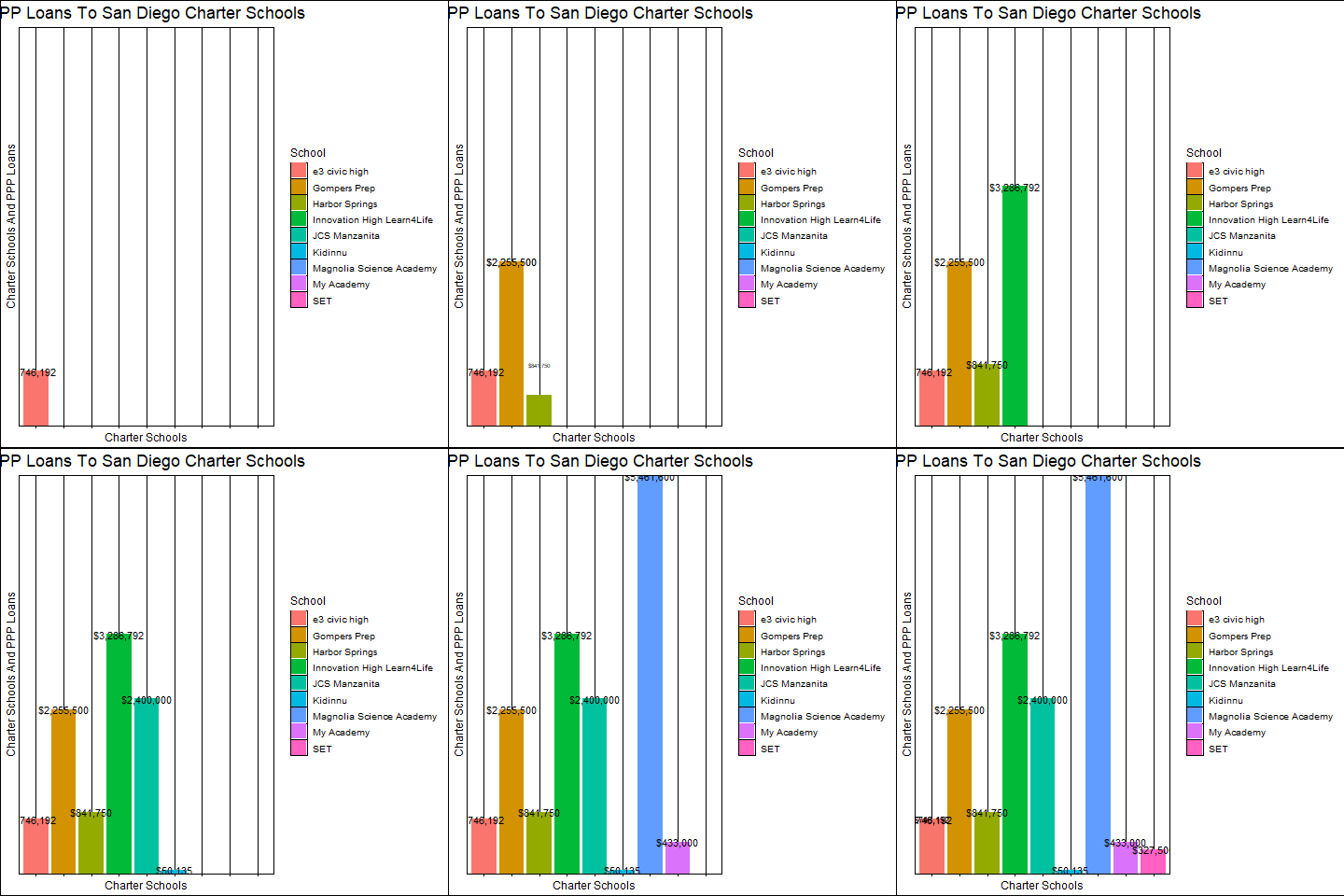
Publicly funded charter schools in San Diego County have received more than $15.8 million through the Paycheck Protection Program (PPP,) a federal government fund aimed at helping small businesses from shutting down during the coronavirus pandemic. 
Some of the recipients include large charter school companies with campuses throughout California such as Learn4Life, and Magnolia Public Schools are among those that received millions in PPP loans. 
Charter schools have historically straddled a fine line when it comes to whether they are considered public schools or private businesses. However, that distinction, at least in terms of public funding during the coronavirus pandemic, appears to be more clearly defined.
According to the data obtained by NBC 7 Investigates, local charter schools including Gompers Preparatory, The School for Entrepreneurship and Technology (SET), E3 Civic High, and Magnolia Science Academy have received $3.1 million in CARES Act funding from the federal government which is meant for public schools. Of those, Gompers Prep secured the most CARES Act funding, receiving $408,364 in CARES Act funding while the school also raked in $2.25 million in PPP loans.
In addition to federal education funding under the CARES Act, more than a dozen charter schools in San Diego County have applied for PPP loans with nine schools so far already having received the funds.
Those loans range from $50,135 received by Kidinnu Academy in El Cajon, which has an enrollment of 115 students from TK through 5th Grade, to $5.6 million in loans that went to Magnolia Public Schools, which operates two charter schools in San Diego County and several other campuses statewide.
Graph of Schools That Received PPP LOans
CONTINUE READINGUnchartered Territory: County Charter Schools Take $15.8M in Federal Small Biz Loans – NBC 7 San Diego

Wednesday, June 24, 2020

In California budget deal, no cuts for K-12 but billions in late payments to schools | EdSource

In California budget deal, no cuts for K-12 but billions in late payments to schools | EdSource

In California budget deal, no cuts for K-12 but billions in late payments to schools
Layoff protections for teachers and some but not all school employees


Gov. Gavin Newsom and legislative leaders announced Monday that they have reached an agreement on the 2020-21 budget that will preserve spending for K-12 schools and community colleges at current levels but potentially could result in funding cuts of nearly $1 billion combined for the University of California and California State University.
The budget will also provide language that will prevent the layoffs of teachers and many other school employees over the next year — actions that unions representing teachers and other employees, known as classified workers, had strongly lobbied for. These protected employees will include bus drivers, custodians and nutrition workers but not classroom aides.
While not the increase that Newsom had sought in his pre-COVID-19 budget in January, there should be enough funding to assure the reopening of school this fall, Newsom said at a press conference Monday. “I think the funding will substantially exist,” he said. “We think a lot of that anxiety is mitigated.” CONTINUE READING: In California budget deal, no cuts for K-12 but billions in late payments to schools | EdSource

Michigan Republicans Attempt to Get Out Ahead in Back-to-School Policy | Teacher in a strange land

Michigan Republicans Attempt to Get Out Ahead in Back-to-School Policy | Teacher in a strange land

Michigan Republicans Attempt to Get Out Ahead in Back-to-School Policy


The first thing I did when I retired from teaching was embark on a PhD program in education policy. When I enrolled, my advisor wondered immediately why a newly retired teacher would want to study education policy. She thought I should be in the teacher education program—or maybe the ed leadership division, with all the wannabe superintendents.
But I wanted to study education policy—to see just how the sausage was made, by whom and for what reasons. As a long-suffering object of education policy, I wanted to untangle the process that had so often made me ask: What were they thinking, when they came up with this?
I learned a number of things, most of which weren’t part of any syllabus, none more important than the fact that education policy creation is seldom measured and thoughtful, informed by research, goodwill and common goals.
John Kingdon, one of the most influential thinkers on policy creation, believes that there are ‘windows’ where changes in policy become possible as three streams—a problem, a policy proposal, and politics converge to yield something new.
That’s where we are right now. Big problem: returning to school (or not) during a pandemic. Tons of policy options to address this problem. Politics swirling around the issue, from state control over health mandates, a bitter election season and the CONTINUE READING: Michigan Republicans Attempt to Get Out Ahead in Back-to-School Policy | Teacher in a strange land

White People, We Need to be Responsible for Our Own Racism | gadflyonthewallblog

White People, We Need to be Responsible for Our Own Racism | gadflyonthewallblog

White People, We Need to be Responsible for Our Own Racism

Hey, White people.
We need to talk.
You may be watching all these protests and demonstrations lately and be wondering what they have to do with you.
After all, you didn’t kill George Floyd. You didn’t put up a Confederate statue. You didn’t call the police on a Black person just because he was being Black.
At least, I hope you didn’t.
But all this strife and unrest really does have a lot to do with you.
Not because of anything you did necessarily, but because of who you are – your role in society.
Now don’t get all defensive on me.
I’m not saying you should feel guilty for things that you had no control over, don’t CONTINUE READING: White People, We Need to be Responsible for Our Own Racism | gadflyonthewallblog

Teacher Tom: A New Better Normal

Teacher Tom: A New Better Normal

A New Better Normal


Whenever I hear someone talk about the "new normal," I find myself listening with a sense of foreboding, as if it's a phrase from Orwell's Newspeak lexicon. It's as if people are trying to put a positive spin on a world without live theater or lively bars; where human contact is largely limited to waves and winks; where everyone is working from basement offices with screens as their primary window on the world.

I instinctively push back. I don't want a new normal. People speak hopefully about human resilience, about how love and art and humanity will "find a way," but there is no guarantee that the new way will be an improvement, or even an adequate replacement, for the old. In fact, looking back on many of the new normals that have emerged in my lifetime, I have legitimate reason to worry. The fact that today's children have far less freedom than I did as a child is an appalling new normal, one woven from a "crisis" invented by the irrational fears of minds no less fevered than those of today. The new normal of high stakes standardized testing and curricular standardization and trying to force three-year-olds to read that emerged from the manufactured crisis of "falling behind" has lead to a new normal in which our youngest citizens are suffering from mental illnesses at rates unheard of in the old normal. And I'm far from convinced that our new normal of anonymous suburbs and cities is an improvement on the old normal of towns and villages where neighbors knew one another.

I understand the instinct to think positive, to anticipate rather CONTINUE READING: Teacher Tom: A New Better Normal


NANCY BAILEY: The Standardized Testing Horror Show is Not Over!

The Standardized Testing Horror Show is Not Over!

The Standardized Testing Horror Show is Not Over!


Several well-received reports and blog posts provide hope that high-stakes standardized testing is reaching the end of its days. Good riddance! But before parents, educators, and students relax, it’s important to realize this horror show is not over.
Think of the movie Carrie. The audience shivers through the scary scenes. It wraps up. Then, Stephen King tricks us. Like a lot of horror movies, it isn’t over when you think it’s over. That’s the same scenario with standardized tests.
High-stakes standardized testing is being replaced with competency-based online assessment. It isn’t better. It’s worse! It’s advertised as rigor, benchmarks are still standardized, only now students must continuously master objectives online. Parents worry about online data collected about their students.

Diverting CARES Act Money to Online Assessment and Data 

This is especially important to recognize at this time, when parents are relying on online learning from home, and states and local school districts are pushing to use money from the CARES Act to fund online assessment.
In Colorado, groups like Stand for Children, Democrats for Education Reform, and Transform Education Now want school districts to fund online assessment with CONTINUE READING: The Standardized Testing Horror Show is Not Over!

No Matter What Trump Says, School Choice Is Not the Civil Rights Issue of our Times | janresseger

No Matter What Trump Says, School Choice Is Not the Civil Rights Issue of our Times | janresseger

No Matter What Trump Says, School Choice Is Not the Civil Rights Issue of our Times


Twice in the past couple of weeks, President Donald Trump has been out promoting school choice as the civil rights issue of our times.
Trump went to Dallas,Texas, supposedly to discuss the recent tragic police killings of unarmed African Americans. The Washington Post‘s Valerie Strauss describes what happened: “At Gateway Church in Dallas, Trump met with law enforcement officials, pastors and business owners and talked about his four-point plan to ‘build safety and opportunity and dignity’ for communities of color. He did not discuss why the police chief, sheriff and district attorney of Dallas—all of whom are African Americans, were not invited to the event focused on injustice and policing. Trump bashed public schools, calling them ‘bad government schools’ in which African Americans get ‘trapped’—although Surgeon General Jerome M. Adams said at the same event that it was important for schools to reopen safely as soon as possible.”
Then last Tuesday, The Hill‘s Brett Samuels reported that in remarks at the White House Rose Garden, Trump once again mentioned school choice: “We’re fighting for school choice, which really is the civil rights (issue) of all time in this country… Frankly, school choice is the civil rights statement of the year, of the decade and probably beyond because all children have to have access to quality education.”
I certainly agree with the President that all children must have access to quality education, but I also appreciate what Samuels noticed: “The comments describing school choice as the preeminent civil rights issue of the day appeared out of place as the nation is gripped by protests over the treatment of black Americans by law enforcement.”
Perhaps the President has recently turned to Education Secretary Betsy DeVos to help him CONTINUE READING: No Matter What Trump Says, School Choice Is Not the Civil Rights Issue of our Times | janresseger