Latest News and Comment from Education

Thursday, June 11, 2020

2020 Medley #12 — Post-pandemic Education | Live Long and Prosper

2020 Medley #12 — Post-pandemic Education | Live Long and Prosper

2020 Medley #12 — Post-pandemic Education


POST-PANDEMIC EDUCATION
Have you read anything lately about “when schools reopen after the pandemic is over?” There are ideas galore…some good, some ridiculous. It’s good to plan ahead, of course, but we don’t really know what the situation will be in three months.
One thing is sure, with the pandemic there came an economic downturn — a recession, which actually began in February. The House of Representatives has passed a spending bill that’s stalled in the Senate. States are running out of money…and schools are, as usual, at the top of the list of cuts.
Here in Indiana, schools have yet to recover from the recession of 2008. More cuts to education, at a time when increased funding for education is absolutely necessary, will be disastrous. Last week I suggested that one way to reduce costs for public schools is to cancel testing…another way would be to return charter and voucher money back to the public schools. Those, however, are not likely to happen, the latter especially.
So the post-pandemic calls for more bus service, smaller classes, teachers teaching online and in person, and a host of other ideas which will cost more money. How does that happen?
Pasi Sahlberg, author, with William Doyle, of Let the Children Play: How More Play Will Save Our Schools and Help Children Thrive, has some ideas of what NOT to do when schools reopen. At the top of the list is refusing to accept that CONTINUE READING: 2020 Medley #12 — Post-pandemic Education | Live Long and Prosper

NYC Educator: Letter from the Chancellor

NYC Educator: Letter from the Chancellor

Letter from the Chancellor

Dear Colleagues,

 
I hope you and your families are safe and healthy. At this moment the entire country is in turmoil, and none of us know what to do about it. I don't either, but it's important that you think I'm somehow in control, even though I have no idea how to handle what the hell is going on not only in the city, but also in the state, the country, and the world. You know, just like you.

It is my job to try to make you think otherwise. That's why I boldly announced that we would continue instruction last Monday as we were doing citywide PD. I knew that was awkward for you, so I announced it to parents and to principals, but didn't bother contacting you at all. But that damn New York Post couldn't write up a story about how kids weren't doing diddly-squat, even though truth be told they were not.

We started planning for this return the moment that we closed buildings in March. While it didn't do much good since we had no idea what the hell was gonna happen next, one thing is for sure: we haven't got the faintest notion just what we're gonna do when September rolls around.
 
Since we cannot yet predict what September will look like, we can—and we must—be prepared for a range of possibilities. Our job is to be ready and nimble. What if we are invaded by mutant clowns from Mars? We have an entire focus group looking at that. If that happens, we are 100% prepared!
 
Just in case that doesn't happen, there are 8 key areas outlined below. We've discussed these things with absolutely everyone except working teachers, who are complainers, and who tend to ask questions like, "How the hell can we open school buildings during a pandemic and also prevent Covid infections?" It's these nattering nitpickers and nagging nuisances who never nod to our nebulous needs.

As you all know, we left schools open for weeks after we closed Broadway. We also ignored hundreds of thousands of your signatures until the pressure became too much for us to bear. I myself, upon seeing 108,000 signatures of UFT members demanded there be 108,000 signatures of epidemiologists instead. Hey man, CONTINUE READING:
 NYC Educator: Letter from the Chancellor


NYC Public School Parents: Today's "Talk out of School PODCAST" - removing School Safety Agents from police control, saving youth jobs and ending admission screens

NYC Public School Parents: Today's "Talk out of School" - removing School Safety Agents from police control, saving youth jobs and ending admission screens

Today's "Talk out of School PODCAST" - removing School Safety Agents from police control, saving youth jobs and ending admission screens


Today on "Talk out of School," I spoke to Matt Bromme, former NYC principal and Superintendent of District 27 in Queens and former HS student Cat Oteng of the YA-YA Network about the need to remove School Safety Agents from the NYPD control, and add school counselors, psychologists, social workers, and other ways to defuse tension at schools.

Then we spoke to Alex Rodriguez of Teens Take Charge on the campaigns to restore the Summer Youth Employment Program (SYEP) and end school admission screens.


For more information on ending the school to prison pipeline, check out this letter signed by hundreds of NYC school leaders urging the Mayor to transfer School Safety Agents to the supervision of principals rather than the NYPD, and the websites of the YA-YA Network and Dignity in Schools campaign.
To find out about the campaign of Teens Take Charge to end school admission screens, check out their website; see also their proposals about how the SYEP could be reconfigured to meet the needs of youth and the community at this time.
NYC Public School Parents: Today's "Talk out of School" - removing School Safety Agents from police control, saving youth jobs and ending admission screens

How a Taxi Ride Changed My Life (Ed Bridges) | Larry Cuban on School Reform and Classroom Practice

How a Taxi Ride Changed My Life (Ed Bridges) | Larry Cuban on School Reform and Classroom Practice

How a Taxi Ride Changed My Life (Ed Bridges)


June is commencement time for American students and nearly all will be done remotely. Commencement speeches are a genre unto themselves. Occasionally, a talk doe not follow the well-worn ruts. A professor I knew well gave one such speech a few years ago.
Ed Bridges was Professor Emeritus of Education at Stanford University. His focus on educational administration, leadership, principal preparation, and problem-based learning earned him the respect of both students and educators globally for decades. We had been colleagues and friends for over 38 years. He gave this commencement address June 17, 2012 at the Stanford University School of Education. Bridges died in 2019.
It is an honor and a privilege to be your commencement speaker. After accepting the invitation to be your speaker, I consulted my oldest and one of my dearest friends. Since he had served as the president of four Canadian universities and the Chairman of the Board for the Emily Carr University of Art and Design, I knew that he had listened to many commencement speeches and delivered a few as well. Over a Guinness, I said, “George, what advice could you give me?” He paused, leaned over, and spoke softly and slowly. Here is what he said, “A commencement speaker is like a body at an Irish wake; the organizers need you for the party and don’t expect you to say much.”
I intend to follow my friend’s advice and talk briefly about how my life was CONTINUE READING: How a Taxi Ride Changed My Life (Ed Bridges) | Larry Cuban on School Reform and Classroom Practice

Teacher Tom: The Play First Summit: Let's Build a Paradise from Hell

Teacher Tom: The Play First Summit: Let's Build a Paradise from Hell

The Play First Summit: Let's Build a Paradise from Hell


I despise the novel Lord of the Flies. I hope they're still not making kids read it. As I passed through middle school, high school, and college I had to read this mean, nasty piece of work no less than three times. I'm not saying it isn't well written. I'm not even saying it isn't worthy 
literature. No, what puts this book on my bottom shelf, spine turned toward the wall, is its ugly take on human nature. William Golding held the Hobbsian view that people are essentially evil and that if left to our own devices, without the strong control of institutions like governments, churches, and schools, we would revert to a warlike state of every man for himself. Even as an adolescent, I resented that Golding had set up an opportunity to examine paradise by proposing a group of boys my age being stranded alone on a tropical island then, instead of utopia, had them create a kind of hell. That they are ultimately saved by Her Majesty's Navy makes it almost impossible to stomach.

It's not alone in being a good book based on bad philosophy. But this novel, because so many people my age have read it, has become a kind of cultural touchstone, frequently brought up in argument as "evidence" that we can't trust children or poor people or Black people or anyone for that matter to do anything good without a great white master strictly enforcing rules that have been passed down from on high. I can't count how often people have evoked Lord of the Flies at me as a CONTINUE READING: 
Teacher Tom: The Play First Summit: Let's Build a Paradise from Hell


Wednesday, June 10, 2020

"We Must be in It for the Long Haul" - Black Foundation Executives Request Action by Philanthropy on Anti-Black Racism | Schott Foundation for Public Education

"We Must be in It for the Long Haul" - Black Foundation Executives Request Action by Philanthropy on Anti-Black Racism | Schott Foundation for Public Education

"We Must be in It for the Long Haul" - Black Foundation Executives Request Action by Philanthropy on Anti-Black Racism

“We are managing a pandemic within a pandemic. Police brutality is a scourge, it is a pandemic. The pre-existing condition before COVID, and it still exists, is racism.” -- Representative Ayanna Pressley
While COVID-19 is novel as a virus, the pestilence of anti-Black racism that dictates its disproportionate impact on Black communities is centuries old. Few things drive this point home more poignantly than the massive protests sparked by the recent killing of Ahmaud Arbery, Breonna Taylor, George Floyd, and Tony McDade at the hands of the police and white vigilantes. The inability to breathe for Black people stricken with COVID-19 and George Floyd’s last breaths being stolen from him by a white police officer’s knee on his neck are profoundly painful symbols of the intersecting threats to Black life caused by the ubiquitous plague of anti-Black racism. 
For several weeks ABFE worked with over 60 Black Philanthropic CEOs in the US, including Puerto Rico and Virgin Islands, to craft a set of imperatives for ensuring the well-being of Black communities to guide the philanthropic community’s response to the COVID-19 crisis. As we set to release our statement, the country erupted in righteous rage at the brutal murder of George Floyd and the demand to defend Black lives from state sanctioned violence. As the Black community struggles to manage these overlapping pandemics, we challenge philanthropy to be bold and be inspired by the courage of the protestors who are risking their well-being for the sake of defending Black lives.          
Our long-term goal is to free Black people from disparate treatment that result in the racial disparities we see in COVID-19, police brutality and on almost every indicator of well-being. To get there, we must dismantle the structures (institutional policies and practices) that disadvantage and marginalize Black people as well as the false narratives about Black communities that allow for continued inhumane treatment. This will lead to stronger Black communities. Philanthropy has a critical role to play and must step forward. In addition, a more robust partnership moving forward between philanthropy, government, businesses and Black communities is needed to address immediate needs and opportunities (targeted COVID-19 relief and police reform); as well as the longer-term strategies to address racial inequity. We need deep, transformative institutional change in this country; foundations and donors that support Black communities, in addition to those from other sectors (government, business, etc.) must commit to and deploy an equity analysis to investments moving forward. This is a marathon, not a sprint and all of us in philanthropy must be in it for the long haul.  
Our imperatives for the philanthropic sector are follows (for the full document, click here):   
1. BUILD AGENCY. Increase investments in Black-led organizations that connect individuals and families to a wide CONTINUE READING: "We Must be in It for the Long Haul" - Black Foundation Executives Request Action by Philanthropy on Anti-Black Racism | Schott Foundation for Public Education


New Estimate to Reopen Schools After Coronavirus: $116.5 Billion | Education News | US News

New Estimate to Reopen Schools After Coronavirus: $116.5 Billion | Education News | US News

New Estimate to Reopen Schools After Coronavirus: $116.5 Billion
A projection by the American Federation of Teachers estimated that America’s K-12 schools will need an average of $1.2 million each to reopen from coronavirus-related closures.


A SOBERING NEW ESTIMATE for how much it will cost schools to reopen in the fall – both safely and with the proper academic and emotional supports in place for the 55 million children whose schools were shuttered as the coronavirus spread across the U.S. – puts the total financial burden at $116.5 billion.
"This is a five-alarm fire," said Randi Weingarten, president of the American Federation of Teachers, the 1.7-million member teachers union that calculated the estimate.
"Since late April we have been exploring ways to safely reopen school buildings in the fall," she said. "Our children need it, and our families deserve it. Our educators want it, and the economy won't recover without it. But if schools can't get the money they need to safely reopen, then they won't reopen, period."
According to AFT's analysis, the average school will need an additional $1.2 million, or $2,300 per student, to open its doors.
The cost estimate is the second to surface this week, coming just hours before the Senate Health, Education, Pensions and Labor Committee is scheduled to hold a hearing Wednesday morning about what it will take to safely reopen the country's K-12 schools.
Earlier this week, AASA, the School Superintendents Association, and the Association of School Business Officials International, said that in order to adhere to the Centers for Disease Control and Prevention's safety recommendations for reopening, school districts will be forced to spend nearly $2 million per district that they hadn't budgeted for – a cost so prohibitive that some are now scrapping plans for in-person classes entirely this fall.
Baked into the AFT's more severe analysis, which more than quadruples previous estimates, is funding for instructional staff, distance learning, before- and after-school care, transportation, personal protective equipment, cleaning and health supplies, health staffing, custodial and cleaning staff, meeting children's social and emotional needs and additional academic support for students.
The biggest ticket items include $36 billion for additional academic support for students CONTINUE READING: New Estimate to Reopen Schools After Coronavirus: $116.5 Billion | Education News | US News

Arkansas: Preparing to Sell the Children to Tech Entrepreneurs | Diane Ravitch's blog

Arkansas: Preparing to Sell the Children to Tech Entrepreneurs | Diane Ravitch's blog

Arkansas: Preparing to Sell the Children to Tech Entrepreneurs


Cathy Frye is a veteran journalist who worked for the Arkansas Public School Resource Center, then quit when she decided she could no longer stomach being part of the Walton Goubdation machine.
She writes here about the plan to outsource schooling this fall to a tech corporation that is under investigation.
She writes:
I got curious and took a little gander today at the Arkansas Public School Center’s website. And yep, there it was – APSRC’s latest attempt to help its digital “learning” providers by – once again – taking advantage of the pandemic’s effects on public schools.
Pay attention, folks: This partnership – announced today – involves the Arkansas Public School Resource Center, the Arkansas Department of Education and an outfit known as Lincoln Learning Solutions. This partnership will affect how public schools operate during the 2020-2021 school year.
APSRC and the Arkansas Department of Education are endorsing a digital learning provider that is currently CONTINUE READING: Arkansas: Preparing to Sell the Children to Tech Entrepreneurs | Diane Ravitch's blog

“Science of Reading” Advocacy Stumbles, Falls – radical eyes for equity

“Science of Reading” Advocacy Stumbles, Falls – radical eyes for equity

“Science of Reading” Advocacy Stumbles, Falls


First, the stumble.
Yet another education journalist (also identified as a novelist and historian), Natalie Wexler, has weighed in on the “science of reading” (SoR). Wexler isn’t an educator, and she seems to suffer from the Columbus Syndrome far too common among journalists covering education.
I am not linking to the article, but it has already been updated since Wexler has received strong challenges to her tactics in this over-stated and misleading article
Accompanying the standard misrepresentations about teaching reading in the U.S., Wexler attempts to cast an accusatory shadow—invoking racism—over teaching reading by joining the “science of reading” propaganda movement.
However, Zaretta Hammond set the record straight on Twitter. In brief, Hammond challenges Wexler’s jumbled attempts at calling out racism and misguided references to recent racist police violence as well as implicating CONTINUE READING: “Science of Reading” Advocacy Stumbles, Falls – radical eyes for equity

Minneapolis and Growing List of Other School Districts Cease Employing Armed Police as School Resource Officers | janresseger

Minneapolis and Growing List of Other School Districts Cease Employing Armed Police as School Resource Officers | janresseger

Minneapolis and Growing List of Other School Districts Cease Employing Armed Police as School Resource Officers


In the aftermath of the tragic police killing of George Floyd and the widespread protests of police brutality that have followed, the Schott Foundation for Public Education comments: “We want to lift up one ray of hope in this dark moment: The Minneapolis Board of Education made in important step… when it voted to sever its relationship with the Minneapolis Police Department… which until now had been the recipient of more than $1 million in education funds to put its officers in schools… The danger of police officers in schools—and their contribution to creating the school-to-prison pipeline that threatens so many children of color—is well documented and their removal has been a central demand of education justice organizations that Schott is proud to support….”
Several school districts have followed the lead of the Minneapolis Board of Education including the schools of Rochester, New York, and Portland, Oregon.  It also looks as though the members of the Denver, Colorado Board of Education will vote to terminate the employment of police school resource officers, known everywhere these days as SROs.
In a  short, 2015 guidance document, the American Civil Liberties Union explains why police guards do not belong in public schools: “Many under-resourced schools become pipeline gateways by placing increased reliance on police rather than teachers and administrators to maintain discipline. Growing numbers of districts employ school resource officers to patrol school hallways, often with little or no training in working with youth.  As a result, children are far more likely to be subject to school-based arrests—the majority of which are for nonviolent offenses, such as disruptive behavior—than they were a generation ago.  The rise CONTINUE READING: Minneapolis and Growing List of Other School Districts Cease Employing Armed Police as School Resource Officers | janresseger

CURMUDGUCATION: Without The Big Standardized Test, Would Schools Be Flying Blind?

CURMUDGUCATION: Without The Big Standardized Test, Would Schools Be Flying Blind?

Without The Big Standardized Test, Would Schools Be Flying Blind?

The future of the big standardized test is in doubt. This year’s pandemic pause made the annual rite of spring both logistically impossible and generally pointless as a means of data collection. With the year thoroughly disrupted, there was no chance that the tests would generate any sort of usable information, but their cancellation raises two more questions—wouldn’t testing next year be equally pointless, particularly when the time could be better spent helping students catch up, and wouldn’t a two-year hiatus be the perfect time to end the practice entirely?
As noted in the delightfully-titled “Statewide Standardized Assessments Were in Peril Even Before the Coronavirus. Now They’re Really in Trouble,” the testing regimen has been falling out of favor with a wide variety of folks. Two years ago I was writing about the eroding support for high stakes testing, and things have not improved since,
This could be the end, but the annual Big Standardized Test still has its supporters. Some argue that even more testing will be required when schools open, perhaps to determine if students move up a grade, while one advocate tweeted that scrapping the tests means “we’ll fly blind.” That echoes the argument for the high stakes tests that has been pushed CONTINUE READING: CURMUDGUCATION: Without The Big Standardized Test, Would Schools Be Flying Blind?

Upcoming: 2020 Summer Webinar Series – radical eyes for equity

Upcoming: 2020 Summer Webinar Series – radical eyes for equity

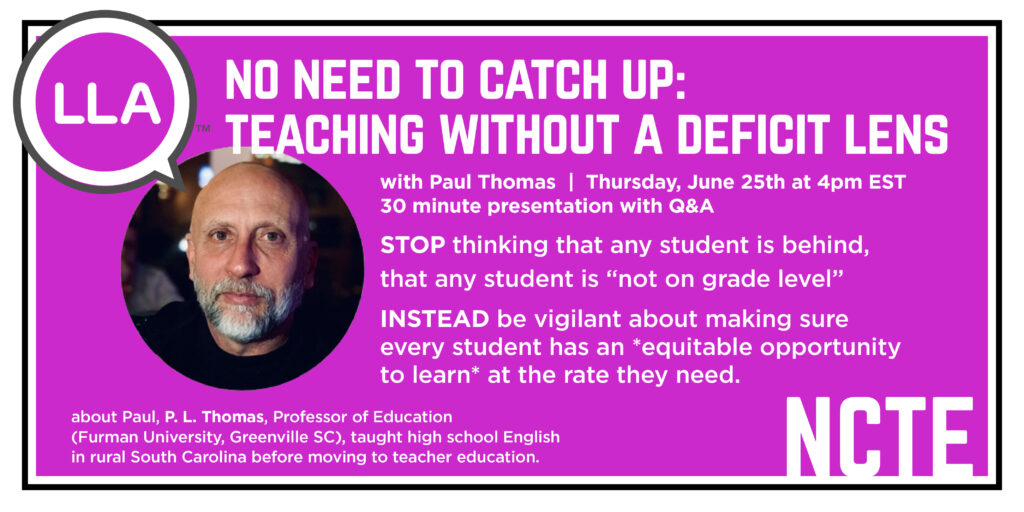
Upcoming: 2020 Summer Webinar Series


No Need to Catch Up: Teaching Without a Deficit Lens
with Paul Thomas
Thursday, June 25, 2020
4:00 p.m. EST
See Also
Upcoming: 2020 Summer Webinar Series – radical eyes for equity

COVID 19: FSMC Monitoring and Allowable Costs Q&A - Nutrition (CA Dept of Education)

COVID 19: FSMC Monitoring and Allowable Costs Q&A - Nutrition (CA Dept of Education)

COVID 19: FSMC Monitoring and Allowable Costs Q&A


On June 3, 2020, the U.S. Department of Agriculture released Policy Memorandum SP 21-2020, CACFP 12-2020, SFSP 12-2020: Questions and Answers (Q&A) related to Food Service Management Company (FSMC) Contracts and Allowable Costs during the COVID-19 PandemicExternal link opens in new window or tab. (PDF). It provides further guidance related to the flexibility provided under COVID-19: Child Nutrition Response #19: Nationwide waiver of Food Service Management Contract Duration in the National School Lunch Program and Summer Food Service Program. Additional questions and answers address documentation requirements for food safety inspections; as well as allowable costs as they pertain to personal protective equipment, provision of non-congregate meal service, staff salaries, and non-refundable program costs.
For more comprehensive COVID-19 guidance, please visit the School and Child and Adult Day Care Meals web page.
Contact Information
For any questions regarding these waivers, please contact your respective program’s County Specialist. The County Specialist for each program can be found in the following Form IDs in the CNIPS Download Forms section:
  • Summer Food Service Program (SFSP)—Form ID SFSP 01.
  • National School Lunch Program (NSLP), School Breakfast Program (SBP), and Seamless Summer Option (SSO)—Form ID Caseload.
  • Child and Adult Care Food Program (CACFP)—Form ID CACFP 01.
Questions:   Nutrition Services Division | 800-952-5609

Organized to Disrupt | tultican

Organized to Disrupt | tultican
Organized to Disrupt


By Thomas Ultican 6/10/2020
The New Schools Venture Fund (NSVF) is the Swiss army knife of public school privatization. It promotes education technology development, bankrolls charter school creation, develops charter management organizations and sponsors school leadership training groups. Since its founding in 1998, a small group of people with extraordinary wealth have been munificent in their support. NSVF is a significant asset in the billionaire funded drive to end democratically run public schools and replace them with privatized corporate structures.

1990’s Silicon Valley was a Happening Place

Mark Andreessen had just co-written the world’s first web-browser, Mosaic, before he came to town from the University of Illinois to co-found Netscape. John Doerr left Intel in 1980 to join the venture capital firm Kleiner Perkins where his reputation for picking winners became legendary. His wins include Amazon, AOL, Compaq, Electronic Arts, Google, Netscape and Twitter. Internet search engines were in their infancy when in 1999 Doerr convinced his partners to put $12.5 million into Google. Five years later that investment turned into billions.
Like elsewhere in America, every little strip mall in San Jose, California had a Blockbuster video rental store. In 1997, Reed Hastings and Netflix co-founder Mark Reynolds came up with a disruptive idea that put Blockbuster out of business. For a monthly fee, they offered DVD’s by mail with no late charges. Blockbuster did not adapt fast enough and went bankrupt.
In the Valley, everyone was aware that their business could be just one new technology innovation away from being the next Blockbuster.
“DoWopDon” Shalvey was the superintendent of schools in San Carlos, California a bedroom community about a third of the way up the peninsula between San Jose and San Francisco. When California passed its 1992 charter school legislation, Shalvey’s application for a charter turned into California’s first charter school. It officially opened in August 1994.
Apparently, Don Shalvey was an amateur DJ and very into music. His twitter handle is @dooWopDon.
Shalvey joined with Reed Hastings in writing a statewide initiative for the 1998 ballot that lifted the cap on charter schools and eased restrictions on starting one. At that time, Hastings was made president of Technology Network, a bipartisan lobbying group formed by Silicon Valley CEOs. With their support, CONTINUE READING: Organized to Disrupt | tultican

Yup, Police PACS Give A Lot Of Money – redqueeninla

Yup, Police PACS Give A Lot Of Money – redqueeninla

Yup, Police PACS Give A Lot Of Money


There’s been some shock about LA City Council members receipt of monies from the LA Police Protective League.
But they all do it, accept money from these PACS.
Here’s the collected contributions to politicians between 2017-2020 from off calaccess of LAPPL, ID# 743579.  There are 170 currently active “Recipient Cmtes” registered throughout the state with the name “Police” in their title. There are four different recipient committees for the “LA Police Protective League” alone. And there are many more LA-based law enforcement associations. This is just one of these PACS. And it contributed a total of $2.5m (so far) to various candidates statewide in the 3½ years between 2017 – 2020.
The table below is organized by the last office type a politician ran for. So if Suzy Q ran for school board and then later Assembly, both contributions get listed as CONTINUE READING: Yup, Police PACS Give A Lot Of Money – redqueeninla

Teach for America’s 2020 Trainees to Enter the Classroom with Only Tutoring Experience | deutsch29

Teach for America’s 2020 Trainees to Enter the Classroom with Only Tutoring Experience | deutsch29

Teach for America’s 2020 Trainees to Enter the Classroom with Only Tutoring Experience


In this time of school closures and social distancing, teacher temp agency, Teach for America (TFA), has decided to “train” its 2020 corps members online.
As former TFAer-gone-career teacher, Gary Rubinstein, writes, pre-COVID, TFA trainees actually teach on average one hour per day over the course of four weeks during the summer, in classrooms which they share with four other TFA trainees.
As such, TFA trainees have no experience teaching even one entire school day in a classroom in which the trainee is responsible for all instruction.
And now, with the social restrictions and classroom complexities introduced by the coronavirus, TFA’s 2020 trainees will have no experience being in charge of a classroom– not even an entire classroom online.
Their big exposure to students will come in the form of online tutoring via a summer reading program offered by Springboard Collective, a nonprofit started by TFA alum Alejandro Gibes de Gac (Springboard Collective derives from an entrepreneurial pitch at TFA’s 20th Anniversary Summit in 2010. TFA offered Gibes de Gac $5,000 in seed money to fund the pilot in 2011.)
Springboard Collaborative is excited to announce a joint partnership CONTINUE READING: Teach for America’s 2020 Trainees to Enter the Classroom with Only Tutoring Experience | deutsch29