Latest News and Comment from Education

Wednesday, October 16, 2019

NANCY BAILEY: Problematic “Scientific Based” Phonics: The Flawed National Reading Panel

Problematic “Scientific Based” Phonics: The Flawed National Reading Panel

Problematic “Scientific Based” Phonics: The Flawed National Reading Panel

It’s odd and detrimental that the National Reading Panel is highlighted in reports as science, used to promote phonics and criticize how teachers teach reading. It has become so intense that teachers are being advised to drop certain reading methods to focus solely on “systematic, explicit phonics!”
The NRP was discredited long ago. Why it’s resurfacing as scientific proof for a phonics-driven reading curriculum raises serious concerns.
In a recent Education Week report “How Do Kids Learn to Read? What the Science Says” the National Reading Panel is positively referenced six times! Similar reports repeatedly cite the NRP.
Primary teachers should know how to teach phonics. But phonics shouldn’t be taught in a vacuum, and the idea that scientific proof backs phonics based on the NRP is flawed.
Science based reading in reference to phonics started with the discredited National Reading Panel.
Some History
In 2002, Stephen Metcalf for The Nation wrote “Reading Between the Lines,” describing the excitement publishing companies had surrounding NCLB. The Bush administration had heralded in a new day for reading based on the NRP. The CONTINUE READING: Problematic “Scientific Based” Phonics: The Flawed National Reading Panel

Hidden Messages Your School Sends to Students | Teacher in a strange land

Hidden Messages Your School Sends to Students | Teacher in a strange land

Hidden Messages Your School Sends to Students


Once, at a staff meeting, my principal shared a short video he’d seen at an administrators’ conference.  It was an effort, I think, to talk about important things at mandated staff meetings, rather than simple announcements. Although there was a lot of eye-rolling when he cued it up, I thought it was worthwhile, with some apt observations about schooling.
One of those was a suggestion that if we wanted to assess what was most important to us, we should look at the times when the normal academic schedule was disrupted, and the student body gathered for an all-school assembly.
At that point in the school year, we’d had five assemblies:
  • An assembly on the first day, where students were welcomed, then informed which teacher would be leading them to their first hour class and giving them schedules.
  • An annual ‘rules’ assembly for each grade, where the assistant principal went through all the rules in the student handbook.
  • An all-school assembly to introduce the annual fund-raiser, and a follow-up assembly, two weeks later, to reward all the students who sold enough sausage and cheese with an hour out of class to play in bouncy castles and batting cages.
  • A fall sports assembly to recognize athletic teams.
I mentioned this to my principal, who asked tartly if I thought that our school was all about schedules, rules, fund-raising and sports? Why else would we be having CONTINUE READING: Hidden Messages Your School Sends to Students | Teacher in a strange land

Save The Date: Black Lives Matter at School Week, Feb. 3-7, 2020 – I AM AN EDUCATOR

Save The Date: Black Lives Matter at School Week, Feb. 3-7, 2020 – I AM AN EDUCATOR

Save The Date: Black Lives Matter at School Week, Feb. 3-7, 2020


Mark your calendar! The Black Lives Matter at School national week of action will be held from February 3-7th, 2020–and educators from coast to coast are organizing to make this the biggest coordinated uprising for racial justice in the schools yet.
Black Lives Matter At School is a national coalition educators, parents and students organizing for racial justice in education.  We encourage community organizations and unions to join our annual week of action during the first week of February each year. To learn more about how to participate in the week of action, please check out the BLM@School starter kit.
If you or your organization would like to support or endorse the week of action, please email us at: BlackLivesMatterAtSchool2@gmail.com.   

BLMschool_Background.jpg
During the 2018-2019 school year, BLM@School held its second national week of action in some 30 different cities around the country. During the nationally organized week of action, thousands of educators around the U.S. wore Black Lives Matter shirts to school and taught lessons about the guiding principles of the Black Lives Matter Global Network, structural racism, intersectional black identities, black history, and anti-racist social movements.
In addition to centering Blackness in the classroom, BLM at School has these four demands:
1) End “zero tolerance” discipline, and implement restorative justice
3) Mandate Black history and Ethnic Studies in K-12 curriculum
The lessons that educators teach during the week of action corresponded to the guiding principles of Black Lives Matter:
Monday: Restorative Justice, Empathy and Loving Engagement
Tuesday: Diversity and Globalism
Wednesday: Trans-Affirming, Queer Affirming and Collective Value
Thursday: Intergenerational, Black Families and Black Villages
Friday: Black Women and Unapologetically Black
With your help, this year’s BLM at School week of action can continue to grow and provide healing for Black students.  Learn more about how to participate by visiting our website, www.BlackLivesMatterAtSchool.com. Let us know what you are planning for BLM at School week this school year or ask us how to get involved with the action by emailing us at: BlackLivesMatterAtSchool2@gmail.com.

Save The Date: Black Lives Matter at School Week, Feb. 3-7, 2020 – I AM AN EDUCATOR

Chicago teachers poised to walk. – Fred Klonsky

Chicago teachers poised to walk. – Fred Klonsky

CHICAGO TEACHERS POISED TO WALK


If as expected, the Chicago Teachers Union’s House of Delegates votes to go ahead with the Thursday strike deadline, I will be heading over to my neighborhood school, Darwin, to walk the line.
I consider it part of my responsibility as a retired union teacher.
Over the past eight years since I retired from teaching I have walked on quite a few picket lines with striking teachers all over northern Illinois.
I encourage all retired teachers to do the same.
Michael Antonucci, the union basher who writes for The 74, thinks the CTU demand for full staffing of nurses, social workers, psychologists and librarians along with contractual class size limits is some kind of trick by the union to collect more dues.
“It is no coincidence that virtually all of these new employees would be eligible for union membership,” he writes.
Well, I would hope so!
I particularly resonate to the issue of putting class size limits in the contract and CONTINUE READING: Chicago teachers poised to walk. – Fred Klonsky
klonsky 2
CTU strike, 2012. Photo: Fred Klonsky

The Delano Grape Strike: A Complete Visual History | Teen Vogue

The Delano Grape Strike: A Complete Visual History | Teen Vogue

The Complete History of the Famed Delano Grape Strike
This visual history details how Dolores Huerta and Cesar Chavez helped found the United Farm Workers and led one of the most successful union boycotts in American history.


SEE THE REST OF THE STORY: The Delano Grape Strike: A Complete Visual History | Teen Vogue


Court Injunctions Protect Immigrant Families from Imposition — Yesterday — of Trump’s Public Charge Rule | janresseger

Court Injunctions Protect Immigrant Families from Imposition — Yesterday — of Trump’s Public Charge Rule | janresseger

Court Injunctions Protect Immigrant Families from Imposition — Yesterday — of Trump’s Public Charge Rule

Last Friday, NPR reported the good news: “Federal judges in three states—New York, California and Washington—have issued temporary injunctions against the Trump administration’s ‘public charge’ rule, preventing it from taking effect on Oct. 15.”
For NBC NewsDaniella Silva explains exactly how the Trump administration’s punitive rule—which DID NOT go into effect yesterday as planned—would have excluded legal immigrants and their families.  An old rule previously denied green cards to immigrants, “who depended on cash assistance or government-funded long-term institutional care.”  “The new rule expands the definition to include additional benefits such as food stamps, non-emergency Medicaid, certain prescription drug subsidies and housing vouchers.  And the rule would now define public charge as any immigrant who uses or is deemed likely to use at some point one public benefit for 12 months during a 36-month period. Receipt of two public benefits in one month counts as two months, the rule noted. Once labeled a ‘public charge’ immigrants could be denied green cards, visas and other forms of legal immigrant status.”
The judges’ injunctions issued last Friday will delay the imposition of the new rule, described by the NY Times‘ Miriam Jordan as “developed by Stephen Miller, the White House aide who is the architect of several of the government’s hard-line immigration policies.”
The Trump administration’s rule has not been permanently overturned.  However, the courts have blocked its implementation while the matter of its constitutionality moves through the court system.  Jordan quotes Steve Yale-Loehr, an immigration professor at Cornell Law School: “The court rulings today represent at least a temporary setback in the Trump administration’s attacks on both legal and illegal immigrants… Ultimately, I predict these CONTINUE READING: Court Injunctions Protect Immigrant Families from Imposition — Yesterday — of Trump’s Public Charge Rule | janresseger

The Koch network says it wants to remake public education. That means destroying it, says author of new book on billionaire brothers. - The Washington Post

The Koch network says it wants to remake public education. That means destroying it, says author of new book on billionaire brothers. - The Washington Post

The Koch network says it wants to remake public education. That means destroying it, says the author of a new book on the billionaire brothers


Early this year, the Koch network committed to starting an effort to transform public education. What would that look like?
The author of a new book on the billionaire Charles Koch and his late brother, David, says it would amount to the destruction of public education as we know it.
The Koch network is the influential assemblage of groups funded by billionaire industrialist Charles Koch and more than 600 wealthy individuals who share his pro-business, anti-regulation view of economics and positions on social policy, such as climate change denial.

The focus on K-12 education follows long involvement by the Koch brothers in higher education. As leaders of a conservative movement that believes U.S. higher education is controlled by liberals who indoctrinate young people, they spent as much as an estimated $100 million on programs at hundreds of colleges and universities that support their views.

Now the network says it is going to try to transform K-12 education, though the details are unclear. The Kochs and their allies have long supported the school choice movement — which seeks alternatives to traditional public school districts — as well as the use of public funds for private and religious school education, as does Secretary of Education Betsy DeVos.
In June, two Koch-related education initiatives were announced. One is a group called “Yes Every Kid,” which, its creators say, will bring together partisans in the education labor and funding debates to try to find solutions. The other is a project called 4.0 that commits the Charles Koch Foundation and the Walton Family Foundation to pledge $5 million each — along with $5 million from other donors — to support, according to a statement, “600 education entrepreneurs in incubating, testing and launching innovative approaches to education.” (The Walton foundation has long supported charter schools and other parts of the school choice movement.)


Little Rock Educators Fighting for Equity, Local Control - NEA Today

Little Rock Educators Fighting for Equity, Local Control - NEA Today

Little Rock Educators Fighting for Equity, Local Control

Thousands of Arkansas educators, students and community members held candles and sang in front of historic Little Rock Central High School last week, protesting a plan by the governor-appointed State Board of Education that would re-segregate the city’s students.
Every single one of us, students, parents and teachers, should feel valued, heard and respected,” said state Teacher of the Year Stacey McAdoo, a Little Rock Education Association (LREA) member, as she stood in front of a banner that read, “Separate Is Not Equal.” “Nothing should be done to us or about us without us. Our voices matter and so do the things we say. Let us remember that this is personal.”
Educators were heard. And then, it seems, they were punished for speaking up for their students.
On Thursday, the board first backed off on its plan, at least somewhat, and then voted to eliminate recognition of the union. The Arkansas Education Association quickly responded: “For 150 years, our union has fought for students, and as long as children are being educated in our state, that will not change. We have never asked for or needed the blessing of the Governor or the state board to care for our students, and we will continue to fight for them now and going forward.”
“LREA is not going anywhere,” vowed LREA President Teresa Knapp Gordon. “We will continue to fight for our students. We will continue to fight for our educators.”
The state took over Little Rock schools in 2015. The original plan, which was CONTINUE READING: Little Rock Educators Fighting for Equity, Local Control - NEA Today

CURMUDGUCATION: Betsy DeVos, Polly Williams, Vouchers, And Selective Facts

CURMUDGUCATION: Betsy DeVos, Polly Williams, Vouchers, And Selective Facts

Betsy DeVos, Polly Williams, Vouchers, And Selective Facts
Secretary of Education Betsy DeVos kicked off her back to school tour at the Saint Marcus Lutheran School in Milwaukee a few weeks ago. This piece ran back then at Forbes, and I don't repost everything from there, but we've developed such goldfish memories under this administration, I'm going to trot this one out again here. Because we need to remember what the threat to public education is. 
The choice of location itself sent a message about what DeVos means by “freedom.” The school’s mission is “to disciple children for Christ, now and for all eternity, and to train them in excellence for their roles in their family, church, community, workplace and country,” and it is a longtime beneficiary of Wisconsin’s voucher program. Its core values are “Christ First, Biblical Discipleship, Sacrificial Love, and Radical Expectations.” It is not particularly unusual to find that a voucher-supported school is using public tax dollars in a private religious setting; in most voucher programs, the vast majority of taxpayers’ money is directed to religious schools
It’s not surprising that DeVos would support this. Years ago, she and her husband were clear that their hope for education was for “kingdom gain” and a return to the days when the church, and not the public school, was the center of the community.
Her speech on Monday is supportive of that vision, even as it elides some inconvenient facts.
Portions of the speech are simply allegations. She says that “too many students can’t read,” and she blames that on “the education cabal.” She discusses the average amount of money spent on CONTINUE READING; CURMUDGUCATION: Betsy DeVos, Polly Williams, Vouchers, And Selective Facts

Tuesday, October 15, 2019

Code Acts in Education: Psychodata | National Education Policy Center

Code Acts in Education: Psychodata | National Education Policy Center

Code Acts in Education: Psychodata

‘Social and emotional learning’ (SEL) has become one of the most active topics in education policy and practice over the last few years. At an international scale, the OECD is about to run its new Study on Social and Emotional Skills for the first time this month, in its bid to produce policy-relevant comparative data on different nations’ ‘non-cognitive’ capacity. Nationally and regionally, government education departments have begun to endorse SEL as a key priority. At classroom level, teachers are using SEL-based edtech devices like ClassDojo, Panorama and HeroK12 to observe students’ social-emotional learning, twinned with tasks such as ‘emotion diaries’, ‘managing your emotions’ posters, and self-assessment scales for children to rate their emotions.
How should we understand this SEL explosion? In a new research article entitled ‘Psychodata‘, just published in Journal of Education Policy, I argue that SEL is a good case of a ‘policy infrastructure’ that is currently in-the-making, and that its main objective is the construction of ‘data infrastructure’ for the measurement of students’ social-emotional skills. The article presents my attempt to ‘disassemble’ the statistical, psychological and economic infrastructure of social-emotional learning into some of its main constituent parts.
Policy & data infrastructures
By policy infrastructure I mean all the various organizations, forms of expert knowledge, concepts, techniques and technologies that all have to be brought together to make any policy area operational. Psychology, economics and statistics–which include people, knowledge, devices, practices and techniques–are key aspects of SEL policy infrastructure. And by data infrastructure I mean the technologies, modes of quantification, actors and desires that have to be assembled together for large-scale measurement–the system of data collection, analysis and presentation. In fact, I argue that the construction of data infrastructure is making social-emotional learning possible to conceive and enact as a key policy area. A policy infrastructure, in this sense, to a large extent is its data system.
Social-emotional learning sounds like a progressive, child-centred agenda, but behind the scenes it’s CONTINUE READING: Code Acts in Education: Psychodata | National Education Policy Center

Mapping America’s Teacher Evaluation Plans Under ESSA | VAMboozled!

Mapping America’s Teacher Evaluation Plans Under ESSA | VAMboozled!

Mapping America’s Teacher Evaluation Plans Under ESSA
Image result for Mapping America’s Teacher Evaluation Plans Under ESSA

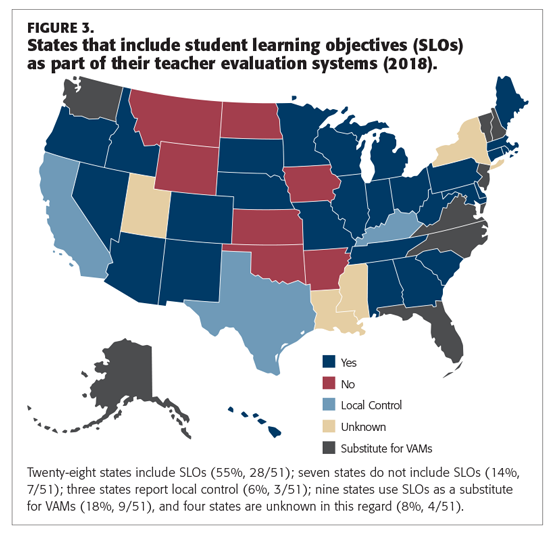
One of my doctoral students — Kevin Close, one of my former doctoral students — Clarin Collins, and I just had a study published in the practitioner journal Phi Delta Kappan that I wanted to share out with all of you, especially before the study is no longer open-access or free (see the full article as currently available here). As the title of this post (which is the same as the title of the article) indicates, the study is about research the three of us conducted, by surveying every state (or interviewing leaders at every state’s department of education), about how each state’s changed their teacher evaluation systems post the passage of the Every Student Succeeds Act (ESSA).
In short, we found states have reduced their use of growth or value-added models (VAMs) within their teacher evaluation systems. In addition, states that are still using such models are using them in much less consequential ways, while many states are CONTINUE READING: Mapping America’s Teacher Evaluation Plans Under ESSA | VAMboozled!
Image result for Mapping America’s Teacher Evaluation Plans Under ESSA

For better student outcomes, hire more black teachers - The Hechinger Report

For better student outcomes, hire more black teachers - The Hechinger Report

For better student outcomes, hire more black teachers

Supporting teachers and communities will boost children’s academic achievement

There are 60,000 fewer public education jobs than there were before the recession began in 2007, according to an analysis of the latest Bureau of Labor Statistics jobs report by the think tank Economic Policy Institute. States and districts haven’t moved on from the austerity measures imposed by most states more than a decade ago when the recession hit. “If we include the number of jobs that should have been created just to keep up with growing student enrollment,” the EPI report states, “we are currently experiencing a 307,000 job shortfall in public education.”

A shortfall of more than 300,000 jobs in public education. Think about that the next time news of a teacher strike hits the headlines. Maybe severe budget cuts made sense to folks in 2007, but the underlying rationale behind firing teachers has never made sense to me.
In the Obama years, Republicans and Democrats alike were delighted to find common cause against teachers. Students weren’t doing so well, they argued, because their teachers simply weren’t good enough. Education reform was the name of the game, and everyone who wasn’t a quality teacher just had to go.
Problem was, that was a myopic view of the world. Neither students nor teachers exist in a vacuum. As I like to say, students don’t live in schools — they live in communities. And when their communities are negatively affected, that has a negative impact on them. So if you fire a whole bunch of black teachers, as education reformers did, with devastating effect, in New Orleans, Washington, D.C., and CONTINUE READING: For better student outcomes, hire more black teachers - The Hechinger Report

California Foolishly Trusts Charters to Hire Their Own Auditors | Diane Ravitch's blog

California Foolishly Trusts Charters to Hire Their Own Auditors | Diane Ravitch's blog

California Foolishly Trusts Charters to Hire Their Own Auditors

Will Huntsberry of the San Diego Union-Tribune has covered the scandals blighting California’s Charter Industry, especially the A3 online scandal, the largest in American history.
In this article, he goes straight to the heart of the scandals: the flawed audit process.
California lawmakers created a system that places just one process at the forefront of detecting fraud and mismanagement in the state’s schools: a yearly audit, conducted by a “state-approved,” “independent” auditor, according to the Department of Education.
But these auditors are not independent, in so much as they are hired and fired at will by the schools they are auditing. The term state-approved is also something of a misnomer. To qualify as an approved firm, the State Controller’s Office must only verify that the potential auditors are accountants in good standing with the California Board of Accountancy.
No special training or vetting required.
The audits themselves are also not designed to dig deeply into a school’s finances, according to transcripts from a grand jury proceeding into an alleged $80 million CONTINUE READING: California Foolishly Trusts Charters to Hire Their Own Auditors | Diane Ravitch's blog

What parents can do to stop bullying - Vox

What parents can do to stop bullying - Vox

So your kid is a bully. Here’s how to stop it.
First step: Try not to freak out.

t’s easy to think of bullying as something that other people’s children do, but not something yours might ever do. And, look, I don’t know you or your kid, but I can say with confidence that some children bully, and your kid certainly could be one. Even if they aren’t, we’ll be better off if all adults know how to intervene if a child is bullying. If you never have to use this information, great! I genuinely hope you don’t. But if you do need it at some point, that’s okay too.
The Centers for Disease Control and Prevention defines bullying as unwanted aggressive behavior by another youth (or group of youths) that includes “observed or perceived power imbalance.” It can be physical, verbal, or relational (think: spreading rumors, excluding people). According to a 2017 CDC survey, 19 percent of high school students said they were bullied at some point on campus in the 12 months prior, and 14.9 percent reported being bullied online in that time. Bullying is often targeted toward minority groups: A separate 2017 CDC report said that 33 percent of gay, lesbian, and bisexual students experienced bullying (compared to 17.1 percent of heterosexual students) in the year prior.
Bullying doesn’t just affect the child being bullied; it affects every child who witnesses it. And while much has (rightfully) been written about the adverse effects of bullying on victims, it’s worth noting that kids who bully don’t fare well either; according to the US Department of Health and Human Services, they are more likely to drop out of school, get into fights, abuse drugs and alcohol, have criminal convictions as adults, and be abusive toward partners and children as adults.
“If a bully is not helped with being a bully, that’s a mental health issue,” says Mary Gordon, author of Roots of Empathy: Changing the World Child by Child. If a child you know and love is the aggressor, read on for some expert advice on what to do next.

Try not to freak out

“As a parent, I feel so badly for the parents of bullies,” Gordon says. “There’s a feeling of, ‘I’ve done something wrong, I’ve been a terrible parent.’ Don’t beat yourself up. Don’t make this about you. You’re not a bad parent.”
Psychologist Michael Reichert, author of How To Raise A Boy: The Power of Connection to Build Good Men, says that bullying behavior is fairly normative; the child who is bullying is CONTINUE READING: What parents can do to stop bullying - Vox

Let’s never see another first-grader in handcuffs- Hechinger Report

We must end the school to prison pipeline that starts in early childhood

OPINION: Let’s never see another first-grader in handcuffs
It is far past time to end the school-to-prison pipeline that starts in early childhood

The Hechinger Report is a national nonprofit newsroom that reports on one topic: education. Sign up for our weekly newsletters to get stories like this delivered directly to your inbox.
Two first-graders in Florida are not the same children today as they were last month. Consider the distress, fear and confusion that being forcibly taken, handcuffed and driven away from your school by a police officer would cause in any 6-year-old you know. Imagine it’s your child, your grandchild.
We both worked in the Obama administration, one of us as a senior policy advisor for early childhood development, and the other as a deputy assistant to the president and policy lead on criminal justice reform. Though we shared an office suite at the White House, our work worlds rarely collided. The main exception? School discipline, an issue that brings together two topics that should be separate: early childhood and criminal justice.
Last month, our worlds collided again. Two 6-year-old black children were arrested for incidents in their first-grade classroom in Florida. The officer involved in the incident was fired. But that doesn’t erase the trauma that those children faced and will continue to face. It doesn’t fix the system that enabled the officer’s behavior.
After months of operating in our own “lanes,” we got in touch with each other and shared our reactions to the story.
Criminalizing the developmentally appropriate behavior of  black children is something that’s been happening for generations. In past years, there have been other well-publicized cases of school-resource officers handcuffing children whose hands are too small for CONTINUE READING: We must end the school to prison pipeline that starts in early childhood