Latest News and Comment from Education

Wednesday, April 12, 2017

We Were Warned: The DeVos Family: Meet the Super-Wealthy Right-Wingers Working With the Religious Right to Kill Public Education | Alternet

The DeVos Family: Meet the Super-Wealthy Right-Wingers Working With the Religious Right to Kill Public Education | Alternet:

The DeVos Family: Meet the Super-Wealthy Right-Wingers Working With the Religious Right to Kill Public Education
By now you've surely heard of the Kochs. Meanwhile, the powerful, wealthy DeVos family has remained largely under the radar, while leading a stealth assault on America's schools.


Since the 2010 elections, voucher bills have popped up in legislatures around the nation. From Pennsylvania to Indiana to Florida, state governments across the country have introduced bills that would take money from public schools and use it to send students to private and religious institutions.
Vouchers have always been a staple of the right-wing agenda. Like previous efforts, this most recent push for vouchers is led by a network of conservative think tanks, PACs, Religious Right groups and wealthy conservative donors. But "school choice," as they euphemistically paint vouchers, is merely a means to an end. Their ultimate goal is the total elimination of our public education system.
The decades-long campaign to end public education is propelled by the super-wealthy, right-wing DeVos family. Betsy Prince DeVos is the sister of Erik Prince, founder of the notorious private military contractor Blackwater USA (now Xe), and wife of Dick DeVos, son of the co-founder of Amway, the multi-tiered home products business.
By now, you've surely heard of the Koch brothers, whose behind-the-scenes financing of right-wing causes has been widely documented in the past year. The DeVoses have remained largely under the radar, despite the fact that their stealth assault on America's schools has the potential to do away with public education as we know it.
Right-Wing Privatization Forces
The conservative policy institutes founded beginning in the 1970s get hundreds of millions of dollars from wealthy families and foundations to develop and promote free market fundamentalism. More specifically, their goals include privatizing social security, reducing government regulations, thwarting environmental policy, dismantling unions -- and eliminating public schools.
Whatever they may say about giving poor students a leg up, their real priority is nothing short of the total dismantling of our public educational institutions, and they've admitted as much. Cato Institute founder Ed Crane and other conservative think tank leaders have signed the Public Proclamation to Separate School and State, which reads in part that signing on, "Announces to the world your commitment to end involvement by local, state, and federal government from education."
But Americans don't want their schools dismantled. So privatization advocates have recognized that it's not politically viable to openly push for full privatization and have resigned themselves to incrementally dismantling public school systems. The think tanks’ weapon of choice is school vouchers.
Vouchers are funded with public school dollars but are used to pay for students to attend private and parochial (religious-affiliated) schools. The idea was introduced in the 1950s by the high priest of free-market fundamentalism, Milton Friedman, who also made the real goal of the voucher movement clear: “Vouchers are not an end in themselves; they are a means to make a transition from a government to a free-market system." The quote is in a 1995 Cato Institute briefing paper titled “Public Schools: Make Them Private.”
Joseph Bast, president of Heartland Institute, stated in 1997, “Like most other conservatives and libertarians, we see vouchers as a major step toward the complete privatization of schooling. In fact, after careful study, we have come to the conclusion that they are the only way to dismantle the current socialist regime.” Bast added, “Government schools will diminish in enrollment and thus in number as parents shift their loyalty and vouchers to superior-performing private schools.”
But Bast's lofty goals have not panned out. That's because, quite simply, voucher programs do not work.

Governor Jeb Bush to deliver keynote address at AFC’s annual Summit - American Federation for Children

Governor Jeb Bush to deliver keynote address at AFC’s annual Summit - American Federation for Children:
Governor Jeb Bush to deliver keynote address at AFC’s annual Summit 


The American Federation for Children, the nation’s voice for educational choice, is pleased to announce that school choice champion and former Florida Governor Jeb Bush will deliver a keynote address at its annual National Policy Summit – Monday, May 22, and Tuesday, May 23, in Indianapolis, Indiana.

“Governor Bush has been at the forefront of the educational choice movement, and we are thrilled he will be joining us in Indianapolis for this year’s Summit,” said Bill Oberndorf, Chairman of the American Federation for Children. “His bold and visionary leadership has been instrumental in our efforts to give millions of families across the country educational freedom, and hearing his insights on the state of our education revolution will be a highlight at this year’s event.”


"Betsy's Boy"

 "Betsy's Boy"
(You're not a kid anymore)
When people ask of me
What would you like to be
Now that your not a kid anymore
(You're not a kid anymore)
I know just what to say
I answer right away
There's just one thing
I've been wishing for...
I want to be Betsy's Boy
That's the most important thing to me...
And if I was Betsy's Boy
If I was Betsy's Boy
What a faithful, thankful boy I'd be
Each night I sit at home
Hoping that she will phone
But I know Betsy has someone else
(You're not a kid anymore)
Still in my heart I pray
There soon will come the day
When I will have her all to myself...
I want to be Betsy's Boy
That's the most important thing to me...
And if I was Betsy's Boy
If I was Betsy's Boy
What a faithful, thankful boy I'd be
I want to be Betsy's Boy

 Be My Baby


What you need to know about immigration enforcement in schools | MLive.com

What you need to know about immigration enforcement in schools | MLive.com:

What you need to know about immigration enforcement in schools

Image result for What you need to know about immigration enforcement in schools


Image result for What you need to know about immigration enforcement in schools

Success Academy wrong to suspend special needs kid for 45 days - NY Daily News

Success Academy wrong to suspend special needs kid for 45 days - NY Daily News:

Success Academy marks big failure by suspending special needs student for 45 days

Based on the facts of the case, Success Academy’s decision to suspend a student with a disability for 45 days cannot be condoned.
Even if the child had no special needs, the child has a right to an education and a 45-day suspension seems excessive.
Whatever punitive or remedial rationale for the suspension could reasonably be accomplished in much less time.
Moreover, children with special needs have specific due process rights prior to lengthy suspensions that do not appear to have been followed here.
A “manifestation determination review” must be held to assure that the behavior does not arise from the child’s disability, as the parent alleges.
It would simply be unfair to punish a child for behavior not within his control. In short, this appears to be a classic “push-out” situation.
Aside from these Draconian measures, the matter raises questions about whether the child’s special needs wereSuccess Academy wrong to suspend special needs kid for 45 days - NY Daily News:


New Study: Why Teachers Created a New Genre: The “I Quit” Letters | Diane Ravitch's blog

New Study: Why Teachers Created a New Genre: The “I Quit” Letters | Diane Ravitch's blog:
New Study: Why Teachers Created a New Genre: The “I Quit” Letters


There is a photograph circulating on Twitter of a teacher recruitment fair in Michigan, in a large room with many tables staffed and ready for recruits. But the room is empty. It is a sad picture, dramatizing the effect of the current policy atmosphere on the profession.
Please note that the empty job fair was held in Michigan. That is Betsy DeVos’s home state. Apparently in her dream school of the future, computers will replace teachers. That has long been the gospel of Jeb Bush. If you harass teachers enough, they will go away and everyone can go digital.
A new study was just released by two professors at Michigan State University analyzing what they call a new genre: the teacher resignation letter.
I have posted many resignation letters on this site. They are usually anguished, sometimes angry, always sorrowful. They come from people who had a calling to teach, but could not stand the demands on them by administrators nor the frequency of high-stakes testing. Working in a climate that requires compliance and subservience, one that expects you to abandon your professional ethics, is not appealing for most professionals.
I have posted many such letters. The one that got the most overwhelming response was written by North Carolina teacher Kris Neilsen. It was published October 27, 2012, and received 165,000 views. Nearly 900 people commented on it. It went worldwide.
Here is the report on the teacher resignation letter as a genre:
In a trio of studies, Michigan State University education expert Alyssa Hadley Dunn and colleagues examined the relatively new phenomenon of teachers posting their resignation letters online. Their findings, which come as many teachers are signing next year’s contracts, suggest educators at all grade and experience levels are frustrated and disheartened by a nationwide focus on standardized tests, scripted curriculum and punitive teacher-evaluation systems.
Teacher turnover costs more than $2.2 billion in the U.S. each year and has been shown to decrease student achievement in the form of reading and math test scores.


“The reasons teachers are leaving the profession has little to do with the reasons most frequently touted by education reformers, such as pay or New Study: Why Teachers Created a New Genre: The “I Quit” Letters | Diane Ravitch's blog:
 Image result for I Quit

For-Profit School Chain Camelot Suffers Setback Following Abuse Allegations - ProPublica

For-Profit School Chain Camelot Suffers Setback Following Abuse Allegations - ProPublica:

For-Profit School Chain Camelot Suffers Setback Following Abuse Allegations

After our reporting on alleged physical abuse of students at alternative schools run by Camelot Education, a Georgia school district delayed awarding a $6.4 million contract to the company.

Image result for Camelot Under Siege

This story was co-published with Slate.
The Muscogee County School Board in Columbus, Georgia, dealt another blow to embattled Camelot Education when it voted Monday night to delay for three months a decision on whether to hire the company to run its alternative education programs.
The delay in awarding the $6.4 million annual contract comes in the wake of a recent report by ProPublica and Slate that more than a dozen Camelot students were allegedly shoved, beaten or thrown by staff members — incidents almost always referred to as “slamming.” The for-profit Camelot runs alternative programs across the country for more than 3,000 students, most of whom have emotional or behavioral difficulties or have fallen far behind academically.
"The abuse allegations were one of many red flags for me,” said Muscogee school board member Frank Myers, one of five board members who supported postponement, while three were opposed. If the district is going to privatize such an important service, he said, “You ought to have an outfit that has a pristine record.”
The board bucked the wishes of school district officials, including Superintendent of Education David Lewis, who pushed to hire Camelot. “There was no transparency,” Myers said. “They wanted us to rush this thing.”
Instead, a community advisory council will be created, and additional public hearings will be held. The council is expected to report back within three months.
Efforts to reach Lewis were unsuccessful. Camelot spokesman Kirk Dorn said in an email that the company often encounters delays when it enters new partnerships. The company expects to meet with the community later this month “and will continue to ensure that those who still have questions get answers,” Dorn said. “We know from experience that the more a community learns about how we help students succeed the more reassured they become that we will be an asset.”
Camelot has faced recent setbacks in other states as well. On March 9, the day after the report was published, the Houston school board voted unanimously not to renew its For-Profit School Chain Camelot Suffers Setback Following Abuse Allegations - ProPublica:

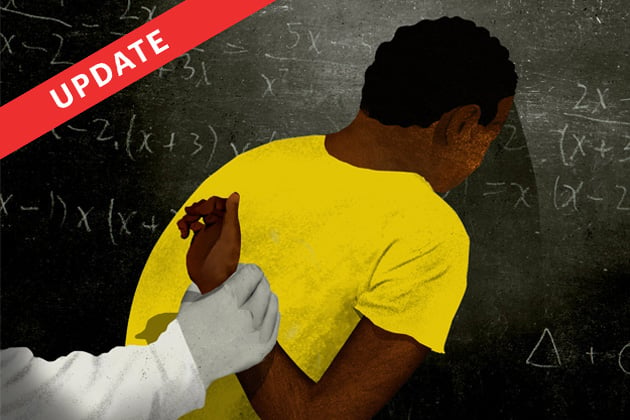
Where Corporal Punishment Is Still Used In Schools, Its Roots Run Deep : NPR Ed : NPR

Where Corporal Punishment Is Still Used In Schools, Its Roots Run Deep : NPR Ed : NPR:

Where Corporal Punishment Is Still Used In Schools, Its Roots Run Deep

Image result for spare the rod spoil the child

Robbinsville High School sits in a small gap in the Smoky Mountains of North Carolina. Green slopes dotted with cattle hug in around the school before they rise into a thick cover of pine trees.
David Matheson is the principal here. And he's the only high school principal in the state who still performs corporal punishment. At Robbinsville, corporal punishment takes the form of paddling - a few licks on the backside Matheson delivers with a long wooden paddle.
North Carolina state law describes corporal punishment, as "The intentional infliction of physical pain upon the body of a student as a disciplinary measure."
Robbinsville High School's policy allows students to request a paddling in place of in-school-suspension, or ISS. Last year, 22 students chose it.
"Most kids will tell you that they choose the paddling so they don't miss class," Matheson says.
One of those students is Allison Collins. She's a senior now and says she chose to be paddled her sophomore year after her phone went off in class. She describes it as, "My first time ever being in trouble."


Collins went to the assistant principal's office where she was told she had a day of in-school-suspension. Collins told Principal Matheson she'd rather take a paddling and so he called her father to get permission.
"And my dad was like, 'Just paddle her,'" she says. "Because down here in the mountains, we do it the old-school way."
That's the policy here. Principal Matheson paddles a student only if he gets permission from their parent. And, he says, very few parents opt out. Matheson grew up here and went to school with a lot of his students' parents. "It's something that the family decides," he adds.
Nationwide, it's not unusual for parents to support the use of corporal punishment as a form of discipline. Recent surveys show about 75 percent of Americans believe it's sometimes necessary to spank a child.
"I think it goes back to traditional values," says Cheri Where Corporal Punishment Is Still Used In Schools, Its Roots Run Deep : NPR Ed : NPR:


Don’t Buy Bluster from Teacher Quality VAM-pires | radical eyes for equity

Don’t Buy Bluster from Teacher Quality VAM-pires | radical eyes for equity:

Don’t Buy Bluster from Teacher Quality VAM-pires


The responses are predictable online and through social media any time I address teacher quality and policy focusing on teacher evaluation such as my recent commentary on Charleston adopting value-added methods (VAM).
How dare I, some respond, suggest that teacher quality does not matter!
The pattern is exhausting because most responding in indignation first misrepresent what I have claimed and then make the most extreme arguments themselves in order to derail the conversation along their own agenda, usually linked to the charter school movement grounded in teacher bashing and making unobtainable promises.
So let me state here that the central elements of what we know about teacher quality and efforts such as VAM-based teacher evaluation is that teacher quality is not an independent variable (any teacher may be effective for one student and ineffective for another, for example) and, since student high-stakes testing is not designed to measure teacher quality and is more strongly linked to out-of-school factors, VAM is both a horrible technique for identifying teacher quality and, ironically, a guaranteed process for devaluing the importance of teachers.
Teacher quality is unparalleled in importance in terms of student learning, but it is also nearly impossible to measure, quantify—especially through student scores on high-stakes standardized tests.
Teacher quality VAM-pires, then, often have agendas [1] that are masked by their bluster about teacher quality.
Trying to measure and quantify teacher quality is a mistake; linking any evaluation of teacher quality to student test scores lacks validity and reliability—and VAM discourages teachers from teaching the most challenging populations of students (high-poverty, special needs, English language learners).
Focusing on simplistic and inappropriate measures reduces teacher impact to 10-15% of what high-stakes standardized testing measures; in other words, VAM itself devalues teacher quality.
My informed argument, based on 18 years as a public school classroom teacher and 15 years as a teacher educator and scholar, then, is that we must recognize teacher quality is impacted by teacher preparation, teaching/learning conditions, student characteristics, and dozens of other factors inside and outside of schools—many of which are beyond the control of teachers or students.
As well, we must address the teacher quality issues that political and Don’t Buy Bluster from Teacher Quality VAM-pires | radical eyes for equity:


Rahm Emanuel's Graduation Rule Is 'Neoliberal School Reform Fantasy'

Rahm Emanuel's Graduation Rule Is 'Neoliberal School Reform Fantasy':

CHICAGO TEACHER: RAHM EMANUEL’S GRADUATION REQUIREMENT SHOWS HE HAS ‘NO INTEREST IN UNDERSTANDING THE ISSUES’

Incoming high school freshman will soon face a new graduation requirement thanks to Chicago Mayor Rahm Emanuel: provide the Chicago Public School District with evidence of an acceptance letter to a university, community college, apprenticeship or trade school, internship, or the armed services, or you won’t receive your diploma upon graduation—whether you’ve passed all your classes, or not.
Emanuel recently told CBS that this policy is one he borrowed from charter schools. “We want to make 14th grade universal. That’s the new goal line,” he said.
Members of the Chicago Board of Education are likely to approve of Emanuel’s post-high school scheme, known as “Learn, Plan, Succeed,” because they are appointed by Emanuel.
The Chicago Teachers Union (CTU) has come out in strong opposition against the new graduation requirement. Communications manager Ronnie Reese expressed the union’s disapproval, citing “self-inflicted budget problems” which will leave most high schools without enough counselors “who would be called upon to assist students with plans for their future.”
In February, the district of Chicago sued the Illinois State Board of Education over what it describes as “separate and unequal systems of funding for public education in Illinois.” The suit further alleges Chicago Public School students, specifically those who are black and Hispanic, are treated “as second-class children, relegated to the back of the state’s education funding bus.”
“The reality is that a child’s race continues to dictate whether she or he will receive a good education or something far short. Chicago’s predominantly African American and Hispanic children still suffer from stark educational inequalities,” the suit argued. Despite this, Emanuel proposes another hurdle for Chicago students, one that ignores the impact of race, class, their intersections, and the cost of higher education.
Lauren Kaufman, a 28-year-old vocational skills teacher to students with disabilities, ages 16-22 years-old, Rahm Emanuel's Graduation Rule Is 'Neoliberal School Reform Fantasy':
Chicago Teachers Union protest. Photo by Joe Brusky on Flickr.

Blaine Amendments Protect Religious Liberty, Prohibit Establishing Religion via School Vouchers | janresseger

Blaine Amendments Protect Religious Liberty, Prohibit Establishing Religion via School Vouchers | janresseger:

Blaine Amendments Protect Religious Liberty, Prohibit Establishing Religion via School Vouchers

Image result for church schools discriminate

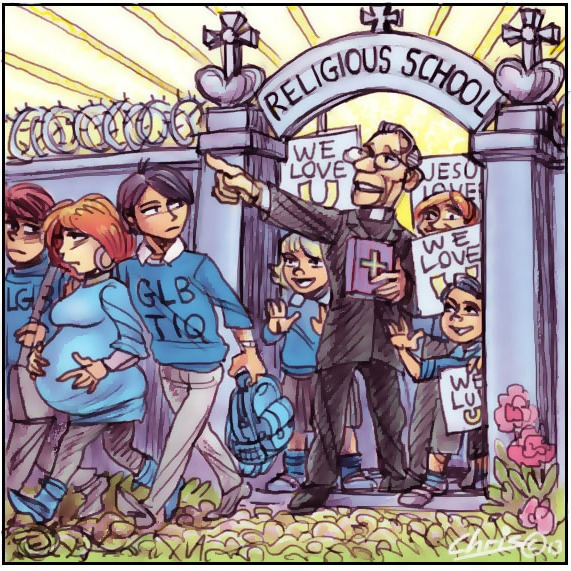
So-called Blaine Amendments in many of the state constitutions prohibit the diversion of taxpayer dollars to religious schools.  Over the weekend, The Hill published a commentary on the state Blaine Amendments by Robert G. Natelson , a retired professor of constitutional law and a fellow at the the far-right Heartland Institute. Natelson argues that the U.S. Supreme Court should overturn the Blaine Amendments in several state constitutions because they were created in an era of anti-Catholic bias and at a time when public schools reflected their Protestant beginnings.
Several times in the 1870s and 1880s, Speaker of the U.S. House of Representatives, James G. Blaine proposed a federal constitutional amendment to prohibit the expenditure of public dollars at religious schools.  While the amendment to the U.S. Constitution was never adopted, a number of the states passed so-called Blaine Amendments to their constitutions. In many those states today, the Blaine Amendment has been interpreted to mean that the state constitution prohibits the use of school vouchers in sectarian schools.
Diane Ravitch, the historian of education, responds to Natelson at the Huffington Post. She agrees with Natelson about the origin of the Blaine Amendments:, “Natelson is right that the public schools of the 19th century were deeply imbued with Protestant teachings and practices… The arrival of large numbers of Irish immigrants in the 1840s, mostly Catholic, concurred with the beginnings of public school systems in urban areas…. The Blaine Amendment appealed to anti-Catholic sentiment among the dominant Protestant majority….”
Ravitch explains, however, that public schools are no longer dominated by any religion, nor do they incorporate religious practices.  Courts, according to Ravitch, ought to consider the reality that today, public schools have shed religious practices, particularly since the 1962, U.S. Supreme Court decision in Engel v Vitale, that banned school prayer.  Today public schools are expected to protect the right of each child to worship according to the child’s or family’s religious beliefs and to protect the U.S. Constitutional ban on religious education.
There is widespread acceptance today in public schools and across U.S. religious bodies that the First Amendment protection of freedom of religion applies in schools operated in the public sphere by government. Here is the First Amendment to the U.S. Constitution: “Congress shall make no law respecting an establishment of religion, or prohibiting the free exercise thereof; or abridging the freedom of speech, or of the press; or the right of the people Blaine Amendments Protect Religious Liberty, Prohibit Establishing Religion via School Vouchers | janresseger:
Image result for church schools discriminate

NYC Educator: Happiness and Teaching

NYC Educator: Happiness and Teaching:

Happiness and Teaching


Yesterday I wrote about a young teacher who was happy when she ate lobster. Today I'm going to look at something a little more broad--what exactly makes teachers happy? That's a tough question, because there are a lot of variables. I know a lot of unhappy teachers, and the reasons for their unhappiness are varied, with some more valid than others.

I like my job a lot, and I feel blessed for that. I'd like to share this happiness, but it's very much about circumstance and point of view, so I'm not always able to do it. It's a little easier to give students optimism than it is to give it to adults. Because I'm happy with my work, I try to show them that they can be too. I try to show them that they have choices. That's important to me. Alas, it's not important to the politicians who make the laws, or the bureaucrats who regulate my work.

For example, I wrote a few days back that I will be rated based on the NY State English Regents scores of six beginning ESL students. This is awkward because my main role is not to teach them whatever it is they do on the English Regents this year. My main role is to teach them to speak, understand, write and read English. If that means teaching them, "My name is ___________. What's your name?" then that's what I do. I want them to be happy here, and it's hard for me to see how they do that if they can't communicate.

If I were to judge myself by the same standard the State does, I'd be very unhappy indeed. I do not expect those six students to pass that test, and I will not waste one minute of my time preparing them to do so. They will pass that test when they are ready. I judge myself differently. Little things kids say to me mean a lot.

I have had one girl in my class for a long time. She arrived toward the end of the 2014-15 school year. In 2015-16, she didn't manage to pass my tests, and was very quiet. This year, for some reason, she started talking. She started making jokes. In fact, she recently went out and got herself a job as a cashier somewhere. I congratulated her, and told her how happy I was with her progress.

"It's great to see you speaking English like this, " I told her. "How did it happen?"

"I don't know," she said. "I was surprised too."

But it was her time. I may or may not have had something to do with it, but regardless, I'm very happy about it. This means a lot more to me NYC Educator: Happiness and Teaching:


La. Supt. John White Falsely Credentials Himself with BESE Member James Garvey’s Help | deutsch29

La. Supt. John White Falsely Credentials Himself with BESE Member James Garvey’s Help | deutsch29:

La. Supt. John White Falsely Credentials Himself with BESE Member James Garvey’s Help

In order to have his or her contract renewed, a state education superintendent in Louisiana must be approved by a two-thirds vote of the state board of education every time a new state board is elected every four years.
That would be 8 out of 11 state board members.
In January 2012, the Louisiana Board of Elementary and Secondary Education (BESE) approved John White for state superintendent by a vote of 9 to 1, with one abstention. They offered him this contract.
In January 2016, White’s contract renewal did not come up for a vote because only seven members of the newly-elected/appointed BESE board can be counted on to vote for contract renewal.
What this means is that as Louisiana state superintendent, John White is now a month-to-month employee. As it stands, BESE is locked in a holding pattern where a majority of 7 are holding on to White (and will not seek a replacement), but without the ability to sway one more vote, this majority cannot offer White another contract. (To read about the office of Louisiana state superintendent, including terms of appointment and continued employment, see page 3 of this Title 28 excerpt.)
In order to be Louisiana state superintendent, White does not need any certification or licensure. And to be state superintendent, he does not need any minimum number of years in the classroom.
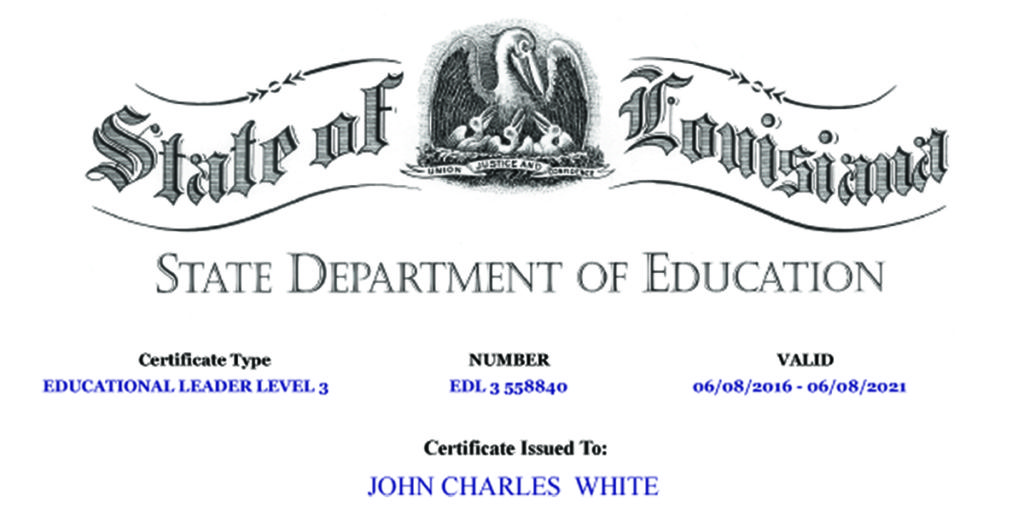
However, it seems that not long after the 2016 BESE board was seated, White quietly credentialed himself as a certified “educational leader” in Louisiana.
In fact, White now has three Louisiana certificates on file, all for educational leader– levels 1 through 3:
White’s certificates for educational leader 1 and educational leader 2 were issued on La. Supt. John White Falsely Credentials Himself with BESE Member James Garvey’s Help | deutsch29:

CURMUDGUCATION: Corporations versus Human Persons

CURMUDGUCATION: Corporations versus Human Persons:

Corporations versus Human Persons


The story of United Airlines and the Shameful Assault on a Paying Customer has been more thoroughly covered than almost anything this week (congrats, Beloved Leader Trump, on a widespread distraction from your latest screwup). We've had lessons from the airlines in free market delights before, but this is an even more direct and clear example of why the corporate approach is a bad idea for public education.

And that is how you run a No Excuses airline

Note that the United screwup is even worse than is generally reported. Though folks have blamed this on an overbooking of the flight, but actually, the airline wanted to bump four paying customers so that they could fly four of their own employees to Louisville.

This means they absolutely had the option of saying, "We need these employees in Louisville? Well, the seats on the plane are already filled with paying customers, so obviously we'll have to solve this internal transportation problem some other way." But no. They had a clear choice to make between the interests of the company and the care of the customers, and they picked the company. Well, not exactly "picked," because there was no decision so much as an auto-default to choosing in the corporate concerns, a default so strong and obvious to them, that they clearly didn't even reflect on how this should look.

And why should they? Sure, it would be shabby treatment for four customers, but the airlines barely bump one customer out of a thousand, and when you're operating at large scale, the smooth wheels of corporate operation can afford to grind up a tiny number of customers. And the selection process 
CURMUDGUCATION: Corporations versus Human Persons:

Related image

A Story About The High Expectations Conversation [The Art of the Professional Insult] | The Jose Vilson

A Story About The High Expectations Conversation [The Art of the Professional Insult] | The Jose Vilson:

A Story About The High Expectations Conversation [The Art of the Professional Insult]

Image result for A Story About The High Expectations Conversation [The Art of the Professional Insult]

“Mr. Vilson, how do you feel about us opting out because I’m thinking about it.”
“Let me tell y’all something, and this is real talk: if you have good grades and decide to opt out of this test, I ain’t mad at you …”
A student grumbled, knowing he had failed almost all of his grades throughout the school year.
“Now wait a minute. If you don’t have good grades and decide to opt out of the test, I’m not mad at you either. You haven’t been given a fair shot to succeed on this test. I’m going to do my absolute best to push you from here on out, but you gotta work with me here. But if you still don’t feel comfortable and opting out if something you and your parent make a conscientious decision about, please do.”
The students, all with different grades, had taken a series of mock tests demanded from on high to give students a sense of how the test might go. Instead of using the time to teach, I’d been asked to give a fake test in preparation for the forthcoming, very real and still fake test. The test might tell me whether they know the answers to the questions given on this test, but, until I see the questions on the test, I have little confidence that it’s assessing what I’m teaching and what they’re learning. Modern-day eugenicists love to say that standardized tests hold us (teachers and students) accountable like never before, but I was under the impression that students and parents do a good job of that already.
Because I don’t teach in ways that satisfy the test-prep advocates, does that make my work here any less urgent?
I could have told this story any time during the last twelve years, really. On a number of occasions, people questioned whether my educational philosophy was grounded in the work necessary to elevate students. Educators, especially with progressive leanings, know the depths to which other adults will go to discard and destroy the tenets to which we abide. They assume that letting students argue among each other is a sign of classroom mismanagement. They see unseated A Story About The High Expectations Conversation [The Art of the Professional Insult] | The Jose Vilson:


Seattle Schools Community Forum: More Thoughts on Gifted Education

Seattle Schools Community Forum: More Thoughts on Gifted Education:

More Thoughts on Gifted Education

Image result for More Thoughts on Gifted Education

At last Wednesday's Board meeting, one person (whose name I missed) speaking on the need for Ethnic Studies said that there were five people working in the Race & Equity office while there were seven in Advanced Learning.  (It's unclear why she picked that example.)

Two comments.  One, I checked with the district and Advanced Learning has eight FTEs while Race & Equity/School & Family Partnerships has 7.0 FTEs.

Two, every single department in the district is supposed to be looking at their work thru the lens of equity.  So, in that way, everyone who works for the district is thinking about equity.  I don't think the district would disagree with that statement.

What I find baffling is this idea that Advanced Learning is a program for white children.  It's not.  I don't hear enough about people who want to find more children of color to be in the program, just that it's terribly wrong that the program is mostly white and Asian children.

Don't people want more kids of color in the program OR is it that they just don't want the program at all?  It would be a good idea to be honest about that point.

 The Times recently had a story about how Federal Way School District is reaching more black and Latino students with advanced learning.  It's a wide-ranging article and I would say the tone towards Seattle schools is less-than-friendly (and actually not totally accurate).

The biggest problem with this article is the casual use of "advanced 
Seattle Schools Community Forum: More Thoughts on Gifted Education: