Latest News and Comment from Education

Wednesday, August 15, 2012

Happy Birthday Woodstock

The Woodstock Festival of 1969


Historical Importance of the Woodstock Festival of 1969: The Woodstock Festival was a three-day concert (which rolled into a fourth day) that involved lots of sex, drugs, and rock 'n roll - plus a lot of mud. The Woodstock Music Festival of 1969 has become an icon of the 1960s hippie counterculture.
Dates: August 15-18, 1969
Location: Max Yasgur's dairy farm in the town of Bethel (outside of White Lake, New York)
Also Known As: Woodstock Music Festival; An Aquarian Exposition: Three Days of Peace and Music
Overview of the Woodstock Festival of 1969:
The Organizers of Woodstock
The organizers of the Woodstock Festival were four young men: John Roberts, Joel Rosenman, Artie Kornfeld, and Mike Lang. The oldest of the four was only 27 years old at the time of the Woodstock Festival.
Roberts, an heir to a pharmaceutical fortune, and his friend Rosenman were looking for a way to use Roberts' money to invest in an idea that would make them even more money. After placing an ad in The New York Times that stated: "Young men with unlimited capital looking for interesting, legitimate investment opportunities and business propositions," they met Kornfeld and Lang.

Shanker Blog » Common Core Opens The Second Front In The Reading Wars

Shanker Blog » Common Core Opens The Second Front In The Reading Wars:


Common Core Opens The Second Front In The Reading Wars

Our guest author today is Kathleen Porter-Magee, Bernard Lee Schwartz policy fellow and editor of the Common Core Watch blog at the Thomas B. Fordham Institute. Previously, Ms. Porter-Magee served as both a middle and high school teacher, as well as the curriculum and professional development director for a network of public charter schools.
Up until now, the Common Core ELA standards were considered path-breaking mostly because of their reach. This isn’t the first time a group attempted to write “common” standards, but it is the first time they’ve gained such widespread traction.
Yet the Common Core standards are revolutionary for another, less talked about, reason: they define rigor in reading and literature classrooms more clearly and explicitly than nearly any of the state ELA standards they’ve replaced. Now, as the full impact of these expectations is starting to take hold, the decision to define rigor—and 

Susan Pimentel and David Coleman, Common Core's lead writers, respond in the comments of today's post - http://shankerblog.org/?p=6506

Privatization of Public Education

Privatization of Public Education:

Privatization of Public Education


In the United States, we have prided ourselves for generations on a system of public education that has been envied by nations all over the world.  Public schools are publicly funded, universally available, and accountable to the public. Today there are myriad attacks on the public in public education. 

NEW IN AUGUST 2012: As the school year begins, Justice & Witness Ministries creates a resource to comment from the point of view of the church on the conditions in public schools and public school reform. In years past, we have mailed the resource to all churches; these days we publish our resources on-line only. Here is the JWM 2013 Message on Public Education:The Public Purpose of Public Education.
The questions we must ask when private alternatives are promoted are whether the market has a greater interest in serving the poorest and most vulnerable children and what all children and our society have to lose or gain if we privatize all or part of the vast institution of public education.  We in the churches have advocated for a long, long time to make public schools more equitable.  Because they are public institutions, we have been able to do that. 
The UCC's General Synod has recognized that allocation of scarce public dollars 

Privatization

In the United States, public services have traditionally been understood to serve society as a whole in addition to the individuals directly served.  Public services have traditionally included the operation of public schools, jails and prisons, the military, local, state and national parks, resources like rivers and public lands, roads and highways, the administration of social programs, and services like police, fire, garbage collection. 
Privatization is turning over traditional public services to not-for-profit agencies or for-profit companies or contractors.  While public services are overseen by public boards and regulated through laws passed by democratically elected bodies, privatized services are privately managed and most often no longer accountable to the public but instead to privately-appointed boards and/or shareholders, who are exempt from sunshine laws.
While public services are paid for primarily through taxes, privatized services may be paid for with any combination of public funds, fees charged for services, or grants from individuals or philanthropy.  Privatized services may be provided without profiting the provider, or they may be offered for profit. 
The United Church of Christ's Twenty-fifth General Synod named concerns about privatization in a Resolution for the Common Good, passed in 2005: "A just and good society balances individualism with the needs of the community.  In the past quarter century our society has lost this ethical balance... While some may suggest that the sum total of individual choices will automatically constitute the common good, there is no evidence that choices based on self interest will protect the vulnerable or provide the saveguards and services needed by the whole population.  While as a matter of justice and morality we strive always to expand the individual rights guaranteed by our government for those who have lacked rights, we also affirm our commitment to vibrant communities and recognize the important role of government for providing public services on behalf of the community."
The "Resolution for the Common Good" resolves "to affirm the role of public institutions paid for by taxes for ensuring essential services and protecting the good of the wider community," and to make our culture reflect the following values: "that government policy and services are central to serving the common good," "that paying taxes for government services is a civic responsibility of individuals and businesses," and "that the tax code should be progressive, with the heaviest burden on those with the greatest financial means."
Here are ways our work in Justice & Witness Ministries speaks to privatization.
Privatization: A Challenge to the Common Good (Faith Reflections on Privatization) is a somewhat dated Justice & Witness Ministries' resource from 2003, but it covers issues that remain relevant today including the privatization of water, Social Security, health care, public education, prisons, and the military. 

NYC Educator: The TCRWP; Or, How Bad Ideas Survive Even When You Try to Squash Them

NYC Educator: The TCRWP; Or, How Bad Ideas Survive Even When You Try to Squash Them:


The TCRWP; Or, How Bad Ideas Survive Even When You Try to Squash Them

As some of my regular readers may know, I have no great love for the Teachers' College Reading and Writing Project; or, more accurately, how the TCRWP tends to get implemented in the city schools.  It has some fine ideas in theory, and it may be appropriate in some settings, but with the populations that most of us tend to teach, it's like giving a violin player a tuba.

So I read, with something like horror, that there is in the world a book called (ludicrously) Pathways to the Common Core by none other than TCRWP's high priestess, Lucy Calkins.  Education Gadfly's Common Core Watch does a pretty good job of calling into 

Jersey Jazzman: Ryan & Rhee: Phonies Only a Pundit Could Love

Jersey Jazzman: Ryan & Rhee: Phonies Only a Pundit Could Love:


Ryan & Rhee: Phonies Only a Pundit Could Love

Whatever your feelings about Paul Ryan, I'm going to ask you to read what Paul Krugman says here with some detachment. Because he's making a brilliant point about our nation's current education debate - without even mentioning it:
So, let me clarify what I believe is really going on in the choice of Paul Ryan as VP nominee. It is not about satisfying the conservative base, which was motivated anyway by Obama-hatred; it is not about refocusing on the issues, because R&R are both determined to avoid providing any of the crucial specifics about their plans. It is — as Jonathan Chait also seems to understand — about exploiting the gullibility and vanity of the news media, in much the same way that George W. Bush did in 2000.
Like Bush in 2000, Ryan has a completely undeserved reputation in the media as a bluff, honest guy, in Ryan’s case supplemented by a reputation as a serious policy wonk. None of this has any basis in reality; Ryan’s much-touted plan, far from being 

Missouri Education Watchdog: Unpacking the Standards

Missouri Education Watchdog: Unpacking the Standards:


Unpacking the Standards

Many teachers across the state have just spent hours "unpacking" new standards for their classes this year. This is the process where they take the language in the standard and try, as a coordinated group, to decide what specific skill set it it meant to refer to and how, using the resources they have, they will teach it to their classes. Teachers are used to doing this. Unless a district has adopted a new textbook method, like Everyday Math, unpacking the standards is usually not difficult and may only be a matter of tweaking previous lesson plans or bringing newer teachers on board with how a particular school handles the standards. As elements of Common Core Standards are rolled out, unpacking has become more complex, and in some cases depressing, for teachers.

Let's take a look at an example of a math standard to see what this process looks like,

CCSS Math Standard (Grade 4) 

Find whole-number quotients and remainders with up to four-digit dividends and one-digit divisors, using 

Gerald Coles: KIPP Schools: Power over Evidence - Living in Dialogue - Education Week Teacher

Gerald Coles: KIPP Schools: Power over Evidence - Living in Dialogue - Education Week Teacher:


Gerald Coles: KIPP Schools: Power over Evidence

Guest post by Gerald Coles.
In the debate over charter schools, KIPP (Knowledge is Power Program) schools are hailed by charter advocates as illustrative of what these alternatives to public schools can produce. With KIPP, poverty need not impede academic success. Enroll students from economically impoverished backgrounds in a "no excuses" school like KIPP and their chances of attaining academic success would soar markedly. There, neither hunger, poor health, relentless stress, lack of access to the material sustenance and cultural experiences available to students from more affluent homes, nor other adverse effects of poverty are impediments to learning and the attainment of good test scores. If only poor youngsters were not in the nothing-but-excuses public schools where they are taught by nothing-but-excuses teachers.
So the story goes and so it was conveyed to me by a KIPP schools manager who, in an oped exchange, presented what the chain considers its best supporting evidence. Whether this evidence actually makes the 

Duncan Announces 2012 Cross-Country Back-to-School Bus Tour | U.S. Department of Education

Duncan Announces 2012 Cross-Country Back-to-School Bus Tour | U.S. Department of Education:


Duncan Announces 2012 Cross-Country Back-to-School Bus Tour

“Education Drives America” to Spotlight Classroom Success, Link Education and the Economy

Contact:  
 (202) 401-1576, press@ed.gov 

U.S. Education Secretary Arne Duncan and senior leaders from the U.S. Department of Education will push the message that “Education Drives America” in its third annual back-to-school bus tour this fall. In a series of events from coast-to-coast, Department officials will highlight education successes across the country and engage communities in conversations about school reform (P-12), college affordability and completion, and the link between education and jobs.
“America’s future is directly linked to the quality of education that we provide our children, young people and adults,” Duncan said. “It is the key to a vibrant middle class, strong national security and our global economic competitiveness.”
The bus tour will begin on Sept. 12 in Redwood City, California, and conclude at the Department of Education’s headquarters in Washington, D.C., on the evening of Sept. 21. Additional stops include, Sacramento, California; Reno and Elko, Nevada; Salt Lake City, Utah; Rawlins, Rock Springs, and Cheyenne, Wyoming; Denver and Limon, Colorado; Topeka and Emporia, Kansas; Kansas City and Columbia, Missouri; Mt. Vernon, Illinois; Evansville, Indiana; Lexington, Kentucky; Charleston and McDowell County, West Virginia; Roanoke and Richmond, Virginia.
“In the past three years, I’ve traveled to 47 states, visited hundreds of schools and met with thousands of teachers, parents and students who are finding new and innovative ways to teach and learn,” Duncan said. “This bus tour is an opportunity to highlight what’s working and create momentum for education reforms that improve the lives of all students.”
This is the third annual back-to-school bus tour for Secretary Duncan and the Department of Education. In 2010, the back-to-school bus tour included the Delta region in the South and the Northeast. In 2011, the tour covered the Midwest from Pennsylvania to Wisconsin.
Duncan will lead the tour from Redwood City through Reno, Denver through Kansas City, and Charleston through Washington, D.C. Deputy Secretary Tony Miller and Under Secretary Martha Kanter will also lead portions of the tour.
Additional details, including specific sites, event times and participants, will be announced in the coming weeks. Senior department officials are also participating in over 60 satellite events along the bus tour route.

UPDATE: Chilean Students Occupy High Schools « Student Activism

Chilean Students Occupy High Schools « Student Activism:


Eight Things I Remembered At #HereUsNow

1. Trust is a risk worth taking.
2. A rough beginning can be a reason for optimism.
3. The people you are in awe of are often in awe of you.
4. Sleeping on a church floor is a beautiful thing.
5. The road is long because it’s supposed to be long.
6. Sharing stories is life-altering.
7. The beloved community exists in a state of constant reinvention.
8. Where the movement is now … is thrilling.


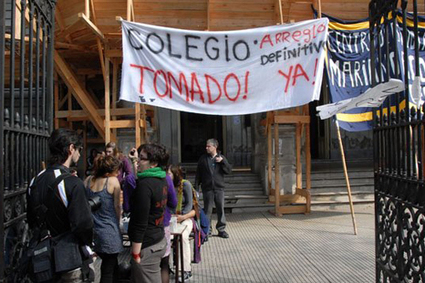
Chilean Students Occupy High Schools

Chilean student activists hold control of at least seven schools in the country’s capital this morning, following street protests that saw 75 arrested and three city buses burned.
The students are seeking to reverse the privatization of the country’s educational system that took place under dictator Augusto Pinochet, the Associated Press reports, rejecting government proposals to expand scholarships and lower loan rates as inadequate:
Mass demonstrations initially raised expectations for profound changes but more than a year after the first protests few students have seen any real benefits. Protesters say the system still fails families with poor quality public schools, expensive private universities, unprepared teachers and banks that make education loans at high interest rates most Chileans can ill afford…
Student leaders say real change will only come when the private sector is regulated and education is no 

Activists Warn of Possible Dangers of Deferred Action in Video - Hispanically Speaking News

Activists Warn of Possible Dangers of Deferred Action in Video - Hispanically Speaking News:


Activists Warn of Possible Dangers of Deferred Action in Video

Activists Warn of Possible Dangers of Deferred Action in Video
Photo: Still from the video
A group of pro-immigrant activists in Chicago on Tuesday released an informational video warning about the possible dangers of deferred action, which on Wednesday will begin to register undocumented young people who want to try and postpone deportation.
The video, “Defer the Bulls—t,” may be seen online atwww.moratoriumondeportations.org and is an effort to resist the government’s alleged disinformation campaign about the program.
“While some youth may have a chance at relief, Deferred Action is at best insufficient, and at worst misleading, dangerous and deliberately deceptive,” said Jose Herrera of the Moratorium on Deportations Campaign on Tuesday.
Some 20 members of various groups gathered in front of Barack Obama’s campaign headquarters in Chicago to denounce the president for “using immigrants as guinea pigs for his 

Because A Few Parents Beat Their Kids, None Should Have Choice? - Caffeinated Thoughts

Because A Few Parents Beat Their Kids, None Should Have Choice? - Caffeinated Thoughts:


Because A Few Parents Beat Their Kids, None Should Have Choice?

 | August 14, 2012 1 Comment
john-white1
John White
Louisiana State Superintendent of Education
I wrote about this earlier today on another blog, but wanted to expand my comments here.  Over the weekend Diane Ravitch, defender of public teachers and public education everywhere, responded to the statement that the Louisiana State Superintendent of Education, John White, made defending that state’s voucher program, “To me, it’s a moral outrage that the government would say, ‘We know what’s best for your child.’  Who are we to tell parents we know better?”
Frankly I find a comment like coming from a state’s chief school officer refreshing.  To Ravitch that must seem like  a great offense.  How dare anybody suggest parents actually know what is best for their children!  Let alone somebody who is 

UPDATE: LISTEN TO DIANE RAVITCH 8-15-12 Diane Ravitch's blog

Diane Ravitch's blog:

Click on picture to Listen to Diane Ravitch


RTTT: More Lipstick on a Pig?

Larry Ferlazzo notes that the latest requirements for Race to the Top is just more lipstick on a pig.
By which, he means that when RTTT refers to “personalized learning,” what it really means is using online learning for adaptive testing.
That’s pretty much what the hawkers of technology mean too.
But teachers had something else in mind, something that would encourage students to explore and think and make their own decisions, not just answer test questions.


Is This a Failing School with Great Graduates?

According to the state of Pennsylvania, the Hazleton Area High School is a low performing school.
One day its staff may be fired and the school may be closed and replaced by privately managed charter schools, or who knows, its students may be sent to register for online homeschooling.
But a Pennsylvania reader says that a member of the Mars rover team is a graduate of this high school. What gives?

PSSA testing in PennsylvaniaDr. Jill Tombasco Seubert is a 2001 graduate from Hazleton Area High School, a school just designated by Pennsylvania as a low performing school. She was part of the team that just landed the Mars Curiosity rover. Can such a “bad” school (according to the test) produce such a brilliant scientist? Here’s a quote from the article:


Change.org Did Not Drop StudentsFirst

A reader writes that Change.org continues to offer deceptive petitions to recruit members for StudentsFirst (petitions like “do you support great teachers?” “are you against bullying?”). Frankly, I don’t think any of the organization’s membership claims are meaningful because no one pays dues, and no one knows how many names were added by deceptive petitions on websites like Change.org. I am still a member of StudentsFirst, even though I never knowingly joined. How many hundreds of thousands of others are there listed as members who are in the same boat? I was a “member” for over a year and never knew it. I was informed by a spokesman for Change. org when I complained about the same deception described here:
Diane, you’ve written a lot about how Michelle Rhee’s group StudentsFirst recruits most of their members from 


Amazing News from Georgia

In Georgia, the Republican party has lined up to support a constitutional amendment this fall that would give the governor power to override the decisions of local school boards and open charters whether the local boards like it or not.
Obviously, such a law would eviscerate local control and also raid the local school budget to fund the charters.
Where did this idea come from? Not surprisingly, from the rightwing organization called ALEC, which values 

Arizona, the Wild West of Charter Schools

The Arizona Daily Star reviewed the charter sector and came up with some amazing and disturbing findings.
The state has 500 plus charter schools, and provides next to no oversight.
A new charter may get a visit in the first year or two, but seldom after that.
They are on their own.
There are only 7 people in the state department of education to oversee the charters, but five of the positions are


An Apology to Offended Parents

This teacher wrote a dissent to the letter that caused a ruckus. She wrote it immediately. I posted her dissent. Now she writes again. Will any of the angry homeschooling parents read what she writes? Obviously, they did not read her previous comment defending parents.
The lesson. Be informed. Don’t rush to judgment. Stop, look, and listen.
The letter you posted actually offended me, too.  I didn’t think it was respectful to the disabled 


Facts About the “Parent Trigger”

The new film “Won’t Back Down” apparently celebrates the “parent trigger.” Since this film is fictional, it is likely to provide misinformation about this concept.
Parents Across America invited member Caroline Grannan, who lives in California and often writes about education, to prepare a fact sheet about the real “parent trigger,” which was passed as a law in that state in early 2010.
Here is her summary.


In Praise of Valerie Strauss


       Valerie Strauss
All of us who are frustrated and occasionally outraged by current federal and state education policy owe a debt of thanks to Valerie Strauss of the Washington Post.
Her daily blog “The Answer Sheet” is a source of sustenance, information, and wisdom.
She has provided a regular outlet for teachers, researchers, and everyone else who has important things to say about high-stakes testing, privatization, the war on teachers, the politics of education, No Child Left Behind, Race to the Top, and almost everything else that is on the minds of education-minded people these days.
When my last book was published, I was very fortunate to be interviewed by Valerie on C-SPAN. I had never met her. The hour passed very quickly, as we enjoyed the conversation. Over the past two years, many of my articles have appeared on her blog. She helped me find my audience, as she helps educators everywhere know that they are not alone.
Thank you, Valerie, for all you do to encourage the people who dedicate their lives every day to educating the nation’s children. Thank you for your support for teachers, principals, and administrators. Thank you for understanding parents and children. Thank you for your wisdom, your courage, and your steadfastness.

UPDATE: Who us? Vallas and illegal Bridgeport Board of Education trumpet their commitment to “process.” - Wait, What?

Who us? Vallas and illegal Bridgeport Board of Education trumpet their commitment to “process.” - Wait, What?:


The Bizarre and Upside Down World of Education Reform


When it comes to Connecticut government and politics, the term “Local Control” is the closest we come to the notion that some concepts are so sacred that it would be more accurate if we simply referred to them as “the word of God,” and called it a day.
While reasonable people might secretly discuss the negative impact Connecticut’s absurdly small geo-political units (read cities and towns) have on racial isolation, poverty, educational achievement, property tax rates and equity in education funding, the fact is, that the issues are so fraught with political ramifications, that one MUST insert the word “voluntary” before any concepts associated with regionalism, desegregation or other attempts to break down the walls that surround our 169 towns.
But last February, Governor Malloy, a Democrat, proposed legislation that would give his 


Who us? Vallas and illegal Bridgeport Board of Education trumpet their commitment to “process.”

An Ominous Political Trend for Common Core'ites :: Frederick M. Hess

An Ominous Political Trend for Common Core'ites :: Frederick M. Hess: