Latest News and Comment from Education

Thursday, June 25, 2020

Landmark Ruling Protects LGBTQ Workers, But the Work is Far From Over

Landmark Ruling Protects LGBTQ Workers, But the Work is Far From Over

Landmark Ruling Protects LGBTQ Workers, But the Work is Far From Over


Until recently, it was legal in more than half of the states to fire workers for being gay, bisexual, or transgender. A Florida educator, for example, married her wife on Saturday and was fired on Monday. In another case, an Oregon educator was named teacher of the year—in part because of his LGBTQ advocacy—and attended a White House ceremony in his honor on Friday, and was fired for his sexual orientation on Monday. These terminations and others like it, are now, under federal law, illegal.
It’s been a long time coming for members and allies of the LGBTQ community: On June 15, 2020, the U.S. Supreme Court ruled to protect LGBTQ workers from discrimination based on sexual orientation or gender identity.
Or, as the Court put it, “An employer who fires an individual merely for being gay or transgender defies the law.” Over 100 federal statutes prohibit sex discrimination, including Title IX of the Education Amendments of 1972, and the Court’s ruling should apply to those statutes as well.
“This means that educators can no longer be fired at work for who they love or who they are,” says NEA President Lily Eskelsen García, adding that students are also protected under the federal law from discrimination at school.
While this is a momentous turning point for the LGBTQ community—particularly for “LGBTQ educators and students who endured discrimination yet continued to stand up to fight for themselves, their co-workers and their students—there is so much CONTINUE READING: Landmark Ruling Protects LGBTQ Workers, But the Work is Far From Over

Mayor threatens even more budget cuts; send your letters today! | Class Size Matters

Mayor threatens even more budget cuts; send your letters today! | Class Size Matters Mayor threatens even more budget cuts; send your letters today! | A clearinghouse for information on class size & the proven benefits of smaller classes

Mayor threatens even more budget cuts; send your letters today!


Friends–
Update: The NYC budget is due June 30, a week from today. This morning, Mayor de Blasio announced that he is considering another $1 billion in cuts, which would necessitate the layoff of an additional 22,000 municipal workers.  
PLEASE, send a letter to the Mayor and Chancellor todayif you haven’t already, urging him NOT to cut the education budget but to allocate more funding to schools as this will be necessary to ensure health, safety and sufficient teachers and counselors to allow for smaller classes, social distancing and the support NYC kids will badly need, given the losses they have suffered this year.
Also, send a letter to the NYC Council Speaker and Education/Finance chairs, with much the same message.
2.This morning, I spent three hours in a meeting of the Regents Advisory Task Force, discussing what programs and precautions should be in place if schools reopen next year. During our discussion it was clear that many of the ideas put forward by participants rely on more funding to be achieved. Spending was also a repeated concern of the parents, teachers and others who responded to our online survey; the word “budget” was mentioned 52 times by respondents, and “funds” or “funding” another 59 times.
Please do send your letters today and share this email with others who care,
Leonie

CURMUDGUCATION: CA: Charter Decides To Grab A Small Business Loan

CURMUDGUCATION: CA: Charter Decides To Grab A Small Business Loan

CA: Charter Decides To Grab A Small Business Loan


Palisades Charter High School has a lot of history. When launched in 1961, it was the most expensive high school in the LA City School system. The state grabbed the farm property through eminent domain; previous residents included the daughter if Francis X. Bushman, and Debbie Reynolds and Eddie Fisher. Members of the Class of '65 were the basis for What Really Happened to the Class of '65?. By 1989, 20/20 aired an episode about the school, characterizing the school as both high academic performance and high drug and alcohol abuse.


By 1992, enrollment had dropped so far that the district was thinking about shutting them down entirely; instead, staff and parents argued for becoming a charter school, so in 1993, the high school and three of its feeders became the first charter school "cluster" in California. Enrollment bounced back; today there are about 3,000 students at PCHS. The campus, which is big and beautiful, has been used in movies and tv shows, and alumni include J.J. Abrams and Jennifer Jason Leigh.

PCHS is a charter school, and like many other such outfits, they have heard the siren song of the Paycheck Protection Program, the loan program designed to help small businesses stay afloat during the current pandemic mess (the second one, meant to clean up after the first one that ran out of money almost instantly). They are not alone--many charter schools are deciding that, for purposes of grabbing some money, they will go ahead and admit they are small private businesses and not public schools. Two thirds of the charter school businesses in New Orleans have put in for the loans.

What makes Palisades special is that we have video of their board discussing the issues of accepting CONTINUE READING: 
CURMUDGUCATION: CA: Charter Decides To Grab A Small Business Loan

Unchartered Territory: County Charter Schools Take $15.8M in Federal Small Biz Loans – NBC 7 San Diego

Unchartered Territory: County Charter Schools Take $15.8M in Federal Small Biz Loans – NBC 7 San Diego

Unchartered Territory: County Charter Schools Take $15.8M in Federal Small Biz Loans


Publicly funded charter schools in San Diego County have received more than $15.8 million through the Paycheck Protection Program (PPP,) a federal government fund aimed at helping small businesses from shutting down during the coronavirus pandemic. 
Some of the recipients include large charter school companies with campuses throughout California such as Learn4Life, and Magnolia Public Schools are among those that received millions in PPP loans. 
Charter schools have historically straddled a fine line when it comes to whether they are considered public schools or private businesses. However, that distinction, at least in terms of public funding during the coronavirus pandemic, appears to be more clearly defined.
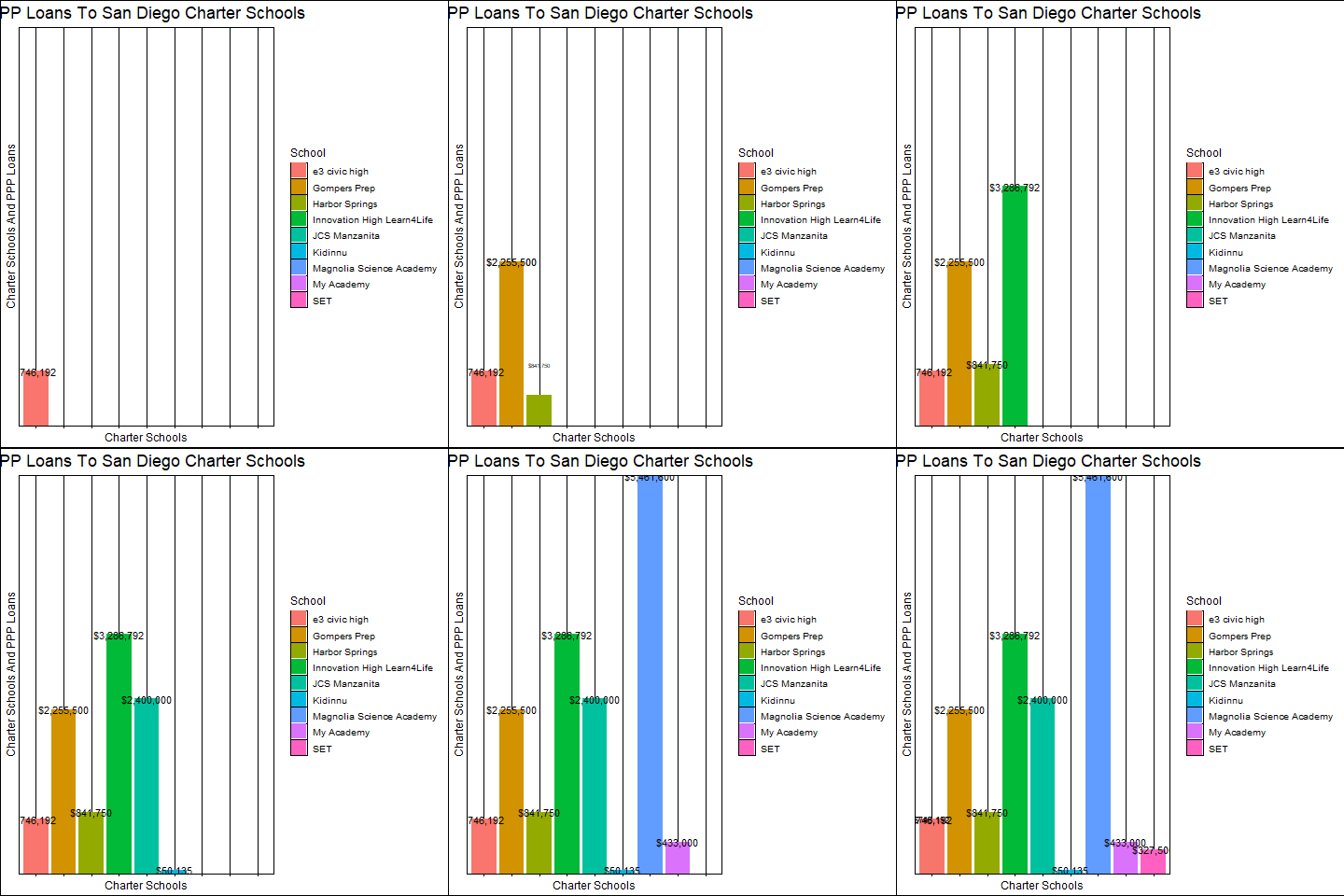
According to the data obtained by NBC 7 Investigates, local charter schools including Gompers Preparatory, The School for Entrepreneurship and Technology (SET), E3 Civic High, and Magnolia Science Academy have received $3.1 million in CARES Act funding from the federal government which is meant for public schools. Of those, Gompers Prep secured the most CARES Act funding, receiving $408,364 in CARES Act funding while the school also raked in $2.25 million in PPP loans.
In addition to federal education funding under the CARES Act, more than a dozen charter schools in San Diego County have applied for PPP loans with nine schools so far already having received the funds.
Those loans range from $50,135 received by Kidinnu Academy in El Cajon, which has an enrollment of 115 students from TK through 5th Grade, to $5.6 million in loans that went to Magnolia Public Schools, which operates two charter schools in San Diego County and several other campuses statewide.
Graph of Schools That Received PPP LOans
CONTINUE READINGUnchartered Territory: County Charter Schools Take $15.8M in Federal Small Biz Loans – NBC 7 San Diego

Wednesday, June 24, 2020

In California budget deal, no cuts for K-12 but billions in late payments to schools | EdSource

In California budget deal, no cuts for K-12 but billions in late payments to schools | EdSource

In California budget deal, no cuts for K-12 but billions in late payments to schools
Layoff protections for teachers and some but not all school employees


Gov. Gavin Newsom and legislative leaders announced Monday that they have reached an agreement on the 2020-21 budget that will preserve spending for K-12 schools and community colleges at current levels but potentially could result in funding cuts of nearly $1 billion combined for the University of California and California State University.
The budget will also provide language that will prevent the layoffs of teachers and many other school employees over the next year — actions that unions representing teachers and other employees, known as classified workers, had strongly lobbied for. These protected employees will include bus drivers, custodians and nutrition workers but not classroom aides.
While not the increase that Newsom had sought in his pre-COVID-19 budget in January, there should be enough funding to assure the reopening of school this fall, Newsom said at a press conference Monday. “I think the funding will substantially exist,” he said. “We think a lot of that anxiety is mitigated.” CONTINUE READING: In California budget deal, no cuts for K-12 but billions in late payments to schools | EdSource

Michigan Republicans Attempt to Get Out Ahead in Back-to-School Policy | Teacher in a strange land

Michigan Republicans Attempt to Get Out Ahead in Back-to-School Policy | Teacher in a strange land

Michigan Republicans Attempt to Get Out Ahead in Back-to-School Policy


The first thing I did when I retired from teaching was embark on a PhD program in education policy. When I enrolled, my advisor wondered immediately why a newly retired teacher would want to study education policy. She thought I should be in the teacher education program—or maybe the ed leadership division, with all the wannabe superintendents.
But I wanted to study education policy—to see just how the sausage was made, by whom and for what reasons. As a long-suffering object of education policy, I wanted to untangle the process that had so often made me ask: What were they thinking, when they came up with this?
I learned a number of things, most of which weren’t part of any syllabus, none more important than the fact that education policy creation is seldom measured and thoughtful, informed by research, goodwill and common goals.
John Kingdon, one of the most influential thinkers on policy creation, believes that there are ‘windows’ where changes in policy become possible as three streams—a problem, a policy proposal, and politics converge to yield something new.
That’s where we are right now. Big problem: returning to school (or not) during a pandemic. Tons of policy options to address this problem. Politics swirling around the issue, from state control over health mandates, a bitter election season and the CONTINUE READING: Michigan Republicans Attempt to Get Out Ahead in Back-to-School Policy | Teacher in a strange land

White People, We Need to be Responsible for Our Own Racism | gadflyonthewallblog

White People, We Need to be Responsible for Our Own Racism | gadflyonthewallblog

White People, We Need to be Responsible for Our Own Racism

Hey, White people.
We need to talk.
You may be watching all these protests and demonstrations lately and be wondering what they have to do with you.
After all, you didn’t kill George Floyd. You didn’t put up a Confederate statue. You didn’t call the police on a Black person just because he was being Black.
At least, I hope you didn’t.
But all this strife and unrest really does have a lot to do with you.
Not because of anything you did necessarily, but because of who you are – your role in society.
Now don’t get all defensive on me.
I’m not saying you should feel guilty for things that you had no control over, don’t CONTINUE READING: White People, We Need to be Responsible for Our Own Racism | gadflyonthewallblog

Teacher Tom: A New Better Normal

Teacher Tom: A New Better Normal

A New Better Normal


Whenever I hear someone talk about the "new normal," I find myself listening with a sense of foreboding, as if it's a phrase from Orwell's Newspeak lexicon. It's as if people are trying to put a positive spin on a world without live theater or lively bars; where human contact is largely limited to waves and winks; where everyone is working from basement offices with screens as their primary window on the world.

I instinctively push back. I don't want a new normal. People speak hopefully about human resilience, about how love and art and humanity will "find a way," but there is no guarantee that the new way will be an improvement, or even an adequate replacement, for the old. In fact, looking back on many of the new normals that have emerged in my lifetime, I have legitimate reason to worry. The fact that today's children have far less freedom than I did as a child is an appalling new normal, one woven from a "crisis" invented by the irrational fears of minds no less fevered than those of today. The new normal of high stakes standardized testing and curricular standardization and trying to force three-year-olds to read that emerged from the manufactured crisis of "falling behind" has lead to a new normal in which our youngest citizens are suffering from mental illnesses at rates unheard of in the old normal. And I'm far from convinced that our new normal of anonymous suburbs and cities is an improvement on the old normal of towns and villages where neighbors knew one another.

I understand the instinct to think positive, to anticipate rather CONTINUE READING: Teacher Tom: A New Better Normal


NANCY BAILEY: The Standardized Testing Horror Show is Not Over!

The Standardized Testing Horror Show is Not Over!

The Standardized Testing Horror Show is Not Over!


Several well-received reports and blog posts provide hope that high-stakes standardized testing is reaching the end of its days. Good riddance! But before parents, educators, and students relax, it’s important to realize this horror show is not over.
Think of the movie Carrie. The audience shivers through the scary scenes. It wraps up. Then, Stephen King tricks us. Like a lot of horror movies, it isn’t over when you think it’s over. That’s the same scenario with standardized tests.
High-stakes standardized testing is being replaced with competency-based online assessment. It isn’t better. It’s worse! It’s advertised as rigor, benchmarks are still standardized, only now students must continuously master objectives online. Parents worry about online data collected about their students.

Diverting CARES Act Money to Online Assessment and Data 

This is especially important to recognize at this time, when parents are relying on online learning from home, and states and local school districts are pushing to use money from the CARES Act to fund online assessment.
In Colorado, groups like Stand for Children, Democrats for Education Reform, and Transform Education Now want school districts to fund online assessment with CONTINUE READING: The Standardized Testing Horror Show is Not Over!

No Matter What Trump Says, School Choice Is Not the Civil Rights Issue of our Times | janresseger

No Matter What Trump Says, School Choice Is Not the Civil Rights Issue of our Times | janresseger

No Matter What Trump Says, School Choice Is Not the Civil Rights Issue of our Times


Twice in the past couple of weeks, President Donald Trump has been out promoting school choice as the civil rights issue of our times.
Trump went to Dallas,Texas, supposedly to discuss the recent tragic police killings of unarmed African Americans. The Washington Post‘s Valerie Strauss describes what happened: “At Gateway Church in Dallas, Trump met with law enforcement officials, pastors and business owners and talked about his four-point plan to ‘build safety and opportunity and dignity’ for communities of color. He did not discuss why the police chief, sheriff and district attorney of Dallas—all of whom are African Americans, were not invited to the event focused on injustice and policing. Trump bashed public schools, calling them ‘bad government schools’ in which African Americans get ‘trapped’—although Surgeon General Jerome M. Adams said at the same event that it was important for schools to reopen safely as soon as possible.”
Then last Tuesday, The Hill‘s Brett Samuels reported that in remarks at the White House Rose Garden, Trump once again mentioned school choice: “We’re fighting for school choice, which really is the civil rights (issue) of all time in this country… Frankly, school choice is the civil rights statement of the year, of the decade and probably beyond because all children have to have access to quality education.”
I certainly agree with the President that all children must have access to quality education, but I also appreciate what Samuels noticed: “The comments describing school choice as the preeminent civil rights issue of the day appeared out of place as the nation is gripped by protests over the treatment of black Americans by law enforcement.”
Perhaps the President has recently turned to Education Secretary Betsy DeVos to help him CONTINUE READING: No Matter What Trump Says, School Choice Is Not the Civil Rights Issue of our Times | janresseger

Whatever Happened to the Platoon School? | Larry Cuban on School Reform and Classroom Practice

Whatever Happened to the Platoon School? | Larry Cuban on School Reform and Classroom Practice

Whatever Happened to the Platoon School?


Huh? The Platoon School?
My hunch is that very few readers have ever heard of this widespread Progressive reform that began in Gary (IN) in 1907. Praised by John Dewey and Evelyn Dewey in 1915, the innovative way of schooling native, migrant, and immigrant children (and their parents) established by Superintendent William Wirt (who served as superintendent between 1906 and 1938) gained traction in school districts across the country. Platoon schools appeared in big cities like New York, Detroit, and Pittsburgh as well as small towns throughout the second and third decades of the 20th century. By the 1940s, however, many districts had dumped the innovation although it lasted until 1960 in Gary.*
What Problems Did the Platoon School Organization Intend To Solve?
In cities where immigrant families settled to find work, schools soon became overcrowded. Many districts had to have double-sessions, that is shorter school hours, so that all students could be accommodated during the day. In some districts, superintendents turned away children because there were no more seats for them. Progressive educator William Wirt, a former student of John Dewey at the University of Chicago wanted to solve two problems: how to use a school building to its capacity and how to give children access to a full education with the arts, special subjects like music, woodworking, and physical exercise. Wirt added auditoriums, gymnasiums, music and drawing rooms to existing CONTINUE READING: Whatever Happened to the Platoon School? | Larry Cuban on School Reform and Classroom Practice

NEA President: Educators Are Finding Unique Ways to Reach, Teach and Inspire

NEA President: Educators Are Finding Unique Ways to Reach, Teach and Inspire

NEA President: Educators Are Finding Unique Ways to Reach, Teach and Inspire


When the COVID-19 pandemic closed schools, the work of public school educators didn’t stop. It went into overdrive as they figured out ways to feed students who rely on school meals, provide creative ways to keep instruction going (online and offline, when necessary) and make regular check-ins with students and families they knew were struggling. For families and communities across America, schools continued to be their anchor.
“Educators’ swift creation and launch of virtual engagement classrooms and opportunities for students to both maintain skills and provide students and families with a sense of continued engagement and community has been nothing short of extraordinary,” said NEA president Lily Eskelsen García at a June 22 keynote address for Rise Up for Equity: A Virtual Summit on Community Engagement and Family Engagement, a joint conference of the Community Schools National Forum and the National Family and Community Engagement Conference. “They are finding unique ways to reach, teach and inspire.”
NEA is a partner of the Institute for Educational Leadership and the Coalition for Community Schools, the sponsors of the event, and is an advocate for the Community Schools model that adapts to the needs of individual schools’ students, families, staff and communities.
The virtual conference has connected nearly 4,000 participants—everyone from students to school district leaders, community organizers to elected officials, early childhood educators to university faculty. It is a month-long event that began June CONTINUE READING: NEA President: Educators Are Finding Unique Ways to Reach, Teach and Inspire

My Personal COVID-Protection Plan | deutsch29

My Personal COVID-Protection Plan | deutsch29

My Personal COVID-Protection Plan


I teach high school.
In my professional world, universal social distancing and mask-wearing on campus are aspirational, not practical.
So, I have been working on a plan to distance myself from contracting COVID to the best of my ability, if/when I am teaching on campus in 2020-21.
Here are my plans and the thinking that led up to them:
I can contract COVID via my eyes, nose, and mouth. For nose and mouth, I have purchased a pretty decent adjustable mask that I could wear all day, if need be.
As for my eyes: I shopped protective eyewear and found goggles that convert to glasses. They were not sealed completely around the face, so I created a seal using black duct tape.
Thus, what I now have is reasonable barrier to protect eyes, nose, and mouth in situations in which others are not doing the same on my behalf. Mind you, this is not the same as official hazmat gear, but it creates a really good barrier, and creating that barrier is what I am after.
Social distancing is important, but I believe barriers in general are also important for protecting myself (and others) from COVID. It is better to sneeze into a napkin, or to even put one’s head inside one’s own shirt for a sec when CONTINUE READING: My Personal COVID-Protection Plan | deutsch29

White Teachers, White Activists: Anti-racist Work (#1) | Educate All Students, Support Public Education

White Teachers, White Activists: Anti-racist Work (#1) | Educate All Students, Support Public Education

White Teachers, White Activists: Anti-racist Work (#1)


I plan to post a number of articles and commentary on the role of white teachers and white activists in this transformative time.
“If you are not prepared to change your thinking, you are not prepared to make real change.”
“The teachers of Black youth must believe in them. They must have faith in them and their community. They must trust them and encourage them and defend them.”  W.E.B. Du Bois
The Philadelphia group BAR WE (Building Anti-Racist White Educators) Developed a few key guidelines for white teachers and white activists for approaching anti-racist work.
  1. White people have a responsibility to work with other white people to build anti-racist identities and practices. It is not the burden of people of color to do that work for us. We can (and should) talk critically about racism and white supremacy, even if there isn’t a person of color in the room.
  2. True anti-racism training must be ongoing, and it must involve networks to support us in this practice. If we are going to confront racism and white supremacy in our lives and work, we are going to have to get uncomfortable and deeply question long-held beliefs. We’ll need to build and maintain relationships with other folks in the work with us. While one-off implicit bias trainings are a useful step, they are not enough. The work of building identities and practices that push back against white supremacy in our society must be an ongoing process.
  3. This work must be accountable to the people of color who find themselves targeted by racism on a daily basis. Though we as white people can challenge each other, this work should not and cannot be divorced from the experiences of people of color. We must be open and transparent about this work and these conversations with our colleagues of color.
  4. Humility must be central to this work. We must learn from and listen to people of color, especially our colleagues and students. We should also approach our work with fellow white educators from the perspective of fellow learners, rather than as experts.
  5. Talking about racism and white supremacy isn’t enough—conversation alone won’t change the oppressive conditions people of color face daily. However, discussion is an essential part of this work. Anti-blackness is something that we have learned over the course of our lives, and unlearning will take a lot of introspection and conversation. CONTINUE READING: White Teachers, White Activists: Anti-racist Work (#1) | Educate All Students, Support Public Education

Success Academy Spokesperson Resigns to Protest “Racist and Abusive” Practices | Diane Ravitch's blog

Success Academy Spokesperson Resigns to Protest “Racist and Abusive” Practices | Diane Ravitch's blog

Success Academy Spokesperson Resigns to Protest “Racist and Abusive” Practices


Alex Zimmerman of Chalkbeat wrote today that a spokesperson for Success Academy, New Tork City’s largest charter chain, resigned to protest “abusive” practices at the schools.
A spokesperson for New York City’s largest charter network resigned in protest, stating she can no longer defend Success Academy’s “racist and abusive practices” that are “detrimental to the emotional well being” of its students.
“I am resigning because I can no longer continue working for an organization that allows and rewards the systemic abuse of students, parents, and employees,” wrote Liz Baker, a Success spokesperson, in a resignation letter Tuesday.


“As the organization’s press associate, I no longer wish to defend Success Academy in response to any media CONTINUE READING: Success Academy Spokesperson Resigns to Protest “Racist and Abusive” Practices | Diane Ravitch's blog

CURMUDGUCATION: Trump Back DeVos On Soaking Scammed Students

CURMUDGUCATION: Trump Back DeVos On Soaking Scammed Students

Trump Back DeVos On Soaking Scammed Students


Trump has mostly ignored DeVos and the education department (insert joke about Trump and education here), but he's now decided to jump in, with both feet, right onto the backs of people scammed by for-profit colleges.

This story has been dragging on for-freakin-ever. In 2017, 18 states and DC sued DeVos over her stated intention of ignoring/rewriting the Borrower Defense to Repayment rule from 2016, which was supposed to help out those students who were being crushed by debt they'd incurred so they could attend fraudulent for-profit colleges. While that dragged on, the department "accidentally" kept collecting debt, in some cases attaching paychecks of students. The "accident" was egregious enough that the court found DeVos and the department in contempt and fined them bigly for ignoring the injunction to stop the collecting.


Judge Sallie Kim was pretty cranky when she offered the October ruling (“I’m not sending anyone to jail yet, but it’s good to know I have that ability.” So she was not any happier in December when it turned out that the department had been collecting-- against the injunction-- from not just 16,000 students, but from over 45,000. So, a more-than-double oopsy.

DeVos has been plenty clear in her feelings about debt relief, siding whole-heartedly the corporate interests. She has thoroughly choked off the public service loan forgiveness program as a prelude to proposing to kill it entirely. Called in before CONTINUE READING: 
CURMUDGUCATION: Trump Back DeVos On Soaking Scammed Students

REOPENING SCHOOLS | The Merrow Report

REOPENING SCHOOLS | The Merrow Report

REOPENING SCHOOLS


Here’s a letter I just received from an experienced K-4 school principal.
Dear John,
You asked how I would go about reopening schools this fall. My answer focuses on the schools I know best, K-grade 4, but I believe these ideas are applicable at all levels of public education.  
Others proposals, including those from teacher unionsEducation Week, and think tanks, concentrate on the practical, physical arrangements necessary to open school safely, with such strategies as ‘Staggered opening,’ ‘One week on, two weeks off,’ and ‘Bubble classrooms.’  
In addition to testing for the virus, social distancing, and basic hygiene, I would insist on the following SEVEN steps: 
1) Internet access for all students
2) Clearly defined benchmarks that students are expected to achieve during their five years at the school but NOT by grade level. Along the way, ‘accomplishment levels’ that are clearly defined;
3) Students randomly assigned to a team (the number of teams being dependent CONTINUE READING: REOPENING SCHOOLS | The Merrow Report