Latest News and Comment from Education

Friday, August 19, 2016

Editorial: Attendance key to accountability | The Columbus Dispatch

Editorial: Attendance key to accountability | The Columbus Dispatch:

Editorial: Attendance key to accountability


As the Electronic Classroom of Tomorrow, ECOT, continues trying to duck accountability, a finding against two other shuttered charter schools underscores the need for vigilance and persistence on the part of Ohio Department of Education auditors.
Two Columbus academies overcharged the state at least $62,211. An ODE review of student data found that the Talented Tenth Leadership Academy for Boys and the Talented Tenth Leadership Academy for Girls was not eligible for most of the $80,000 it had received in state foundation payments because — wait for it — enrollments didn’t meet state minimums. Other charter schools in Ohio this year also have been told to repay excess state aid for inflated enrollment.
Provost Academy, a Columbus-based online charter, agreed to return $800,000 of the $1 million received for the 2014-15 school year; an ODE review found 32 full-time students, not the 155 the school reported. And Lakewood Digital Academy of Hebron was told to repay $150,000 after the state found 16 full-time students, not the 57 claimed.
In the case of the Talented Tenth schools, prosecutors called their founder a con man. Andre Tucker, sentenced in November for stealing $7,500 from the schools, was ordered to repay the money and given five years of probation.
But his circumstances — he was an employee of the schools’ sponsor, the North Central Ohio Educational Service Center — underscored Ohio’s lack of oversight of charter schools. Until legislative reforms took effect earlier this year, for-profit charter school operators could control their school board and sponsor-overseers had conflicts of interests, including selling their schools services.
The reform bill ended this, but only after Ohio had become a national laughingstock for its “ Wild-West” system of charter-school accountability. Now, a move is rumored to be afoot — reportedly led by ECOT, whose founder is a generous donor to Republican Statehouse campaigns — to dilute the new charter-school standards. The fear is that legislators later this year will allow online schools to be paid merely for offering 920 instructional hours a year, as if signing up students equates to educating them.
Meanwhile, ECOT appears to be trying to run out the clock in a protracted court fight to prevent the Education Department from looking at its attendance data. The state wishes to make sure that ECOT’s 15,000 students are getting an education, a required minimum of 920 hours a year, before forking over another $106 million in taxpayer funding.
ECOT, in fact, has the dubious distinction of being the leader of the nation’s school dropout factories, according to federal data. For every 100 students who graduate on time, 80 do not, The New York Times reported in May.
In the latest twist, ECOT — after much stalling — handed over student attendance records to the state. But it almost immediately demanded the records back, claiming that those records illegally contain student names. Names were stamped in a watermark across ECOT-supplied printed pages. Now, ECOT argues the state is breaking the law by having these documents that it supplied.
But surely ECOT is at fault for supplying records in a form that made it impossible to redact the names and allow a state audit.
The school’s leader already has said that if the state is allowed to see its records, it might have to close. The surmise is ECOT might have to return tens of millions of dollars. That’s honest. At least he isn’t in the same league as the convicted Talented Tenth “con man”; he only gamed the system for tens of thousands of dollars.Editorial: Attendance key to accountability | The Columbus Dispatch:

 

Teachers union strengthens schools

Teachers union strengthens schools:

Teachers union strengthens schools


More than 20 years ago, I left the University of Northern Iowa with a degree in elementary education in my hand and optimism in my heart. I was going to make the world a better place, one student at a time.
One of the first moves I made was to become a member of the Iowa State Education Association.
For me, it wasn’t because of a discount on liability insurance. That’s what Drew Klein from Americans for Prosperity suggests in his Aug. 16 column in the Register.
For me, it was because the ISEA pushed for higher standards in teaching — they led the fight to require teachers have a two-year degree, and later, a four-year degree  — which means higher quality instruction for our students.
I liked that, and I thought that an organization that worked to attract the best graduates to the profession and keep them deserved my support. It’s a philosophy that drove me to obtain national board certification in 1999 and, just this last year, a doctorate in teacher leadership.
For me, being a member was, and is, the right thing to do.
But there are a lot of different reasons educators choose to join the ISEA.
I know this, because we ask them. As president of the ISEA, I want to make sure we’re doing the best we possibly can to for our members, the students they teach and care for as well as the citizens they serve as public education professionals.
Our members continue to fill our professional development courses, they support our mentoring programs and they like that the ISEA  has a seat at the table when important decisions are being made about the Every Students Succeeds Act, Iowa’s Teacher Leadership and Compensation program and other important policies that affect our profession. And of course, they welcome the expertise we have when it comes to negotiating the master contract every Iowa school district has with its employees.
ISEA members know there are 34,000 educators across the state they can lean on for support and guidance. They know they have a choice to be a part of their association and choose to do so.
Most of all, our members tell us they are grateful students are at the center of every decision we make, whether it’s fighting to keep public resources for school programs, advocating to keep class sizes small so students have more time for one-on-one instruction or just working to make sure every child, regardless of their ZIP code, has a competent and qualified instructor in the classroom.
One more point: The ISEA operates a political action committee to help us research and evaluate candidates for public office based on their level of concern for our students and our schools. Our members understand nearly every decision made about their profession is a political one made by someone in public office.
PAC contributions are voluntary and entirely separate from union dues.
To say otherwise, as the AFP representative does, is a result of his shoddy work and simply untrue.
I encourage everyone to find out more about the ISEA PAC by visiting the ISEA website at www.isea.org.
To our students, parents, educators and our urban, suburban and rural Iowa communities, thank you for supporting your schools. You are all making this world a better place, one community, one school and one student at a time.
Let’s make this the best school year yet.
636071270903900896-TAMMY2.JPG
TAMMY WAWRO of Cedar Rapids is the president of the Iowa State Education Association. Contact: twawro@isea.org Teachers union strengthens schools:

Green ramps up attack on teachers' union, and Jordan fires back

Green ramps up attack on teachers' union, and Jordan fires back:

Green ramps up attack on teachers' union, and Jordan fires back


School Reform Commissioner Bill Green is ramping up his rhetoric against the Philadelphia Federation of Teachers, accusing the union of stalling on any contract settlement until the turnover in School Reform Commission membership that's expected in January.
Green, a longtime PFT critic, said the District has offered a reasonable financial package to the teachers that would result in “net raises,” even after restructuring medical benefits so that members contribute toward their health-care costs, which most do not do now.
PFT president Jerry Jordan immediately shot back, accusing Green of “trash talking” and disputing his point that the District is offering his members a financial deal that the union leadership could accept in good conscience.
“We put fair raises on the table,” Green said. “Nobody would disagree that members of the PFT should contribute to health care, like everybody else in America, including all the surrounding teachers' unions in the suburbs.
“Let’s just face reality,” he added, “it’s not the District that is not bargaining in good faith, it’s the PFT simply trying to wait for a change in membership on the SRC.”
The terms of three of the five members – Chair Marjorie Neff, Sylvia Simms, and Feather  Houstoun – are due to expire in January. Their replacements will be appointed by Mayor Kenney and Gov. Wolf, both Democrats who were strongly supported by the PFT in their election campaigns.
Green spoke out during an interview the morning after the Pennsylvania Supreme Court ruled that the SRC could not unilaterally cut back medical benefits and divert savings into school personnel and programming, which it tried to do in October 2014. Green said he was “disappointed” in the ruling, which relied on a narrow definition of what state law means by a “teacher's contract.”  
Both Green and Jordan said that the last negotiations took place in June, but otherwise they disagreed on everything regarding this unprecedented four-year stalemate. The District and the union, which is prevented by state law from striking, have been unable to reach a settlement since 2012. PFT members have received no raises during that period – not even the so-called “steps” that they are entitled to based on their years of service and degrees attained.
Jordan countered Green’s accusation that the union was stalling with his own theory: that the SRC was holding out in anticipation that the state Supreme Court would support its position that it had the power to impose a contract on the District’s largest union. 
“We heard that the SRC and Green were avoiding a settlement because they were hoping to win the Supreme Court case and not have to negotiate with us,” Jordan said. “So that goes two ways. There are lots of things that people are saying that are rumors and inaccurate information floating out there.”
Evident in the separate interviews was the level of distrust between the District leadership and the union that represents its teachers – the very people expected to carry out its most Green ramps up attack on teachers' union, and Jordan fires back:

Report: Charter administration costs double those of other public schools

Report: Charter administration costs double those of other public schools:

Report: Charter administration costs double those of other public schools


Charter-school administrative expenditures are nearly double those of conventional public schools, and their highest-ranking officials are paid far more.

They spend less on instruction than school districts, but more on support services and facilities.
And while charter-school enrollment has jumped significantly over time, payments to the schools are far outpacing their actual rates of growth in admission.
All that is according to a report on Pennsylvania's charter schools issued Thursday by the Pennsylvania School Boards Association, made up of nearly 4,500 school board members.
In a 35-page study that came after rounds of records requests during the last 15 months, the conclusions present a broad picture of Pennsylvania's 173 charter schools, which have become part of an ongoing national debate about what effect the charter-school movement is having on traditional public schools.
"This is not intended to be any sort of an attack on charter schools," said Andrew Christ, education policy analyst for the organization, during a conference call Thursday.
But, he said, "charter schools need to be held to the same standards of accountability and transparency as traditional public schools."
Charter schools in the Keystone State and across the country have been growing rapidly. They also have been beset with criticism, mostly from proponents of traditional public schools.
Receiving the bulk of their revenue from districts - in Pennsylvania, nearly 84 percent - charter schools' critics have argued that using taxpayer money for charters has taken funds away from conventional schools.
Charter-school advocates have countered that charters provide more choices for families, and can increase learning opportunities and encourage innovation.
To analyze information on charter revenue and expenditures, the association filed records requests with all charter schools across the state. The association received information from nearly 85 percent.
According to the report, tuition payments to charters accounted for about 5.4 percent of all statewide school district expenditures in 2014-15. However, some districts in the area have felt the squeeze more than others.
In Delaware County's beleaguered Chester Upland School District, which has operated under receivership for four years, nearly half of its expenditures were allocated to charter-school payments, the report stated. In the Philadelphia School District, slightly more than one-quarter of its expenditures went to charter schools.
Focused largely on how money flows out of school districts and into charter schools, the report highlighted the disparities in spending between the types of schools - including special-education costs. It found that charter schools were overpaid for special education by nearly $100 million in 2014-15.
The report also called for a greater level of oversight by the Pennsylvania Department of Education.
"Charter schools are public schools," the report stated. "However, charter schools are not held to the same standards as other stewards of public tax dollars when it comes to transparency in operational and financial decisions."
In a response Thursday afternoon, the Pennsylvania Coalition of Public Charter Schools said that while it had not examined the report in detail, it took exception to some of its recommendations, including one for charter schools to be more open about their operations.
"Charter schools are already subject to the same accountability and transparency laws as district schools," the organization said in a statement. It said that despite some opposition from the school boards association, the legislature has been working to pass legislation that would increase charter school accountability.
Beyond analyzing payments to charters, the report focused on the differences in expenditures between district-run schools and their charter-school counterparts. On average, the report stated, charter schools allocated a greater proportion of their budgets to administrative costs - about 13.3 percent - including support personnel, building services, and maintenance. Conventional school districts spent about 5.6 percent of their budgets on administrative costs, it said.
In addition, the association reported, charter schools are spending about three times more per pupil on top administrative salaries.Report: Charter administration costs double those of other public schoolscmccabe@philly.com


ACLU says illegal policies at Central Coast charter schools can lead to discrimination | KCBX

ACLU says illegal policies at Central Coast charter schools can lead to discrimination | KCBX:

ACLU says illegal policies at Central Coast charter schools can lead to discrimination

FLICKR MEMBER ALAMOSBASEMENT. IMAGE EDITED FROM ORIGINAL FORM.


Several charter schools in San Luis Obispo and Santa Barbara Counties are being accused by the Southern California branch of the ACLU of having illegal policies that force parents to volunteer their time, as well as accusations of problems with economic and racial diversity.
New Times Reporter Chris McGuinness has a piece on the parent issue in the August 11 edition of the paper and has a follow up piece looking at the diversity charges in the August 18 issue.
NOTE: This transcript is from an interview that was edited for time purposes.
Randol White: So, let's start with the issue of forcing parents to volunteer time. How does that go against state or federal law and which local schools does the ACLU point a finger at?
Chris McGuinness: Essentially charter schools are usually set up by private groups, but they still are essentially public schools because they take public funding, and under the California Constitution and under our charter school laws all kids have an  equal access to an education, which means they can't be turned away for certain reasons. And so, basically what the ACLU is saying in this report is that some of these policies, because they set certain requirements for parents to volunteer, that it may cause parents or guardians to not even bother to apply to get into these charter schools.
Randol: Like parents who may work two or three jobs and just don't have the time to volunteer.
Chris: Yeah, they also note foster parents or perhaps if you're grandparents who are guardians of a grandchild, that may not have the ability to do that.
Randol: So, because it gets the public school money, needs to follow the same equal-access rules.
Chris: Exactly. And the two specific schools here in SLO County are the Bellevue-Santa Fe Charter School which is located in San Luis Obispo, and the Almond Acres Charter Academy which is located in San Miguel.
Randol: And we should mention that your piece took a look at San Luis Obispo County schools, being a San Luis Obispo paper, but in Santa Barbara County, Peabody Charter and also Santa Ynez Valley Charter were accused of this same parent volunteering issue. You reached out to the schools and the districts for comment in San Luis Obispo County, did you get any response?
Chris: I did. After the piece ran, I did get a response from the Bellevue-Santa Fe Charter School. They're standing by their policy essentially. They did say that they are reviewing the literature and the policies on their site and are looking at possibly clarifying the language to say specifically that it is not required.
Randol: And how about the other school?
Chris: Almond Acres, they did not get back to me from the school specifically, but I did talk to the San Miguel Joint Union School District. They told me that in 2014, during some committee hearings on another matter, that a parent did bring Almond Acres Charter volunteer policies up as a concern. They said that they looked at these policies and that they had them changed, but from what I saw on the website, they are still pretty explicit in their requirements. 
Randol: Now Chris, this is all in print, does the ACLU have any proof that it's happening?
Chris: The report is only going off of the written policies that they were able to pull from the websites.
Randol: Now your new piece deals with diversity charges, what is the ACLU saying here?
Chris: Well the ACLU doesn't specifically address diversity in this current report. What they do say is that these policies, as well as some of the other policies they touched on, that they will freeze out certain groups of students. So, what I did is after looking at that, is I went and pulled data on the racial/socioeconomic and English-language learner numbers of these two charters schools and compared them to the districts that they're in as a whole to see if there were any gaps there.
Randol: And did you find any?
Chris: Yeah. In both of these charter schools, the diversity — both in terms of race and of socioeconomics — doesn't really seem to match up to the district as a wholeACLU says illegal policies at Central Coast charter schools can lead to discrimination | KCBX:

Differing views on charters and vouchers | Harvard Magazine

Differing views on charters and vouchers | Harvard Magazine:

What the Public—and Teachers—Think About School Choice


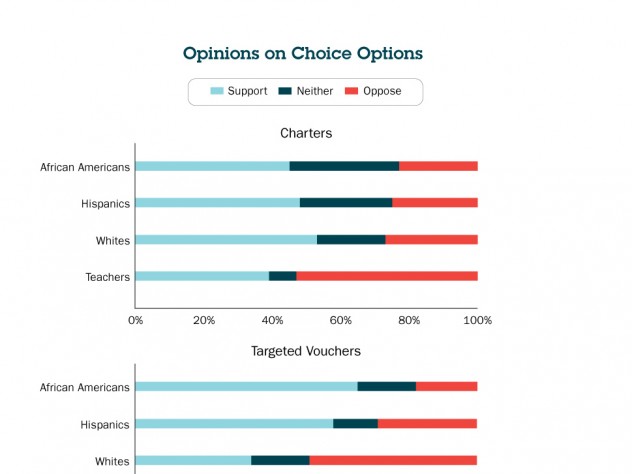
 ANNUALLY since 2007, Education Next, a journal of opinion and research about education policy, has asked a representative sample of U.S. adults for their opinions on a range of education policies. The design provides for a sampling of teachers and African American, Hispanic, and white adults large enough to allow for reasonably precise estimates of the opinions of these groups. Presented in the accompanying figure are the levels of support observed in June 2015 for three types of school choice: charter schools; vouchers for low-income students; and vouchers for all students.

As can be seen, a majority of teachers are opposed to all three of these forms of school choice. By contrast, African-American, Hispanic, and white members of the public as a whole all favor charters by a roughly two-to-one margin. However, blacks and Hispanics are considerably more likely to favor school vouchers than are whites. If vouchers are targeted to low-income families, 66 percent of African Americans and 58 percent of Hispanic adults favor them, but only 33 percent of whites do. If vouchers are made available to all students, white support increases to 41 percent with 43 percent opposed (the remainder taking a neutral position), but it still trails black and Hispanic support by a considerable margin.
(For a full discussion of the Education Next survey, see Michael B. Henderson, Paul E. Peterson, and Martin R. West, “The 2015 EdNext Poll on School Reform,” Education Next [Winter, 2016], pages 9-20. Paul A. Peterson served as the journal’s editor-in-chief until July 1, 2016, when Martin R. West, an associate professor at the Harvard Graduate School of Education, succeeded to that post.)Differing views on charters and vouchers | Harvard Magazine:

Florida education officials want to fight standardized testing lawsuit in federal court | Blogs | Orlando Weekly

Florida education officials want to fight standardized testing lawsuit in federal court | Blogs | Orlando Weekly:

Florida education officials want to fight standardized testing lawsuit in federal court

PHOTO BY ALBERTO G. VIA FLICKR

A U.S. District judge has set a Friday hearing to consider whether a lawsuit challenging the state's third-grade retention policies should be decided by a federal court, a new twist in an evolving legal fight over Florida's standardized testing system.

The Florida Department of Education and six school districts facing a lawsuit before Leon County Circuit Judge Karen Gievers asked the federal court to intervene, saying the case raises federal issues in addition to state ones. The original claim by a group of parents challenging the retention policies raised equal-protection and due-process objections under both the Florida and U.S. constitutions. 

At the center of the case is a battle over whether students can "opt out" of the Florida Standards Assessment for third grade, which is generally used to help decide whether a child can move up to the fourth grade.

Parents who filed the lawsuit believe state law gives them the right to tell their children not to answer questions on the standardized test. But while the law spells out ways to advance that don't require passing the assessment, the Florida Department of Education and school districts say that doesn't give students the opportunity to refuse to take it.

At a hearing last week, Gievers declined to immediately order the students to be allowed to start fourth grade. But she signaled she had concerns about the state law and later scheduled a hearing for Monday morning. That hearing is now canceled, according to the Leon County clerk of courts website.

The federal filing by the Department of Education and the school districts —- Broward, Hernando, Orange, Osceola, Seminole and Pasco counties —- offers little in the way of explanation for the move beyond highlighting the federal claims in the lawsuit. Sarasota County, which was also originally a defendant, has been dismissed because it promoted one of the students at the heart of the case to the fourth grade.

An attorney for the parents of the students filed a motion Thursday with the federal court to drop the claims under the U.S. Constitution, which would leave just the state claims remaining. The lawyer, Andrea Mogensen, also filed a request for the federal court to return the case to the state level. Friday's hearing is before U.S. District Judge Mark Walker.

"The remaining state law claims raise novel issues of state law that no Florida court has adjudicated," Mogensen wrote. "There are no remaining federal claims."

The original lawsuit, filed last week, argues that a requirement that students take the standardized test is irrational. Also, it says a confusing array of instructions from state and local officials during the past school year resulted in students who opted out being allowed to move on without test scores in some cases, but not in others.

The standardized tests are one of the hallmarks of the education-reform movement that swept Florida in the 1990s and early 2000s. They are meant to prevent "social promotion," where teachers give passing marks on report cards so students can move on with peers, regardless of whether the students have learned the required material.

The parents in the lawsuit say their children earned good grades and were ready to move on, and that in many cases there was no warning about the possibility of the children being held back because of reading issues until they refused to take the test.

In the hearing last week, which at times grew emotional, Gievers indicated she was sympathetic to the case being made by the parents and their students. But she wanted to make sure education officials were given enough time to respond so her decision wouldn't be overturned on appeal.

"I don't like what I'm seeing as far as youngsters being made sad and not being in classes they think they belong in," Gievers said as she addressed the families, "but I don't have the legal authority, if I do my job right, to take away the right of every party to have enough time to properly prepare."Florida education officials want to fight standardized testing lawsuit in federal court | Blogs | Orlando Weekly:

Thursday, August 18, 2016

Dear Governor Brown, Please Support Ethnic Studies (AB 2016) — Hmong Innovating Politics

Dear Governor Brown, Please Support Ethnic Studies (AB 2016) — Hmong Innovating Politics:

Dear Governor Brown, Please Support Ethnic Studies (AB 2016)


Dear Governor Brown,

On behalf Hmong Innovating Politics (HIP), we join with State Superintendent of Public Instruction Tom Torlakson, educators, students and community members across the state to urge you to sign AB 2016 into law. Unlike last year’s AB 101, this year’s bill, AB 2016 was developed in coordination with the Instructional Quality Commission (IQC) and would provide additional information and resources to educators to teach ethnic studies courses to their students.  Specifically, AB 2016 would allow the IQC to develop model curriculum as a guide for school districts and schools that choose to offer an ethnic studies course to reflect the unique experiences of the students in their communities.

California is home to one of the largest Hmong American populations in the United States and largest resettlement of refugees in the world. Unfortunately, the current high school curriculum does not even mention the role Hmong and other Southeast Asians played in aiding the United States Military during the Vietnam War and the Secret Wars in Laos and Cambodia. Moreover, the current curriculum makes no mention about the massive exodus of Hmong, Mien and other Southeast Asian refugees to the United States as a result. In line with your veto message for last year’s AB 101, we made several attempts to provide guidance and feedback to Signing AB 2016 would allow students to learn from a curriculum that reflects their own histories and help them gain a better understanding of about their respective culture in the context of California’s history.

Developing ethnic studies programs in all public high schools is an integral part of cultivating a classroom environment that is accepting of diverse cultures. It is vital for young people to learn about their history, but also important for them to feel like they can change their communities in positive ways. This bill will help close the achievement gap by reducing student truancy, increasing student enrollment, reduce dropout rates and better prepare Californian youth to be college-prepared and career-ready.

Hmong Innovating Politics (HIP) is a grassroots-organizing group whose mission is to strengthen the political power of Hmong and disenfranchised communities through innovative civic engagement and strategic grassroots mobilization. We envision a Sacramento of empowered communities that thrive in a socially and economically just democracy.

If you have any questions regarding AB 2016 and communities it would affect, please do not hesitate to contact Hmong Innovating Politics at hmonginnovatingpolitics@gmail.com.

Thank you for your time and consideration.

Respectfully,
Nancy Xiong

I Teach The Toughest Kids, and I Love It | gadflyonthewallblog

I Teach The Toughest Kids, and I Love It | gadflyonthewallblog:

I Teach The Toughest Kids, and I Love It

Screen Shot 2016-08-18 at 2.29.55 PM
It was rarely a good thing when LaRon smiled in school.
It usually meant he was up to something.
He was late to class and wanted to see if I’d notice. He just copied another student’s homework and wondered if he’d get away with it. He was talking crap and hoped someone would take it to the next level.
As his teacher, I became rather familiar with that smile, and it sent shivers down my spine.
But on the last day of school, I couldn’t help but give him a smile back.
A few minutes before the last bell of the year, I stood before my class of 8th graders and gave them each a shout out.
“I just want to say what an honor it’s been to be your teacher,” I said.
They shifted in their seats, immediately I Teach The Toughest Kids, and I Love It | gadflyonthewallblog:

‘We can no longer teach a whitewashed history’ - The Washington Post

‘We can no longer teach a whitewashed history’ - The Washington Post:

‘We can no longer teach a whitewashed history’

A march against police brutality arrives at the Capitol after starting near the White House on July 7 in Washington. (Paul Holston/AP)

Twenty-three-year-old Leanna Diggs grew up in Silver Spring, Md., and attended James Hubert Blake High School in Silver Spring and Dickinson College in Carlisle, Pa., double-majoring in political science and law and policy, focusing her studies on systemic inequity. In May 2015, she joined Teach For America and was placed in Miami-Dade County Public Schools as a ninth-grade algebra teacher at Miami Edison Senior High School. With an interest in the law, she interned this summer with Judge Thomas Logue of the Third District Court of Appeal in Florida, and she hopes to begin law school in a year, after fulfilling her two-year requirement with Teach For America.
Diggs says that Logue encouraged her to write the following post about her belief that educators cannot pretend society is colorblind but, rather, should find valuable ways to address the racial tensions and fear among students that are heightened by mass media coverage. In this post she makes a call for teachers to discuss #BlackLivesMatter in class as part of a long-overdue and difficult conversation about social, political, and economic inequality based on race.
By Leanna Diggs
As I scroll through Twitter, Facebook and Instagram as well as conventional new media outlets, I am forced to reconsider my role as an educator.
In July, a new hashtag surfaced, #AltonSterling, followed by a video of a police officer shooting a black man. A day later, another hashtag, #PhilandoCastile, appeared on my news feed also accompanied by a video. And most recently, in the streets of North Miami,  Charles Kinsey with his hands raised in the air was shot by police while attempting to help a patient with autism. Three more black men shot for no apparent reason except the color of their skin. The same color as my skin and as the skin of my students.
As part of Teach For America corps, I teach ninth-grade Algebra at Miami Edison Senior High School. The students at Edison are 99 percent minority. Eighty-seven percent of those students receive free or reduced meals. Historically low performing, surrounded by gangs and violence, Miami Edison Senior is a product of hyper-segregation. Miami Edison Senior is an example of how urban ghettos continue to systemically limit spatial mobility of blacks, which obstructs social mobility.
As a millennial, I understand my student’s connection to their phones and social media. As a person of color, I understand the feelings of despair and fear as I scrolled through my Facebook news feed this summer. As a teacher, I have a duty.
School curriculums and texts operate from a place of colorblindness. But our students do not ‘We can no longer teach a whitewashed history’ - The Washington Post:

CURMUDGUCATION: No, CAP-- CCSS Is Not the Path to Better Reading

CURMUDGUCATION: No, CAP-- CCSS Is Not the Path to Better Reading:

No, CAP-- CCSS Is Not the Path to Better Reading


At this point, there is nobody-- absolutely nobody-- who can match the Center for American Progress in senseless devotion to the Common Core State [sic] Standards. CAP, the left-tilted thinky tank founded by Hillary Clinton's campaign chief John Podesta, has remained absolutely unflinching in their support of the standards, no matter how little sense they are making.

For instance, yesterday we get this piece from Melissa Lazarin, a CAP policy advisor with no actual background in education. Her piece is entitled "Reading, Writing, and the Common Core State Standards" and does not include the sub-heading "One of These Things Is Not Like the Others." She then goes on to demonstrate a lack of understanding about English language instruction.

She opens with the uncredited (but credible) data point that more high school students read The Fault Is in Our Stars and Divergent than read MacBeth or Hamlet. Yes, that could well be true.

Lazarin is bothered because the popular teen lit books do not have complex texts. In fact, she's worried that the lack of complexity in their reading and writing will make them unprepared for college. And she goes on to demonstrate how thoroughly she misunderstands the nature of reading and reading instruction:

Three of the top five most commonly assigned titles in grades 9 through 12 are To Kill a Mockingbird, The Crucible, and Of Mice and Men. All three books, while classics, are not particularly challenging in terms of sentence structure and complexity. 

Yes, so? This is the great reading fallacy of the standards-- the notion that reading is somehow a series of discrete tasks, skills that can exist independent of any content, and that in fact content is irrelevant, even unnecessary. This is nonsense, like trying to learn a language without learning the 
CURMUDGUCATION: No, CAP-- CCSS Is Not the Path to Better Reading:


I Don't Belong To Any Organized Party: I'm A Democrat

I Don't Belong To Any Organized Party: I'm A Democrat 


I wish the leaders of United Opt Out luck in their endeavors. They are seasoned dedicated activists who have earned everyone's respect. I am not writing them off because I am upset by the departure of friends who once ran the organization. I believe, along with Jesse Turner, that we need all hands on deck on this struggle. However, I reserve the right to remain skeptical of the role that the Democratic Party and the national teachers union leadership are playing in influencing the policy of activist groups which have become non profit organizations- whether the organization be BATs, UOO, SOS, or Network for Public Education. Raising questions about that role, at this historic juncture, is not divisive. It is essential in keeping our struggle honest and independent
Once an activist group becomes a non profit organization and starts raising funds, the source of that funding becomes a legitimate target of inquiry, whether the organization is seeking to fund day to day operations or a national event.
Trying to silence that kind of inquiry does not speak well for those doing the silencing.
The best way to answer criticism is to do great work. I fully expect that to take place in the case of United Opt Out. Their leaders deserve our support and our respect- but NOT our silence about the political climate in which they are working

Mark Naison | Facebook


Big Education Ape: Badass Teachers Association: Am I Radical Enough? Thoughts on Being a Black Education Activist Surrounded by White Liberals - http://bigeducationape.blogspot.com/2016/08/badass-teachers-association-am-i.html

Big Education Ape: Schools Matter: Weingarten Coopts United Opt Out National - http://bigeducationape.blogspot.com/2016/08/schools-matter-weingarten-coopts-united.html

Seattle Schools Community Forum: 100 Black Parents' Survey

Seattle Schools Community Forum: 100 Black Parents' Survey:

100 Black Parents' Survey


In advance of the meeting tonight at Mt. Zion Baptist Church at 6 pm with Garfield principal Ted Howard and black parents at GHS,  I thought I would put up their short survey. 

I'm putting it up for two reasons.

One, if there are any black Garfield parents who haven't seen it, they might want to weigh in.

Two, I note the list of items that is their wish list of 17 items.  Know what's NOT on it?  Blended classes.  It's a long list and that's not on it.  What they do say on honors is this:

Increase of black students in Honors and AP classes

Now I asked public education activist and Garfield teacher Jesse Hagopian about this issue of drawing more students of color into Honors/AP.  I asked if there couldn't be encouragement for kids to go into these classes and supports for those who need it.  He had no real answer except that there wasn't enough of a cohort of these kids for a comfort level for them. 

A cohort.  Yes, that's a term used a lot at Garfield but usually HCC students.  It apparently matters to many groups of students.

What the list DOES include are supports like:

- academic supports like tutoring
- college/career opportunities
- resource list for testing, AP, etc and supports for tests like SAT/ACT, AP

I think the entire list is valid and quite interesting.

As well, you may remember that I posted an article earlier this year from The Atlantic on more black parents who are homeschooling.  Here's another interesting one on that same topic from the Christian Science Monitor.


While some parents cite religious and moral reasons, others say they are keeping their kids out of public schools to protect them from school-related racism.Seattle Schools Community Forum: 100 Black Parents' Survey: