Latest News and Comment from Education

Thursday, June 16, 2016

Does Research Based Reform Require Standardized Tests?

Does Research Based Reform Require Standardized Tests?:

Does Research Based Reform Require Standardized Tests?

2016-06-16-1466099007-8549520-DoesResearch06_16_2016.jpg
Whenever I speak about evidence-based reform someone always asks this question: “Won’t all of these randomized evaluations just reinforce teaching to the (very bad word) standardized reading and math tests?” My wife Nancy and I were recently out at our alma mater, Reed College. I gave a speech on evidence-based reform, and of course I got this question.
Just to save time in future talks I’m going to answer this question here once and for all. And the answer is:
No! In fact, evidence-based reform could be America’s escape route from excessive use of accountability and sanctions to guide education policy.
Here’s how this could happen. I’d be the first to admit that today, most studies use standardized tests as their outcome measures. However, this need not be the case, and there are in fact exceptions.
Experiments compare learning gains made by students in a given treatment group to those in a control group. Any assessment can be used as the posttest as long as it meets two key standards:
a) It measures content taught equally in both groups, and
b) It was not made up by the developer or researchers.
What this means is that authentic performance measures, measures aligned with today’s standards, measures that require creativity and non-routine problem Does Research Based Reform Require Standardized Tests?:


The Invisibility of Homelessness in American Schools - The Atlantic

The Invisibility of Homelessness in American Schools - The Atlantic:

The Complicated Task of Identifying Homeless Students

Few states know where those children are, making it difficult to connect them with resources.

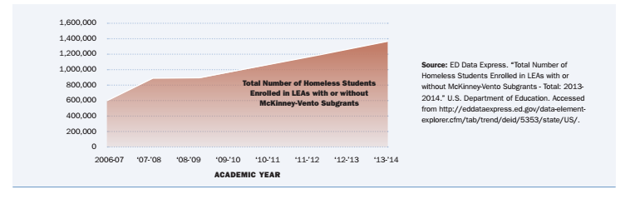
Increasing Rates of Student Homelessness, 2006-07 to 2013-14

The number of homeless students in the United States has doubled in the past decade. During the 2013-14 school year, more than 1.3 million students were homeless, a 7 percent increase over the previous school year, according to a newreport by the advocacy group Civic Enterprises and the polling firm Hart Research Associates. A disproportionate number are students of color or identify as LGBT.

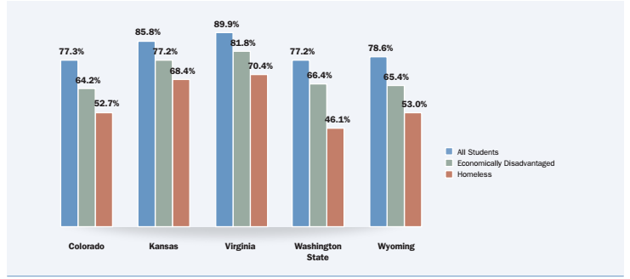
As alarming as those numbers are, the fact that figures on homeless students exist at all is a step in the right direction. That’s because, until recently, only five states have voluntarily collected that data: Colorado, Kansas, Virginia, Washington, and Wyoming. In those states, graduation rates for this population lagged behind the rest of the students, even those who are low-income. Now, provisions in the newly passed Every Student Succeeds Act (ESSA), the nation’s federal education law, are strengthening the visibility of homeless students and other disadvantaged groups. Beginning in the 2016-17 school year, states and local school districts will be required to disaggregate the graduation rates of homeless students for the first time in history, which educators say will help states and districts direct resources to the kids who need help the most.

Homelessness in schools has often gone unrecognized, John Bridgeland, the co-author of the report and the CEO of Civic Enterprises, said during a presentation of the report’s findings at the U.S. Capitol this week. Students who don’t have a stable place to go after school and at night are more likely to do poorly in class and more likely to drop out of school altogether, which means they are less likely to go to college, to find good employment, and to lead productive adult lives. Yet, the report notes, “Until this year, states and schools were not even accountable for tracking and making progress on their rates of graduation for homeless students.”

2014 Graduation Rates, by Economic and Housing Status

(Civic Enterprises)

One hurdle to collecting data is the difficulty of identifying homeless students in the first place. Unlike data that is collected on other groups of students (by income, race, ethnicity, disability, and language), homelessness is a challenge that is often invisible to the teachers and administrators tasked with supporting a student population whose educational performance is increasingly hampered by The Invisibility of Homelessness in American Schools - The Atlantic:

How Long Can Big Money Keep Democrats In The Charter School Camp?

6/16/2016 – How Long Can Big Money Keep Democrats In The Charter School Camp?:
How Long Can Big Money Keep Democrats In The Charter School Camp?


THIS WEEK: Chronic Absences … Homeless Students … Transgender Bathrooms … Poor Pay For Pre-K … New Reform Lie

TOP STORY

How Long Can Big Money Keep Democrats In The Charter School Camp?

By Jeff Bryant

“In the California Democratic Party’s primary race … many Democratic Party candidates relied on money from the petroleum industry and ‘education reform’ advocates backing charter schools to win their contests over ‘more progressive’ candidates … Charter school advocates also team up with big finance to influence Democratic Party candidates … Although, the issue of charter schools has barely been addressed in the presidential contest, there’s little doubt the subject is clearly a matter of intense and bitter debate down ticket.”
Read more …

NEWS AND VIEWS

More Than 6 Million U.S. Students Are ‘Chronically Absent’

NPR

“If students miss 10% of the school year – that’s just two days a month – research shows they are way more likely to fall behind – even drop out … More than 6 million kids are missing 15 days or more of school a year … More than 2 million high schoolers are missing 15 days or more. The figures for minority students are even more alarming: More than a fifth of black high schoolers are chronically absent. It’s 20 percent for Latino high school students and 27 percent for American Indians and Native Alaskans.”
Read more …

With Homeless Students On The Rise, Will New Education Law Help?

US News & World Report

“Homeless students are one of the fastest-growing subgroups of students in the U.S. … More than 1.3 million students were homeless during the 2013-14 school year… Students who experience homelessness are more likely than their non-homeless peers to be held back from grade to grade; have poor attendance or be chronically absent from school; fail courses; have more disciplinary issues; and drop out of school … Beginning in the 2016-2017 school year, states will be required under the new federal education law … to report graduation rates for homeless youth. In addition, districts will have more flexibility in how they use some pots of federal funding, and policymakers are hoping they choose to direct more of that toward providing support for homeless students.”
Read more …

What Does Research Suggest About Transgender Restroom Policies?

Education Week

“A 2013 national school climate survey of nearly 8,000 LGBT youths between the ages of 13 and 21 found that 63% of transgender students avoided school bathrooms, and 52% of transgender students avoided school locker rooms because they felt unsafe or uncomfortable … Regular access to restrooms can have a direct impact on academic participation and performance … There is currently no evidence of any increase in sexual assaults or other criminal behavior in restrooms in the 18 states and Washington, D.C., that have enacted gender-identity-inclusive public-accommodations nondiscrimination laws.”
Read more …

It’s Ridiculous How Little We Pay Preschool Teachers

Slate

“Teacher quality matters a lot in the early years … And yet. In spite of the rising need for childcare in this country – approximately 58 percent of mothers of infants work full time – and its increasingly obscene cost, preschool teachers are paid very, very little… an average of $28,570 last year. Daycare worker salaries are even more pitiable, with the average worker making $9.77 an hour in 2015, or $20,320 a year … Daycare workers have joined fast-food employees and other hourly wage workers in the Fight for $15.”
Read more …

The New Education Reform Lie: Why Denver Is A Warning Sign, Not A Model, For Urban School Districts

Alternet

Jeff Bryan writes, “Numerous articles and reports in mainstream media outlets and education policy sites enthusiastically tout Denver as the place to see the next important new ‘reform’ in education policy in action … Denverites tell a different story about Denver-style urban school reform. Instead of a glowing example, they point to warning signs. Rather than a narrative of success, their stories reveal disturbing truths about Denver’s version of modern urban school reform – how policy direction is often controlled by big money and insiders, why glowing promises of ‘improvement’ should be regarded with skepticism, and what the movement’s real impacts are, especially in communities dominated by poor families of color.”
Read more …


The new education reform lie: Denver is a cautionary tale, not a model, for urban school districts - Salon.com

The new education reform lie: Denver is a cautionary tale, not a model, for urban school districts - Salon.com:
The new education reform lie: Denver is a cautionary tale, not a model, for urban school districts
The city has opened 27 new charters in the past five years. At least 40 percent are performing below expectations


This article originally appeared on AlterNet.
AlterNet
Scott Gilpin works in advertising, so he’s used to dealing with people in the promotions business. He’s just not used to seeing them operating a local public school.
Gilpin lives in Denver, where he grew up, graduated from high school and now has two children enrolled in the public school system. Recently, when he decided to get more involved in Denver school politics, he discovered that the most rapidly growing form of school in his community were charter schools. So he determined to check one out.
When he toured his first charter, a school in the Strive Preparatory network, he couldn’t help but take note of the school’s staffing structure, which could have supported a mid-sized promotional campaign: his guide was the chief of external affairs for the network, and the school boasted a senior director of development and an associate director of recruitment, too.
Gilpin—who sent his children to the local public school they were zoned for, as his parents had done—wondered, “What kind of local public school needs to recruit its students?”
As Gilpin would learn, lots of new Denver schools are that “kind of school.”
Across the city, Denver has opened 27 charter schools in the last five years, and plans to start up six more in the 2016-17 school year – effectively doubling the number of charter schools in the city in less than six years, according to a recent report from the Center for Popular Democracy, a left-leaning research and advocacy organization in Washington, DC. Yet this rush to expand charters is hardly justified by the performance of the ones already in operation.
According to CPD, based on the school performance framework Denver uses to evaluate its own schools, “Forty percent of Denver charter schools are performing below expectations.” And of those schools, 38 percent are performing significantly below expectations.
Nevertheless, numerous articles and reports in mainstream media outlets and The new education reform lie: Denver is a cautionary tale, not a model, for urban school districts - Salon.com:

Librarian-Gate In Christina Heats Up: Sophie’s Choice or Misinformation? You Decide! – Exceptional Delaware

Librarian-Gate In Christina Heats Up: Sophie’s Choice or Misinformation? You Decide! – Exceptional Delaware:

Librarian-Gate In Christina Heats Up: Sophie’s Choice or Misinformation? You Decide!

I wrote a post yesterday about the Christina School District choosing not to rehire librarians that were cut as a result of their 2nd failed referendum last year.  Many have gone on the attack against the district and many have jumped to their defense.  One clear and obvious thing is Delaware needs to change their antiquated unit-based funding system to some extent.  I don’t think anyone is arguing that point.  But a lot of accusations were thrown out as a result of my article and I wanted to point out some of them.
During Christina’s 3rd referendum attempt, the situation was dire.  As a result of the last two failed referenda, they had to make some major cuts.  Teachers, para-professionals, specialists, and yes, including librarians.  In several places, whether in writing or spoken word, the district mentioned they wanted to hire back the positions they cut and reduce classroom sizes.  This year, there were anywhere between 35-45 kids in some classrooms.  That isn’t good for any student, much less some of the high-need populations in the district.  One of the members of Christina’s Citizen Budget Oversight Committee, Brian Stephan, also writes for Delaware Liberal.
Let me point out this simple fact: I like Brian.  I think he is a good guy and a very involved parent.  I wish more parents were as involved as Brian and his wife in public education (and on a volunteer basis at that).  I have no doubt in the world he is very well-versed in school financing.  But just as I get my readers stuck in the weeds on issues such as special education or regulations for example, I think that may happen to Brian when he is explaining district financing.  Like any television show, there is frequently a “previously on…” before the show starts.  The brains of everyday citizens don’t remember Librarian-Gate In Christina Heats Up: Sophie’s Choice or Misinformation? You Decide! – Exceptional Delaware:

How Dr. Steve Perry Sells Black Kids To The Highest Bidder — Medium

How Dr. Steve Perry Sells Black Kids To The Highest Bidder — Medium:

How Dr. Steve Perry Sells Black Kids To The Highest Bidder

c.o Lance Murphey
As an educator who’s been doing this for 11 years, I’m always fascinated by the perfect stories we tell about kids. Either our kids are shining examples of the future or abject failures in need of reform. The word “failing” is of particular interest to me because, as I see my kids walk into class this morning, the first thing they don’t want to hear come out my mouth is “You’re a failure!” Even as sometimes-petulant teenagers, they prefer to hear “good morning” as they come into my class. Some come in with short haircuts with three cuts on the size, others in dreads, others still in fros. Their hair styles are extensions of their personality, perhaps, but if I decided to exclude them from my teaching, I’d be the failure that some of these pundits spew hate upon so confidently.

Which brings me to this weekend. On Saturday, June 11th, proselytizer Dr. Steve Perry celebrated a collaboration between him, comedian Steve Harvey, and the US Armed Forces. The cause? They would transform 200 young men of color into their version of righteousness:


In subsequent tweets, he comes within inches of calling himself the next Messiah, stopping kids from stuttering and pulling them from gangs, stepping in for their absent fathers, and keeping them up until midnight for no other reason than his own need to set these boys straight. In subsequent tweets, he How Dr. Steve Perry Sells Black Kids To The Highest Bidder — Medium:

State budget heads to Gov. Brown: How education fared | EdSource

State budget heads to Gov. Brown: How education fared | EdSource:

State budget heads to Gov. Brown: How education fared

Including the 2016-17 state budget, revenue for K-12 schools and community colleges from Proposition 98 has grown $24.6 billion or 52 percent since 2011-12, the low point of funding following the recession.
CREDIT: JUSTIN ALLEN / EDSOURCE
Including the 2016-17 state budget, revenue for K-12 schools and community colleges from Proposition 98 has grown $24.6 billion or 52 percent since 2011-12, the low point of funding following the recession.
Facing a midnight deadline, the Legislature Wednesday passed a $171 billion state budget for the fiscal year starting July 1 that steers an extra $2 billion that Gov. Jerry Brown demanded into a rainy day reserve and commits an additional half-billion dollars for early childhood education over the next four years. Brown is expected to sign the budget, which his staff negotiated.
Education will fare well. The 4 percent overall  increase in revenue for K-12 districts in 2016-17, while it pales compared with the unusual 11 percent increase last year, is large by historical standards. Forecasts of revenue in coming years are cloudy and will depend on whether a recession happens, as Brown predicts, and whether voters in November re-up Proposition 30, extending an income tax increase on the state’s wealthiest residents.
 Here are some of the big numbers for education in the budget for 2016-17:

PROPOSITION 98

  • $71.9 billion: The Proposition 98 guarantee, the main source of money for K-12 and community colleges. That’s $2.8 billion more than the revised total for 2015-16, and $3.5 billion more than the Legislature appropriated a year ago for the current year.
  • $10,657: Per-student funding, upState budget heads to Gov. Brown: How education fared | EdSource:


14 arrested at teacher protest in downtown Raleigh | News & Observer

14 arrested at teacher protest in downtown Raleigh | News & Observer:

14 arrested at teacher protest in downtown Raleigh


Police arrested 14 people Wednesday evening, including several teachers, after they blocked a downtown intersection during a protest of Gov. Pat McCrory’s education policies.
The Organize 2020 group, sponsored by the N.C. Association of Educators, had sought to meet with McCrory after a 23-mile protest march from Durham and North Raleigh to the State Capitol.
McCrory’s staff said the governor had a scheduling conflict and could not meet with the group. The governor’s office later offered to arrange a meeting with two top McCrory aides. But when the group arrived at the Capitol building around 5 p.m., the building was locked.
That’s when the group decided to block the intersection of Morgan and Fayetteville streets. About 14 of them sat down and linked arms in the street, while dozens of others cheered and chanted from the sidewalk.
“What would be the harm in him sitting down with teachers and students and parents to talk about the state of education?” said Todd Warren, a Spanish teacher from Greensboro who was one of the protest organizers. “Obviously, we’re not getting the governor’s attention. He was last night at a fundraiser for (presidential candidate Donald) Trump, catering to the wealthiest 1 percent.”
Raleigh police loaded the protesters into two prisoner transport vans and took them to the Wake County Detention Center. The department said they will be charged with impeding the flow of traffic and resisting, delaying or obstructing law enforcement officers. A police news release said the group “declined to follow multiple directives to disperse.”
When they were booked at the Wake County Detention Center, seven protesters said they work for the Durham Public Schools, two for the Wake County Public School System, two for the Guilford County schools and one for the Chapel Hill Carrboro City Schools. Two gave no employer.
McCrory spokesman Josh Ellis said the group initially didn’t respond to an offer to meet with the governor’s deputy chief of staff, Jimmy Broughton, and senior education 14 arrested at teacher protest in downtown Raleigh | News & Observer:


Read more here: http://www.newsobserver.com/news/politics-government/state-politics/article84023702.html#storylink=cpy

Charter advocates acknowledge ‘disturbingly low performance’ of virtual schools - The Washington Post

Charter advocates acknowledge ‘disturbingly low performance’ of virtual schools - The Washington Post:
Charter advocates acknowledge ‘disturbingly low performance’ of virtual schools


Full-time virtual charter schools have become increasingly popular during the past decade, now enrolling 180,000 students nationwide, students who learn by logging on to laptops from home instead of going to brick-and-mortar schoolhouses. But these schools’ growing enrollment has been accompanied by intense scrutiny: Journalists, activists and scholars have reported on virtual schools’ poor performance and raised questions about whether the schools are designed to effectively teach kids — or to effectively make a profit.
Now national charter-school advocates are calling for tighter oversight of virtual schools and closure of those that persistently fail, acknowledging that full-time virtual schools — most of which are run by for-profit companies — have “significant problems” and “disturbingly low performance.”
The Center for Research on Education Outcomes, which is generally seen as friendly to charter schools, found last year that students enrolled in full-time online charter schools learn far less than their peers in traditional public schools. The online charter students lost an average of about 72 days of learning in reading and 180 days of learning in math during the course of a 180-day school year, the study found. That is, in math, it’s as if the students did not attend school at all.
Charter advocates acknowledge ‘disturbingly low performance’ of virtual schools - The Washington Post:

NEWS FLASH - Malloy + Dems slammed with record fine for campaign finance violations but slip off the hook - Wait What?

NEWS FLASH - Malloy + Dems slammed with record fine for campaign finance violations but slip off the hook - Wait What?:

NEWS FLASH – Malloy + Dems slammed with record fine for campaign finance violations but slip off the hook


 During 2013 and 2014, Wait, What? repeatedly reported on the outrageous campaign finance violations being perpetrated by Democratic Governor Dannel Malloy and his political operatives during his 2014 gubernatorial re-election campaign.  Wait, What? coverage included both original investigative pieces and detailed analysis of the outstanding reporting of the Courant’s Jon Lender.

Now, a year and a half latter, rather than face the full impact of their illegal activities, Malloy’s team “plea-bargained” a deal that was quickly voted on today by the Connecticut State Elections Enforcement Commission.  The deal, adopted by a 2-1 Commission vote , lets Malloy and his team off the hook, although they will be paying a record fine for their violation of Connecticut law.
Had Malloy and his operatives been found guilty of intentionally violating Connecticut’s public financing system, he could have been forced to return his $6 million taxpayer-funded public finance grant that he received in return for swearing, under oath, not to circumvent that law and accept outside donations.  Instead, the Democratic Party will pay a $325,000 fine to make the “problem” go away.
The Hartford Courant, in a breaking story entitled, Agency Approves Settlement That Would End Probe Of Democrats’ Spending On Malloy Re-Election reports;
State election regulators voted in favor of a negotiated settlement to a high-
NEWS FLASH - Malloy + Dems slammed with record fine for campaign finance violations but slip off the hook - Wait What?:

Schools Matter: Los Angeles Education: The Corporate Black Box

Schools Matter: Los Angeles Education: The Corporate Black Box:

Los Angeles Education: The Corporate Black Box


Last year the wrinkled Putin-esque remains of Eli Broad announced a charter privatization plan for Los Angles that was unacceptable. 


Now the phony organization created to front the plan has announced another version of that unacceptable plan, any details of which shall remain a secret until such time as the withering Eli allows the public to know what he plans for their tax dollars.  
If this were Russia, one could understand.  This is Los Angeles, USA.  A clip from the LA Times:
Timed with the release of its plan, Great Public Schools Now will launch a six-figure TV and print campaign, including ads in the L.A. Times.  
“Let’s stop fighting and start fixing,” urges one, which then guides readers to the group’s website. 
While insisting that its focus will be on all schools, not charters alone, the group isn’t disclosing all pertinent details. It declined this week to provide information on its funders and how much money they are providing.  
The group’s board members dismissed concerns that the rapid movement of students to charters could lead to afinancial crisis in L.A. Unified, shrinking its budget as it struggles with long-term pension and healthcare obligations.
Will Eli allow some public schools to stay open, if they carry out Broad's paternalistic agenda?  Will magnet schools become part of the corruption?  Will the Third Way come to Los Angeles, which is just another way to let corporations control every element of public schools?  Will we hear an announcement from the corporate unions that they have arranged for union members to keep their jobs in these new hybrid hybrid hybrid hell schools?  Schools Matter: Los Angeles Education: The Corporate Black Box:


Mike Klonsky's SmallTalk Blog: WaPo's Strauss: Chicago's school system at the brink

Mike Klonsky's SmallTalk Blog: WaPo's Strauss: Chicago's school system at the brink:

WaPo's Strauss: Chicago's school system at the brink


Ed writer deluxe, Valerie Strauss at (Donald Trump's fave) Washington Post asks, "Is the nation’s third-largest school district in danger of collapse?" She's referring to Chicago, of course, even though technically, Puerto Rico  has the nation's third-largest. Chicago is fourth, especially now that so many African-American families have left the city.

But the answer to her question is a definite, YES.

Strauss writes:

Dozens of principals, including some from the district’s best schools, have decided to leave, but those who are staying were warned recently that they could see 39 percent cuts in funding. That goes for teachers, after-school programs and enrichment programs. Chicago public schools, long in dire financial straits, face a budget deficit of more than $1 billion and must contribute $676 million to the Chicago Teachers Pension Fund by June 30, which, the Chicago Sun Times says, would leave only $24 million in the district’s coffers.
 Meanwhile, problems with facilities have been growing  since the district, in what it said was a cost-cutting move, privatized cleaning services two years ago by awarding more than $300 million in contracts to two firms, Aramark and SodexoMAGIC (the latter associated with former NBA star Magic Johnson, who, Mike Klonsky's SmallTalk Blog: WaPo's Strauss: Chicago's school system at the brink:


Teacher Uses Settlement Proceeds To Fund Activists, Organizations | I AM AN EDUCATOR

Teacher Uses Settlement Proceeds To Fund Activists, Organizations | I AM AN EDUCATOR:

Teacher Uses Settlement Proceeds To Fund Activists, Organizations

BEM_PressConferencePic
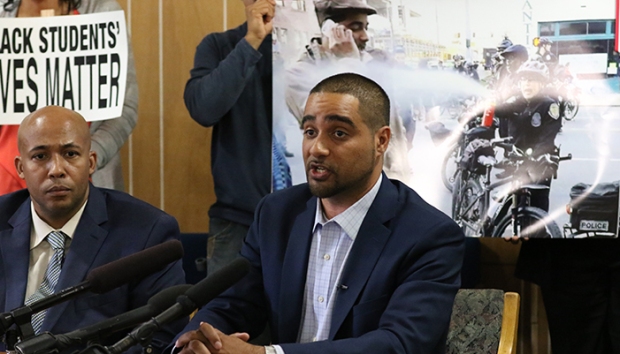
History teacher Jesse Hagopian talks about his $100,000 settlement with the City of Seattle after being pepper-sprayed by a police officer last year. Hagopian is using the proceeds from the settlement to fund youth activists and community-based organizations. Staff Photo/Chris B. Bennett.
By Chris B. Bennett
The Seattle Medium
Jesse Hagopian, a community activist and history teacher at Garfield High School, recently reached a $100,000 settlement with the City of Seattle for an incident in which he was pepper-sprayed, without provocation, by a Seattle Police officer after he gave a speech at a community rally on Martin Luther King, Jr. Day in 2015.
At the time of the incident, Hagopian was on the phone with his mother– arranging plans for a ride to his two-year-old son’s birthday party — when Seattle police officer Sandra Delafuente assaulted him with pepper-spray.
“That day was deeply painful, and not only because of the burning in my ears, nostrils, and swollen eyes,” said Hagopian. “What hurt the most was the fear that I brought to my two sons who were deeply troubled watching me writhe in pain and pour milk on face to try to sooth the burning.”
The pepper-spray assault was caught on video and garnered millions of views online and was the subject of national and international news stories. As a result of the video, Hagopian was able to show that the incident was unwarranted.
“It is deeply disappointing that we are in this place again that we see how protestors and peaceful marchers are treated by the Seattle Police Department,” said Attorney James Bible, whose law firm represented Hogapin in his claim against the City. “I think the question that should be posed by many is what would happen if there, in fact, was no video in this particular case. We’d be stuck with nothing but the narrative of law enforcement and what we know now is that the narrative of the law enforcement rarely, if ever, matches the video that we’re able to capture and gather on occasion.”
Hagopian, to his credit, has turned the incident into an opportunity to support people who are making a difference in the Seattle area, as he is providing money from the settlement to support the work of groups and individuals to improve the plight of people of color.
At a press conference held Monday at the NAACP office, Hagopian announced the establishment of his Black Education Matters Scholarship for student activist. Hagopian presented three high school students – Marcelas Owens, Ifrah abshir and Ahlaam Ibraahim – with $1,000 to use in order to continue their work in the community.
Marcelas Owens has been on the recognized for her work both locally and nationally on healthcare and transgender issues.
Ahlaam Ibraahim hosts an annual Islamophobic event to educate people who may be afraid of Muslim people due to media bias. In addition, she also uses social media to address bad things Teacher Uses Settlement Proceeds To Fund Activists, Organizations | I AM AN EDUCATOR:


CURMUDGUCATION: Eli Broad's Bloodless Coup

CURMUDGUCATION: Eli Broad's Bloodless Coup:
Eli Broad's Bloodless Coup
I don't think there's ever been anything like it.


Well, maybe Teapot Dome, kind of. Back in the early 1920s, the feds had special oil reserves set aside for the Navy. One was near Teapot Dome in Wyoming, and during the administration of Warren G. Harding, some folks engineered the oil reserves at Teapot Dome being handed off to the department of the interior. But since Secretary Albert Bacon Fall had been fully bought by Sinclair Oil, he quickly and quietly turned over what was supposed to be a public national resource to a private company in a secret-ish no-bid process that let the oil go for so little money that it could hardly be called selling it.

Imagine. There was a time when that sort of thing, with public officials bought and corrupted by private interests giving away public resources, was actually shocking.

But now it's 2016, and if Eli Broad wants to just go ahead and take over a public school system, he can just go ahead and do it in plain sight.

This, of course, is not new. Broad long ago decided that education would be better run by people with a business background, not an education one, and so he set up Broad Academy, a-- school? program? thingy?-- that finds the Right People, puts them through some edu-business training, and declares that they are fit to be superintendents because Eli Broad says they are. It is an amazing piece of ballsiness, as if I set up an Officer's Training School in my back yard and started issuing certificates declaring my graduates were First Lieutenants in the US Army. Well, it would be like that if I were really, really rich and well-connected and managed to convince the US Army to let my trained "officers" actually take command. But this is the guy who literally wrote the book about how to shut down a public school system and replace it with privately operated charters. 

Broadies have been put in place in districts all around the country. And what we saw in Kansas City, when Broad picked up the phone and told John Covington that he was going to Detroit, is that the 
CURMUDGUCATION: Eli Broad's Bloodless Coup:


Wisconsin Faculty Fighting the Destruction of Public Higher Education

Wisconsin Faculty Fighting the Destruction of Public Higher Education:

Wisconsin Faculty Fighting the Destruction of Public Higher Education

Scott_Walker_HigherEd_Cuts
A faculty vote of “no-confidence” is the nuclear option on campus— the “delete your account” of academia. It says publicly, loudly, and collectively that professors no longer believe their president or other leaders can give students what they need.
This spring, an unprecedented wave of thousands of faculty on University of Wisconsin (UW) campuses, plus the 13 two-year UW System Colleges, have voted no-confidence in UW System President Ray Cross and Board of Regents. Fed up with devastating state budget cuts, attacks on tenure and shared governance, and also what they see as the systematic demolition of one of the world’s finest public universities for political purposes, they have said enough is enough.
“By voting no confidence, we protest the intentional destruction of our internationally recognized university system,” UW-Milwaukee professor Rachel Ida Buff told the Milwaukee Journal Sentinel.
In Milwaukee, the largest meeting of  UWM faculty in decades or possibly ever—nearly 300 people—voted unanimously in May. Their vote was preceded by the initial action at UW-Madison, the system’s flagship university, and also UW-River Falls and UW-La Crosse, and then quickly followed by similar censures on other campuses. “This resolution is an expression of frustration…over what has happened to public higher education [here] over the past year, 18 months, whatever,” said Mitch Freymiller, University of Wisconsin-Eau Claire Senate chair, to Wisconsin Public Radio.
Meanwhile, key UW faculty members have thrown up their hands at Wisconsin Gov. Scott Walker—the architect of these university “reforms”—and quit UW altogether. “At my new university in another state, I will have stronger tenure protections than I now have here. I will earn about 50 percent more than my current salary for the Wisconsin Faculty Fighting the Destruction of Public Higher Education:


Orlando - Network For Public Education

Orlando - Network For Public Education:

Orlando
NPE Orlando Home Featured


 The Network for Public Education joins the BATs in expressing our deep sorrow for those killed in Orlando and urge educators to fight for LGBT inclusion and tolerance in our schools.

Click HERE to read the statement.

The Sacramento city voters have spoken - Opinions

Sacramento News & Review - The Sacramento city voters have spoken - Greenlight - Opinions - June 16, 2016:

The Sacramento city voters have spoken

The Sacramento Metropolitan Chamber of Commerce and city council should listen
Jeff vonKaenel is the president, CEO and majority owner of the News & Review newspapers in Sacramento, Chico and Reno.


The Sacramento city voters have spoken. Darrell Steinberg will be our new mayor, and city council members Allen Warren, Steve Hansen, Eric Guerra and Larry Carr all will be returning.

None of the city council races were seriously contested. No one even ran against Guerra. Despite a long list of mayoral candidates including Tony “The Tiger” Lopez and fighting single mom Councilwoman Angelique Ashby, Steinberg won in a landslide, capturing 59 percent of vote.

While the Sacramento council will be the same, it will be a whole new ballgame with Steinberg replacing disgraced Mayor Kevin Johnson. While reasonable people can agree or disagree about the arena or the strong-mayor initiative, anyone who has listened to the police-recorded transcript of Johnson talking with Phoenix teenager Mandi Koba will probably agree that a 10-foot pole should be kept between him and their underage daughter. And it appears there are numerous other women who wish a similar pole had been placed between them and Mr. Johnson.

Now that we have a new mayor, the new mayor and council should appoint the new city manager. In a puzzling and petty move, Johnson led an effort to replace City Manager Sacramento News & Review - The Sacramento city voters have spoken - Greenlight - Opinions - June 16, 2016: