Latest News and Comment from Education

Monday, January 14, 2013

Common Core State Standards - Special Education (CA Dept of Education)

Common Core State Standards - Special Education (CA Dept of Education):


Common Core State Standards


Resources and guidelines on the Common Core State Standards (CCSS) for the Special Education Community.
Educational standards describe what students should know and be able to do in each subject in each grade. In California, the State Board of Education decides on the standards for all students, from kindergarten through high school. Since 2010, 45 states have adopted the same standards for English and math. These standards are called the Common Core State Standards (CCSS). Having the same standards helps all students get a good education, even if they change schools or move to a different state. Teachers, parents, and education experts designed the standards to prepare students for success in college and the workplace. For details regarding the CCSS for all students visit the main CCSS Web page.
This site offers resources and guidelines on what the CCSS and the new tests will mean for California students in the Special Education Community. 

CCSS Resources

The Common Core State Standards (CCSS) for English and math were adopted in 2010. These standards define what students need to learn at each grade level. They provide a chance to improve access to quality content standards for students with disabilities.
  • Aligning CCSS to Individualized Education Programs (Coming Soon)
    This web page includes resources and tools to help align the CCSS to individual Education Programs
  • Special Education CCSS Frequently Asked Questions (Coming Soon)

Questions:   Kristen Brown | NCSC@cde.ca.gov | 916-445-1064

Smarter Balanced TRT January 2013 New Features


Several changes have been made to the Smarter Balanced Technology Readiness Tool (TRT) in January 2013 to support readiness reports and school exception reports.

Device and Network Readiness Reports

The Device Indicators and Network Indicators reports (under the Results & Indicators tab) will show a percentage of “readiness” in the following ranges: 0%-25% (red), 26-50% (orange), 51%-75% (yellow), and 76%-100% (green).
Since some of the Smarter Balanced minimum system requirements External link opens in new window or tab. do not align directly to existing TRT options, previously submitted Mac OS X 10.1-10.5, Linux, and Chrome devices will need to be updated to new operating system options before the Device Indicator report will be accurate. Similarly, devices with less than 512 MB of memory need to be updated to new memory options before the Device Indicator report will be accurate.
Option Value Prior to Jan 2013Conversion Value (Post Jan 2013)
Mac OS X 10.1 - 10.5Mac OS X 10.4.3
Mac OS X 10.6 - 10.7Mac OS X 10.6
Linux UbuntuLinux Ubuntu v9 - 12
Linux FedoraLinux Fedora v1 - 5
Google Chrome
(operating system)
Google Chrome v19
Less than 512 RAM256 MB
Reference the Devices File Import Layout for specific information on the new operating system and memory options.
The readiness reports are run as a daily batch process during non-business hours. Changes to devices or school readiness survey data will not be reflected until the following day.

"School Complete" Checkbox

A separate method to mark the “school complete” checkbox has been implemented. Previously, the “school complete” checkbox was the first question  in the School Survey Questions section. For this release, the section has been renamed to Readiness Survey Questions, and the “school complete” checkbox has been removed from the section.  Instead, use the new Mark Data Entry Complete option under the Setup tab when you are ready to mark a school as complete.

School Exception Reports

There is a new option, School Exception Report, under the Results & Indicators tab. The report has various options to allow a district-level user to identify schools that are in various stages of TRT completion. For example, an exception report can be run to identify schools that have submitted device information, but have not submitted Readiness Survey Questions information. The reports are run as a daily batch process during non-business hours.

Questions:   Smarter Balanced Technology Readiness Coordinator | sbac-itreadiness@cde.ca.gov

Seattle Schools Community Forum: Seattle Schools This Week

Seattle Schools Community Forum: Seattle Schools This Week:


Seattle Schools This Week

Monday,  January 14th
Opening day for the Washington State Legislature.  Here's where the rubber meets the road on education.

For those legislators who don't want to raise taxes, tell us what you would cut elsewhere. 

For those legislators who say we don't need more money for public education, tell us how you would spend the current dollars better.  What would you cut and/or what would you add?  (I'm pretty sure the "private sector could do it better and cheaper" will come into play at some point.)

Curriculum&Instruction Meeting from 4-5:30 p.m. Agenda includes Creative Approach Schools update, professional development waivers and parent-teacher conferences and alternative learning experience schools or program revisions.

Wednesday, January 16th
Committee of the Whole: Strategic Plan from 4-5:30 p.m.

College Goal Sunday from 6-8 p.m. at Roosevelt High School

Thursday, January 17th
Operations Committee meeting of the Whole from 3:30-5:15 p.m.  Agenda

There will be a number of construction contracts viewed at this meeting but it stands out in importance for two things: reviewing the 2013-2014 transportation services standards and "capacity management/NSAP- comparative data reviewed."

These two items will give guidance to what the interim plan will be for 2013-2014.  From an e-mail from Director Peaslee:

Thanks to all who have provided input into our very public capacity planning process. Public involvement is playing a significant role and we are working very hard to land a plan that most will be able to support. 

My community meeting last night was packed with parents from almost every impacted school in the north end. We reviewed two scenarios that I asked staff to compare to each other. Scenario 3 would lead to a 6th Grade 

Schools Matter: FairTest Urges Nation to Join Seattle in Testing Boycott

Schools Matter: FairTest Urges Nation to Join Seattle in Testing Boycott:


FairTest Urges Nation to Join Seattle in Testing Boycott

NationalCenterfor Fair & Open Testing

for further information:

Dr. Monty Neill(617) 477-9792

Bob Schaeffer(239) 395-6773

for immediate release Monday, January 14, 2013

*NATIONAL ASSESSMENT REFORM LEADERS ENDORSE *

*SEATTLE TEACHERS' SCHOOL TEST BOYCOTT;*

*CALL FOR MORE EDUCATORS, PARENTS TO "JOIN IN"*

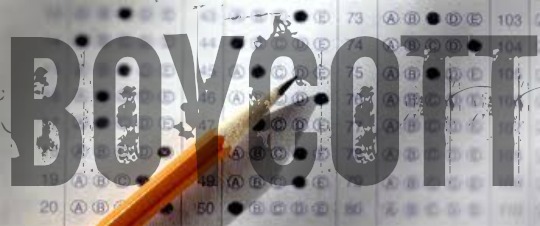
The country's leading testing reform organization today announced its support for the boycott of Seattle Public Schools' Measures of Academic Progress (MAP) exam launched by teachers at Garfield High School. National Center for Fair & Open Testing (FairTest) Executive Director Dr. Monty Neill said, "Children across the U.S. suffer from far too much standardized testing that is misused to judge students, teachers and schools. We applaud Garfield High educators who refused to administer these useless exams and urge others to join in."

Dr. Neill explained, "Seattle requires administration of the MAP tests three times per year. This eliminates days of valuable teaching time and ties up the school's computer labs for weeks. The tests are used to judge teachers even though they are not aligned with the state's standards and not instructionally helpful. The 

U-Can ‘Unity Breakfast’ Fundraiser Announced

U-Can ‘Unity Breakfast’ Fundraiser Announced:


U-Can ‘Unity Breakfast’ Fundraiser Announced

Alan Rowe.86SACRAMENTO – It takes a village. An area group is helping raise money for local African American students looking to pursue higher education.
District 2 Unity in the Community hosts a Unity Breakfast on Saturday, January 19. The event is a fundraiser for the United College Action Network, run by Dr. Alan Rowe. The program, known largely by its acronym, U-CAN, helps students gain exposure to and enrollment in History Black Colleges and Universities (HBCU). Throughout the year, U-CAN hosts a number of college fairs to introduce students to HBCUs and also has programs aimed at helping students be successful once they’ve gained enrollment at one.
The Unity Breakfast is set to run 8:30-11 a.m. at the Robertson Community Center, located at 3525 Norwood Avenue. The keynote speaker will be Dr. Ramona Bishop, Superintendent of the Vallejo City Unified School District. Dr. Bishop previously served as Associate Superintendent for Education Services of the Twin Rivers Unified School District.
Tickets are $25. Proceeds benefit U-CAN’s 2013 College Tour/Fair. For more, contact James Moore at (916) 821-2770 or Crandall Rankin at (916) 969-0178.

Seattle Schools Community Forum: What Should Garfield's Teachers Do?

Seattle Schools Community Forum: What Should Garfield's Teachers Do?:


What Should Garfield's Teachers Do?

Superintendent Banda has come out with the district's response to the Garfield teachers' ringing rejection of giving the MAP test.   Basically, it's "we're going to talk about issue this spring; you must continue giving the test now." 

Before the issue was raised by our teachers at Garfield High School, the School Board had already asked for a thorough review of our how we assess student learning, including MAP testing.  During an annual report to the Boardon Nov. 28, it was agreed that the District would review the effectiveness of MAP testing. We plan to report back to the Board this spring. 

Starting in February, I will invite principals and teachers to be part of a formal process to review the MAP test and make recommendations for assessing student learning in Seattle Public Schools. This is the appropriate venue to share concerns and to have an in-depth discussion about the test. We will work together to find the best way to move 

Joy Resmovits: No Labels Reveals 'Problem Solver' Caucus -- But Where Are The Education Legislators?

Joy Resmovits: No Labels Reveals 'Problem Solver' Caucus -- But Where Are The Education Legislators?:


No Labels Reveals 'Problem Solver' Caucus -- But Where Are The Education Legislators?

One upon a time, education was known as a bipartisan issue in Congress. The passage of No Child Left Behind, for example, was heralded by Democrats like Ted Kennedy and George Miller, as well as Republicans like John Boehner and former President George W. Bush.

That fact was the cause of much nostalgia during the most recent round of No Child Left Behind reauthorization talks -- because it's not exactly true anymore. The rancorous hyperpartisan atmosphere that characterizes Congress has certainly affected the legislative process on education issues (despite, it should be noted, bipartisan support for one House charter school bill).

I was thinking about this yesterday when I was reporting on a story for HuffPost Politics about one attempt to bust up partisan gridlock. A group called No Labels is relaunching today with former Utah Gov. Jon Huntsman (R) and Sen. Joe Manchin (D-W. Va.) at the helm -- and with a class of legislative "problem solvers."

From our story:

As part of this new push, No Labels has identified 25 "problem solvers" in Congress -- including 

UPDATE: My Nekritz moment. and Tony at the Red Line Tap. « Fred Klonsky

Tony at the Red Line Tap. « Fred Klonsky:


Pat Quinn on Chicago Tonight tonight. Email Carol Marin with a question.

Hey pension advocates.
Governor Pat “Squeezy” Quinn is on WTTW’s Chicago Tonight.
Tonight.
This Tweet from Carol Marin:
Carol Marin (@CarolMarin)
What should I ask Governor Pat Quinn? He’ll be live on Chicago Tonight@7P!


Tony at the Red Line Tap.

tonyattheredline
“Got any of that oak aged from Two Brothers?”
Marty nodded. “Just got some in,” she mumbled.
“I think she’s tired this morning,” said Tony. “Up watching the Golden Globes.”
“I watched it too,” I said. “But I’m not tired since I slept through most of it.”
“The media gets all excited about the Golden Globes because you get to watch people get drunk. Shit. I get to


My Nekritz moment.

nekritz
My friend Glen Brown posts a scathing indictment of media on his blog today.
“Stupid Gets,” he calls them.
Brown is so friggin’ brilliant. I always say that I feel like a Jerry Lewis to his Jean Paul Sartre.
I had to Google what calling reporters “stupid Gets” means. They just repeat the crap that any politician feeds them. No questions asked.
A stupid Get?
1. A completely ignorant, childish person with no manners. 
2. A person who feels justified in their callow behaviour. 
3. A pubescent kid who thinks it’s totally cool to act like a


Case dismissed.

swartz_dismissal2-660x686

Part 5: High Stakes Testing and Opting Out: The Push Back | Seattle Education

Part 5: High Stakes Testing and Opting Out: The Push Back | Seattle Education:


Part 5: High Stakes Testing and Opting Out: The Push Back

Hassib Muhammad – Greening Forward bringing youth voices to environmental activism Student Voice

Student Voice:


Hassib Muhammad – Greening Forward bringing youth voices to environmental activism

A couple of weeks ago, I came home from the worst day of practice ever. I was dizzy and dehydrated. My body was sore and had bruises all over. And to top it all off, I had an AP Chemistry test the next day. It made me never want to go back to Math Team practice again. What! Are you kidding me? Great. So naturally, I bolted into my room and did what any productive teenager would do – procrastinate. I found myself flipping through the TV channels. One after another after another but then it hit me. A brilliant young lady appeared on my TV screen, and she said something that has changed my life forever. She said, and I quote, “A dollar makes me holler Honey Boo Boo!”
Now, ladies and gentlemen, Honey Boo Boo was onto something. She found what made her holler – her passion. Passion is a compelling force that drives us to accomplish the seemingly unaccomplishable. To make possible the impossible. You may already have a passion and might not know it! It may be something you enjoy doing on the weekend with friends and family or something you see wrong in this world but wish of redressing. Some common passions include eating, reading, underwater basket-weaving. Honey Boo Boo’s passion was 

Four More Years? | The Forum for Education and Democracy

Four More Years? | The Forum for Education and Democracy:


Four More Years?

About this time four years ago I was on my way to Washington to watch the inauguration of Barack Obama.  I was looking forward to his administration, hoping that having Linda Darling-Hammond as the leader of his education transition team meant good things for public schools.
I have to say I have been disappointed.  While there have been some good things, there has been much to puzzle over.
I wonder why there has been so much support for Teach for America and so little support for teacher preparation and teachers in the classrooms.  I am not sure why Title 1 has become more of a competitive grant program with mountains of paperwork as opposed to the anti-poverty program it started out to be. And I cannot figure out why interest in 

If We Don't Have Time to Do the Standards Right, When Will We Have Time to Do Them Over? — Whole Child Education

If We Don't Have Time to Do the Standards Right, When Will We Have Time to Do Them Over? — Whole Child Education:


Bryan Goodwin

If We Don’t Have Time to Do the Standards Right, When Will We Have Time to Do Them Over?

As 46 states move to adopt Common Core State Standards, the opportunity may never be better to rethink not only standards themselves, but also how we get students interested in learning.
Let's face it. We haven't always done a good job getting kids interested in learning. Studies suggest that the longer students stay in school, the less motivated they become; their intrinsic motivation in core subject areasbegins to drop off around age nine (PDF) and continues to fall throughout secondary school years. By the time they reach high school, a national survey of 81,000 students (PDF) found that nearly two-thirds of them (65 percent) report being bored in class on a daily basis.
As educators nationwide labor to bring Common Core standards into their schools and classrooms, a recent study conducted by economist Steven Levitt, author of the popular book, Freakonomics, may give us pause. Levitt and his colleagues gave some 7,000 students in the Chicago area small rewards (e.g., cash prizes up to $20 for older students or $3-value trophies for younger ones) to see whether simple bribes would entice them to perform better on standardized tests.
Surprisingly, the bribes worked: students promised rewards for good performance demonstrated about 5–6 

Teachers For Social Justice: Upcoming TSJ Events

Teachers For Social Justice: Upcoming TSJ Events:


Upcoming TSJ Events

JANUARY 14, 2013 LEAVE A COMMENT
Teachers for Social Justice and CORE will be having two joint events in the coming month, both related to the work of Lois Weiner.

The first will be a discussion of Weiner's new book, The Future of Our Schools: Teachers Unions and Social Justice. This is an important, short, very readable book. You can buy it from Haymarket Books, (they'll send right out), or email here. We will be discussing Part 1, pp. 3-81, and Chapter 12. 
Here are details and a link to RSVP:

TSJ/CORE Book Discussion
Sat., Jan 26th
1:00-3:00 pm
UIC College of Education, Room 3233
RSVP here

Here is what Karen Lewis of the CTU had to say about Lois Weiner's new book:
"Lois Weiner's book should be a wake-up call for all of us who work in K-12 schools. Her analysis of the current political climate is clear, sharp and desperately needed. The Future of Our Schools provides a template for rank and file members to be pro-active in their unions and a nudge to union leadership to open the process to defeat the corporate agenda." --Karen Lewis, President, Chicago Teachers Union
The second event will be a public forum with Lois Weiner on Friday, February 8th. The exact time and location are TBD, so please stay tuned!


Sat. Jan 19th - City-wide Community Outreach to Save Our Schools

SaveOurSchoolsRally082

Join the Grassroots Education Movement (GEM), parents, students, educators, and community organizations across Chicago in community canvassing on Saturday, Jan. 19th in the morning and early afternoon hours!

The Mayor and Board of Education have closed or taken over dozens of schools every year, targeting Black and Latino neighborhoods. These closings take resources that students deserve, destabilize our neighborhoods, and increase racial inequality in the schools. The Board of Ed is now planning to close dozens more schools, taking even more from the communities that have lost the most. They plan to close schools in part to pay for corporate handouts and more privatized charger schools controlled by the Mayor's supporters--taking our community's schools, jobs, and VOICE.

Join us in spending a few hours of the Marting Luter King, Jr. Day weekend fighting for our communities, our students and our schools.

For details on locations and times throughout the city, please click here for the flier.

Best of the Ed Blogs | National Education Policy Center

Best of the Ed Blogs | National Education Policy Center:


Best of the Ed Blogs

The Quick and the Ed » A Comprehensive Review of the MET Project

The Quick and the Ed » A Comprehensive Review of the MET Project:


A Comprehensive Review of the MET Project

On Tuesday the Measures of Effective Teaching (MET) Project released its third and final series of reports. The media has reported the main findings: that we can measure and predict effective teaching. And, because the MET Project randomly assigned students to teachers, we can say that there is causality in this relationship, that teachers with high value-added scores in one year caused student achievement to rise in the following year.
But the reports also include a host of interesting detail and helpful suggestions to districts and states. Among them:
  • Current state tests can be used to identify effective teachers. Assessments that require higher-order thinking skills are likely to be better at differentiating teachers, but even the current low-level tests that states are using are valuable in identifying effective teachers. Important, the same teachers who raised student achievement on low-level state tests also raised student achievement on more cognitively