Latest News and Comment from Education

Showing posts with label SECURITY. Show all posts

Wednesday, March 31, 2021

In the wake of man bringing live bombs, zip gun to Sac elementary school, major leap announced in campus protection tech • Sacramento News & Review

In the wake of man bringing live bombs, zip gun to Sac elementary school, major leap announced in campus protection tech • Sacramento News & Review
In the wake of man bringing live bombs, zip gun to Sac elementary school, major leap announced in campus protection tech


Authorities are being tight-lipped about what might have motivated Gustavo Aguilar, the 57-year-old man arrested last week for allegedly bringing two improvised, working bombs and a loaded homemade gun to Ethel Baker Elementary School in South Sacramento. Meanwhile, on the global front, a Canadian company confirmed that it’s racing ahead with a novel technology designed to stop such threats to school campuses.   

The investigation into Aguilar began shortly after 8 a.m. on March 2, after a program manager working at Ethel Baker noticed two suspicious devices resting on a sidewalk near one of the entrances.

Children were due to arrive at the school that morning. Even with COVID-19 restrictions, Ethel Baker has been one of the Sacramento City Unified School District’s learning hubs, a place where community groups partner with school staff to offer distance-learning support to students. This generally involves providing computer access to roughly 40 kids at a time, with an adult supervising as they log-in for classes.  

According to SCUSD Chief Communications Officer Tara Gallegos, the students hadn’t arrived on campus when the first menacing devices were uncovered.

“Our principal was able to get ahold of the students quickly, and made sure they knew to stay home,” Gallegos told SN&R. “Because this happened so early, most of the staff hadn’t arrived yet, either.”

Sacramento Sheriff’s personnel converged on Laurine Way. An Explosive Ordnance Disposal Team soon approached the devices. Sheriff’s Sergeant Rod Grassmann said that one was a 2.5-inch diameter steel pipe, sealed at both ends, with an improvised fuse on it. It was packed with metal shrapnel, clay putty, firecrackers and gasoline.

The other device was a “zip gun” made from a steel pipe. It had a spring-loaded cap that could fire a 12-gauge shotgun round. The zip gun was loaded.

No one was harmed as the Sheriff’s team neutralized both devices.

Another live pipe bomb was found on the campus on March 19.

Five days later, Sheriff’s detectives arrested Aguilar.  He was booked into the Sacramento County Main Jail on CONTINUE READING: In the wake of man bringing live bombs, zip gun to Sac elementary school, major leap announced in campus protection tech • Sacramento News & Review

Tuesday, February 16, 2021

Did College Board change its mind about requiring cameras on this year’s online AP exams? What security software will the online AP require? | Parent Coalition for Student Privacy

Did College Board change its mind about requiring cameras on this year’s online AP exams? What security software will the online AP require? | Parent Coalition for Student Privacy
DID COLLEGE BOARD CHANGE ITS MIND ABOUT REQUIRING CAMERAS ON THIS YEAR’S ONLINE AP EXAMS? 
WHAT SECURITY SOFTWARE WILL THE ONLINE AP REQUIRE?


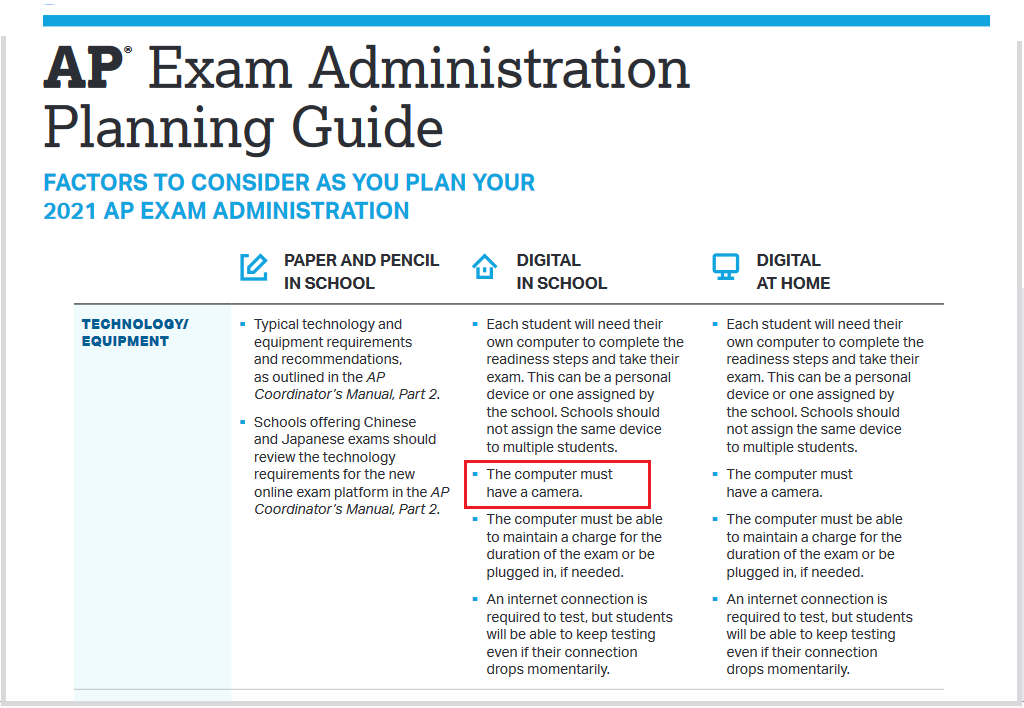
College Board’s AP Guide said the 2021 Digital AP Exams Require Computers with Cameras–but then changed their mind?

Last week the College Board announced they were making changes to this year’s Advanced Placement exam administration, offering both paper or digital versions.  While reading about the online testing options, on the College Board website, I clicked on this 2021 AP® Exam Administration Planning Guide. (I downloaded and archived the AP Guide here on Feb 5, 2021.) 

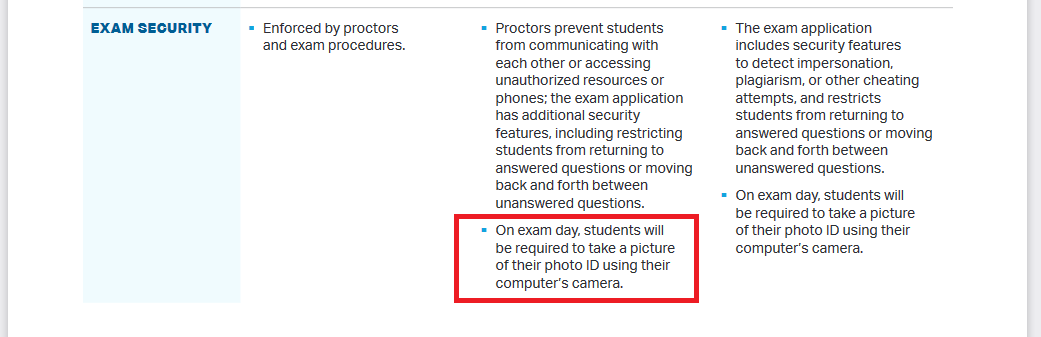
This guide said students would  be required to use a computer that has a camera and would have to use their camera to take a picture of their photo ID prior to taking the digital AP exam.  The guide also said that schools must  “push” (install) exam application software on all devices to be used for digital testing, and the College Board also mentioned that the security application would do so. 

The AP planning guide also said,  “The exam application includes security features to detect impersonation, plagiarism, or other cheating attemptsand restricts students from returning to answered questions or moving back and forth between unanswered questions.” [emphasis added]


I asked the College Board (on twitter) if students would be required CONTINUE READING: Did College Board change its mind about requiring cameras on this year’s online AP exams? What security software will the online AP require? | Parent Coalition for Student Privacy

Monday, November 9, 2020

What happens when there are school data breaches?

What happens when there are school data breaches?
What happens when private student information leaks
Congressional watchdog report counts breaches of Social Security numbers and health records at schools


ow vulnerable is student data at U.S. public schools? That’s a critical question now that many, if not most, of the nation’s 51 million students are learning online at least some of the time.

Congressional watchdogs recently attempted to get a handle on the cyber security problem in schools. In a report publicly released in October 2020, the Government Accountability Office (GAO) counted 99 school data breaches over the past four years, from July 2016 to May 2020, that compromised the personal information of thousands of students in kindergarten through high school.

Attacks by cyber criminals were rare, the GAO found. More common were unintentional leaks in which private information, such as health records and telephone numbers, were accidentally made public. Students were responsible for more than a quarter of the breaches; their most frequent motive was changing grades.

The GAO relied on a private database of cyber attacks and leaks collected by Doug Levin of EdTech Strategies, a consulting firm. That’s because there’s no federal requirement for school districts to report data breaches. Most states have data breach notification laws but they vary a lot and there’s no obligation for state agencies to disclose them publicly. So the GAO turned to Levin’s K-12 Cybersecurity Resource Center, which has been collecting press clips about school data breaches from around the country and monitoring the states that do publicly report, such as Texas.

However, Levin’s own analysis of the data he shared with the GAO arrived at different totals. He counted 458 data breaches in school districts; 315 involved the unauthorized release of student data. That’s more than four times greater. Levin documented that more than a million student records CONTINUE READING: What happens when there are school data breaches?

Friday, October 30, 2020

CURMUDGUCATION: Psychic AI and Plagiarism Detection

CURMUDGUCATION: Psychic AI and Plagiarism Detection
Psychic AI and Plagiarism Detection


Artificial Intelligence is used to sell a lot of baloney. It would be bad enough it were used only to teach badly and provide poor assessments of student work, but AI is also being hawked as a means of rooting out plagiarism. For an example of this phenomenon at its worst, let's check in on a little webcast from Mark Boothe at Canvas Learning Management System. He's talking to Shouvik Paul at Copyleaks, a plagiarism checking company and partner of Canvas. I'm going to watch this so you don't have to--and you shouldn't. But you should remember the names just in case somebody at your place of work suggests actually using these products.

We start with a quick intro emphasizing Copyleaks' awesomeness. And then Boothe hands it over to Paul, the Chief Revenue Officer at Copyleaks, because when you want to talk about a product, you definitely want to talk to the revenue people at the company. Incidentally, sales and marketing has been Paul's entire career--no computer or education background anywhere in sight. But this is going to be a sales pitch for thirty-some minutes. Great.

First, Paul offers general background on Copyleaks. An AI company, building "very cool" stuff. That includes a product that does grading of essays on standardized tests. It takes humans hours, but their Ai can grade those papers "within seconds" within 1% accuracy of a human grader. Spoiler alert: no, it can't. They have offices around the world. 

So they were working on ed tech, and "as we all know" everyone from universities through k-12 is using some kind of plagiarism detection (oh my lord-- does that mean there are first grade teachers out there running student paragraphs through turnitin?). Paul says they found that some of the technology out there was outdated, meaning that when you're out there in education dealing with students, "it's such a cat and mouse game--they're always looking for new ways to beat the system." So we're going to adopt a cynical premise about those awful students as a starting point. Great. 

"Let's face it. What's the first thing a student's going to do? They're going to youtube, and they're going to type in something like 'how to cheat plagiarism check' Right?" And he is showing us on CONTINUE READING: CURMUDGUCATION: Psychic AI and Plagiarism Detection

Monday, October 19, 2020

Data breaches hit thousands of K-12 students, federal watchdog reports - POLITICO

Data breaches hit thousands of K-12 students, federal watchdog reports - POLITICO
Data breaches hit thousands of K-12 students, federal watchdog reports
Student academic records were most commonly compromised, including assessment scores and special education records.


Thousands of K-12 students were affected by 99 reported data breaches in the United States over the last four years, according to a Government Accountability Office analysis published this week.

U.S. GAO - Data Security: Recent K-12 Data Breaches Show That Students Are Vulnerable to Harm - https://www.gao.gov/products/GAO-20-644 via @USGAO

Student academic records were most commonly compromised, including assessment scores and special education records. Coming in second were records with personally identifiable information, such as student Social Security numbers, according to the analysis of data from July 2016 to May 2020.

Key findings: Wealthier, larger and suburban districts were more likely to report a breach, the report says, citing information from the Cybersecurity Resource Center.

“Breaches were either accidental or intentional, although sometimes the intent was unknown, with school staff, students, and cybercriminals among those responsible,” the GAO report said. “Reports of breaches by cybercriminals were rare but included attempts to steal [personally identifiable information].”

Background: As schools rely more on information technology systems, they collect more student data electronically that can put student information at risk of disclosure, the report warns. Distance learning during the pandemic has put a spotlight on K-12 cybersecurity issues.

This summer, the FBI alerted private industry that new cyberattacks were likely ahead as schools began virtual learning. Following that warning, districts like the Fairfax County school system near Washington, D.C., fell victim to ransomware attacks, and a Miami-area teenager blocked thousands of students and staff from classes during their first week of online learning. READ MORE: Data breaches hit thousands of K-12 students, federal watchdog reports - POLITICO

Thursday, September 24, 2020

NYC Educator: The Chancellor Buys Non-Cut and Paste Software

NYC Educator: The Chancellor Buys Non-Cut and Paste Software

The Chancellor Buys Non-Cut and Paste Software


Dear Colleagues,

As you know, the COVID-19 pandemic has had a grave impact on our economy and the budge of New York City’s government, including the DOE. However, we’ve notice that someone has been parodying my Very Important Letters. Therefore we’ve taken immediate and decisive action.

For now and going forward, we’re devoting ourselves to a new program in which my email can be neither forwarded, nor copied and pasted. Therefore no one will be able to copy my emails and make fun of them. The cost of this program is in the tens of millions, but we’ve found a way to make up a fraction of the expenses.

All managerial and non-represented City employees—meaning employees who are not union members—will be required to take five unpaid workdays as furlough between October 1, 2020 and March 31, 2021. This means that people like me, who make $345,000 a year will have to get by on maybe 340, and people working hand to mouth with no contract are screwed, but hey, no more nasty parodies from uppity school teachers.

We don’t expect staff to work on furlough day. We are incredibly understanding. Low-salaried non-union workers are free to take day trips and place them on their expense accounts. Excuse me, my secretary informs me they CONTINUE READING: 
NYC Educator: The Chancellor Buys Non-Cut and Paste Software

Tuesday, September 22, 2020

Cybercriminals Strike Schools Amid Pandemic | The Pew Charitable Trusts

Cybercriminals Strike Schools Amid Pandemic | The Pew Charitable Trusts

Cybercriminals Strike Schools Amid Pandemic


Just days before the Aug. 3 scheduled start of school, officials at the Athens Independent School District in East Texas received a shock.
Cybercriminals had attacked the district’s entire computer network, encrypting all the data and demanding $50,000 in ransom for its release. Access to everything from teacher communications to student assignments was blocked.
“It was terribly disruptive, to put it mildly,” said Toni Clay, the district’s spokesperson. “We no longer had access to any student information, such as schedules, email addresses, anything that would be stored. Internally, we had no staff information. It was all frozen.”
The plan had been to begin school online for three weeks and then transition to a hybrid model of both virtual and in-person classes. Instead, officials ended up delaying the start of school completely for a week.
Athens is one of at least 16 school districts, from California to New Jersey, that have been victimized in a rash of ransomware attacks since the end of July.
Some have been forced to push back school reopening dates. Others that already started school have had to cancel classes for a day or more.
The attacks have placed a heavy burden on school administrators as they grapple with whether it’s safe for students and teachers to return in person and whether schools are prepared to handle social distancing and other requirements.
School information technology staffs, meanwhile, have been consumed with the transition to CONTINUE READING; Cybercriminals Strike Schools Amid Pandemic | The Pew Charitable Trusts