Latest News and Comment from Education

Thursday, April 8, 2021

Cato Indoctrination for Educators | tultican

Cato Indoctrination for Educators | tultican
Cato Indoctrination for Educators


By Thomas Ultican 4/8/2021

The Education Week Advertiser just notified me about an opportunity to be indoctrinated into the Cato Institute’s culture and education views. The ad proclaims, “The Cato Institute and the Sphere Education Initiative are excited to announce the return of Sphere Summit: Teaching Civic Culture Together for the Summer of 2021!” They generously offer impressive full scholarship programs for educators and administrators.

The money for all this comes from Charles Koch and associated libertarians. It is funneled through the Cato Institute which was originally called the Charles Koch Foundation, Inc. when he and fellow libertarian Edward Crane founded it in 1977. It is one of the many organizations and businesses that Charles Koch uses to advance his personal interests which are often referred to as the Kochtopus.

Sphere Summit Speakers

Ryan Bourne – According to libertarianism.org, he is “the R. Evan Scharf Chair for the Public Understanding of Economics at Cato.” Bourne writes about fiscal policy, inequality, minimum wages, infrastructure spending and rent control.He is a contributor to the Daily Telegraph and the UK website ConservativeHome.

Arnold Kling – A Senior Affiliated Scholar at the Mercatus Center at George Mason University to which the Charles Koch Foundation contributed a total of $29,156,700 in 2017 and 2018 (EIN: 48-0918408). He specializes in housing-finance policy, financial institutions, macroeconomics, and the inside workings of America’s federal financial institutions. He also is an adjunct scholar at the Cato Institute in Washington, DC.

Clark Neily – He is vice president for criminal justice at the Cato Institute. Neily served as co-counsel in the District of Columbia v. Heller case in which the CONTINUE READING: 


Shawgi Tell: New York State: 50 Charter Schools Closed in 20 Years | Dissident Voice

New York State: 50 Charter Schools Closed in 20 Years | Dissident Voice
New York State: 50 Charter Schools Closed in 20 Years


According to New York Charter School Fact Sheet (January 2021) from the New York State Education Department, the number of charter schools issued in New York State since the passage of the state’s charter school law in 1998 is 397. The total number of privately-operated charters permitted statewide under 2015 legislative amendments is 460. It is worth noting that a conversion of an existing public school to a charter school is not counted toward the numerical limits established by Article 56 of Education Law. This amounts to about 10 charter schools.

A separate but related document from the New York State Education Department, New York State Charter Schools (January 2021), claims that 46 privately-operated charter schools closed or never opened in the state. Fifteen of these charter schools closed since 2010.

It is not unreasonable to assume that more investigation and more recent data would reveal that more than 46 charter schools have actually closed in the state over the past 20 years. For example, the Buffalo School Board voted in April 2021 to close two failing charter schools in Buffalo.

Broken Promises: An Analysis of Charter School Closures From 1999 – 2017 provides a more comprehensive picture of the high failure and closure rate of charter schools nationwide. Equally problematic, persistently poor oversight CONTINUE READING: New York State: 50 Charter Schools Closed in 20 Years | Dissident Voice

Diane’s Practical Tips for Everyday Life | Diane Ravitch's blog

Diane’s Practical Tips for Everyday Life | Diane Ravitch's blog
Diane’s Practical Tips for Everyday Life


I know this is an education blog, but I sometimes take excursions into other areas of life that interest me.

So from time to time, I will share a few things that I have learned that I want to share.

Today I am going to tell you about the best treatment for leg cramps that I have ever discovered.

After I had a total knee replacement in 2014, I started getting occasional leg cramps that were beyond painful. My thighs would start cramping, then the rest of my leg, and the pain was excruciating. It would always catch me unawares, watching television, or while sleeping at night. There was nothing I could do other than wait it out, as tears rolled down my cheeks.

A couple of years ago, my son told me about a cure for leg cramps. I am always skeptical but it was worth a try. It’s called CrampsAway. It comes as little packets in a small box of 10. I bought a box online to give it a try. There is nothing in it but vitamins. It works. It is amazing. On three occasions since I bought it, I have had leg cramps and immediately opened the packet and swallowed the couple of tablespoons within. Cramps gone.

I am not a doctor or a physical therapist. I have no credentials. This is an over-the-counter product that you can buy without a prescription. It contains no prohibited substances. It worked for me.

In case you are wondering, I wrote this post in late March before my surgery. I’m guessing that at the moment, I am totally sedated on the operating table.

Diane’s Practical Tips for Everyday Life | Diane Ravitch's blog

Why Parents and Students in Los Angeles Won't Go Back + What You Need to Know about Distance Learning in 2021 - LA Progressive

Why Parents and Students in Los Angeles Won't Go Back - LA Progressive
Why Parents and Students in Los Angeles Won’t Go Back


The exact figures may change slightly over the next few weeks, but for the most part, parents and students in the massive Los Angeles Unified School District have had their say. In overwhelming numbers, it appears, they’re not going back to the classroom this school year.

It’s not for a lack of effort on the part of the LAUSD, the nation’s second-largest school district with more than 600,000 students. Quite the opposite: After spending many months describing why it wasn’t safe for students to return to class, district administrators have launched a recent media blitz aimed at convincing parents and students it’s OK to send their children back to campus — an effort that includes detailed explanations of the mitigation and sanitizing measures in place at every school.

But the reluctance is real. It is borne out by LAUSD’s own survey data, which indicates that as of April 1, only about 38% of elementary school children will return to campuses when they reopen in mid-April. Among middle schoolers, the figure drops to 25%, and among high school students it plummets to 16%.

Because those survey figures assume that any nonresponding family is going to remain in distance learning, there’s some wiggle room in the CONTINUE READING: Why Parents and Students in Los Angeles Won't Go Back - LA Progressive


Introduction

Distance learning has existed long before COVID-19 was unleashed on the world, beginning in 2020. In 2017 alone, an estimated 6.6 million students depended on online platforms to receive their education. Distance learning has always been advancing; the pandemic only boosted its growth as it forced the world to acclimatize to e-learning school education. 

Distance learning may be here to stay

Initially, everyone doubted that e-learning and education in classrooms could yield similar results to traditional methods of learning. In fact, most institutions gave no credence at all to the idea; however, in order to maintain continuity in learning, educators and institutions were left with little choice in the matter. As a result, as lockdowns took hold across the world, soon everyone became acquainted with the benefits of e-learning school education.

Although a quick retreat back to more conventional methods of learning could occur, the shift to an online education e-learning method was destined to become a reality.

Now, world leaders are beginning to speculate what education will look like in a post-COVID-19 era. Although a quick retreat back to more conventional methods of learning could occur, the shift to an online education e-learning method was destined to become a reality. It has become clear that e-learning will likely continue to be adopted as the go-to learning method for the foreseeable future. Throughout this article, we’ll give you some tips on how to benefit from online distance learning — dubbed “distance learning 2021.” Be sure to keep reading for more CONTINUE READING: What You Need to Know about Distance Learning in 2021

Legislation to Diversify the Teaching Workforce + U.S. DOE Approves California’s Assessments Plan - Year 2021 (CA Dept of Education)

Legislation to Diversify the Teaching Workforce - Year 2021 (CA Dept of Education)
First-of-its-Kind Legislation to Diversify the Teaching Workforce Advances with Unanimous Assembly Education Committee Support
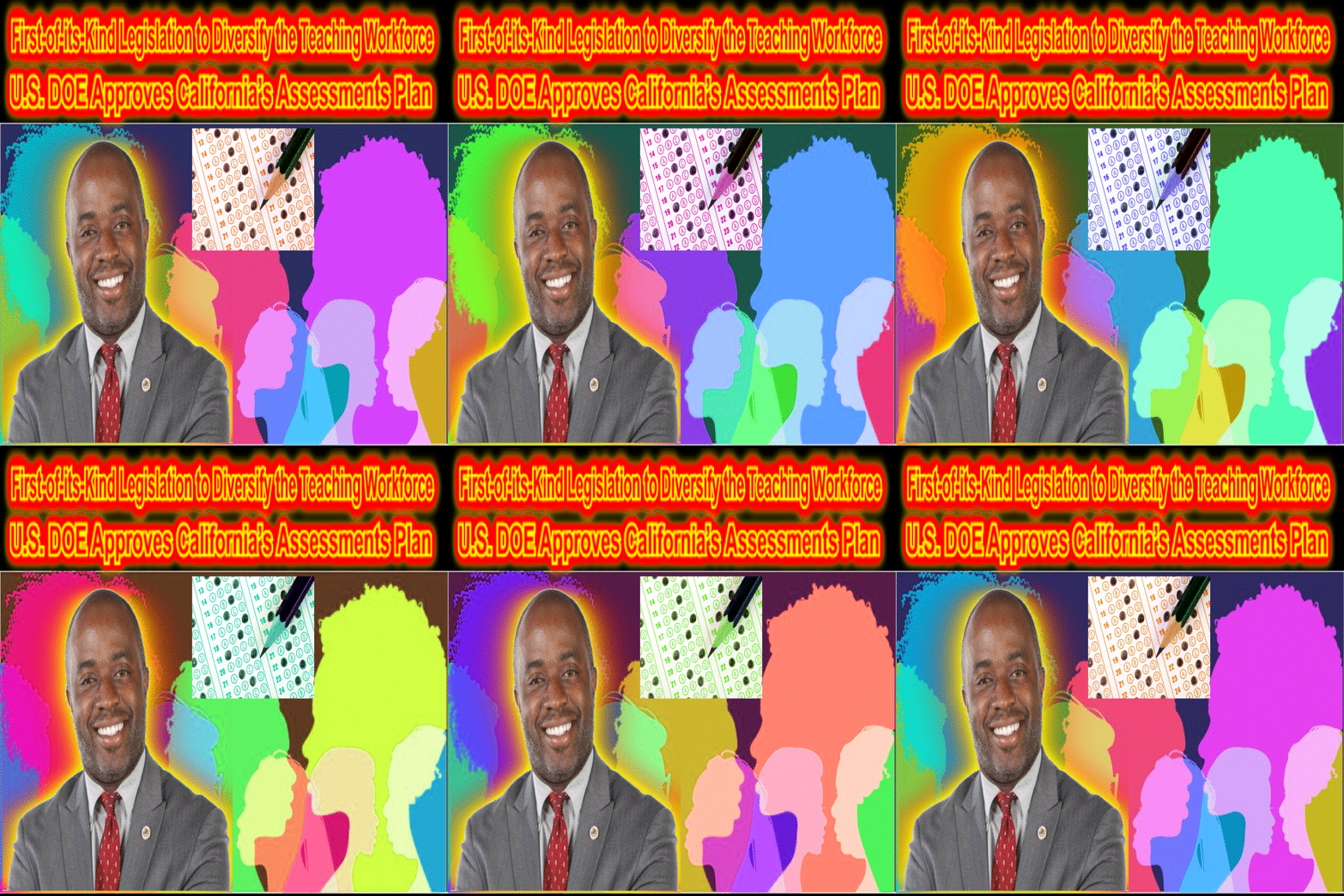


SACRAMENTO—New legislation designed to help support male educators of color and diversify the teaching workforce—sponsored by State Superintendent of Public Instruction Tony Thurmond and authored by Assemblymember Mike A. Gipson (D-Carson)—received unanimous approval from the California State Assembly Committee on Education today, accelerating efforts to create an educator workforce to better reflect the students it serves.

Assembly Bill (AB) 520, which will head to the Appropriations Committee next Wednesday, will establish the California Diversifying Teacher Grant Program, awarding $15 million in grants for school districts to provide one-time competitive grants that develop and implement new (or expand existing) programs that address a local need to develop the teacher workforce while emphasizing the retention of male teachers of color.

“When I talk to students, they tell me they want to learn from adults who look like them and have shared their life experiences. There is mounting research that tells us that teachers of color boost the academic performance of all students—but especially students of color. This includes improved reading and math test scores, improved graduation rates, and increases in aspirations to attend college,” Thurmond said. “We've long known that having teachers of color matters for students of color—but our public schools do not reflect this. We can and must do better if we want to dismantle the historic educational inequities in ways that can level the playing field for all students.”

“Student success is amplified when they are taught by teachers who reflect the diversity of those students. In addition to academic benefits, students of color experience social-emotional gains to having teachers who look like them, also lessening the likelihood of chronic absenteeism and suspension," Gipson said. "Assembly Bill 520 seeks to create a program that will prepare and invest in the recruitment and retention of a larger and diverse pool of teachers. It will assist California with addressing the racial and ethnic disparities that exist throughout the state, helping to reduce the equity gap.”

Men of color comprise less than 10 percent of California’s teaching force, with Black and Latinx men making up 1 percent and 2 percent of their peers. Data show that only one-third of teachers are non-white, even though students of color make up about three-quarters of California’s student population.

Statistics show that male teachers are leaving high-need schools when they do not have the support strategies in place to help develop their teaching skills. These strategies can include, but are not limited to, social and emotional learning, school climate, trauma support, and restorative justice.

Additionally, research shows that Black and Latinx educators feel that they're not valued and feel frustration at being expected to take on extra duties without compensation or even the necessary support systems. As a result, teachers of color give up their careers more often than white teachers do.

AB 520 will address retention problems by enhancing a school district’s ability to equip, cultivate, and bolster male teachers of color within its schools to effectively preserve teachers. Schools that foster an environment of professional learning are more likely to attract and retain teachers in high-need schools.

Schools that invest in retention strategies that cultivate success and professional learning are more likely to retain male teachers of color. By concentrating on the investment of teachers of color, California will address the racial and ethnic disparities that exist throughout the state, helping to reduce the equity gap.

More information on AB 520 can be found in the bill analysisExternal link opens in new window or tab..

# # # #

Tony Thurmond — State Superintendent of Public Instruction
Communications Division, Room 5602, 916-319-0818, Fax 916-319-0100

SACRAMENTO—The U.S. Department of Education notified California this week that the state’s request for relief from certain federal testing, accountability, and reporting requirements has been granted.

In a letter to State Superintendent Tony Thurmond and State Board President Linda Darling-Hammond, Deputy Assistant Secretary for Policy and Programs Ian Rosenblum said he was “pleased to approve” California’s request. “The intent of these accountability waivers is to focus on assessments to provide information to parents, educators, and the public about student performance and to help target resources and supports,” Rosenblum wrote. “This is particularly crucial this year, due to the COVID pandemic.”

In February, the State Board of Education voted to seek a waiver that would give schools the means to account for the impact of the COVID-19 pandemic in their ability to assess students. The Board’s action was in response to federal guidanceExternal link opens in new window or tab. allowing states to seek flexibility given that most students have yet to return to in-person instruction either part- or full-time.

The state also discussed its plan to give schools permission to report data from standards-aligned interim or diagnostic tests they have been using where it is not viable to administer the state summative assessments due to the impact of the COVID-19 pandemic.

Unlike last year, the U.S. Department of Education did not invite states to apply for blanket waivers that would allow states to opt-out of annual testing altogether, citing the role testing data plays in supporting students.

As granted, California’s waiver:

  • Decouples state assessments from federal accountability requirements, as applicable. Instead, any data collected will be used to inform local educators, parents, and the public and align resources to student supports.
  • Waives federal penalties for student testing participation rates of less than 95 percent on the state’s Smarter Balanced English language arts and math. Under the Every Student Succeeds Act, all states that receive federal funds for low-income students and English learners must assess annual learning progress in math, language arts, science, and English learner language proficiency, as applicable.

At its November meeting, the State Board voted to approve shortened blueprints of the Smarter Balanced assessments in English language arts and math in order to administer shorter tests in these subjects during the 2020–21 school year.

The Board also extended the window by which schools must complete test administration to July 30 for the California Assessment of Student Performance and Progress (CAASPP), the English Language Assessments for California (ELPAC), which measures English learners’ progress toward language proficiency, and the California Science Test (CAST).

In a separate letter received this week, Rosenblum said California need not apply for another waiver, which the Board contemplated, because California is administering all of its required assessments and expecting they will be used except in cases where local conditions make the administration of the tests not viable.

With many of the state’s students still engaged in distance learning, both CDE and State Board staff have advised districts—as the federal guidance states—that students should not be brought back to in-person instruction solely for the purpose of standardized testing.

And in some cases, students still in remote learning may not be able to access the state’s summative tests because they lack secure browsers on their computers or sufficient bandwidth to meet the demands of the tests. In such a case, student assessment data could be provided through a high-quality interim or diagnostic test that meets Board-approved criteria.

“We remain committed to supporting all States in assessing the learning of all students,” Rosenblum wrote. “Obtaining data on student learning includes high-quality statewide assessments, which can help identify where opportunity gaps are persistent and have been exacerbated—particularly during the pandemic—and, along with other data, can help States direct resources and support to close those gaps.

“At the same time,” he continued, “we must also recognize that we are in the midst of a pandemic that requires real flexibility...(I)n cases where students are unable to take the statewide summative assessment, we hope that States and districts use other assessments to measure student learning and progress and to provide information to parents and educators. These interim, diagnostic, or formative assessments do not replace statewide summative assessments, but they can serve to provide valuable information to meet our goal of maximizing the number of students for whom we have quality data this year.”

# # # #

Tony Thurmond — State Superintendent of Public Instruction
Communications Division, Room 5602, 916-319-0818, Fax 916-319-0100


A 30-year Fight for School Funding Equity Ends in a Resounding Victory | Schott Foundation for Public Education

A 30-year Fight for School Funding Equity Ends in a Resounding Victory | Schott Foundation for Public Education
A 30-year Fight for School Funding Equity Ends in a Resounding Victory


The 2021-22 New York State budget meets a thirty-year-old demand and thirteen-year-old broken promise: equitably fund New York State's public schools so that no matter what zip code a child resides in, there is a baseline of quality their public schools can afford to meet.

The massive, downright Dickensian difference in funding between schools that sometimes are mere blocks from each other has been a hallmark of New York's public education system for generations. In 2012, a Schott Foundation report on the particularly stark disparities in New York City described it as education redlining: schools with predominantly white children were far better funded — and unsurprisingly, had higher academic outcomes — than schools with predominantly Black and Latinx children. We found a similar disparity with income as well. As the report concluded, "A Black or Hispanic student, or a student of any race or ethnicity from a low-income household, is most likely to be enrolled in one of the city’s poorest performing high schools."

By 2012 it shouldn't have been that way. Five years earlier, in 2007, the 13-year Campaign for Fiscal Equity lawsuit concluded in a victory for public schools: New York State agreed, under court mandate, to commit more than $5.5 billion in funding over four years to equitably fund all public schools. 70% of that funding was to go to the lowest-income school districts, whose property tax bases couldn't compare with those of wealthier cities and neighborhoods. However, this funding, known as Foundation Aid, never fully materialized. Between the 2008 financial crisis and a wave of budget cuts by legislators, what should have been a decade of equity became one of austerity. And as is always the case when state governments tighten their belts, low-income and BIPOC residents bore the brunt of it.

But the Campaign for Fiscal Equity was always more than just a lawsuit: it was at the heart of a renaissance of education CONTINUE READING: A 30-year Fight for School Funding Equity Ends in a Resounding Victory | Schott Foundation for Public Education

Teacher Tom: Are Uncluttered Classrooms Really Best for Young Leaners?

Teacher Tom: Are Uncluttered Classrooms Really Best for Young Leaners?
Are Uncluttered Classrooms Really Best for Young Leaners?


The conventional wisdom is that an uncluttered classroom is best for young learners. I regularly see photos labeled as "classroom don'ts" with scads of posters and other art on the walls, things dangling from the ceilings, and materials stuffed willy-nilly on shelves. These busy, messy spaces, we're told, are full of distractions, making it difficult to concentrate. They are visually over-stimulating, whereas a cleaner, tidier space, with it's bare walls and organized shelves, calms children, which is, according to this theory, the proper mindset for learning. Indeed, research indicates that a tidy space may promote such desirable traits as healthy eating and generosity. People in tidy spaces are, likewise, more likely to follow rules, adhere to expectations, and to make "conventional" choices, which would, I presume, make them better at, say, passing a test.
"If a cluttered desk is a sign of a cluttered mind, of what, then, is an empty desk a sign?" ~Albert Einstein
Research also indicates that a messy space promotes creative thinking and stimulates new ideas. "Disorderly environments seem to inspire breaking free of tradition, which can produce fresh insights," according Kathleen Vohs, the University of CONTINUE READING: Teacher Tom: Are Uncluttered Classrooms Really Best for Young Leaners?

Big Education Ape: Teacher Tom: Let's Turn The World Around: Teacher Tom's Play Summit - https://bigeducationape.blogspot.com/2021/04/teacher-tom-lets-turn-world-around.html


Jack Schneider: What is “Public” about Public Education? | Diane Ravitch's blog

Jack Schneider: What is “Public” about Public Education? | Diane Ravitch's blog
Jack Schneider: What is “Public” about Public Education?


Jack Schneider is a historian of education at the University of Massachusetts in Lowell. He and Jennifer Berkshire recently published a superb book, A Wolf at the Schoolhouse Door, which I recommend to you.

The “Public” in Public Schools

There are two stories that we tell over and over these days about our schools. The first is that schools are a mechanism for getting ahead in our society. In a competition of each against every, schools are the ostensibly meritocratic sorting mechanism that determines who gets what. The second story is that schools are the engine of the economy. Education builds human capital, which in turn promotes economic growth.

These aren’t entirely wrong. Despite the fact that the privileged work feverishly to tilt the playing field for their children, schools can and often do serve a leveling function. And it is impossible to imagine the American economy thriving in the same way without an educated populace. Yet this is a torturously narrow way of understanding the value of public education.

We don’t have public schools in this country so that CONTINUE READING: Jack Schneider: What is “Public” about Public Education? | Diane Ravitch's blog

Failure to Disrupt. Again – Have You Heard

Failure to Disrupt. Again – Have You Heard
Failure to Disrupt. Again


The pandemic gave the education technology industry the opportunity to FINALLY deliver on the bold promises it has been making for decades. What happened instead was just another failure to disrupt, says MIT’s Justin Reich. Transcript is here. And a description of the Imagining September project with links to participate is here.


Big New Report On Growth Mindset Benefits | Larry Ferlazzo's Websites of the Day...

Big New Report On Growth Mindset Benefits | Larry Ferlazzo's Websites of the Day...
BIG NEW REPORT ON GROWTH MINDSET BENEFITS


The Organisation for Economic Co-operation and Development (OECD) this morning released a huge report titled Sky’s the limit: Growth mindset, students, and schools in PISA

The report has a ton of great information about Carol Dweck’s “growth mindset” concept.

I have to say, though, I’m not entirely convinced that a ton of conclusions about who has and does not have a growth mindset can be accurately measured by what they did – which is basically ask just one question:

In PISA 2018, about 600 000 students from 78 countries and economies were surveyed to depict the landscape of growth mindset for 15 year-olds. PISA 2018 asked students whether they agreed (“strongly disagree”, “disagree”, “agree”, or “strongly agree”) with the following statement: “Your intelligence is something about you that you can’t change very much”. Disagreeing with the statement is considered a precursor of a growth mindset, as it is more likely that someone who thinks intelligence can change will challenge him/herself to improve it.

Nevertheless, a ton of other studies have reached similar conclusions (see The Best Resources On Helping Our Students Develop A “Growth Mindset” to find them), so my reservations aren’t that strong.

I do like that it highlights several strategies teachers and schools can implement to support the development of a growth mindset among students, which are highlighted in a chart at the end of this post.  I’m not sure that they are very helpful, since I would think most teachers make them part of their practice now, but I might be wrong.

I also noted that the report also suggests another strategy to support a growth mindset:

Seeking written feedback from students (e.g. regarding lessons, teachers or resources) for quality assurance

I’ve certainly posted a lot about that practice: Best Posts On Students Evaluating Classes (And Teachers)

I was surprised that it didn’t seem to offer specific suggestions to teachers about CONTINUE READING: Big New Report On Growth Mindset Benefits | Larry Ferlazzo's Websites of the Day...

Education Matters: Another failure in leadership

Education Matters: Another failure in leadership
Another failure in leadership


The renaming of our schools is another failure of district leadership. 

For ten months, the process to change six of our schools named after confederate era figures has been going on. TEN MONTHS.  

Last June, after the killings of George Floyd, Ahmaud Arbury, and Breonna Taylor, the nation had a reawakening of interests in civil rights, and protests erupted all over the nation, not just because of the deaths but because of generational and systematic racism too. Duval County Public schools decided to join in, just in their own slow, disorganized, and painfully awkward way. 

I spoke at the first meeting where the name changes were proposed by Board Member Warren Jones. The gist of my speech was we couldn’t have schools named after people who never did anything questionable because we could never find anyone, but we could have schools that weren’t named after slavers, racists, and traitors. That and sometimes we revere historical figures despite their flaws, see our founding fathers, but confederates were revered because of their flaws.  

This was the beginning of June, and I was optimistic that those schools would open in the fall with new names, but that has been far from the case. 

After months of little or no action, it became obvious that the district did not want to do anything until after the vote on  CONTINUE READING: Education Matters: Another failure in leadership

Great news; with more federal AND state funding, no excuse left for NYC Mayor to deny kids the smaller classes they need! | Class Size Matters

Great news; with more federal AND state funding, no excuse left for NYC Mayor to deny kids the smaller classes they need! | Class Size Matters  | A clearinghouse for information on class size & the proven benefits of smaller classes
Great news; with more federal AND state funding, no excuse left for NYC Mayor to deny kids the smaller classes they need!


1.Tremendous news!  The state finally came through with the additional foundation aid that our schools were promised years ago as a result of the CFE lawsuit, which will mean more than $600 million for NYC schools next year, increasing to an estimated $1.6 billion annually in three years.

This is in addition to the approximately $6 billion our schools will receive in additional federal aid over the next two years. Now the Mayor and the Chancellor have NO excuse not to do the right thing for NYC kids by lowering their class sizes. Smaller classes will be not only more necessary than ever before for health, safety and emotional support, as I said in this article, but should be absolutely required. This is especially critical, given how the state’s highest court in the CFE case said more funding was needed because NYC students were denied their constitutional right to a sound basic education, as evidenced by the fact that their class sizes were too large.

If you haven’t already, please sign our petition to the Mayor and the City Council, urging them to use $1 billion of these funds to lower class size, and $365 million for more school counselors and social workers, for provide our kids with the health and safety precautions and the academic and emotional support they will need next year more than ever before. Also please let me know if you want us to provide a resolution that your CEC, SLT or PTA could pass, urging the Mayor and the Council to do so.

2. We recently released a new Class Size Matters report,  DoE Overspending On Charter School Facility Costs and Underspending On Matching Funds To Public Schools, that revealed that the NYC Department of Education has overspent by many millions on rent for charter schools, while CONTINUE READING: Great news; with more federal AND state funding, no excuse left for NYC Mayor to deny kids the smaller classes they need! | Class Size Matters  | A clearinghouse for information on class size & the proven benefits of smaller classes