Toward Wisdom Rather Than Mere Education
-
It's "fire season" here on the West Coast of the US. Currently, there are
32 active "large" fires burning, not to mention the dozens of smaller fires
or ...
Trump vs. The Military
-
The USS Abraham Lincoln is on its way home after spending many months at
sea. It’s coming home because family members of its crew complained about
the mora...
McMahon Doesn't Understand Education
-
McMahon's particular brand of passionless functionary was on display Sunday
morning for a dozen minutes with Dana Bash. The interview kicked around a
few t...
This and That, August 24, 2026
-
I meant to post this sooner - this event is tomorrow night, the 25th.
I am hearing that Governor Bob Ferguson and State Superintendent Chris
Reykdal ...
Spider-Man Lands a Punch: Fist to Cheese
-
The classic line from the Spider-Man show was, “Lookout! Here comes the
Spider-Man.” And so, Spider-Man punched a white supremacist. Fist to
cheese. For so...
MNPS and Not-So-Secret Secrets
-
Nashville education blogger TC Weber highlights what some say are
significant challenges around student discipline in MNPS. It is one of the
worst-kept sec...
No Compromise: End the War Now!
-
At this hour, solidarity begins with a clear demand: the United States and
Israel must end their illegal war, and they must retreat.
Understanding Education: Corporal Punishment
-
15 states have laws that allow corporal punishment in schools. Here’s
where, and why, Katie Mills (NPR, 19 August 2026) Recommended Summary
Physical punish...
We Love Billionaires!
-
As a middle school teacher, I spent a fair amount of time talking with
kids—mostly 8th graders, going into high school—about what you might call
their life...
What Is the Far Left ?
-
What is the Far Left ?
The growing visibility of Democratic Socialists of America (DSA) and
victories by some DSA-backed candidates has triggered an upsu...
SPI Welcomes Salinas Students Back to Campus
-
California State Superintendent of Public Instruction Tony Thurmond
welcomes Salinas students back to campus and celebrates community schools.
Under the Lights, the Truth Is Harder to Hide
-
“The problem is that progress stopped making sense. More and more of us
looked up one day and realized that the emperor had no clothes.” ― Anna
Lowenhaupt ...
SQ 844: How is this better?
-
In plain terms, the new language gives the Legislature the authority to
establish both the amount and methodology for distributing ad valorem
reimbursement...
-
It's time to Revise Louisiana's
School Curriculum
Present standards do not allow for individual differences and life goals
For the last 15 years Louisiana'...
Read This If You Want to Learn to Read
-
I want you to experience how a skilled teacher makes certain that her first
graders learn to read. Imagine that you’re sitting in the back of a
classroom...
What’s the Pattern?
-
The Pattern. Is it the thing that holds our raises down? Yup. What
precisely is it? Activists and advocates know it is a problem. That’s good.
They are rig...
Time to change our Nation’s Diaper
-
It’s time to change our nation’s diaper. Our national identity now reeks
due to our inability to clean out the mess caused by the Orange Turd.
Corruption i...
GLP-1 Meds for Kids? Some Info.
-
Like many consumers of television and social media, I have been bombarded
with ads for GLP-1s (short for glucagon-like peptide-1). The ads are
everywhere. ...
By One Dishonest Measure
-
A loaded question that education reformers like to ponder is: Exactly how
many students in the boroughs of New York City are trapped in failing
schools? In...
1776
-
__________
“The fate of unborn millions will now depend, under God, on the courage and
conduct of this army…. We have, therefore, resolved to conquer...
May’s Parent Engagement Resources
-
San Diego Unified Created a System to ‘Empower’ Parents. It Unraveled is
from The Voice of San Diego. Why Those Disengaged Parents in Your School
Deserve a...
Reflections on America, the world, and life
-
I acknowledge that I rarely post here anymore. Folks should remember that I
am approaching my 80th birthday in less than 9 weeks, I am still teaching
ful...
Shutting Down The Site
-
Ten years ago, I ran for a seat on the LAUSD School Board of Education with
the goal to *Change the LAUSD*.
I am proud of the campaign we ran. We achieve...
Blogoversary #19 — Time to Move on
-
Times have changed. I had a nice long run here, but let’s face it, it ended
a while ago. So I’ve moved. I’m not writing much any more, but when I do it
wil...
Il Papa è Morto
-
Francis brought a distinct pastoral outlook to his papacy. A simple man, he
lived in a small apartment in the guesthouse. He sought to make the church
acce...
Mike Shulman the ARISE UFT Judenrat
-
I was surprised to learn that Mike Shulman has aligned himself with ARISE.
I previously supported him, advocating that the Castle Doctrine could have
bee...
AIN’T IT AWFUL
-
As the terrible feelings of dread and angst spread across the world the
great majority of the American people feel powerless before the onslaught
of those ...
Vote NO on the UFT Contract. Here is Why:
-
The best reason to vote no on this contract is this: UFT Unity* lied* to us
in 2018. They misrepresented that contract. It was predicated on deals we
wer...
Testimony to the CPS Truancy Task Force
-
I prepared testimony for one of two public hearings held by the Chicago
Public Schools Truancy Task Force, a body mandated by state legislation.
The meetin...
There Is A Teacher Shortage.Not.
-
THERE IS A TEACHER SHORTAGE. And just to be sure you understand, it’s not
that teachers don’t want to teach. It’s not that there aren’t enough
teachers cer...
Book Banning Turns to Dick and Jane
-
Breaking News: Dateline February 4, 2022 - Parents in Dimwitty, Alabama
have asked the Dimwitty Board of Education to ban the children's primer *Fun
with...
Have You Heard Has a New Website
-
TweetHave You Heard has a new website. Visit us at
www.haveyouheardpodcast.com to find our latest episodes and our entire
archive. And be sure to check out...
Follow me at Substack
-
I've moved. Follow me at Substack
I'm now posting regularly at Substack. You can subscribe for free to my new
Edu/Pol blog at michaelklonsky.substack.com
...
I’ve moved.
-
I’m on Substack now. You can continue to receive periodic posts for free.
Or you can read every post and comment for $5 a month, $60 a year.
fredklonsky.su...
Aspiring Teachers Get New Help Paying For College
-
[image: colorful classroom pattern]
*; Credit: shuoshu/Getty Images*
Cory Turner | NPR
New rules kick in today that will help aspiring teachers pay for c...
Tips Akses Situs Judi Qq Tanpa Perlu Takut Nawala
-
Kegiatan berjudi slot melalui situs judi qq online, sekarang sudah
dilakukan oleh banyak penjudi Indonesia. Tentu, Kamu yang sedang membaca
artikel ini a...
The Threat of Integration
-
I have lived in the same house in the Miracle Mile section of Los Angeles
for over 30 years, where up until now I have had little or no interaction
with th...
We fight for a democracy worthy of us all!
-
The nation stands at a crossroads, said NEA President Lily Eskelsen García
in her final keynote address to the 2020 NEA Representative Assembly and
it’s up...
The Passing Of Chaz 1951-2020 Age 69
-
I am the son of Chaz and like to inform you that he passed away this
afternoon from the COVID virus. My father passed in peace beside his loved
ones. We ar...
The Fight For Our Children
-
*The number of suicides among people ages 10 to 24 nationally increased by
56 percent between 2007 and 2017, according to a new federal report showing
the ...
Read to Self: Just a Kid and a Book.
-
Date: Monday, January 5, 2020 Place: My classroom Student: Mrs.Mims, could
we start doing Read to Self again because I got this great book for
Christmas an...
Reminiscences
-
I just finished dumping the rest of my lesson plans. I guess I held on to
the calculus ones for so long because I spent so much time working on them
an...
Just Asking for some Teachers I know.
-
Recently Wisconsin Governor Tony Evers stated, We must … recognize that
part of supporting our kids in the classroom means supporting the educators
who t...
Cara Menang Bermain Judi Bola Online
-
Bermain judi bola online tentu saja memiliki kesenangannya tersendiri baik
itu mendapatkan keuntungan maupun ketika menantikan hasil skor pada sebuah
perta...
A Critique of Standards-Based Grading
-
It first happened to me about ten years ago. I was beginning my third year
of teaching in a new school in Washington, DC. Social studies teachers were
si...
Reduced time for testing? Not so fast.
-
NYSED and Commish Elia continue to say that the NYS Assessments are of
reasonable length, I completely disagree.
Here is what NYSED states are average expe...
The World According to Michelle Rhee
-
The men behind the curtain fashioning the brave new world of corporate run
education in America! Michelle Rhee is the founder of StudentsFirst, The
New T...
Whose Opinions Matter in Education World?
-
It's hard to identify education heroes and sheroes. And perhaps even harder
to pinpoint just whose work is slanted, paid-for and dishonest.
New Local Businesses in Sacramento
-
Starting a new local business in Sacramento is a monumental task, but can
be accomplished with footwork, perseverance and knowledge. One must learn
the loc...
Lesson Plan: Rhyme and Rhythm in Poetry
-
I’ve started a recent unit on poetry with my class. I’m not a poet, and I’m
not a poetry fan (I don’t hate it, but I’m a prose gal), so this makes it
harde...
The Apotheosis of Betsy DeVos
-
Betsy Devos has drawn few headlines in recent months, and that is a good
thing for the Secretary of Education. Her tenure began with Vice President
Mike P...
Education Is a Civic Question
-
In their final post to end Bridging Differences' decade-long run, Deborah
Meier and Harry Boyte urge readers to put the energy, talents, wisdom, and
hard w...
Site News: New Home for Education News & Commentary
-
Quick! Get over there! The daily education news roundup and education
commentaries that you're probably looking for are now being published over
at The Gra...
Should We Be Grateful?
-
In an odd turn of events, and with little explanation, Michigan Governor
Rick Snyder has decided to return the state’s School Reform Office back to
the Dep...
An Open Letter to NC Lawmakers
-
An Open Letter to NC State Lawmakers and NC State Superintendent Mark
Johnson: I am a NC native, voter, and public school teacher. I am
addressing you all ...
The Secret to Fixing Schools (My Next Bestseller)
-
The Secret to Fixing Schools (My next bestseller) Prologue I just finished
watching a fascinating documentary on Netflix entitled, “The Secret”. The
film p...
Farewell, Sleep
-
Today is the official last day of my spring break. I've done a scientific
survey: My natural bedtime is 2 AM, and my natural wake up time is 9:41
AM. Tom...
REPORT: States With the Best and Worst Schools
-
States With the Best (and Worst)Schools
By *Evan Comen, Michael B. Sauter, Samuel Stebbins and Thomas C. Frohlich*
January 20, 2017- http://247wallst.com
...
Test Refusal = People Power
-
In recent months, social media has been ablaze with talk of regular folk
taking action to resist the Trump agenda. Protests are a daily occurrence,
and ev...
Random Musings and Observations. . . .
-
I’ve been gone a while from the blogging scene. Some of my more regular
readers no doubt noticed but did not hassle me about it. Thank you for
that. Sinc...
AB 934: A LEGISLATIVE FIX FOR VERGARA?
-
By Michael Stratford | in the Politco Morning Education Report | via email
05/24/2016 10:00 AM EDT :: Two national education groups are backing a
Califor...
MY NEW BLOG
-
My new blog will consist of fictitious headlines, meant to be a blend of
humor and satire. I apologize ahead of time if any other satirical site has
simila...
Thank you
-
Dear Readers,
Thank you for visiting *The Perimeter Primate*. This blog is being retired
for the time being. Although I no longer post here, I do still s...
I am Retiring
-
I have some news: I am retiring from the PBS NewsHour and Learning Matters.
[[ This is a content summary only. Visit my website for full links, other
conte...
New Beginnings: Kickstarter and EdWeek Teacher
-
Greetings to InterACT readers one and all! If you’ve been following posts
here recently you might recall that I’m moving my blogging activity to
other loca...
Adelaide L. Sanford Charter School
-
*“With Adelaide L. Sanford Charter School closing, Newark families must
move on.”* The Star-Ledger (NJ), 6/25/2013
NEWARK — Bobby and Troy Shanks saw the...
Don’t force schools to give standardized tests this pandemic year, research scholars ask Education Secretary Cardona
More than 540 education researchers and scholars are asking Education Secretary Miguel Cardona to reconsider his department’s decision requiring school districts to administer federally mandated standardized tests this pandemic year, saying the exams will “exacerbate inequality” and “produce flawed data.”
A letter signed by 548 members of the academic research community was sent to the Education Department on Monday, urging that Cardona award states waivers from federal testing mandates. It also urges the department to invest in “more holistically evaluating school quality” by “developing new measures of educational opportunities.”
The Education Department announced in February — before Cardona was confirmed by the Senate — that public school districts had to administer exams in math and English Language Arts required annually by the federal 2015 Every Student Succeeds Act, which replaced the 2002 No Child Left Behind law.
And as late as last week, Cardona said at an education forum that the department was planning to go ahead with its testing decision.
The high-stakes tests are given every spring as a central part of the two-decade-old school reform movement. Testing advocates say the exams provide vital data on how all student groups are performing in school. Student test scores are used — at least in part — by some states to evaluate teachers and by states to evaluate districts and schools.
DeVos, who is reportedly worth more than $2 billion, reported outside earnings from dividends, interest and rents of at least $225 million and “potentially well over $414 million” during her time in the Cabinet role, according to an analysis of her financial disclosures by watchdog group Citizens for Responsibility and Ethics in Washington.
“It is impossible to know the exact amount because DeVos’s income is reported in broad ranges, but we do know for a fact that she made nine figures during her four years in office,” the group, known as CREW, said in a statement Monday.
At the most modest end of her reported income, DeVos would have raked in more than $158,000 each day of her 1,422 days in the position. That works out to more than $6,500 per hour.
At the most modest end of her reported income, DeVos would have raked in more than $158,000 each day of her 1,422 days in the position. That works out to more than $6,500 per hour.
DeVos, who pledged to donate her government salary to charity, resigned from her job after the U.S. Capitol riot on Jan. 6. She cited Trump’s divisive rhetoric as an “inflection point.”
Critics, however, said DeVos’ condemnation of the then-president was too little, too late.
Florida Voucher School Hires Unqualified Teachers, Ex-Con, State Doesn’t Care
The Orlando Sentinel has been covering scandal after scandal in the voucher schools of Florida, but the Legislature doesn’t care about their scandals and is planning to take even more money from public schools to fund more private voucher schools. The Sentinel published a story about one troubled voucher school that has received over $5 million from the state since 2015 despite the fact that it hires teachers without college degrees.
The job applicant hoped to teach fourth grade at Winners Primary School, a small private school in west Orange County. She didn’t have a college degree and her last job was at a child care center, which fired her.
Introducing 8 to 3, a newsletter for parents about kids, school and education
A new chapter is opening for families of school-age children and teenagers. Campuses throughout California are finally opening after a year of coronavirus-forced closures — and for parents who have navigated distance learning alongside their children, their connection to education has been rewired.
Newsletter
The perils of parenting through a pandemic
What’s going on with school? What do kids need? Get 8 to 3, a newsletter dedicated to the questions that keep California families up at night.
You may occasionally receive promotional content from the Los Angeles Times.
The shared frustrations, struggles, empathy and resilience between parent and child has reshaped engagement in schooling. With a new newsletter called 8 to 3, The Times aims to be a part of the back-in-school life of parents and guardians as we recover from a year like no other and move forward.
We begin this endeavor painfully aware of how the pandemic has upended education and exposed the depth of inequities families face. Our foremost mission is to help navigate new challenges with powerful storytelling, useful guides, vital data and personal stories — whether on campus in a classroom or in front of a laptop in the living room. The Times’ coverage of COVID-19-era schooling places considerable attention on systemic inequities, which we will continue to explore in depth.
The newsletter, sent every Monday evening, is written by Sonja Sharp and edited by Mitchell Landsberg, with support from Education Editor Stephanie Chavez and education reporters Nina Agrawal, Howard Blume, Paloma Esquivel, Melissa Gomez, Laura Newberry and Teresa Watanabe.
A veteran journalist, Sharp joined the education team during the pandemic to cover the crisis in early childhood education and day care. She will draw on her experience as a reporter, the mother of a 5-year-old and a kindergarten-through-UC-Berkeley graduate of California public schools to help readers navigate everything from daily struggles of parenting school-age children to coping with thorny policy issues.
The name of the newsletter refers to the traditional school day — but we know that education never really stops, and that parents, above all, are their children’s primary teachers. We are ready to answer your questions, aiming to give you insight into both emerging and ongoing issues while offering a forum for dialogue. And we will also point readers to the best stories in California education, both our own and those from other publications.
Schooling these days is already overwhelming, but we are here to help. We hope you will add 8 to 3 to your reading list. Sign up here or on our newsletters page.
"We still had a blacksmith in our town in those days, if you can believe it."
I was talking to the great grandfather of one of my students. Most of the time, the grandparents aren't much older than me, but here was a man 30 years my senior. I make a habit of talking to older people about their childhoods. I like seeing how they tend to light up. I learn about recent history through intimate stories, and I'm especially drawn to childhood memories.
"My friends and I used to walk into town to watch him work. He opened his doors up wide to get some ventilation. They were like barn doors. There was a counter, then behind it was the fire and the anvil. We boys would stand in the doorway to watch. Sometimes he'd come out a talk to us. His arms were like this." He showed me with his hands, then chuckled, "At least one of them was. And he was always covered in soot and sweat. For a long time, I wanted to be a blacksmith when I grew up."
Sam Wineburg is a professor of education and history at Stanford University, He along with Susan Ramiraz and Peter Stearns authored Human Legacy, a high school world history textbook.This appeared in Education Week, June 5, 2007
History textbooks have long merited special scorn. Thicker than a Duraflame log (and weighing more), today’s books feature pages that rival news Web sites (think CNN) for busyness and clutter. Artwork with multiple call-out boxes, tricolored pictures with captions of “How to Read Me,” and pointers to end-of-chapter test questions cued to state standards (with special editions produced for your state) dominate the text like the bun that smothered the patty in that famous burger ad.
Years ago, when I first started teaching future history teachers, I urged them to do what I had done as a young teacher: Ditch the book in favor of primary sources. Now, with Google, the job of finding sources is infinitely easier than in my day.
Our testimony about why NYC kids will need smaller classes next year than ever before -- & the federal funding is available to achieve this
Council education budget hearings tomorrow start at 9:30 AM; public testimony starts at about noon. You can watch and listen here, in Virtual Room 2.
Our testimony advocating for a big chunk of the federal funds be used for smaller classes below for the sake of health, safety and to address the damage done by more than a year of remote learning.
Will New York City Reimagine Education or Waste a Generational Opportunity?
We’ve been told for decades we can’t do anything about poverty, we can’t change property tax-based school funding, and we have to use our teaching skills to raise achievement. Sadly states and school districts have relied on top-down edicts and standardized testing, teacher voice is absent.
Suddenly, unexpectedly, two Democratic Senators are elected in Georgia and President Biden’s American Rescue Plan is law.
,For more than half a century, we have failed to address child poverty in this country. This neglect has resulted in negative outcomes on child well-being and threatens our nation’s future. A child who grows up in poverty is far less likely to perform as well as their classmates in school, more likely to have food insecurity, more vulnerable to homelessness, and more likely to be subjected to violence, abuse, and neglect. While the United States proudly leads the world in science, technology, innovation, and sports, we sadly also leader in infant mortality, violence against children, and child poverty. Despite lots of expressed concern for children, our nation’s leaders have failed make needed investments in child well-being.
The Organization for Economics, Culture and Development, (OECD) studies the forty plus industrialized nations and takes a deep dive into the question: does income poverty affect child outcomes
“You’ll never decide what you want until you’ve decided who you are.” ― Noël Coward
Who’s in charge of education policy in Tennessee?
It seems like a pretty straightforward question, right? Those with a passing knowledge might answer that it’s the General Assembly who set’s policy.
Those with a little deeper knowledge might elaborate more by saying that the General Assembly expresses their priorities based on the desires of their populace. The State Board of Education takes the legislation created by elected officials and creates policy out of it. The TNDOE in turn implements and enforces that policy. Local districts use the boundaries created by DOE policy and mix them with local preferences to execute local governance.
While that is the way it is supposed to work, there is a growing body of evidence that suggests a different story in Tennessee. A story where two private entities, funded by a third, wield more power than that of elected officials. Entities that remain cloaked from the general public while they work their magic. Magic that seemingly benefits their friends and family more than the students and families of Tennessee.
This past week I was finally able to confirm that The New Teacher Project was the recipient of an $8 million state contract(69466 TDOE_TNTP_FA_Literacy_Services_Agreement_FY21 copy) for teacher training. The contract means that the training on foundational skills for all k-5 teachers mandated by recently passed legislation will be facilitated by TNTP, close associates of both SCORE and Commissioner Schwinn. It’s a contract produced by a flawed RFP CONTINUE READING: WHO’S ZOOMING WHO? – Dad Gone Wild
Why We Don't Need The Big Standardized Test In One Quote
This is taken from the reformy Jebucation ExcelInEd website:
If we don't have a strong accountability system, then students from low-income families and students of color will not receive the instruction and resources needed to be successful.
It's an illuminating quote. By "strong accountability system," she of course means high-stakes attached to the Big Standardized Test. Let me make a couple of observations.
1) If you already know that low-income families and students of color are the ones who need instruction and resources, what the heck do you need test results for? Seriously. Stewart is not saying, "Our legislators are poised with a big pile of resources, but they just have no idea where they're needed until we get those CONTINUE READING: CURMUDGUCATION: Why We Don't Need The Big Standardized Test In One Quote
Segregation factories, pt 4: The dark story of "Failure Factories" and "Schools without Rules" shows how power dominates education journalism, narrative, and humanity
Power used the Tampa Bay Times' Pulitzer tagline to strip mine Florida's public schools. It largely ignored the Orlando Sentinel's better, further-reaching voucher reporting. Why?
Today’s Part 4 is a comprehensive history and accounting of the consequences from Florida’s two most important pieces of newspaper journalism since 2015. Both concern education; and both illustrate how power determines the impact of journalism, in different ways. This article may be truncated in email delivery; so you should plan to click through to the website.
It would take a reporter at the Tampa Bay Times, to which I am a subscriber, a couple of days at most to go through the Step Up for Students website and compile a spreadsheet of voucher schools for the counties in their coverage area — with the same information I put together in this spreadsheet. (I will send you the full sheet if you want it, TBT, for a template.)
I would bet my house that every county would have a giant list of racially and ESE-segregated voucher schools with no accreditation or oversight or capital. These voucher schools exist only because of direct taxpayer funding or because big corporations get a public dollar-for-dollar tax break for funding them directly rather than funding real public schools.
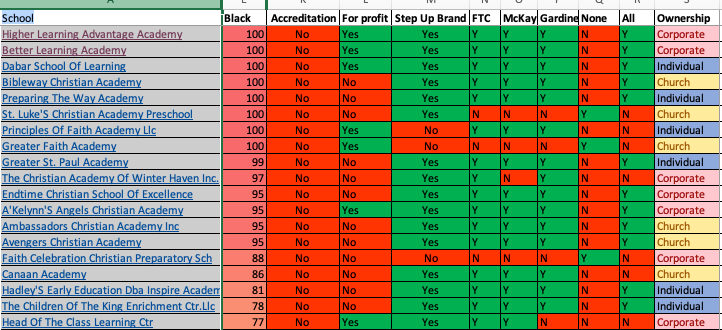
In Polk County, 16 voucher schools have enrollments that are at least 76 percent black. Twelve of the 16 schools are at least 95 percent black or greater. Six are 100 percent black. Not one of those schools has accreditation, of any kind. More than 800 black children attend these segregated, no-capital “schools.”
Integrating Critical Thinking Into the Classroom is the headline of my latest Education Week column. Four educators offer suggestions on helping students develop critical-thinking skills, including through the use of “evaluative praise.” Here are some excerpts:
geralt / Pixabay Here are new additions to THE BEST POSTS PREDICTING (& SHOWING) WHAT SCHOOLS LOOK LIKE DURING THE PANDEMIC (you might also be interested in SCHOOLS WENT REMOTE A YEAR AGO – HERE ARE MY CHOICES FOR THE BEST PIECES WRITTEN ABOUT SCHOOL REOPENING SINCE THEN): Less than 30% of students ready to return to LAUSD campuses, survey shows is from The L.A. Times. Schools already testing stu
This is next week’s question at my Education Week column. Feel free to respond in the ways listed on the image, or just leave a comment here on this post. I think it will be a great series!
geralt / Pixabay Who Americans Spend Their Time With, by Age is an interesting interactive from Visual Capitalist, and you can see their summary of it here. I’m adding it to The Best Visualizations Of How People Spend Their Days (the data is based on pre-COVID info).
Ten years ago, in another somewhat futile attempt to reduce the backlog of resources I want to share, I began this occasional “” post where I share three or four links I think are particularly useful and related to…ed tech, including some Web 2.0 apps. You might also be interested in THE BEST ED TECH RESOURCES OF 2020 – PART TWO , as well as checking out all my edtech resources . Here are this we
A new study, titled Diversity in Schools: Immigrants and the Educational Performance of U.S. Born Students , by David N. Figlio, Paola Giuliano, Riccardo Marchingiglio, Umut Özek & Paola Sapienza, comes to conclusions that many teachers already knew – that the presence of immigrant students definitely does not negatively impact non-immigrant students and, in fact, results in increased achievement
Eight Instructional Strategies for Promoting Critical Thinking is the headline of my latest Education Week column. Four educators share tips for supporting the development of critical thinking in the classroom. Here are some excerpts:
moritz320 / Pixabay California adopts 3-foot-spacing rule for classrooms, changing reopening equation is from The L.A. Times. Education secretary says school in the fall ‘will look more like what it was before Covid’ is from CNN. This is a video from The Wall Street Journal : 3 different parent poll


 “You’ll never decide what you want until you’ve decided who you are.”