Latest News and Comment from Education

Friday, October 28, 2016

CURMUDGUCATION: CA: Is the Fox Guarding the Henhouse?

CURMUDGUCATION: CA: Is the Fox Guarding the Henhouse?:

CA: Is the Fox Guarding the Henhouse?

The Los Angeles Unified School District put away their charter rubber stamp, and it has touched off a wave of hand wringing and baloney shoveling.

Earlier this month, the LAUSD board pulled the plug on five charters. Three of them were Magnolia schools, part of the Gulen charter web of schools allegedly tied to the reclusive cleric who is also an exiled political leader from Turkey allegedly tied to this year's coup attempt. The Magnolia chain has been accused of significant financial shenanigans, The other two were Celerity schools, a chain that has such a spotted record that even reformy John Deasy has cast a wary eye in their direction. Oversight and transparency, two important qualities that charter schools generally do very badly, were cited as issues with the five.

But the unexpected move by the board to hold any charters accountable for anything ever has stirred some folks up.

Here's a charter-friendly look at the "issue" from KPCC,
CURMUDGUCATION: CA: Is the Fox Guarding the Henhouse?:

Big Education Ape: Charter Schools Accused Of Discrimination In Admissions Process « CBS Sacramento - http://bigeducationape.blogspot.com/2016/10/charter-schools-accused-of.html


GA: Ed Consultant Slams Takeover Amendment

In Georgia, reformsters are pushing hard for Amendment 1, a constitutional amendment that would institute a state-level takeover district, modeled after the pioneering Achievement School District in Tennessee.


Dr. David K. Lerch is a Georgia resident and ran his own educational consulting firm for over three decades. He has worked all over the country, writing grants and overseeing programs (e.g. Pueblo hired him to evaluate their STEM programs).

Lerch has presumably seen plenty in the ed  field; he earned his Master's Degree in Public School Administration from the University of Virginia back in 1967By 1984 he was forming the National Association of Magnet School Development and was touting magnets as a path to desegregation and what we now call educational equity. He was also saying the kinds of things that charter fans would chime in on decades later:

Parents want neighborhood schools until they find a program they support and then they will send a child halfway across the county if the education program is attractive.

Lerch now works for the Juliana Group, Inc, a Savannah-based business that specializes in selling furniture for Montessori schools.  

In short, Lerch is not a long-time hard-core supporter for traditional public education. However, 
GA: Ed Consultant Slams Takeover Amendment

Matt Damon explains why he made this surprising new film - The Washington Post

Matt Damon explains why he made this surprising new film - The Washington Post:

Matt Damon explains why he made this surprising new film

backpack
“Backpack Full of Cash” is a film title that suggests some untoward money dealings. And a new film by that title is — though the theme is not the traditional movie yarns about arms or drug dealing.
Actually, it’s a 90-minute documentary about the real and ongoing movement to privatize public education and its effects on traditional public schools and the students they enroll. With actor and activist Matt Damon narrating, “Backpack” tells a scary but important story about corporate school reform policies that critics say are aimed at destroying the U.S. public education system, the country’s most important civic institution.
While many Americans have heard of charter schools, which are publicly funded but privately operated, often by for-profit companies, and school “vouchers,” which use public money to pay tuition for private schools, they may not understand their central place in the broader corporate reform movement. That movement, which also includes policies such as standardized test-based “accountability” systems, thrived under the administrations of presidents George W. Bush, a Republican, and then Barack Obama, a Democrat. But there are both Republicans and Democrats who oppose corporate reform as well.
“Backpack” — done by Stone Lantern Films, and Turnstone Productions — attempts to explain the entire movement through the prism of the 2013-2014 school year. The best way to understand what is happening is by looking at how corporate reform affects schools, teachers and children, and that’s what the film attempts to do. Here’s a description of the film, from its Kickstarter website:
BACKPACK takes viewers to Philadelphia, where in 2013-14, the charismatic principal of South Philadelphia High worries about the upcoming school year — his school has no music teacher, no librarian, and just two counselors for over 1,000 students. Across town, the C.O.O. of a brand new charter school welcomes students to gleaming, high tech classrooms.
In North Philly, a 10th-grader performs a virtual frog dissection on her computer, in her bedroom. Her cyber charter school is run by the biggest for-profit online education company in the world.
In Nashville, TN, a teacher is giving standardized tests to her eight-year-old students. This is their 30th Test Day of the year. Testing companies reap huge dividends.
And in Louisiana, a Bible school headmaster teaches creationism to students who pay tuition with tax-funded vouchers.
The description also notes that the term “backpack full of cash” refers to the belief by corporate Matt Damon explains why he made this surprising new film - The Washington Post:

What is the purpose of the State-sponsored Smarter Balanced Assessment Consortium (SBAC) “Mastery” Test? - Wait What?

What is the purpose of the State-sponsored Smarter Balanced Assessment Consortium (SBAC) “Mastery” Test? - Wait What?:

What is the purpose of the State-sponsored Smarter Balanced Assessment Consortium (SBAC) “Mastery” Test?


Designed to fail a vast share of Connecticut’s students, the SBAC test is aligned to the Common Core, rather than what is actually taught in Connecticut’s classrooms.
If Governor Malloy and his allies in the corporate Education reform industry get their way, the SBAC test will continue to be used to rate and rank order students, teachers and schools.  For them, it is a mechanism to ensure students, and teachers are deemed to be failures, thereby paving the way to turn even more Connecticut public schools over to privately owned, but publicly funded charter school companies and others that seek to profit off the privatization of public education.
With the Connecticut legislature’s approval, the Malloy administration has been busy turning Connecticut’s public schools into little more than testing factories and profit centers for private entities, many of which have become some of Malloy’s biggest campaign donors.
One of the areas that remains unresolved is how the SBAC testing scam will be used in Connecticut’s teacher evaluation process.  Malloy and his ilk want to require that the results of the unfair tests be used as a key tool in determining how well teachers are doing in the classroom.
Teachers, their unions and public school advocates recognize that there are much better teacher evaluation models that could be used and don’t rely on the use of standardized tests to determine which teachers are succeeding, which teachers need additional training What is the purpose of the State-sponsored Smarter Balanced Assessment Consortium (SBAC) “Mastery” Test? - Wait What?:


Miss Information – EduShyster

Miss Information – EduShyster:

Miss Information

 Image result for cheshire cat animated gif

I talk to Tracy Novick about what Question 2 actually says, and what’s behind the Massachusetts school committee rebellion…
EduShysterI thought we could start out with a little TV viewing. Here’s one of the latest spots for the campaign to lift the charter school cap in Massachusetts, and it features none other than our own governor, Charlie Baker.


The spot is just 30 seconds long, but my sense of confusion persisted long after that. The Governor doesn’t seem to be talking about the same ballot question that I’m helpfully linking to here.
Tracy Novick: It is not accurate to say that Question Two is only about nine cities. Right now, when the state considers new charter schools, priority goes to school districts in the lowest 10% of performance. But under the ballot question, the district performance doesn’t even have to be considered unless the state gets more than 12 applications in a year. The largest number of schools the state has actually chartered in a year date back to the mid 90’s, when they chose six or seven in a year. Having more than 12 applications isn’t likely. That means the charters really could go anywhere. Question 2 actually replaces a system where some of those nine cities are first in line with one where most of the time they won’t be. 
EduShyster: I’ve actually been feeling a little bad for the suburban charter schools these days. They’ve been completely ignored during our frenzied debate. For example, the school with the longest wait list is the state isn’t in one of Baker’s nine cities. It’s Mystic Valley, which draws from suburbs around Boston and is in hot demand among parents who want a private school education at public school prices.
osvstagecoachcostumessm.jpg (700×465)NovickThe same is true of Sturgis on the Cape, of the Advanced Math and Science Academy in Marlborough, and the Pioneer Valley Chinese Immersion Charter School in Western Mass. And those are schools that have some serious resources, in term of facilities and fundraising. I can really see boutique kinds of schools being very happy to open up in places like Cambridge and Somerville and Miss Information – EduShyster:


The Truth About Ohio School Report Cards – Blogging with Craig Brown

The Truth About Ohio School Report Cards – Blogging with Craig Brown:

The Truth About Ohio School Report Cards

cropped-BrownLogo.png
A few weeks ago the Ohio school report cards were released. Very few administrators, teachers, or parents were happy. Overall it looks like Ohio schools are doing much worse. Schools in high income areas with high residential property values are doing great while schools in urban areas with low property values are not.
The Ohio school report cards tell us the same thing every year. Except this year, many schools are doing much worse than usual. Is it possible that many Ohio schools are suddenly catastrophic failures? If you believe the report cards then yes. Some sort of day of reckoning- cataclysmic event has hit dozens of school districts.
Except the schools have not significantly changed. Most are doing the same things they did the year before. What happened in a year? How did so many schools make so many mistakes earning such terrible distinctions?
Here is the secret. The schools are not changing. The mechanisms and political mumbo jumbo contributing to the creation of the school report cards changed again last year. This new recipe for measuring schools has yielded an inaccurate result. Once again Ohio state politicians keep messing around with how they measure Ohio schools, and the result is another year of failure for many Ohio school districts. Now the politicians will blame the administrators, teachers, and indirectly the parents for kids not succeeding at an acceptable level.
This allows the state politicians to shift the blame away from themselves for properly funding Ohio schools and lay it at the feet of others. This is a classic political maneuver. For decades Ohio politicians have been messing with school funding, creating new draconian rules for teachers, and adopting common core like rules that take power away from locally elected school boards. It is time we face reality. Ohio’s schools are being engineered to fail.
Wait. Planned to fail? Well, not all schools are being set up, just Ohio public schools. Ohio’s powerful politicians want the privatization of education. They have received millions of dollars in campaign contributions from charter school investors. They have given said investors billions of dollars of our tax money. They have also been forcibly dragged kicking and screaming into any scenario involving holding charter schools accountable. What do you think is happening? The school report cards get “tweaked” every year, and things just keep looking worse for public education. Do these cards accurately reflect what is going on in our schools? No. This is nothing more than an attempt to turn public opinion against our local schools.
Do you need more evidence? Do the research. Look at how Ohio legislators have made it harder to be a teacher in Ohio. Examine the new regulations and new rules. Don’t forget how decades ago the Ohio Supreme Court told legislators to fix the unfair funding of schools in our state. Did they fix it? Nope. We haven’t even talked about the new graduation standards that may prevent tens of thousands of kids from graduating high school next year.
Accountability is a good thing, but it is only good when you are using measurements that are accurate and consistent. Ohio politicians want you to be angry at your public schools. They want you to blame your school administrators and teachers. Remember, this is merely a distraction. Ohio politicians don’t want you to hold the real responsible parties accountable. Ohio politicians don’t want you to see they are the ones to blame for our failing schools.The Truth About Ohio School Report Cards – Blogging with Craig Brown:


Michigan Schools: Can Bill Cobbs Fix What Snyder Broke?

(100) Literacy is Fundamental:

Michigan Schools: Can Bill Cobbs Fix What Snyder Broke? 
Fortune 500 Executive Coach, Bill Cobbs promises to clean up Snyder's educational mess.  "We must stop blaming teachers and empower them," says the executive with his eyes on the Governor's seat.


Image result for Literacy is Fundamental
Literacy is important to both our democracy and freedom as a nation. From all that I've read, one of the most importance aspects of the slave trade was denying slaves the ability to read, and write to maintain servitude. While slavery has ended, even to enjoy Freedom of the Press, we must be able to read what our journalists print. Without literacy, we can’t study our nation’s history, to understand why our nation granted the freedoms we now enjoy. Without literacy, what remains is a dumbed down society plagued by the virus of cognitive dissonance eating away one by one, at our critical thinking, our attention span, and our very moral fiber. And here we are. Trump.
Today's bondage may not be physical, but it is even more insidious. Children are being deprived of basic literacy both in our schools and in the home. In educational policy, we are being drawn into the trap of privatization by "school of choice" marketing. This marketing is not for our benefit. Listen closely when a Governor says he is taking over academic control of your school, but he is not accountable for a quality education! A Governor that would rather spend $35,000 to imprison an illiterate juvenile, than $10,000 to teach a child, has another agenda. Governor Snyder has been deaf to our cries, and out of touch with the components of good Governance. Literacy is all the more difficult to achieve when the average charter school teacher has only one year of experience.
There are four steps to this immoral and unethical scheme to profit from the destabilization of our neighborhoods.
1. Defunding neighborhood schools so they lack books, staff and proper maintenance.
2. Labeling public schools which lack critical resources as “failing” to drive students away.
3. Closing the schools lacking critical resources.
4. Privatizing by giving away publicly funded community assets to for-profit charters.

There was a time that brothers and sisters went to the same school, knew the same teachers, were proud to root for the home team at high school football games. The viability of every neighborhood and it’s cultural institutions is important to literacy. When neighborhoods have safe, clean schools, people desire to put down roots and property values rise.
Conversely, destroying our neighborhood institutions creates crime and instability. It has been shown that closing schools and making children cross into unknown territories increased gang activity and gang membership in Detroit. Poor areas are easy victims because more families are renters, and these families have fewer connections to the neighborhood. Therefore, children who attend charters may have an even more difficult time forming stable positive relationships.
Yet, the opportunity to send our child to a charter school across town with a fancier name is so tempting, we may forget momentarily the impact on our property values when our neighborhood school is boarded up. Let’s remember, we are in this together. Destabilizing neighborhood institutions to benefit a business is counter-intuitive to government efficiency, transparency and accountability. It also creates segregation by dividing children into two classes:
- children who will be accepted at a charter and have transportation
- children who are not accepted at a charter and do not have transportation.
Around the country, brown and black communities are being pushed off the precipice into privatization. Have you noticed that when the public accountability of an elected board is removed, we have the Charles Pughs, and Eddie Longs, eager to step right up to “mentor” a fresh crop of fatherless victims? There are many examples I won't name, but you have heard about them too. If we want literacy, we have a moral responsibility to shore up deficiencies exist in our neighborhood schools and empower teachers and parents with the resources they need.
In the home, we must reinforce the importance of reading. Some families have every game system and shoes with three-figure price tags. These same homes may not have a book. This is the Slavery of Consumerism which keeps us in a financial bondage our children may never escape from. There are still lessons to be learned from Oliver Twist, and I Know Why the Mockingbird Sings. Books can teach us about far away places. Books can show a child that his or her self worth cannot be determined by things. When we hunger for things, we can never have enough things. Things are secondary to character and community pride. Things are secondary to dreams.
At home we must reinforce education’s role in opportunity. We can not allow the television and gaming systems to be the educational tools in our home. Whatever neighborhood we live in, we as parents must expose our children to reading at an early age. Reading is power. We must find creative ways to make learning fun. We break the strangle hold of illiteracy by having strong community based schools and homes that stress reading skills early. We must praise education and make it paramount to the children's future.
We can fix this. We must properly fund public K-12 education. We can not abandon our neighborhood schools. We must stop blaming educators and empower them. We must not allow education of our children to be driven by economic standing. We must not abandon our special needs students. Some charter schools have done excellent work, but destabilization of our public institutions for school privatization is not the answer.
We must increase educational spending, and use our resources more effectively. We must move money from the incarceration process to the educational process. We have to provide our children the tools to become doctors, lawyers, teachers, and public servants and productive contributors to our community?
After nearly 17 years of school choice, it is estimated that Michigan is 40th of 50 states in child literacy. With this in mind, we can no longer allow one family in West Michigan to decide the fate of every child via political contributions.
If we want to throw off the choke hold of illiteracy, we must do our duty as citizens. Many died for our right to vote. Staying home on election day has laid the red carpet for politicians beholden to corporations which turn our children into commodities for sale like corn or wheat. We must care about the policy being written for our community and make our voices heard. We must groom leaders with moral character. We must get in the voting line and we must pull the lever for people who value funding quality education in every Michigan neighborhood. We must open a book, and read to our kids. Literacy is fundamental.


Finally, districts’ accountability plans may be easier to read and use | EdSource

Finally, districts’ accountability plans may be easier to read and use | EdSource:

Finally, districts’ accountability plans may be easier to read and use 

Image result for accountability plans
For three years, school districts have been writing an annual budget and accountability plan using a state-dictated form that has irritated just about everyone writing and reading it. Next week, the State Board of Education is expected to approve a new version that promises to be simpler, better organized and easier to follow.
The revised Local Control and Accountability Plan, or LCAP (see draft template starting page 7), has gotten generally positive reviews, with some reservations, from school officials and advocates for high-needs students who disagree over how much information should be in the document but credit state board staff for trying to strike a balance.
“We are not completely satisfied, but we will support the revised LCAP,” said Martha Alvarez, legislative advocate for the Association of California School Administrators, which had recommended changes through months of hearings and drafts. Districts’ LCAPs had mushroomed to dozens, and in some cases hundreds, of pages over the past three years. It’s unclear, she said, despite improved readability, whether LCAPs will become shorter or longer under the new template. “At this point, districts need time – a number of years without further changes – to work with it,” she said.Finally, districts’ accountability plans may be easier to read and use | EdSource:

A Free Book on Amazon That Explains the Plot to Privatize Public Schools | Diane Ravitch's blog

A Free Book on Amazon That Explains the Plot to Privatize Public Schools | Diane Ravitch's blog:

A Free Book on Amazon That Explains the Plot to Privatize Public Schools 


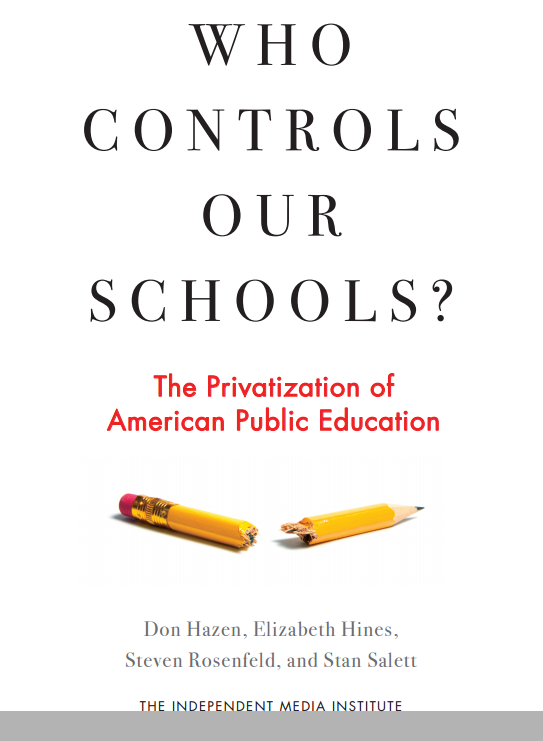
You can go to Amazon and click on this link to receive a free pdf of a 40-page report called “Who Controls Our Schools? The Privatization of American Public Education.”
It is up-to-date, concise, and well-written. It was prepared by Don Hazen, Elizabeth Hines, Steven Rosenfeld, and Stan Salett of THE INDEPENDENT MEDIA INSTITUTE.
If your friends and relatives don’t understand why you are worried about the future of public schools, share this document with them.
Here is the table of contents:
Introduction………………………………….
Analysis/Findings ……………………………..
2.1 How the School Privatization Industry Has Hijacked the Concept of Education Reform
2.2 How a Group of Billionaires Has Aggressively Pushed to Privatize the Public School System
2.3 How the Myth of “Failing Schools” Helped Spur
a Movement. . . One-Sided Propaganda Machine. . . . . . . . . . . ….
2.4 How a Lack of Transparency Undermines Schools
and Communities: Privatization in Action . . . . . . . . . . .
2.5 How Locally Elected School Boards and Democratic Governance Have Been Destroyed . . . . . . . . . . . . . . . . .
In Los Angeles, Pushing Charters,
by Every Means Necessary . . . . . . . . . . .. ……..
2.6 How the Legal Framework for Privatization
and Total Control Has Taken Hold. . . . . . . .. ……. .
2.7 How the Rapid Expansion of Privatized
Charters Is Pushed. . . . . . . . . . . . . . . . . . . . .. ……..
Today’s Battlefront States . . . . . . . . . . . .. ……..
2.8 How to Take a Hard Look at Charter Schools
and Educational Outcomes: Rhetoric Is Not
the Same as Results . . . . . . . . . . . . . . . . . . . . . ……..
2.9 How Charters Create Self-Enrichment Schemes
and Crony Capitalism . . . . . . . . . . . . . . . . . . .
Self-Enrichment……. Nepotism … Corporate Profiteering . . . . . . . . .
2.10 How School Privatization Keeps Out Regulators
or Captures Them . . . . . . . . . . . . . . . . . . . . . . . . . . . . .
Policy Recommendations. . . . . . . . . . . . . . . . . . . . . . . . . . . . .
Acknowledgments ………………………………
About the Authors ……………………………….
 A Free Book on Amazon That Explains the Plot to Privatize Public Schools | Diane Ravitch's blog:

Charter School Expansion Should Be Paused, NAACP President Says

Charter School Expansion Should Be Paused, NAACP President Says:

NAACP President: Why We Should Pause the Expansion of Charter Schools

[Op-Ed] The organization's leader explains their position on the schools and responds to those who have been critical of it


As America’s oldest civil rights organization, the NAACP has fought to this very day to give each of the nation’s youngest citizens a quality education regardless of race. We have even taken that fight to the marble steps of the Supreme Court. There, in the historic Brown v. Board of Education decision, Chief Justice Earl Warren ruled, “In the field of public education the doctrine of ‘separate but equal’ has no place. Separate educational facilities are inherently unequal.”
Over 60 years later, these words ring resoundingly true in the hearts of parents who know all too well that in all too many cases, the education their children are receiving remains separate and unequal.
Earlier this year, 2,000 delegates representing virtually every school district across the country passed a resolution calling for a reasoned pause on charter school expansion, not rash elimination. The National Board then ratified the convention delegates’ position, reaffirming decades of NAACP support for public education. Many allies have commended our position and raised very similar concerns, including the Movement for Black Lives, which called for an end to charter schools as we know them just weeks after our July convention. But there has also been much unfounded outrage, with some critics even claiming that our decades-old position is contrary to the NAACP’s mission.
The NAACP has called for a pause on the expansion of charter schools in order to ensure the quality of them all. We are also calling for solutions, such as better educated and certified teachers that work for students across the board.
Let us be clear, there is a role for high performing charter schools. However, we cannot continue to ignore the proliferation of low-performing charter schools that lack accountability. According to the Center for Research on Education Outcomes, while 27 percent of charter schools outperform traditional public schools in math and reading, 25 percent of charters performed worse. Charter schools are doing no better than traditional public schools at meeting the expectations that we parents hold for our children’s education.
We are sensitive to the needs of African-American parents across our country whose public school systems have failed their children. Parents should not have to wait for the public school system to get this right. However, many parents have also been lured by the false promises of charter school systems that actually underperform public schools. As The New York Times reported earlier this year, in Detroit the results have been disastrous to both traditional and charter schools. And, there are similar races to the bottom in communities all across the country.
Every school district is like a large family, made up of all sorts of students with diverse skills and abilities. Charter schools fragment those families, selecting only some students with the most apparent skills and abilities. As a result, only about 25 percent of charter schools have student bodies that mirror the demographics of their respective sending districts.
Research demonstrates that though charter schools promise a superior education, many have created a privileged subset of privately run, publicly funded schools with minimal government oversight, transparency, or accountability and many fail to provide a quality education. The quality of charter schools is inconsistent at best.
Thriving charter schools often owe their success to exclusionary selection


Read more at EBONY http://www.ebony.com/news-views/naacp-cornell-brooks-charter-schools#ixzz4OOXxFqE5 
Follow us: @EbonyMag on Twitter | EbonyMag on Facebook


Wall Street 'Influence'? Teachers Unions Request Probe Of Donations To Charter School Measure

Wall Street 'Influence'? Teachers Unions Request Probe Of Donations To Charter School Measure:

Wall Street 'Influence'? Teachers Unions Request Probe Of Donations To Charter School Measure


The two largest teachers unions in Massachusetts asked federal and state law enforcement officials to investigate whether large donations to a charter school ballot measure backed by Republican Gov. Charlie Baker violated anti-corruption rules. The request Thursday from the unions was prompted by an International Business Times/MapLight report showing that the state pension board — which Gov. Baker appoints members to — gave lucrative contracts to manage teachers’ pensions to Wall Street firms whose executives then bankrolled the Baker-backed ballot initiative.
“This is about the integrity of our pension investments and the integrity of our elections,” said Massachusetts Teachers Association President Barbara Madeloni. “We need an investigation to find out whether these firms are wielding inappropriate influence in state government.”
Baker’s office did not respond to IBT’s questions. An official at the Massachusetts Pension Reserves Investment Management Board (MassPRIM) declined to comment.
The request by the unions — who represent 135,000 public school personnel in Massachusetts — revolves around federal pay-to-play rules that went into effect in 2011. Those rules are designed to prevent financial firms that manage state pension investments from donating to public officials who can influence investment decisions.
Baker is covered by those rules because he appoints three members to the board of the Massachusetts Pension Reserves Investment Management Board (MassPRIM). IBT/MapLight’s report showed that eight firms delivered more than $778,000 to groups supporting Question 2, which would expand the number of charter schools in Massachusetts. Baker has led the fight for the ballot measure, and a group that received money from MassPRIM money managers is now airing television ads promoting Baker.
While the federal pay-to-play rules aim to restrict Wall Street donations directly to public officials and political parties, they do not explicitly bar such donations to groups that support a lawmaker’s favored cause — or that promote a public official in paid ads. However, the rulesdo include anti-circumvention provisions which prohibit financial firms and public officials covered by the law from doing “anything indirectly which, if done directly, would result in a violation of the rule.”  
“These rules are in place specifically to prevent Wall Street firms from throwing money at the feet of those responsible for awarding financial contracts in an effort to curry favor in the awarding of those contracts,” said Public Citizen’s Craig Holman, whose watchdog group advocates for tougher ethics laws. “We are seeing Wall Street funnel their money to nonprofit organizations and super PACs that support the same governors — and now to a pet policy project of Massachusetts Gov. Baker, backing Wall Street 'Influence'? Teachers Unions Request Probe Of Donations To Charter School Measure:


Parent: My first-grader hates being at school — and I don’t blame her - The Washington Post

Parent: My first-grader hates being at school — and I don’t blame her - The Washington Post:

Parent: My first-grader hates being at school — and I don’t blame her


Tama Koss spent more than 12 years as a child abuse prosecutor in Florida before recently leaving the practice of law to teach and write. She and her husband have two children, ages 6 and 4. Their oldest daughter currently attends public school, and it is her experience in kindergarten and now in first grade that prompted Koss — who focuses on children’s issues and public service — to write this post.


By Tama Koss

I have a young child who turned 5 years old just six days before kindergarten began.  My husband and I made a decision to allow her to attend because we believed she was ready. Now she is in the first grade. Did we make the right choice?
She is now resisting her education and regressing in her emotional development. While she is succeeding in school, she is very resistant to direction at home, is not interested in her homework and often discusses her love of art, which is ignored in school except for 30 minutes each week.
She learns best and is excited by exploring the world around her, a skill not taught in today’s public schools. She loves to create and play. At school, however, she is herded like cattle, not treated like a child. She is forced to sit in a chair most of her day watching a screen. Her teacher teaches through a computer projected onto a wall and uses classroom computers and iPads to occupy students. There is no real guidance on the use of computers. The only restriction is in using “child-friendly” websites.
Excessive computer use, conformist teaching methods and minimal playground and outdoor time frighten me. Is she learning? Will she succeed in the ways I want her to? If I don’t push her, will she fall behind? If I do push her will she succeed in life?
My job as a parent is confusing. I want to foster my daughter’s interest in learning, not squander her curiosity at the age of 6. I want to feel comfortable knowing my daughter’s teachers are fostering her individuality and assisting her in finding her own way of learning. How are we accomplishing this by conforming to a bureaucratic view of how best to educate our Parent: My first-grader hates being at school — and I don’t blame her - The Washington Post:


Where The Money Comes From In The Fight Over Charter Schools | Edify

Where The Money Comes From In The Fight Over Charter Schools | Edify:

Where The Money Comes From In The Fight Over Charter Schools


Both sides in the ballot fight over the charter cap are out knocking on doors in the run-up to Election Day. The public faces of each campaign are students, parents and teachers, pleading for fairness and excellence in every child’s education.
Behind the scenes, though, an unprecedented clash of titans is taking place.
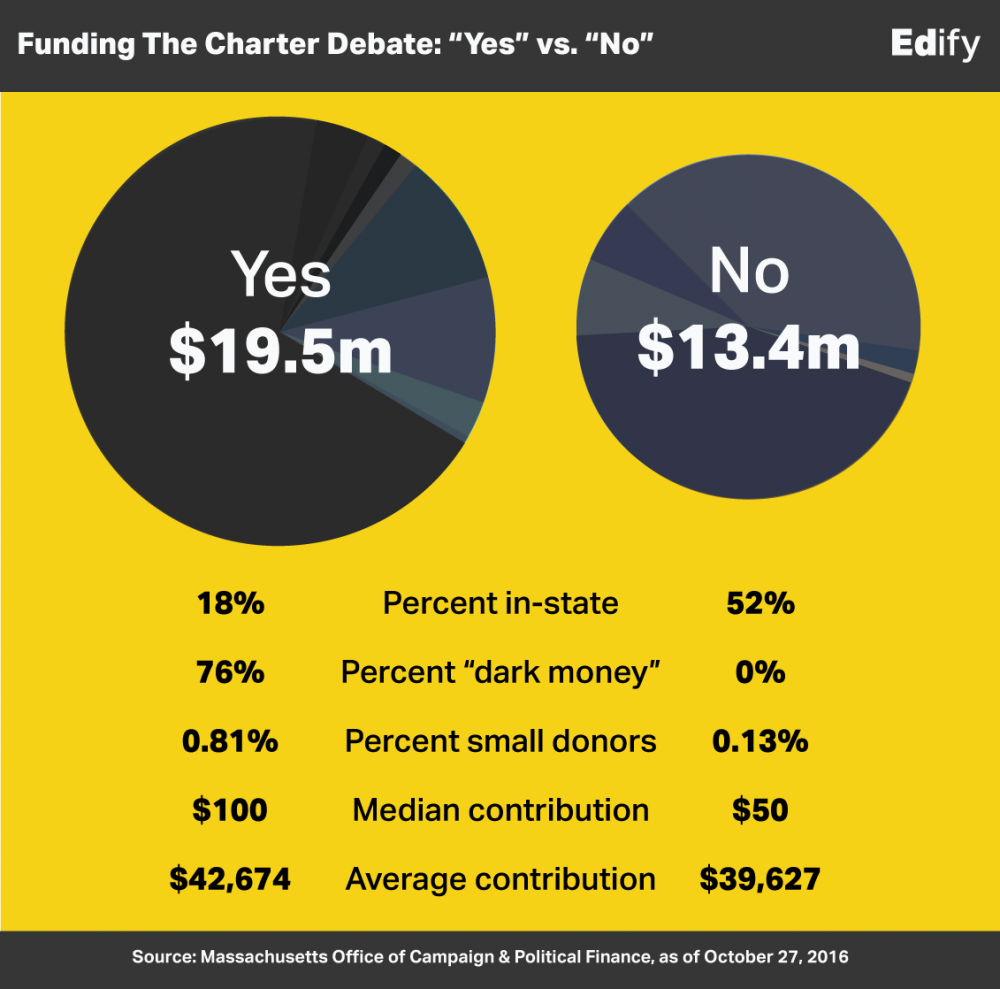
Supporters of Question 2 — the ballot measure that would raise the cap on the number of charter schools allowed to operate in Massachusetts — have contributed $19.5 million to the campaign; opponents have kicked in $13.4 million, according to filing data kept by the state Office of Campaign & Political Finance.
Together that makes almost $33 million — more than twice the $15 million spent, mostly by gaming interests, in the 2014 casino debate, which had been the state’s most expensive campaign on a ballot question.
And very little of that money comes from small, Bernie Sanders-sized donations. Though hundreds of people have contributed modest amounts of money this past year, the average contribution on both sides is about $40,000.
noon2-infographics-final
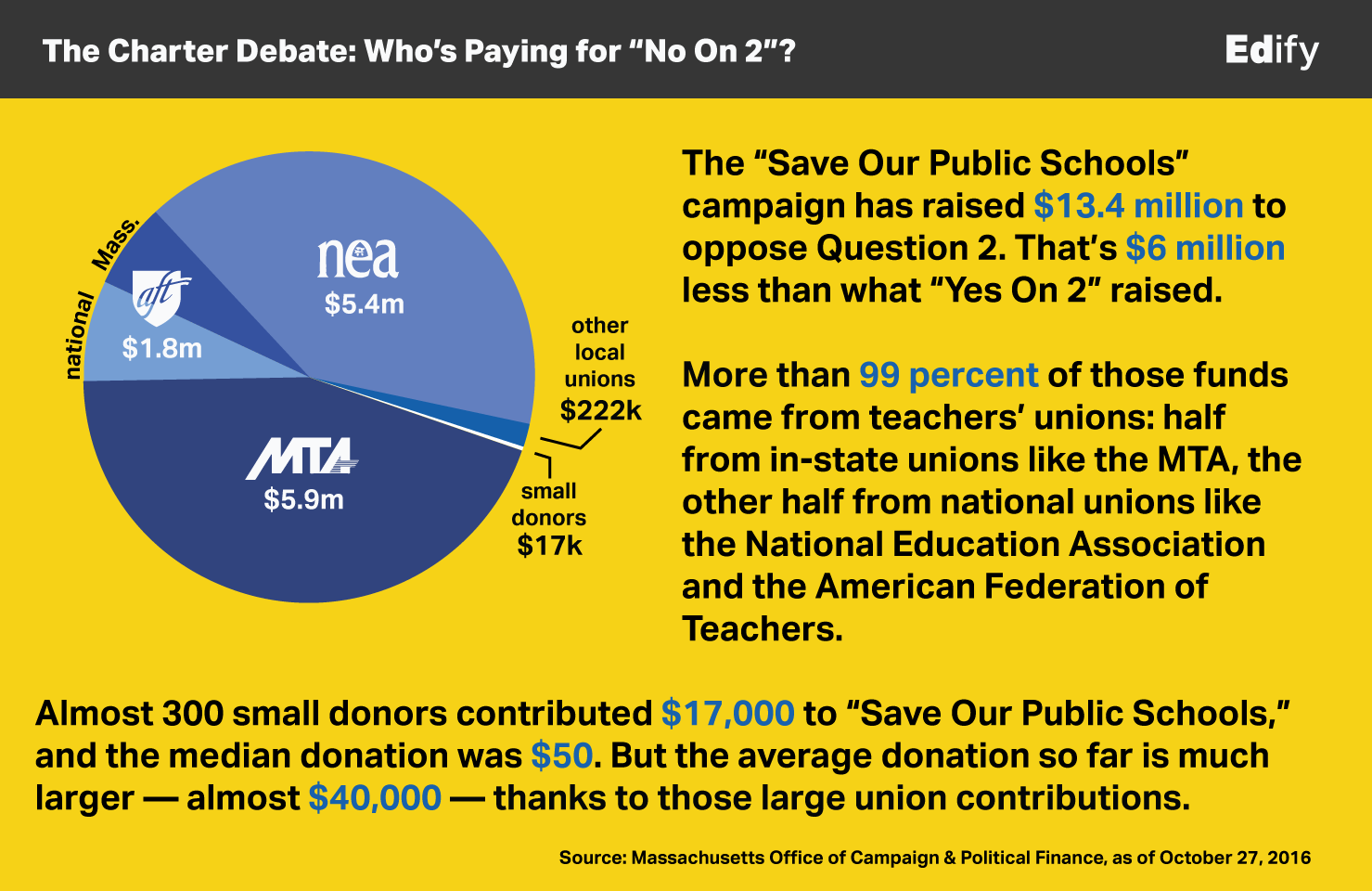
The opposition to Question 2 — organized under the name “Save Our Public Schools” — is almost entirely funded by national and local teachers’ unions; less than 1 percent came from other sources.
The Massachusetts Teachers Association, the largest state union, contributed $5.9 million, surpassing the $5.4 million given by the National Education Association, the nation’s largest union with 2.9 million members. Smaller locals, led by the Boston Teachers Union, contributed around $300,000.
In total, about 56 percent of the “No” funding comes from sources inside Massachusetts.
On both sides, the money mostly bought a relentless wave of TV advertising and outreach. Save Our Public Schools has spent almost $9.2 million on "media placement" with advertising firms as well as with Hulu and Facebook.
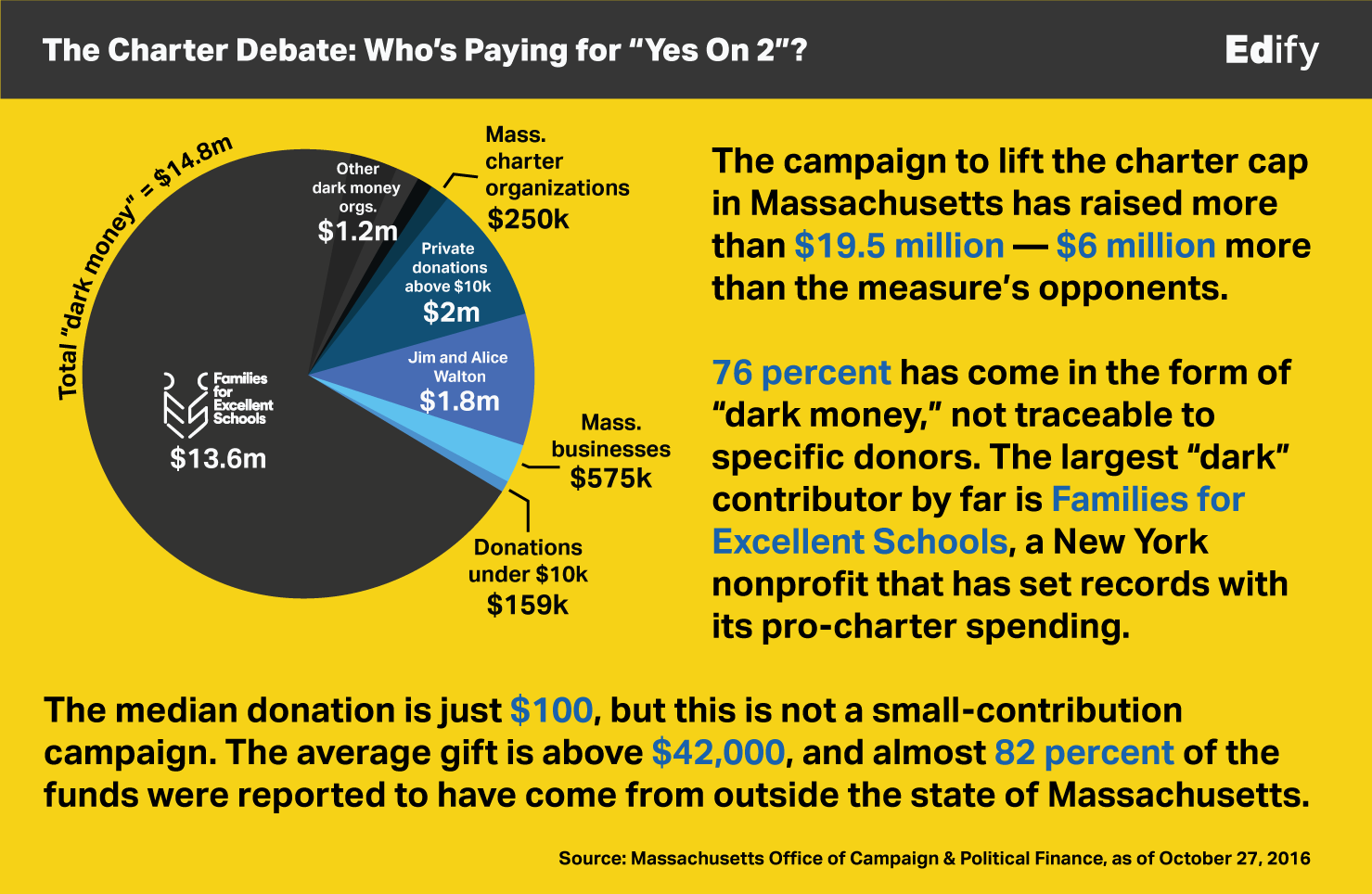
Meanwhile, groups in support of Question 2 have spent $13.2 million on media buys with a single Alexandria, Virginia, ad agency — as well as $627,000 on canvassing.
yeson2-infographics-final2
If the “No” contributions are mostly from teachers’ groups, they’re at least transparent. The base of “Yes on 2” supporters is more varied — and more unknown.
According to OCPF data, almost 82 percent of contributions in support of Question 2 come from out-of-state, but it’s hard to say exactly where they originate. That’s because almost $15 million of the campaign’s total receipts Where The Money Comes From In The Fight Over Charter Schools | Edify:


Community Schools: Steady Improvement for Students and Support for Families | janresseger

Community Schools: Steady Improvement for Students and Support for Families | janresseger:

Community Schools: Steady Improvement for Students and Support for Families

Image result for Community Schools


A test-score-yardstick and a short time line—those are the tools we use these days to evaluate school improvement. Bush’s No Child Left Behind and Obama’s Race to the Top gave us four approved plans for school “turnaround,” and if the school wasn’t turned around quick enough, the most stringent of the four was imposed—closure.
Policy makers have assumed that school turnaround could be neat, quick, and cheap only to discover that the solution too often made things worse for the students and their communities. Rachel Cohen, writing for The American Prospect, describes the impact of school closures on neighborhoods—specifically in Chicago where 50 schools were closed at the end of the 2012-2013 school year: “While black students were 40 percent of Chicago’s school district population in 2013, they made up 88 percent of those affected by the closures.”  “(T)hree years later, Chicago residents are still reeling from the devastating closures—a policy decision that has not only failed to bring about notable academic gains, but has also destabilized communities, crippled small businesses, and weakened local property values. With the city struggling to sell or repurpose most of the closed schools, dozens of large buildings remain vacant, becoming targets of crime and vandalism throughout poor neighborhoods.” “In Chicago… 87.5 percent of students affected by closures did not move to significantly higher-performing schools.”
A mass of social science research demonstrates the correlation between students’ standardized test scores and their families’ economic circumstances. Recognizing the futility of the school turnaround plans that pretend it is easy to raise test scores, New York City’s Mayor Bill de Blasio has instead been turning schools in the poorest neighborhoods into full-service, wraparound Community Schools with health and dental clinics and services for parents located right in the school building. Here is how the Children’s Aid Society, the huge social service agency in NYC that has been supporting the development of Community Schools, Community Schools: Steady Improvement for Students and Support for Families | janresseger:

Mike Klonsky's SmallTalk Blog: New study provides more good reasons to vote NO on 2 in Massachusetts

Mike Klonsky's SmallTalk Blog: New study provides more good reasons to vote NO on 2 in Massachusetts:

New study provides more good reasons to vote NO on 2 in Massachusetts


On Tuesday, voters in Massachusetts will decide whether or not to lift the cap on their state's privately-run charter schools. I hope they will consider the findings in a newly-released studydone by Michael Robinson, who describes himself as a concerned parent, taxpayer, and private citizen, and vote NO on Question 2.

Like Mr. Robinson, who has children of his own with disabilities, this issue is more than academic for me, both as an educator and grandparent of a Chicago student with disabilities. The unconstrained expansion of charters has not only drained badly-needed resources from our city's public schools, it has led to further segregation of special-needs and disabled students and less than adequate services delivered to those students within the charters themselves. 

Robinson's study confirms a pile of anecdotal evidence showing that MA charter schools underserve students with disabilities and attempt to improve standardized test performance by using discipline (especially suspensions) as a punitive lever, which many of these schools use to encourage attrition for this resource-intensive population. 

This new report on Massachusetts charters, released today, found "91.3% of districts with highest discipline rates for special education students are charter schools" and 25% of charters have no full-time special educators.

The movement against raising the charter cap is growing. Recent polls show the ballot Mike Klonsky's SmallTalk Blog: New study provides more good reasons to vote NO on 2 in Massachusetts: