Latest News and Comment from Education

Wednesday, February 10, 2016

Teach for America: Lies, Damned Lies, and Special Contracts

Teach for America: Lies, Damned Lies, and Special Contracts:

Teach for America: Lies, Damned Lies, and Special Contracts


Celebrating its 25th anniversary this past weekend, Teach For America (TFA) marked a milestone. Over the past 25 years, the organization has not only expanded, but also shifted their mission and approach. With seemingly good, albeit naive and arrogant, intentions, TFA originated as a solution to the national teacher shortage by recruiting college graduates from "elite universities" to serve as supplemental faculty in hard to staff districts. Founder Wendy Kopp claimed that TFA "would bill itself as an emergency response to a shortage of experienced, qualified teachers and would therefore not be telling the nation that its inexperienced members were preferable to, or as qualified as, experienced teachers." Fully departing from that description, TFA now claims that their corps members are superior to traditionally trained teachers and the organization has effectively changed its mission to "enlist, develop, and mobilize as many as possible of our nation's most promising future leaders to grow and strengthen the movement for educational equity and excellence."
Among these critiques, there has been much anecdotal evidence that TFA displaces other, more qualified teachers. TFA vehemently refutes this, claiming on their website that;
Corps members do not have special contracts with school districts. They apply for open jobs, and they go through the same interview and hiring process as any candidate. Our approach is to bring the best possible people into the field, but no one is obligated to hire our teachers.
Until now, this issue has been an anecdotal back-and-forth and had not been Teach for America: Lies, Damned Lies, and Special Contracts:

Ms. Katie's Ramblings: The Dangers of Teach For America Indoctrination

Ms. Katie's Ramblings: The Dangers of Teach For America Indoctrination:
The Dangers of Teach For America Indoctrination


Now, I have a lot of gripes with Teach For America. (You don't say, Ms. Katie!) I think their 5 week training stinks, and is bad for kids. I think their ties to the neoliberal education reform movement are dangerous and impossible to decouple from all that TFA is. I think their funding, their lobbying efforts, their twisted PR "research" are all crap. I want to strangle every expansion effort they push through even as veteran educators are laid off. They are anti-union. Ridiculously so.

Yet, one effect of TFA that does not get enough coverage, although it's often referenced tangentially, is the power of TFA indoctrination. (But oh! was it in effect at the #TFA25 celebration held over the weekend! Another post, perhaps...)

No one wants to admit that they have been indoctrinated. And we all have to some extent. For the most part, we do not even know that we don't know much of what has been spoon fed to us through the media, cultural norms, or existing power structures. None of us is immune, including myself.

However, what TFA does is something unique. And it's measurable. Think of any encounter you've had with an edreform "true believer". How many times have you thought to yourself, "must have been TFA", then after doing a quick Google search been right! This has happened to me too many times. Way too many times.

Let's take an example. A few weeks back, there was a truly shocking commentary in our Chicago education magazine Catalyst Chicago that was titled How Bailey Reimer's 
Ms. Katie's Ramblings: The Dangers of Teach For America Indoctrination:

Why Randi Spoke at the TFA #25 Convention | Diane Ravitch's blog

Why Randi Spoke at the TFA #25 Convention | Diane Ravitch's blog:

Why Randi Spoke at the TFA #25 Convention 

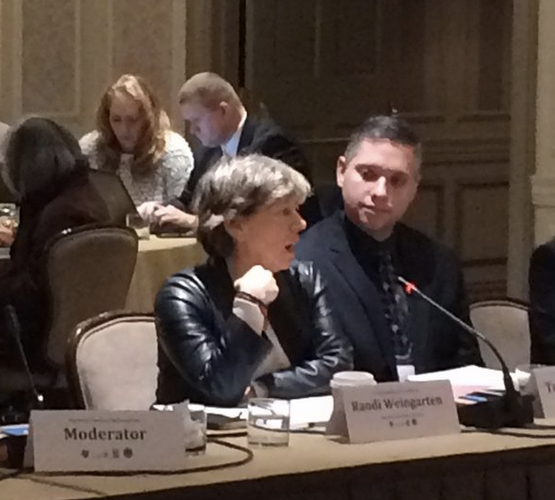
Many readers were upset to learn that Randi Weingarten was speaking at the Teach for America 25th reunion at the Convention Center in Washington, D.C., last weekend.
Randi appeared on a panel with Howard Fuller, who advocates for charters and vouchers. Fuller founded the BAEO, the Black Alliance for Educational Options. He goes around the country promoting school choice to black leaders and communities. Many years ago, he was the superintendent in Milwaukee. When he became a choice advocate, he was funded by the rightwing Bradley Foundation, the Walton Family Foundation, and others.
Randi points out in her article that vouchers have been a failure in Milwaukee, but she wasn’t there to debate Fuller. She explains here whyshe decided to appear at the TFA event.
My purpose was not to debate Fuller; it was to have a conversation about a path forward, to end the ridiculous debate in reform circles that poverty and greater economic issues don’t matter, and to debunk the notion that individual teachers can do it all.
I caught some flack on Twitter and Facebook for even attending a TFA event. The AFT and TFA disagree on a number of fundamental issues regarding education. I believe that teacher preparation should reflect the complexity and importance of this work, and that a crash course simply doesn’t cut it — it’s not fair to corps members or their students. Further, I think that TFA’s model of inadequately prepared teachers and high turnover deprofessionalizes teaching by design. And it’s dead wrong when districts use austerity as the excuse to hire TFA recruits as replacements for experienced teachers.

Advisory Commission on Special Education (ACSE) meeting agenda February 24-25, 2016

ACSE Agenda February 24-25, 2016 - Administration & Support (CA Dept of Education):

ACSE Agenda February 24-25, 2016


Advisory Commission on Special Education (ACSE) meeting agenda.
Agenda Times Are Approximate and Are Provided for Convenience Only
Items may be re-ordered to be heard on any day of the noticed meeting. The order of business may be changed without notice. Every effort will be made to Webcast this meeting in its entirety, but some portions may not be Webcast due to logistical constraints.
Advisory Commission on Special Education
Schedule of MeetingLocation
Wednesday, February 24, 2016
10 a.m. - 5 p.m. Pacific Time ±
California Department of Education
1430 N Street, Room 1101
Sacramento, California
916-445-4602
Thursday, February 25, 2016
9 a.m. - 3 p.m. Pacific Time ±
California Department of Education 
1430 N Street, Room 1101 
Sacramento, California 
916-445-4602

Please see the detailed agenda for more information about the items to be considered and acted upon. The public is welcome.
Guidelines for Public Input Sessions
The Commission welcomes public involvement. Opportunities for public comment are provided at every Commission meeting.
Reasonable Accommodation for Any Individual With a Disability
Pursuant to the Rehabilitation Act of 1973 and the Americans with Disabilities Act of 1990, any individual with a disability who requires reasonable accommodation to attend or participate in a meeting or function of the Advisory Commission on Special Education (ACSE), may request assistance by contacting the Special Education Division, 1430 N Street, Suite 2401, Sacramento, CA, 95814; telephone, 916-445-4602; fax, 916-327-3706.

Advisory Commission on Special Education
Agenda, Wednesday, February 24, 2016, 10:00 a.m. Pacific Time
California Department of Education
1430 N Street, Room 1101
Sacramento, California 
NOTE: Items not heard or completed on February 24, 2016, may be carried over to February 25, 2016.
10:00–10:30 a.m.
  • Call to Order–Roll Call
  • Salute to the Flag
  • Welcome and Recognize New Commissioners: Michele Auon; Christina Mills; Keila Rodriguez; Pablo Gonzalez, Jr.
  • Communication and Announcements
  • Meeting Survey for Public Input
  • Review of Agenda and Meeting Standards
10:30–11 a.m.
Item 1–Curriculum Frameworks and Instructional Resources Update: Cynthia Gunderson, Interim Administrator, Curriculum Frameworks Unit, Curriculum Frameworks and Instructional Resources Division, California Department of Education (CDE), will provide an overview of resources. The curriculum and instructional resources can be found on the CDE, Curriculum Frameworks & Instructional Materials Web page. (Item type: Information, discussion, action)
11–11:45 p.m.
Item 2–Assessment Update: Jessica Barr, Administrator II, Assessment Development and Administration Division, CDE, will provide an update on the California Assessment of Student Performance and Progress Systems. (Item type: Information, discussion, action)
11:45 a.m.–Noon
Item 3–ACSE Commissioner Work Specific to Priority Areas: The ACSE is committed to furthering initiatives and policies that promote one education system that is designed to serve all students. To accomplish this, the Commissioners have developed strategic priorities and disability equity considerations to be used to guide policymakers and those in the field as they evaluate all initiatives through the lens of achieving one education system. Commissioners will review the final version of the Disability Rubric document (PDF), and vote on its adoption. (Item type: Information, discussion, action)
Noon–12:15 p.m.
Item 4–Grazer Outstanding Achievement in Learning Award Recommendation: Mariano Sanz, ACSE Commissioner and Chair of the Grazer Outstanding Achievement in Learning (GOAL) Award Committee, will share the review process for GOAL applications, highlights of the process, and the Committee's recommendation for the 2015–16 GOAL award recipient. Additional information on the GOAL award can be found on the CDE, Grazer Outstanding Achievement in Learning Web page. (Item type: Information, discussion, action)
12:15–1:15 p.m. LUNCH
1:15–1:30 p.m.
Item 5–Selection of the Chair of the Nominations and Elections Committee (NEC). The Commission will select the Chair for the 2015–16 NEC, to oversee the process to elect ACSE officers, and a brief overview of the upcoming election process will be provided. (Item type: Information, discussion, action)
1:30–2 p.m.
Item 6–Capital Region Academies for the Next Economy Consortium (CRANE) Training and Transition Presentation: Brendan Peacock, Coordinator, CRANE Training and Transition, will discuss the CRANE Initiative. This program helps Capitol region school districts improve and expand Linked Learning Pathways for students with disabilities by analyzing the local context through a needs assessment, and collaborating in designing an action plan to improve Linked Learning Pathways. For more information, visit the CRANE Web site External link opens in new window or tab.. (Item type: Information, discussion)
2–2:30 p.m.
Item 7–Blueprint 2.0: Glen Price, Chief Deputy Superintendent of Public Instruction, CDE, will provide an overview of the Blueprint 2.0 program, specifically how special education has been woven through the various initiatives. For more information, visit the CDE, A Blueprint for Great Schools Version 2.0 Web page. (Item type: Information, discussion, action)
2:30–3:15 p.m.
Item 8–Born This Way Presentation: Mariano Sanz, ACSE Commissioner; and his daughter, Cristina Sanz, will discuss the new reality show, Born This Way, which stars Cristina. The show follows a group of seven young adults who were each born with Down syndrome. Throughout this docu-series, each cast member pursues their dreams, navigates work, and explores relationships. Mr. Sanz and Cristina will share experiences from her kindergarten through grade twelve (K–12) education, as well as her top recommendations to the field now that she has finished school. For more information, please visit the Born This Way program on the A&E Web site External link opens in new window or tab. . (Item type: Information, discussion)
3:15–3:30 p.m.
Item 9–General Public Comment and Organizational Input: Public comment and organizational input is invited on any matter, including items not on the agenda. The ACSE is precluded from discussing matters not on the agenda; however, questions may be asked for clarification purposes. Issues raised by the public may be referred to a future meeting agenda. Depending on the number of individuals wishing to address the ACSE, the Chair may establish time limits on presentations. (Item type: Information)
Teleconference details:
  • Wednesday, February 24, 2016
  • 3:15 to 3:30 p.m.
  • Call in number: 641-715-3865
  • Participant passcode: 595570#
3:30–3:45 p.m.
Item 10–Family Voice: Family Empowerment Centers (FECs) and Parent Training and Information Centers (PTIs) participants will present issues of importance to families. Stakeholders wishing to give public comment via teleconference may contact their local FEC or PTI prior to the meeting to arrange in person comment at the FEC or PTI. A listing of California’s federally funded FECs and PTIs can be found on the CDE, California Parent Organizations Web page or at theCalifornia Family Empowerment Centers on Disability External link opens in new window or tab. (PDF). (Item type: Information, discussion)
3:45–4 p.m. BREAK
4–4:30 p.m.
Item 11–Budget Update: Ian Johnson, Principal Program Budget Analyst, California Department of Finance, Education Systems Unit, will provide an update on the Governor’s 2016–17 budget proposal for K–12 education. The budget summary is available on the California Budget Web page External link opens in new window or tab. (PDF). The section related to K–12 education begins on page 19. (Item type: Information, discussion, action)
4:30–4:45 p.m.
Item 12–State Special Schools Director’s Report: Scott Kerby, Director, State Special Schools and Services Division, CDE. (Item type: Information, discussion)
4:45–5 p.m.
Item 13–Discussion of Day’s Session: Commissioners will discuss the day’s presentations and outcomes (Item type: Information, discussion)
Adjournment of day's session.

Advisory Commission on Special Education 
Agenda, Thursday, February 25, 2016, 9:00 a.m. Pacific Time 
California Department of Education 
1430 N Street, Room 1101 
Sacramento, California
9–9:15 a.m.
  • Call to Order–Roll Call
  • Salute to the Flag
  • Communication and Announcements
  • Review of Agenda
9:15–9:45 a.m.
Item 14–Local Control Funding Formula Update: Jeff Breshears, Director of the Local Agency Systems Support Office, will provide an update on the local control funding formula (LCFF). For details, visit the LCFF Overview Web page and theState Priority Related Resources Web page. (Item type: Information, discussion, action)
9:45–10:45 a.m.
Item 15–ACSE Commissioner Work Specific to Priority Areas: Commissioners will meet to discuss items specific to the proposed accountability system, to include the following questions:
  • As it relates to students with disabilities, what suggestions does ACSE have related to LCFF Priority 3? For additional information, visit the CDE, Local Control Funding Formula Web page.
  • As it relates to middle and high school grades, are there additional indicators that are missing related to students with disabilities, or does the existing data need to be disaggregated more specifically?
  • How does ACSE want local educational agencies (LEAs) to disaggregate and use the data?
(Item type: Information, discussion, action)
10:45–11:15 a.m.
Item 16–Special Education in Correctional Facilities Steering Committee Update: James Johnson III, Education Administrator, Focused Monitoring and Technical Assistance Unit Three, SED, CDE, and Chair of the Special Education in Correctional Facilities Steering Committee, will discuss the work of the committee to date. (Item type: Information, discussion, action)
11:15–11:30 a.m.
Item 17–Liaison Reports: Updates by ACSE liaisons, SBE liaison, and legislative liaisons. (Item type: Information, discussion, action)
11:30–11:45 a.m.
Item 18–General Public Comment and Organizational Input: Public comment and organizational input is invited on any matter, including items not on the agenda. The ACSE is precluded from discussing matters not on the agenda; however, questions may be asked for clarification purposes. Issues raised by the public may be referred to a future meeting agenda. Depending on the number of individuals wishing to address the ACSE, the Chair may establish time limits on presentations. (Item type: Information)
Teleconference details:
  • Thursday, February 25, 2016
  • 11:30 to 11:45 a.m.
  • Call in number: 641-715-3865
  • Participant passcode: 595570#
11:45 a.m.–1 p.m. LUNCH
1–1:15 p.m.
Item 19–California’s Individuals with Disabilities Education Act (IDEA) Part B Application: Jeffrey Reyes, Education Programs Consultant, Quality Assurance Unit, SED, CDE, will report on the federal IDEA application process, including the required 60 day public comment period during which stakeholders are invited to provide verbal or written comment. (Item type: Information)
1:15–2:30 p.m.
Item 20–State Systemic Improvement Plan Update: Chris Drouin, Interim Director, SED, CDE, will provide an update on the development of Indicator 17 of the State Systemic Improvement Plan, Phase II. To view Phase I of the State Systemic Improvement Plan, visit the CDE, SBE Agenda for March 2015 Web page, agenda item one. (Item type: Information, discussion, action)
2:30–2:45 p.m.
Item 21–State Special Education Director’s Report: Chris Drouin, Interim Director, SED, CDE. (Item type: Information, discussion)
2:45–3 p.m.
Item 22–Agenda Building for Upcoming ACSE Meeting: Commissioners will discuss potential items to be included on future ACSE meeting agendas. (Item type: Information, discussion, action)
Adjournment of day's session.
Adjournment of meeting. 
Questions: Venetia Davis | vdavis@cde.ca.gov | 916-323-9773 
Last Reviewed: Wednesday, February 10, 2016
 ACSE Agenda February 24-25, 2016 - Administration & Support (CA Dept of Education):

L.A. teachers union wins dues increase, vows to battle foes of traditional public education - LA Times

L.A. teachers union wins dues increase, vows to battle foes of traditional public education - LA Times:

L.A. teachers union wins dues increase, vows to battle foes of traditional public education

Alex Caputo-Pearl
Alex Caputo-Pearl
L.A. teachers union President Alex Caputo-Pearl greets people after a 2014 news conference calling for smaller class sizes, fully staffed schools and higher pay for educators. On Wednesday, the union won an internal election over raising dues to pursue these goals. (Wally Skalij / Los Angeles Times)


  Angeles teachers have overwhelmingly agreed to raise their membership duesafter union leaders said they needed more money to battle the growth of non-union charter schools and other challenges to the traditional public education system.

The votes were tallied Wednesday at United Teachers Los Angeles headquarters in Koreatown after members mailed in ballots and cast votes online. Eighty-two percent of those who cast ballots supported the dues increase.
Union President Alex Caputo Pearl said the 30% increase in dues is needed, in part, to fight well-funded opponents, including foundations and wealthy donors who have bankrolled efforts to limit teacher job protections and spur the growth of charter schools.
Charters are independently operated and currently enroll about 101,000 students in Los Angeles. Because funding is tied to student attendance, a panel of independent experts recently concluded that charter growth could push the L.A. Unified School District into insolvency or force severe cutbacks.
The union and other critics also have asserted that charters serve fewer of the types of public school students who may be more difficult or more expensive to educate because of disabilities, a lack of English language skills or other learning issues.
Charter supporters say their schools provide options that are popular with parents and helpful to students.
Most of the union’s 32,000 members are teachers, but UTLA also represents school nurses, counselor and psychologists. Teachers will now pay nearly $1,000 per year in L.A. teachers union wins dues increase, vows to battle foes of traditional public education - LA Times:

Why We Must Believe (Our Formation) | The Jose Vilson

Why We Must Believe (Our Formation) | The Jose Vilson:

Why We Must Believe (Our Formation)

Screen Shot 2016-02-10 at 5.56.10 PM
“Come on, let’s get this done, I believe in you.”
“Why do you always say that, Mr. Vilson, like …”
“Um, because I believe in you.”
“Oh my God, this is, like, the only class I hear a teacher say that …”
It was a weird moment for me. I promised this school year I would change my vibe. I promised myself that I would be more affirmative, more caring, more relaxed, more forgiving. This worked well until December 1st, when my program changed from 90 students to 145 students with no breathing room. I was asked to redistribute the energy I once gave to 3 classes and push myself towards 5. That put a dent in my spirits that didn’t fully heal until Christmas break.
Because this is often the work of alchemists, those who had to make base metals into gold. Or in this Why We Must Believe (Our Formation) | The Jose Vilson:

Seattle Schools Community Forum: Finding Out about What Happened During Lull of Washington State Charter Schools

Seattle Schools Community Forum: Finding Out about What Happened During Lull of Washington State Charter Schools:
Finding Out about What Happened During Lull of Washington State Charter Schools


As I have previously stated, I have had public disclosure requests in for some time to various groups including former charter schools in Washington State, OSPI, and the Charter Commission.  I am still awaiting yet another drop from OSPI.

I had a very difficult time getting ahold of anyone from couple of former charters and gave up.  But, if they ARE public schools, there should be no mystery of who is their public disclosure officer and how to contact that person.

The former charter schools I did finally reach?  All told me "March or April" for my requests.  That is interesting that school that had been open less than four months at the time of my narrow request can't get the documentation to me for at least three months.  One of the them, Green Dot, sent my request to their CFO (?) and he okayed it to at least four other people.

It's this kind of subterfuge that gives charters a bad name. 

Here's what I think happened when the Supreme Court came down with their 
Seattle Schools Community Forum: Finding Out about What Happened During Lull of Washington State Charter Schools:


A California superintendent speaks out on charter schools | Parents Across America

A California superintendent speaks out on charter schools | Parents Across America:

A California superintendent speaks out on charter schools


 The following was shared with us by our newest chapter, PAA-Marin (CA):

18 months into a highly contentious local battle over the conversion of a “district-wide program of choice” into a charter school, which included two unanimous denials by the local school board, and a unanimous denial by our county office of education, the Ross Valley Charter was approved by the CA State Board of Education.
During its twenty year history, the district program had received many critiques, perhaps the most stinging came after a discrimination complaint was investigated by a third party investigator, who found proof that the program had “unintentionally discriminated” against English Language Learners, low-income, and special needs students.
The charter petitioners currently have no location, and are making thinly veiled threats to file a “Prop 39 Request,” which will entitle them to a district school facility which is “reasonably equivalent” to other school sites. Our district may have to close one of its schools to house the charter.
Proposition 39 was a Trojan Horse, which ostensibly made the process for approval of school bonds easier, but which contained the aforementioned provision for charter schools. Proposition 39 was funded by 4 billionaires in the year 2000, including Reed Hastings (Netflix), John Walton (WalMart heir), and two other tech execs.
They shared the remarks their Superintendent made at the State Board of Ed when the Ross Valley Charter
- See more at: http://parentsacrossamerica.org/california-superintendent-speaks-charter-schools/#sthash.Sx59fzDL.dpuf

What Happens to Artists Who Aren’t Good Readers?

What Happens to Artists Who Aren’t Good Readers?:

What Happens to Artists Who Aren’t Good Readers?

Children doing arts and crafts in a playschool
Imagine children in public schools today, who do not read well, but who are undiscovered, gifted artists. They are continually drilled in reading and get few opportunities to express themselves artistically.
In some schools, if a student does not test well in reading they do not get to be in the band, or they are not permitted to sign up for art.
If a student does not test well in reading, their fate is usually sealed. They get repetitive reading remediation–reading drill–to prepare for the tests.
In fact, often struggling schools no longer offer the arts because administrators and state officials are obsessed with testing.
Jane Piirto in her wonderful book Understanding Those Who Create, writes about the What Happens to Artists Who Aren’t Good Readers?:

Beyoncé Upstaged by White Fragility at the Super Bowl | gadflyonthewallblog

Beyoncé Upstaged by White Fragility at the Super Bowl | gadflyonthewallblog:

Beyoncé Upstaged by White Fragility at the Super Bowl

Pepsi Super Bowl 50 Halftime Show
SANTA CLARA, CA – FEBRUARY 07: Beyonce performs during the Pepsi Super Bowl 50 Halftime Show at Levi’s Stadium on February 7, 2016 in Santa Clara, California. (Photo by Harry How/Getty Images)
Black women’s bodies are scary.
That’s the lesson we learned this Super Bowl Sunday.
When Beyoncé and 30 backup dancers performed a brief rendition of her new song, “Formation” during the halftime show, talking heads all over the countryexploded.
Oh my God! Are those pro-black lyrics!? Are they making an allusion to the Black Panthers!? Was the music video to this song critical of overzealous police murdering black folks!?
Turn off the TV! This is too political for family entertainment!
When did we become so squeamish in this country? Can’t we all just sit back and enjoy seductive women gyrating in unison anymore?
I guess not. Not if they’re black.
Sleek female bodies in tight leather outfits displaying every curve of their Beyoncé Upstaged by White Fragility at the Super Bowl | gadflyonthewallblog:


Charters schools see mixed results after complaining about treatment by L.A. Unified - LA Times

Charters schools see mixed results after complaining about treatment by L.A. Unified - LA Times:

Charter school groups complain to LAUSD, then score some new schools


After formally complaining that the Los Angeles Unified School District is treating them with increasing unfairness, charter school operators caught a few breaks at Tuesday's school board meeting.

The Board of Education did reject one proposal for a new charter, but members approved two others. Backers withdrew four other start-up petitions rather than face an anticipated thumbs-down.
In addition, one current charter won its bid for another five-year operating agreement even though the L.A. Unified charter division had called for it to be closed.
Twenty-one charters groups, which enroll about 56,000 students, had complained in a letter sent Monday to district officials. Among the figures they cited: The district approved about 9 in 10 charter petitions two years ago, compared with under half this year.


The decisions on Tuesday followed long discussions among board members about the specific issues before them and the handling of charters in general.
"It was encouraging to see the board seriously and openly examine whether it has been inconsistent in its review of charter school petitions,” said Malka Borrego, founder of Equitas Academy and one of the charter directors who signed the letter.
he added that charter leaders want to meet with the district “to press for clear, consistent guidelines for charter petition reviews. All we want is a transparent and consistent process that supports schools and students.”
The issue weighed on board member Monica Ratliff, who said during the meeting that she would like to see a review going back five years. She would like to know whether the charter division is handling evaluation and oversight differently than before.
“I believe we should take all allegations seriously,” Ratliff said, adding that she does not assume that any change is necessarily for the worse.

The Ohio Department of Education has a lot of explaining to do about its charter school grant: editorial | cleveland.com

The Ohio Department of Education has a lot of explaining to do about its charter school grant: editorial | cleveland.com:
The Ohio Department of Education has a lot of explaining to do about its charter school grant: editorial


 At this point, it's nearly impossible to trust anything the Ohio Department of Education has to say on charter school performance, the subject of so much chicanery last year that in November the federal government froze a giant $71 million charter school expansion grant to Ohio. 

And it just gets worse.
The latest news? A Jan. 29 letter from ODE to federal regulators sent in an attempt to win back the grant reveals that Ohio has nearly 10 times as many failing charter schools as it first reported to the U.S. Department of Education in its 2015 charter-school-expansion grant application.
The letter was in response to a federal government request for more information from Ohio as it reviews the state's once-successful grant that would allow the best charter schools to expand using federal funds.
Feds demand more information about Ohio's charter school application
Ohio must provide the U.S. Department of Education with a lot more details about its charter school oversight programs before receiving any of $71 million in federal charter expansion grants.


The feds froze the grant because of a separate issue: David Hansen, then ODE's school choice director, failed to include the F grades of online schools, as required by state law, in a statewide evaluation of charter sponsors, organizations that are responsible for the schools.  
Hansen resigned, but suspicion also fell on the state's grant application, as well it should, and on who else within ODE knew about this attempted sleight of hand The Ohio Department of Education has a lot of explaining to do about its charter school grant: editorial | cleveland.com: