Latest News and Comment from Education

Wednesday, September 13, 2023

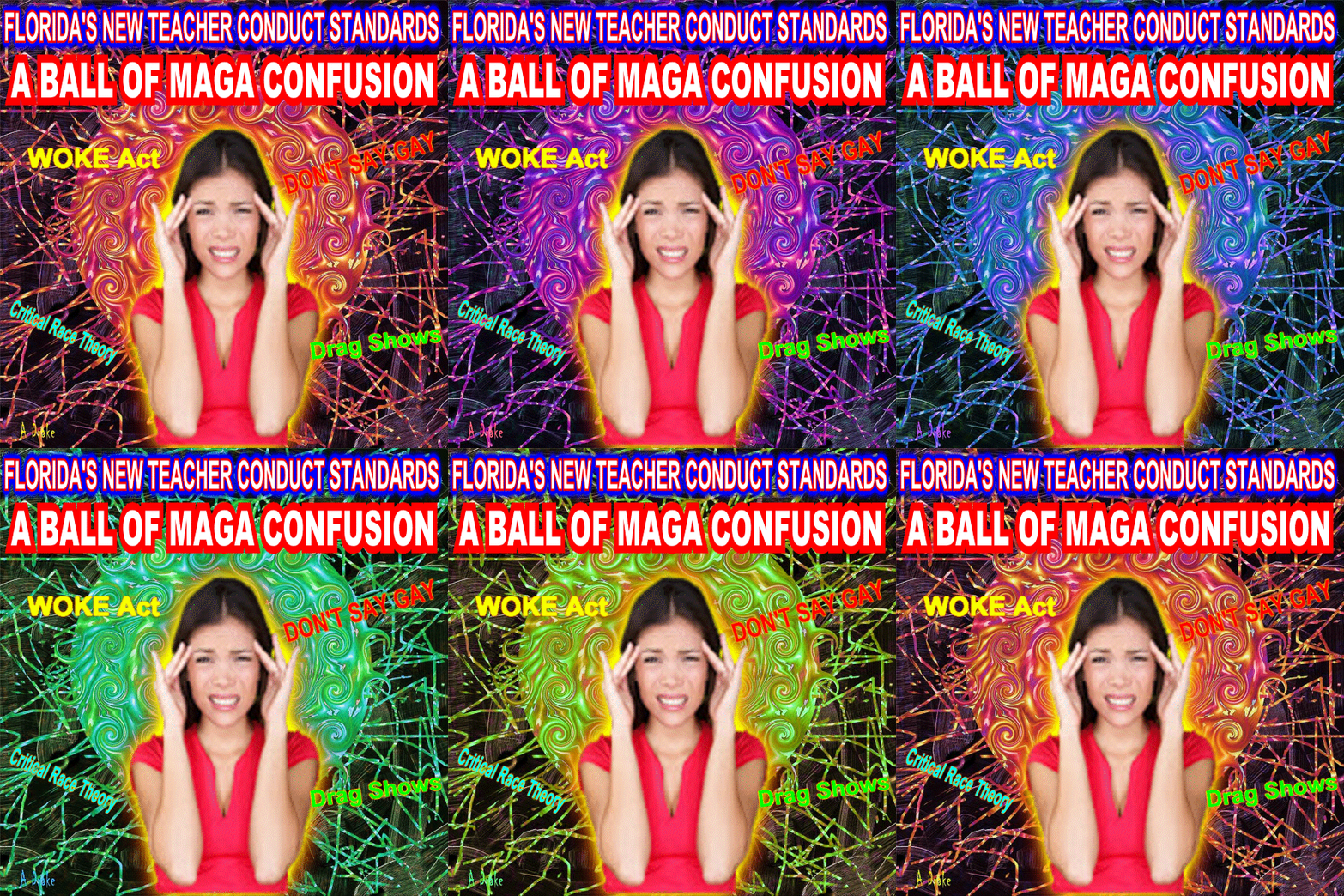
FLORIDA'S NEW TEACHER CONDUCT STANDARDS: A BALL OF MAGA CONFUSION


FLORIDA'S NEW TEACHER CONDUCT STANDARDS

A BALL OF MAGA CONFUSION 


In a recent move that has left many educators scratching their heads, the state of Florida has introduced a set of new professional conduct standards for teachers. These guidelines include a laundry list of prohibitions that range from the absurd to the downright offensive.

First on the list: don't say gay. Yes, you read that right. Teachers in Florida are now forbidden from even mentioning the word "gay" in their classrooms. Apparently, the state believes that acknowledging the existence of LGBTQ+ people is just too much for our delicate young minds to handle.

But it doesn't stop there. Teachers are also banned from using any nicknames for their students, no matter how endearing they may be. So if you've been calling little Timmy "T-Bone" all year, you better watch out.

And if you thought that was bad, get ready for this: teachers are now required to use the correct pronouns for their students, regardless of their gender identity. That's right, folks. In Florida, acknowledging someone's gender identity is now a punishable offense.

But wait, there's more! Florida teachers are also forbidden from teaching any history that might make white kids feel bad. That means no discussion of slavery, Jim Crow laws, or any other uncomfortable truths about America's past.

And if you thought climate change was a hot-button issue before, just wait until you hear this: teachers in Florida are now banned from teaching about it altogether. Apparently, the state believes that acknowledging the existence of climate change is just too controversial.

But perhaps the most ridiculous prohibition on this list is the ban on anything "woke." That's right, folks. In Florida, being aware of social and political issues is now a punishable offense.

And just in case you thought this couldn't get any more absurd, there's also a ban on Drag Queen Story Hour. Because apparently, reading a book to children while dressed in drag is just too scandalous for Florida's delicate sensibilities.

So what happens if a teacher violates any of these guidelines? According to Christie Gold from Hillsborough school district's HR department and the state's Educational Practices Commission, disciplinary measures could range from warnings to termination. But no penalty guidelines have been attached to the new language, leaving educators uncertain about the consequences of their actions.

The issue is further complicated by lawsuits related to the 2022 Florida law that restricts instruction about gender identity and sexual orientation in schools. Rob Kriete, the president of Hillsborough Classroom Teachers Association, believes that the laws and updated guidelines are part of a campaign to privatize education, making unions more important than ever before.

School district leaders in Florida are struggling to comply with these new education laws regarding gender issues, sex, library books, and race. The rules are vaguely worded, directives keep changing, and guidance from state officials is confusing. This confusion and dysfunction have bred mistrust among educators.

School district officials and educators in Florida are frustrated by the lack of clarity on compliance for topics like book selection, AP psychology, and gender identity lessons. The strained relationships between districts and the Department of Education have made it difficult for teachers to navigate these new guidelines.

The state officials of Florida have introduced a new version of the Principles of Professional Conduct for teachers that includes six new restrictions, adding to the existing laws and rules that govern classroom content. Teachers are becoming increasingly anxious about what they can say in their classrooms, and the penalties for any violations have become much tougher.

In conclusion, Florida's new teacher conduct standards are a ball of MAGA confusion. These guidelines are not only absurd but also offensive to many educators and students. It's time for the state to rethink these restrictions and start focusing on creating an inclusive and welcoming learning environment for all.

Educators: Penalties for violating new conduct guidelines are unclear | WUSF Public Media https://wusfnews.wusf.usf.edu/education/2023-09-13/new-professional-conduct-florida-guidelines-teachers-penalties-breaking-unclear 

Florida teachers face stiffer sanctions over classroom restrictions https://www.tampabay.com/news/education/2023/09/11/florida-teachers-face-stiffer-sanctions-over-classroom-restrictions/ 

Florida’s new edicts on schools keep changing, and locals are confused https://www.tampabay.com/news/education/2023/09/13/floridas-new-edicts-schools-keep-changing-locals-are-confused/ 

Big Education Ape: MAGA MADNESS FLORIDA TEACHERS CAUGHT IN THE CROSSFIRE https://bigeducationape.blogspot.com/2023/09/maga-madness-florida-teachers-caught-in.html 


WHEN BILLIONAIRES FUND 'MAGIC' CHARTER SCHOOL RESEARCH

WHEN BILLIONAIRES FUND 'MAGIC' CHARTER SCHOOL RESEARCH 

Ah, charter schools. The beloved darling of the billionaire class. They're like a shiny new toy that the super-rich just can't resist playing with. And why not? They get to feel like they're doing something good for society while also getting to pat themselves on the back for being so darn smart. It's a win-win!

But here's the thing: when billionaires fund research into charter schools, they miraculously always seem to get the exact results they paid for. It's like magic! And boy, is that some well-spent money.

Take, for example, a recent report by the National Education Policy Center. The report details the flaws in research conducted by pro-charter think tanks and academic departments. According to the report, these studies often claim that charters are underfunded compared to their district public school counterparts. But as it turns out, these claims are based on some seriously flawed methodology.

For one thing, these studies often compare individual schools to other individual schools, rather than looking at entire districts as a unit of analysis. This is like comparing apples to oranges, except even less useful. Additionally, these studies often make invalid comparisons of student populations and functions between charters and district public schools. And let's not forget about the unaccounted for charter revenues!

But fear not, dear reader. The National Education Policy Center has provided a handy guide for stakeholders to evaluate the accuracy and transparency of research. Because let's face it, we wouldn't want to make any decisions based on unsound research that could negatively impact district schools and state budgets.

So why do billionaires love charter schools so much? Well, for one thing, it's a way for them to feel like they're making a difference in the world without actually having to pay their fair share in taxes. And let's not forget about the ego boost they get from having their name plastered all over a shiny new charter school building.

But the real reason they love charter schools so much? Because they get to control them. That's right, when you're a billionaire, you get to play school superintendent. And who wouldn't want that kind of power?

Of course, there are some pesky little things like accountability and oversight that get in the way of total control. But hey, that's what all that "magic" research is for, right? To make sure that everything goes exactly according to plan.

So let's raise a glass to all the billionaires out there who are funding "magic" charter school research. Because without them, we might actually have to rely on sound evidence-based research to make decisions about education policy. And where's the fun in that?

Evaluating Research That Alleges Funding Disparities Between Charter and District Schools | National Education Policy Center https://nepc.colorado.edu/publication/funding-disparities 

CURMUDGUCATION: Report: The Flaws In Charter Funding Research https://curmudgucation.blogspot.com/2023/09/report-flaws-in-charter-funding-research.html 

Big Education Ape: RESEARCH MISCONDUCT: HOW STATE DEFUNDING AND PRIVATIZATION IS MAKING FOOLS OF US ALL https://bigeducationape.blogspot.com/2023/08/research-misconduct-how-state-defunding.html 

Tuesday, September 12, 2023

QUEEN FOR A DAY: AN EDUCATOR FOR LIFE


QUEEN FOR A DAY

AN EDUCATOR FOR LIFE

Ladies and gentlemen, boys and girls, gather around because we have a story that will make you laugh, cry and maybe even gasp a little. It's the tale of Shane Murnan, the principal of John Glenn Elementary School in Oklahoma, who also happens to be a drag queen named Shantel Mandalay.

Now, before you start clutching your pearls and fainting from shock, let me tell you that Shane/Shantel is a man of many talents. He's been working in public education in Oklahoma for 26 years and has been performing as Shantel for just as long. And let me tell you, he puts on a show that would make RuPaul herself proud.

But not everyone is a fan of Shane's alter ego. State Superintendent of Public Instruction Ryan Walters has been on Fox News twice in the past week to criticize Shane's side career as a drag queen. And some parents have even gone so far as to send him death threats. Can you believe it? Death threats over a man in a wig and heels.

But Shane isn't one to back down from a fight. He's defended himself and his art, saying that he's open about who he is and that performing as Shantel is a form of therapy and performance art. And let's be real, who doesn't love a good therapy session in sequins and feathers?

Now, some people have brought up a child pornography charge from 20 years ago that Shane had to explain. But he says that it was a result of bias against gay educators. And honestly, who among us hasn't been unfairly targeted because of who we are?

Despite all the backlash, Shane's school district has defended their hiring decision, stating that he has an outstanding reputation. And Shane himself has even paused his performances as Shantel, stating that his priority is his school and job.

But let me tell you, if I were a student at John Glenn Elementary School, I would be begging for a private performance from Shantel Mandalay. Can you imagine the looks on those kids' faces when their principal struts into the cafeteria in full drag? It would be like Christmas morning and Halloween combined.

So let's all raise a glass to Shane Murnan, aka Shantel Mandalay. Queen for a day, educator for life. May he continue to slay the education game and the drag game with equal fierceness. And may all the haters learn to live and let live (and maybe even learn to appreciate a good lip sync).

‘Very open with who I am’: Western Heights principal defends drag queen alter ego https://nondoc.com/2023/09/11/western-heights-principal-shane-murnan-drag-queen-shantel-mandalay/ via @nondocmedia 

Some support, others concerned about principal in Western Heights https://www.koco.com/article/oklahoma-western-heights-elementary-school-principal-board-meeting/45091612 

Community shares mixed reactions about embattled principal at Western Heights meeting | KOKH https://okcfox.com/news/local/community-shares-mixed-reactions-about-embattled-principal-at-western-heights-board-meeting-school-district-meeting-doctor-shane-murnan-council-grove-elementary-libs-of-tiktok-state-superintendent-ryan-walters-drag-queen-child-pornography-charges 


Ryan Walters calls for drag queen principal to be fired | Fox News Video https://www.foxnews.com/video/6336759708112 

RYAN WALTERS THE MAD MAGA MONK OF OK ED PROMISES MAGA INDOCTRINATION FOR EVERY KID IN OKLAHOMA


RYAN WALTERS THE MAD MAGA MONK OF OK ED

PROMISES MAGA INDOCTRINATION FOR EVERY KID IN OKLAHOMA

Ladies and gentlemen, hold onto your hats (or MAGA caps, if you prefer) because we have a new hero in town. Meet Ryan Rasputin Walters, the Mad MAGA Monk of Oklahoma Education and Superintendent of Public Instruction. 

This guy is a real hoot. Just last Sunday, he spoke to a crowd in Tulsa and declared that PragerU content will be in every school instead of just being an option. I mean, who needs freedom of choice when you can have propaganda shoved down your throat, am I right? 

But let's take a closer look at what kind of content PragerU is peddling. According to some reports, PragerU Kids is promoting denialism of climate change, colonialism, and even slavery. Yup, you read that right. Apparently, they think that slavery wasn't all that bad and that colonialism was actually a good thing. 

Now, I don't know about you, but I think it's safe to say that this kind of thinking belongs in the garbage bin of history along with mullets and shoulder pads. But apparently, Ryan Walters thinks differently. Maybe he's been hitting the communion wine a little too hard. 

And speaking of questionable decisions, let's talk about Ben Sasse. This former senator of Nebraska and current president of the University of Florida has been making some interesting choices lately. For one thing, he's been hiring McKinsey consultants left and right. Because nothing says "I care about education" like bringing in a bunch of corporate suits to tell you how to run things. 

But that's not all. Ben has also been promoting DeSantis' "reform" agenda. You know, the one that's been causing all kinds of controversy and outrage? Yeah, that one. It's almost like he's trying to set himself up for failure. 

Look, I don't want to be too hard on these guys. After all, they're just trying to do what they think is best for their states and their country. But when your idea of "best" involves denying climate change and promoting slavery, maybe it's time to take a step back and reevaluate your priorities. 

In the meantime, I'll be over here with my popcorn, watching the show and laughing my head off. Because let's face it, sometimes the only way to deal with the madness is to laugh at it. And with guys like Ryan Walters and Ben Sasse in charge, we'll never run out of material.

Walters Says PragerU Will Be In 'Every School' https://www.newson6.com/story/64ff9889b41d320705361e33/walters-says-prageru-will-be-in-every-school 

Two Grim Education Stories: Ben Sasse at University of Florida and Public Schools and PragerU https://www.esquire.com/news-politics/politics/a45086438/prageru-schools-curriculum-florida-oklahoma/ 

Big Education Ape: OKLAHOMA APPROVES PRAGERU (PU) FOR SCHOOLS: WILL REPLACE HISTORY BOOKS WITH MAGA COLORING BOOKS https://bigeducationape.blogspot.com/2023/09/oklahoma-approves-prageru-pu-for.html 

Big Education Ape: WHAT IS THE PRAGERU CURRICULUM AND OF COURSE FLORIDA APPROVES USE IN SCHOOLS https://bigeducationape.blogspot.com/2023/07/what-is-prageru-curriculum-and-of.html 

Big Education Ape: GET YOUR DAILY DOSE OF BS EDUCATION AT PRAGERU https://bigeducationape.blogspot.com/2023/08/get-your-daily-dose-of-bs-education-at.html 

CHARTER SCHOOL GIRLS TICKET TO RIDE: THE PURPLE MENSTRUAL PASS

CHARTER SCHOOL GIRLS TICKET TO RIDE

THE PURPLE MENSTRUAL PASS 

In the wacky world of charter schools, where rules can be as unpredictable as a chameleon on roller skates, one school in San Antonio, Texas has taken the concept of bathroom passes to a whole new level. Brace yourselves, folks, because we're about to dive into the absurdity that is Great Hearts Western Hills.

Now, let's start with the basics. Bathroom passes are a common sight in schools across the globe. They're usually simple slips of paper that grant students the freedom to relieve themselves when nature calls. But at Great Hearts Western Hills, they've decided to spice things up a bit. Instead of plain old white passes, they've gone for a vibrant purple color. And if that wasn't enough to make you scratch your head in confusion, get ready for this - these purple passes are specifically for female students during their menstrual cycle.

Yes, you read that right. The school has introduced what they call "menstrual passes." These purple slips of paper come complete with a Shakespearean sonnet printed on them. Because nothing says "I need to go to the bathroom" like a beautifully crafted verse from the Bard himself. I can just imagine a student reciting, "Shall I compare thee to a summer's day? Forsooth, I must away to the loo without delay!"

Now, the school claims that these menstrual passes were implemented to tackle the rampant abuse of bathroom access. Apparently, students were taking advantage of their bathroom privileges left, right, and center. But here's the thing - why should girls be singled out for having to use a bathroom pass during their time of the month? It's like saying, "Hey ladies, we know you're going through a natural bodily function, so here's a slip of paper to remind you that you're different and should be ashamed of it." Talk about adding insult to injury!

And let's not forget the awkwardness factor. Imagine being a teenage girl and having to explain to your teacher that you need to use the bathroom because Aunt Flo is visiting. It's cringe-worthy enough as it is, but now they have to whip out their purple pass and recite a Shakespearean sonnet just to justify their bodily functions. I can already picture the uncomfortable silence that follows as the teacher tries to process what just happened.

But wait, there's more! The school also sent an email to parents outlining their bathroom policy. Apparently, each student is entitled to four passes per quarter. But here's where it gets really interesting - girls on campus were given an additional colored slip of paper that grants them unlimited bathroom access. Yes, you heard me right. Unlimited bathroom access. It's like they're saying, "We know it's tough being a girl, so here's your golden ticket to the porcelain throne."

Now, I can't help but wonder what other crazy rules exist in this charter school. Do they have a chartreuse pass for students with indigestion? Or maybe a neon pink pass for those who need a break from quadratic equations? The possibilities are endless!

In all seriousness though, it's important to address the underlying issues here. Girls should never feel ashamed or singled out because of their bodies. They should have the freedom to use the bathroom whenever they need to, regardless of their menstrual cycle. And let's be real - students will always find a way to abuse any system, even with these so-called menstrual passes.

So, Great Hearts Western Hills, let's take a step back and reevaluate these crazy charter school rules. Let's create an environment where all students feel comfortable and respected, without the need for purple passes or Shakespearean sonnets. And hey, if you're ever in need of some wacky bathroom pass ideas, I'm just a phone call away. I've got a whole rainbow of colors and literary quotes ready for you!

Until then, let's flush away these ridiculous rules and embrace a world where bathroom breaks are as simple as answering nature's call. And remember, folks, when life hands you purple passes, just laugh it off and keep on rolling - because sometimes, you've just got to find humor in the absurdity!

Texas charter school issues menstrual passes for students https://www.mysanantonio.com/news/local/article/san-antonio-schools-bathroom-pass-18360218.php 


Monday, September 11, 2023

HAVING 'THE MAN' ON CAMPUS: COPS DOING THE JOB OR WINDOW DRESSING


POLICE IN SCHOOLS

COPS DOING THE JOB OR WINDOW DRESSING

Ah, school. A place of learning, growth, and the occasional dodgeball to the face. But in recent years, schools across the United States have seen an increase in something far more alarming than a rogue rubber ball: gunfire. And in response, many districts have turned to an unlikely solution – the good old boys in blue.

Yes, ladies and gentlemen, police officers have found their way back into our hallowed halls of education. But are they really keeping our children safe, or are they just using their handcuffs as a fashion accessory? Let's dive deep into this issue, shall we?

Proponents of police in schools argue that their presence improves safety. After all, who wouldn't feel safer with Officer Friendly patrolling the hallways? But let's not forget, folks, that we're talking about schools here, not maximum-security prisons. Do we really need armed officers to protect us from rogue spitballs and stolen lunch money?

And let's not overlook the potential for positive relationships between law enforcement and students. Sure, Officer Bob might be great at solving crimes, but can he solve the mystery of why Billy can't find his homework? Perhaps we should be focusing on hiring more counselors who can navigate the treacherous waters of teenage angst, rather than relying on Officer Bob to break up a fight over who gets the last chicken nugget.

But what about prevention and intervention? Surely having police officers in schools can help deter substance abuse, bullying, and gang activity. Well, folks, I hate to break it to you, but Officer Bob is no match for the allure of a forbidden vape pen or the cunning tactics of a middle school bully. Maybe we should be investing in more resources for mental health support and counseling, rather than expecting Officer Bob to single-handedly save the day.

Now, let's talk about the cons of having police in schools. First up, we have the issue of disproportionate discipline. Studies have shown that having police officers in schools increases the likelihood of suspensions and arrests, especially for students of color. So not only are we subjecting our children to the horrors of algebra, but we're also setting them up for a future behind bars. Talk about a double whammy.

And let's not forget about the negative interactions that can occur between law enforcement and students. Picture this: Officer Bob is having a bad day because he spilled coffee on his freshly pressed uniform. Little Timmy accidentally bumps into him in the hallway, and suddenly Officer Bob is barking orders and making Timmy feel like he's auditioning for an episode of "Cops." It's not exactly the kind of interaction that fosters trust and respect.

But perhaps the most compelling argument against police in schools is the opportunity cost. By investing in more officers, we're diverting resources away from other educational programs that could benefit students more. Imagine if we used that money to hire more counselors, nurses, social workers, or teachers. We could create an environment where students feel supported academically and emotionally, rather than feeling like they're one step away from being handcuffed.

So, folks, what's the verdict? Are police officers in schools the heroes we need, or are they just causing more harm than good? It's a tough question with no easy answer. But one thing's for sure – we need to start prioritizing the well-being of our students over the illusion of safety.

So let's put down our handcuffs and pick up our thinking caps. Let's invest in mental health services, counseling programs, and resources that truly make a difference in our children's lives. And maybe, just maybe, we'll find that the real superheroes were inside us all along.

Now if you'll excuse me, I have an urgent appointment with the cafeteria's tater tots. It's a matter of national security – or at least my stomach thinks so. Stay safe out there, folks!

Disclaimer: The views and opinions expressed in this article are purely for comedic purposes and do not reflect the views or opinions of any law enforcement agencies or educational institutions. We take no responsibility for any food cravings induced by reading this article.

More school districts are bringing back or adding police. Will it help? https://www.usatoday.com/story/news/education/2023/09/11/more-school-districts-are-bringing-back-or-adding-school-resource-officers/70731118007/ 


THE DEFT DIVE


Pros and cons of police in schools, based on the web search results

**Pros of police in schools:**

  • - Improved safety: Having police in schools can deter crime and violence, and provide an immediate response to emergencies or security threats. This can help to create a safer environment for students, staff, and visitors⁴⁵.
  • - Positive relationships: Police in schools can foster positive relationships between law enforcement and students, especially if they are trained in youth development and conflict resolution. Police can also serve as mentors, role models, and educators for students, and help them develop civic skills and values⁴⁵.
  • - Prevention and intervention: Police in schools can help prevent and intervene in situations involving substance abuse, bullying, gangs, or mental health issues. They can also provide referrals to social services or counseling for students who need support⁴⁵.

**Cons of police in schools:**

  • - Disproportionate discipline: Police in schools can contribute to the school-to-prison pipeline, which is the process of criminalizing minor misbehavior that would otherwise be handled by school staff. Studies have shown that the presence of police in schools increases the likelihood of suspensions and arrests, especially for students of color, who are disproportionately targeted by school police¹²³.
  • - Negative interactions: Police in schools can create negative interactions between law enforcement and students, especially if they are not trained or supervised properly. Some students may feel intimidated, harassed, or violated by police, which can undermine their trust and respect for authority figures²³.
  • - Opportunity costs: Police in schools can divert resources away from other educational or preventive programs that could benefit students more. For example, hiring more counselors, nurses, social workers, or teachers could provide more academic and emotional support for students, and reduce the need for police intervention²³.

Bing, 9/11/2023

  • (1) Pros and Cons of Police in Schools - Benefits and Drawbacks. https://prosconss.com/pros-and-cons-of-police-in-schools.
  • (2) 20 Pros and Cons of Police in Schools 2023 - Ablison. https://www.ablison.com/pros-and-cons-of-police-in-schools/.
  • (3) What research shows about police in schools - Chalkbeat. https://www.chalkbeat.org/2020/6/23/21299743/police-schools-research.
  • (4) Do police belong in schools? | Pro/Con - Inquirer.com. https://www.inquirer.com/opinion/commentary/police-reforms-school-resource-officers-20200626.html.
  • (5) The Pros and Cons of Policing Schools: Alternatives to ... - Collegenp. https://www.collegenp.com/article/the-pros-and-cons-of-policing-schools/.


MAGA MADNESS FLORIDA TEACHERS CAUGHT IN THE CROSSFIRE


MAGA MADNESS FLORIDA

TEACHERS CAUGHT IN THE CROSSFIRE

In a move that has left many Florida educators feeling like they don't know whether to "shit or go blind," Governor Ron DeSantis has announced a slew of new MAGA-inspired rules that are leaving teachers scratching their heads. But the ACLU is fighting back, with a lawsuit aimed at protecting free speech in the classroom.

The new rules, which have been added to the Principles of Professional Conduct, are leaving many teachers feeling like they're walking on eggshells. From prohibitions on discussing systemic racism to tough penalties for violations, it's clear that DeSantis is taking a page out of Trump's playbook when it comes to cracking down on free speech.

But the ACLU isn't taking this lying down. In a lawsuit filed against Florida's "Individual Freedom Act," the organization is fighting to protect the rights of teachers and students alike. And they're not alone. Educators across the state are speaking out against the new rules, with many saying that they're having a chilling effect on classroom discussions.

Dr. Dana Thompson Dorsey, an Associate Professor of Educational Leadership and Policy Studies at the University of South Florida in Tampa, is one of those educators. She says that the new law distorts history by limiting what can and cannot be taught. "We can't just sweep issues like systemic racism under the rug," she says. "We need to have open and honest discussions about these topics if we're ever going to make progress."

Student activist Johana Dauphin agrees. She believes that school should be a place where students are encouraged to question their beliefs and explore diverse ideas. "If we're not allowed to discuss these issues in the classroom, where are we supposed to do it?" she asks.

But despite the pushback from educators and activists, DeSantis seems determined to continue down this path. In fact, he's even gone so far as to say that he can "out stupid" Trump when it comes to MAGA laws. It's a statement that has left many wondering just how far he's willing to go.

So what does this all mean for Florida's teachers and students? Well, for now, it means that they'll have to tread carefully when it comes to discussing certain topics in the classroom. But with the ACLU fighting back and educators speaking out, there's hope that free speech will ultimately prevail. As for DeSantis? Well, let's just say that he might want to think twice before trying to outdo Trump in the stupidity department.

Florida teachers face stiffer sanctions over classroom restrictions https://www.tampabay.com/news/education/2023/09/11/florida-teachers-face-stiffer-sanctions-over-classroom-restrictions/ 

Protecting Free Speech and the Right to Learn in Florida | ACLU https://www.aclu.org/news/free-speech/protecting-free-speech-and-the-right-to-learn-in-florida 

SCHOOL VOUCHERS: A RACIST WET DREAM

SCHOOL VOUCHERS

A RACIST WET DREAM

Are you tired of being educated? Do you hate the idea of learning new things? Well, good news! Both MAGA fascist and libertarian billionaires are working hard to defund public education and establish a two-tiered system of education in the US - one for the poor and another for the wealthy. And if you think this is just a conspiracy theory, think again.

The destruction of the public school system has long been the wet dream of racists since Brown v Board integrated our nation's schools. You may scoff at the idea that resegregation is the goal, but just look at the response of Prince Edward County in Virginia. This county was one of the most extreme cases of resistance to school desegregation in the United States.

Back in 1951, a group of black students at Robert Russa Moton High School, led by 16-year-old Barbara Johns, staged a walkout to protest the poor conditions of their school compared to the white school. They contacted the NAACP, which agreed to represent them in a lawsuit against the county school board, demanding equal facilities or integration. The case, Davis v. County School Board of Prince Edward County, was one of the five cases that were consolidated into Brown v. Board of Education, the landmark Supreme Court decision that declared segregated public schools unconstitutional in 1954.

However, the county did not comply with the court order to desegregate its schools. Instead, it joined the state's Massive Resistance campaign, a series of laws and policies enacted by Virginia's political leaders to prevent or delay integration. One of these laws was the Stanley Plan, which authorized the governor to close any public school that attempted to integrate and provided tuition grants for white students to attend private schools.

In 1959, after the federal courts struck down the Stanley Plan and ordered Prince Edward County to integrate its schools by September 1, the county chose to close its entire public school system rather than admit black students. The county also cut off local funding for public education and diverted it to a private, segregated academy that was established for white students. The academy received state tuition grants and tax credits from the county, making it essentially a publicly funded white school.

The closure of public schools left about 1,700 black students without access to education in the county. Some of them were able to attend schools in nearby counties or out of state with the help of relatives, friends, or organizations such as the American Friends Service Committee. Others attended makeshift schools in church basements or community centers, run by volunteers and funded by donations. But many black children missed part or all of their education for five years.

The situation in Prince Edward County drew national and international attention and condemnation. President John F. Kennedy called it "a serious blow to our efforts to advance the principles of freedom and equality" in a speech to Congress in 1963. Civil rights activists such as Martin Luther King Jr., Roy Wilkins, and Oliver Hill visited the county and held rallies and marches to support the black community. Journalists such as Edward R. Murrow and Carl Rowan reported on the plight of the black students and exposed the injustice of the county's actions.

The legal battle to reopen the public schools continued until 1964 when the Supreme Court ruled in Griffin v. County School Board of Prince Edward County that the county's actions violated the Equal Protection Clause of the Fourteenth Amendment and ordered it to resume public education immediately. The court also declared that state tuition grants for private schools were unconstitutional if they fostered racial discrimination. The county finally reopened its public schools on an integrated basis in September 1964, ending five years of educational deprivation for black children.

But here's the thing - racism never really went away. And now, it's rearing its ugly head once again in red states across America. Both MAGA fascist and libertarian billionaires are pushing hard to defund public education and establish a two-tiered system of education - one for the poor and another for the wealthy, one of color and one white.

The destruction of public education is being disguised as "school voucher schemes" - a seemingly innocuous term that actually means taking money away from public schools and giving it to private schools that are often segregated and discriminatory. And who benefits from this? The wealthy, white elite who can afford to send their children to these private schools.

This is not just a problem in red states either. Even blue states like California are facing challenges with charter schools - publicly funded schools that operate independently from traditional public schools and often have less oversight and accountability.

So what can we do about it? Well, for starters, we can call out these billionaires for what they are - racists who are trying to destroy public education and create a two-tiered system that benefits only them. We can also support our local public schools by attending school board meetings, volunteering, and donating money or supplies.

Education is a fundamental right for all Americans, regardless of race or socioeconomic status. Let's not allow racism to win again. Let's fight for quality education for all.

Why the school choice movement is finally scoring breakthrough wins in the Biden era - Vox https://www.vox.com/politics/23689496/school-choice-education-savings-accounts-american-federation-children 


THE DEFT DIVE

FROM BING AI

Segregation and Vouchers

- Segregation and vouchers are two terms that are often linked in the history and debate of school choice policies in the United States. School vouchers are a form of public funding that allows parents to send their children to private schools of their choice, instead of attending public schools assigned by their residence.

  • - One of the earliest and most notorious uses of school vouchers was to resist racial integration in public schools after the Supreme Court's decision in Brown v. Board of Education (1954), which declared segregated public schools unconstitutional. Some southern states adopted voucher schemes to enable white students to attend private schools, often called segregation academies, that excluded black students¹³. One example was Prince Edward County in Virginia, which closed its public schools for five years (1959-1964) and provided vouchers for white students only¹.
  • - The modern voucher movement, however, has a different origin and rationale. It is largely influenced by the economic theory of Milton Friedman, who advocated for parental school choice as a way to improve the efficiency and quality of public education by introducing market competition². The first urban voucher program was established in Milwaukee, Wisconsin, in 1990, with the aim of providing low-income families with more options for their children's education².
  • - The empirical evidence on the effects of school vouchers on segregation is mixed and inconclusive. Some studies have found that vouchers increase racial or socioeconomic segregation in public schools, by allowing more advantaged students to exit the system and enroll in more homogeneous private schools⁴. Other studies have found that vouchers have little or no impact on segregation, or even reduce it, by allowing more disadvantaged students to access more diverse private schools².
  • - The political debate on school vouchers is also polarized and partisan. Supporters of vouchers argue that they enhance parental choice, foster competition and innovation, and provide opportunities for disadvantaged students. Opponents of vouchers contend that they drain resources from public schools, violate the separation of church and state, and increase segregation and inequality². The legal status of vouchers also depends on the interpretation of federal and state constitutional provisions regarding education and religion².

Bing, 9/11/2023

  • (1) The Racist Origins of Private School Vouchers. https://www.americanprogress.org/article/racist-origins-private-school-vouchers/.
  • (2) School voucher - Wikipedia. https://en.wikipedia.org/wiki/School_voucher.
  • (3) School Vouchers and Race: It’s Complicated - The Century Foundation. https://tcf.org/content/commentary/school-vouchers-race-complicated/.
  • (4) Do Private School Vouchers Pose a Threat to Integration?. https://tcf.org/content/report/private-school-vouchers-pose-threat-integration/.
  • (5) Housing Choice Voucher Discrimination. https://socialinnovation.usc.edu/wp-content/uploads/2021/04/Housing-Choice-Voucher-Discrimination-1.pdf.

Prince Edward County in Virginia was one of the most extreme cases of resistance to school desegregation in the United States. Here is a deep dive into what happened and why:

  • - The county's involvement in the desegregation issue began in 1951, when a group of black students at Robert Russa Moton High School, led by 16-year-old Barbara Johns, staged a walkout to protest the poor conditions of their school compared to the white school¹. They contacted the NAACP, which agreed to represent them in a lawsuit against the county school board, demanding equal facilities or integration. The case, Davis v. County School Board of Prince Edward County, was one of the five cases that were consolidated into Brown v. Board of Education, the landmark Supreme Court decision that declared segregated public schools unconstitutional in 1954¹².
  • - However, the county did not comply with the court order to desegregate its schools. Instead, it joined the state's Massive Resistance campaign, a series of laws and policies enacted by Virginia's political leaders to prevent or delay integration. One of these laws was the Stanley Plan, which authorized the governor to close any public school that attempted to integrate, and provided tuition grants for white students to attend private schools²³.
  • - In 1959, after the federal courts struck down the Stanley Plan and ordered Prince Edward County to integrate its schools by September 1, the county chose to close its entire public school system rather than admit black students. The county also cut off local funding for public education and diverted it to a private, segregated academy that was established for white students. The academy received state tuition grants and tax credits from the county, making it essentially a publicly funded white school²³⁴.
  • - The closure of public schools left about 1,700 black students without access to education in the county. Some of them were able to attend schools in nearby counties or out of state with the help of relatives, friends, or organizations such as the American Friends Service Committee. Others attended makeshift schools in church basements or community centers, run by volunteers and funded by donations. But many black children missed part or all of their education for five years²³⁴.
  • - The situation in Prince Edward County drew national and international attention and condemnation. President John F. Kennedy called it "a serious blow to our efforts to advance the principles of freedom and equality" in a speech to Congress in 1963². Civil rights activists such as Martin Luther King Jr., Roy Wilkins, and Oliver Hill visited the county and held rallies and marches to support the black community. Journalists such as Edward R. Murrow and Carl Rowan reported on the plight of the black students and exposed the injustice of the county's actions²⁴.
  • - The legal battle to reopen the public schools continued until 1964, when the Supreme Court ruled in Griffin v. County School Board of Prince Edward County that the county's actions violated the Equal Protection Clause of the Fourteenth Amendment and ordered it to resume public education immediately. The court also declared that state tuition grants for private schools were unconstitutional if they fostered racial discrimination²³. The county finally reopened its public schools on an integrated basis in September 1964, ending five years of educational deprivation for black children²⁴.
  • - The legacy of Prince Edward County's school closings is still evident today. Many of the black students who were affected by the closings suffered long-term consequences in terms of their academic achievement, career opportunities, and mental health. Some of them have shared their stories in books, documentaries, and oral histories²⁴. The county's public schools remain largely segregated by race and class, as most white students still attend private schools or homeschooling. The county also faces challenges in providing quality education and addressing racial disparities and tensions²⁴.

Bing, 9/11/2023

  • (1) The County That Closed Its Public Schools Rather Than ... - Time. https://time.com/5277732/brown-board-education-prince-edward-county/.
  • (2) The Closing of Prince Edward County's Schools | Virginia Museum of .... https://virginiahistory.org/learn/civil-rights-movement-virginia/closing-prince-edward-countys-schools.
  • (3) When a Va. county closed its schools rather than admit black students. https://bing.com/search?q=Prince+Edward+County+in+Virginia%2c+which+closed+its+public+schools+for+five+years+%281959-1964%29+and+provided+vouchers+for+white+students+only.
  • (4) Prince Edward County School Closings - Moton Museum. https://motonmuseum.org/learn/prince-edward-county-school-closings/.
  • (5) The Forgotten School in Brown v. Board of Education. https://www.theatlantic.com/education/archive/2014/05/forgotten-school-in-brown-v-board/371026/.

School vouchers are a controversial policy that allow parents to use public funds to pay for private school tuition. The history of school vouchers in the United States is complex and intertwined with issues of race, religion, and politics. Here is a brief overview of some key events and debates in the history of school vouchers:

  • - The origin of the modern voucher movement can be traced to the Nobel laureate Milton Friedman’s defense of parental school choice in The Role of Government in Education (1955)². Friedman promoted vouchers as a way to spark competition, improve the efficiency of public school systems, and improve the actual performance of schools.
  • - However, the first voucher programs in the United States were not motivated by Friedman’s economic theory, but by resistance to racial integration. In the wake of the Brown v. Board of Education decision (1954), which declared segregated public schools unconstitutional, some southern states adopted voucher schemes to enable white students to attend private schools, often called segregation academies, that excluded black students¹⁴. One notorious example was Prince Edward County in Virginia, which closed its public schools for five years (1959-1964) and provided vouchers for white students only¹.
  • - The oldest extant school voucher programs in the United States are the Town Tuitioning programs in Vermont and Maine, beginning in 1869 and 1873 respectively³. These programs allow students who live in rural areas without public schools to attend either a secular private school or a public school in another district. However, these programs have also faced legal challenges for including religious schools as options for voucher recipients.
  • - The first modern urban voucher program was established in Milwaukee, Wisconsin, in 1990³. This program was designed to provide low-income families with tuition subsidies of up to $2,500 to attend private schools, initially only secular ones. In 1995, the Wisconsin legislature expanded the program to include religious schools, but this was challenged in court until 1998, when the Wisconsin Supreme Court upheld the program. Since then, the program has grown to serve more than 14,000 students in 2005-2006².
  • - Other publicly funded voucher programs have been implemented in Cleveland, Ohio (1995); Florida (1999); Washington, D.C. (2004); and Louisiana (2008)³. These programs vary in their eligibility criteria, funding levels, and accountability measures. Some of them target students with disabilities, students attending failing public schools, or students from low-income families. Some of them also require participating private schools to administer standardized tests, comply with anti-discrimination laws, or accept the voucher as full payment for tuition.
  • - The empirical evidence on the effects of school vouchers is mixed and inconclusive. Some studies have found positive effects on student achievement, parental satisfaction, or public school performance; others have found no effects or negative effects. The results depend on the design of the voucher program, the quality and diversity of private school options, and the methods and data used to evaluate the outcomes².
  • - The political debate on school vouchers is polarized and partisan. Supporters of vouchers argue that they enhance parental choice, foster competition and innovation, and provide opportunities for disadvantaged students. Opponents of vouchers contend that they drain resources from public schools, violate the separation of church and state, and increase segregation and inequality. The legal status of vouchers also depends on the interpretation of federal and state constitutional provisions regarding education and religion².

Bing, 9/11/2023

  • (1) School Vouchers | Encyclopedia.com. https://www.encyclopedia.com/social-sciences-and-law/education/education-terms-and-concepts/school-vouchers.
  • (2) The Racist Origins of Private School Vouchers. https://www.americanprogress.org/article/racist-origins-private-school-vouchers/.
  • (3) When Privatization Means Segregation: The History of School Vouchers. https://www.dissentmagazine.org/online_articles/private-school-vouchers-racist-history-milton-friedman-betsy-devos/.
  • (4) School voucher - Wikipedia. https://en.wikipedia.org/wiki/School_voucher.

Sunday, September 10, 2023

DIVINE INTERVENTION OR DIVINE COMEDY? THE CLT BRINGS GODLINESS TO YOUR STANDARDIZED TESTING EXPERIENCE

DIVINE INTERVENTION OR DIVINE COMEDY? THE CLT BRINGS GODLINESS TO YOUR STANDARDIZED TESTING EXPERIENCE

Attention all students! Get ready to say goodbye to the boring and mundane standardized tests you've been taking for years because the Classic Learning Test (CLT) is here to make testing great again! And by great, we mean godly.

That's right, folks. The CLT is not just any old test. It's a test that reflects a classical education, with questions based on great works of literature, philosophy, history, mathematics, and science. It's so great that it's even approved by white Jesus himself. Can we get an amen?

But wait, there's more. The CLT is not just any old test that you take in a stuffy classroom. You can take it online or in person. That's right, you can take this godly test from the comfort of your own home. You can even wear your holy robes if you want to.

Now, let's talk about the format of this divine test. It consists of 120 multiple-choice questions, divided into four sections: Verbal Reasoning, Grammar/Writing, Quantitative Reasoning, and Reading Comprehension. And don't worry, there's a time limit of two hours, so you won't have to spend all day praying to the testing gods.

But wait, there's even more. The CLT offers an optional essay section. That's right, you can show off your writing skills to the colleges that require it. And who knows, maybe your essay will be so good that it'll be canonized in the holy scriptures.

Now, let's talk about how you can prepare for this heavenly test. You can start by ordering the official CLT Student Guide for $19.99. This guide contains three full-length practice tests, essay prompts, and helpful information on the test content and format. And if you're a cheapskate, you can always take advantage of the free online practice tests for the CLT and the CLT10 (a preparatory exam for grades 9 and 10), which provide immediate results and answer explanations.

And if you really want to impress the testing gods, you can visit Clayborne Test Prep, a partner of CLT that provides individualized tutoring and self-study materials. Sure, it'll cost you a pretty penny, but isn't your eternal salvation worth it?

So there you have it, folks. The Classic Learning Test is here to make testing great again. And who knows, maybe one day you'll be able to boast to your grandkids that you took the godly test that was approved by white Jesus himself. But for now, let's just focus on passing this test so we can get into college and start our journey towards enlightenment. And don't forget to send in your 20 bucks to the testing gods. They need to pay their heavenly bills too.

Florida accepts conservative and Christian-backed test as alternative to the SAT : NPR https://www.npr.org/2023/09/10/1198638538/what-to-know-classic-learning-test-florida-sat-act-colleges 


THE DEFT DIVE

FROM BING AI

The Classic Learning Test (CLT) is a standardized test that evaluates the academic skills and knowledge of students in grades 11 and 12 who are seeking admission to colleges and universities. The CLT is designed to reflect a classical education, with questions based on great works of literature, philosophy, history, mathematics, and science. The CLT is an alternative to other college entrance exams such as the SAT and ACT, and it is accepted by over 250 colleges and universities in the US and abroad. ¹

The CLT consists of 120 multiple-choice questions, divided into four sections: Verbal Reasoning, Grammar/Writing, Quantitative Reasoning, and Reading Comprehension. The test has a time limit of two hours, and it can be taken online or in person. The CLT is scored on a scale of 0 to 120, with each section contributing 30 points to the total score. The CLT also offers an optional essay section, which is scored separately by the colleges that require it. ²

To prepare for the CLT, you can take advantage of the following resources:

  • - The official CLT Student Guide, which contains three full-length practice tests, essay prompts, and helpful information on the test content and format. You can order the guide from the CLT website for $19.99. ³
  • - The free online practice tests for the CLT and the CLT10 (a preparatory exam for grades 9 and 10), which provide immediate results and answer explanations. You can access the practice tests through your free CLT account. ⁴
  • - The example test for the CLT, which gives you a feel for what the CLT platform is like. This is not a graded test, but it can help you familiarize yourself with the software and the types of questions to expect. You can take the example test without creating an account. ⁵
  • - The additional resources and support offered by Clayborne Test Prep, a partner of CLT that provides individualized tutoring and self-study materials. You can visit their website to learn more about their services and fees. ⁶

Bing, 9/10/2023

  • (1) Classic Learning Test (CLT) - Suite of Assessments for Grades 3-12. https://www.cltexam.com/.
  • (2) Classic Learning Test - Wikipedia. https://en.wikipedia.org/wiki/Classic_Learning_Test.
  • (3) Classic Learning Test (CLT) - Association of Christian Schools .... https://your.acsi.org/CLT.
  • (4) CLT Practice Test (2023) - Mometrix Test Preparation. https://www.mometrix.com/academy/clt-practice-test/.
  • (5) Cross-Laminated Timber (CLT) | CLT Disadvantages and Advantages. https://www.timberblogger.com/cross-laminated-timber/.
  • (6) Benefits and risks of building with Cross Laminated Timber. https://axaxl.com/fast-fast-forward/articles/benefits-and-risks-of-building-with-cross-laminated-timber.
  • (7) Advantages and disadvantages of CLT - Methods of Language Teaching. https://mkhaledbh.wordpress.com/2015/11/14/advantages-and-disadvantages-of-clt/.
  • (8) Community Land Trust: Meaning, Pros and Cons, Example - Investopedia. https://www.investopedia.com/community-land-trust-5206374.
  • (9) What You Should Know About Cross-Laminated Timber Construction. https://blog.strongtie.com/what-you-should-know-about-cross-laminated-timber-construction/.
  • (10) All there is to know about Cross-laminated timber (CLT) - Pro Arkitects. https://www.proarkitects.co.uk/all-there-is-to-know-about-cross-laminated-timber-clt/.
  • (11) Take a CLT Practice Exam - Classic Learning Test. https://www.cltexam.com/tests/practice-test/.
  • (12) See an Example Test for the Classic Learning Test (CLT). https://www.cltexam.com/tests/example-test/.
  • (13) CLT Exam Questions and Answers PDF – InstaPDF. https://instapdf.in/clt-exam-questions-and-answers/.
  • (14) The CLT10 – College Preparatory Exam – Classic Learning Test. https://www.cltexam.com/tests/clt-10/.
  • (15) Test Preparation for the CLT. https://www.cltexam.com/tests/test-prep/.
  • (16) How to Prepare for CLAT 2024: Check Section-Wise ... - Collegedunia. https://collegedunia.com/exams/clat/preparation-tips.
  • (17) CLAT Exam Preparation Tips 2024: Study Material, Best Books ... - Shiksha. https://www.shiksha.com/law/clat-exam-preparation.
  • (18) CLAT GK Preparation Tips & Strategy 2024 by LegalEdge - Toprankers. https://www.toprankers.com/clat-gk-preparation-tips.
  • (19) Official CLT Study Guide for Students - Classic Learning Test (CLT). https://www.cltexam.com/tests/student-guide/.

NORTH CAROLINA STATE BOARD OF EDUCATION TO CHARTER SCHOOLS: YOU'RE NOT THE BOSS OF US


NORTH CAROLINA STATE BOARD OF EDUCATION TO CHARTER SCHOOLS YOU'RE NOT THE BOSS OF US

In a move that has left charter school advocates scratching their heads, the North Carolina State Board of Education has told the Charter Schools Advisory Board to "slow your roll" and stop trying to destroy public education on their watch. In a statement that was equal parts stern and sassy, the board reminded the advisory panel that they are not in charge of giving away public money to charter schools, and that they should check with the State Board of Education before approving any such funds.

The move comes amidst growing concerns that the North Carolina legislature, which is currently controlled by MAGA supporters, is doing everything it can to privatize the state's public schools. With the number of charter schools in the state set to double over the next decade, many fear that traditional public schools will be left behind, with fewer resources and less support.

But it's not all fun and games. The State Board of Education is serious about its mission to protect public education in North Carolina. With the new policy, they hope to regain control over the charter school approval process, ensuring that only those schools that meet their rigorous standards receive state and federal funding.

Of course, not everyone is thrilled about this new development. Charter school advocates have accused the State Board of Education of trying to limit their growth and innovation, while lawmakers have questioned the legality of the new policy. But for now, the State Board of Education seems determined to keep fighting for what they believe is best for North Carolina's students.

In the end, only time will tell who will come out on top in this battle between traditional public schools and charter schools. But one thing is for sure: with the State Board of Education leading the charge, it's going to be one heck of a ride.

NC board reasserts funding control over charter schools after losing other powers | WLOS https://wlos.com/news/local/north-carolina-board-reasserts-funding-control-over-charter-schools-after-losing-other-powers 


THE DEFT DIVE

FROM BING AI

According to the web search results, the State Board of Education in North Carolina has approved a policy that seeks to regain control over charter schools after the General Assembly shifted decision-making for approving these nontraditional public schools to a panel filled with mostly legislative appointees. The policy, which was adopted on June 3, 2021, states that the board will review and approve all charter school applications, renewals, and revisions, as well as monitor the performance and compliance of charter schools. The policy also clarifies the roles and responsibilities of the board, the Department of Public Instruction, and the Charter Schools Advisory Board, which is the panel created by the legislature in 2013 to review and recommend charter school applications.

The policy is a response to a series of legislative changes that have expanded the number and autonomy of charter schools in North Carolina, while reducing the oversight and accountability of the State Board of Education. Some of these changes include:

  • - Removing the cap on the number of charter schools in the state, which has increased from 100 in 2011 to 200 in 2021.
  • - Allowing charter schools to enroll up to 20% more students than their approved enrollment without seeking board approval.
  • - Exempting charter schools from participating in the state's teacher evaluation system and from following the state's curriculum standards.
  • - Allowing charter schools to receive a share of local tax revenue from county commissioners without having to comply with local school board policies.
  • - Creating a separate Charter School Teacher Licensure Commission to issue licenses to charter school teachers without requiring them to meet the same standards as public school teachers.

The State Board of Education argues that these changes have undermined its constitutional authority to supervise and administer the public school system, and have created a dual system of education that is inequitable and inefficient. The board also claims that the Charter Schools Advisory Board has been biased and inconsistent in its recommendations, and has failed to ensure quality and diversity among charter schools. The board hopes that the new policy will restore its role as the final authority on charter schools, and will improve the transparency and accountability of the charter school sector. However, some charter school advocates and lawmakers have criticized the policy as an attempt to limit the growth and innovation of charter schools, and have questioned its legality under the existing statutes. It is possible that the policy will face legal challenges or further legislative action in the future.

Bing, 9/10/2023

  • (1) Legislation/Policy | NC DPI. https://www.dpi.nc.gov/students-families/alternative-choices/charter-schools/legislationpolicy.
  • (2) Charter Schools | NC DPI. https://www.dpi.nc.gov/students-families/alternative-choices/charter-schools.
  • (3) Charter schools in North Carolina - Ballotpedia. https://ballotpedia.org/Charter_schools_in_North_Carolina.

Saturday, September 9, 2023

UTAH'S SPECTRUM ACADEMY: ANOTHER CHARTER SCHOOL SCANDAL (NUMBER 1,666,666)

UTAH'S SPECTRUM ACADEMY: ANOTHER CHARTER SCHOOL SCANDAL (NUMBER 1,666,666)

In the latest episode of "Charter School Scandal," we have Utah's Spectrum Academy taking center stage. This charter school for children with Autism Spectrum Disorders has been federally investigated for classroom-related civil rights concerns, and let's just say, it's not looking good for them.

The investigation found that the school violated Section 504 of Title II of the Civil Rights Act by repeatedly using restraint and seclusion practices on its students. Now, I don't know about you, but I thought we left those practices back in the medieval times. Apparently, Spectrum Academy missed the memo.

But wait, it gets better (or worse, depending on how you look at it). The Office for Civil Rights (OCR) found that these practices took time away from students' education. So not only were these kids being subjected to archaic forms of punishment, but they were also missing out on valuable learning time. Talk about a double whammy.

And as if that wasn't bad enough, the school failed to provide compensatory resources to make up for the lost classroom time. So not only were these kids being punished unnecessarily, but they were also being cheated out of their education. Bravo, Spectrum Academy. Bravo.

But fear not, dear readers, justice has been served. The school has agreed to implement significant changes to its policies, procedures, and training requirements. And they've also agreed to provide individual remedies for students who experienced restraint during that time. So I guess that's something.

Now, I know what you're thinking. "This is just one charter school. It can't be that bad." Well, my friend, you couldn't be more wrong. If charter schools aren't stealing public funds, committing fraud, or engaging in corruption, they're abusing kids too. It's like a never-ending cycle of scandal and controversy.

Don't believe me? Check out the Network for Public Education's "Another Day Another Charter Scandal" page. They've even got a sorting feature that allows you to search charter scandals by state and by 12 different categories. It's like a buffet of scandalous behavior.

Look, I'm not saying all charter schools are bad. I'm sure there are some out there that are doing great things for their students. But with so many scandals and controversies surrounding the charter school system, it's hard to keep up.

So to all the charter schools out there, I have a message for you: stop it. Just stop it. Stop stealing public funds, committing fraud, engaging in corruption, and abusing kids. It's really not that hard.

And to Utah's Spectrum Academy, I have another message: get it together. Restraint and seclusion practices have no place in a modern-day classroom. It's time to join the rest of us in the 21st century.

In conclusion, let's hope that this latest scandal serves as a wake-up call for the charter school system as a whole. It's time to clean up your act and start putting the needs of your students first. And if you can't do that, maybe it's time to re-evaluate whether or not you should be in the education business at all.

Read Spectrum Academy documents: What investigators found at Utah charter for kids with autism https://www.sltrib.com/news/education/2023/09/09/read-spectrum-academy-documents/ 

Utah's Spectrum Academy federally investigated for civil rights concerns https://www.abc4.com/news/wasatch-front/utahs-spectrum-academy-federally-investigated-classroom-related-civil-rights-concerns/ 

Charter Scandals - Network For Public Education https://networkforpubliceducation.org/charter-scandals/


GOV. DESANTIS DR LADAPO SAY VACCINES ARE FOR LOSERS: NEVER BE WOKE AGAIN

GOV. DESANTIS DR LADAPO SAY VACCINES ARE FOR LOSERS: NEVER BE WOKE AGAIN

In a recent press conference, Florida Governor Ron DeSantis proudly announced that he has finally found someone dumber than himself. And who might this person be, you ask? None other than his very own state's surgeon general, Dr. Joseph "Kevorkian" Ladapo.

Yes, you read that correctly. The man responsible for the health and well-being of millions of Floridians is being touted by DeSantis as the poster child for stupidity. It's almost as if the governor is trying to outdo himself in the realm of absurdity.

But wait, it gets even better. DeSantis and Ladapo are now encouraging residents to ignore public health advice and avoid new vaccines targeting a resurgence of Covid-19. Because who needs science and logic when you can just wing it and hope for the best, right?

Democratic leaders in Florida are understandably up in arms over the governor's blatant disregard for the safety of his constituents. They've accused him of hypocrisy and warned that Covid-19 deaths are inevitable in the state if people continue to listen to DeSantis and Ladapo's nonsensical advice.

It's hard to imagine how much more bizarre DeSantis's brand of MAGA can get, but somehow he manages to top himself every day. It's almost as if he's playing a game of "how many outrageous things can I say before people stop taking me seriously?"

Well, Governor DeSantis, we hate to break it to you, but we stopped taking you seriously a long time ago. Your constant pandering to the MAGA base has turned you into a caricature of yourself. It's like watching a train wreck in slow motion - you know it's going to end badly, but you can't look away.

So, what's next on the agenda for DeSantis and Ladapo? Perhaps they'll suggest that Floridians start drinking bleach to ward off Covid-19. Or maybe they'll recommend that everyone just hold their breaths until the virus magically disappears.

One thing's for sure - we're all in for a wild ride as long as these two are at the helm. Buckle up, folks. It's going to be a bumpy one.

DeSantis backs Florida surgeon general in urging residents against new Covid vaccines | Florida | The Guardian https://www.theguardian.com/us-news/2023/sep/09/florida-covid-vaccines-desantis-joseph-ladapo 


ARIZONA GOV ACCUSES STATE SUP OF PUBLIC ED OF PLAYING FAVORITES WITH FEDERAL FUNDS

ARIZONA GOV ACCUSES STATE SUP  OF PUBLIC ED OF PLAYING FAVORITES WITH FEDERAL FUNDS

In a recent feud between Arizona Governor Katie Hobbs and Superintendent of Public Education Tom Horne, the topic of discussion is federal school funding. Hobbs is accusing Horne of withholding up to $27.5 million in funding, while Horne is accusing Hobbs of putting politics before pupils. It's a classic case of he said, she said, but with a humorous twist.

Hobbs has been pushing for the Department of Education to transfer unobligated Emergency Assistance to Non-Public Schools funds from the Coronavirus Response and Relief Supplemental Appropriations Act. In other words, she wants private schools to receive more funding than public schools. Hobbs is known for her controversial stance on defunding public schools, and it seems she's not backing down anytime soon.

But Horne is not having it. He's standing up for all of Arizona's kids, not just those who attend private schools. He's saying "up yours, Hobbs" and insisting that public money should go to public schools. It's a battle of epic proportions, and it's all over federal COVID-19-related funding.

Hobbs is angry because Horne's refusal to allocate more funding to private schools doesn't align with the MAGA plan to defund public schools. She's been a vocal supporter of this plan, which aims to redirect public school funding to private schools. But Horne is standing his ground and saying that public money should stay in public schools.

The situation has become so heated that Hobbs has accused Horne of lying and not following federal law. But Horne is firing back, accusing Hobbs of playing politics and not putting the needs of Arizona's children first.

It's a classic case of politicians putting their own interests ahead of the people they were elected to serve. But in this case, it's also pretty funny. The idea of defunding public schools in favor of private schools is ridiculous, and the fact that this is even a debate is laughable.

At the end of the day, it's clear that Horne is the hero we need right now. He's standing up for all of Arizona's kids, not just those who attend private schools. And while Hobbs may be angry, she can't deny that Horne is doing what's best for the state.

So let's raise a glass to Tom Horne, the superintendent who isn't afraid to say "up yours, Hobbs" and fight for what's right. We may not know what the future holds for Arizona's education system, but at least we can laugh about it in the meantime.

Arizona Gov. Hobbs says state supt. withholding school funds https://www.azfamily.com/2023/09/08/gov-hobbs-says-arizona-state-supt-horne-holding-federal-school-funds-hostage/ 

Groups upset over losing COVID money for tutoring program - YouTube https://www.youtube.com/watch?v=Gfy1-1u-q-U