Latest News and Comment from Education

Tuesday, August 11, 2020

DID YOU MISS DIANE RAVITCH'S BLOG TODAY? A site to discuss better education for all

 Diane Ravitch's blog | A site to discuss better education for all


DID YOU MISS DIANE RAVITCH'S BLOG TODAY? 

A site to discuss better education for all


What Trump’s Executive Orders Really Do
David Dayen writes the blog “Unsanitized” for the American Prospect. In this post, he explains what Trump’s executive orders really do. Please open the links to see the many embedded links. After weeks of unproductive talks with Democrats bending but the White House unyielding, over the weekend Donald Trump issued three memoranda and an executive order that, at this moment, reflect the only addit
Leonie Haimson: The Risks and Benefits of Opening New York City Schools
Leonie Haimson summarizes the pluses and minuses of reopening schools in New York City. She points out: Many public health experts and epidemiologists agree that NYC schools seem to be in the best position of any large district in the country to offer face-to-face learning, with an COVID positivity rate of only about one percent. Our positivity rate is very low and the lowest we are likely to see
A Face Mask That Teachers Should Consider
NPR had a story recently about a face mask designed to help those who are deaf and hard of hearing . It has a large plastic panel that reveals the mouth and aids those who read lips. It’s not just those with hearing loss who are clamoring for cloth face masks that have a see-through panel. They are a hot item among teachers, for example, and others who work with children or the elderly. Vendors o
Bob Shepherd: How to Use Remote Learning Wisely
Bob Shepherd. Is a former teacher, editor, curriculum designer, and assessment developer. He believes that a return to in-person instruction would be “an unprecedented catastrophe.” But he defines remote learning as a guarantee that any real learning will be remote. How to find a path forward give the dangers of reopening and the tedium of remote learning? He writes: Clearly, if we are to depend
Jack Hassard: Georgia Is Not Ready to Open Schools
Jack Hassard has spent his career teaching science and training science teachers. He lives in Georgia, where Governor Brian Kemp is determined to open schools without regard to the state of the virus. Hassard says, based on the science, that Georgia is not ready to open its schools . The infection rate in Georgia is unacceptably high at 13-16%. It is important for us to use the science to make de
Is Brian Kemp of Georgia the Dumbest Governor?
That’s a trick question because a Governor Kemp has stiff competition from several other governors, such as Florida’s Ron DeSantis. Politico interviewed Georgia Governor Brian Kemp. He said his early reopening of schools for full-time in-person instruction was going really well, except for the photo that went viral of high school students packed together in a hall while changing classes. Under Ke
Today is the Anniversary of Magellan’s Voyage
This account was posted on Garrison Keillor’s “The Writer’s Almanac.” It was on this date in 1519 that the explorer Ferdinand Magellan set off to sail around the world. Although he was Portuguese, Magellan had sworn allegiance to Spain, and he began the journey with a fleet of five ships and 270 men to see if he could accomplish what Columbus had failed to: find a navigable route to Asia that did
Trump Wants His Face on Mount Rushmore
Trump believes he is one of the greatest presidents ever. He is surrounded by enablers who encourage his fantasies. Those who speak truth to Trump are soon fired. Think Mattis, Kelly, Tillerson. James Hohmann writes today in the Washington Post: President Trump said Sunday night that etching his likeness in granite on Mount Rushmore alongside George Washington, Thomas Jefferson, Abraham Lincoln a
New Orleans: Why Some Charter Teachers Want to Join a Union
The Education Research Alliance of New Orleans just released a study of why some charter teachers in the nation’s only all-charter district want to join a union. Their reasons sound very much like the reasons that teachers in public schools want a union. No one told them that the Waltons, charter lobbyists, and other supporters of the charter movement don’t like unions. Immediately after Hurrican
Gary Rubinstein Reviews Thomas Sowell’s Book About Charter Schools
Gary Rubinstein reviews Thomas Sowell’s recent book about charter schools and their enemies. Thomas Sowell is an economist and a senior fellow at the conservative Hoover Institution. He is African American and has long been highly critical of affirmative action and anything that smacks of lowered standards for black students. He is a hard-right libertarian. Many years ago, we were friends, and I
Mercedes Schneider: My Pandemic Classroom
Mercedes Schneider teaches high school in Louisiana. She is supposed to resume full-time, in person instruction in a few weeks, although her state has a 14% positivity rate for COVID. She describes how she will rearrange her classroom and how she will teach, in detail. I am the teacher, and I am supposed to limit my movement in my own classroom. Is every conversation with a student to be said lou

Teacher: The Hidden Scandal in U.S. Education
A teacher in the District of Columbia wrote about the hidden scandal in public education: crumbling buildings. She writes: For all the debate about why schools should not open … the most obvious elephant in the room is invisible 

 Diane Ravitch's blog | A site to discuss better education for all

Monday, August 10, 2020

Parental Choice Won’t Save Us From Unsafe School Reopening Plans | gadflyonthewallblog

 Parental Choice Won’t Save Us From Unsafe School Reopening Plans | gadflyonthewallblog

Parental Choice Won’t Save Us From Unsafe School Reopening Plans


I am the parent of a public school student.

And I have a choice.

I get to decide whether my daughter will go back to school in-person or online.

That’s the only thing that should matter to me.

At least, that’s what the superintendent of my home district told me when I went before school directors last week asking them to reconsider administration’s unsafe reopening plan.

At McKeesport Area School District (MASD), Dr. Mark Holtzman and administration propose unlocking the doors for half day in-person classes Mondays through Fridays.

Kids would be split into two groups – one attending in the mornings, the other in the afternoons. That way, with buildings at half capacity, there would be enough physical space for social distancing. The remainder of the time, kids would be CONTINUE READING:  Parental Choice Won’t Save Us From Unsafe School Reopening Plans | gadflyonthewallblog

Incoming NEA head Becky Pringle says it’s time ‘to turn up that heat’ - Chalkbeat

Incoming NEA head Becky Pringle says it’s time ‘to turn up that heat’ - Chalkbeat

Incoming head of nation’s largest teachers union says it’s time ‘to turn up that heat’


Shortly after it became official that Becky Pringle would be the next head of the nation’s largest teachers union, she set the tone for her presidency with a tweet that ended like this: “We are ready to turn up that heat.”
In an interview Friday, the National Education Association’s incoming president said that means supporting local strikes or protests over teacher safety in the era of the coronavirus, filing lawsuits to block reopening plans that teachers see as unsafe, and other efforts to put teachers at the center of the national conversation.
“You saw that as our teachers came together in the Red for Ed movement,” Pringle said, referring to the wave of teacher activism in recent years calling for higher teacher pay and more school funding. Some educators went on strike, some didn’t, she noted. “But they were willing to come together as this powerful force and demand the resources their students and their schools needed. That is the kind of energy and power that I want to unleash.”
Pringle’s election comes as the U.S. continues to struggle to figure out how to reopen its schools. Nationally, COVID-19 case numbers have continued rising, and most of the CONTINUE READING: Incoming NEA head Becky Pringle says it’s time ‘to turn up that heat’ - Chalkbeat

CURMUDGUCATION: To Teachers Contemplating Retirement

 CURMUDGUCATION: To Teachers Contemplating Retirement

CURMUDGUCATION: To Teachers Contemplating Retirement


This fall marks the beginning of my third go round of starting the school year as a retiree. Thanks to the pandemic, it's in some ways the hardest year so far. I get that the pandemic is also giving many teachers pause to consider whether or not to go back. Here (expanded from a twitter thread) are my thoughts.

One of the hard parts of retirement is managing the guilt. You're leaving your friends and colleagues to continue the work. And it's important work, work you value. And they're going to keep doing it while you walk away.

This is unavoidable, because the work in schools is never done, ever. Every year some stories end, and some other stories begin, and most of the stories continue somewhere in the middle. There will never be a moment when you can brush your hands together and declare, "Okay, everything's wrapped up, so this is the perfect moment for me to peace out." Never going to happen.

So to retire, you have to shake the notion that you should really stick around and help (it took me months to shake the notion that I should run for school board). You know, intellectually, that you are not indispensable or irreplaceable. You moved into someone's spot, and someone will move into yours. In the meantime, your actual legacy is out in the world. You taught a bunch of CONTINUE READING: 
 CURMUDGUCATION: To Teachers Contemplating Retirement

UTLA's Arlene Inouye Fights On - LA Progressive

UTLA's Arlene Inouye Fights On - LA Progressive

UTLA’s Arlene Inouye Fights On


I wrote the message below to family and friends on Facebook after my 70th birthday.  I added some additional context to the basic message for the LA Progressive.
I want to thank family and friends for the birthday wishes and support as I enter the next decade.  I am thankful that through zoom I could be surrounded by close family- with song, pictures and expressions of love. It is always a treat to see my beautiful 13 and 11 year old granddaughters, as we have struggled through the quarantine together. And an unexpected call from my Mother’s nursing home, where my 98-year-old Mom was holding a happy birthday balloon.  When I asked her how old I am, she said “I don’t want to tell”. It was wonderful to see her alert and spunky. I am grateful for my husband, Michael, who did his best to cook throughout the day, and be supportive, as it was another working day for me at UTLA.
Upon reflection I more fully realize that my life has been in three stages, and it has taken me longer than most to bloom.  The first stage was from the age of 5 years old, when I decided to try to be the good little girl I was supposed to be.  Not realizing the intergenerational trauma of the incarceration during WWII, I took on the model minority myth, white supremacy culture and internalized oppression. When growing up in Los Angeles I was constantly asked “where are you from?”.  Saying that I was born in LA wasn’t good enough.  I was encouraged to go into home economics, and felt the societal pressure to get married at a young age. This led to my vulnerability in being in a marriage and situation where I was further devalued and felt that I was never good enough. I closed off my heart to survive for 26 years.
But at the age of 47 years old, I left that situation and started the second phase of my life. I made a CONTINUE READING: UTLA's Arlene Inouye Fights On - LA Progressive

Emerging consensus about kids and school transmission of covid

Emerging consensus about kids and school transmission of covid

PROOF POINTS: The evolving science of how kids contract and spread coronavirus
Emerging consensus that kids are getting and spreading it has implications for schools


In March 2020, as the coronavirus pandemic erupted in the United States, epidemiological reports circulated that children weren’t getting the virus very often and, when they did, their cases were mild. Four months later, in late July, three important public health studies documented that kids do get sick and are transmitting the virus. 
What this shift in the scientific literature means for opening up schools is still unclear. Parents and educators are confused because they have to deal with scientific progress in real time. This is still a new virus and scientists are just beginning to understand it. 
As an education reporter who covers quantitative research, I began to devour public health studies and try to make sense of them. The first study that caught my attention was on March 16, a day after New York City shut down public schools. The decision in New York was a controversial one. In the second week of March, the city had only a small number of cases and the mayor wanted to keep the schools open. But his public health officials warned about exponential spread. The mayor belatedly acceded to the demands of his health officials and agreed to lockdown the city. 
Yet a March 16 study out of South Korea had me wondering if New York had overreacted. South Korea was initially hard hit by the virus, but early on, fewer than 2 percent of its Covid-19 cases were children.  A study published in the Journal of Korean Medical Science about the first pediatric case in that country determined that a 10-year-old girl probably got it from her mother and uncle at home, not from schoolmates. She had had a mild pneumonia in February and recovered on her own without special treatment. Nonetheless, the medical scientists who wrote the study argued that Korea’s school closures were “justified.” 
By the end of March, school systems around the world had shut down. UNESCO calculated that children were out of school in 193 countries. That’s roughly nine out of 10 students worldwide.  CONTINUE READING: Emerging consensus about kids and school transmission of covid

How to Show Kids the Joy of Reading - The Atlantic

How to Show Kids the Joy of Reading - The Atlantic

How to Show Kids the Joy of Reading
Deloris Fowler had seen educational reforms come and go. Then one of them surprised her.


Editor’s Note: In the next five years, most of America’s most experienced teachers will retire. The Baby Boomers are leaving behind a nation of more novice educators. In 1988, a teacher most commonly had 15 years of experience. Less than three decades later, that number had fallen to just three years leading a classroomThe Atlantic’s “On Teaching” project is crisscrossing the country to talk to veteran educators. This story is the 20th in our series.


"Look at this cloud,” Deloris Fowler coaxed her third graders during a science lesson about different types of clouds last year. “What shape do you think it is?”

A student I’ll call Abby raised her hand. “That cloud is shaped like an anvil,” she volunteered.
Fowler was impressed. Anvil isn’t a word most 21st-century third graders would know. Abby came from a family with little formal education and was particularly unlikely to have picked up vocabulary like that at home.
In fact, Abby remembered the word from a story Fowler had read to the class weeks before, about a Viking boy whose father was a blacksmith—a story all the kids had followed with rapt attention. Abby had a reading disability, but Fowler had seen her confidence grow over the course of the school year. She often contributed some of the most insightful comments during class discussions. While she still had some trouble sounding out words, her score on a reading-comprehension test had zoomed from the 10th percentile at the beginning of the school year to just below average by mid-December.

Things weren’t always like this in Fowler’s classroom. In her 28 years of teaching, she’s seen educational reforms come and go. That’s not unusual; in a 2017 survey of a nationally representative sample of teachers, 84 percent said that as soon as they “get a handle on a new reform,” it changes. To Fowler, some of the changes only seemed to make it harder for her students to learn—like a directive to discontinue an effective phonics program, or the emergence of a joyless and stressful regime of test prep. So when the district unveiled yet another new initiative a few years ago, Fowler was skeptical. But, to her surprise, it turned out to be the one that did the best job of CONTINUE READING: How to Show Kids the Joy of Reading - The Atlantic

The Blue Cereal Podcast For New (Or Reviving) Teachers | Blue Cereal Education

The Blue Cereal Podcast For New (Or Reviving) Teachers | Blue Cereal Education

The Blue Cereal Podcast For New (Or Reviving) Teachers


Recording TechWell, my #11FF, I decided to record a few podcasts for new (or reviving) educators. This seems like a wonderful idea because I lack the proper equipment, there are dozens of excellent education podcasts out there already, I have nothing to sell, and this year is so weird it's hard to know how to prepare for it anyway.
In other words, why not?
If you're looking for polished rhetoric or witty repartee, book recommendations or big education words, you're a tiny bit out of luck this time around. If your'e looking for the truth about teaching and how to survive it, on the other hand... welcome to the Eleven Faithful Followers. You are home.
Episode #1: Everything Is Weird (Roll With It)

Episode #2: Of Grades & Grading (You're Doing It Wrong)

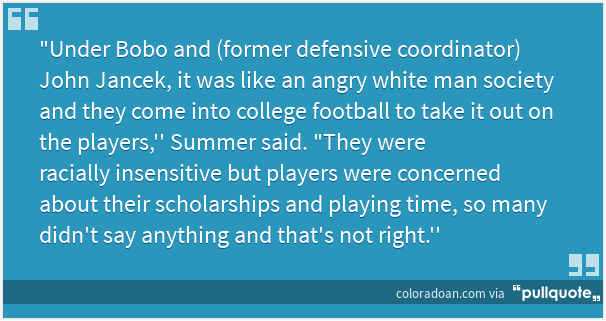
Big Time Football: “angry white man society” – radical eyes for equity

Big Time Football: “angry white man society” – radical eyes for equity

Big Time Football: “angry white man society”


While Trevor Lawrence—probably the highest profile white Division I college football player in 2020—has become the face for the #WeWantToPlay campaign calling for a start to college football amidst a pandemic, the Colorado State University football program has been forced to reckon with a racially toxic culture, implicating their former coach and current assistant coach at the University of South Carolina (Mike Bobo).
The #WeWantToPlay campaign appears to be garnering greater media and public coverage, but the CSU controversy should not be ignored, and should not be examined as a culture problem somehow centered only at CSU or in the individual coaches named in that coverage.
Charges by Black players at CSU are powerful and damning:
Image
However, again, this is not about CSU solely or a few high-profile coaches; this is about “closed systems” and a normalized culture of abuse “hidden in plain sight”: CONTINUE READING: Big Time Football: “angry white man society” – radical eyes for equity

Russ on Reading: Reading Instruction at a Distance: Read Aloud, Read Along, Read Alone, Read Again

Russ on Reading: Reading Instruction at a Distance: Read Aloud, Read Along, Read Alone, Read Again

Reading Instruction at a Distance: Read Aloud, Read Along, Read Alone, Read Again


Whether teaching at a safe distance in school, or online, or some combination of the two, teachers and students face a unique challenge this year. While reading instruction for our most vulnerable readers will necessarily look much different from normal practice, many best practices can still be used effectively. An instructional design I would recommend is Read Aloud, Read Along, Read Alone, Read Again. Let's take a look at these four elements and see how we can use them in this brave new teaching world.


Read Aloud

This well-documented and effective reading strategy can and should remain central to our distanced instruction. Read aloud is not only a pleasurable activity for most, but it also builds student vocabulary and background knowledge, provides a model of fluent reading for children, and provides the teacher with opportunities to model reading comprehension strategies like predicting, summarizing, rereading, adjusting reading rate, and questioning.

During this pandemic, while I haven't been able to visit my grandchildren, I have been recording video  read alouds and sending them off to be shared at bedtime. Teachers can choose to do recorded read alouds or real time read alouds with their students this fall. For more on Read Aloud you can look here.

Read Along

As I wrote in a recent post you can find here, the read along is an assisted CONTINUE READING: Russ on Reading: Reading Instruction at a Distance: Read Aloud, Read Along, Read Alone, Read Again

Teacher: The Hidden Scandal in U.S. Education | Diane Ravitch's blog

Teacher: The Hidden Scandal in U.S. Education | Diane Ravitch's blog

Teacher: The Hidden Scandal in U.S. Education


A teacher in the District of Columbia wrote about the hidden scandal in public education: crumbling buildings.
She writes:
For all the debate about why schools should not open … the most obvious elephant in the room is invisible or just a footnote in most discussions. Yes… schools are crowded, yes… the government is not giving timely funding for the necessary PPE and such… and there are SO MANY reasons I could provide as to the dangers at this current time from early childhood issues to teen issues. But the glaring one involves a problem that has existed LONG before the pandemic, but would now be impossible “to fix” in order to make schools safe to open this fall.
US public school buildings are falling apart and have been for years. My school has a rampant mold problem. Two years ago we had a terrible rainy summer and came back to see that the mold was no longer hidden and just “peeking through, but rather was everywhere. I had a giant black clump of black mold on my ceiling in one spot where there is always moisture under normal circumstances. Mold was everywhere – hallways, CONTINUE READING: Teacher: The Hidden Scandal in U.S. Education | Diane Ravitch's blog

Network for Public Education Releases New Report on Charter School Closure, Churn, and Instability | janresseger

Network for Public Education Releases New Report on Charter School Closure, Churn, and Instability | janresseger

Network for Public Education Releases New Report on Charter School Closure, Churn, and Instability


Last week the Network for Public Education (NPE) released a fine new report tracking school closures over time in the charter school sector. The comprehensive new study, Broken Promises: An Analysis of Charter School Closures from 1999-2017, tracks built-in instability in this education sector which sucks money out of the public schools.
Charter schools are paid for with public tax dollars and surely ought to operate for the benefit of their students and the communities where they are located. But the charter school sector has been troubled from the beginning. For years we have learned about problems in charter schools, one school at at time, one scandal at a time: academic failure, graft and corruption, sudden school closures, selection of students in a sector that is supposed to be open to all, the violation of students’ rights through punitive discipline and pushout schemes, and other problems. It has been hard to get a handle on overall trends, as a succession of breaches of the public good were reported one-at-a-time, city-by-city in the press.  The Broken Promises report instead documents a long trend.

NPE’s new report begins by defining the marketplace philosophy underneath the idea of charter schools: “Charter schools began in the 1990s as an experimental alternative to public schools. Today charter schools are a multi-billion dollar sector composed of both nonprofit and for-profit corporations that embrace the philosophy of the marketplace. The survival of charter schools, much like the survival of small businesses, depends on their ability to out-compete other schools and to attract new customers. Unlike businesses, however, public tax dollars are used to pay charter operators who personally assume little financial risk. The public places bets on schools in a marketplace model. Too often, it is a losing gamble. Supporters of charters see school failure as a natural feature of the model.” The overly simplistic assumption is that the schools which don’t serve children well will cease to attract CONTINUE READING: Network for Public Education Releases New Report on Charter School Closure, Churn, and Instability | janresseger

CURMUDGUCATION: Why Isn't AI More Widely Used?

 CURMUDGUCATION: Why Isn't AI More Widely Used?

Why Isn't AI More Widely Used?


That's the question that Wired asked last month, and it's important to consider because even as a truckload of ed tech folks are "predicting" (aka "marketing") a future in which ed tech is awash in shiny Artificial Intelligence features that read students minds and develop instantaneous perfectly personalized instructional materials. Why is it, do you supposed, that AI is being thrust at education even as private industry is slow to embrace it?

The article looks at a study of data from a 2018 US Census survey. What they found was that only 2.8% of companies had adopted any form of "machine learning," the magical AI process by which computers are supposed to be able to teach themselves. The big advanced tech winner was touchscreens, which are considerably more friendly than AI, and even those only clocked in at 5.9%, so I suspect that schools are ahead of the game on that one. Total share of companies using any kind of AI (which included voice recognition and self-driving vehicles) was a mere 8.9%.

Adoption was heavily tilted toward big companies, aka companies that can afford to buy shiny things that may or may not actually work, aka companies where the distance between those who buy the stuff and those who use the stuff is the greatest.

Another finding of the study is that, shockingly, that many previous "estimates" of AI use were seriously overstated. For instance, consulting giant McKinsey (a company that has steamy dreams CONTINUE READING: 
 CURMUDGUCATION: Why Isn't AI More Widely Used?