Latest News and Comment from Education

Tuesday, July 11, 2017

Reaping What We Sow | radical eyes for equity

Reaping What We Sow | radical eyes for equity:

Reaping What We Sow

Related image


Do not be deceived: God cannot be mocked. A man reaps what he sows.
Today marks about a month spent navigating between two polar worlds of responsibility as I approach 60 in a few years.
My two grandchildren live with me and I often provide care for them. I also now visit my mother every day as she recovers from a stroke in a rehabilitation facility where my father died just over two weeks ago.
My three-year-old granddaughter and mother, in fact, are sharing a similar journey with language—uttering smalls bursts of distinguishable speech among strings of mostly gibberish.
Watching my father’s declining health and death along side my mother’s unexpected stroke and painstaking recovery, I have experienced more directly what I have known most of my adult life: medical insurance, Medicaid, Medicare, and Social Security are frail and inadequate sources for basic human dignity.
But these realities are shared daily by millions of people discarded in the U.S. where we simply have no interest in being a Christian nation or a charitable people. No, we prefer Social Darwinism and burying our heads in the sands of the free market and consumerism.
“Consumerism,” in fact, is the perfect and disturbing metaphor for our self-defeating beliefs and practices.
And that brings me to the ugly facts I have been confronting about my Reaping What We Sow | radical eyes for equity:

‘I Quit!’ – Have You Heard

‘I Quit!’ – Have You Heard:

‘I Quit!

Related image

Have You Heard Episode #21: Teachers Are Leaving and They Want to Tell You Why 


 In this episode of Have You Heard, we hear from teachers who left their jobs – and wanted to tell the world why. Some left *kicking and screaming,* as was the case with Oklahoma Teacher of the Year Shawn Sheehan. Others shared powerful emotional appeals with the world to object to everything they feel is wrong with public education. These very public resignations are a form of activism, a way for teachers to articulate how and why teaching needs to change. Warning: this episode should be rated *p* for powerful! You can read the transcript of the episode here.


“Our labor is our weapon.” – Fred Klonsky

“Our labor is our weapon.” – Fred Klonsky:

“Our labor is our weapon.”

19510404_10156300266162067_4252592447536322468_n
Ken Franklin, me, Debra Lane, Clem Balanoff, Mike Klonsky and Elmondo Pass on Hitting Left with the Klonsky Brothers.

I liked Ken Franklin the moment he walked into our Lumpen Radio studio for our broadcast/podcast of Hitting Left with the Klonsky Brothers a couple of weeks ago.
You can hear the podcast here.
Ken Franklin is president of Local 308 of the Amalgamated Transit Union.
I wrote about their issue with the city’s Second Chance program which I posted here.
He was joined in our studio by his union brother and sister Elmondo Pass and Debra Lane.
When you read about Chicago unions it is usually about the Chicago Teachers Union. And for good reason. The CTU has led the way in “Our labor is our weapon.” – Fred Klonsky:

Pending Train Wreck: Trump’s Budget and Healthcare Cuts on Top of Widespread State Fiscal Crises | janresseger

Pending Train Wreck: Trump’s Budget and Healthcare Cuts on Top of Widespread State Fiscal Crises | janresseger:

Pending Train Wreck: Trump’s Budget and Healthcare Cuts on Top of Widespread State Fiscal Crises

Image result for Pending Train Wreck animated gif

What’s been happening in our statehouses over the past few weeks may help us picture the train wreck that looms if President Trump’s proposed budget, and/or the repeal-and-replace or total repeal of the Affordable Care Act should be enacted by Congress. We were warned several weeks ago in a report from the Center on Budget and Policy Priorities that these proposals being considered by Congress make outlandish assumptions about the fiscal capacity of state governments. But only in the past couple of weeks, during rancorous state budget debates that preceded the end of Fiscal Year 2017, have the ugly details about the condition of state budgets been explored in detail by the press.
Thirty years ago Grover Norquist of Americans for Tax Reform began demanding that state legislators and members of Congress sign his pledge never to raise taxes. Wikipedia explains: “Prior to the November 2012 election, the pledge was signed by 95% of all Republican members of Congress and all but one of the candidates running for the 2012 Republican presidential nomination.”  In the past month, however, state legislators have been begun to break their promise to Grover Norquist as despairing constituents have demanded tax increases to preserve essential services and protect their state economies.
Here is the warning from the Center on Budget and Policy Priorities about the danger of Trump’s and Congress’s assumption that states can absorb the impact of massive tax slashing by the federal government: “The reality… is that states lack the wherewithal to replace the magnitude of funds they would lose under the budget. States operate under balanced budget requirements, and most states are already struggling to balance their current budgets, even before any federal cost shifts. Recent state revenue growth has been weaker than expected, leaving 28 states with budget shortfalls this fiscal year… Most of these states have responded by cutting services, using reserves, and taking other steps to balance their budgets…. More Pending Train Wreck: Trump’s Budget and Healthcare Cuts on Top of Widespread State Fiscal Crises | janresseger:


Learning is social and emotional; our classrooms should be too - The Hechinger Report

Learning is social and emotional; our classrooms should be too - The Hechinger Report:

Learning is social and emotional; our classrooms should be too

Accountability should not equal punishment

Image result for social-emotional learning (SEL)


My stepson’s inability to read because of a disability didn’t lessen my expectation that his school teach him.
Anyone with a child who has an intellectual or learning disability knows that learning entails much more than knowing how to read, write and compute. The absence of literacy doesn’t mean that he can’t learn skills essential to becoming a productive member of society. I enrolled my stepson in a high school in New Orleans based upon where I felt his social and emotional needs would best be met.
Learning is social and emotional. My stepson’s social and emotional needs aren’t ancillary to the academic skills the state holds schools responsible for developing. He should get the quality instruction he deserves.
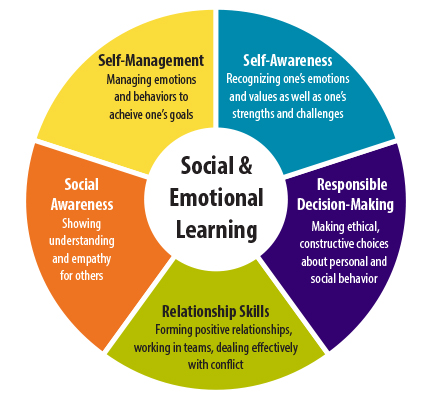
After years of head scratching, trying to figure out why American schools haven’t closed achievement gaps across racial lines, many educators now look to social-emotional learning (SEL). Also known as social-emotional and academic learning (SEAD), social-emotional development (SED), soft skills, non-cognitive skills, 21st century skills, grit, and growth mindset, SEL refers to the development of skills to manage emotions, become self aware and maintain positive relationships.
Join the conversation later on Andre Perry’s radio show, “Free College,” hosted Tuesdays on WBOK1230 in New Orleans at 3pm Central/4pm Eastern 504.260.9265.
Research show that supporting students’ social and emotional development can produce an 11 percentile point gain on academic scores. This is encouraging. However, educators should not make academics pull the SEL wagon. Schools have a responsibility to develop social and emotional skills that are as critical for Learning is social and emotional; our classrooms should be too - The Hechinger Report:

State board faces deadline, tough decisions on new federal law for improving schools | EdSource

State board faces deadline, tough decisions on new federal law for improving schools | EdSource:

State board faces deadline, tough decisions on new federal law for improving schools 

With only two meetings left before a mid-September deadline, the State Board of Education is feeling the heat to make progress on the state plan for the federal Every Student Succeeds Act. Two of the unsettled issues the board will delve into this week are the criteria for choosing the lowest-performing 5 percent of schools needing assistance and a framework for a coherent system of oversight and assistance in a state with nearly 1,000 school districts and more than 10,000 schools.
In lengthy letters, civil rights and advocacy groups in particular criticized the school selection methodology as seriously flawed. They also called for more details on how assistance would work, who’d provide it and for clearer expectations and benchmarks of progress. A lot of changes are needed in the next 60 days, before submission to U.S. Secretary of Education Betsy DeVos, to make a credible plan, they said.
“The draft plan offers far too few details regarding how school improvement will happen in schools identified as needing help,” wrote the Equity Coalition, composed of two dozen statewide and local advocacy organizations, in an analysis. “It describes some elements that it ‘may include’ without any firm commitments.”State board faces deadline, tough decisions on new federal law for improving schools | EdSource:


John Thompson: Reports highlight hard facts prior to coalition summit - NonDoc

Reports highlight hard facts prior to coalition summit - NonDoc:

Reports highlight hard facts prior to coalition summit

hard facts
(U.S. Chamber of Commerce Foundation/Center for Education and Workforce)
Although registration for the Potts Family Foundation’s Oklahoma Early Childhood Coalition Business Summit is sold out, a couple of timely studies are in the news as the event approaches on Wednesday.

Brookings Institution influencing policies

On Thursday, KOSU’s Emily Wendler reported on City Councilman Ed Shadid’s initiative petition seeking a 0.25 percent city income tax to help fund teachers’ salaries. Although there are a lot of uncertainties associated with Shadid’s campaign, some sort of a tax increase would be a no-brainer if we were just discussing what is best for businesses (not to mention families).
Wendler cites Positioned for Growth: Advancing the Oklahoma City Innovation. (The report was previously described in Non Doc.) It recommended that the city:
Form a standing committee on diversity and inclusion … The committee would comprise and/or work more broadly with representatives from the district’s institutional and private-sector stakeholders; education providers such as Oklahoma City Public Schools, local community colleges, and technology (CareerTech) centers; area workforce entities; and the nonprofit community, including neighborhood groups. The committee would focus on issue areas like education, workforce development, entrepreneurship, and placemaking/neighborhood development.
In her article, Wendler also notes that Shadid frequently cites the Brookings Institution’s warning that Oklahoma City is running out of time for addressing its education problems. Brookings researcher Scott Andes was quoted as saying that the city has a lot of strengths in terms of competing in the global marketplace, but it needs “a clear pipeline through your education system.”
Andes also praised the OKC innovation district, but he “questions whether the state itself is spending enough money to get Oklahoma school children where they need to be to thrive in the 21st-century economy.” Andes advised, “When companies and others start making their bets around the world, are they going to look at Oklahoma City? If you don’t have the workforce it won’t happen.”

The business case for early education

Katharine Stevens of the conservative American Enterprise Institute issued another major report last week. Echoing Brookings, the AEI’s report concludes:Reports highlight hard facts prior to coalition summit - NonDoc:

School Nutrition Programs Eligibility - School Nutrition (CA Dept of Education)

School Nutrition Programs Eligibility - School Nutrition (CA Dept of Education):

School Nutrition Programs Eligibility

Each school year, local educational agencies (LEA) must determine and certify a student’s eligibility to qualify for free and reduced-price (F/RP) meals or free milk benefits.

Image result for School Nutrition Programs


This Web page contains School Nutrition Programs (SNP) eligibility information and policies for LEAs that participate in the National School Lunch Program (NSLP), School Breakfast Program (SBP), Afterschool Meal Supplements (Snack) under the NSLP, Special Milk Program (SMP), and State Meal Program.
LEAs must provide households with an application that allows them to apply for F/RP meals or free milk for all children in the household and cannot require the household to submit an application for each student within the same LEA. Also, LEAs cannot require a household to submit an application for F/RP meals or free milk if they choose to decline to participate in the program. LEAs are required to include the application and instructions with the letter to household and must distribute these materials near the beginning of each school year.
The SNP prototype eligibility materials comply with federal and state requirements that are monitored by the California Department of Education (CDE) during an SNP Administrative Review. There is no requirement to use the SNP eligibility materials, but LEAs should validate that their eligibility materials are in compliance with federal requirements from the USDA Eligibility Manual for School Meals; Title 7, Code of Federal Regulations (7 CFR), Part 245; and state requirements from California Education Code (EC) Section 49557.


 School Nutrition Programs Eligibility - School Nutrition (CA Dept of Education):

Here's How The Oil Industry Is Influencing Science Lessons In Public Schools : NPR

Here's How The Oil Industry Is Influencing Science Lessons In Public Schools : NPR:

Reading, Writing And Fracking? What The Oil Industry Teaches Oklahoma Students

Oil's pipeline to America's schools.

It's a Saturday at Choctaw High School, but for hundreds of Oklahoma teachers, there's a training class in session. Carrie Miller-DeBoer perches atop a stool monitoring a pair of soda bottles linked with a small length of thin plastic tubing created to mimic enhanced oil recovery, while teaching chimstry fundamentals.
"I love it and my students will be so excited," she says.

About This Story

This story was reported in partnership with the Center for Public Integrity, an investigative news organization, and StateImpact Oklahoma, a collaboration of local NPR member stations.
Continue reading more from the investigation here.
Oil's pipeline to America's schools.

Eben Mccue
DeBoer is among 14,000 teachers in Oklahoma being trained to instruct a K through 12 education curriculum funded by the oil and gas industry. The lesson plans, created by the Oklahoma Energy Resources Board, have been used in Kansas, and the overall model has been pitched to at least five other states.
The program centers on teaching math and science through oil-centric lessons and labs. That includes things like calculating the mileage of tanker trucks, or the slope of pipelines.
"Half of our budget is restoration, half is education," says Dara McBee, communications director with the Oklahoma Energy Resources Board.
Since the 1990s, the energy board – funded by oil and gas taxes – has spent $40 million on the education program. But an investigation by the Center for Public Integrityand StateImpact Oklahoma, a collaboration of local NPR member stations, reveals there's a blurry line between industry promotion and education.
Documents show educators had some role in creating the plans, but it's unclear how the lessons are written and updated each year. The board's education director does not have a background in education or science.
Here are just a few of those lessons:


Hydraulic Fracturing:
Oklahoma Energy Resources Board YouTube

Coding: The New Vocationalism (Part 1) | Larry Cuban on School Reform and Classroom Practice

Coding: The New Vocationalism (Part 1) | Larry Cuban on School Reform and Classroom Practice:

Coding: The New Vocationalism (Part 1)

Image result for Coding

There is hardly any work we can do or any expenditures we can make that will yield so large a return to our industries as would come from the establishment of educational institutions which would give us skilled hands and trained minds for the conduct of our industries and our commerce. Theodore Search, National Association of Manufacturers, 1898
Coding should be a requirement in every public school…. We have a huge deficit in the skills that we need today versus the skills that are there. Tim Cook, CEO Apple speaking to President Donald Trump at White House, 2017

Goodbye to old vocational education preparing youth for jobs in an industrial economy. Hello to the new vocational education of teaching coding and computer science to all U.S. students
Public schools have experienced two spasms of vocationally-driven reform. One created the  “old vocational education” in the early 20th century endorsed by the National Association of Manufacturers (see above quote) and now the “new vocational education” a century later, endorsed by high-tech CEOs spreading the gospel for teaching children to learn to code and take computer science courses. Then and now, policymakers saw an intimate connection between a strong economy and strong schools. And that is why Theodore Search and Tim Cook could easily have sat down and had a cold beer together.
And were I to join Search and Cook in drinking beers, I would ask each: what is Coding: The New Vocationalism (Part 1) | Larry Cuban on School Reform and Classroom Practice:

The Problem With Public Schools Isn’t Low Test Scores. It’s Strategic Disinvestment | gadflyonthewallblog

The Problem With Public Schools Isn’t Low Test Scores. It’s Strategic Disinvestment | gadflyonthewallblog:

The Problem With Public Schools Isn’t Low Test Scores. It’s Strategic Disinvestment

We-Shall-Overcome-School-Closings

Imagine you’re settling in to enjoy an article on-line or in your favorite print newspaper and you come across this headline:
U.S. Schools Ranked Low Internationally!
Or
Out of X Countries, U.S. Places Far From the Top in Math!
You feel embarrassed.
Soon that embarrassment turns to anger.
Sweat starts to break out on your brow.
And then you start to grasp for a solution to the problem – something major, something to disrupt the current system and bring us back to our proper place in the lead.
TWEEEEEEEET!
That was me blowing a gym teacher’s whistle. I’ll do it again:
TWWEEEEEEEEEEEEEEEEEEEEEEEEEEET!
Hold it right there, consumer of corporate media. You’ve just been had by one of the The Problem With Public Schools Isn’t Low Test Scores. It’s Strategic Disinvestment | gadflyonthewallblog:
Image result for big education ape starving

Betsy, Eva, Andrew: The Beginning of the Demise of Teacher Certification or A Cuomo Political Strategy? | Ed In The Apple

Betsy, Eva, Andrew: The Beginning of the Demise of Teacher Certification or A Cuomo Political Strategy? | Ed In The Apple:

Betsy, Eva, Andrew: The Beginning of the Demise of Teacher Certification or A Cuomo Political Strategy?


Within days of the end of the special session of the state legislature the SUNY Board of Trustees approved a new regulation – teachers in SUNY authorized charter schools are no longer required to be certified by the State Department of Education – charter school networks can now self-certify teachers: no college courses, no student teaching, no pre-service tests.  Politico writes,
New York City’s charter school sector appears to have secured a significant victory in the 11th hour of the Legislative session Wednesday night, with a set of regulations that will make it much easier for large charter networks to hire more uncertified teachers.
All other teachers must complete a program approved by the state education department as well as meet CAEP Standards (Council on the Accreditation Of Education Programs) and pass three separate tests: the edTPA (a self-assessment developed by Stanford), Educating All Students (multiple choice and essay test emphasizing teaching children with disabilities and English language learners) and a Content Specialty Test, also multiple choice and essay testing knowledge and literacy within their area of expertise. SUNY teachers would not Betsy, Eva, Andrew: The Beginning of the Demise of Teacher Certification or A Cuomo Political Strategy? | Ed In The Apple:

Alabamians Ask; Trump Administration Enables State Control of Assessments | Truth in American Education

Alabamians Ask; Trump Administration Enables State Control of Assessments | Truth in American Education:

Alabamians Ask; Trump Administration Enables State Control of Assessments

Alabama State Department of Education Headquarters

Alabama Superintendent Sentance sent a letter June 1, 2017, to Acting Deputy Jason Botel of the United States Department of Education (USDE) on behalf of Alabama State Board of Education that requested to substitute other assessments for Aspire.  Superintendent Sentance also had a phone conversation with Mr. Botel and other officials from the USDE. The request was denied by USDE. Sentance then told the Alabama State Board of Education in regard to the waiver, “It was pretty clear right from the start the answer was going to be no.” The Alabama State Board of Education requested that Sentance make a more formal request from the USDE. Meanwhile, Stephanie Bell and other Board members appealed to Washington officials.
That’s when Alabamians began showing their support for the State Board’s position. On June 14, Eagle Forum in a memo to the Alabama Congressional delegation wrote:
 “….we need our Congressional delegation to intervene right away.  The State Board is facing a July 1 deadline to non-renew Aspire …Because Aspire claims to be aligned with Alabama College and Career Ready (Common Core) Standards, the continued use of Aspire will lock Alabama into the failing common core system that has resulted, for example, in our NAEP scores dropping from 25th and to dead last…”
This message went to key White House and USDE staffers as well as to influential Alabama constituents. On that same day, Congressman Brooks responded and immediately sent a letter to the USDE requesting that Alabama be granted flexibility in its choices in regards to assessments. And on June 15, Betty Peters published her article: “What Do the Feds Expect Us to Do Without ESSA Waiver?” The Alabama Congressional delegation was working toward releasing a joint letter Alabamians Ask; Trump Administration Enables State Control of Assessments | Truth in American Education: