Latest News and Comment from Education

Friday, March 31, 2017

Betsy DeVos thinks schools could not get much worse.

Betsy DeVos thinks schools could not get much worse.:

Betsy DeVos’ American Carnage
Echoing her boss, she sees horrendous decline in America’s schools—but even the numbers she cites undermine her point.


 Throughout the 2016 campaign and since his election victory, Donald Trump has been spinning Americans a bleak yarn of a nation teetering on the brink of collapse. On the campaign trail, he repeatedly insisted that black voters “suffering” under Democratic control had nothing to lose by casting a vote for him. On Inauguration Day, he told of industrial decline and “American carnage.” The president thinks that public schools “deprive” students of knowledge; that inner cities are riddled with crime; that the health care system is about to implode (or perhaps explode); and that the country is losing out big league to allies who’ve been treating Americans like chumps.

But this doomsaying isn’t just coming from the Oval Office. On Wednesday, at a forum at the Brookings Institution in Washington, the president’s Education Secretary Betsy DeVos was asked whether she would concede that when poorly implemented, the “school choice” doctrine she has championed for much of her career could have a negative effect on students. She saw no such risk:
“Well, I’m not sure how they could get a lot worse on, you know, a nationwide basis than they are today,” the secretary said. “The fact that our PISA scores have continued to deteriorate as compared to the rest of the world and, you know, that we’ve seen stagnant—at best—results with the NAEP scores over the years—I’m not sure that we can deteriorate a whole lot.”
American carnage—right in America’s classrooms!
The problem with DeVos’ sweeping assertion—and by extension, her apocalyptic view of American public education—is that the numbers tell a more complex, muddier story. Take PISA, the Programme for International Student Assessment, a test that compares 15-year-olds’ performance across dozens of countries. Depending on how you read the most recent PISA results from 2015, American schools could be described as doing great (we’re ahead of Switzerland in reading, and above France and Sweden in science), as doing OK (the U.S. placed near the middle overall), or as failing miserably (America’s math ranking is bad and has gotten worse since 2012).
And, of course, numbers can also be an unreliable diagnostic tool: Just because you think the PISA or National Assessment of Educational Progress numbers are awful doesn’t mean you know what to do to improve them—or even know how to track that you’re doing something right. DeVos certainly doesn’t seem to: Asked earlier in the Brookings Q&A what dataset could be used to assess her own performance as education secretary in four years’ time, DeVos rambled a little about the primacy of policies that favor choice while conceding, “I’m not a numbers person.”
If the secretary of education were a numbers person, the data and researchBetsy DeVos thinks schools could not get much worse.:

Former Oakland charter schools director charged with fraud - SFGate

Former Oakland charter schools director charged with fraud - SFGate:

Former Oakland charter schools director charged with fraud


Benford “Ben” Chavis, 59, who ran the American Indian Model Schools in Oakland, faces six felony counts of mail fraud and money laundering, according to the U.S. attorney’s office in San Francisco.

Chavis allegedly applied for and received more than $1 million in federal grant funding from 2006 to 2012 that he said would be used for the charter schools. The money was instead used for lease payments on properties Chavis owned, according to a grand jury indictment.
Chavis faces up to 20 years in prison for each of the three counts of mail fraud and 10 years for each count of money laundering, federal officials said. The Lumberton, N.C., resident was released on personal recognizance bond and ordered to appear in federal court in Oakland by April 14.
Chavis had been under investigation since at least 2013, when FBI and Internal Revenue Service agents raided his Oakland home and the three schools, seizing computers, documents and other records.
The Oakland school board voted earlier that year to close the charter schools over concerns of financial impropriety. A 2012 California audit uncovered $3.8 million in allegedly improper payments to Chavis and his wife through real estate deals they struck when they operated the charter schools.
The schools challenged the decision in court and staved off closure. They are still open, under new leadership.
Chavis maintained his innocence after the federal raid and defended the charter schools.
“If you didn’t do anything, why be upset?” he said at the time. “If I stole money, I need to be put in jail, but the schools need to stay open.” Chavis could not be reached for comment Thursday.
The announcement of his arrest surprised local school leaders.
“It affirms for me that the decision we made to revoke the charter was absolutely the right decision,” said school board member Jody London.
Chavis was a controversial figure at the American Indian charter schools, known for using foul language, enforcing rigid rules and meting out harsh discipline.
Students were often publicly humiliated and forced to attend Saturday school and detention. Chavis drew both national scorn and praise for his tactics. The schools, which at the time enrolled predominantly Asian American students, had among the Former Oakland charter schools director charged with fraud - SFGate:

March Grassroots Education Network Newsletter - Network For Public Education

March Grassroots Education Network Newsletter - Network For Public Education:

March Grassroots Education Network Newsletter


For many grassroots public education activists around the country 2017 has been jam packed with one challenge after another.
We know how hard you’re working. Please continue to let us know what we can do to support you in your work. Our email addresses are at the bottom of every newsletter we send – don’t be afraid to use them. We want NPE’s Grassroots Education Network to be a resource you can lean on for both information (stay tuned for a soon to be published Toolkit on school privatization) and support. Don’t forget about our Facebook group – it’s a great way to make connections and ask advice. We need spaces where we can come together and share our successes and our struggles.
Speaking of successes, I am quite certain you’ve all seen this viral meme:
It was created by one of the newest groups to join NPE’s Network, Iowans for Public Education, just as they were starting to organize and push back against Iowa’s out of control legislature. The meme immediately launched them into the spotlight, and even got them a mention in the New York Times. You can learn more about the phenomenal work they’re doing in one of this month’s reports below.
Tennessee’s own Momma Bears have been using their blog to chronicle the similarly out of control legislature in their state. Below you’ll find their post detailing Tennessee’s latest failed attempt to move a voucher bill.
And Arizonans for Charter School Accountability was featured in the latest installment of NPE Executive Director Carol Burris’s charter school report on Valerie Strauss’s Answer Sheet blog in the Washington Post. Jim Hall of Arizonans for Charter School Accountability has shared a must read in-depth report on Arizona’s unaccountable charter school sector.
Charters and vouchers may be dominating the news cycle thanks to the school choice policy push coming out of Washington D.C. and state legislatures, but testing issues are percolating to the surface as “testing season” officially begins across the country. Our national partner, FairTest, has shared a report on the latest facts you need to know to help launch a successful opt-out campaign in your state.
You can find a link to this month’s reports here.

Momma Bears – The Last Remaining Voucher Bill Stalls in Committee

When a voucher bill dies in committee, the Momma Bears of Tennessee ask, “What exactly is the point of vouchers?”

Opt-out of testing for better public education!

Our friends at FairTest make the argument that by educating and organizing toward clear testing reform goals, we can win.

The Rise of Iowans for Public Education

As ALEC targets Iowa and Americans for Prosperity sets up offices statewide, Iowans for Public Education know they’re in for a long and difficult fight.

The Consequences of Unmonitored Charter Schools

The most basic transparency is a simple accounting of where public dollars are spent. This transparency is sorely lacking in Arizona.

Is there a grassroots group doing great work in your state that we’ve overlooked? Please invite them to join.
Thank you for all that you do,
Darcie Cimarusti
 Grassroots Project Manager
Carol Burris
Executive Director


charters are one tool in the school choice tool box that they say will be front and center of their
March Grassroots Education Network Reports
March Grassroots Education Network Reports read this month's reports from Iowa, Arizona, Tennessee and from our national partner, FairTest Momma Bears – The Last Remaining Voucher Bill Stalls in Committee When a voucher bill dies in committee, the Momma Bears of Tennessee ask, “What exactly is the poin
 March Grassroots Education Network Newsletter - Network For Public Education:

Exclusion of Music & The Arts In Delaware’s ESSA Plan Results In Awesome Letter To Delaware Legislators – Exceptional Delaware 2017

Exclusion of Music & The Arts In Delaware’s ESSA Plan Results In Awesome Letter To Delaware Legislators – Exceptional Delaware 2017:

Exclusion of Music & The Arts In Delaware’s ESSA Plan Results In Awesome Letter To Delaware Legislators


The Delaware Music Educators Association sent a letter to every single member of the Delaware General Assembly earlier this week urging the Delaware Dept. of Education to include certain recommendations in the final draft of their Consolidated State Plan for the Every Student Succeeds Act.  Members of the organization felt their pleas for inclusion in the state plan were ignored.  Last night at the final Delaware Governor’s ESSA Advisory Committee meeting, the head of the organization gave public comment.  He wished Delaware would include music and the arts in their accountability system.  The Delaware DOE will submit their final plan to Governor Carney for signature on Monday, April 3rd.  Below is the letter sent to the Delaware lawmakers.
Every summer, members of each state’s Music Educators Associations convene in Washington, DC to discuss matters of advocacy, share visions for the future of music education, and speak with our elected members of Congress regarding these issues.  In June of 2014, members of the Delaware Music Educators Association (DMEA), in conjunction with the National Association for Music Education (NAfME) and other state Music Educators Associations, helped to successfully lobby members of Congress to reauthorize the Elementary and Secondary Education Act of 1965, putting an end to the era of No Child Left Behind. This was a major victory for education—specifically music education. Some of the most important provisions of the Every Student Succeeds Act for music education include:
  • A New and Clear Intent to Support Our Nation’s Schools Through a Well-Rounded Education: This is a change from NCLB, which focused heavily on the academic success of students narrowly defined as reading and math only.  
  • Enumeration of Music as a Well-Rounded Subject: Replacing the Core Academic Subject language from NCLB, this language clearly articulates that music should be a part of every child’s education, no matter their personal circumstance.  
  • Requirements for Well-Rounded Education: Schools will now be able to assess their ability to provide a well-rounded education–including music–and address any deficiencies using federal funds.  All Title I programs, both schoolwide and targeted, are now available to provide supplemental funds for a well-rounded education, including music.  
  • More Professional Development for Music Educators: Funds from Titles I, II and IV of ESSA, may support professional development for music educators as part of supporting a well-rounded education.  
  • Flexible Accountability Systems: States must now include multiple progress measures in assessing school performance, which can include such music education friendly measures as student engagement, parental engagement, and school culture/climate.  
  • Protection from “Pull Outs”: The new ESSA discourages removing students from the classroom, including music and arts, for remedial instruction. 

At Brookings, DeVos Restates Her One Belief: School Choice Will Take Care of Everything | janresseger

At Brookings, DeVos Restates Her One Belief: School Choice Will Take Care of Everything | janresseger:

At Brookings, DeVos Restates Her One Belief: School Choice Will Take Care of Everything

On Wednesday, Betsy DeVos, our U.S. Secretary of Education, went to the Brookings Institution to make a big speech on school choice. This was guaranteed to be an audience sympathetic to her ideas, as the event was the announcement of Brookings’ fifth annual Education Choice and Competition Index.
Here is Valerie Strauss of the Washington Post describing the event: “DeVos gave keynote remarks at Brookings, where the think tank unveiled its fifth annual Education Choice and Competition Index, its ranking of school choice in the nation’s 100 largest school districts.  For the 2016 index, the district with the highest score was Denver, followed by the Recovery School District in New Orleans, New York City, Newark and Boston.  D.C. Schools was ninth on the list, which is compiled with a number of measures, including the availability and mix of choice options for parents.”
In her speech at Brookings, Betsy DeVos once again describes herself as “passionate about… increasing education options for parents and students. It’s something I view as a fundamental right too long denied to too many kids… First, parents know what is best for their kids… Secondly, good teachers know what’s best for the students in their classrooms… And thirdly, state and local leaders are best equipped to address the unique challenges and opportunities they face, not the federal government.” DeVos affirms her belief in the primary right of the family and her support for state’s rights and local control.
One bright spot here:  On Wednesday, DeVos declared that she trusts school teachers.  That is actually sort of radical these days.
But the focus is on choice: “I am in favor of increased choice, but I’m not in favor of any one form of choice over another. I’m simply in favor of giving parents more and better options to find an environment that will set their child up for success… Let me say it again: we must At Brookings, DeVos Restates Her One Belief: School Choice Will Take Care of Everything | janresseger:

The power of a myth - The Washington Post

The power of a myth - The Washington Post:

The power of a myth


Ashley Lamb-Sinclair is  the 2016 Kentucky Teacher of the Year and she teaches high school English and creative writing. Lamb-Sinclair, who authors the www.beautifuljunkyard.comwebsite, took a sabbatical during the 2015-16 school year and worked with the Kentucky Department of Education.  She is also the founder and chief executive officer of Curio Learning, an educational technology company launching a platform for teacher professional development.  And she has written several posts for this blog, including this one, titled, “Why white students need black teachers — by a white teacher.
In this reflective piece, she looks at the mythologies that people carry with them — and why teachers have to help students change their negative myths to positive ones that build self-worth. She notes that schools sometimes create and perpetuate the negative myths about some students that damages their self-image, and it is the responsibility of teachers to help students create positive stories about themselves as learners.
By Ashley Lamb-Sinclair
My mom was barely 20 years old when I was born, and not in the best health. She is a smoker since early adolescence and smoked throughout her pregnancy with me (it was the 1980s, after all), so her labor was not a smooth one. In fact, it was an emergency. Her health quickly deteriorated, both of our heartbeats dropped dangerously low, and the nurses and doctors prepped my mom for a cesarean. My mom was young and had made some mistakes that haunted her throughout her pregnancy with me, so in the midst of the panic in the room, she lost herself in fear and regret. She was convinced that because of her mistakes, I would surely die. The logic was skewed, but anyone who is a parent knows the illogical trails our minds will walk when it comes to worrying about our kids.
While struggling with her own crashing health and her fear of what would happen to me, the room suddenly went silent. My mom told me it was like a silent movie; the nurses and doctors were running around, obviously yelling and panicking, but she heard nothing. Through the silence, she heard a voice that to this day she believes was the voice of God, which said to her, “I know you worry I will take her because of what you did, but I won’t. She is blessed and she will The power of a myth - The Washington Post:


How Dumb Do We Want Prospective Teachers To Be? | Truth in American Education

How Dumb Do We Want Prospective Teachers To Be? | Truth in American Education:

How Dumb Do We Want Prospective Teachers To Be?


Not much smarter than the dumbest students they will teach, it seems. But the exact answer will depend on the “research” read by those few who still read. If this National Center on Education and the Economy (NCEE) publication is accorded the status of research, they may accept one of its many internal (and misleading) conclusions:  “…there is mixed evidence on the number or type of courses a teacher takes and his or her performance in the classroom” (p. 75).
Its authors are suggesting that we really don’t know if teaching ability depends on the kinds of courses and how many of them a teacher takes, so they have no clear advice to give on whether we would have better elementary school teachers if they took any or more academic coursework in the subjects they taught.
Actually, the NCEE assertion was poorly stated, and the evidence isn’t mixed. What is mixed are the kinds of studies that were combined for an analysis addressing the wrong question. Evidence will be unclear if not misleading if all studies of K-12 teachers’ academic background are put into one basket to analyze, whether the teachers taught elementary or high school, and if one talks about the relationship of background courses to teaching skills, not to student achievement.

It has long been obvious that one can’t teach what one doesn’t know. That is why teacher licensing began many decades ago as an effort to ensure that prospective teachers understood the subjects they were going to be legally licensed to teach. Education schools quickly objected that licensure test scores weren’t related to teaching ability. Quite right. They didn’t correlate because licensure tests of subject knowledge weren’t designed to predict teaching skill. They came into being to assess whether the test-taker had the subject area knowledge needed for teaching the range of students at the grade levels specified by the license (see Ann Jarvella Wilson’s thesis-based paper, ED 262 049, on the history of teacher licensure tests).
That didn’t stop education school faculty from criticizing teacher licensure tests of subject area knowledge on spurious grounds. Unfortunately, irrelevant criticism did change the tests; they were watered down in content demand, and came to feature pedagogical items, especially at the elementary level.  However, the public was simply told that licensure tests didn’t predict teachers’ teaching skills and were thus useless. The public wasn’t told that these tests had a different How Dumb Do We Want Prospective Teachers To Be? | Truth in American Education:

Betsy DeVos’ Mother’s Brief Stint as a Public School Teacher: Some Details | deutsch29

Betsy DeVos’ Mother’s Brief Stint as a Public School Teacher: Some Details | deutsch29:

Betsy DeVos’ Mother’s Brief Stint as a Public School Teacher: Some Details

Related image


In her US Department of Education (USDOE) bio, US ed sec Betsy DeVos advertises that her mother was “a public school teacher”:
Secretary DeVos has been involved in education policy for nearly three decades as an advocate for children and a voice for parents. She is especially passionate about reforms that help underserved children gain access to a quality education.
DeVos’ interest in education was sparked at an early age by her mother, a public school teacher.
I heard DeVos make a similar, *my mother taught public school* statement during her confirmation hearings. However, as is true in her USDOE bio, DeVos offered no additional details.
So, I went searching for some.
The December 15, 1953, Holland, Michigan, Evening Sentinel, a newspaper from DeVos’ home town, carries the following article:
School Board Approves Four New Teachers
Hiring of four new teachers for the public schools was approved by the Board of Education at its monthly meeting Monday night.
Miss Elsa Zwiep of Holland will teach early elementary classes starting next semester succeeding Mrs. Joyce Brieve who requested a release in order to join her husband on the west coast. Miss Zwiep is a graduate of Christian High School and will be graduated from Calvin College early in 1954 with an A.B. degree.
 (Click image to enlarge)
The details of Zwiep’s 1953-54 mid-year hire were again publicized in the January 20, 1954, Sentinel.
 (Click image to enlarge.)
Zwiep’s degree from Calvin College was in sociology, not elementary education.
In August 1953, Zwiep became engaged to DeVos’ father, Edgar Prince. The couple Betsy DeVos’ Mother’s Brief Stint as a Public School Teacher: Some Details | deutsch29:


Ethnic Studies Now!: Seattle students ask, “Why aren’t we learning this in school?” | I AM AN EDUCATOR

Ethnic Studies Now!: Seattle students ask, “Why aren’t we learning this in school?” | I AM AN EDUCATOR:

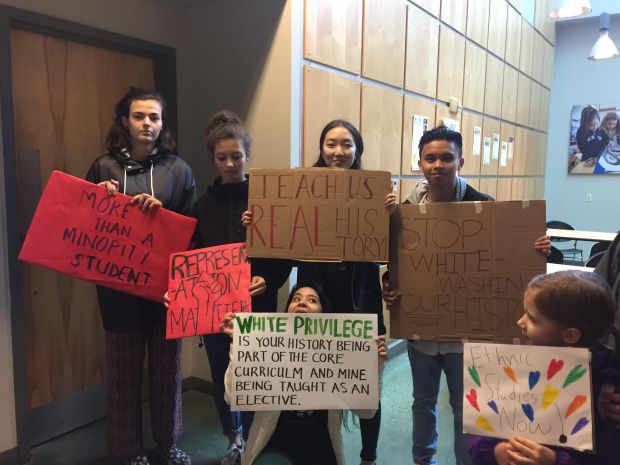
Ethnic Studies Now!: Seattle students ask, “Why aren’t we learning this in school?”

EthnicStudies_SeattleRally
From disproportionate discipline rates to its hyper-segregated schools, Seattle is a tough place to be for students of color. The city has an alarming pattern of segregation both between and within schools, and when the district was investigated by the Department of Education, it was found to suspend black students at four times the rate for white students for the same infractions.
In response, the NAACP, in collaboration with numerous education and social justice organizations, has launched a new ethnic studies campaign. “We have to get rid of this white supremacy,” Seattle NAACP Education Chair Rita Green told the Seattle Times in January. “Ethnic studies is learning about the other cultures within your building.”
The benefits of ethnic studies programs are numerous.

A recent study of San Francisco students conducted by researchers in the Stanford Graduate School of Education found that attendance increased by twenty-one percentage points, GPA by 1.4 grade points and credits earned by twenty-three. There were positive effects across male, female, Asian and Hispanic groups of students, and especially for boys and Hispanic students. The study also found significant effects on GPA specific to math and science.
As Jon Greenberg, Seattle social studies teacher, member of Social Equality Educators, and a leading organizer in the ethnic studies campaign recently told NPR, “The level of engagement goes up astronomically when you’re talking about issues that affect a lot of students’ lives.”
And benefits of ethnic studies go far beyond academics. Many of the discipline problems in the classroom stem from students who are disengaged with the curriculum and don’t see a connection to their lives. These students often act out and are quickly labeled disobedient—but maybe that disobedience is better understood as resistance to a whitewashed curriculum that Ethnic Studies Now!: Seattle students ask, “Why aren’t we learning this in school?” | I AM AN EDUCATOR:
Ethnic Studies Now Coalition http://bit.ly/24vIwvP

More on the College Board’s evasions and lies about collecting and selling your child’s personal data | Parent Coalition for Student Privacy

More on the College Board’s evasions and lies about collecting and selling your child’s personal data | Parent Coalition for Student Privacy:

MORE ON THE COLLEGE BOARD’S EVASIONS AND LIES ABOUT COLLECTING AND SELLING YOUR CHILD’S PERSONAL DATA


College Board officials belatedly responded to Cheri Kiesecker’s post describing their practice of collecting and selling personal student data without parental consent –and and their response is included at the end of her article in today’s  Washington Post Answer Sheet.
Interestingly, in their response  they did not deny that they sell students’ personal data – or in their words, “license” the data for a fee to institutions, for-profit corporations and the military.
You can see how they admit this on their website — at the cost of 42 cents per name.  Selling this data is a violation of law in many states including NY and Colorado, and also a violation of the Student Privacy Pledge, which the College Board has signed.
And despite their claims to the Washington Post that “When students take the SAT and PSAT, the proctor instructions make clear that some items on the questionnaire are optional, and they may skip if they prefer not to answer” nothing could be further from the truth.
First, there is nothing on the student answer sheet to let students know which questions they do not have to answer.
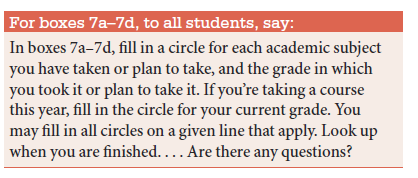
And if you read   the script for  proctors, as specified in the 2017 PSAT supervisors manual,  on pp. 10-12, you can see how evasive, confusing and ambiguous are the instructions that are supposed to be read aloud to students.
After asking students to fill out  their (obligatory) names and addresses, this is what the proctor is then supposed to say :

Turtle Learning: March is nearly over and I didn't do anything for WOMEN'S HISTORY MONTH

Turtle Learning: March is nearly over and I didn't do anything for WOMEN'S HISTORY MONTH:

March is nearly over and I didn't do anything for WOMEN'S HISTORY MONTH


I was inspired when I saw this meme I guess it can be called of WOMEN IN STEM and "IT'S OKAY TO BE SMART"   And I began thinking about how the only subject I really loved as a young girl was science.  I wanted to be a scientist and later an Astronaut!   I know this love was influenced by my father who was on his way to becoming a doctor when the Depression hit and he had to go to work to help support his parents and siblings.   I do feel that I was born too early -- that young women today are much more likely to go into science than in my day.  I hope so!   So let's celebrate WOMEN OF SCIENCE for the end of Women's History Month.


http://www.itsokaytobesmart.com/post/114706927717/inappropriatelyadorable-awesome-women-in-stem?utm_medium=email&utm_source=html&utm_campaign=weekly_top_posts_subject_13&utm_term=post_114706927717  

Fred Klonsky blogger and artist - or rather -- artist and blogger - had a great blog today about Susan B. Anthony and Frederick Douglass - https://preaprez.wordpress.com/2017/03/30/donald-trump-doesnt-have-a-clue-about-susan-b-anthony-or-frederick-douglass/  


In a way it summarizes my feeling about racism and sexism and which shall disappear first. But it does imply that men got the vote -- ALL MEN -- before any women did.  Women are still relegated to the kitchen and the bedroom all over the world. And #45 is trying to bring all that back.

We have so much to fight for right now -- and while feminism isn't #1 for me, it certainly is high on the list.  But it has to be a feminism that serves all women, and not just bourgeois white women, which is what it has been in the past.   When Black Lives Matter embraces feminism we will have a fighting chance.

When we stand up for women everywhere -- in particular the continents where 
Turtle Learning: March is nearly over and I didn't do anything for WOMEN'S HISTORY MONTH:


Children should not be a number.: Educators: Are You Complicit?

Children should not be a number.: Educators: Are You Complicit?:

Educators: Are You Complicit?


Dear NYS Educators,

Did you attempt to bribe, coerce, or scare your students into "opting in" to this week's NYS ELA Assessment?  

If so, you are complicit in the attacks on your students, profession, and our public schools. Many parents across NYS are disappointed in the educators who offered candy, treats, pizza and even field days or trips, to the students who would be taking the ELA Assessment.  Others made false claims to scare children that your school would lose funding or students would not be prepared for the high school Regents Exams or SAT. 


Are you complicit in harming the education of your students?
As a fellow educator, I find it difficult to understand how those in my profession cannot see how the current NYS Assessment system is a flawed measure of student achievement and hurts our children.


  • Have you read the questions and passages, that are often confusing and many times have arguably more than one correct answer?
  • How about most of the assessments containing reading passages that are often 2 grade reading levels above your students' grade?
  • Do we really need 3 days of testing for 90 minutes for each subject? (or far beyond as a result of "untimed" testing)
  • Do you see students break down in tears or banging their heads on their desk as they encounter age-inappropriate tasks on the state assessments?
  • The vague assessment results come months later and do not provide detailed information to educators about your students. ( In the case of teachers, often your former students)
  • Are you aware that NYSED sets cut and proficiency at inappropriate levels that set up our students for failure?