Latest News and Comment from Education

Wednesday, July 1, 2015

How the Increase in Class Sizes Is Leading to a Decrease in Teachers in America - The Atlantic

How the Increase in Class Sizes Is Leading to a Decrease in Teachers in America - The Atlantic:

Too Many Kids

School districts are packing more and more students into classrooms—and that’s pushing teachers out.


Erica Oliver has worked for the Atlantic City School District for a decade, teaching first grade and a few reading programs. Early in her career, Oliver typically taught no more than four students at a time. The small classes meant that students who struggled could be easily targeted, lessons could be tailored to individual needs, and progress could be expedited, she said. Over the years, however, Oliver has seen her class sizes grow: first to 16 students, and then to 24 or 25 kids per class. She found it harder to manage her classroom, properly supervise reading groups, and encourage her students to complete projects efficiently. All of this slowed down the group’s collective achievement.
Unfortunately, things aren’t going to get any easier for Atlantic City’s teachers and students. The city has struggled to offset an increase in tax rates because of a decline in property-tax revenues and is forced to make budget cuts as a result. While the school board initially rejected a proposal to cut more than 220 jobs, the the state monitor ultimately overrode the vote in an effort to rein in spending: In late May, 147 Atlantic City educators were notified that their contracts were not going to be renewed.
Although Oliver, who’s African American, hasn’t been let go, the alternative isn’t much rosier. The massive layoffs mean that classrooms will likely become even more crowded, and Oliver and others fear that could take a toll on student learning, in part because children will receive less individualized attention and have to work fewer school supplies. Also on the chopping block are extracurricular activities, including summer programs designed to keep students on track to graduation.
The cuts could prove especially detrimental for the district considering the population it serves. Nearly half of children ages 5 to 17 in the school district live with families living in poverty, according to census data. A majority of students are black or Latino, while just 2 percent identify as white. Atlantic City is also home to one of the worst graduation rates in New Jersey, with only about two-thirds of high-schoolers getting their diplomas.
The situation parallels budget crises facing other school districts across the country. Philadelphia, for example, has eliminated thousands of staff positions in the past two or so years, and officials have warned that some campuses will have to pack as many as 40 students into a classroom. Arizona’s Sunnyside Unified How the Increase in Class Sizes Is Leading to a Decrease in Teachers in America - The Atlantic:

U.S. DOE Continues to Force Test Failure on Children with Special Needs and ELL Students

U.S. DOE Continues to Force Test Failure on Children with Special Needs and ELL Students:


Businessman running and pull the failure and success petals off a daisy


U.S. DOE Continues to Force Test Failure on Children with Special Needs and ELL Students


According to information given to me by Deborah Abramson Brooks, the U.S. Dept. of Education is insisting that the New York Board of Education continue to force all students with disabilities, except for those with the severest disabilities, to take the tests matching their chronological age, not their developmental age, ignoring their cognitive disabilities. HERE is the notification from June 29.
In addition, they are still insisting students struggling to learn English must take the regular tests after one year instead of two.
They will not consider the waiver requested by the Regents.
Both requests were aimed at reducing stress on students and yielding more useful results. State officials say that federal rules that require testing students at their chronological age, with narrow exceptions for students with very severe disabilities, set up some disabled students for failure and turn the tests into stressful guessing games. School officials in districts with many immigrant students say one year often is not enough for new arrivals to be ready to take language arts exams written in English.
Certain civil rights groups, as we know, have been behind this draconian testing too, along with, U.S. Assistant Education Secretary Deborah Delisle who is leaving to be the new CEO of the ASCD. The requirements, she says, are “necessary to ensure U.S. DOE Continues to Force Test Failure on Children with Special Needs and ELL Students:

This Week In Education: Thompson: We Need a Marshall Plan for Schools and Prisons

This Week In Education: Thompson: We Need a Marshall Plan for Schools and Prisons:

Thompson: We Need a Marshall Plan for Schools and Prisons


I grew up in the post-World War II era known as "Pax Americana." We all knew that our ambitious New Deal/Fair Deal era policies, ranging from G.I. Bill to the rebuilding of Europe with the help of the Marshall Plan, were not perfect. But, we knew in our bones that tomorrow would be better than today. Government and social science would both play a role in the campaigns to expand the promise of America to all.
The Marshall Project's Eli Hager, in What Prisons Can Learn from Schools, pulls two incredibly complicated social problems together in a concise and masterful synthesis. Hager's insights are deserving of a detailed analysis. This post will merely take a first step towards an explanation of why Democrats and liberals, especially, must heed his wisdom.
School and prison reform are both deeply rooted in the Reaganism and the lowered horizons of the 1980s. The defeat of the "guns and butter" approach to the Vietnam War demonstrated the limits of our power. The Energy Crisis of 1973, along with a decade and a half of falling or stagnant wages, was somehow blamed on liberalism. The U.S. entered the emerging global marketplace without the confidence that had marked our previous decades, meaning that we were more preoccupied with surviving competition than building community. 
Americans lowered our horizons. As Hager explains, we were loath to tackle the legacies to the "overwhelming unfairnesses of history."  So, we broke off schools and prisons into separate "silos," and sought less expensive solutions for their challenges. We rejected the social science approach to tackling complex and interconnected social problems that were rooted in poverty. Our quest for cheaper and easier solutions would soon coincide with the rise of Big Data as a substitute for peer reviewed research in service to a Great Society.


I was researching the legal history of Oklahoma County when forces unleashed by the Reagan administration transformed my world. Its repudiation of the supposedly liberal regulation of finance brought down the savings and loan industry and the banking system in the Southwest. Virtually overnight, "Supply Side Economics" destroyed most of our high-quality blue collar jobs, and the "War on Drugs" further devastated families.
Oklahoma's criminal justice system of the 1980s still had one foot squarely planted in the old Jim Crow. Although records often were kept the old-fashioned way, data-driven policies were common, as should be clear to anyone who was ticketed by law enforcement officers needing to meet their "quota." In the Oklahoma County Courthouse, we had barely outgrown a numbers-driven ritual that should This Week In Education: Thompson: We Need a Marshall Plan for Schools and Prisons:

Democrats: There Are Better Choices Than School Choice to Improve Education | Arthur Camins

Democrats: There Are Better Choices Than School Choice to Improve Education | Arthur Camins:

Democrats: There Are Better Choices Than School Choice to Improve Education


Over the next year we can expect to hear a lot from Republican presidential candidates about school choice- the word of choice to marshal political support to expand the number charter schools and vouchers for private schools. Democrats, except maybe the governor of New York, have traditionally opposed public funding for vouchers. However, many have supported the idea of choice by sending scarce tax dollars to charter schools. We have yet to hear clear statements from the Democratic candidates about where they stand.
As policy framing rhetoric, the word choice is meant evoke the imagery of democracy and equity. Words are powerful, especially in framing and influencing political debates. Words can conjure positive or negative emotional responses. However, sometimes words clarify and sometimes they obscure underlying values. So it is with choice.
In our culture the "the right to choose" suggests an almost inalienable individual right, making for powerfully resonant political rhetoric. However, behind the easy-to-swallow positive connotation of choice, there is underlying message in its use in the context of education. If stated explicitly, the message might cause a little indigestion: Be out for yourself and don't worry so much about your neighbors or community.
I do not say this to castigate parents who choose to send their children to charter schools or the teachers who work in them. However, what is moral or sensible for an individual does not make for sound or just education policy for a society. The moral burden falls not on parents, but on those who knowingly advance the wellbeing of the at the expense of the many.
Many centuries ago Rabbi Hillel sagely wrote,
If I am not for myself, who will be for me? But if I am only for myself, who am I? If not now, when?" Ethics of the Fathers, 1:14.
It is time to reframe the policy dialog from choosing just for me to choosing to ensure better schools for us.
There is reason for hope. While choice is a deeply held American value, so is community responsibility. In fact, reference to individualism and community responsibility in politics has ebbed and flowed in recent American history. The New Deal of the 1930s and the Great Society of the 1960's- catalyzed by the labor and civil rights movements- represented high points for collective solutions, such as Social Security or Medicare, to complex problems. Alternatively, the election of Ronald Reagan initiated a sustained period of individualism. In periods of relative or growing equity and shared prosperity individualism may foster personal interests and Democrats: There Are Better Choices Than School Choice to Improve Education | Arthur Camins:

'We Have Grown Complacent About Racially Isolated Schools' - OpEducation - Education Week Teacher

'We Have Grown Complacent About Racially Isolated Schools' - OpEducation - Education Week Teacher:

'We Have Grown Complacent About Racially Isolated Schools'


The causes of violence, whether at the hands of police or private individuals, are obviously complex, even more so for interracial violence. It is healthy for institutions to consider their part in perpetuating or stemming the violence. But it is a mistake to believe that any single institution is solely responsible or can solve the problem on its own.

James E. Ryan
That said, it seems clear that, as a nation, we have not done nearly enough to teach our children how to look across lines of race and class and see similarities rather than differences—to see themselves and their friends reflected in the faces of others rather than unknown and perhaps unknowable strangers. It seems equally clear that we will continue to fail in this task if our schools remain as racially separated as they are today. As Justice Thurgood Marshall astutely observed in 1974, "Unless our children begin to learn together, there is little hope that our people will ever begin to live together."
Schools of education can play a not-so-minor role by doing more to promote integrated schools and prepare students to teach and lead in those schools. Through our research, we can identify obstacles to integration and the most effective ways to remove or avoid those obstacles. Through our teaching, we can intentionally prepare our students to teach and lead in integrated schools, recognizing that it takes work to ensure that diversity is a source of strength rather than division. 
Two concrete examples help illustrate what education schools can do. Last year, we began a communitywide, year-long discussion around the theme of "fulfilling the promise of diversity," which included lectures, a common reading, panel discussions, and workshops designed to help our students begin the work to build more diverse schools and ensure those schools are more successful because of their diversity. We will extend that conversation this year. We will also launch the Integrated Schools Project, which will combine teaching, field research, and partnerships with a network of diverse schools to create relevant metrics, identify best practices, and share those findings with the network and beyond. 
As a country, we have grown complacent about racially isolated schools, just like we were 'We Have Grown Complacent About Racially Isolated Schools' - OpEducation - Education Week Teacher:

Charter-school reform is tabled in Ohio House until September | The Columbus Dispatch

Charter-school reform is tabled in Ohio House until September | The Columbus Dispatch:

Charter-school reform is tabled in Ohio House until September


A bill that would implement widespread Ohio charter-school reforms to a system that has been sharply criticized and ridiculed both inside and outside the state passed the Senate last week with unanimous support.
The House had enough votes to concur with the Senate’s changes to House Bill 2, including a prime bill sponsor, Rep. Kristina Roegner, R-Hudson. That would have sent it to Gov. John Kasich, who also has been pushing for charter-law changes.
Despite all that, the bill stalled, leaving supporters scratching their heads about why legislation that appeared to be a priority to finish before the summer break will instead collect dust until the fall.
“There were 75 major changes, and we need to take time to look through those,” said Speaker Cliff Rosenberger, R-Clarksville, noting that the two prime sponsors of the bill had split opinions on supporting the Senate changes.
Asked about his specific concerns, Rosenberger said his focus has been on the budget and an anti-monopoly resolution. “I really haven’t focused a lot on (House Bill) 2. Clearly we need some more work.”
While Roegner supported the Senate changes to the bill, her joint sponsor, Rep. Mike Dovilla, R-Berea, said he wanted it to go to a conference committee where House and Senate leaders could work out a final bill. But in a closed-door meeting on Friday, it became apparent that a majority of the House would instead vote to pass the bill — something even Senate President Keith Faber, R-Celina, said he did not want.
So House leaders pulled the bill. The House and Senate are not expected to return to session until September.
“The irony now is this process will take longer than if we had just sent the bill to conference, worked out some of the differences, and got it done before we left for the summer,” Dovilla said. “ The very people who are complaining it didn’t get done should have done it our way.”
Dovilla said he wants changes to parts of the bill dealing with contractual language and truancy.
Sen. Peggy Lehner, R-Kettering, who has been the Senate’s point person on crafting charter-school reforms, said that she recently got a verbal list of changes that some House Republicans wanted.
“They really are pretty minor — a word change here and there. There wasn’t anything that caused me any heartburn,” she said. “I really don’t know why they didn’t choose to move ahead.”
Lehner said that one issue was not on the list — a behind-the-scenes push by the statewide online school Electronic Classroom of Tomorrow (ECOT) to change the accountability system for charter schools from the current value-added model to a California-based system.
William Lager, the founder of ECOT, was the second-largest Charter-school reform is tabled in Ohio House until September | The Columbus Dispatch:

Mayor Kevin Johnson deleted text messages about arena deal | The Sacramento Bee

Mayor Kevin Johnson deleted text messages about arena deal | The Sacramento Bee:

Mayor Kevin Johnson deleted text messages about arena deal


Sacramento Mayor Kevin Johnson deleted text messages, including some related to the city’s arena deal, after city officials received a legal letter advising them that they were required to preserve all electronic communications related to the deal.
Johnson, testifying in court on day six of a lawsuit that seeks to invalidate the city’s agreement to subsidize an arena, told the court he sent texts infrequently at the time and that very few of those he deleted involved arena discussions.
Mayor Kevin Johnson testifies Tuesday in the trial challenging the city’s arena subsidy.
The Whole Truth and Nothing But the Truth?

“I did it without thinking,” Johnson said on the witness stand in Sacramento Superior Court on Tuesday afternoon. “There was no ill intent.”
He described what he erased as “chit chat, but nothing relevant” to the court case challenging the deal the mayor and the city struck in 2014 to partner on building a new arena.
Judge Tim Frawley asked the mayor a series of pointed questions, however, and indicated he would consider Johnson’s actions when ruling on whether the city engaged in secret elements of the arena deal.
The plaintiffs, three city residents, allege the city put several goodies into the half-billion-dollar arena deal in order to secretly compensate an investor group for overpaying for the team in 2013 to keep it from moving to Seattle.
Frawley noted that the plaintiffs have asked him to impose sanctions on the city for failing to adhere to their attorneys’ legal request in June 2013 for preservation of communications relevant to the arena deal, including emails and texts.
The judge said the law allows him, when deciding the case, “to draw a negative inference from the destruction of that evidence.”
“I’m trying to get a handle on what would be an appropriate sanction, if any,” Frawley said Tuesday as he questioned the mayor.
Johnson did not estimate how many texts he erased but said that he may have texted 10 to 15 times a day and that it was his normal habit to erase texts. Johnson said he did not recall how many texts he erased from players in the arena deal but conceded at least a few were arena-related.
Frawley told the attorneys for the city and the plaintiffs that he will give the text issue the weight he feels it deserves, at trial’s end, in issuing his ruling on the case.
The trial is expected to last at least to the end of the week.
The plaintiffs sued in 2013 after the city and Kings agreed to a nonbinding term sheet. They are seeking to invalidate the deal that the team and the city reached last year. If that were to happen, it is unclear what effect it would have on arena construction, which is well underway and scheduled for completion in October 2016.
Johnson spent more than three hours on the stand Tuesday. During his testimony, he said the prospective Kings owners initially asked the city two years ago if it could chip in more to the deal, but he said no.
“I shot it down,” Johnson. “It was ridiculous from the onset. They were just negotiating. We said absolutely not and moved on.”
Plaintiffs’ attorney Jeffrey Anderson, who has said he believes the city did put sweeteners in the deal, showed Johnson and the court numerous memos and emails, obtained from theMayor Kevin Johnson deleted text messages about arena deal | The Sacramento Bee:

Celebrating Same-Sex Ruling, As Battle Continues | The Jewish Week

Celebrating Same-Sex Ruling, As Battle Continues | The Jewish Week:

Celebrating Same-Sex Ruling, As Battle Continues


 Like many Americans, Rabbi Sharon Kleinbaum spent part of her morning last Friday glued to her computer watching the live blog from the U.S. Supreme Court.

The blog, of course, carried the court’s momentous decision granting a constitutional right to same-sex marriage — news that wasn’t unexpected for the rabbi, but that still had her “in shock” five hours later.
“It shows the radical social transformation is possible and that you can’t give up. We’re out of Egypt, so to speak, although we’re not at the Promised Land. We still have work to do, but we’re instructed to celebrate,” said Rabbi Kleinbaum, senior cleric at Congregation Beit Simchat Torah, known informally as New York’s gay and lesbian synagogue.
It was a theme that Rabbi Kleinbaum repeated in the comments of other rabbis, activists and communal leaders, all of whom expressed joy over the court’s decision while acknowledging the challenges that lie ahead.
For members of Rabbi Kleinbaum’s congregation, the chance to share their jubilation with others began at Friday night services, which coincided with the start of Gay Pride Weekend. They heard an emotional words from the bima, linked arms while singing “We Shall Overcome,” and listened to the evening’s speaker, Diane Ravitch, the prominent educator who, for the first time publicly, announced she was gay.
Ravitch told The Jewish Week that she decided to “come out” publicly as soon as she was invited to speak at CBST. 
The jubilation continued Sunday during New York’s annual Gay Pride Parade, which included contingents from CBST, the American Jewish World Service, Jewish Queer Youth and Mosaic of Westchester. 
Each group sported distinct banners, signs, and t-shirts and garnered shouts of “Shalom!” A hora circle formed midway through the route around Congregation Beit Simchat Torah’s float (which featured a chuppah  made of a rainbow flag and a spangled Star of David.)
Part civil rights demonstration, part celebration of LGBTQ identities, exuberant onlookers waved and cheered as decorative floats, families, and rainbow flags paraded down Fifth Avenue.
Shonna Levin wore a black suit, white shirt, and wide-brimmed black hat, an outfit Celebrating Same-Sex Ruling, As Battle Continues | The Jewish Week:

Today Is My Birthday | Diane Ravitch's blog

Today Is My Birthday | Diane Ravitch's blog:

Today Is My Birthday 


I was born July 1, 1938, at 12:01 am at St. Joseph’s Hospital in Houston, Texas. I was my parents’ third child. We lived in a tiny house on Dunlop Street. Five more children followed over the next 10 years. We would eventually be five boys and three girls.
I went to public schools from K-12. Then, encouraged by my rabbi and his wife, I applied to Wellesley and was accepted. Going east to college changed my life.
Birthdays make you think back on your life as you get older. When you are young, birthdays make you either want to party or think about the future.
I’ll save the look back for my memoirs, if I ever find the time.
I’m still looking forward. The struggle to save public education against privatization and to protect kids from test-mania will grow stronger. The opt out movement will spread across the nation. Researchers will continue to demonstrate the failed policies of high-stakes testing and privatization.
You can help. If you want to make a gift for my birthday, join the Network for Public Education. Give as generously as you can. The Network helps grassroots activists across the nation and connects them to allies.
Here is the contact information: The Network for Public Education. Open the link to learn how to contribute online and/or become a member. This organization is fighting for public schools, for students, parents, teachers, and all other citizens who care about the future of our democracy.
If you want to send a check, here is the address:
Network for Public Education
P.O. Box 44200
Tucson, AZ
85733

LAUSD Engaging Parents - Change The LAUSD

Engaging Parents - Change The LAUSD:

Engaging Parents


-Derek Horowitz, LAUSD Principal

Now that Tamar Galatzan is a former member of the LAUSD School Board, there is not one Board Member who has children enrolled in the district. Granted, this change is only symbolic as Galatzan had a reputation for ignoring the concerns of other parents (there is a reason that three parents ran against her in the March primary) and focusing on the needs of the charter school advocates whofinanced her campaigns.  However, symbols are important and the new Board needs to take steps to show that it takes its goals of “parent and community engagement” seriously.
Whoever is elected Board President can begin this process by instituting rules that hold the Board Members to the same standards as the students in their classrooms. The members of the community deserve to be heard when they address the Board and should not have to compete with smartphones, tablets and other electronic devices. If students can be expected to limit their bathroom breaks, then Board members should also. The district’s goal of 100% attendanceshould also apply to our elected representatives.
Next, the Board needs to revisit some of the controversial issues of the last term and either reverse course or get parental buyin. Moving the start of the school year to August remains an unpopular decision for many. The Breakfast in the Classroom  program was implemented in a way that alienated many parents. Teachers should not be punished for letting parents know that they can legally opt their students out of standardized testing. Even better, the district should move to an opt-in system for these tests.
Parents who push for reform at the school level should be protected by the district, not treated as “disgruntled” and told that they should transfer their children to another school. Under the last Board, the district expanded their program of intimidating teachers through the use of Teacher Jail to intimidating parents by increasing the issuance of disruptive parent letters, which ban these parents from participating in their children’s school.  These letters should  not be issued purely at the discretion of a principal and a formal district policy should be instituted at the district level for parents to appeal their issuance.
Dramatic change is also needed  in the way parents of those with special needs Engaging Parents - Change The LAUSD:


Tuesday, June 30, 2015

Feds Awarded Colorado Charter Schools $46 Million Because of "Hiring and Firing" Rules | PR Watch

Feds Awarded Colorado Charter Schools $46 Million Because of "Hiring and Firing" Rules | PR Watch:

Feds Awarded Colorado Charter Schools $46 Million because of "Hiring and Firing" Rules


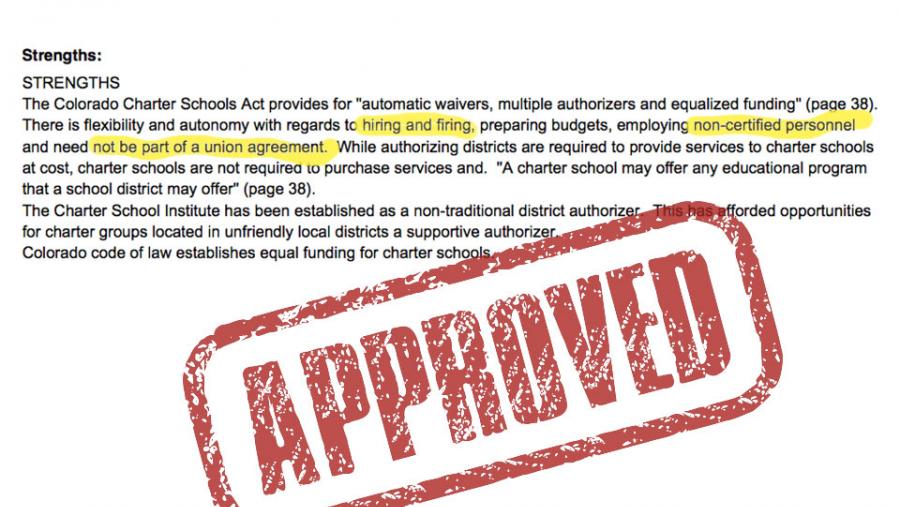
Between 2010 and 2015, the U.S. Department of Education (ED) awarded Colorado $46 million under the Charter Schools Program. Part of the reason the state landed the competitive grant was that charters are free to hire unlicensed teachers and then fire them at will, documents reviewed by CMD show.
Designed to create and expand “high-quality” charter schools, the quarter-billion-dollar-a-year program has been repeatedly criticized by the watchdogs at the department's Office of the Inspector General watchdog for suspected waste and poor financial controls.
Two weeks ago, CMD revealed that there are currently nationwide probes underway into closed charter schools and the “lack of accountability” within the program.
As Congress stands poised to reauthorize the program—and quite possibly expand it by 48 percent—ED has deflected all criticism. It has told stakeholders that while it has stepped up its monitoring activities and efforts to hold states accountable, it is mainly “the responsibility of states to make sure they develop and submit plans” to ensure that the federal millions end up in classrooms rather than missing in action.
Well, do they? CMD continues its investigation by taking a closer look at the reality on the ground. First out is Colorado.

Seeking "Non-Certified Personnel"

When Colorado applied for the competitive grant in 2010, four out of five reviewers contracted by ED to score the application raised concerns about the lack of oversight and accountability, especially when it came to charter school authorizers:
  • “There is no detail on how authorizers are monitored.”
  • “[I]t is not clear what step will be taken to hold authorizers accountable.”
  • “The response could be strengthened by providing more detail to ways in which authorizers will be held accountable.”
  • “The states[!] plan for evaluation of changes in authorizer practices is limited to self-reporting of improved policies.”
But this was more than made up for by what the reviewers considered to be a strong plan for how charters would improve student achievement, and the “flexibility” charter schools enjoy under Colorado law. One reviewer, for example, enthused over schools having complete autonomy when it comes to “hiring and firing,” employing “non-certified personnel, and not abiding by union agreements.

Colorado Education Department Pushes Back against Oversight

The Schools of Choice Office (SOC) at the Colorado Department of Education is responsible for managing the CSP grants by vetting the charter schools applying, and by making sure that those awarded money comply with federal guidelines during the whole grant cycle. The Office is also tasked with developing guidelines for charter school applications, and with collecting and compiling data on school performance.
CMD’s review of emails obtained through an open records request does not, however, show an independent agency judiciously reviewing grant applications as much as an office rewarding grants on a whim, and pushing for even less
- See more at: http://www.prwatch.org/news/2015/06/12866/feds-awarded-colorado-charter-schools-46-million-because-hiring-and-firing-rules#sthash.pfvIsoc1.dpuf


Lessons from New Orleans: 'Don't Copy' - On California - Education Week

Lessons from New Orleans: 'Don't Copy' - On California - Education Week:

Lessons from New Orleans: 'Don't Copy' 


I went to New Orleans to see if its 10-year experience with charter schools and market-based school choice had application to Los Angeles.  I came away with the admonition of my 4th Grade teacher ringing in my ears: Do your own work; don't copy.
In other words, context matters.  A lot.  It's not just that L.A. is 12 times larger than New Orleans, or that we haven't yet had a natural disaster, or that we have five times as many charter schools with three times as many students.  The two cities are profoundly different, and that difference shapes how to interpret the New Orleans results, which are being represented as the leading edge of school reform.
Unprecedented Changes
Doug Harris.jpgWithout doubt New Orleans' changes are historically unprecedented.  The Recovery School District, which controls most schools, represents most radical school reform in a century, and the most complete example of a "portfolio" school district.  Some 93% of the schools are charters, open enrollment exists throughout the city, and the data show that students and their parents are active choosers.  About 86% percent of students attend a school other than the one closest to their home.
New Orleans schools educate about the same number of students as Oakland, Sacramento, or Garden Grove in California.  A decade after Hurricane Katrina, enrollments have risen to 46,457, about 70% of their pre-storm level.  About 84% of the students are African-American.  Before the storm, enrollments stood at 66,372, 93% of whom were African-American.  Still, fully 25% of students in New Orleans attend private school, the highest non-public school-going rate among large cities in the country.  Private school enrollments are about 50% white.
Student achievement gains were trumpeted at a conference sponsored by the Education Research Alliance for New Orleans (ERA).  Graduation rates have gone up, the numbers of students going to schools labeled as "failing" has gone down, and performance on the state's standardized tests has increased.  While the significance of these changes is open to intense discussion and debate, including whether the new regime "juked" the stats (see this on failing and excelling schools), it's clear that outcomes are moving in the right direction.  There is intense excitement and pride among the civic elite.
But the theme of the conference was not whether the New Orleans transformation worked in its city of origin, but whether it represents "the urban education of the future."  Douglas Harris, Tulane University economist and president of the ERA (pictured above), argues that the effects of New Orleans' reforms are relevant and significant to other cities, such as Detroit, and the rest of the country.
Harris makes the point that politicians from different ends of the spectrum—from Barack Obama to Bobby Jindal—have lauded the reforms based on technocratic management, weakened teacher unions, and the relentless focus on output data.  The same big foundations that put money into New Orleans are transporting its "proof of concept" throughout the country.  Indeed, several states areconsidering creating charter districts.
I was interested in New Orleans in part because it has decentralized and that it has tried to find a path using autonomous operating groups of schools.  LAUSD, which has struggled with decentralization for decades, has five times as many autonomous schools as New Orleans if one counts both charters and Pilot schools, but autonomous operation hasn't become "the system."
In Learning from L.A., I wrote about creating autonomous networks of schools as a way of accomplishing decentralization, and, certainly, the civic elite in Los Angeles embraced charters in the wake of its frustration with the last decentralization effort in the 1990s.  In recent posts, I recalled my advocacy of network organization as a way to transform LAUSD.
Political Trash Talk
But my takeaway lessons were not to embrace the package of reforms that New Orleans Lessons from New Orleans: 'Don't Copy' - On California - Education Week:

Sacramento city schools to roll out ethnic studies pilot beginning 2016 - Sacramento News & Review -

Sacramento News & Review - Sacramento city schools to roll out ethnic studies pilot beginning 2016 - Beats - Local Stories - June 25, 2015:

Sacramento city schools to roll out ethnic studies pilot beginning 2016

Proposal cited minority students’ lack of engagement with high school literature, history classes


The fourth most diverse school district in the nation is finally adding an ethnic studies graduation requirement—in 2020.
The Sacramento City Unified School District's Board of Trustees unanimously approved the proposal from its Student Advisory Council on June 4. The proposal will create an ethnic studies pilot program for fall 2016.
In collaboration with community organizations, local university professors and college students, the council cited research that minority students feel culturally disconnected from the standard curriculum in high school classes, particularly in literature and history classes. Students also reported little interaction between different ethnic groups on campus.
Approximately 80 percent of district students identify as students of color. There's also a significant English-learner population—with at least 44 recognized languages—and large European immigrant populations to boot.
Jonathan Tran, an organizer with Hmong Innovating Politics and a past school board candidate, worked on the ethnic studies campaign. He said such courses improve campus climate and graduation rates.
“Students begin to see themselves in the curriculum,” he said. “They become more invested in the subject they're studying.”
In a last-minute amendment to the proposal, the new requirement will be monitored by the district's High Sacramento News & Review - Sacramento city schools to roll out ethnic studies pilot beginning 2016 - Beats - Local Stories - June 25, 2015:

EFFECTIVE teachers are continually learning and DEVELOPING | WagTheDog

EFFECTIVE teachers are continually learning and DEVELOPING | WagTheDog:

EFFECTIVE teachers are continually learning and DEVELOPING


The dictionary says developing means to grow, advance, and mature. In NY State a  teacher rated developing is not considered to be effective and a teacher improvement plan (TIP) must be implemented the following school year.
developing
On any given day a teachers interactions with students can range from INEFFECTIVE to HIGHLY EFFECTIVE and ideally all teachers are continually learning and DEVELOPING.
Using a single standardized test score along with three to five classroom observations over the course of a 180-day school year is clearly an unreliable and INEFFECTIVE way to measure student learning and teacher quality.
Americans have been “sold” the Common Core by leaders who have carefully crafted and regulated the words, language, and narrative of the education reform movement. As Humpty Dumpty declared…
‘When I use a word,’ Humpty Dumpty said in rather a scornful tone, ‘it means just what I choose it to mean—neither more nor less.’
‘The question is,’ said Alice, ‘whether you CAN make words mean so many different things.’
‘The question is,’ said Humpty Dumpty, ‘which is to be master—that’s all.’
Humpty_Dumpty
Humpty Dumpty leaders with their penchant for doublethink rely on a litany of terms and  “educationese” to justify and sell their reforms to trusting parents using reinvented and EFFECTIVE teachers are continually learning and DEVELOPING | WagTheDog:

Policies on ethnic disparity awry compared to research :: SI&A Cabinet Report :: The Essential Resource for Superintendents and the Cabinet

Policies on ethnic disparity awry compared to research :: SI&A Cabinet Report :: The Essential Resource for Superintendents and the Cabinet:

Policies on ethnic disparity awry compared to research


A recent article published in Educational Researcher underscores what many of us have long suspected – that our measures for ethnic and linguistic disproportionality have discounted crucial factors leading us to erroneous, even damaging, conclusions.
The carefully constructed study suggests that when eligibility rates in high incidence categories are examined in a cohort with adjustments for covariates – such as socioeconomic status – minorities are not over-represented in special education but, in fact, are under-represented. The article flies in the face of the perspective that has been advanced by the U.S. Department of Education for almost a decade and, ironically, comes to light as the national discussion on race has intensified in the wake of the Charleston tragedy and Ferguson shooting.
In 2007 Alexa Posny, then Director of the U.S. Department of Education Office of Special Education Programs wrote a memorandum to State Directors of Special Education saying, in part, “greater efforts are needed to prevent the intensification of problems connected with mislabeling minority children with disabilities; African-American children are identified as having mental retardation and emotional disturbance at rates greater than their white counterparts;…studies have found that schools with predominately white students have placed disproportionately high numbers of their minority students into special education.”
These statements take their cue from the 2004 reauthorization of the Individuals with Disabilities Education Act wherein various procedural and financial mechanisms were put in place to prevent and correct the disproportionate over identification of ethnic groups in special education.
The language in the law and Posny’s subsequent statements imply that special education has been used as a vehicle in an implicitly biased educational system to wherehouse children of color apart from the mainstream.
But the article, entitled, “Minorities Are Disproportionately Underrepresented in Special Education: Longitudinal Evidence Across Five Disability Categories” was posted online late last week, indicates the opposite conclusion. That is, that certain ethnic groups, when compared to the general population, have had not fully utilized the protections and supports offered through special education and that the disparity is due to socio-economic and environmental factors unrelated to race.
In other words, there is an equity issue but it has to do with lack of full access to specialized services rather than the use of those programs for segregation.
The results bring to the surface many of the other re-occurring issues about disproportionality and concomitant legal guidelines that have been part of an undercurrent of skeptical observation for years now.
One glaring contradiction, that reflects the findings in the aforementioned study, is that federal regulation of disproportionality only applies to over identification, not its equally evil twin, under identification. This willful neglect stands in contrast to federal regulations that require educational agencies to maintain a “comprehensive child find system.” The policy is even more glaring in light of the 2001 Compton Unified School District v. Addison decision by the Ninth Circuit Court essentially declaring that a failure to properly identify a child was equivalent to denial of a free appropriate public education.
Nevertheless, in 2012 the Education Department announced that it would no longer collect information about the underrepresentation of ethnicities in special education, the rationale, being in part, that it obscured the focus on overrepresentation, which, of course we now know, could be fallacious.