Latest News and Comment from Education

Saturday, July 1, 2017

Special Nite Cap: Catch Up on Today's Post 7/1/17


Special Nite Cap: Catch Up on Today's Post 7/1/17
Featured Post

Today is Diane's Birthday Diane Ravitch's blog | A site to discuss better education for all


CURMUDGUCATION: Alternative Certification Paths
CURMUDGUCATION: Alternative Certification Paths : Alternative Certification Paths We need alternative paths to the classroom. Mind you, we don't need paths that are shortcuts. We don't need an alternative path that is just a five 

Meeting Needs Of Homeless Youth: Public Schools vs. Government | PopularResistance.Org

Meeting Needs Of Homeless Youth: Public Schools vs. Government | PopularResistance.Org : Meeting Needs Of Homeless Youth: Public Schools Are Doing What Government Won't Do Directly Above Photo: Food is served to students at Public School 397 in New York, November 21, 2013. (Photo: Joshua Bright / The New York Times) Dr. Art McCoy, superintendent of schools in Jennings, Missouri, is a humble man.
What Philanthropy and Community Learned in the Wake of the Pulse Nightclub Shooting | Schott Foundation for Public Education

What Philanthropy and Community Learned in the Wake of the Pulse Nightclub Shooting | Schott Foundation for Public Education : What Philanthropy and Community Learned in the Wake of the Pulse Nightclub Shooting This June marked the anniversary of a day that holds many titles: the deadliest mass shooting by a single shooter in the United States the deadliest incidence of violence against the LGBTQ
Why John Adams saw July 2 as America’s true Independence Day - The Washington Post

Why John Adams saw July 2 as America’s true Independence Day - The Washington Post : Why John Adams saw July 2 as America’s true Independence Day (This is a version of a post I have published previously around the Fourth of July) July 4, of course, is Independence Day, a federal holiday celebrated to commemorate the adoption in 1776 of the Declaration of Independence, which split the 13 American
Officials restore money to L.A. schools soon after making controversial funding cuts - LA Times

Officials restore money to L.A. schools soon after making controversial funding cuts - LA Times : Officials restore money to L.A. schools soon after making controversial funding cuts Barely a week after the Los Angeles Board of Education approved a budget based on reduced federal anti-poverty aid, schools officials have restored nearly all of the funding. The added dollars will help L.A. Unified
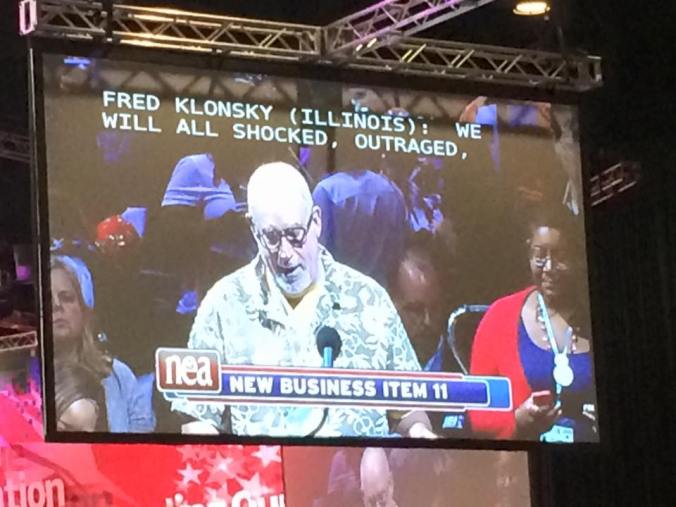
Keeping retirement weird. Charter schools at the NEA Representative Assembly. | Fred Klonsky

Keeping retirement weird. Charter schools at the NEA Representative Assembly. | Fred Klonsky : Keeping retirement weird. Charter schools at the NEA Representative Assembly. After 20 years, my last NEA RA was a couple of years ago in Orlando. For a couple of decades I celebrated the Fourth of July weekend in what ever town the National Education Association was holding their national Representativ
Mike Klonsky's SmallTalk Blog: Chicago in violation of state law on ELL. Charters worst violators.

Mike Klonsky's SmallTalk Blog: Chicago in violation of state law on ELL. Charters worst violators. : Chicago in violation of state law on ELL. Charters worst violators Most of the worst violators of state law were charter schools. Fifteen were run by the UNO Network of Charter Schools; nine were run by the Noble Network of Charter Schools. Source: Chicago Public Schools Congrats to Chicago Report
What should students know about religion? New guidance on teaching it in public schools. - The Washington Post

What should students know about religion? New guidance on teaching it in public schools. - The Washington Post : What should students know about religion? New guidance on teaching it in public schools Try to guess when this was written: “In this era of educational reform, the social studies curriculum has been a frequent target of critics representing every point on the political spectrum. While
Badass Teachers Association: The School Years Fly By Like Months by Dr. Michael Flanagan

Badass Teachers Association: The School Years Fly By Like Months by Dr. Michael Flanagan : The School Years Fly By Like Months by Dr. Michael Flanagan This week concludes my 31st year in education. It seems the school years fly by like months, each one faster than the last. I blink and another year has gone. Teachers crawl to summer break, and question if we are making a difference at all. Pack a
Today is Diane's Birthday Diane Ravitch's blog | A site to discuss better education for all

Diane Ravitch's blog | A site to discuss better education for all : Today is Diane's Birthday Diane Ravitch's blog A site to discuss better education for all Help wish Diane a Happy Birthday! July 1st is Diane’s birthday. She asks for only one gift: the hope that America’s public education system will thrive for the sake of our children – all of our children. The Network for Public Education, the
It's gonna be a Wowser: SBE Agenda for July 2017 - State Board of Education (CA Dept of Education)

SBE Agenda for July 2017 - State Board of Education (CA Dept of Education) : SBE Agenda for July 2017 Agenda for the California State Board of Education (SBE) meeting on July 12-13, 2017. State Board Members Michael W. Kirst, President Ilene W. Straus, Vice President Sue Burr Bruce Holaday Feliza I. Ortiz-Licon Patricia A. Rucker Niki Sandoval Ting L. Sun Karen Valdes Trish Williams Olivia Sison,

YESTERDAY


Special Nite Cap: Catch Up on Today's Post 6/30/17

Special Nite Cap: Catch Up on Today's Post 6/30/17 Featured Post New school board member Kelly Gonez isn't as pro-charter as many donors to her campaign - LA Times NEA teachers' union nixes longtime gadfly's bid to cover convention


Top Posts This Week


CURMUDGUCATION: Alternative Certification Paths

CURMUDGUCATION: Alternative Certification Paths:

Alternative Certification Paths

Image result for alternative paths

We need alternative paths to the classroom. 

Mind you, we don't need paths that are shortcuts. We don't need an alternative path that is just a five week long truncated training that wouldn't prepare a camp counselor for a summer with jumpy ten year olds. We don't need alternative paths used by charter operators to train people to fill their own charter openings with not-too-qualified bodies. And we definitely don't need the alternative path, favored by more and more states, that is no path at all, but just dumping someone into a classroom when her only qualification is a college degree and a pulse.

Most of the alternative paths in use these days are intended to help businesses fill openings or to help politicians look like they are addressing the teacher "shortage" (a shortage that is really a lack of willingness to do what it takes to make teaching more appealing work).

These alternative paths are bad-- bad for the profession, bad for the people who follow them, bad for the schools where those "teachers" end up working.

But it would also be a mistake to suggest that if you didn't decide to pursue a teaching degree when you were nineteen or twenty, the window has closed and you can never choose teaching as a career.

Nor is it reasonable to expect a later-in-life career switcher to somehow navigate a traditional teacher education program while still supporting herself or her family.

So what would a real alternative certification path for career-changers need to look like?

* Some standard of content knowledge. Yes, even if you're a former astrophycisist who wants to teach first grade. Knowing content well enough to use it in your profession, and knowing it well 
CURMUDGUCATION: Alternative Certification Paths:

Meeting Needs Of Homeless Youth: Public Schools vs. Government | PopularResistance.Org

Meeting Needs Of Homeless Youth: Public Schools vs. Government | PopularResistance.Org:

Meeting Needs Of Homeless Youth: Public Schools Are Doing What Government Won't Do Directly

Food is served to students at Public School 397 in New York, November 21, 2013. (Photo: Joshua Bright / The New York Times)


Above Photo: Food is served to students at Public School 397 in New York, November 21, 2013. (Photo: Joshua Bright / The New York Times)
Dr. Art McCoy, superintendent of schools in Jennings, Missouri, is a humble man. But when he speaks of his school district as “a lighthouse for informed practices that respond to the needs of homeless and low-income kids,” his pride is obvious.
As a leader of the movement pushing public schools to address the overlapping emotional and material needs of impoverished students, Jennings is a model — stepping in to provide food, shelter, health care and consolation to students who need it. Not surprisingly, school districts throughout the US are looking to Jennings for inspiration, especially since federal and state governments have done very little to assist this population.
Jennings is adjacent to Ferguson, the small city that was catapulted to prominence in August 2014 after police murdered 18-year-old Michael Brown. Each of Jennings’ eight public schools — with an enrollment of 2,600 students, most of them poor and 160 of them homeless — have “comfort rooms”: private spaces where students can meet with counselors and address the obstacles they’re facing.
“The biggest issues for our students are domestic violence and the death of a loved one,” McCoy states. “About 2,000 of our 2,600 enrolled students see school-based therapists each academic year to address the multiple traumas in their lives.”
This alone would be a staggering achievement, but Jennings schools do far more: They distribute more than 8,000 pounds of free food every two weeks, and no-cost washers and Meeting Needs Of Homeless Youth: Public Schools vs. Government | PopularResistance.Org:

What Philanthropy and Community Learned in the Wake of the Pulse Nightclub Shooting | Schott Foundation for Public Education

What Philanthropy and Community Learned in the Wake of the Pulse Nightclub Shooting | Schott Foundation for Public Education:

What Philanthropy and Community Learned in the Wake of the Pulse Nightclub Shooting

Memorial site at Pulse Nightclub Photo by Rafael Torres
This June marked the anniversary of a day that holds many titles:
    • the deadliest mass shooting by a single shooter in the United States
    • the deadliest incidence of violence against the LGBTQ community in the United States
    • the deadliest terror attack within our country since September 11th
On June 12, 2016, Pulse, a gay nightclub in Orlando, Florida, was hosting “Latin Night” when a shooter entered and ultimately killed 49 people. At Orlando Strong Funders Symposium: One Year Later, national and local philanthropic leaders gathered in the city to share lessons learned from the response to the Pulse shooting tragedy. I attended the two-day symposium, held June 14-15, and came away with many lessons about the power of a community coming together to stand in the face of hate, as well as what happens when different philanthropies are challenged to move swiftly during a crisis.
The symposium’s first day focused on how various service sectors united to respond to unspeakable tragedy within the first days, weeks, and months following the massacre. The breadth and depth of the panels displayed just how many people came together quickly to make change. Doctors and hospital staff, for example, discussed the importance of having emergency plans and enacting drills. From hospitals to fire departments, lines of communication, which didn’t exist before the shooting, emerged and became crucial to recovery efforts.
Immediately after the shooting, philanthropies united to take action. The Ford FoundationOpen Society FoundationsThe W.K. Kellogg FoundationArcus FoundationRobert Wood Johnson FoundationThe Executives’ Alliance to Expand Opportunities for Boys and Men of Color, and Our Fund Foundation joined together as contributing partners to the Contigo Fund. The Contigo Fund is “an effort to strengthen and network existing agencies and to identify and support grassroots efforts that advance Latinx and LGBTQ causes and the intersection of these two communities.”
Normally, things don’t happen that fast in philanthropy, but in this case, the response was rapid.
Orlando’s economy thrives off tourism, and I was proud to see the tourism industry and theme parks step up right away. NBC Universal donated $1 million to the OneOrlando Fund, which was set up to aid the victims of the attack. That contribution then sparked a $1 million donation from The Walt Disney Co., as well as a dollar-for-dollar donation match from the company for its employees’ donations. 
The City of Orlando also deserves recognition for how it handled the tragedy. It responded by embracing its native children. The outpouring of love and support was essential to begin the healing process. Today, Orlando is clad with rainbow flags and lights, made by the city and local businesses, to honor the victims and survivors. The city has taken steps also to identify the What Philanthropy and Community Learned in the Wake of the Pulse Nightclub Shooting | Schott Foundation for Public Education:

Why John Adams saw July 2 as America’s true Independence Day - The Washington Post

Why John Adams saw July 2 as America’s true Independence Day - The Washington Post:

Why John Adams saw July 2 as America’s true Independence Day


(This is a version of a post I have published previously around the Fourth of July)
July 4, of course, is Independence Day, a federal holiday celebrated to commemorate the adoption in 1776 of the Declaration of Independence, which split the 13 American colonies from England.
But John Adams, who had a lot to do with the American colonies’ break from Great Britain, didn’t think the day to commemorate was July 4. Adams, a leader of the American Revolution who became the first vice president and the second president of the United States, thought July 2 was the date that would be celebrated “as the great anniversary festival.”
Why? Because it was on July 2, 1776, that delegates at the Second Continental Congress meeting in Philadelphia officially separated the 13 American colonies from Britain by approving a motion for independence advanced by Richard Henry Lee of Virginia. Twelve of the 13 colonies approved it (New York abstained, as its representatives did not have permission to vote for it at that time).
The next day, on July 3, Adams wrote a letter to his wife Abigail with this prediction:
The Second Day of July 1776, will be the most memorable Epocha, in the History of America. I am apt to believe that it will be celebrated, by succeeding generations, as the great anniversary Festival. It ought to be commemorated, as the Day of Deliverance by solemn Acts of Devotion to God Almighty. It ought to be solemnized with Pomp and Parade, with Shews, Games, Sports, Guns, Bells, Bonfires and Illuminations from one End of this Continent to the other from this Time forward forever more.
Later that day, the Pennsylvania Evening Post published this:
“This day the Continental Congress declared the United Colonies Free and Independent States.”
So why do we celebrate July 4 as Independence Day?
That’s when the actual Declaration of Independence — whose principal author was Thomas Jefferson — was adopted (although not signed) by members of the Continental Congress. Jefferson had been writing it, draft after draft. He was one of the Committee of Five the Why John Adams saw July 2 as America’s true Independence Day - The Washington Post:

Officials restore money to L.A. schools soon after making controversial funding cuts - LA Times

Officials restore money to L.A. schools soon after making controversial funding cuts - LA Times:

Officials restore money to L.A. schools soon after making controversial funding cuts

Image result for LAusd schools

Barely a week after the Los Angeles Board of Education approved a budget based on reduced federal anti-poverty aid, schools officials have restored nearly all of the funding.
The added dollars will help L.A. Unified avoid some cutbacks and may make some planned layoffs unnecessary.
While the news was welcome, it was less clear why the belt-tightening went forward in the first place: Federal officials had told the district about the improved funding projection in a May 24 letter, and the school board did not approve the budget until June 20.
“I am relieved that schools will not after all be enduring a disproportionate cut in budget and services,” said board President Steve Zimmer, whose term ended Friday. “I am troubled by the stress that they went through over a cut that, in the end, was not nearly as dramatic as people feared.”
The planned $40-million reduction would have affected more than 700 campuses, about 70% of district schools. The cut in the anti-poverty funds was about 16.5% at each affected Officials restore money to L.A. schools soon after making controversial funding cuts - LA Times:

Keeping retirement weird. Charter schools at the NEA Representative Assembly. | Fred Klonsky

Keeping retirement weird. Charter schools at the NEA Representative Assembly. | Fred Klonsky:

Keeping retirement weird. Charter schools at the NEA Representative Assembly.

1512423_467766756732699_416154896127317245_n
After 20 years, my last NEA RA was a couple of years ago in Orlando.
For a couple of decades I celebrated the Fourth of July weekend in what ever town the National Education Association was holding their national Representative Assembly.

Not any more.
Last night Anne and I were listening to the symphony in Millennium Park in downtown Chicago.
I didn’t love the choice of music they were playing, but the setting and the weather were unbeatable.
A young couple sat down next to us. He was from a small town in Lyon, France. She was from a Polish town near Krakow, Poland. He was working here for a French firm. She was on a short visa to see him.
“I don’t understand,” he said. “I never meet anyone who voted for Trump and yet he was elected.”
“Wrong city,” I explained.
Meanwhile one of the big issues at the RA in Boston is charter schools.
Funny thing about the NEA. They were early to endorse Hillary Clinton but are just Keeping retirement weird. Charter schools at the NEA Representative Assembly. | Fred Klonsky:


Mike Klonsky's SmallTalk Blog: Chicago in violation of state law on ELL. Charters worst violators.

Mike Klonsky's SmallTalk Blog: Chicago in violation of state law on ELL. Charters worst violators.:

Chicago in violation of state law on ELL. Charters worst violators
Most of the worst violators of state law were charter schools. Fifteen were run by the UNO Network of Charter Schools; nine were run by the Noble Network of Charter Schools. Source: Chicago Public Schools
Congrats to Chicago Reporter's Kalyn Belsha whose story on CPS's failure to meet the needs of English learners was named among this week's top education stories by Atlantic Magazine.

Belsha reports on a recent review of CPS records which found that, of the 342 schools audited, nearly 71%, or 242, had bilingual programs that were in serious violation of state law. As a result, English learners go without legally required services, such as books in their native language and teachers who speak that language or have English as a Second Language training.

Most of the worst violators of state law were charter schools. Fifteen were run by the UNO Network of Charter Schools; nine were run by the Noble Network of Charter Schools.

In 2009, U.S. District Judge Charles Kocoras lifted the consent decree ending three decades of efforts to integrate Chicago schools. The decree’s bilingual education provisions, according to Kocoras, duplicated protections in state law. The ruling came despite evidence presented by DOJ lawyers in court that the district repeatedly failed to enroll English learners in bilingual education fast enough or provide them with required services.

I would be remiss if I failed to point out once again, that it was former schools CEO Arne Duncan who successfully pushed Judge Kocoras to abandon the consent decree. Thousands of the district's English language learners and their families are still paying the price.Mike Klonsky's SmallTalk Blog: Chicago in violation of state law on ELL. Charters worst violators.:

Image result for Que diablos


What should students know about religion? New guidance on teaching it in public schools. - The Washington Post

What should students know about religion? New guidance on teaching it in public schools. - The Washington Post:
What should students know about religion? New guidance on teaching it in public schools

Related image

Try to guess when this was written:
“In this era of educational reform, the social studies curriculum has been a frequent target of critics representing every point on the political spectrum. While educators argue that history is neglected and traditional values are missing, others contend that the curriculum lacks social relevance and avoids significant public issues. Most agree, however, that religion is not adequately included in the social studies curriculum. They argue that teachers, administrators, school boards, and textbook publishers have tended to strip social studies courses of all but the most bland references to religion as a social force in the past and present. As a result, students are prevented from learning in school about one of the most significant factors in human societies from the prehistoric era to the world today.”
If you had said that it is current, you could be excused, as it reflects prevailing thinking, but, in fact, it was published in 1988, the start of a piece titled “Teaching About Religion in the Social Studies.”
Now, all these years later, the National Council for the Social Studies has attached a supplement to its College, Career, and Civic Life (C3) Framework for Social Studies State Standardsas noted here by Education Week.  The new section, which is described by its authors as “Guidance for Enhancing the Rigor of K-12 Civics, Economics, Geography, and History,” joining sections that provide resources on teaching psychology, sociology and anthropology.
Why now? The introduction to the section — titled Religious Studies Companion Document for the C3 Framework — notes:
“Student inquiry into complex issues — including the dynamic relationships within a religion, between religions, and between religion and secularism — provides a unique environment to learn how to recognize and evaluate assumptions without undermining personal religious identity, to navigate diverse and shifting cultural values, to engage respectfully with diverse neighbors, and to resist common misunderstandings that have negative real-world consequences. These skills are invaluable in a society whose increasingly multicultural schools, workplaces, and local, national, and international public spheres all need What should students know about religion? New guidance on teaching it in public schools. - The Washington Post:


Badass Teachers Association: The School Years Fly By Like Months by Dr. Michael Flanagan

Badass Teachers Association: The School Years Fly By Like Months by Dr. Michael Flanagan:

The School Years Fly By Like Months by Dr. Michael Flanagan


This week concludes my 31st year in education.

It seems the school years fly by like months, each one faster than the last.

I blink and another year has gone.

Teachers crawl to summer break, and question if we are making a difference at all.

Pack away the books, rip down the bulletin board papers

Wonder how we can possibly do this another year.

Wasn’t it just September?

What could we have done better?

Next year I’ll do things differently

I will be stricter about the cell phones.

I’ll own that Danielson teacher evaluation

“Highly effective,”  here I come!

Or, maybe I will just continue being the best teacher I can be, rubrics be damned

Teachers scramble to find standardized exam scores