Latest News and Comment from Education

Tuesday, June 20, 2017

June Solstice - Summer and Winter Solstice

June Solstice - Summer and Winter Solstice:

June Solstice: Longest and Shortest Day of the Year

Image result for Summer Solstice

The June solstice is the Summer Solstice in the Northern Hemisphere and the Winter Solstice the Southern Hemisphere.


Illustration image
The June Solstice. (Not to scale)


The date varies between June 20 and June 22, depending on the year, and the local time zone.
June Solstice in Citrus Heights, California, USA is on

Tuesday, June 20, 2017 at 9:24 pm PDT (Change city)
June Solstice in Universal Coordinated Time is on

Wednesday, June 21, 2017 at 04:24 UTC

Zenith Furthest Away from the Equator

A solstice happens when the sun's zenith is at its furthest point from the equator. On the June solstice, it reaches its northernmost point and the Earth’s North Pole tilts directly towards the sun, at about 23.4 degrees.
It's also known as the northern solstice because it occurs when the sun is directly over the Tropic of Cancer in the Northern Hemisphere.

Meaning of Solstice

'Solstice' (Latin: 'solstitium') means 'sun-stopping'. The point on the horizon where the sun appears to rise and set, stops and reverses direction after this day. On the solstice, the sun does not rise precisely in the east, but rises to the north of east and sets to the north of west, meaning it's visible in the sky for a longer period of time.
Although the June solstice marks the first day of astronomical summer, it's more common to use meteorological definitions of seasons, making the solstice midsummer or midwinter.


Illustration image
Stonehenge in England.
©bigstockphoto.com/dubassy


Solstices in Culture

Over the centuries, the June solstice has inspired countless festivals, midsummer celebrations and religious holidays.
One of the world's oldest evidence of the Summer Solstice's importance in culture is Stonehenge in England, a megalithic structure which clearly marks the moment of the June Solstice.
In the Southern Hemisphere, where the June solstice is known as the shortest day of the year, it marks the first day of astronomical winter, but the middle of winter in meteorological terms.

Midnight Sun or Polar Night?

On the June solstice, the midnight sun is visible (weather permitting) throughout the night, in all areas from just south of the Arctic Circle to the North Pole.
On the other side of the planet, south of the Antarctic Circle there's Polar Night, meaning no Sunlight at all, on the June Solstice.

Solstice Dates Vary

Even though most people consider June 21 as the date of the June Solstice, it can happen anytime between June 20 and June 22, depending on which time zone you're in. June 22 Solstices are rare - the last June 22 Solstice in UTC time took place in 1975 and there won't be another one until 2203.
The varying dates of the solstice are mainly due to the calendar system – most western countries use the Gregorian calendarwhich has 365 days in a normal year and 366 days in a Leap Year.
tropical year is the time it takes the Earth to orbit once around the Sun. It is around 365.242199 days long, but varies slightly from year to year because of the influence of other planets. The exact orbital and daily rotational motion of the Earth, such as the “wobble” in the Earth's axis (precession of the equinoxes), also contributes to the changing solstice dates.

Moving to Other Seasons



Equinox and solstice illustration.
Equinoxes and Solstices


After the June solstice, the sun follows a lower and lower path through the sky each day in the Northern Hemisphere until it reaches the point where the length of daylight is about 12 hours and eight to nine minutes in areas that are about 30 degrees north or south of the equator.
Areas 60 degrees north or south of the equator have daylight for about 12 hours and 16 minutes. This is the September Equinox, the Autumnal Equinox in the Northern Hemisphere.
Earth does not move at a constant speed in its elliptical orbit. Therefore the seasons are not of equal length: the times taken for the sun to move from the March Equinox to the June Solstice, to the September equinox, to the December solstice, and back to the March equinox are roughly 92.8, 93.6, 89.8 and 89.0 days respectively.
The consolation in the Northern Hemisphere is that spring and summer last longer than autumn and winter.June Solstice - Summer and Winter Solstice:
Image result for Summer Solstice


U.S. Department of Labor Funds States to Link Workforce to Education Data | Truth in American Education

U.S. Department of Labor Funds States to Link Workforce to Education Data | Truth in American Education:

U.S. Department of Labor Funds States to Link Workforce to Education Data

This isn’t new. Student data privacy advocates have warned about the expansion of these databases to track your student from birth or preschool all the way to their participation in the workforce.


The U.S. Department of Labor announced they awarded $11.4 million in state grants to “develop, enhance state workforce databases.”
Here’s the text of the press release from Friday:
The U.S. Department of Labor announced today the award of $11.4 million in federal Workforce Data Quality Initiative grants. The grants are designed to increase efficiency and effectiveness of these programs.
The department awarded six grants – each approximately $1 million – to eligible State Workforce Agencies in Alabama, Indiana, Iowa, Kentucky, Massachusetts and Missouri for the development or enhancement of a state workforce longitudinal administrative database. These databases include information on programs that provide training and employment services and allow tracking of similar information on identical subjects at multiple points in time.
For the first time, the department awarded two grants of $2.7 million to SWAs for the integration of their states’ case management, performance reporting, and/or fiscal reporting systems with their states’ longitudinal administrative databases. The grants are awarded to SWAs in Mississippi and Rhode Island.
“This administration is committed to reinvigorating workforce development systems in America,” said U.S. Secretary of Labor Alexander Acosta. “Access to high-quality data is essential to making good, evidence-based decisions. These Workforce Data Quality Initiative grants help states and local agencies improve the quality and breadth of workforce data, which will benefit businesses, workers and job seekers.”
Grantees will be expected to use their longitudinal databases to conduct research and analysis aimed at determining the effectiveness of workforce and education programs, and to develop tools to better inform customers about the benefits of the publicly funded workforce system.
WDQI databases include information on programs that provide training and employment services, and connect with education data. They may be linked at the individual level and are capable of generating workforce training provider performance information and outcomes, including information and outcomes relevant to Workforce Innovation and Opportunity Act performance reporting, in a standardized, easy-to-understand format to help customers select the education and training programs that best suit their needs.
Grantees will be expected to achieve multiple objectives during the three-year grant 
U.S. Department of Labor Funds States to Link Workforce to Education Data | Truth in American Education:

Is School Choice Just Expanding Privilege? | HuffPost

Is School Choice Just Expanding Privilege? | HuffPost:

Is School Choice Just Expanding Privilege?

Students who need the most support are not well-served by choice policies.

Image result for big education ape school choice


When my father was 19 years old, he got into a serious car accident. At the time he was a college student studying to be a math teacher. The car accident kept him out of school for several months, and when he was ready to return, the scholarships that allowed him to attend college were no longer available to him.
He and his father went to the bank to take out a $500 loan in order to enroll in classes. The bank denied him the loan, and my father never went back to college ― instead, the bank hired him to work as a teller.
Despite the fact that he went on to be an officer and director in 37 banks throughout the Midwest, he always felt embarrassed when anyone discovered he didn’t have a college degree. To him, being “educated” was a sign of prestige.
My father’s success as a banker allowed him to live in nice homes, drive nice cars, travel the world, and live a very privileged lifestyle, but the one thing that mattered to him most was that his children receive the best possible education. His professional success allowed him to choose where our family would live and he chose Ames, Iowa because of the quality of the public school system. He was able to choose where we went to school, and it was a choice he took very seriously.
In a perfect world, all parents would be able to locate themselves in a neighborhood with a school that meets all of their needs. Those who advocate for “school choice” would have you believe that using tax dollars to build for-profit charter schools and vouchers Is School Choice Just Expanding Privilege? | HuffPost:
 Image result for big education ape school choice
Image result for big education ape school choice

Frederick M. Hess: Parents Need to Play a Role in Their Children's Education | US News

Parents Need to Play a Role in Their Children's Education | Knowledge Bank | US News:

Don't Give Parents a Pass on Education

Hold schools accountable – but parents play a role helping their kids learn, too.

Image result for big education ape parents can

America's schools are caught in a peculiar vise. We've made it clear that we expect schools to succeed with every child. That wasn't always the norm. Over the past 25 years, though, reformers on the left and right fought to ensure that schools be expected to educate every child. Today, we largely take that mission for granted. That represents a tectonic shift and a tremendous victory.
Back in the 1980s and 1990s, American education paid a lot of attention to the quality of parenting and far too little to the quality of teaching and schooling. It wasn't unusual to hear educators declare that certain students were unteachable or that they couldn't be blamed for not teaching kids who weren't there to learn.
In the early 1990s, I was supervising student teachers for Harvard University's Graduate School of Education and I'll always recall one exchange that crystallized the old ethos for me. I was visiting an iconic Boston high school that had seen better days. The bell rang and the social studies class I was observing got started. In a room of 30 or 35 kids, there were maybe a dozen who were taking notes, participating, and paying attention. The rest were passing notes, staring out the window and generally tuning out. My student teacher tried all manner of teaching strategies, but none made much difference.
The class finally ended and the students shuffled out. The student teacher, his mentor teacher and I sat down to talk. I asked the mentor, "So, how'd you think the class went?"
He said, "What really impressed me was how engaged the students were."
I wondered if he was kidding. He didn't seem to be. I said, "Here's the thing. To me, it looked like maybe 10 students were really involved. Did I miss something?"
What he said next has always stuck with me: "No, that's about right. But he had all of the students who were here to learn. The others, the knuckleheads, well, you just want to keep them in line."
Times have changed. Today, that kind of mindset is deemed unacceptable. If educators say such things, they mutter them privately. That shift is a wonderful thing.
It's come at a cost, though. The insistence that parents need to also do their part has been lost along the way. Talk of parental responsibility has come to be seen as little more than a case of blaming the victim. Reformers worry that such talk will let schools and Parents Need to Play a Role in Their Children's Education | Knowledge Bank | US News:
 Image result for big education ape parents can vote

Texas law bars parents from suing schools — even when their children fall into a den of rattlesnakes

Texas law bars parents from suing schools — even when their children fall into a den of rattlesnakes:

Texas law bars parents from suing schools — even when their children fall into a den of rattlesnakes


According to personal injury lawyer John Kemmrer Ivey, “the State of Texas and the school district doesn’t care” about children harmed due to negligence at school.
The Houston Press described the horrifying incident of a boy playing in a sandbox on the school playground when the ground caved in and he dropped into a den of rattlesnakes. He was bitten multiple times and nearly died, but because the incident didn’t occur in a school vehicle, nothing can be done.
The reason is that Texas has the strongest laws in the country protecting schools against litigation. The only way a school can be sued is if an injury occurs in a motor vehicle.
Houston attorney Al Durrell’s five-year-old son was carried upside down from the cafeteria to the principal’s office and his jaw was broken in the process. The school called Durrell saying there was blood on his son and his clothing and they didn’t know whose it was. When he picked up his son, the boy wasn’t talking and pointed to his mouth. His father rushed the child to the dentist where two teeth had to be pulled and they discovered the broken jaw.
Court documents show program coordinator “Krystal Perkins stated that her elbow had come into contact with C.B.D.’s face in the hallway. Beth Bonnette [school principal] also stated that she had contact with C.B.D.” The third school employee involved was listed as a school administrator. C.B.D. are the initials used to protect Durrell’s son’s identity.
But despite his best efforts, the boy’s father still doesn’t know what happened, despite cameras recording the incident. The reason is that the school falls under the doctrine of sovereign immunity.
The State of Texas “has long recognized that sovereign immunity, unless waived, protects the State of Texas, its agencies, and its officials from lawsuits for damages, absent legislative consent to sue the State,” according to “A Synopsis of Texas and Federal Sovereign Immunity Principles.” There’s also a $100,000 cap on any damages given to a single person or a single incident.
Durrell was first told he could have a copy of the footage of the incident but was then Texas law bars parents from suing schools — even when their children fall into a den of rattlesnakes:

Seattle Schools Community Forum: SPD Shooting of Mother Sparks Loss for SPS Communities

Seattle Schools Community Forum: SPD Shooting of Mother Sparks Loss for SPS Communities:

SPD Shooting of Mother Sparks Loss for SPS Communities

Image result for Charleena Lyles


I was away this weekend and so am just coming to learning about the terrible shooting of a black pregnant mother of three, Charleena Lyles, at transitional housing for people coming out of homelessness.  Her children - two in Seattle schools - may have been present at the shooting.

I heard the audio tape of the incident and it's hard to grasp how quickly the police apparently felt threatened by what is to be a small woman with mental health issues.  And especially since the police knew she had mental health issues.  I'm sure I am not alone in believing that had Ms Lyles been white, she would be alive today.

SEA will have a rally at 5 pm followed by a press conference/vigil tonight at 6 pm at Brettler (the re-settlement site at Magnuson).  Teachers are being encouraged to wear their Black Lives Matter t-shirts today. 

But to the point of affecting Seattle Schools communities comes this from Director Geary via Facebook:
I have visited Thornton Creek, Sand Point and Laurelhurst this morning and have heard families want to help, so let's come up with a plan for long term support. Soup for Teachers will also be posting on things that can be done.

SPS Communications via Twitter:
Our thoughts are with the Brettler Family Place community. SPS provided more staff to support those needing help to make sense of tragedy. 

From Soup for Teachers:

We have gotten plenty of schools signed on for care pack items. If there's not a point person coordinating at your school who has the drop-off address, please 
Seattle Schools Community Forum: SPD Shooting of Mother Sparks Loss for SPS Communities:


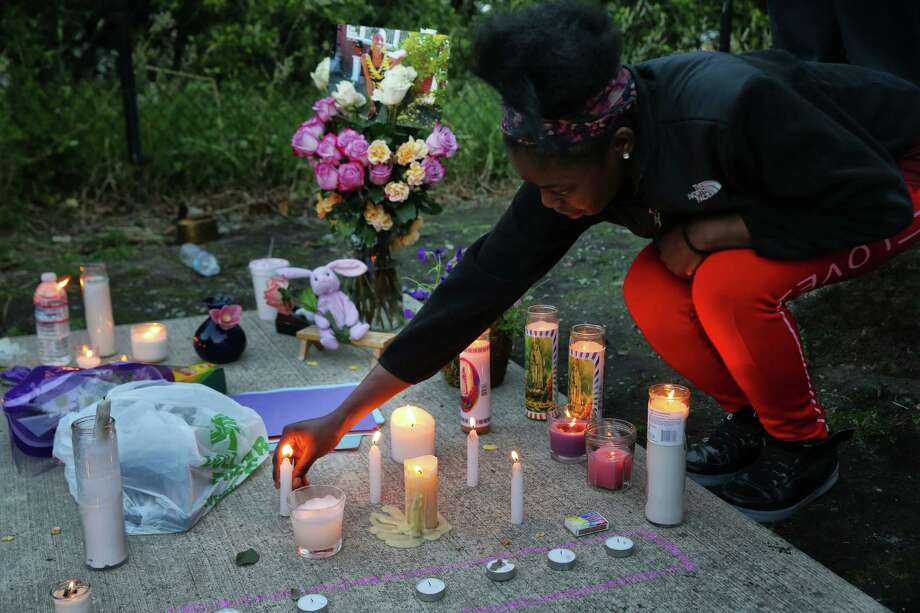
Charleena Lyles, a pregnant Seattle mother, was fatally shot Sunday, June 18, by police officers responding to her North Seattle home. Lyles, 30, had reported a burglary attempt at her home.
Media: Levi Pulkkinen / SeattlePI

Tiny, Decent Things – Live Long and Prosper

Tiny, Decent Things – Live Long and Prosper:

Tiny, Decent Things


PART I: THE WAR AGAINST PUBLIC EDUCATION
I began my whine against the overuse and misuse of standardized testing when No Child Left Behind passed in 2001 and Indiana doubled down on student testing.
I complained to my principal, the school corporation, my local legislators. I became an officer in my local teachers association, and a delegate to the state teachers association representative assembly, but we couldn’t change things either.
I retired in June of 2010 and two years later joined a public education advocacy group, the Northeast Indiana Friends of Public Education. Since the Save Our Schools March in 2011 in Washington D.C., our members have been working to end and undo “education reform” in Indiana and the U.S.
2011 was a watershed year for privatization in Indiana. Mitch Daniels and his Superintendent of Public Instruction, Tony Bennett, along with help from the Indiana General Assembly, hit hard at public schools and public school teachers.
2011 was the year that Indiana…
  • cut $300 million from public school funding while at the same time they…

Study: Shootings Kill Or Injure 19 US Children Each Day | WBEZ

Study: Shootings Kill Or Injure 19 US Children Each Day | WBEZ:

Study: Shootings Kill Or Injure 19 US Children Each Day

Image result for Shootings Kill Or Injure 19 US Children Each Day


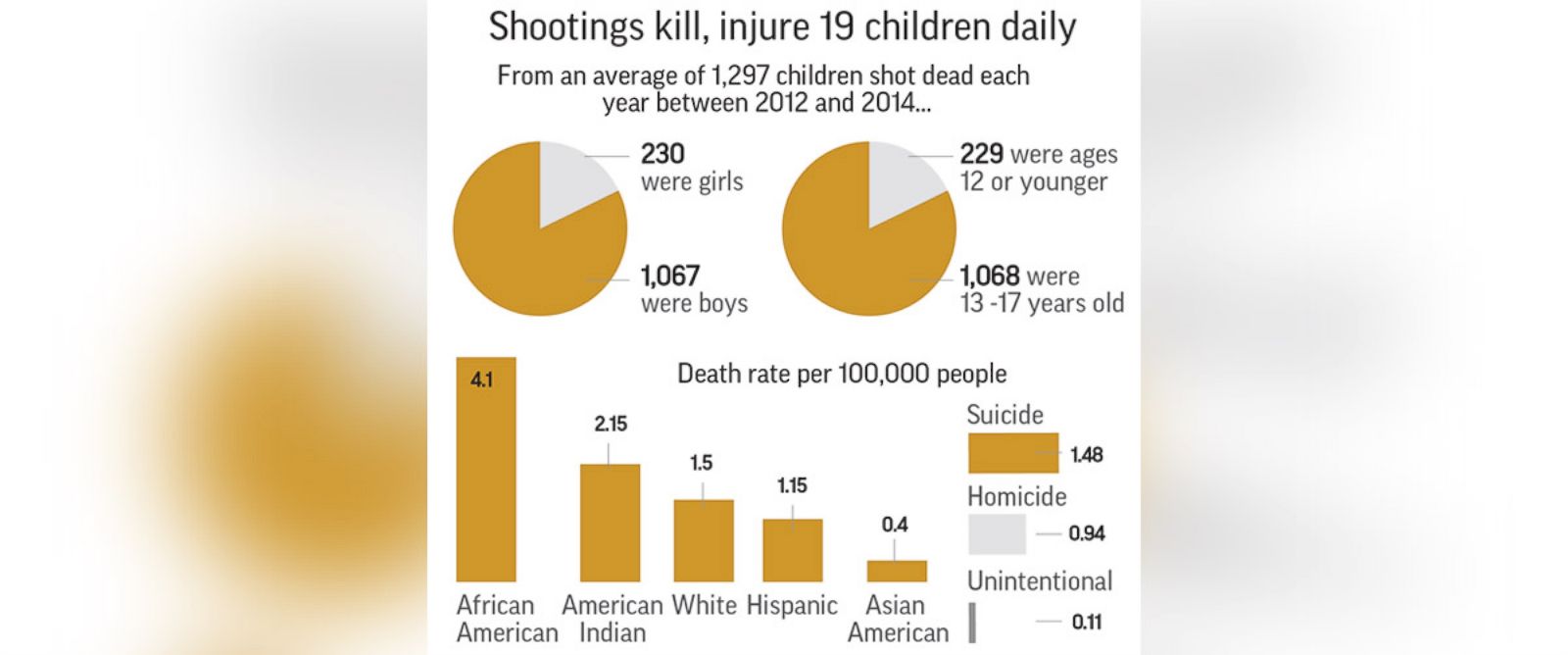
Shootings kill or injure at least 19 U.S. children each day, with boys, teenagers and blacks most at risk, according to a government study that paints a bleak portrait of persistent violence.
The analysis of 2002-14 U.S. data is billed as the most comprehensive study on the topic. While it mostly confirms previously released information, it underscores why researchers view gun violence as a public health crisis.
The report from the Centers for Disease Control and Prevention involves children and teens through age 17. It was compiled by analyzing death certificates and emergency room reports. Among the findings published Monday in the journal Pediatrics:
  • The yearly toll is nearly 1,300 deaths and almost 6,000 nonfatal gunshot wounds — most of them intentional.
  • Most deaths result from homicides and suicides, while assaults caused most of the nonfatal injuries.
  • The annual death rate is nearly 2 out of 100,000 children — the rate is double for blacks — while nonfatal gunshot wounds injure almost 8 out of 100,000 kids each year.
  • Suicides increased from 2007-14, from 325 to 532. The suicide rate increased 60 percent over those years to 1.6 per 100,000. One-third of these kids were depressed and most had experienced a recent crisis, including relationship breakups and problems at school.
  • Homicides fell from 2007-14, from 1,038 to 699, the rate dropping by 36 percent to less than 1 per 100,000.
  • Most unintentional deaths resulted from playing with guns and unintentionally pulling the trigger. Most victims were bystanders although among kids up to age 10 in this group, more than 40 percent accidentally shot themselves.
The report notes that unintentional shooting deaths may be significantly underreported, which was highlighted in a report by The Associated Press and USA TODAY Network. The news organizations found during the first six months of 2016, minors died from accidental shootings — at their own hands, or at the hands of other children or adults — at a pace of one every other day, far more than limited federal statistics indicate.
Congress has prohibited the CDC from using federal money to advocate or promote gun control. CDC spokeswoman Study: Shootings Kill Or Injure 19 US Children Each Day | WBEZ:
 Image result for Shootings Kill Or Injure 19 US Children Each Day

New LA school board member says his election was not about ‘the proliferation of charters’ | EdSource

New LA school board member says his election was not about ‘the proliferation of charters’ | EdSource:

New LA school board member says his election was not about 'the proliferation of charters'


he May runoff election for two seats on the Los Angeles Unified District school board has resulted in a new majority backed by charter school advocates.  In addition to incumbent Monica Garcia, who won re-election in March, the two new board members who won in the May runoff are 28-year-old Kelly Gonez and 31-year-old Nick Melvoin. Both will join the board in July.  
As a public service, EdSource is publishing an edited transcript of interviews we conducted with both of them about their priorities. Despite charter school advocates spending millions of dollars on their behalf through independent expenditure committees, both candidates say they will not be pushing for a significant expansion of charter schools in the district. Below is our interview with Nick Melvoin, who previously taught at L.A. Unified’s Markham Middle School and Loyola Marymount University, and was director of policy at Great Public Schools in Los Angeles. The interview was conducted on May 18, before the current board voted to extend Superintendent Michelle King’s contract to 2020. 
EdSource: Can people expect to see a major increase in charter schools in LAUSD as a result of this new board majority? 
Melvoin: I think people can expect to see an amplification of what works in public education and a replication. I was an LAUSD teacher, I obviously was supported by charter supporters, but we were very clear with our messaging from the start that this wasn’t about the proliferation of charters. It was not about an artificial number of new charters. It was about looking at what works within the district and replicating that. I don’t think districts like LAUSD have learned lessons from the charter movement the way that it was initially intended. I’ll ask charter principals, “Has the district come and asked what’s working and how to replicate it?” They laugh, as if that’s a crazy question, given the political climate. I’d like to see an increase in schools that are serving kids. I’m much less interested in whether that is a district school or a charter or a magnet school. I’d like to see us cross-pollinate, New LA school board member says his election was not about ‘the proliferation of charters’ | EdSource: 

The Conservative Case for Unions - The Atlantic

The Conservative Case for Unions - The Atlantic:

The Conservative Case for Unions

How a new kind of labor organization could address the grievances underlying populist anger


lthough i was as dumbfounded on Election Day as the next D.C. bubble-dweller, I did feel that I had one scrap of insight into the working-class anger that helped power Donald Trump’s improbable victory. Last year, I got a taste of what many Americans are coping with in a globalized economy—a globalized economy, more specifically, in which many workers feel voiceless and powerless. A taste was more than enough.


Early last year, my husband, Michael, took a part-time service job with an international airline. He immediately encountered the practice called just-in-time scheduling. The company would distribute shift schedules in advance, but then it would adjust them at will, often with only a couple of days’ notice and without bothering to consult the affected workers. Michael might be told on a Thursday that he would be working the Saturday-afternoon shift, and never mind our plans to be at a wedding that day.
He didn’t have kids to pick up, or classes to attend, or a second job to work, or any of the other commitments that make just-in-time scheduling an intolerable burden for many workers. Even so, the disruption to our lives soon became unbearable. The unpredictable hours were problematic, but even more demoralizing was the sense of being treated like a machine part. Most frustrating of all was that the company’s random, dysfunctional scheduling practices could easily have been improved by worker input, had there been channels for worker input; but Michael’s supervisor seemed just as helpless as he was, and unsurprisingly, ground-based workers like Michael had no union representation.
I say “unsurprisingly” because private-sector unions are close to extinct. In the 1950s, more than one in three private-sector workers belonged to a union; today, unionization is down to 6 percent of the private-sector workforce, which is lower than it was a century ago, before the modern labor movement took off. And the rate continues to drop.
Even before getting my small taste of what working-class Americans are experiencing in horse doctors’ doses, I had come to see the decline of unions as one of the country’s most pressing problems—and at least as much a social and political problem as an economic one. Old-style, mid-20th-century industrial unions had their flaws, unquestionably. But when unions work as they should, they serve important social functions. They can smooth the jagged edges of The Conservative Case for Unions - The Atlantic:

Image result for big education ape union
 Image result for big education ape union

More than 120 layoffs proposed in L.A. school district budget - LA Times

More than 120 layoffs proposed in L.A. school district budget - LA Times:

More than 120 layoffs proposed in L.A. school district budget


A $7.5-billion Los Angeles schools budget set for approval Tuesday includes 121 layoffs and 180 “reassignments” that would result in pay cuts and possible additional job losses.
Among the hardest hit in the proposal are library aides: 30 would lose their jobs, leaving 43 elementary schools without library staffing because some of the aides work at two campuses. That’s about 9% of the library aides in the nation’s second-largest school system.
Others who would lose their jobs include some clerks, payroll specialists, accounting technicians, teaching aides and security aides. The number of central office administrators, coordinators and managers also would shrink by about 150. Many of them have tenure as school administrators or teachers and could return to these other positions — with reduced pay. The district believes it will have enough vacancies to accommodate them.
No teachers are targeted for layoffs. Although declining enrollment means fewer positions for instructors, the reduction is expected to come through attrition, such as teacher retirements.
The hardest direct hit would be on Los Angeles 500, the local chapter of the California School Employees Assn., whose membership would be hit by 87 layoffs and 120 reassignments, said union President Letetsia A. Fox.
“It’s like we’re being punished for asking for and receiving a raise,” said Fox, who is the senior financial manager for Dorsey High School in the Baldwin Hills/Crenshaw area.
Her union members, who include library aides, clerks, accounting specialists and technicians, received a 9.96% raise over a three-year contract that ends in June. Fox’s members earn as little as $13 an hour, she said, even though the district announced three More than 120 layoffs proposed in L.A. school district budget - LA Times:


In high-crime areas, education reform needs to expand outside the classroom - The Hechinger Report

In high-crime areas, education reform needs to expand outside the classroom - The Hechinger Report:

In high-crime areas, education reform needs to expand outside the classroom

A science project can be the difference between life and death for kids in New Orleans

Image result for STEM superhero


In the 21st century, our children have one of three options: take something, break something or make something,” says New Orleans native Calvin Mackie, engineer and founder of the nonprofit STEM NOLA, which conducts hands-on science projects, mainly in New Orleans. (STEM refers to Science, Technology, Engineering and Mathematics.)
“If we don’t give them the skills and education to make something,” he continued, “then we leave them with the two options we see on the news every night.”
As of May 31, there were 300 shooting victims in New Orleans. In 2015 and 2016, it took two months longer to hit that dubious target. New Orleans is on pace to be a record year. Thirteen people were shot on June 3 alone, which according to New Orleans crime analyst Jeff Asher, is the per-capita equivalent of 90 people in a day in Chicago.
When school is out, kids are vulnerable to violence, especially in neighborhoods where the shortsightedness of “an eye for an eye” justice must be unlearned. Students need safeguards, and a quality education is a proven buffer. School hours are the safest for children. From the time students get on the bus to go to school till the last bell rings, fewer crimes are committed against and by youth.
Join the conversation later on Andre Perry’s radio show, “Free College,” hosted Tuesdays on WBOK1230 in New Orleans at 3pm Central/4pm Eastern 504.260.9265.
While I’m a proponent of year-round school and look forward to a modernized school calendar, shielding students by locking them up in a school building all year isn’t the answer. (Though schools thatIn high-crime areas, education reform needs to expand outside the classroom - The Hechinger Report
Related image
Image result for STEM superhero

Middle school graduation and a travel day. | Fred Klonsky

Middle school graduation and a travel day. | Fred Klonsky:

Middle school graduation and a travel day.


First there was the deluge.
Then came the rainbow over Coney Island as my granddaughter graduated with over 400 of her fellow middle school students last night.
And I mean the rainbow arched right over Coney Island.
In a covered open air arena a few steps from the Cyclone roller coaster and Nathan’s hot dogs.
Fantastic.
The kids were great.
The school played a video tape of Nelson Figueroa, former Mets player, current sports announcer and alum.
“This past year has shown that anybody can be President. Anybody,” he told the students.
The assembled 1,400 parents and family members laughed.
Another DOE bureaucrat told the kids that they had just spent the last year “mastering Middle school graduation and a travel day. | Fred Klonsky:

Marc Tucker: Trump’s Budget Takes from the Poor to Give to the Rich | Diane Ravitch's blog

Marc Tucker: Trump’s Budget Takes from the Poor to Give to the Rich | Diane Ravitch's blog:

Marc Tucker: Trump’s Budget Takes from the Poor to Give to the Rich

Image result for big education ape trump robinhood


Marc Tucker says that Trump’s budget will not make America great again.It is a reverse Robin Hood plan, taking from the poor and giving to the rich.
“The first reaction is all gut. The budget, on its face, would represent a gigantic redistribution of resources from the poor to the rich. To say that that is morally bankrupt is to understate the case. There is no rational argument for such a policy.
“The administration makes three cases for its proposals. The first is that tax breaks for the rich while robbing the poor to pay for the tax cuts will generate so much growth that the taxes on the increased income will more than pay for the tax relief. That argument has been advanced again and again despite a continuing lack of evidence that it has ever actually worked out that way. If you want to see the most visible and colossal evidence for the failure of this theory, you have only to look at Kansas, which has been virtually bankrupted by Governor Sam Brownback’s determination to go down this rat hole.
“The second is that all the administration is doing is giving freeloaders an incentive to work. That may be a masterpiece of propaganda, but not a masterpiece of reasoning. Someone has to explain to me how taking away financial support to go to college from low-income high school graduates is going to give these “freeloaders” an incentive to work. I want to know how giant cuts to the National Institutes of Health research budget on life-saving drugs is giving freeloaders an incentive to work.
“The third and last argument this administration has advanced for this budget is that the evidence that the programs they plan to terminate work is either weak or nonexistent. Without conceding the strength of their evidence that they do not work—the evidence is at worst mixed—let’s just look at the logic of the argument. Almost all of these programs are intended to help vulnerable populations. Surely, if they do not work, the responsibility of government is to replace them with stronger programs Marc Tucker: Trump’s Budget Takes from the Poor to Give to the Rich | Diane Ravitch's blog: 

Mike Klonsky's SmallTalk Blog: Rahm's latest 'reform". Moving backward in Chicago.

Mike Klonsky's SmallTalk Blog: Rahm's latest 'reform". Moving backward in Chicago.:

Rahm's latest 'reform". Moving backward in Chicago.


Chicago recorded it's 00th homicide over Father's Day weekend. Among those killed was 17-year-old Tiara Viramontes, a student at Marine Leadership Academy. 

After a Chicago weekend with 50 more shootings of mostly young people, eight of them fatal, Rahm Emanuel responded symbolically by laying off 50 more Head Start aides on the eve of the last day of school. Then, pirouetting past the graveyard, the mayor boarded a plane to D.C. where he is set to take the stage at the National Press Club, touting his latest plan to make it more difficult for African-American and Latino students to graduate from ravaged Chicago high schools.

His speech, being billed ironically as “Moving Forward in Chicago,” will detail his plan to require all public high school seniors to provide a college or trade school acceptance letter, proof of military enlistment or a job offer in order to graduate. It's another one of those "reforms" that would be mocked to death if proposed in the rich white suburban schools Rahm attended or in the private school where he sends his own children.

Mainly poor, black and Latino Chicago students students will have to comply with the new 
Mike Klonsky's SmallTalk Blog: Rahm's latest 'reform". Moving backward in Chicago.:


HITTING LEFT

Budget Expert, Robert Greenstein Explores Trump’s Heartless Budget in Cleveland City Club Address | janresseger

Budget Expert, Robert Greenstein Explores Trump’s Heartless Budget in Cleveland City Club Address | janresseger:

Budget Expert, Robert Greenstein Explores Trump’s Heartless Budget in Cleveland City Club Address

Image result for Trump’s Heartless Budget


Robert Greenstein, the President of the Washington, D.C., Center on Budget and Policy Priorities, addressed the Cleveland City Club last Friday. Greenstein’s subject was President Trump’s proposed budget and what it will mean for real people. Although Greenstein did not specifically address the federal education budget, what he said has profound and tragic implications for the future of public education as well as for health and social services. I urge you to watch the video or listen to the podcast or read Greenstein’s remarks.
President Trump’s budget, explains Greenstein, is a “topic that should be of grave concern to our nation, the state of Ohio, and the city of Cleveland… The Trump budget is different from any that I’ve seen from any President of either party in the 45 years I’ve been working on these issues… First, it is surprisingly unprofessional. President Trump has outlined a very large tax cut that he says will be one of the biggest tax cuts in U.S. history. Yet his budget makes a series of assumptions that few analysts find credible—such as assumptions of soaring economic growth year after year…. The budget also proposes to repeal the federal estate tax but then continues to count the revenue from it as though the tax would remain in place. And second, the budget proposes the most aggressive, Robin-Hood-in-Reverse, budget and tax policies that any modern President has ever proposed.”
Contrary to what we may have been reading in the paper, Greenstein worries that Congress may actually pass a budget like Trump’s proposal: “Now, you may have heard it said that the Trump budget is dead on arrival in Congress. Please don’t believe it. The Trump budget is, in large part, an exaggerated version of the budget plans that the very conservative House Republican majority has advanced every year since 2011, as well as of the last budget plan that the House and Senate jointly adopted, in 2015. Every one of those budgets would have deeply cut programs for Americans of limited means, deeply cut non-defense discretionary programs, shifted costs to states and localities, and provided substantial tax cuts for those at the top. None of those budgets made their way into law because Barack Obama was president. But now, the White House, House, and Senate are controlled by the same party, and they all have the same general idea about budget cuts and tax cuts.”
The first way Greenstein’s remarks speak to the future of our nation’s public schools is his discussion of the Robin-Hood-In-Reverse budget priorities that will take from the poor and near-poor and reward the rich through massive tax cuts. It has been well established that Budget Expert, Robert Greenstein Explores Trump’s Heartless Budget in Cleveland City Club Address | janresseger:
 Image result for Trump’s Heartless Budget
Image result for Trump’s Heartless Budget