Latest News and Comment from Education

Monday, February 20, 2017

Special Nite Cap: Catch Up on Today's Post 2/20/17


Special Nite Cap: Catch Up on Today's Post 2/20/17

Featured Post

Betsy DeVos Had an Awfully Difficult First Week on the Job | Diane Ravitch's blog


#FAKEPRESIDENTSDAY 2017 | Reclaim Reform
#FAKEPRESIDENTSDAY 2017 | Reclaim Reform : #FAKEPRESIDENTSDAY 2017 #FAKEPRESIDENTSDAY 2017 | Reclaim Reform :
CURMUDGUCATION: Barber: Let It All Burn
CURMUDGUCATION: Barber: Let It All Burn : Barber: Let It All Burn On Valentine's Day, Sir Michael Barber (the head education honcho at Pearson) took to the74 to offer a rather odd and ultimately confused metaphor for education reform by walking us through the story of St. Paul's Cathedral . It's the test from his speech at the 2016 Global Google Education Symposium. Yikes. The problem, he asserts
Finland’s School Reforms are Troubling: 4 Reasons Why
Finland’s School Reforms are Troubling: 4 Reasons Why : Finland’s School Reforms are Troubling: 4 Reasons Why Finland’s new curriculum means that schoolchildren will no longer need to sit down quietly in classrooms, since they will instead be able to choose where and how they study. In future there will not necessarily be any traditional enclosed classrooms. —“The Truth About Finnish Schools” Thi
Two Thirds of Californians Disapprove of Trump’s Job Performance (PPIC Press Release)
A Third of Californians Approve of Trump’s Job Performance (PPIC Press Release) : Two Thirds of Californians Disapprove of Trump’s Job Performance Views on Immigration, Health Care, Climate Change, Abortion at Odds with President SAN FRANCISCO, February 9, 2017—Just a third of Californians approve of the way President Trump is doing his job, according to a statewide survey released today by the P
The Japanese education system may solve the problems of US public education | TheHill
The Japanese education system may solve the problems of US public education | TheHill : The Japanese education system may solve the problems of US public education The uproar over the new Secretary of Education’s first days in the cabinet and the state of American public education K through 12 ignores the challenge of how we might actually improve teaching. And it can be a relatively simple fix.
Happy (Not My) Presidents Day!
Happy (Not My) Presidents Day! Anti-Trump protesters come out for ‘Not My Presidents Day’ rallies A broad range of activists opposed to the month-old Trump administration were using Monday's President's Day holiday to hold “Not My ” rallies nationwide. With most government workers, school employees and students enjoying a day off due to the federal holiday, events were underway in New York, Chica
Keep DeVos Away From Our Public Schools! - Action Network
Keep DeVos Away From Our Public Schools! - Action Network : Keep DeVos Away From Our Public Schools! Tell the National School Boards Association, The School Superintendents Association, and The National PTA to keep DeVos out of our public schools! Her goal has been, and always will be, to liquidate our public school system. BATs will deliver this petition to the NSBA, SSA, and Nat. PTA on March 2
Betsy DeVos Had an Awfully Difficult First Week on the Job | Diane Ravitch's blog
Betsy DeVos Had an Awfully Difficult First Week on the Job | Diane Ravitch's blog : Betsy DeVos Had an Awfully Difficult First Week on the Job Teachers who teach children with multiple disabilities and children who are homeless may think that they have a tough job, but consider what a very hard time Betsy DeVos had in her first week as Secretary of Education , very likely the first paying job she
Activist, politician Tom Hayden is remembered at UCLA memorial - LA Times
Activist, politician Tom Hayden is remembered at UCLA memorial - LA Times : Activist, politician Tom Hayden is remembered at UCLA memorial tomhayden.com - The Democracy Journal - http://tomhayden.com/ When Robert Kennedy was assassinated in 1968, the senator’s family picked Tom Hayden to be an honorary pallbearer at the funeral because the young antiwar activist embodied “the great hope that my f
The Importance of Asking the Right Policy Question: Technology in Schools | Larry Cuban on School Reform and Classroom Practice
The Importance of Asking the Right Policy Question: Technology in Schools | Larry Cuban on School Reform and Classroom Practice : The Importance of Asking the Right Policy Question: Technology in Schools About a century ago, electronic technologies entered the classroom. Initially as the film (1920s), radio (1930s), and instructional television (1960s), these devices derived from the entertainmen
Experience Matters | EdCentrist
Experience Matters | EdCentrist : Experience Matters The new Secretary of Education, Betsy Devos, is receiving quite a bit of slack for this recent interview . Although the interview covers a variety of education-related topics, I want to focus solely on the question and answer regarding her visit to Jefferson Academy Middle School, in Washington, D.C. Full disclosure, I have the privilege of wor
The problem with special education in Illinois is not over-funding or over-identification of students with special needs. Amend HB 2808. | Fred Klonsky
The problem with special education in Illinois is not over-funding or over-identification of students with special needs. Amend HB 2808. | Fred Klonsky : The problem with special education in Illinois is not over-funding or over-identification of students with special needs. Amend HB 2808. State Senator Andy Manar told the Gov. Rauner’s School Funding Reform Commission on January 17 that there wa
The Mile High Promise, And Risk, Of School Choice : NPR Ed : NPR
The Mile High Promise, And Risk, Of School Choice : NPR Ed : NPR : The Mile High Promise, And Risk, Of School Choice Choice here, he charges, represents "hope and ideology not supported by current evidence" that closing low-performing schools really improves outcomes. During Betsy DeVos' bitter confirmation hearing last month for education secretary, U.S. Sen. Michael Bennet pointed to Denver as
Rough First Week Gives Betsy DeVos a Glimpse of the Fight Ahead - The New York Times
Rough First Week Gives Betsy DeVos a Glimpse of the Fight Ahead - The New York Times : Rough First Week Gives Betsy DeVos a Glimpse of the Fight Ahead By the end of her first full week as the secretary of education, Betsy DeVos had already sparred with a middle school and a former schools chancellor in Washington, accused some of the school’s teachers of passively awaiting instruction and said sh
It’s a Terrible Time to Be Secretary of Education, Especially If You Don’t Understand the Job - Education Law Prof Blog
Education Law Prof Blog : It’s a Terrible Time to Be Secretary of Education, Especially If You Don’t Understand the Job Publish Post Even if Betsy DeVos understood her job, she could not have taken over the Department of Education at a worse time. The busiest and most complex process that any Secretary of Education will likely see over the next several years is beginning. States are set to submit
Mike Klonsky's SmallTalk Blog: WEEKEND QUOTABLES
Mike Klonsky's SmallTalk Blog: WEEKEND QUOTABLES : WEEKEND QUOTABLES Toni Morrison Toni Morrison This is precisely the time when artists go to work. There is no time for despair, no place for self-pity, no need for silence, no room for fear. We speak, we write, we do language. That is how civilizations heal. -- The Nation Rick Ayers Threats and bluster might work when you are building a casino bu
Schools Matter: Yolie Flores Aguilar email colluding with charter school executives
Schools Matter: Yolie Flores Aguilar email colluding with charter school executives : Yolie Flores Aguilar email colluding with charter school executives “PLEASE don’t forward this email. simply state it in your own words.”— Yolie Flores Aguilar This email was addressed to some 60 individuals, including myself, on February 4, 2017. While its authenticity is not absolutely certain, I have research

YESTERDAY

Married teachers, their children, and President Trump’s supporters | Reclaim Reform
Married teachers, their children, and President Trump’s supporters | Reclaim Reform : Married teachers, their children, and President Trump’s supporters My friend Darcey Addo and her husband, Dan, are teachers on the Space Coast in Brevard County. They have two young children in the public schools. They are sweet and loving people. Here is Darcey’s own account of one witnessed incident that occur
Special Nite Cap: Catch Up on Today's Post 2/19/17
Special Nite Cap: Catch Up on Today's Post 2/19/17 Featured Post Ed Notes Online: DeVos to Tour Schools With Randi - Marshals Doubled to Protect Randi From Union Members' Outrage NYC Public School Parents: Update on Lead - 


Top Posts This Week


#FAKEPRESIDENTSDAY 2017 | Reclaim Reform

#FAKEPRESIDENTSDAY 2017 | Reclaim Reform:

#FAKEPRESIDENTSDAY 2017


fakepresidentsday-010-copy

CURMUDGUCATION: Barber: Let It All Burn

CURMUDGUCATION: Barber: Let It All Burn:

Barber: Let It All Burn


On Valentine's Day, Sir Michael Barber (the head education honcho at Pearson) took to the74 to offer a rather odd and ultimately confused metaphor for education reform by walking us through the story of St. Paul's Cathedral. It's the test from his speech at the 2016 Global Google Education Symposium. Yikes.

The problem, he asserts, began with the construction of the original St. Paul's, a classic Gothic construction whose spire had been shattered by a lightning strike in the 1560s, a mess that was never repaired. A century later, royal surveyors recommended patch and repair, but fortunately, just a few years later, the Great Fire of London leveled the city, St. Paul's included. Christopher Wren got to build a new cathedral.

Does this historic example of disaster-based opportunity remind you of Katrina-socked New Orleans? Well, it does Barber. And it represents for him a choice that he will repeat throughout the piece--- patch and mend, or transformation?

He proceeds with a litany of ills-- blacks men sent to prison, poor students not admitted to Oxford, Greece's huge levels of youth unemployment, illiterate Ugandan teachers, jobs at risk for automation.

Patch and mend, or transformation?

He's talking now about the education system. And he will now call out the reasons he think transformation isn't happening.

Cost-- it's easy to let short term concerns "override long-term aspirations." Kind of like poor people could save money over time by buying a Tesla with the $80,000 they don't have.

Entrenched status quovians-- Oh, those damn teachers' unions. They advocate for crazy things like 
CURMUDGUCATION: Barber: Let It All Burn:


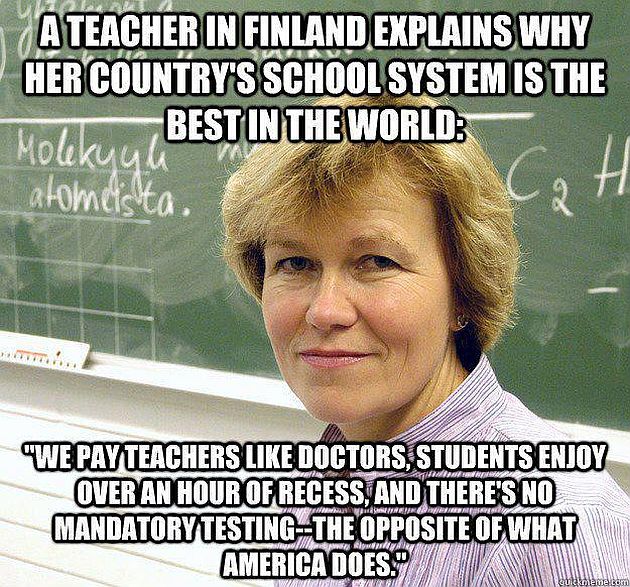
Finland’s School Reforms are Troubling: 4 Reasons Why

Finland’s School Reforms are Troubling: 4 Reasons Why:

Finland’s School Reforms are Troubling: 4 Reasons Why


Finland’s new curriculum means that schoolchildren will no longer need to sit down quietly in classrooms, since they will instead be able to choose where and how they study. In future there will not necessarily be any traditional enclosed classrooms.
Finland’s schools have been admired for years. Americans and others from around the world have visited and marveled at their success. Scores on the Programme for International Student Assessment (PISA) have consistently been high.
I list several sources below describing the past beauty of Finnish schools and how they have done much that is right when it comes to teaching.
The United States has never imitated Finland’s winning practices. That’s because the goal here has been to privatize public schools.
But wait! Now schools in Finland are changing to mirror America’s reforms! What’s Finland’s School Reforms are Troubling: 4 Reasons Why:
 Image result for Finland’s School

Two Thirds of Californians Disapprove of Trump’s Job Performance (PPIC Press Release)

A Third of Californians Approve of Trump’s Job Performance (PPIC Press Release):

Two Thirds of Californians Disapprove of Trump’s Job Performance 
Image result for Trump’s Job Performance sucks

Views on Immigration, Health Care, Climate Change, Abortion at Odds with President

SAN FRANCISCO, February 9, 2017—Just a third of Californians approve of the way President Trump is doing his job, according to a statewide survey released today by the Public Policy Institute of California (PPIC), with funding from the James Irvine Foundation.
In the survey, taken January 22–31, the president’s job approval rating is 30 percent among California adults and 34 percent among likely voters. Majorities in both groups disapprove (58% all adults, 55% likely voters). There’s a strong partisan divide among Californians on this question: 72 percent of Republicans and 10 percent of Democrats approve of the president’s job performance. Approval is low across regions of the state. There are differences across racial/ethnic groups, with whites (39%) and Asian Americans (37%) twice as likely as Latinos (17%) and African Americans (15%) to approve. Californians overall are less likely to approve of President Trump than are adults nationwide (45% approve), according to a Gallup tracking poll from January 23–29.
Trump’s favorability rating is 33 percent among adults and 37 percent among likely voters. Most have an unfavorable opinion (60% adults, 59% likely voters), and about half in each group have a strongly unfavorable one. Slightly less than a third of Californians have confidence (15% great deal, 13% good amount) that the president will make the right decisions for the country’s future (26% just some confidence, 45% none at all).
"The California public’s early reviews of President Trump are generally negative,” said Mark Baldassare, PPIC president and CEO. "Yet they also demonstrate that the state’s voters have deep partisan divisions that are very much in line with national politics.”
Most Support State, Local Action on Immigration
As California leaders consider their responses to Trump’s early action on immigration, the survey asked whether state and local governments should make their own policies and take actions—separate from the federal government—to protect the legal rights of undocumented immigrants in California. A solid majority of adults (65%) and 58 percent of likely voters favor state and local action. Opinion differs widely across political parties: 80 percent of Democrats favor state and local government action, while 69 percent of Republicans oppose it. Majorities across regions and racial/ethnic groups are in favor.
Consistent with PPIC surveys over the past year, an overwhelming majority of Californians (85%) say there should be a way for undocumented immigrants to stay in the US legally if certain requirements are met. Strong majorities across parties hold this view (93% Democrats, 84% independents, 65% Republicans). Of those who say they voted for Trump, 61 percent say undocumented immigrants should be allowed to stay and 34 percent say they should not.
When Californians are asked to name the one issue facing the state that is most important for the governor and legislature to work on, immigration is tied with jobs and the economy as the top issue (14% adults, 13% likely voters). Last January, Californians said water and drought (17% adults, 18% likely voters) and jobs and the economy (16% adults, 19% likely voters) were most important.
A Slight Majority Oppose ACA Repeal
In the wake of Trump’s pledge to repeal the Affordable Care Act (ACA), the survey asked Californians for their opinions of the 2010 health care law. Half (51% adults, 53% likely voters) view the law favorably (39% adults, 40% likely voters view it unfavorably). Californians are somewhat more likely to have favorable opinions of the law than were adults nationwide in a December Kaiser Family Foundation survey (43% favorable, 46% unfavorable). There are stark partisan differences: 77 percent of Democrats view the law favorably and 74 percent of Republicans view it unfavorably. Independents are more evenly divided but are more likely to view the law favorably (50%) than unfavorably (40%).
A slight majority of Californians (53%) oppose repealing the ACA. About a quarter (26%) say Congress should wait to repeal it until details of a replacement plan are announced, while 16 percent favor an immediate repeal. Across political parties, most Democrats (78%) and independents (57%) oppose repealing the ACA, while Republicans (80%) overwhelmingly favor it.
Strong Majority See Climate Change as Major Threat
The Trump administration’s approach to federal climate change policy appears likely to diverge from California’s. A strong majority of Californians (65%) say global climate change is a major threat to the well-being of the US (20% minor threat, 12% not a threat). Adults nationwide were much less likely to see climate change as a major threat in a January Pew Research Center survey (52% major, 32% minor, 14% not a threat). In the PPIC survey, Democrats (82%) are far more likely than independents (62%) and Republicans (27%) to say climate change is a major threat. A solid majority of Californians (63%) say they favor the state government making its own policies—separate from the federal government—to address global warming. Partisans are split: 77 percent of Democrats, 64 percent of independents, and just 30 percent of Republicans favor the state making its own policies. Republican support has dropped 19 points since last July.
Most across Parties Support Abortion Access
As Congress considers Trump’s Supreme Court nominee, abortion policy is an important issue in the debate. Most Californians (71%) say the government should not interfere with a woman’s access to abortion, while 27 percent say the government should pass more laws to restrict the availability of abortion. Since PPIC first asked this question in 2000, solid majorities of Californians have said the government should not interfere with access. Today, this view is held across parties (87% Democrats, 75% independents, 60% Republicans). Majorities of men and women and majorities across racial/ethnic, age, education, and income groups concur. Asked about the Roe v. Wade decision establishing a woman’s constitutional right to an abortion, 71 percent of Californians say they do not want to see the decision completely overturned. In PPIC surveys since 2005, at least 65 percent of Californians expressed this view.
"Californians’ policy preferences are deeply at odds with the new federal direction on abortion access, climate change, health insurance, and undocumented immigrants,” Baldassare said.
Most Approve of Supreme Court’s Job Performance
Most adults (57%) approve of the way the Supreme Court is handling its job. Independents (61%) are the most likely to approve, followed by Democrats (54%) and Republicans (49%). Asked about the ideology of the court, 20 percent say it is too liberal, 24 percent say it is too conservative, and 47 percent say it is just about right. Across parties, 48 percent of Republicans say it is too liberal, while 47 percent of Democrats and 37 percent of independents say it is just about right.
Approval Ratings for Congress Are Similar to Trump’s
Californians’ job approval ratings for Congress are similar to their ratings for Trump. Just a third of adults (33%) and a quarter of likely voters (25%) approve of the way Congress is doing its job. Democrats (19%) are much less likely than independents (35%) and Republicans (39%) to approve.
Although Republicans control the executive and legislative branches of the federal government, only about half of Californians (50% adults, 55% likely voters) say the president and Congress will be able to work together and accomplish a lot in the next year. An overwhelming majority of Republicans (85%) and a majority of independents (56%) expect productive collaboration, compared to 34 percent of Democrats. The belief that the president and Congress will be able to accomplish a lot is down sharply from January 2009, when there was a Democratic president and Democratic-controlled Congress. Then, 81 percent of Californians—including 66 percent of Republicans—held this view.
Half of Californians (52%) think the nation will have good times financially in the next year. When they are asked about the direction of the nation, just 36 percent of adults and 37 percent of likely voters say the US is headed in the right direction.
Governor Brown, California Legislature Get High Ratings
When asked about state leaders, California adults and likely voters each give Governor Brown 62 percent job approval rating—a record high in PPIC Statewide Surveys. The legislature’s approval ratings—57 percent among all adults and 50 percent among likely voters—are the highest since 2001. A record-high 66 percent of adults and 64 percent of likely voters say the governor and legislature will be able to work together and accomplish a lot in the next year. About half of Californians (53% adults, 51% likely voters) say the state will have good times financially in the year ahead. Most (58% adults, 58% likely voters) say things in California are generally going in the right direction.
"Californians give much higher approval ratings to the governor and legislature than to the president and Congress today,” Baldassare said. "With starkly different views of the direction of the state and the nation, many Californians have hopes that the governor and legislature will be able to work together and keep the state on its current track.”
Fewer Than Half Support Brown’s Budget
When Brown proposed his 2017–18 budget, he estimated a $1.6 billion deficit for the state. Yet just 37 percent of Californians see the budget situation as a big problem—a record low since PPIC first asked the question in 2006. Brown’s plan includes modest spending increases in K–14 and higher education, health and human services, and prisons and corrections. It also calls for slowing spending growth in K–14 education and other areas, and putting $1.1 billion in the state rainy day fund. When read a short description of the plan, just under half of California adults (47%) and 43 percent of likely voters favor it.
Brown has proposed about $43 billion in additional spending over the next ten years to address a multibillion-dollar shortfall in funding for infrastructure improvements. Funding would come from a $65 fee on all vehicles, increased state gas and diesel taxes, and cap-and-trade funds. When they are read a short description of this proposal, 41 percent of adults and 43 percent of likely voters are in favor.
For more survey findings on transportation, read "Californians and Transportation.”
"The public strongly believes that transportation spending should be a high priority for the state government,” Baldassare said. "Yet with most saying that we also have to spend what we have more wisely, state bonds are much more popular than fees and taxes for funding much-needed improvements.”
About the Survey
The PPIC Statewide Survey was conducted with funding from the James Irvine Foundation and the PPIC Donor Circle. Findings are based on a telephone survey of 1,702 California adult residents, including 681 interviewed on landline telephones and 1,021 interviewed on cell phones. Interviews took place from January 22–31, 2017. Interviews were conducted in English or Spanish, according to respondents’ preferences.
The sampling error, taking design effects from weighting into consideration, is ±3.3 percent for all adults, ±3.6 percent for the 1,428 registered voters, and ±4.1 percent for the 1,107 likely voters. For more information on methodology, see page 23.
Mark Baldassare is president and CEO of PPIC, where he holds the Arjay and Frances Fearing Miller Chair in Public Policy. He is founder of the PPIC Statewide Survey, which he has directed since 1998.
The Public Policy Institute of California is dedicated to informing and improving public policy in California through independent, objective, nonpartisan research. We are a public charity. We do not take or support positions on any ballot measure or on any local, state, or federal legislation, nor do we endorse, support, or oppose any political parties or candidates for public office. Research publications reflect the views of the authors and do not necessarily reflect the views of our funders or of the staff, officers, advisory councils, or board of directors of the Public Policy Institute of California.A Third of Californians Approve of Trump’s Job Performance (PPIC Press Release):

PPIC Statewide Survey: Californians and Their Government
Mark Baldassare, Dean Bonner, David Kordus, and Lunna Lopes
A strong majority of Californians disapprove of President Trump’s job performance—but opinion varies widely across parties. Majorities differ with the president in their views on immigration, health care, climate change, and abortion. A solid majority approve of Governor Brown’s performance, but fewer than half favor his proposed budget.

 Crosstabs:
All Adults [PDF]
Likely Voters [PDF]
 Time Trends:
All Adults [PDF]
Likely Voters [PDF]
This research was supported with funding from the James Irvine Foundation and the PPIC Donor Circle.

The Japanese education system may solve the problems of US public education | TheHill

The Japanese education system may solve the problems of US public education | TheHill:

The Japanese education system may solve the problems of US public education

Image result for Japanese education system

The uproar over the new Secretary of Education’s first days in the cabinet and the state of American public education K through 12 ignores the challenge of how we might actually improve teaching. And it can be a relatively simple fix.  
Blocked by protesters from visiting a Washington, D.C. school recently, newly confirmed Education Secretary Betsy DeVos, an avid support of privatization, met with public school officials eventually.
Yes, DeVos had faced a historically close vote — the first ever cabinet confirmation when a vice president cast the tie-breaking vote.
Opponents of DeVos cited her lack of experience, the poor performanceof the Michigan Charter schools and her financial contributions to many of the senators voting for her confirmation. 
Secretary DeVos revealed alarming misunderstandings about education policy and resisted calls to maintain funding for public education or to hold private schools and charter schools to the same standards as public schools. She remains a supporter of privatization.  


However, as Diane Ravitch argues in her 2013 book “Reign of Error: The Hoax of the Privatization Movement and the Danger to America’s Public Schools,” there is scant evidence privatization works.
If privatization approaches, such as vouchers, charter schools, merit pay and abolishing tenure haven’t provided the magic bullet to improving education, it is because they don’t directly address how we improve teaching.
What may solve the problems of American public education is what already works in Japan.
In researching the K-12 Japanese educational system, typically compared favorably to ours, Catherine Lewis, senior research scientist at Mills College, asked Japanese teachers how they learned problem-solving approaches to teaching mathematics. Reportedly Lewis reacted in disbelief when they told her that were developed by American researchers.
Elizabeth Green, author of Building a Better Teacher: How Teaching Works (and how to Teach it to Everyone) found a similar pattern when she interviewed Akahiko Takashi, once one of Japan’s leading teachers and now Associate Professor of Elementary Math Teacher Education at DePaul University.
As Green describes in her book, Takashi came to Chicago to observe classrooms using the innovative teaching approaches of John Dewey, George Polya and the National Council of Teachers of Mathematics. The Japanese education system may solve the problems of US public education | TheHill:
Related imageImage result for Japanese education system