Latest News and Comment from Education

Monday, October 31, 2016

'Common Enrollment' - The Newest Page in School Privatizers' Playbook

'Common Enrollment' - The Newest Page in School Privatizers' Playbook:
‘Common Enrollment’ – The Newest Page in School Privatizers’ Playbook


In October 2015, Kim Davis, a parent of public school students in Oakland, attended a community meeting about improving the large district’s student assignment system, a process that many parents agreed was in need of some sort of repair.
But Davis, co-founder of Parents United for Public Schools (OUSD Parents), immediately suspected that something about this particular meeting wasn’t quite right. First of all, it wasn’t led by district officials, educators or parents, but by representatives from Educate 78 and Great Oakland Public Schools (or GO Public Schools), two groups with deep ties to the corporate education privatization agenda.
Also, the presentation was infused with hyperbolic rhetoric about the “crisis” engulfing the enrollment process. There was no time to waste because the current system was profoundly unfair to Oakland parents and in need of an urgent overhaul – or so attendees were told.
But revamping the system was easily attainable, they promised, because the estimated $1.4 million tab would be picked up by various “philanthropic” organizations. That is, on one condition –  the new system must combine public schools and charter schools in one enrollment process.
“It was all very manipulative,” recalls Davis. “The way they framed the issue as this big emergency and then they kind of slid charters in under the door near the end of the meeting. That’s what this proposal was all about – opening up even more doors to charters in Oakland.”
But that’s a familiar tack of charter supporters in their push to expand the sector, including in this fledgling movement to overhaul enrollment systems.  Advocating for a more streamlined process is far more digestible, after all, than asking a community for greater access to its students and public money – particularly at a time when the luster of the charter industry, amid mounting financial and accountability scandals,has worn off.
[Common enrollment] presents all schools in its system as public schools, even though charter schools are privately-managed and not publicly accountable” – Trish Gorham, president, Oakland Education Association
But that’s exactly what groups like Educate 78 and GO Public Schools and their financial backers have their sights on for Oakland: an even greater market share for charter schools, which already comprise almost half of the city’s K-12 institutions.
Many of the existing charters have waiting lists, but a cluster of new schools is in the offing that will benefit from easier access to more Oakland students.
To charter supporters, common enrollment punches that ticket.
Advocates say the system provides a convenient “one-stop shop” for parents who 
Image result for Common Enrollment


Schools Matter: The Gorilla in the Room

Schools Matter: The Gorilla in the Room:

The Gorilla in the Room

Image result for The Gorilla in the Room
by Susan Ohanian

Note: When Lisa Sanders' book was published in 2009, I wrote a version of this essay. Now, with Achieve the Core banging the drum even more loudly for  teachers to Connect classroom instruction to assessment, it's time to post it again.


Lisa Sanders, M. D., author of the New York Times Magazine "Diagnosis" column, and technical Advisor to the TV show "House, M.D.," offers many provocative stories in Every Patient Tells a Story: Medical Mysteries and the Art of Diagnosis. The gorilla story is my favorite.
 Sanders was invited by Dr. Marvin Chun, professor in the Visual Cognitive Neuroscience Lab at Yale to view a video quite famous in the field of vision and attention. Two teams, one dressed in white, one in black, are in the corridor of an unidentified office building. Each team has a basketball. Sanders' job was to watch the white team and keep track of how many times the ball was passed between players, keeping separate counts of when it was passed overhead and when it was bounced from person to person.

The image started to move and I kept my eyes glued to the white team's basketball as it was passed silently among the moving mass of black and white bodies. I got up to six overhead passes and one bounce pass and I lost track. Determined not to give up, I kept going until the thirty-second video was complete. 

Eleven overhead passes and two bounce passes? I ventured. I told Chun that I got a little confused in the middle. Despite that, I'd done a good job, he told me. I missed only one overhead pass. Then he asked, "Did you see anything unusual in the video?" Other than the unusual setting for the game, no, I saw nothing at all out of the ordinary. 

"Did you see a gorilla in the video?" 

A gorilla? No, I had definitely not seen a gorilla. 

"I'm going to show you the video again, and this time, no counting, just look at the game." He restarted the video. The white and black teams sprang back into action. Eighteen seconds into the game--around the time I lost my concentration--I saw someone (a woman, I find out later) in a gorilla suit enter the hallway court on the right. She strolled casually to the middle of the frame, beat her chest like a cartoon gorilla from a children's TV show, then calmly exited out of the left side of the picture. Her on-camera business lasted eight seconds and I hadn't seen her at all. 

If you had asked me if I thought that I could miss a gorilla--or even a woman in a gorilla suit--strolling through the picture, I would have agreed that Schools Matter: The Gorilla in the Room:


Open Letter to MA Governor Charlie Baker: No Education Lottery for the Lucky - Living in Dialogue

Open Letter to MA Governor Charlie Baker: No Education Lottery for the Lucky - Living in Dialogue:

Open Letter to MA Governor Charlie Baker: No Education Lottery for the Lucky


By Ruth Rodriguez-Fey.
Governor Charlie Baker has intensified his campaign to lift the cap on Charter Schools with the help of his wealthy investors from New York, I am re posting this letter to remind our Governor that his job is to ensure quality public schools for all the children of the Commonwealth, not just the lottery winners. We need to remind him that his job is not to help his wealthy friends get richer at the expense of our children’s future:
Governor Charlie Baker
Massachusetts State House
Office of the Governor
Room 280
Boston, MA 02133
Dear Governor:
The people of the Commonwealth wait for your leadership to protect our most sacred institution, our public schools. We look for your assurance to families that you will use the power to make every public school the quality every child deserves. We have followed your campaign promoting charter schools, while portraying the public schools as failing. The “failing” based solely on a test designed with a 60% failing rate. You have shown disrespect to the thousands of teachers, families and students that have been at the helm of a system that prior to the privatization reforms, enjoyed the admiration of the nation and the world.
Yes, there were challenges educators and students faced; challenges such as, large class size, lack of resources to enhance classroom instruction environment, increased number of children living in poverty, and an array of other social ills. There was also former Governor Mitt Romney unfortunate Unz Initiative that ended Bilingual Education. Most of those charter schools you praised, do not accept English language learners, or students with Special Needs, while the public schools that the Charters take money away from, have to teach every student with less resources. When families and educators begged our legislators to Open Letter to MA Governor Charlie Baker: No Education Lottery for the Lucky - Living in Dialogue:


The Truth of the Common School Movement - Bridging Differences - Education Week

The Truth of the Common School Movement - Bridging Differences - Education Week:

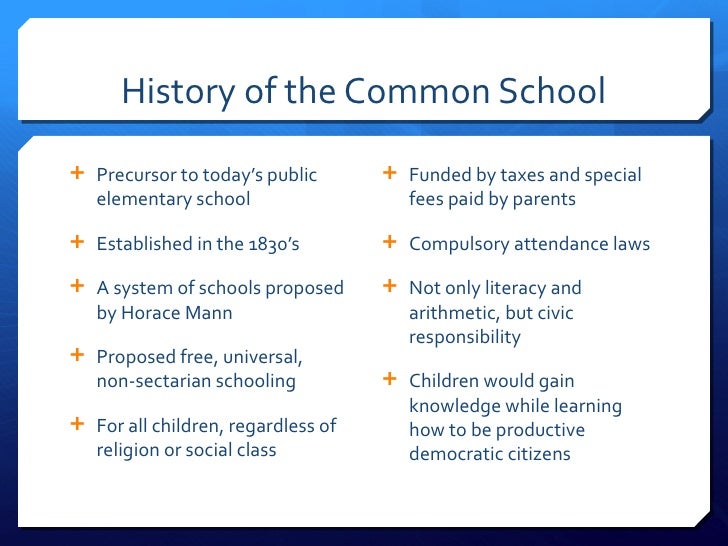
The Truth of the Common School Movement


Image result for Common School Movement
Harry Boyte continues his conversation with Deborah Meier. To read their full exchange, please visit here.
Dear Harry and friends,
Is there a "common school movement" of any sort today? No. We're split between basically school reform groups with a focus on teachers who have a shared set of ideas, several national parent groups to protect parental rights, and an assortment of national groups with a somewhat overlapping agenda such as Diane Ravitch's PE, SOS, and more. This could be a strength, and it could be a weakness.
There are critical questions we remain not divided on, but unclear about. Probably the key one is "where should decisions be made about what?" In a legitimately distrustful society with race and class dividing us in serious ways, it's hard to settle this question. What should remain a national imperative backed by the federal government and the courts? What should belong to the states in keeping with the original Constitutional conception? And equally what decisions must—for the sake of democracy and good education—be made as close to the family, teacher and child as possible with all the flexibility, and attention to context, that is required?
The shift away from local control has a long history—and of late, much has been driven by concerns over equal rights—civil rights, specific rights for other particular students (disabled, etc), parental rights—and by "the needs of the nation as a whole," with its focus on the economy as viewed by various elites. Plus traditional teacher and labor rights.
From the viewpoint of a local teacher or parent I see no significant difference whether the mandates come from the state or federal government. Sometimes that can be said as well for rights written into union contracts that feel like orders from afar rather than protection from arbitrary power. Even "autonomy" for schools usually means more autonomy for principals who are not even directly responsible to parents, teachers or students. 
Democracy as a principle rarely comes into the discussion, even though our young people presumably spend 12 or more years in a public institution that's supposed to teach them "about" democracy—while not itself being in any way democratic.
Yes yes yes, Harry.  We need a "common school movement" that builds schools that belong to its constituents—within as slim a set of limits as necessary. We need to figure out what those limits must be—for any school receiving tax-payer subsidies—and leave the rest of a body that represents all the needed constituents operating democratically.
In the 1990's, with the help of the Annenberg Foundation—we had an idea about how this might work in large cities. Alas, on the verge of its launching a new chancellor vetoed it.  The Pilot schools in Boston were another experiment that we can learn from although support for it has waned considerably since it was initiated twenty years go. The charter schools are another experiment we can learn from—since it operates somewhat differently in each state and even city. Even private school networks (Monetessori, etc) might be interesting to explore. Do you know of any places where democratic "common school" ideas have been tried out over a sufficiently long time to help us see what it might look like if scaled up—what were the positives as well as drawbacks?
Actually, Harry, I'm involved in imagining a book that tells some of the stories of individual schools, but what we also need to see is how this can be a movement—led not only by any single constituency but by all those who are directly affected and whatever allies they can bring along. For this we'll need the help of community organizing groups and their years of experience.
Maybe we can attach this to the Sanders revolution? But maybe it is also a conservative idea?
Deb
The Truth of the Common School Movement - Bridging Differences - Education Week:

Federal regulations threaten civil rights – Cloaking Inequity

Federal regulations threaten civil rights – Cloaking Inequity:

Federal regulations threaten civil rights


Do the U. S. Department of Education (USDOE) recently proposed regulations threaten the civil rights of English Learner (EL) students? The new regulation (34 C.F.R. §299.19 (c) (3)) would eliminate the use of state content assessment results and other evidence of actual classroom performance in English Learner (EL) program exit decisions, violate the rights of thousands of Hispanic, Chinese, Haitian, and other language minority parents to have meaningful input into the education of their children, silence the voice of teachers into program exit decisions, and disrupt the rules and procedures in place in most of the nation’s schools and districts and in all of Florida’s. These changes would result in harm to ELs since premature termination of language and academic support would increase their risk of school failure and negatively impact their life chances.
Entry and exit criteria determine who becomes eligible for the benefits of program participation, how students become eligible, and for how long they remain eligible.  If students are reclassified on the basis of one sole score on an English Proficiency (ELP) test and are thrust into mainstream classes before they are ready, the challenges they face in meeting achievement standards are magnified. To meet our legal and moral obligations as educators, we must provide English Language Learners opportunities to learn the English language, to learn the subject matter required for grade to grade promotion and graduation, and to acquire the academic language needed for success in school, higher education, and life.  To accomplish these goals, parents and educators must consider factors in addition to the results of an (ELP) assessment (a test of language skills that does not assess content knowledge and is administered only to ELs) when making high-stakes placement decisions.

Psychometric Standards

The proposed regulation ignores the need for multiple measures upon which to base decisions that will have major impact on a student, the Federal regulations threaten civil rights – Cloaking Inequity:


Demand the Impossible! (excerpt # 9) | Bill Ayers

Demand the Impossible! (excerpt # 9) | Bill Ayers:

Demand the Impossible! (excerpt # 9)


Image result for DEMAND the IMPOSSIBLE! bill ayers

Bill Ayers -- Demand the Impossible!: A Radical Manifesto | Haymarket Books -http://www.haymarketbooks.org/pb/Demand-the-Impossible

In contemporary America, belief in the free market economy above all else is absolute. It is unarguable. And yet there is no such thing as a “free market,” despite the noisy claims of the fundamentalist marketeers, their apologists in the bought media, and the well-mannered barbarians from the business schools. The “free market” is highly contested, politically managed, extensively regulated, and supported by government policy and our tax dollars at every level—often, but not always, to the advantage of the rich. Historically the free marketeers have howled at the elimination of child labor (“Let the little tykes earn a buck!”), inspections at meatpacking plants, the organizing of trade unions (“Selfish Bolsheviks!”), environmental regulations, clean air and water standards (“The market will sort it all out in the long run”), health and safety regulations in mines and fields and factories, the eight-hour day (“How dare you arrogant elitists deprive the laborer of his freedom to work as many hours as he likes?”), and the abolition of their right to trade in human beings. Of course chattel slavery was but one form of human trade and trafficking, and wage slavery—though different—is another. Today a defining stance of the marketeers is roaming the world in the company of extravagant military power in search of resources and markets as well as dirt-cheap, super-exploited labor that can be had without those pesky rules (“Child labor has the added benefit of teaching the natives discipline and obedience right from the start”) and then get cast aside without consequence.

Modern economists extol the wisdom of the “free market” in hushed tones typically reserved for glorifying a holy book, or they mumble about the “laws of the marketplace” as if explaining the laws of magnetism or optics or aerodynamics. When my oldest son was in college he took Economics 101 and within a couple of weeks he’d figured it out: if you substituted the word “capitalism” every time the textbooks or the professor said “market,” “economics,” or “industrialism” it made the readings and lectures completely sensible. Economics was simply a metric that reflected political choices and (with more or less accuracy) the social and class relations of society. When he asked why the course wasn’t called Capitalism 101, the professor responded, “Same thing.” Indeed.

Economists quantify everything, disguising their values and their meanings in a mystifying faux-language of objectivity. They advise the rest of us ordinary folks, as the Wizard advised the four seekers skipping down the yellow brick road toward Oz, “Don’t look behind that curtain!”

Let’s look anyway.

It would be more honest to admit that economics—like history or anthropology or political science—is a smashing together of the subjective and the objective, or, more precisely an interpretive look at facts and forces that exist in the world. It’s the gathering of statistics in order to describe and construct the world, and the decision as to what we count is of primary importance. Neither the facts and forces nor the interpretations are beyond the comprehension of us mere mortals. We don’t need to be technical experts to be active citizens engaged in the big questions that impact who we are or what we become as people or as a society. We can know we want clean food and water without being epidemiologists; we can say that we want bridges to hold up and airplanes to stay in the air without degrees in engineering; we can recognize that gross disparities in wealth distort and destroy democracy without spreadsheets that can only be read with a magnifying glass; we can decide that nuclear power plants are a bad idea without PhDs in physics. And we can decide we want a system of production and distribution that is transparent, participatory, and in the service of the general welfare—it’s not rocket science. Oh, and we can decide what kinds of rockets ought to be built, too, and how they should be used as well.

But now we see clearly that everything is quantified and everything has its price under capitalism. Everything can be bought and sold; everything is reduced to a cash nexus. Birthing a child, cancer treatments, childhood vaccinations, clean water—everything is monetized. We’re encouraged to know the price of everything but the value of nothing. We’re instructed to think of health, for example, not as a human right or a common good, but as an industry—the health care industry. Similarly it becomes less and less jarring to hear talk of the housing market (as opposed to housing), the food industry (not food as an obvious universal need), and the public safety and education markets. The water bazaar is well under way; still to come: the air exchange. This is the way it is, but this is not the way it has to be—not at all.Demand the Impossible! (excerpt # 9) | Bill Ayers:

Schools Hustle To Reach Kids Who Move With The Harvest, Not The School Year : NPR Ed : NPR

Schools Hustle To Reach Kids Who Move With The Harvest, Not The School Year : NPR Ed : NPR:

Schools Hustle To Reach Kids Who Move With The Harvest, Not The School Year

Teacher Sarah Ross and students (from left to right) Ximena, age 4, Yareli, age 3, and Kendra, age 2 at the Indiana Migrant Preschool Center, a free preschool for migrant children ages 2 to 5. The school teaches students in English and Spanish with the goal of preparing migrant children for kindergarten, wherever it may be.
Peter Balonon-Rosen/Indiana Public Broadcasting
If you're carving a jack-o-lantern tonight, take a minute to think about who picked that pumpkin.
Maybe it was Anayeli Camacho, one of the country's estimated 3 million migrant farm workers, and mother of two. For part of the year she rents a trailer on farmland in Oaktown, Indiana where she works in the fields, harvesting pumpkins and other crops.
But as the fall harvest comes to a close, she and her family will head back down south for the winter, following seasonal work. This is what Camacho has done for the last decade, traveling north and south, from Florida to Indiana, bringing her family, which now includes 4-year-old Ximena, along with her.
Ximena is young, but her education is arguably vital right now. Often children living this lifestyle face interrupted schooling, cultural and language barriers, and social isolation — all factors that inhibit a child's ability to do well in school.
Her preschool, a public school for migrant children ages 2 to 5, is working on that.


"Because their parents move around a lot, they don't have the stability of being in one location for very long where they might be able to take advantage of other preschool services," says Debbie Gries, education coordinator for the Indiana Migrant Regional Center.
"Our goal, when they're 5, is to have them ready for kindergarten," where ever that may be.
For migrant families, barriers to school services
The children of migrant workers are some of the country's poorest, most undereducated and hardest to track down.
But tracking them down is exactly what a preschool for migrant children needs to do.
"Staff go into fields trying to find and talk to these families and see if they want to Schools Hustle To Reach Kids Who Move With The Harvest, Not The School Year : NPR Ed : NPR:


EEK! elections - emails - education — PS connect

EEK! elections - emails - education — PS connect:

EEK! elections - emails - education  


It's Halloween and the fate of the Republic is in our hands. A double whammy, if you dare.
There’s much talk about how little talk there has been about public education in the presidential election. I guess the Russians just aren’t interested enough in American education policy to dump emails on the topic. Quick, somebody call Finland and tell them to check their firewall!

One leaked email did have particular relevance to public education though. David Dayen in the New Republic calls it “the most important Wikileaks revelation.”

A month before the 2008 presidential election, a senior Citicorp executive sent his appointment picks to Obama advisor John Podesta. Those preferences included Arne Duncan as Education Secretary. So now we know for sure why schools started to feel like franchises. Duncan, who put the public-education-as-a-competitive-marketplace on steroids. So destructive was Duncan that his legacy turns out to be a backlash. The years-in-waiting revamp of the Elementary and Secondary Education Act removes most of the power from anyone who becomes the Secretary of Education.

Flash forward to 2016, when some education activists are crying foul that their union leaders might be, well, leading. Randi Weingarten and Lily Eskelson Garcia appear to be having discussions about education with Hillary Clinton. For shame!

While many education advocates are grateful that the frontrunner’s advisors this time around include actual educators, the more militant activists see something nefarious. They could be relieved, though, that leaked emails show that the Clinton campaign recognized Rahm Emanuel as a liability for the civil war he has stoked against Chicago public schools. These are indicators that we might be in for some change of thinking about public education policy.

You do not need WikiLeaks to see that education issues are out in the open in other elections.
Massachusetts is having a hu-u-u-ge public debate about lifting its charter cap, which even LAUSD ex-pat and Boston Supe Tommy Chang opposes. Edushyster tells us that elected officials in that state, from mayors to Senator Elizabeth Warren, oppose lifting the cap, and the massive out-of-state and decidedly right-wing money backing “Question 2” has raised eyebrows enough to show the charter agenda is about a lot more than charter schools.

In Oakland, the charter group deceptively named Parent Teacher Alliance (the same PAC that ran the disgusting campaign against L.A. school board veteran Bennett EEK! elections - emails - education — PS connect:

Seattle Schools Community Forum: Can School Districts Use Race in Enrollment Policies?

Seattle Schools Community Forum: Can School Districts Use Race in Enrollment Policies?:

Can School Districts Use Race in Enrollment Policies?

Image result for Can School Districts Use Race in Enrollment Policies?


Yes, you can.

The question is - why is Seattle Schools saying, in document after document - you can't?

From the majority opinion:


Importantly, Justice Kennedy drew a distinction between school district plans that rely on the race of individual students and plans that seek to achieve diversity or avoid racial isolation through more generalized race-conscious measures:
If school authorities are concerned that the student-body compositions of certain schools interfere with the objective of offering an equal educational opportunity to all of their students, they are free to devise race-conscious measures to address the problem in a general way and without treating each student in different fashion solely on the basis of a systematic, individual typing by race.
Id. at 788-89 (Kennedy, J., concurring in part and concurring in the judgment).
Justice Kennedy went on to state that race-conscious approaches that do not rely on individual racial classifications are “unlikely” to “demand strict scrutiny” and are likely to pass constitutional muster. In so doing, he also provided some examples of the sorts of approaches that he had in mind:
School boards may pursue the goal of bringing together students of diverse backgrounds and races through other means, including strategic site selection of new schools; drawing attendance zones with general recognition of the demographics of neighborhoods; allocating resources for special programs; recruiting students and faculty in a targeted fashion; and tracking enrollments, performance, and other statistics by race. These mechanisms are race conscious but do not lead to different treatment based on a classification that tells each student he or she is to be defined by 
Seattle Schools Community Forum: Can School Districts Use Race in Enrollment Policies?:
 Seattle Schools Community Forum: Seattle Schools This Week - http://saveseattleschools.blogspot.com/2016/10/seattle-schools-this-week_30.html

Teaching American Literature at Mountain View High School: Technology Integration | Larry Cuban on School Reform and Classroom Practice

Teaching American Literature at Mountain View High School: Technology Integration | Larry Cuban on School Reform and Classroom Practice:

Teaching American Literature at Mountain View High School: Technology Integration

Image result for Teaching American Literature


Mark Twain’s Huck Finn is a classic American novel, Written in 1885, it is a book that students have read year in and year out in high school literature classes. The language used in the book, especially when the slave Jim is involved has become a contentious issue both in the past and now when communities have called for the banning of the book (see here). Issues of whether to use the N-word have arisen repeatedly. And it is so now as Kristen Krauss, an 11th grade English teacher goes over the initial chapters of the book in a 45-minute lesson I observed on October 10, 2016.
Krauss is a veteran teacher who has taught in elementary and middle schools before coming to Mountain View High School* in 2000. The room she teaches in has benefited from a grant to replace usual pods of three-four desks where students sit to high colorful tables with chairs on rollers and a small sofa in the rear of the room.
kristen-room
At 7:15AM, there are 14 students. Before the chime sounds to begin class, Krauss asks students to take out their tablets and laptops—the school implemented a Bring-Your-Own-Device policy a few years ago—and tells them to review Teaching American Literature at Mountain View High School: Technology Integration | Larry Cuban on School Reform and Classroom Practice:


Atlanta NCTE 2016: Confronting Educator Advocacy with Pre­Service and Early Career Teachers | the becoming radical

Atlanta NCTE 2016: Confronting Educator Advocacy with Pre­Service and Early Career Teachers | the becoming radical:

Atlanta NCTE 2016: Confronting Educator Advocacy with Pre­Service and Early Career Teachers


Image result for Atlanta NCTE 2016: Confronting Educator Advocacy with Pre­Service and Early Career Teachers
The 2016 NCTE Annual Convention features a multitude of amazing authors, educators, and presenters. Here we list some of the larger events where featured speakers are scheduled to appear:

General Sessions

Click on the pictures below to learn more about the speakers and when they will be appearing. 
Diane RavitchDoug HesseMeg MedinaJason Reynoldse.E. Charlton-Trujillo
G. NeriSharon DraperIbtisam Barakat Ta-Nehisi CoatesBrad Meltzer

Section Events

Whether you work in the Elementary, Middle, Secondary, or College realm - you're in for a treat at this year's Convention. Incredible speakers can be found at special events for every section. These are just a few of the folks on the program.

Kwame Alexander

Bess Altwerger
Sara Ahmed
Antero Garcia
Laurie Halse Anderson

Juan Guerra

Carmen Tafolla

Duncan Tonatiuh

Rich Wallace

Sandra Neil Wallace

Luncheons and Breakfasts

The following speakers will be featured at meal events throughout the Convention. Additional tickets are required to attend breakfast and luncheon events. Visit the convention registration form for meal ticket pricing.
Theater seating will be available in breakfast and luncheon rooms for anyone wishing to hear the speakers without attending the meal.

Andrew Aydin

Deborah Brandt

Don Brown

Leila Christenbury

Jocelyn Chadwick

Mignon Fogarty

S.E. Hinton

Christopher Myers

Nate Powell

Neal Shusterman

FEATURED SESSION: Saturday, November 19, 2016 – 8:00 – 9:15 am (A 302)
F.01 Confronting Educator Advocacy with Preservice and Early Career Teachers
  1. “But what does this have to do with me?”: Supporting preservice teachers trying to advocate for culturally responsive curriculum
Dr. Ann D. David
Kaci Boylan
Elyse Helbig-Guevara
Description: Preservice teachers face challenges advocating for culturally responsive curriculum in field placements and during student teaching and teachers educators face challenges in preparing them to be advocates.  Elyse and Kaci will share their experiences advocating for culturally responsive curriculum as student teachers.  Ann will share how she designs her course, Culturally Responsive Teaching, to support preservice teachers in navigating the challenges of being advocates.
  1. Challenging Controversy: Affiliate Support Addressing Censorship Issues
Jennifer Paulsen
Kevin Roberts
Katheryn Benway
Sheila Benson
Has anyone questioned why you teach the texts you’ve chosen? This discussion offers resources and support for teachers selecting controversial materials in order to successfully prepare for and address censorship challenges, particularly The Absolutely True Diary of a Part-Time Indian and All American Boys. 
  1. Teacher Advocacy: A Southern Dilemma
Nicole Amato
Kristen Marakoff
P.L. Thomas
Sean P. Connors
A round table discussion with teacher educators and early career teachers on advocating both for students and for the teaching profession. The discussion will center on the unique challenges of advocacy in conservative Southern schools, including the politics of remaining apolitical and the lack of support for professionalism in teaching.
  1. Culturally Complex Classrooms: Teacher Advocacy for English Language Learners (ELL)
Tracy Butler
Kayci Owen
Bobbi Siefert
Ashley Zimmer
As the number of English Language Learners (ELL) continue to increase in many states across the country, mainstream teachers overwhelmingly report they are not equipped to respond to unique learning needs in culturally complex classrooms. This presentation will focus on advocacy practices with cultural and Atlanta NCTE 2016: Confronting Educator Advocacy with Pre­Service and Early Career Teachers | the becoming radical:

Struggling new teachers pose dilemma for schools - San Francisco Chronicle

Struggling new teachers pose dilemma for schools - San Francisco Chronicle:

Struggling new teachers pose dilemma for schools

Cleveland Elementary school teacher Fernando Che (center) teaches English to third-graders Alan (left) and Christopher (right) in San Francisco. Photo: Liz Hafalia, The Chronicle
Photo: Liz Hafalia, The Chronicle Cleveland Elementary school teacher Fernando Che (center) teaches English to third-graders Alan (left) and Christopher (right) in San Francisco.

Principal Susan Ritter agonized over the decision she had to make: Should she keep four struggling new teachers on staff at San Francisco’s Balboa High School, or get rid of them at the end of the school year?
The choice was difficult.
If she let the probationary teachers remain, it would mean leaving the four floundering in classrooms while they headed for tenure, making it harder to remove them later if they didn’t improve. If she let them go, she would have to search for replacements amid a broad teacher shortage and probably end up with equally inexperienced educators when school started in the fall.
Principals face this dilemma across the state every year, with hundreds of new teachers — often those working with the neediest students — losing their jobs less than two years after starting their careers.
They are called non-reelects, and they cost districts millions of dollars annually to remove and replace while exacerbating high teacher turnover in the state’s most challenging schools. Already, principals are evaluating who will stay and who will go at the end of this school year. They have to decide before March.
Education leaders blame a range of factors for the problem, including insufficient preparation in college credentialing programs, a lack of support for new teachers in schools, and California’s two-year probation period, one of the shortest tenure tracks in the country.
At the core is the desire to weed out ineffective teachers. Yet when pressed, education officials, labor unions, teachers and principals question how many of these rejected teachers could have succeeded with more time and training and additional classroom support — perhaps even a transfer to a different school.
At Balboa High earlier this year, Ritter made her choice. All four would have to go.
“I think people go into this because they truly want to be teachers,” she said. “It’s a shame. In a lot of these cases, if you just had another year.”
Over the last five years, San Francisco public schools have hired 1,400 teachers, while 330 new teachers were told to leave, though some chose to resign rather than put “non-reelected” on their resume, according to data reviewed by The Chronicle.
According to a 2007 study by the National Commission on Teaching and America’s Future, it costs $9,000 for a school district to replace a teacher who leaves. That would put San Francisco’s five-year price tag at $3 million.Struggling new teachers pose dilemma for schools - San Francisco Chronicle:


Relay Graduate School of Education - Illegal lobbying marks effort to undermine Connecticut’s teacher certification law - Wait What?

Relay Graduate School of Education - Illegal lobbying marks effort to undermine Connecticut’s teacher certification law - Wait What?:

Relay Graduate School of Education – Illegal lobbying marks effort to undermine Connecticut’s teacher certification law

Image result for Relay Graduate School of Education


The charter school industry and their allies in the corporate education reform business are chortling over the news that the State Board of Education is meeting on Wednesday, November 2, 2016 at 9:30 a.m. in Room 1D of the Legislative Office Building Room to approve an underhanded effort to allow a major education reform company to end-run Connecticut’s teacher preparation program.
According to the State Board of Education’s agenda, Governor Dannel Malloy’s political appointees will hold an executive session, on Wednesday, and then immediately re-convene to adopt a motion that would allow the charter school industry’s Relay Graduate School of Education to operate in Connecticut.
Recently rejected in both California and Pennsylvania, the Relay Graduate School of Education corporation has set up shop in New Haven, Connecticut where it offers selected charter school personnel and others with a drive-through Master’s Degree in Education.
As for Relay Graduate School of Education, Seton Hall Professor Daniel Katz wrote a scathing article about the education reform entity reporting;
It is a “Graduate School of Education” that has not a single professor or doctoral level instructor or researcher affiliated with it. In essence, it is a partnership of charter school chains Uncommon Schools, KIPP, and Achievement First… Relay’s “curriculum” mostly consists of taking the non-certified faculty of the charter schools, giving them computer-delivered modules on classroom management (and distributing copies of Teach Like a Champion), and placing them under the auspices of the “no excuses” brand of charter school operation and teachers who already have experience with it.
Not only is the Malloy administration’s upcoming action bad public policy, it now appearRelay Graduate School of Education - Illegal lobbying marks effort to undermine Connecticut’s teacher certification law - Wait What?:


Image result for Relay Graduate School of Education

Report Reveals Illegal Admissions Policies at Charter Schools, By Molly Hunter Education Law Prof Blog

Education Law Prof Blog:

Report Reveals Illegal Admissions Policies at Charter Schools, By Molly Hunter

UnequalAccess-Cover


Over 20 percent of all California charter schools have enrollment policies that violate state and federal law, according to the report "Unequal Access," released in August by the ACLU of Southern California (ACLU SoCal) and Public Advocates of San Francisco. Charter schools in other states use some of the same enrollment policies.
Among the violations cited in "Unequal Access" are admission requirements that violate the California Charter Schools Act, which requires charters to "admit all pupils who wish to attend," regardless of academic performance, English proficiency, immigration status or other factors.
"We hope this report brings to light practices that prevent charter schools from fulfilling their obligations to all students who seek access," said Victor Leung, a staff attorney with the ACLU SoCal. "The report should make it clear to all California charter school authorizers and operators that they cannot cherry pick the students they enroll."
The study examined policies at most charter schools across the state and found that at least 253 violated students' rights by:
  • Denying enrollment to students who do not have strong grades or test scores;
  • Expelling students who do not maintain strong grades;
  • Denying enrollment to students who fail to meet a minimum level of English proficiency;
  • Selecting students based on onerous, pre-enrollment requirements, such as essays or interviews;
  • Discouraging or precluding immigrant students from attending by requiring information about pupils' or parents' immigration status;
  • Requiring parents to volunteer or donate money to the school.
"The idea behind charters was never to create private academies with public funds," said John Affeldt, managing attorney at Public Advocates. "Charter schools, like regular public schools, need to be open to all students. Admission requirements and processes that limit access or discourage certain kinds of students have no place in the public school system."
While the report is the first of its kind to be based on a broad survey of charter admission policies, concerns about these illegal policies surfaced earlier. In 2013, Public Safety Academy in San Bernardino ran into trouble after the school sent letters to 23 students whose grade-point averages had fallen below a 2.0 in one semester. The letter advised them to enroll in another school. Officials at the charter school changed their policy after being contacted by the ACLU SoCal.
In 2014, Public Advocates released a report documenting the charter practice of requiring parents to volunteer "service hours." The report led to new guidance from the California Department of Education, explaining that requirements for volunteer hours are illegal. But the "Unequal Access" report shows the practice still continues in some schools.
In addition to the survey, the report provides recommendations to charter schools, charter-authorizing bodies and the California Department of Education to address the violations.Education Law Prof Blog: