Latest News and Comment from Education

Thursday, October 13, 2016

Special Nite Cap: Catch Up on Today's Post 10/13/16


Special Nite Cap: Catch Up on Today's Post 10/13/16

Featured Post

OIG audit more evidence charter schools are the new subprime mortgages - Business Insider


The Washington Post asked Clinton, Trump for their education vision. Here’s what they said. - The Washington Post
The Washington Post asked Clinton, Trump for their education vision. Here’s what they said. - The Washington Post : The Washington Post asked Clinton, Trump for their education vision. Here’s what they said. The Washington Post asked the two major presidential candidates — Democrat Hillary Clinton and Republican Donald Trump — to respond to an identical series of questions about their vision and
CURMUDGUCATION: Embracing Education Productivity?
CURMUDGUCATION: Embracing Education Productivity? : Embracing Education Productivity? Rick Hess recently posted a piece that makes a couple of discussion-worthy points while neatly sliding right past a couple of other ones. In " Why You Should Learn to Love Educational Productivity ," Hess argues for an embrace of "productivity," but I'm not sure that word means exactly what he thinks it means. W
VAM-Based Chaos Reigns in Florida, as Caused by State-Mandated Teacher Turnovers | VAMboozled!
VAM-Based Chaos Reigns in Florida, as Caused by State-Mandated Teacher Turnovers | VAMboozled! : VAM-Based Chaos Reigns in Florida, as Caused by State-Mandated Teacher Turnovers The state of Florida is another one of our state’s to watch in that, even since the passage of the Every Student Succeeds Act (ESSA) last January, the state is still moving forward with using its VAMs for high-stakes acco
The @NYTopinion Trumpian support of charter schools – Cloaking Inequity
The @NYTopinion Trumpian support of charter schools – Cloaking Inequity : The @NYTopinion Trumpian support of charter schools Trumpian=twisted and incorrect sense of reality. So you might have had a chance to hear what charter proponents and education “reformers” have said recently in the New York Times and everywhere else about the NAACP charter resolution that will be voted on the the National
Dear Personalized Learning Salesmen: Please Join Us! – Save Maine Schools
Dear Personalized Learning Salesmen: Please Join Us! – Save Maine Schools : Dear Personalized Learning Salesmen: Please Join Us! By now, most people know that the Common Core State Standards have not only been an epic failure, but that the PR machine designed to sell the standards to the public was a botched job as well. Unfortunately, not as many folks realize that our billionaire reformers have
Back Door Vouchers or State Tax Subsidies for Private K-12 Education
ITEP Reports : State Tax Subsidies for Private K-12 Education Read the Full Report Including Appendices in PDF INTRODUCTION One of the most important functions of government is to maintain a high-quality public education system. In many states, however, this objective is being undermined by tax credits and deductions that redirect public dollars for K-12 education toward private schools. Twenty s
Charter Schools Do Little To Combat Racial Segregation, Says National StudyRivard Report
Charter Schools Do Little To Combat Racial Segregation, Says National StudyRivard Report : Charter Schools Do Little To Combat Racial Segregation, Says National Study Charter schools have been around for 25 years, following a 1991 Minnesota law that paved the way for eight such schools there. Today, charter schools enroll a small percentage of public school students across the country, but they c
Massachusetts Charter Expansion Ballot Question Pits Dark Money Against People Power - Network For Public Education
Massachusetts Charter Expansion Ballot Question Pits Dark Money Against People Power - Network For Public Education : Massachusetts Charter Expansion Ballot Question Pits Dark Money Against People Power By Lisa Guisbond, Executive Director, Citizens for Public Schools When they head to the polls on November 8, Massachusetts voters will decide whether to embrace unfettered charter school expansion
What’s Behind the Netflix CEO’s Fight to Charterize Public Schools?
What’s Behind the Netflix CEO’s Fight to Charterize Public Schools? : What’s Behind the Netflix CEO’s Fight to Charterize Public Schools? B rett Bymaster, a Silicon Valley electrical engineer, was optimistic when Rocketship Education, a non-profit charter school chain, began building its flagship Mateo Sheedy elementary school next to his San Jose home in 2007. He and his family lived in a lower-
Nationwide Rally Demands Government Leaders Prioritize Education
10/13/2016 – Nationwide Rally Demands Government Leaders Prioritize Education : Nationwide Rally Demands Government Leaders Prioritize Education October 13, 2016, 2016 Subscribe THIS WEEK: Chicago Averts Strike … Segregation By Real Estate … College Bureaucracies Grow … Racism Affects Learning … Indigenous Peoples Day TOP STORY Public School Activists Stage Massive Nationwide Rally Demanding Gove
Study Finds That Harsh School Discipline Costs Nation $35 Billion - Education Law Prof Blog
Education Law Prof Blog : Study Finds That Harsh School Discipline Costs Nation $35 Billion, Showing Connection to Much Larger Education and Social Issues Yesterday, the Civil Rights Project released a new report, The High Cost of Harsh Discipline and Its Disparate Impact . The study attempts to quantify the cost of harsh school discipline through the dropouts and social costs it produces. It loo
Mike Klonsky's SmallTalk Blog: Big biz slams Rahm 'retreat' on CTU contract. But he was right.
Mike Klonsky's SmallTalk Blog: Big biz slams Rahm 'retreat' on CTU contract. But he was right. : Big biz slams Rahm 'retreat' on CTU contract. But he was right. Chicago teachers have won a major victory without going on strike. But the mayor is under fire from his own LaSalle Street pals for "taking the easy path" and "leaving another eventual crisis for somewhere down the road." They may be righ
Opting out of testing in Connecticut — now a civic duty by Drew Michael McWeeney - Wait What?
Opting out of testing in Connecticut — now a civic duty by Drew Michael McWeeney - Wait What? : Opting out of testing in Connecticut — now a civic duty by Drew Michael McWeeney Drew Michael McWeeney is an Early Childhood Education major and teacher candidate at Southern Connecticut State University. His powerful commentary piece first appeared in the CTMirror. You can read and comment on it at: h
As Strike Averted, CTU Affirms Rights and Contributions of School Teachers | janresseger
As Strike Averted, CTU Affirms Rights and Contributions of School Teachers | janresseger : As Strike Averted, CTU Affirms Rights and Contributions of School Teachers This blog will take a short fall break. Look for a new post on Monday, October 24. Late Monday night, after two years of negotiations, Chicago Public Schools and the Chicago Teachers Union reached a tentative agreement to avert a str
Russ on Reading: Fostering Curiosity in an Age of Accountability
Russ on Reading: Fostering Curiosity in an Age of Accountability : Fostering Curiosity in an Age of Accountability In my capacity as Coordinator of College Reading at Rider University in New Jersey, I have the opportunity to teach many students who are, like I was 50 years ago, the first in their family to attend college. Because of this, their SAT scores and a number of other factors, these stud
CURMUDGUCATION: Fed's Stupid Teacher Prep Program Rules
CURMUDGUCATION: Fed's Stupid Teacher Prep Program Rules : Fed's Stupid Teacher Prep Program Rules The feds have released their rules governing teacher preparation programs, and they are just as stupid as they have promised to be all along. How stupid? Kate Walsh of the impossible-to-take-seriously National Council on Teacher Quality saw the rules and pronounced them even "better" than she had exp
Why Was El Camino’s Charter Renewed?
Why Was El Camino’s Charter Renewed? : Why Was El Camino’s Charter Renewed? Since we are on a timeline and it seems that the other issues that would prevent a renewal just don’t exist here, that everything else is very, positive…we are on a timeline and I think that we should vote the renewal up or down. ” – Steve Zimmer, LAUSD Board President It is yet to be revealed just how long the “ financia
TBFURMAN: An Astonishing Account Of Gulen Charter School Fraud
TBFURMAN: An Astonishing Account Of Gulen Charter School Fraud : An Astonishing Account Of Gulen Charter School Fraud Not sure if I'm going to get spanked for this or not, but I took-without-asking some Periscope footage from Progress Ohio. It's the press conference from a couple days ago--- the one where Robert Amsterdam highlights some of the themes of his complaint filed with the state auditor
Serious privacy concerns with new Summit/Facebook platform, used in 100 schools across the nation | Parent Coalition for Student Privacy
Serious privacy concerns with new Summit/Facebook platform, used in 100 schools across the nation | Parent Coalition for Student Privacy : SERIOUS PRIVACY CONCERNS WITH NEW SUMMIT/FACEBOOK PLATFORM, USED IN 100 SCHOOLS ACROSS THE NATION Our concerns about the open-ended data sharing of the Summit/Facebook software platform was featured on the front page of today’s Washington Post . This software
OIG audit more evidence charter schools are the new subprime mortgages - Business Insider
OIG audit more evidence charter schools are the new subprime mortgages - Business Insider : We just got even more evidence supporting the theory that charter schools are America's new subprime mortgages The Office of the Inspector General late last month released the results of a damning audit of the charter school industry , which found that charter schools' relationships with their management o
3 Gülen-linked charter schools in California face closure - Daily Sabah
3 Gülen-linked charter schools in California face closure - Daily Sabah : 3 Gülen-linked charter schools in California face closure US media reports that three FETÖ-linked charter schools in Los Angeles may face closure as local authorities will soon decide whether they are poorly managed, three months after Gülenists allegedly attempted to overthrow the government in Turkey The United States, th
Election 2016: Standardized Testing "Opt-Out" Movement Spills Into Florida | WUSF News
Election 2016: Standardized Testing "Opt-Out" Movement Spills Into Florida | WUSF News : Election 2016: Standardized Testing "Opt-Out" Movement Spills Into Florida Third-graders Hailey Everett, Maddison Hohman, and Madelynn Kinkade were not promoted to fourth grade, despite receiving all A's and B's on their report cards at Chocachatti Elementary School in Brooksville. MELINDA HOHMAN The day befo
Terror funding claims: Local lawmakers call for charter school reform | WKBN.com
Terror funding claims: Local lawmakers call for charter school reform | WKBN.com : Terror funding claims: Local lawmakers call for charter school reform Turkey claims that the company managing Ohio charter schools, including Horizon Science Academy in Youngstown, funds terrorists YOUNGSTOWN, Ohio (WKBN) – Lawmakers in Youngstown are calling for reform of the charter school system. This comes afte

YESTERDAY

Special Nite Cap: Catch Up on Today's Post 10/12/16
Special Nite Cap: Catch Up on Today's Post 10/12/16 Featured Post CURMUDGUCATION: FL: Oh, Come On Now! + Community Torlakson Announces CA Teachers of the Year - Year 2016 (CA Dept of Education) by mike 

Top Posts This Week


The Washington Post asked Clinton, Trump for their education vision. Here’s what they said. - The Washington Post

The Washington Post asked Clinton, Trump for their education vision. Here’s what they said. - The Washington Post:

The Washington Post asked Clinton, Trump for their education vision. Here’s what they said.


The Washington Post asked the two major presidential candidates — Democrat Hillary Clinton and Republican Donald Trump — to respond to an identical series of questions about their vision and plans for public schools should they become president of the United States.
Public education is one of the most important issues the country faces, but there has been little discussion about it during this campaign cycle. The Post’s education team asked questions about a number of topics, including school funding, school choice, standardized testing, early-childhood education and the Common Core State Standards. And we asked some personal questions, including whether they ever cheated in school.
Trump’s campaign declined requests to answer the Post’s questions and instead provided the following comment and said it preferred “to direct voters to Mr. Trump’s plan” on his website. Here is Trump’s response as provided by Jessica Ditto, the candidate’s deputy communications director:
“As your president, I will be the nation’s biggest cheerleader for school choice. I want every single inner city child in America who is today trapped in a failing school to have the freedom – the civil right – to attend the school of their choice. I understand many stale old politicians will resist. But it’s time for our country to start thinking big once again. We spend too much time quibbling over the smallest words, when we should spend our time dreaming about the great adventures that lie ahead.”
Clinton’s campaign responded to the questions. Here are the questions we asked of both candidates, with Clinton’s responses:
FUNDING
Q: Local school districts in the United States are funded primarily by property taxes, meaning that every district spends a different amount per student and wealthier districts have more to spend. Is this system fair? If not, how would you change it to ensure that funding equity?
Clinton: I believe that every child deserves a world-class education, with good teachers and The Washington Post asked Clinton, Trump for their education vision. Here’s what they said. - The Washington Post:

CURMUDGUCATION: Embracing Education Productivity?

CURMUDGUCATION: Embracing Education Productivity?:

Embracing Education Productivity?

Image result for Productivity animated gif

Rick Hess recently posted a piece that makes a couple of discussion-worthy points while neatly sliding right past a couple of other ones.

In "Why You Should Learn to Love Educational Productivity," Hess argues for an embrace of "productivity," but I'm not sure that word means exactly what he thinks it means.

We get to the "productivity" issue by sliding past a different one. Hess opens by noting that there have been many attacks on charter schooling lately, and he expresses not-so-much surprise:

At one level, this isn't shocking. Education has long been rife with suspicion of ideas that seem too "businesslike." The very term "productivity" can set teeth on edge. 

But here Hess makes two large leaps. First, we leap from charter opposition to ideas that seem too businesslike. But charter opposition is based on far more than any opposition to a businesslike approach to school. For instance, my objections to modern charters include the destruction of democratic and transparent process as well as the charter refusal to serve all students instead of just a chosen few. Second, Hess leaps from "businesslike" to "productivity." But many folks object to a businesslike approach to school because it usually values dollars over students.

So the whole opening of this piece is rather a cheat. However, I'm just going to pretend that Hess wrote, "I'd like to talk about productivity in education now," and move forward.


Hess argues that we should not resist "productivity" because it's just an attempt to make best use of resources. "... 
CURMUDGUCATION: Embracing Education Productivity?:


VAM-Based Chaos Reigns in Florida, as Caused by State-Mandated Teacher Turnovers | VAMboozled!

VAM-Based Chaos Reigns in Florida, as Caused by State-Mandated Teacher Turnovers | VAMboozled!:

VAM-Based Chaos Reigns in Florida, as Caused by State-Mandated Teacher Turnovers


The state of Florida is another one of our state’s to watch in that, even since the passage of the Every Student Succeeds Act (ESSA) last January, the state is still moving forward with using its VAMs for high-stakes accountability reform. See my most recent post about one district in Florida here, after the state ordered it to dismiss a good number of its teachers as per their low VAM scores when this school year started. After realizing this also caused or contributed to a teacher shortage in the district, the district scrambled to hire Kelly Services contracted substitute teachers to replace them, after which the district also put administrators back into the classroom to help alleviate the bad situation turned worse.
In a recent post released by The Ledgerteachers from the same Polk County School District (size = 100K students) added much needed details and also voiced concerns about all of this in the article that author Madison Fantozzi titled “Polk teachers: We are more than value-added model scores.”
Throughout this piece Fantozzi covers the story of Elizabeth Keep, a teacher who was “plucked from” the middle school in which she taught for 13 years, after which she was involuntarily placed at a district high school “just days before she was to report back to work.” She was one of 35 teachers moved from five schools in need of reform as based on schools’ value-added scores, although this was clearly done with no real concern or regard of the disruption this would cause these teachers, not to mention the students on the exiting and receiving ends. Likewise, and according to Keep, “If you asked students what they need, they wouldn’t say a teacher with a high VAM score…They need consistency and stability.” Apparently not. In Keep’s case, she “went from being the second most experienced person in [her middle school’s English] department…where she was department chair and oversaw the gifted program, to a [new, and never before] 10th- and 11th-grade English teacher” at the new high school to which she was moved.
As background, when Polk County School District officials presented turnaround plans to the State Board of Education last July, school board members “were most critical of their VAM-Based Chaos Reigns in Florida, as Caused by State-Mandated Teacher Turnovers | VAMboozled!:


The @NYTopinion Trumpian support of charter schools – Cloaking Inequity

The @NYTopinion Trumpian support of charter schools – Cloaking Inequity:

The @NYTopinion Trumpian support of charter schools


Trumpian=twisted and incorrect sense of reality. So you might have had a chance to hear what charter proponents and education “reformers” have said recently in the New York Times and everywhere else about the NAACP charter resolution that will be voted on the the National Board this weekend.
Donald Trump loves charter schools and market-based approaches to education.
What does the peer reviewed research say about charters schools (Not CREDO)?
I contacted the nation’s top researchers from across the nation who have published peer reviewed research on school choice to crowd source a charter research reading list. (First posted here)
I simply asked them to recommend a few peer reviewed papers that the public could consider in the debate surround charters success, access and inclusion. The vast majority of the information they responded with was peer reviewed work, however there are a few dissertations, books and other items that they felt the public should be aware of. So, without further ado, here is a crowd sourced charter reader. It is lengthy, but I think the research covers many of the arguments you typically hear from charter proponent Kool-Aid drinkers.
Please share online and forward via email to folks you think may be interested in this new charter reader. There is allot of independent research here, which is the point.
Julian Vasquez Heilig // California State University Sacramento
Vasquez Heilig, J., Williams, A., McNeil, L & Lee, C. (2011). Is choice a panacea? An analysis of black secondary student attrition from KIPP, other private charters and urban districts. Berkeley Review of Education2(2), 153-178.
Public concern about pervasive inequalities in traditional public schools, combined with growing political, parental, and corporate support, has created the expectation that charter schools are the solution for educating minorities, particularly Black youth. There is a paucity of research on the educational attainment of Black youth in privately operated charters, particularly on the issue of attrition. This The @NYTopinion Trumpian support of charter schools – Cloaking Inequity:

Dear Personalized Learning Salesmen: Please Join Us! – Save Maine Schools

Dear Personalized Learning Salesmen: Please Join Us! – Save Maine Schools:

Dear Personalized Learning Salesmen: Please Join Us!


By now, most people know that the Common Core State Standards have not only been an epic failure, but that the PR machine designed to sell the standards to the public was a botched job as well.
Unfortunately, not as many folks realize that our billionaire reformers have been working equally hard to sell the public on a make-believe need for “personalized learning” (which also goes by “competency-based” or the highly deceptive term “student-centered” learning) along with the one-to-one digital devices that will make (they hope) this highly lucrative K-12 transformation possible.
Here is just a sample of what the corporate and foundation-fueled agents of the personalized learning PR machine have done over the past few years:


Back Door Vouchers or State Tax Subsidies for Private K-12 Education

ITEP Reports:

State Tax Subsidies for Private K-12 Education

Image result for big education ape vouchers

INTRODUCTION
One of the most important functions of government is to maintain a high-quality public education system. In many states, however, this objective is being undermined by tax credits and deductions that redirect public dollars for K-12 education toward private schools. Twenty states currently divert a total of over $1 billion per year toward private schools via special tax credits and deductions.[1] These tax subsidies are essentially backdoor voucher programs, or “neovouchers,” as they use the tax code to provide what amount to private school vouchers even when traditional voucher programs are unpopular with the public or outright unconstitutional.[2]
Because of the ways that state and federal tax law interact, the subsidies offered in ten of these states turn the concept of a charitable “donation” on its head by offering upper-income taxpayers a risk-free profit on contributions they make to fund private school scholarships. In these cases, even taxpayers who would not ordinarily be interested in contributing to private schools may find the incentive too strong to ignore. Some states have seen an entire year’s allotment of tax credits claimed within days, or even hours, of being made available as wealthy taxpayers seek to capture their share of the profits associated with convoluted “neovoucher” systems. In effect, states that have encountered political or constitutional obstacles to spending public dollars on private schools have instead set up a system that allows wealthy taxpayers to enjoy a profit by facilitating such spending on the state’s behalf.
This report explains the workings, and problems, with state-level tax subsidies for private K-12 education. It also discusses how the Internal Revenue Service (IRS) has exacerbated some of these problems by allowing taxpayers to claim federal charitable deductions even on private school contributions that were not truly charitable in nature. Finally, an appendix to this report provides additional detail on the specific K-12 private school tax subsidies made available by each state.
TYPES OF TAX CREDITS AND DEDUCTIONS
State-level tax provisions designed to subsidize private schools typically fall into one of two categories: those designed to facilitate the granting of private school scholarships, and those designed to offset private school expenses for families with children enrolled in such schools.
Tax subsidies for private school scholarships
The most common, and most costly, tax subsidies for private education are intended to encourage businesses and/or individuals to contribute to organizations that distribute private school scholarships to qualifying students. Seventeen states offer tax credits designed to accomplish this purpose (see Figure 1), and their design varies considerably by state:
  • Sixteen states offer nonrefundable scholarship credits, with some of these limited to a certain percentage of tax liability. In Georgia, for example, the scholarship credit cannot be used to offset more than 75 percent of income tax liability in a given year. Many of these credits can be “carried forward,” however, meaning that if a taxpayer does not owe enough tax to be able to use the credit this year, they can opt to claim some or all of the credit in later years. Louisiana is the only state where the scholarship credit is refundable—actually administered as a rebate—and therefore not tied to tax liability in any way. 
  • Scholarship tax credits range from 50 percent of the contribution amount (Indiana and Oklahoma) to 100 percent of the total contribution (Alabama, Arizona, Florida, Georgia, Montana, Nevada, and South Carolina). Credits equal to 100 percent of the contribution are designed to allow taxpayers to redirect their tax payments toward private institutions at no cost to themselves. In practice, the actual tax benefits for credit recipients can sometimes even exceed the size of the donation. When the impact of state tax credits is combined with federal tax deductions (and sometimes state tax deductions as well), some taxpayers can actually turn a profit by making these so-called “donations”—an outcome described in detail below.
  • Of the seventeen states that offer a scholarship credit, seven states only extend their credits and deductions to businesses (Florida, Kansas, Nevada, New Hampshire, Pennsylvania, Rhode Island, and South Dakota). Notably, four of these states do not levy personal income taxes. Among the ten states that allow both businesses and individuals to claim scholarship credits, four states (Arizona, Georgia, Oklahoma, and Virginia) allow businesses to claim a larger credit than individual taxpayers.
  • While the scholarships funded by many of these tax credits are limited to low- or middle-income families, states such as Arizona, Georgia, and Montana offer at least some of the scholarships with no income restrictions.
  • Some states place further limits on scholarship eligibility beyond income level, such as Pennsylvania where students must live in a “low-achieving” school zone and Kansas where students over six years of age must have been enrolled in a public school during the previous school year. These requirements have not always been strictly enforced, however, such as when the Georgia Department of Education signed off on parents “enrolling” their children in public schools to gain eligibility for the scholarship program, despite having no intention of allowing their children to attend the public schools in which they enrolled.[3]
  • Aggregate limits on the size of these credits vary widely. Oklahoma’s credit is capped at just $3.4 million, for example, while Florida’s cap is set at almost $700 million for Fiscal Year 2018.[4] 
Tax subsidies for private school tuition and/or expenses
Eight states offer tax credits or deductions to individuals to defray the cost of attending a private school (see Figure 1). The design of these tax subsidies varies considerably across states:
  • Four states structure their subsidies as deductions, while five states offer tax credits (Minnesota offers both). Tax credit design also varies by state, with Illinois and Iowa allowing only “nonrefundable” credits that can offset, but not exceed, the taxpayer’s income tax bill. Alabama, Minnesota, and South Carolina offer “refundable” credits that are not dependent on earning enough to owe income tax.
  • The private school expenses that qualify for the tax subsidy vary by state. Wisconsin’s deduction is limited to private school tuition, for example, while Indiana applies its deduction much more broadly to include not just tuition but also textbooks, fees, software, tutoring, and school supplies. Minnesota offers a deduction for both tuition and expenses, as well as a refundable credit that can only be applied against non-tuition expenses.
  • Most state tax subsidies for private school expenses are available to all families regardless of income level or other characteristics. In South Carolina, however, the credit is only available to families with exceptional needs children. In Alabama the benefit is only available for children enrolled in a public school judged to be “failing.” And in Minnesota, the credit portion of the subsidy begins phasing out for families with incomes above $33,500.
  • Each state uses a different formula for calculating the subsidy and imposes different limits on the size of the subsidy. Deductions range in size from $1,000 per dependent in Indiana to $10,000 per dependent (grades 9-12) in Wisconsin. Tax credits vary significantly as well, with more generous credits confined to states such as Alabama and South Carolina that, as mentioned above, only allow a small subset of students to claim them. The broader credits made available to all, or most, private school students vary from a maximum of $250 per dependent in Illinois and Iowa to $1,000 per dependent in Minnesota.
SUBSIDIES RUN AMOK: PROFITING FROM SCHOLARSHIP “DONATIONS”
In 2011, the IRS issued a memo indicating that taxpayers can claim a federal charitable deduction for private school scholarship donations even when those donations are also subsidized with a state tax credit.[5] While the memo states that it “may not be used or cited as precedent,” scholarship organizations in over dozen states have been advising their donors that their contributions are eligible for a federal tax deduction in addition to a state tax credit.[6] For some high-income taxpayers, this dual benefit can turn a scholarship “donation” into a profit-generating scheme where the total tax cut received significantly exceeds the size of the original donation. It should therefore come as little surprise that in some states, the entire allotment of available credits is often claimed just hours after state tax officials begin accepting applications.
A close look at South Carolina’s scholarship tax credit illustrates how this works. In the Palmetto State, taxpayers receive a dollar-for-dollar tax credit for any “donations” they make to certain nonprofit scholarship funding organizations—thereby making the donation essentially costless to the taxpayer. Assuming the taxpayer itemizes on their federal return, the immediate federal tax consequence of a donation is twofold: the taxpayer’s charitable deductions increase by the amount of the donation, and the taxpayer’s state income tax deduction falls by the amount of the tax credit they received. At first, this may appear to result in a wash for the taxpayer. But this is not always the case because in some instances, charitable deductions are more valuable than deductions for state income taxes paid.
At the federal level, one of these instances arises when taxpayers are subject to the individual Alternative Minimum Tax (AMT).[7] The AMT is designed to ensure that taxpayers receiving generous tax breaks pay at least some minimum level of federal income tax. This is accomplished by denying certain tax breaks under AMT rules, including the deduction for state and local tax payments. Charitable donations, however, are still tax deductible under the AMT. So the ability to reclassify state income tax payments as charitable donations via a scholarship tax credit can be of significant benefit to taxpayers subject to the federal AMT—a group overwhelmingly comprised of taxpayers earning over $200,000 per year.[8]
The amount of benefit that can be realized by this reclassification depends on the amount of AMT owed and the taxpayer’s marginal tax rate under the AMT. Since marginal tax rates under the AMT range as high as 35 percent (after taking into account the AMT exemption phase-out), every dollar donated can potentially result in a federal tax cut of up to 35 cents. When combined with a dollar-for-dollar state tax credit, this means that a private school “donation” in South Carolina is better than costless, and can actually result in a risk-free return as high as 35 percent of every dollar “donated.”  Read more: ITEP Reports:
Image result for big education ape netflix vouchers


Charter Schools Do Little To Combat Racial Segregation, Says National StudyRivard Report

Charter Schools Do Little To Combat Racial Segregation, Says National StudyRivard Report:

Charter Schools Do Little To Combat Racial Segregation, Says National Study

Image result for Charter Schools Segregation

Charter schools have been around for 25 years, following a 1991 Minnesota law that paved the way for eight such schools there.

Today, charter schools enroll a small percentage of public school students across the country, but they continue to inspire heated debate about equity and education reform.

Now, a new national study of enrollment, poverty, and testing data concludes that charter schools have little impact on the widespread racial segregation found in traditional public schools.

“Regardless of charter status, white, black, and Hispanic children on average attend schools in which their group is the majority, and Asian and Native American children attend schools where their group is disproportionately represented,” write John Logan of Brown University and Julia Burdick-Will of Johns Hopkins University in the August issue of the Journal of Urban Affairs.

“Charter enrollment has expanded greatly in the last decade, and it is becoming possible now to gain a better sense of their profile – where they are, who enrolls in them, and how they compare to non-charter schools,” according to the study.

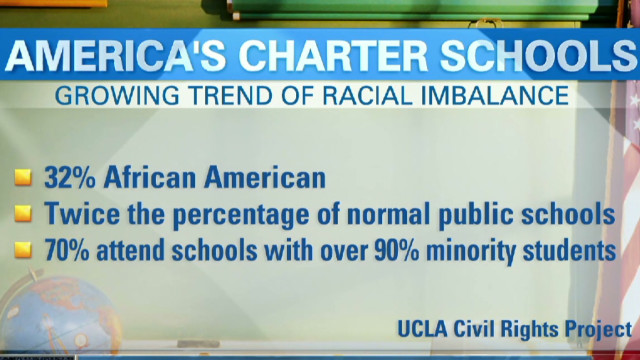
The findings rely on nationwide data from the 2010-2011 school year for fourth and tenth graders in districts with at least one charter school. The study comes at a time of heated debate about the role of charter schools. A 2010 report from the Civil Rights Project out of the University of California, Los Angeles, concluded that “the charter school movement has been a major political success, but it has been a civil rights failure.” The report continues, saying, “though there are some remarkable and diverse charter schools, most are neither.”

Indeed, the study from Logan and Burdick-Will found that charter schools do little to disrupt segregation in public schools and, in some cases, make it worse. “(There) is greater racial isolation in charter schools than in non-charter schools in the same district,” according to the report.

“This effect is found for white children…but even more for elementary black and Native American students.” Racial isolation was also compounded by the relative socioeconomic isolation found in charters as well. “(Poverty) is significantly lower in the charter schools attended by white children, especially in comparison with the charter schools attended by elementary black children and Hispanic high school students.”

Though the study was not an attempt to address the effectiveness of teaching in charter schools, the authors do note that charter school students generally fare no better, if not worse, than traditional public school students on standardized test scores. “Only for Asians is Charter Schools Do Little To Combat Racial Segregation, Says National StudyRivard Report:


Image result for Charter Schools Segregation

Massachusetts Charter Expansion Ballot Question Pits Dark Money Against People Power - Network For Public Education

Massachusetts Charter Expansion Ballot Question Pits Dark Money Against People Power - Network For Public Education:

Massachusetts Charter Expansion Ballot Question Pits Dark Money Against People Power


screen-shot-2016-10-04-at-12-04-08-pm
By Lisa Guisbond, Executive Director, Citizens for Public Schools
When they head to the polls on November 8, Massachusetts voters will decide whether to embrace unfettered charter school expansion or vote no on ballot question 2. Opponents and supporters are embroiled in a high-stakes battle that will demonstrate whether tens of millions of dollars, much of it dark money from outside Massachusetts, can vanquish a grass roots army of students, parents and teachers knocking on doors, making phone calls, planting lawn signs and writing letters to their community newspapers.
screen-shot-2016-10-04-at-12-03-31-pmMy organization, Citizens for Public Schools, is part of a broad-based coalition, Save our Public Schools Massachusetts (SOPS), fighting Question 2. SOPS includes the two major teachers unions and many other labor groups, the Massachusetts Parent Teacher Association, the New England Area Conference of the NAACP, a number of progressive political organizations, the Massachusetts Municipal Association, among many others. A spontaneous movement among elected school committees has resulted in more than 145 passing No on 2 resolutions (meanwhile, there have been zero yes on 2 resolutions to date). On the other side, are Republican Governor Charlie Baker, the Boston Globe and Boston Herald editorial boards, Democrats for Education Reform and a number of Astro Turf groups that have sprung up to push the question to victory, awash in out-of-state and dark money.
At this point, the Yes on 2 folks are outspending us by two to one, with more than $20 million to spend on TV advertising, an unprecedented amount for a Massachusetts ballot campaign. However, polling data and our experiences talking to voters confirm that when people hear both sides of the argument, they move dramatically toward the no side. This holds true for every demographic group in the state.
What would Question 2 do? It would lift current restrictions on charter school growth statewide, allowing 12 new charter schools to open Massachusetts Charter Expansion Ballot Question Pits Dark Money Against People Power - Network For Public Education:
When a Charter Comes to Town: The Mobilization of Suburban Opposition - Network For Public Education - http://wp.me/p3bR9v-1Sh


 Our Children @ Risk: PAA Reports Detail the Dangers of Ed Tech - Network For Public Education - http://wp.me/s3bR9v-7172

What’s Behind the Netflix CEO’s Fight to Charterize Public Schools?

What’s Behind the Netflix CEO’s Fight to Charterize Public Schools?:

What’s Behind the Netflix CEO’s Fight to Charterize Public Schools?

Image result for big education ape Netflix


Brett Bymaster, a Silicon Valley electrical engineer, was optimistic when Rocketship Education, a non-profit charter school chain, began building its flagship Mateo Sheedy elementary school next to his San Jose home in 2007. He and his family lived in a lower-income community, so he figured the new approach could help local kids. “I didn’t know anything about charter schools, so I thought it was a good thing,” he says.
But the more he learned about Rocketship and charter schools, which receive government funding but operate independently of local school boards, the more concerned he became. He was struck by the school’s cramped quarters: over 600 students on a 1-acre campus, compared to the 9.2 acres per 450 students recommended for elementary schools by the California Department of Education. All those students meant big classes; last year Mateo Sheedy had one teacher for every 34 students, more than the maximum allowed for traditional elementary schools under state law.
The teacher deficit seemed to be compensated for with screen time: Thanks to its so-called “blended learning” approach, Rocketship kindergarteners were spending 80 to 90 minutes a day in front of computers in a school learning lab, nearly the daily maximum screen time recommended by the American Academy of Pediatrics. And when the kids weren’t in front of computers, they seemed to be getting disciplined throughout their extra-long school days. Bymaster says he’d constantly see teachers yelling at students. “It’s a military-style environment,” notes Bymaster, who spearheaded a 2013 lawsuit that caused Rocketship to scrap one of its planned San Jose schools. “It’s really a kill-and-drill kind of school.”
Rocketship, which now operates 16 schools in the Bay Area as well as Tennessee, Wisconsin and Washington, D.C., has been praised for using technological innovation to improve test scores andother education measures for its largely low-income and Hispanic student bodies. But its stringent, tech-heavy approach has drawn criticism, while some of those lauded test scores have started to dip. (A Rocketship spokesperson did not respond to e-mailed questions by press time, but the operation published a lengthy defense of its program after an NPR feature detailed Rocketship criticisms this summer.)
Concerns about Rocketship extend to its most prominent backer: Reed Hastings, CEO of Netflix, who has heavily supported the charter chain, including a $2 million donation last year. Rocketship is far from Hastings’ only charter school effort. The one-time California Board of Education president, who declined to be interviewed for this story, helped launch the powerful EdVoice pro-charter lobbying group and so far this election season has donated more than $3.7 million to the California Charter Schools Association (CCSA)’s political action committee. But critics worry that the sort of technologies and efficiencies Hastings used to build his Silicon Valley empire and is now applying to education reform might not work for the nation’s schoolchildren.
These concerns were amplified when Hastings, at a 2014 CCSA meeting, asserted that public What’s Behind the Netflix CEO’s Fight to Charterize Public Schools?:
Image result for big education ape Netflix
 Image result for big education ape Netflix

Nationwide Rally Demands Government Leaders Prioritize Education

10/13/2016 – Nationwide Rally Demands Government Leaders Prioritize Education:

Nationwide Rally Demands Government Leaders Prioritize Education

Image result for Alliance to Reclaim Our Schools


THIS WEEK: Chicago Averts Strike … Segregation By Real Estate … College Bureaucracies Grow … Racism Affects Learning … Indigenous Peoples Day

TOP STORY

Public School Activists Stage Massive Nationwide Rally Demanding Government Leaders Prioritize Education

By Jeff Bryant

“At last week’s massive outpouring at over 2,000 schools in over 200 cities … an estimated 100,000-plus people called for attention to widespread problems in public schools and demanded new policy directions that prioritize quality education for all students … Crowds were surprisingly unified in expressing their exasperation with government leaders who continue to shirk their responsibilities to provide all children with the opportunity to get a high-quality education … Frustration expressed at many of the events at last week’s walk-ins may have an effect on elections in November.”
Read more …

NEWS AND VIEWS

Officials, Parents Worry Chicago Schools Deal Won’t Stick

Education Week

“Teachers in the nation’s third-largest school district pulled back from a threatened strike after a tentative last-minute contract agreement that Chicago officials acknowledged Tuesday may amount to a temporary fix … A key provision is an agreement by the city to divert about $88 million from a $175 million surplus … to the schools. That figure is less than the $200 million in additional spending the union had sought.”
Read more …

Race, School Ratings And Real Estate: A ‘Legal Gray Area’

NPR

“Advocates for fair housing see a potential problem with the close ties between school ratings and real estate … The common denominator, too often, is race … Most states base their school ratings primarily on more easily measured factors, like standardized test scores and graduation rates. And these indicators, in turn, are heavily influenced by inequities of race and class.”
Read more …

University Bureaucracies Grew 15% During The Recession, Even As Budgets Were Cut And Tuition Increased

The Hechinger Report

“The number of people employed by public university and college central system offices like this one … has kept creeping up, even since the start of the economic downturn and in spite of steep budget cuts, flat enrollment and heightened scrutiny of administrative bloat … This continued growth has happened at a time when states have collectively cut their higher education spending by 18% … Employees in once-separate departments whose positions have been [centeralized] … could eventually help curb costs.”
Read more …

How The Stress Of Racism Affects Learning

The Atlantic

“The stress of racial discrimination may partly explain the persistent gaps in academic performance between some nonwhite students, mainly black and Latino youth, and their white counterparts … Physiological response to race-based stressors … leads the body to pump out more stress hormones in adolescents from traditionally marginalized groups … What emerges is a picture of black and Latino students whose concentration, motivation, and, ultimately, learning is impaired by unintended and overt racism … Reducing student exposure to racial discrimination and improving race relations in the U.S. more generally are the ultimate solutions to this, but in the meantime, there are ways to help students deal with the stress.
Read more …

More Schools Replace Columbus Day With Indigenous Peoples Day

Education Week

“School districts in New York and … Massachusetts are among the districts where school boards voted to change the celebration this year. They’re following the lead of school districts like Seattle … Students have led the charge in several cities … The wave … comes as a standoff between a coalition of Native Americans and the federal government over an oil pipeline in North Dakota has brought the contemporary issues facing Native Americans and their historical context into the national spotlight.”
Read more …
 10/13/2016 – Nationwide Rally Demands Government Leaders Prioritize Education: