Latest News and Comment from Education

Wednesday, September 7, 2016

The Shill-y Season – EduShyster

The Shill-y Season – EduShyster:

The Shill-y Season


Where does Democrats for Education Reform’s single-issue extremism lead? 
At a time when Democrats and their party are, by virtually every index, moving left, a powerful center-right pressure group within the liberal universe has nonetheless sprung up. Funded by billionaires and arrayed against unions, it is increasingly contesting for power in city halls and statehouses where Democrats already govern…
Quick reader: why does this pithy description of the charter school lobby, quoted from a recent op-edin the Los Angeles Times, sound, um, so accurate? If you answered *because this is exactly what’s playing out in Massachusetts,* you would be correct. To see for ourselves, we need travel no further than Somerville, MA, which is the site of a somewhat, ahem, unusualpolitical showdown. In one corner is Senator Pat Jehlen, a longtime progressive leader in the state Senate and public education champion. Her opponent, Leland Cheung, is a former Republican legislative candidate from Virginia turned Harvard student turned Cambridge City Councilor turned Democrat for Education Reform. Thirsty already, reader? 
Blue state blues

massachusetts_blue_state_can_cooler-rce161ff843eb4d88ad66e5d8492c44ca_zl1aq_324.jpg (324×324)Ah, Massachusetts, my adopted home state. How surprised I was upon alighting upon your shores so, so long ago, to learn that your progressive reputation is, how shall I put this delicately?, somewhat exaggerated. If you are reading this from someplace that it is not blue, perhaps you have even cast an envious eye in our direction, coveting our solid cerulean state. Alas, reader, beneath that solid blue Mass. has long lurked something less inspiring: a sort-of three party system in which conservative Dems play BFF with what there is of a Republican party, ganging up again and again to quash any kind of progressive agenda. 
No need to reach for the coozie just yet, reader, for here is where our story takes an inspiring turn. During the past few years, Massachusetts has taken a measurably progressive lurch. Like a million workers getting paid sick time for the first time. Or a big bump in the state’s minimum wage. What happened? I’m going to go ahead and The Shill-y Season – EduShyster:

CURMUDGUCATION: Mother Jones: Black Teachers Matter

CURMUDGUCATION: Mother Jones: Black Teachers Matter:

Mother Jones: Black Teachers Matter

Image result for Mother Jones: Black Teachers Matter


I usually save my reading recommendations for Sunday, but if you read one article this week, it must be "Black Teachers Matter" by Kristina Rizga at Mother Jones.

Rizga addresses the all-important question of why we're missing so many black teachers in this country (and she does it far more thoughtfully than the folks at Brookings) by focusing on one school in the Philadelphia district. It is a sad and frustrating tale, and it shows how black teachers have become the canaries in the educational coal mine. The lack of black teachers is a problem in and of itself, a problem that needs to be addressed-- but it is also a symptom of the larger disease of education reform.


Rizga has done her homework. Some of the data points are familiar, like the huge drop in black teachers in some urban settings-- 18.5% in Philly, 40% in Chicago, and a whopping 62% in New Orleans.

And some of the details were new to me-- the Boston Consulting Group estimates that every child who attends a charter school adds $7,000 to district expenses.

This is the story of how Broad Academy graduates like Hite of Philly are trained to "right-size" districts, how reformers have prioritized charters over integration, how the destruction of schools has become part of the destruction of the inner city.

Most of all it's a clear, direct look at how cutting schools out of a community slices right through the heart of those community's ties. Why are we losing and missing so many black teachers? Because like most schools in the country, inner city schools, non-wealthy schools, non-white schools get many of their teachers from the pipeline that runs right from the heart of their own community, and when you cut the school's ties to the community, you sever that pipeline. And if that doesn't do enough damage, you then replace that community based school with a school that is either colonial in nature, with outsiders coming to impose their view on the community school (because, you know, Those People aren't really fit to educate their own children), or you scare the school that hasn't yet been shut down, scare it into submitting to the imposed agenda just to stay alive.

Chris Emdin, an associate professor of education at Columbia University and the author of For White Folks Who Teach in the Hood...and the Rest of Y'all Too, told me that many black educators leave 
CURMUDGUCATION: Mother Jones: Black Teachers Matter:

Throwback: When a New Administration Tried to Dismantle the Ed. Dept. - Politics K-12 - Education Week

Throwback: When a New Administration Tried to Dismantle the Ed. Dept. - Politics K-12 - Education Week:

Throwback: When a New Administration Tried to Dismantle the Ed. Dept.


If Donald Trump, the real-estate mogul turned GOP nominee, is elected president we might see a push to abolish the U.S. Department of Education.
If that happens, it wouldn't be the first time an incoming administration set its sights on getting rid of 400 Maryland Ave.
Thirty-five years ago this week, in its very first issue, Education Week published details of a tightly guarded memo, written by U.S. Secretary of Education Terrel H. Bell, that concluded that the "Federal Government does not have responsibility for education." (Bell was GOP President Ronald Reagan's first education secretary.) 
The memo, which came out when Reagan had been in office less than a year, proposed a big shift of authority over programs, regulations, and financial management back to states. And it called for transferring some of the Education Department's functions to other agencies.
For instance, the memo suggested, the U.S. Treasury could take over the Pell Grant program.
The goal: to reverse a 25-year "sea change in the relations of government and education" that has resulted in "an overly intrusive federal role."
Those sentiments would be music to the ears of a potential Trump administration ... maybe.
Trump, who hasn't sketched out a comprehensive plan on K-12 education, has said he'd like to eliminate the Education Department, or at least "cut it way, way down." (More on his education positions, and how they stack up against those of his his rival, Hillary Clinton's, here.) For what it's worth, he's also said that education is one of the three most important functions of the federalThumbnail image for Thumbnail image for Thumbnail image for Thumbnail image for Thumbnail image for Thumbnail image for Thumbnail image for Thumbnail image for electionslug_2016_126x126.jpggovernment.
That lack of clarity hasn't stopped Clinton's allies, from using the Republican contender's anti-Education Department pitch against him. The Center for American Progress Action Fund, which is affiliated with a think tank close to the Obama administration, outlined a sort of worst-case scenario of what getting rid of the department might mean.
Its analysis, which assumes that none of the department's programs or responsibilities would wind up on other agencies' plates, warns that 490,000 teaching positions could be eliminated, for example.
For the record, though, it's really, really hard to get rid of the Education Department. Numerous attemps have been made, to no avail.  
Back in 1981, for example, Bell's memo was sent to the White House, stirred up some controversy ... but never came to fruition. Throwback: When a New Administration Tried to Dismantle the Ed. Dept. - Politics K-12 - Education Week:
 

Tuesday, September 6, 2016

In Detroit, Freedom Schools Offer an Alternative to City’s Struggling Education System by Zenobia Jeffries — YES! Magazine

In Detroit, Freedom Schools Offer an Alternative to City’s Struggling Education System by Zenobia Jeffries — YES! Magazine:

In Detroit, Freedom Schools Offer an Alternative to City’s Struggling Education System

As Detroit’s public schools fight to stay afloat, Black families turn to a civil rights-era approach to education.

Detroit Freedom Schools
Victor Gibson teaches math to middle schoolers at the Dexter-Elmhurst Center. The retired teacher signed up to work for the Detroit Independent Freedom School Movement. Photo by Zenobia Jeffries.

Just a few years ago, Aliya Moore’s days during the school year might have resembled that of many American moms actively engaged in their children’s education—transporting them to and from school or to after-school programs and activities, helping with homework, going to parent-teacher conferences, and volunteering in the classroom.
After-school programs have been reduced, teachers have been laid off, and the remaining classes are overcrowded.
That all changed in spring 2013, when Moore’s 11-year-old daughter’s school, Oakman Orthopedic in Detroit, closed—one of several to fall victim to budget cuts by Detroit Public Schools, which was under state-mandated emergency management. At the time, Oakman was the only school remaining in the district to serve physically challenged students, and although Moore’s daughter Chrishawna is not disabled, Oakman was her neighborhood school. Chrishawna and the other 287Oakman students were sent elsewhere.
Now that her daughter is in high school, Moore still finds herself fighting. Because of budget cuts, after-school programs have been reduced, teachers have been laid off, and the remaining classes are overcrowded. Moore’s activism soon evolved from watching out for her own kids to advocating for the rest of the district’s children.
At a community meeting earlier this year, Moore called on parents to boycott the schools. This captured the attention of local activist group Detroiters Resisting Emergency Management (D-REM), which turned to a legacy of the 1960s civil rights movement for a solution: Freedom Schools.
Organized by African Americans in the 1960s, the Freedom Schools presented an alternative setting for all ages centered mostly on voter registration and social change, as well as academic components—mainly reading skills—for young people. Since then, civil rights and racial justice organizations, along with grassroots movements, have resurrected the Freedom School model for their work in African American communities still faced with inadequate education, disenfranchisement, and racial discrimination.
Gloria Aneb House, a member of D-REM who worked with the original Freedom Schools in Alabama in 1965, helped the group to launch the Detroit Independent Freedom Schools Movement (DIFSM).
“We had been talking about the problems in the Detroit education system for a long time,” House said.

At its height in the 1970s, Detroit Public Schools operated nearly 300 schools, and although it remains the largest school district in Michigan, with more than 48,000 students, school closures have left the district with only 97 operating school buildings. Several more schools, however, are slated to close in the coming months amid a controversial law that, enacted July 1, split the beleaguered district, now called the Detroit Public Schools Community District, into two: a “new co.” district that will educate children, and an “old co.” district that will exist in name only to collect taxes to pay down debt.
Except for three years in the mid-2000s, the Detroit district has operated under state control since 1999. Claiming the district was being mismanaged, then-Gov. John Engler removed the locally elected school board and appointed a “reform board.” At that time, however, enrollment was growing, standardized test scores were up, and the district had a $100 million surplus.
In 2004, local activists waged a successful campaign to return the district to local control, and a newly elected board inherited a $200 million deficit, created in just five years of state control.
Unable to get a handle on the growing deficit, the first of a string of emergency managers was appointed in 2009; today, the deficit is more than $1 billion.
School conditions have been ripe in recent years for communities to organize.
School conditions have been ripe in recent years for communities to organize. Moore pointed to not only the loss of local control, but also to the lack of resources in classrooms, overcrowding, school closures, uncertified teachers, inefficient staff, and, of course, the escalating debt, as the impetus for her first form of protest: She called on parents to keep their children home on one of the most important days of the school year—Count Day. On this day, which occurs once during each semester, the state tallies student attendance districtwide to determine per-pupil funding.
Moore’s goal was to make a statement. A week before the February Count Day, she passed out fliers to parents and community members that read, “Parents and students have the power! Show the governor that We run the district! We control the MONEY (stakeholders)!” She and others wanted an accounting of the district’s spending money—since it didn’t appear to be going toward a quality education for Detroit students. A month before, teachers had staged a sick-out to bring attention to poor conditions: caved-in ceilings and peeling paint in the In Detroit, Freedom Schools Offer an Alternative to City’s Struggling Education System by Zenobia Jeffries — YES! Magazine:

John Thompson: Pondiscio Exposes Split in Ed Reform Camps Over Role of Race - Living in Dialogue

Pondiscio Exposes Split in Ed Reform Camps Over Role of Race - Living in Dialogue:

Pondiscio Exposes Split in Ed Reform Camps Over Role of Race 


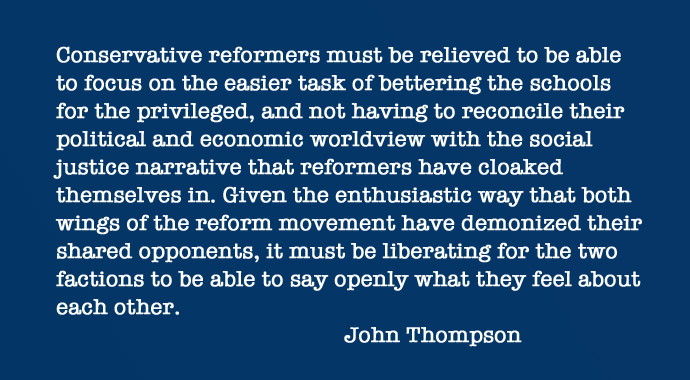
Although I wouldn’t spend too much time eavesdropping on the civil war between liberal and conservative reformers, it is fun to periodically check it out. The first of the loudest shots in their internecine conflict was issued by Fordham’s Robert Pondiscio in the aptly titled post “The Left’s Drive to Push Conservatives Out of Education Reform. He condemned “social justice warriors” who “no longer feel any compunction about accusing their conservative brethren of racism and worse.” Perhaps because he had done such a great job of stirring up the hornet’s nest, I once thought, Pondiscio took a lower profile for the next couple of months.
During Pondiscio’s seeming sabbatical, his Fordham colleagues have enthusiastically (and I believe correctly) critiqued the Obama administration’s regulatory overreach.  Free of needing to defend their commitment to education as the “civil rights movement of the 21st century,” these conservatives embraced No Excuses charters, but often they did so with the disclaimer that it is unclear whether they can be scaled up. For instance, Paul Peterson authored a lengthy treatise on the future of reform and only briefly mentioned so-called “high-performing, high-poverty charters.”   Then in a shocking display of the honesty that is rarely practiced by the liberal wing of the reform movement, Peterson acknowledged that expanding those charters is a “slow, arduous process,” and it will be achieved only if they “demonstrate that they can deliver a superior educational experience.”
And that leads to many conservatives publically demonstrating their true love – promoting schools for high performers, as opposed to the fight against poverty.  Recently, the top five posts on the Fordham Flypaper’s web site were: “The High Flyer Takes Off,” “States Should Use ESSA to Do the Right Thing by High Achieving Students,” “High Stakes for High Achievers,” “Bad Policies Harm Bright Kids in Baltimore,” and “Reflections on Gifted Education from the Olympics.
Such a devotion to “high flyers” could be a blessing.  We teachers could say “goodbye,” and even “go in peace” to conservatives and hope that they will focus on “high achieving” and “bright” kids, and stop attacking those Pondiscio Exposes Split in Ed Reform Camps Over Role of Race - Living in Dialogue:


DEMAND the IMPOSSIBLE! (an excerpt) | Bill Ayers

DEMAND the IMPOSSIBLE! (an excerpt) | Bill Ayers:

DEMAND the IMPOSSIBLE! (an excerpt)

Image result for DEMAND the IMPOSSIBLE! bill ayers
Bill Ayers -- Demand the Impossible!: A Radical Manifesto | Haymarket Books - http://www.haymarketbooks.org/pb/Demand-the-Impossible


My latest book, Demand the Impossible! A Radical Manifesto, will be released this month from Haymarket Books in Chicago (www.haymarketbooks.org), and I plan to post here a paragraph (or more) from the book at the start of each week for the next few months. Please read along and spread the word, and order a book (or two!) from Haymarket if at all possible.

Here is the first brief excerpt from Demand the Impossible! 

“We need to make a distinction here between personal virtues—be honest, do your work, show up on time—and social or community ethics. Personal virtue is surely good, but we would be hard pressed to say that a slave owner who paid the bills on time and was loyal or kind to the children was an ethical person—the blithe indifference to the larger social context allows the rotten system itself to thrive. We need to think about how we act customarily and collectively, how our society functions, how the contexts of politics and culture and economics, for example, interact with what we hold to be good, and how an ethical society allows more of us more of the time to act ethically. Most of us, after all, mostly follow the prevailing conventions of our time and place—most Spartans acted like Spartans; most Athenians, like Athenians; and most North Americans, even those in quite different economic and social circumstances, and for better and for worse, act most often like North Americans. To be an ethical actor and a person of moral character in an unjust social order requires something more: to work in common to change that society, to rewrite its rules and its narrative, to come together with others in order to rise up and resist. It requires activists and agitators and artists and dissidents willing to take risks on behalf of something better. It’s obvious now (even if it was obscure to many people then) that the good people and the moral actors in the days of American slavery were the runaways who exercised their agency in courageous and surprising acts of self-liberation, and the abolitionists who joined the cause. When the system of slavery was legally abolished, a new moral norm was established, and everyone, acting normally, was freed to discover the better angels of themselves.

“What if we took another leap forward, and agreed that predation and exploitation were unacceptable? What if the vast majority of people mobilized to abolish the system of private profit and wage slavery altogether? What if the horizon of our moral universe stretched that far? What could we imagine then, and what might we build together?

“Human beings are driven by a long and continuous “I don’t know, and I’d like to find out.” It’s not the known that propels us out of bed and out the door, it’s not the status quo that prods us up the next hill or onto the next challenge, nor is it “received wisdom” that pushes and pulls us along. Rather, the deep motivation at the core of our humanity, the powerful force pushing toward enlightenment and liberation is the hope that we will once again create and invent, plant and build, challenge and overcome.

“This is a call to resist the insistent pull of tradition or dogma, the easy acquiescence to the orthodox opinion of the moment. It’s an argument against the cynical shrug that says, “That’s just the way things are,” and the world-weary sigh that implies that nothing can be done about it. This is a manifesto against passivity and defeat, and in favor of action as an antidote to despair. This is an invitation to gather together in an expanding public square, hand in hand, shoulder to shoulder, in order to fight for something radically different and dramatically better.

“History has surprised us before, and history can surely surprise us once again.”DEMAND the IMPOSSIBLE! (an excerpt) | Bill Ayers:


Committee Denounces Proposed Mexican-American Studies Textbook | The Texas Tribune

Committee Denounces Proposed Mexican-American Studies Textbook | The Texas Tribune:

Committee Denounces Proposed Mexican-American Studies Textbook

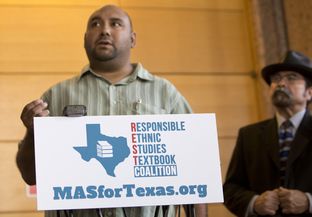
Dr. Christopher Carmona, chair of the National Association of Chicana and Chicano Studies-Tejas Foco's Committee on Pre K-12 Edu. in Texas Schools speaks during a press conference on July 18, 2016

Saying that a proposed Mexican-American studies textbook is "dripping with racism and intolerance," several educators and students are calling for the State Board of Education to reject the controversial book. 
“It is an utter shame we must deal with racially offensive academic work,” State Board member Ruben Cortez Jr., D-Brownsville, said Tuesday at a news conference in Brownsville announcing that a committee he convened had produced a54-page report citing inaccuracies in the proposed "Mexican American Heritage" textbook.
He said the textbook describes Mexicans as people who don’t value hard work and who only bring crimes and drugs into the country. According to the committee's report, one passage said, "Stereotypically, Mexicans were viewed as lazy compared to European or American workers ... It was also traditional to skip work on Mondays, and drinking on the job could be a problem." 
Cortez convened the ad hoc committee — which includes professors and high school teachers — to examine the book being considered for use in Mexican-American studies classes for Texas high school students. A public hearing over the proposed textbook is set for next Tuesday in Austin, and members of the committee will present their report then.
In its report, the committee concluded that the textbook doesn't meet basic standards and guiding principles in the history profession. According to the report, the committee determined the book had more than 68 factual errors, 42 “interpretative errors” and 31 “omission errors.” 
Educators who spoke at Tuesday's news conference — held at Paredes Elementary School, which is named after Brownsville native and Mexican-American scholar Américo Paredes — said it would be irresponsible to support the textbook. 
Trinidad Gonzales, a history professor at South Texas College, said it was difficult to even mark errors because entire passages were factually inaccurate and made up of “a web of racist assertions.”
“It was very difficult to get through it because of the significant errors that kept popping up,” he said. He cited passages in the textbook he claimed to be "anti-Catholic" because it paints a picture of loyalty only to the Pope. The report compared the textbook to a book by Samuel P. Huntington, which claims that Mexican immigration, culture and religion is a threat to the country.
Christopher Carmona, assistant professor at the University of Texas-Rio Grande Valley, said at the news conference that he was appalled by how "blatantly racist" the textbook is. Carmona pointed to one discussion question in the textbook that asks, "Are Chicano Studies beneficial to Mexican-American culture? Explain." He said the question leads students to question the validity of Mexican-American studies.
Most board members have said they intend to hear further debate before making a decision on how to vote.
Board member David Bradley, R-Beaumont, said he thinks the state needs to focus on preparing students for college before adding courses such as Mexican-American studies. He Committee Denounces Proposed Mexican-American Studies Textbook | The Texas Tribune:


CURMUDGUCATION: Chester Finn, the Death of Democracy, and Opposites Day

CURMUDGUCATION: Chester Finn, the Death of Democracy, and Opposites Day:

Chester Finn, the Death of Democracy, and Opposites Day


So today, conservatives hate tradition, and democracy is increased by taking away the vote.

Behind the paywall at Wall Street Journal, Chester Finn (honcho emeritus of the Thomas Fordham Institute), Bruno v. Manno (Walton Foundation), and Brandon Wright (Fordham) are happy to announce the death of one more piece of democracy in this country.

The trio reports that charter schools are spearheading a "quiet revolution" in local control. Because,like Reed Hastings (Netflix), they are happy to see the local elected school board die.

Oh, the elected school board was fine back in the day. "This setup functioned well for an agrarian and small-town society in which people spent their entire lives in one place, towns paid for their own schools, and those schools met most of the workforce needs of the local community." But this set-up does not work for a "country of mobile and cosmopolitan citizens." Not with money coming from the state and feds, and not when "discontent with educational outcomes is rampant." What does that mean? Where is the evidence? What do you mean?! Didn't you hear him? The discontent is rampant! Rampant, I tell you!

Also, they want you to know that some school districts are really, really big. So big that elected boards are no longer "public spirited civic leaders" but are now a "gaggle of aspiring politicians and teacher-union surrogates." Because gaggles of aspiring politicians are far worse than gaggles of aspiring financial masters of the universe. Hedge fund managers are known for their altruism (remember how altruistic Wall Street was back in 2008). Not that these guys are going to mention that the folks behind the great charter revolution are mostly hedge funders and money changers.

So, on opposites day, conservatives like Finn, Manno and Wright are opposed to one of the oldest democratic traditions in this country. But wait-- the bulletins from Bizzaro World are still coming in.

Yet far from undermining local democratic control, these new schools are reinventing it...

>Well, yes. Kind of like Jim Crow laws tried to reinvent freedom for black folks.

>Because these boards function more like nonprofit organizations than political bodies or public agencies, their members need not stand for election. Being generally union-free, they don’t have the headaches of collective bargaining.

"Function like nonprofit organizations" is weasel wording of the highest order. I live in the shadow of UPMC, a nonprofit healthcare giant that turns huge profits and employs some of the highest paid executives and board members around. We need to get past the notion that nonprofits can't be as  
CURMUDGUCATION: Chester Finn, the Death of Democracy, and Opposites Day:


Parents, leaders demand Gov. Jerry Brown end fraud, sign transparency bill - EastBayTimes

Charter school charge: Parents, leaders demand Gov. Jerry Brown end fraud, sign transparency bill - EastBayTimes.com:

Parents, leaders demand Gov. Jerry Brown end fraud, sign transparency bill


SACRAMENTO -- An alliance of community groups and state leaders has banded together to urge Gov. Jerry Brown to sign legislation aimed at charter school accountability and transparency by ensuring public access to the same financial records, governance meetings and conflict of interest protections as required at traditional public schools.
Assembly Bill 709, sponsored by Assemblymember Mike Gipson, D-Carson, requires all charter schools to disclose how they spend taxpayer money, including budgets and contracts. It also prohibits charters' board members and their families from profiting from their schools and mandates that they comply with California's open meetings, open records and conflict of interest laws.

File photo: California Gov. Jerry Brown gestures during a community event in Sacramento on May 18, 2016.
File photo: California Gov. Jerry Brown gestures during a community event in Sacramento on May 18, 2016. (Rich Pedroncelli/Associated Press)
State regulators have found more than $81 million in fraudulent and wasteful spending at charter schools in California, said the bill's advocates at a Thursday news conference. The advocates said that recent news stories and academic studies about waste, fraud, abuse and discriminatory practices by privately run charter schools that receive public taxpayer money, underscore the need for increased accountability.

"Frequently, charter schools are not required to play by the same rules," Gipson said. "There are no clear requirements that their financial and administrative records are open to the public and there are not clear requirements that bar anyone doing business with them from having conflicts of interest.
"Although charter schools are privately governed, they cannot be excused from accountability," he said, adding that many charters that receive public funding do not realize they should be complying with these laws already, so the legislation would help codify and clarify the laws.
Last month, the Senate approved the bill 21-13 and the Assembly passed it 46-31.
Aimee Roylance, a parent who withdrew her children from the Livermore Valley Charter School, spoke about the hurdles she and other parents encountered in trying to get basic questions answered about how the school was using taxpayer money. The school's charter operator, Tri-Valley Learning Corp., is under investigation by the Alameda County District Attorney's Office for financial fraud, illegally charging foreign students tuition, and child cruelty and endangerment.

"Our board, after months of going to meetings, wouldn't answer a simple question about where the money is going and address our questions as stakeholders," she said. "Many students have left, and that board has torn apart our community. There was a complete lack of communication and they weren't being transparent about whether they were paying teachers appropriately and how they were using public funding."
State Treasurer John Chiang said the bill was an important first step in guaranteeing a level of transparency in the state's charter schools. Also legislation will be introduced next year that would hold charter school operators, and not just schools themselves, accountable.
"We all agree much more work needs to be done," he said.
In addition, a recent ACLU report, "Unequal Access," found that more than 20 percent of California's charter schools deny access to students with disabilities, English learners, or students who have lower grades and test scores, said Victor Leung, a staff attorney for the ACLU. As a result of the findings, the NAACP has called for a ban on privately managed charters.
A recent poll by In the Public Interest, a research and policy group, found that Californians overwhelmingly favor proposals to reform charter schools' transparency, said Bob Lawson, the group's director of special projects. It found 80 percent of respondents want to ensure that neighborhood public schools are not adversely affected by the opening of charter schools, he said.
For more information about AB 709, go to http://bit.ly/2ccO21g. For more on the ACLU report, go to https://www.aclusocal.org/unequal-access/. Or for the In the Public Interest study, go to http://bit.ly/2c8daaU.

Chester Finn Tries to Sell Charter Expansion Without Mentioning Hedge Funder and Billionaire Cash | deutsch29

Chester Finn Tries to Sell Charter Expansion Without Mentioning Hedge Funder and Billionaire Cash | deutsch29:

Chester Finn Tries to Sell Charter Expansion Without Mentioning Hedge Funder and Billionaire Cash

Image result for Chester Finn
Chester “Checker” Finn

On September 05, 2016, former Fordham Institute president Chester Finn and others published an opinion piece entitled, “Charter Schools Are Reinventing Local Control in Education” in the Wall Street Journal. In order to read the entire piece, one must have a WSJ subscription, which is good in this case since it limits the audience exposed to this propaganda.
Here is how the Finn et al. op-ed begins:
America’s devotion to local control of schools is dying, but it is also being reborn as a new faith in charter schools. These independently operated public schools—nearly 7,000 across the country, and counting—provide a much-needed option for almost three million youngsters in 43 states.
As students return to school, the enterprise responsible for educating them is changing in ways that few people are aware of. Charters are fomenting a quiet revolution in governance in public education.
As one might expect, the remainder of the op-ed downplays the attendant corruption and mismanagement of under-regulated charters, the funneling of public money out of the public purview, the damage caused by charter churn (i.e., the opening, and closing, and opening of charter schools). Finn et al. deflect any thought that there are any political motivations tied to charter expansion, and, as one sees in the opener above, they try to tell the public that “local control of schools is dying” because the public wants it that way.
And as for that “quiet revolution,” well, it apparently needed the protection of Washington DC-based Center for Education Reform in the form of a $100,000 contestspurred by HBO personality John Oliver, who strongly criticized charter schools onhis August 22, 2016, segment.
As for the Finn et al. op-ed’s landing in WSJ: Wall Street is already keen on charter school expansion, as this May 2016 Moyers and Company piece entitled, ‘How Hedge Funders Built the Pro-Charter Political Network,” notes:
Not too long ago, school board races were quaint affairs. Even in big school districts, candidates usually only had to raise a few thousand dollars to compete.
But as the movement to marketize public education gained momentum, advocates broadened their focus from the federal level to state and local governments. There, where campaign costs were substantially lower than in federal elections, the well-funded movement could more effectively leverage its political money.
One of the starkest casualties of that strategic shift has been the American school board election. A network of education advocacy groups, heavily Chester Finn Tries to Sell Charter Expansion Without Mentioning Hedge Funder and Billionaire Cash | deutsch29:

Is the charter school industry paying off Michigan politicians to avoid oversight?

Is the charter school industry paying off Michigan politicians to avoid oversight?:

Is the charter school industry paying off Michigan politicians to avoid oversight?

killedschool

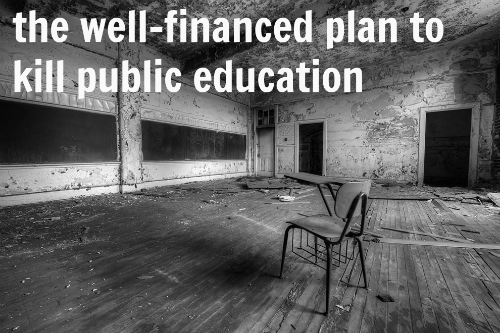
There’s a coordinated attempt afoot to dismantle America’s system of public education, and Michigan Republicans, for the past several years, have been at the forefront, passing laws to weaken our traditional, neighborhood public schools, while, at the same time, clearing the way for unaccountable for-profit charter schools to move in. While I don’t hold out much hope for our state, my hope is that others around the country can learn from what’s happening here, and take action before it’s too late… Here, for those of you interested in knowing just how all of this has come to pass, is news of our most recent battle, which was lost just a few weeks ago.
After struggling to come up with the votes in the Michigan Senate to pass a controversialRepublican House plan that would have funded the creation of a new Detroit school district, while, at the same time, allowing Michigan charter schools to continue operating without meaningful oversight, something apparently happened to tip the scales. The legislation, which was lauded by the Michigan charter school industry,passed the Senate on June 8 by a one vote margin. While it’s difficult to say for certain why Senate Republicans eventually agreed to get onboard and support the bill, some think the answer may be found in newly released campaign finance reports, which show large contributions being given to the Republican Party and several individual lawmakers through members of the DeVos family and their various “school choice” advocacy organizations, just days after the legislation was passed. The following clip comes froman opinion piece in yesterday’s Detroit Free Press by Stephen Henderson.
…The DeVos family, owners of the largest charter lobbying organization, has showered Michigan Republican candidates and organizations with impressive and near-unprecedented amounts of money this campaign cycle: $1.45 million in June and July alone — over a seven-week period, an average of $25,000 a day.
The giving began in earnest on June 13, just five days after Republican members of the state Senate reversed themselves on the question of whether Michigan charter schools need more oversight.
There’s nothing more difficult than proving quid pro quos in politics, the instances in which favor is returned for specific monetary support.
But look at the amounts involved, and consider the DeVos’ near-sole interest in the issue of school choice. It’s a fool’s errand to imagine a world in which the family’s deep 
Is the charter school industry paying off Michigan politicians to avoid oversight?:


Charter School Industry targets Massachusetts - Wait What?

Charter School Industry targets Massachusetts - Wait What?:

Charter School Industry targets Massachusetts


A group of billionaires and corporate executives are using a front group called Great Schools Massachusetts and the New York based charter school advocacy group, Families for Excellent Schools, to pour an unprecedented  amount of money into a campaign to expand the number of charter schools in Massachusetts.
According to published reports, the charter school industry is on track to dump up to $18 million into a record-breaking campaign in support of Massachusetts Question 2, a referendum question on this year’s ballot that would effectively lift the legislative mandated cap on the number of charter schools in the Commonwealth of Massachusetts.
Families for Excellent Schools, a pro-charter school, pro-Governor Andrew Cuomo, anti-teacher group has led a series of expensive advocacy campaigns in New York State and Connecticut on behalf of the charter school industry.
Expanding first to Connecticut and then to Massachusetts, Families for Excellent School has become the preferred money pipeline of choice for a group of corporate elite who seek to anonymously fund the effort to privatize public education in the United States.
Thanks to the demise of campaign finance laws at the federal and state level, Families for Excellent Schools can accept unlimited donations from those who profit from or support the rise of charter school, the Common Core and the Common Core testing scheme.
While most of the money flowing into the Massachusetts Question 2 campaign can’t be traced, public documents reveal that a handful of hedge fund managers and corporate executives donated $40,000 each to kick start the campaign aimed at diverting even more scarce public funds from public schools to charter schools.
Most of the key players in the Question 2 operation are directly or indirectly associated with Charter School Industry targets Massachusetts - Wait What?: