Latest News and Comment from Education

Sunday, August 21, 2016

CURMUDGUCATION: ICYMI: Mid-August Edition

CURMUDGUCATION: ICYMI: Mid-August Edition:

ICYMI: Mid-August Edition

ICYMI: Mid-August Edition

I'm embarrassed that I haven't been saying this all along, but if you find something on this list that speaks to you, be sure to share it on your own networks. Amplifying voices is important, and you can do that just by tweeting and posting anything you find that you like directly. Don't share this post (not just this post) but share the original post that I've linked to.

Teacher Education and a Call To Activism 

Paul Thomas takes a look at teacher education's self-esteem problem, and the foolish things it has led to.  

There's No Such Thing As a Public Charter School

A spirited op-ed that makes this point one more time.

Useless Testing Gap Analyses (and the Newspapers That Love Them)

Mark Weber is the king of explaining complicated statisticky things in ways that ordinary humans can understand. Here's another great explainer on test result gaps.

Why I Quit My Job, But Not Being a Teacher

Yes, it's another "Why I Quit" letter, but it's well done and makes a statement about how strongly teachers identify with the work.

Teacher Pay, Student Poverty, and Inequitably Funded Schools: A Data-Driven Story From Chicago

A look at how the broke-on-purpose school district of Chicago tilts the field against poor neighborhoods. You should also check out the follow-up post at Jersey Jazzman

The Olympic Celebration of Diversity

What if we narrowed the Olympics down to just seven events?

A Conversation with Nashville School Board Member Amy Frogge 

A look inside the recent Nashville school board election, in which reformsters pumped in tons of money and a local Mom still beat them.

Brand New NY Charter Group Has Michigan as Its First Customer

More research from the indispensable Mercedes Schneider, showing how yet another group of reformster consulting profiteers pops up.

Protect Yourself from ASDs

Come for the rundown of what ASDs are, how they spread, and why they're a bad idea. Stay for Chyris Barbic (the pioneer ASD chief) saying that having several states pursue ASDs is problematic.

Following the Money in Washington Primaries

Tracking the dollars that reformsters spread through Washington state in hopes of getting the charter industry more political leverage.

The So-Called Right To Teach 

Nancy Flanagan dissects the newest rhetorical attack on the teaching profession.
 CURMUDGUCATION: ICYMI: Mid-August Edition:


Education and Profit
Even as many charter fans are backing away from the idea of for-profit schools, last month found US News running this piece arguing that profit-making and education go together like a horse and carriage. The author is Ian Lindquist , a 2009 graduate of St. John's College (the read great books 

Mamas, Don’t Let Your Babies Grow Up to Be Ryan Lochte | the becoming radical

Mamas, Don’t Let Your Babies Grow Up to Be Ryan Lochte | the becoming radical:

Mamas, Don’t Let Your Babies Grow Up to Be Ryan Lochte


At our faculty retreat focusing on diversity, a few lessons grew spontaneously from the keynote and related break-out sessions.
One lesson at the individual level exposed blind spots among faculty related to how language offends, the relationship between intent and impact, and a not-so-veiled resistance to listening and then acting on expanding diversity through culturally responsive behavior among faculty with privilege.
Another lesson at the systemic level was a confrontation of the chasm between words and action: what we say matters, but what we fund and how we act ultimately determine if those words are veneer or genuine principles.
My university is a selective liberal arts college that is a microcosm of the larger tensions of culture and diversity facing the U.S.
White heterosexual male privilege dominates (and even fuels) both our wider society as well as any insular community or institution within our society. James Baldwin deconstructed throughout his career how whiteness and blackness inform each other while whiteness seeks always to keep itself central to the American Way.
Now, I do not know what white Americans would sound like if there had never been any black people in the United States, but they would not sound the way they sound….
The brutal truth is that the bulk of white people in American never had any interest in educating black people, except as this could serve white purposes. It is not the black child’s language that is in question, it is not his language that is despised: It is his experience. A child cannot be taught by anyone who despises him, and a child cannot afford to be fooled. A child cannot be taught by anyone whose demand, essentially, is that the child repudiate his experience, and all that gives him sustenance, and enter a limbo in which he will no longer be black, and in which he knows that he can never become white. Black people have lost too many black children that way.
Today, for example, as #BlackLivesMatter rose out of tragedy after tragedy, the narcissism of whiteness has created a backlash that demands attention to how working-class whites have suffered.
And then, on a smaller scale, during the 2016 Rio Olympics—a time ripe with amazing accomplishments by black athletes from the U.S.—we have been handed Ryan Lochte, a case of arrested development as a consequence of privilege.
Somehow we will not address the white gaze, and we are also committed to keeping the gaze of concern on whiteness because, you know, frat-boy life is funny even when guys are biologically grown:Mamas, Don’t Let Your Babies Grow Up to Be Ryan Lochte | the becoming radical:

Choosing Democracy: Back to School Shopping Lists - and State Budgets

Choosing Democracy: Back to School Shopping Lists - and State Budgets:

Back to School Shopping Lists - and State Budgets


“You can exhale now,” the headline in Salon reassures, because “kids have more money than ever to spend on school stuff this year.”
The reason for Salon’s celebratory tone is that a national survey every year by the National Retail Federation finds that preteens preparing for a new school year have a record-breaking average of $80.31 in personal spending money. The author leaps from that nugget of information to conclude this is a sign of a stronger economy ahead. (Disclosure: I’ve written about education for Salon.)
But even if Salon’s analysis makes you breathe easier about the economy, you should understand those school kids aren’t going to keep their cash for very long, because their schools are going to need it.
Indeed, back to school supply lists are likely longer than ever before due to the simple reason that schools increasingly don’t have the funds to pay for items on the list. And because of persistently inadequate budgets that continue to dog our schools, you can be sure the longer your shopping list, the worse the funding situation is throughout your child’s school system.
Not only are school stockrooms increasingly bare of supplies, but teachers aren’t being adequately paid, class sizes are ballooning, programs are being cut, and school buildings increasingly forego required maintenance.
In states like North Carolina – where schools still get less funding than they did in 2008, despite an improving economy – money for necessary school supplies continues to be inadequate.


In the News & Observer, a local paper based in Raleigh, a first-grade teacher explains how the allotment for supplies she and her colleagues receive has gone from $100 per student “over a decade ago” to zero. The shortfall is especially harmful to her school where 70 percent of students are from low-income households that qualify for free or reduced-price lunch. “Some are even homeless,” she says.
Across the state in Asheville, a local reporter explains how in that district’s schools the allocation for classroom supplies dropped from $215,530 in 2007-08 to an expected $136,802 in the upcoming school year. That smaller allocation comes as the number of students grew from 3,800 to an expected 4,500.”
An op-ed in the Raleigh paper explains the cause of the problem: State budget allocations for school supplies are less than half of what they should be based on a comparison to funding levels in 2007-08, adjusted for inflation.
The problem is nationwide. According to the most recent calculation of what it costs for a typical family to begin the school year – the Backpack Index compiled by Huntington bank – since 2007, “the cost of supplies and extracurricular activities has increased 85 percent for elementary school students, 78 percent for middle school students, and 57 percent for high school students.”
Yet many states, over the same time period, continue to fund schools less.
Consequently, teachers are having to beg families for money and dig deeper into their own pockets to purchase items their classrooms need just to function properly. A survey of schoolteachers in 2016 finds the average teacher spends $487 in personal money for their classrooms, mostly for school supplies and learning materials.
Much like in North Carolina, an Oklahoma newspaper describes the problem teachers have with outfitting their classrooms. The reporter sources much of the blame to budget cutbacks passed down from the state to districts. Some districts have eliminated school supply funding altogether.
In some school districts in Michigan, funding for classroom supplies has been cut so much teachers resort to crowd funding for basics Choosing Democracy: Back to School Shopping Lists - and State Budgets:
 

Exclusive: A Delaware Legislator Is Not The Hero For Public Education They Appear To Be – Exceptional Delaware

Exclusive: A Delaware Legislator Is Not The Hero For Public Education They Appear To Be – Exceptional Delaware:

Exclusive: A Delaware Legislator Is Not The Hero For Public Education They Appear To Be


I’ve been wrestling with something for a long time now.  I found out something.  Something big.  Usually my first instinct is to get it out there.  But this was BIG, and if I was wrong about it, it could have shot me in the foot.  It concerns a legislator and an election.  But more than that, it concerned friends.  Friends who are very supportive of this particular legislator.  I’ve had wrestling matches in my head before about these kind of things, but usually the need for truth prevails.  This time though, it was different. 
I reached out to the legislator about this a month ago.  The legislator confirmed what I found out was true.  I asked the legislator why they did what they did.  The legislator explained it to me, and for the past month, I’ve been trying to wrap my head around their answer.  I did talk to some of the friends who support this legislator hoping they could give some type of insight into why the legislator made the choice he did.  There really wasn’t anything they could say that would assuage my doubts about him.
It comes down to truth.  After seeing another Delaware blogger praise this legislator to the high heavens today, I could no longer stand by and not let people know this.  And as I was working on this article, many other dots began to connect.  They will certainly make up their mind either way.  I assume many will just brush it off.  But for some of those who directly support this legislator, they could change their mind about him.  I don’t know.  That is their choice, just as this choice is mine.
Since I started this blog, two bills were very contentious.  One was just getting around to a vote when I began this blog.  The other became the central point of my blog for about five months last year.  House Bill 334 and House Bill 50.  The Smarter Balanced Assessment and the Opting Out of the Smarter Balanced Assessment bills.
Many know the story about what happened with the Smarter Balanced Assessment legislation.  But if you don’t, here is a quick rundown.  House Bill 334 was introduced by two primary sponsors and only one co-sponsor.  Former State Rep. (and also Chair of the House Education Committee at the time) Darryl Scott and Senator David Sokola sponsored the bill.  State Rep. Deb Heffernan was the only co-sponsor.  The bill came out on 5/8/14.  It was released from the House Education Committee on 6/4/14.  The House voted on the bill 6/17/14 where it passed with 30 yes, 9 no, and 2 absent.  From there, it went to the Senate Education Committee where it was released on 6/25/14.  It was put on the agenda for a full Senate vote on 6/26/14.  The day came.  Senator Bryan Townsend gave a very impassioned speech about the bill and the damage this test could do.  The Senate voted.
HB334SenateVote#1
The Smarter Balanced Assessment was defeated!  Students would NOT have to take this test so many were dreading.  It was a rare moment of victory for Exclusive: A Delaware Legislator Is Not The Hero For Public Education They Appear To Be – Exceptional Delaware:

On the State of the Resistance Movement: Between Murder and Suicide and the Need to Claim a Third Space | educationalchemy

On the State of the Resistance Movement: Between Murder and Suicide and the Need to Claim a Third Space | educationalchemy:

On the State of the Resistance Movement: Between Murder and Suicide and the Need to Claim a Third Space


In May of 2016 I officially resigned as an administrator for United Opt Out a group I help create in 2011 along with Peggy Robertson, Tim Slekar, Ceresta Smith, Shaun Johnson, and Laurie Murphy. Since then, Shaun and Laurie rolled off, and we added new admins like Michael Pena, Rosemarie Jensen, Ruth Rodruigez and Denisha Jones.  Very recently, other admins rolled off as well. There’s been a lot of myth-making and rumor-milling about the roll off of admins and the UOO event taking place this fall in Houston.
People keep asking me “What happened?” To quote a scene from a Northern Exposure episode entitled Burning Down the House in which one character -a famous golfer- attempts to explain how or why it was he “blew the Masters” because of a simple putt, he says, “You want to know what happened? ….  I don’t know what happened.” In other words, perhaps some things cannot be reduced to simple answers even though such oversimplification might suit the self- serving motives of others. If you want to know why anyone one admin decided to retire from UOO, the best course of action is to ask them directly, because there are five different people and five different sets of personal and/or political reasons anyone might have for stepping down. There is no “one” reason. Yet the responses within the movement to the changes in UOO has created a dangerous space (within our movement) which French philosopher Jaques Daignault refers to as being “between murder and suicide”. And that is what this post attempt to respond to. Why? Let me explain. According to Pinar et al (1995):
Daignault argues that to know is to kill (1992a, p. 199), that running after rigorous demonstrations and after confirmations is a hunt:  literally (1992a, p. 100) … To know is to put to death….To know is to kill, to rely on death….The reason of the strongest is reason by itself.  Western man is a wolf of science (1992a, p. 198).  Knowledge — understood poststructurally as the reduction of difference to identity, the many to the one, heterogeneity to homogeneity — is violence.  This violence results from competition between ideologies or doctrines, and from the radical transformation of what exists in conformity with what we believe it ought to be (quoted in Hwu, 1993, p. 132).  For Daignault, as for Serres, to know is to commit murder, to terrorize.  Nihilism refers to the abandonment of any attempt to know.  It is the attitude which says anything goes or things are what they are.  It is to give up, to turn ones ideals into empty fictions or memories, to have no hope.  Daignault (1983) calls for us to live in the middle, in spaces that are neither terroristic or nihilistic, neither exclusively political nor exclusively technological.
We are experiencing the contested terrain of the in-between where we need to consider that taking a stand does require taking “a side”— nor does taking sides mean you are taking a stand.
I am choosing to take a stand by not taking sides.
Again Daignault suggests:
The only way to avoid this fate is to allow thought to think itself, to go beyond or to disrupt dualism, and to think the difference between them.  It is to introduce paradox.  It is not to stop defining, but to multiply the definitions.  It is to On the State of the Resistance Movement: Between Murder and Suicide and the Need to Claim a Third Space | educationalchemy:

What Comes Next? Part 2 - United Opt Out at the Crossroads


Pleas e join Internet radio host Dr. James Avington Miller Jr. and special guest Dr. Mark Naison for a special two hour show devoted to United Opt Out.


Dr. Miller and Dr. Naison will be examining what is going on with United Opt Out. They will discuss what the movement has done in the past and what will it may be doing in the futiure. They will attempt to bring some clarification to recent changes in this crtically important group.


The discussion will be enlightening and will bring understanding to what has been taking place as United Opt Out takes a new direction.


Please tune in and call in this Sunday. 

This is the RESISTANCE and we need to be unified in our fight against those forces overtaking and usurping our public schools.

Knowledge is power !

RESISTANCE MATTERS
RESISTANCE IS NOT FUTILE
RESISTANCE IS THE HIGHEST FORM OF EXPRESSION OF DEMOCRACY

RESISTANCE IS SURVIVAL

Please click on the website below to listen live:
http://bbsradio.com/thewarreport
2:00 PM PDT
4:00 PM CDT
5:00 PM EDT

or
A direct listen-in line only
Station 1 - 716-748-0150
To call-in and interact live
Station 1 888-627-6008 toll free 


 What Comes Next? Part 2 - United Opt Out at the Crossroads:

Big Education Ape: I Don't Belong To Any Organized Party: I'm A Democrat -http://bigeducationape.blogspot.com/2016/08/i-dont-belong-to-any-organized-party-im.html

Ciedie Aech’s Wonderful Book | tultican

Ciedie Aech’s Wonderful Book | tultican:

Ciedie Aech’s Wonderful Book


There are few public school systems in America that have been more harmed by what Diane Ravich aptly dubbed “corporate education reform” than those in Denver, Colorado. Ciedie Aech tells the story of a professional educator working in the horrific and unstable environment that developed with the extra-legal federal take-over of public schools. In reality, this is a heart wrenching story, but Aech’s sarcastic humor turns it into a delight. Any teacher in America’s public k-12 system who reads “Why is you always got to be trippin” will immediately recognize many scenes Ciedie delightfully paints while telling this dreadful story.
About the Title
 “One day when noise from unsupervised students caught my attention, I stepped into the hallway to find a group of boys throwing friendly punches outside a neighboring classroom.
 “‘Gentlemen!’ I stated reactively, clearing my throat. Happy to ignore extraneous interference, the boys continued their game. ‘Gentlemen!’ I said again, this time a little more loudly. Straightening, the boys stopped to look my way. ‘Okay, let’s go,’ I directed. ‘Aren’t you supposed to be in class?’ ‘Aw, Miss,’ two or three grumbled as the small group broke up and began to move away. Pulling at chronically sagging pants while smoothing intricately braided hair, a tall, thin young man hung back.
 “As a student who had attended one of my afternoon classes for more than six months, he knew me well. Watching his friends now amble unhurriedly down the hall, he turned to look at me in plaintive wonder. ‘Aw, Miss,’ he protested. ‘Why is you always got to be trippin’?’
 ‘“Why is I always got to be trippin’? …
 “If you don’t take pains to hold them together? If you don’t step in, over and over (and then over again) to pull them circuitously inward towards success – sometimes with no other help than the full power of your will? They struggle, they flounder; they deflate and fall apart. Desperately they count upon the people in their lives who make the effort to ‘trip.’”
 Background for the Story
If you are a fan of privatizing public schools and corporate education reform, Denver is your cup of tea. The Thomas B. Fordham Institute (one of those “think-tanks” that like the New York Times reports is more like a tax free lobbying firm than an honest evaluator of education policy) rated Denver Public Schools (DPS) the third best school choice system in the United States behind only New Orleans and Washington DC.
In the summer of 2005, Michael Bennet, who had spent the previous 2 years with his fellow Wesleyan alum, John Hickenlooper as chief of the mayor’s staff was appointed Superintendent of DPS. He previously earned a law degree at Yale and was editor of the Yale Law Journal. Prior to working for the mayor and future governor of Colorado, Bennet spent six years as the managing director of the Anschutz Investment Company. However, he had no training or experience as an educator or in education administration.
Two years before Bennet departed to become Colorado’s junior United States Senator, he hired another lawyer with no education background (other than tutoring English in Hong Kong) to be chief operating officer of DPS, Tom Boasberg. Before coming to Denver, Boasberg did a stint at the FCC, then went Ciedie Aech’s Wonderful Book | tultican:

NOW AVAILABLE AS A PAPERBACK AT AMAZON BOOKS (ALSO AS KINDLE)

Product Details

Will Tom Toch Ever Find a Reform Bad Enough to Abandon? - Living in Dialogue

Will Tom Toch Ever Find a Reform Bad Enough to Abandon? - Living in Dialogue:

Will Tom Toch Ever Find a Reform Bad Enough to Abandon? 


By John Thompson.
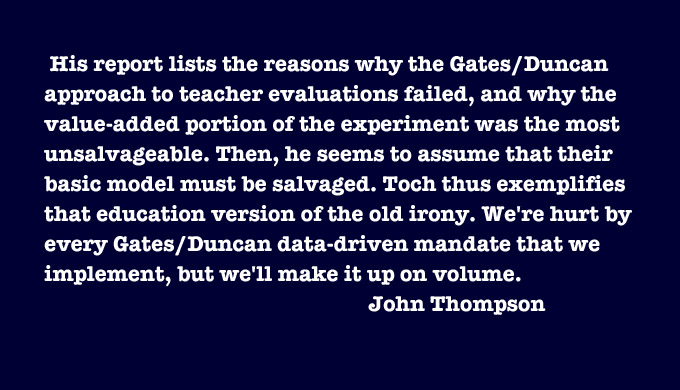
In 2008, Tom Toch’s “Rush to Judgment” reviewed science-based alternatives to value-added teacher evaluations. Toch explained that the District of Columbia’s test-heavy IMPACT teacher evaluation system cost $1000 per teacher. For that price, we could have invested in proven, win-win alternatives such as the National Board for Professional Teaching Standards certification, the Toledo peer review plan, or Robert Pianta’s holistic approach to professional development. The United States spent $500 billion dollars a year on education, and a $3 billion investment in better teacher evaluations should have been seen in the context of the $14 billion dollars of annual spending on professional development, which was often ineffective. Toch observed that some would like to use standardized test results in evaluations, but that those scores “aren’t great measures.” Then, in a sentence that seemed inexplicable after such an overview, he called for test scores to count for as much as 50% in teacher evaluations.
This was the time when corporate reformers took the opportunity to push their entire competition-driven model on the nation, and when Toch was involved in an even more confusing case of wordsmithing. Educational consultant Marc Dean Millot wrote in This Week in Education about Toch’s “Sweating the Big Stuff: A Progress Report on the Movement to Scale Up the Nation’s Best Charter Schools.”
Based on interviews with CMO insiders, publicly available data, and his own analysis, Toch presents a compelling indictment of the “new philanthropy’s” primary investment strategy for education reform. His arguments should be available to all and addressed on the merits. Instead, someone at EdSector hacked away at Toch’s evidence until it fit the rhetoric of CMO advocates.
My take on the paper’s confusing conclusion on the scaling up of charter schools was to emphasize the contradictions inherent in Toch’s paper:
But Toch then writes “the research for a report on CMOs that I’ve produced for the think tank Education Sector reveals that many of these organizations are going to be hard-pressed to deliver the many schools that Duncan wants from them.” … Toch describes “four dozen charter networks’ opening about 350 schools with some 100,000 seats over the past decade. This is a long ways fromthe 5,000 failing public schools. …” (emphasis mine)
Toch further wrote,
CMOs increasingly face the challenge of either paying their teachers more as they gain seniority, or churning through teachers and making it tougher to sustain their schools’ powerful cultures.
Also,
student attrition is high in CMO schools, fueled by higher standards, long hours, and transient families. A study of four San Francisco Bay Area KIPP middle schools found that 60 percent of entering students departed before graduating. The loss of revenue from so many departing students is devastating, but the price of bringing in replacement students is also high.
In retrospect, reading these two papers in tandem provides an insight into why the Duncan administration Will Tom Toch Ever Find a Reform Bad Enough to Abandon? - Living in Dialogue:

Why teachers won Detroit's 'sick-out' case - CSMonitor.com

Why teachers won Detroit's 'sick-out' case - CSMonitor.com:

Why teachers won Detroit's 'sick-out' case

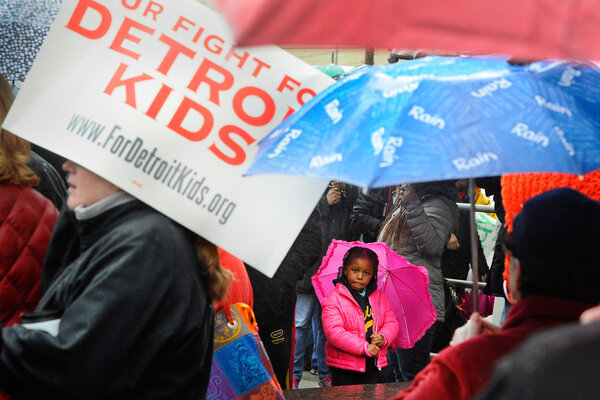
A court has ruled in favor of teachers who protested the poor working conditions in Detroit schools by calling in sick, as the district struggles to function while covering its debt. 

Daniel Mears/The Detroit News/AP/FileView Caption

 An eight-month court battle – between Detroit's struggling school district and teachers accused of inciting illegal strikes – ended Friday with a court decision in the teachers' favor. 

Two teachers won the months-long case against the school district because their protests were essentially political rather than work-related, Ann Zaniewski reported for the Detroit Free Press. The court decided that if teachers see politics as the cause of work-related problems, then complaints about those work conditions – even taking the form of intentional sick-outs – receive First Amendment protection. 
The ruling emphasized teachers' rights to protest, and signaled a victory forparents and administrators, wrote the Christian Science Monitor's Stacy Teicher Khadaroo in January:
After more than a decade of losing enrollment and amassing debt largely under state-appointed emergency managers, the Detroit public school district could be on the verge of writing a new chapter for itself – one in which educators, students, and parents insist on taking back control of their destiny.
Through a series of “sick-outs” that forced more than half of schools to close in recent weeks, teachers “have effectively made the argument that we’re seeing a lack of accountability,” says Thomas Pedroni, a professor at Wayne State University in Michigan who has studied the impact of education policies in Detroit and the state. 
Teachers closed schools 14 times during the 2016 school year with strikes protesting the state's emergency management of Detroit schools, The Wall Street Journal reported. Leaders at the state and local level criticized them as hurting the already-struggling effort to educate Detroit's children, but the union insisted the strikes brought attention to problems hurting Why teachers won Detroit's 'sick-out' case - CSMonitor.com:

Steven Singer: Do Unions Belong in the Fight Against Corporate School Reform? | Common Dreams

Do Unions Belong in the Fight Against Corporate School Reform? | Common Dreams | Breaking News & Views for the Progressive Community:

Do Unions Belong in the Fight Against Corporate School Reform?

Unions "are essential to the health of public education," writes Steven Singer. (Photo: Gadfly on the Wall Blog)

In the fight for public education, the forces of standardization and privatization are running scared.
They’ve faced more pushback in the last few years – especially in the last few months – than in a decade.
They want you to believe that the corporate vultures preying on our public schools are really just misunderstood philanthropists. 
So what’s a corporate education reformer to do?
Answer: Change the narrative.
They can’t control the facts, so instead they try to control the story being told about the facts.
It’s a classic propaganda technique. As Malcolm X put it:
“If you’re not careful, the newspapers will have you hating the people who are being oppressed, and loving the people who are doing the oppressing.”
Their story goes like this – yes, there is a battle going on over public education. But the two sides fighting aren’t who you think they are.

The fight for public schools isn’t between grassroots communities and well-funded AstroTurf organizations, they say. Despite the evidence of your eyes, the fight isn’t between charter school sycophants and standardized test companies, on the one hand, and parents, students and teachers on the other.
No. It’s actually between people who really care about children and those nasty, yucky unions.
It’s nonsense, of course. Pure spin. 
They want you to believe that the corporate vultures preying on our public schools are really just misunderstood philanthropists. And those demanding a fair shake for their own children and communities are really just paid shills from a monolithic and uncaring bureaucracy.
In essence, they want you to believe two things:
1) Despite profiting off the system and zero evidence supporting the efficacy of corporate school policies, they’re motivated purely by empathy.
2) Unions are evil by definition and they pervert everything they touch.
Put simply, unions are not perfect, but they are not evil. In fact, they are essential to the health of public education.
I’m not going to bother with the first claim here. There is an inherent bias from those who wish to change the laws so they can more easily profit off of schools without actually helping students learn and in fact exist at the expense of that learning. If you can’t see through the propaganda wing of the Walmart corporation, the Broad Foundation and Big Daddy Bill Gates, you probably won’t be very receptive to anything else I have to say.
Instead I will focus on the second claim, because it is the more pernicious of the two.
Put simply, unions are not perfect, but they are not evil. In fact, they are essential to the health of public education.
Many progressives are upset with teachers unions because of the current Presidential election. Both the National Education Association (NEA) and theAmerican Federation of Teachers (AFT) endorsed Hillary Clinton in the primary election without what many would consider adequately polling rank and file members. For better or worse, the endorsements were top-down affairs reflecting the preference of union leaders.
That’s not how unions are supposed to work. And it’s having consequences for the way both Do Unions Belong in the Fight Against Corporate School Reform? | Common Dreams | Breaking News & Views for the Progressive Community:

Condemnation of Charter Schools Exposes a Rift Over Black Students - The New York Times

Condemnation of Charter Schools Exposes a Rift Over Black Students - The New York Times:

Condemnation of Charter Schools Exposes a Rift Over Black Students

Students at North Star Academy, a charter school in Newark. Two civil rights organizations have called for a moratorium on charter schools. Credit Kirsten Luce for The New York Times

With charter schools educating as many as half the students in some American cities, they have been championed as a lifeline for poor black children stuck in failing traditional public schools.
But now the nation’s oldest and newest black civil rights organizations are calling for a moratorium on charter schools.
Their demands, and the outcry that has ensued, expose a divide among blacks that goes well beyond the now-familiar complaints about charters’ diverting money and attention from traditional public schools.
In separate conventions over the past month, the N.A.A.C.P. and theMovement for Black Lives, a group of 50 organizations assembled by Black Lives Matter, passed resolutions declaring that charter schools have exacerbated segregation, especially in the way they select and discipline students.
They portray charters as the pet project of foundations financed by white billionaires, and argue that the closing of traditional schools as students migrate to charters has disproportionately disrupted black communities.
Black leaders of groups that support charter schools have denounced the resolutions, saying they contradict both the N.A.A.C.P.’s mission of expanding opportunity and polls showing support for charters among black parents. The desire for integration, the charter school proponents say, cannot outweigh the urgent need to give some of the country’s poorest students a way out of underperforming schools.
“You’ve got thousands and thousands of poor black parents whose children are so much better off because these schools exist,” said Howard Fuller, a longtime civil rights activist and the founding president of the Black Alliance for Educational Options, which encourages support among blacks for charters.
The debate about race and charters is long simmering. Black residents of cities like New Orleans, which has converted nearly all of its public schools to charters in the decade since Hurricane Katrina, have complained that the people who come in presenting themselves as education reformers tend to be white outsiders. Charter school leaders themselves have begun to acknowledge that they do not have enough blacks in their ranks or in front of their classrooms.
But to some black parents, those concerns seem academic.
Chris Stewart recalled feeling “like a complete loser” when his son was entering middle school in Minneapolis. A specialty public school had no room; other parents were warning him away from two nearby traditional public schools; and he could not afford a reduced tuition of $12,000 — what he called “the poor people’s discount” — for a private school.Condemnation of Charter Schools Exposes a Rift Over Black Students - The New York Times:

Funding Opportunities in the Every Student Succeeds Act (ESSA)

Funding Opportunities in the Every Student Succeeds Act (ESSA):

Funding Opportunities in the Every Student Succeeds Act (ESSA)


According to a new guide released by Futures Without Violence, the Every Student Succeeds Act (ESSA) can provide states and school districts with improved ways to support a positive school climate and help address the needs of children who have been exposed to trauma.
Last year, Congress passed ESSA, a law that updated federal policy that provides new direction to states about how they can design their school systems, with particular focus on improving academic achievement among at-risk, neglected and delinquent students. In addition to offering states guidance on creating accountability mechanisms, teacher evaluation systems and other system-wide educational policies, ESSA provides flexibility to local educational agencies (LEAs or school districts) in designing student programs and supports.
Implementation of ESSA will not start until the 2017-18 school year, but as school districts begin complying with the new federal policy, Futures Without Violence presents a guide that includes available resources, program requirements and allowable use of funds under ESSA’s nine different titles, paying special attention to opportunities to prevent and respond to child trauma.
Read the guide here.
 Funding Opportunities in the Every Student Succeeds Act (ESSA):