Latest News and Comment from Education

Wednesday, November 25, 2015

Friedrichs v. California Teachers Association : SCOTUSblog

Friedrichs v. California Teachers Association : SCOTUSblog:


Friedrichs v. California Teachers Association

Docket No.Op. BelowArgumentOpinionVoteAuthorTerm
14-9159th Cir.Jan 11, 2016TBDTBDTBDOT 2015
Issue: (1) Whether Abood v. Detroit Board of Education should be overruled and public-sector “agency shop” arrangements invalidated under the First Amendment; and (2) whether it violates the First Amendment to require that public employees affirmatively object to subsidizing nonchargeable speech by public-sector unions, rather than requiring that employees affirmatively consent to subsidizing such speech.

SCOTUSblog Coverage


DateProceedings and Orders
Friedrichs v. California Teachers Association : SCOTUSblog:

With A Brooklyn Accent: What It Means to Be "White" In a Rapidly Changing Nation

With A Brooklyn Accent: What It Means to Be "White" In a Rapidly Changing Nation:

What It Means to Be "White" In a Rapidly Changing Nation


Being "white" was once a central feature of being American. Those who were able to become "white" had the fullest range of political rights and economic opportunities the rapidly expanding nation had to offer. Those who were not were subject, at various times, to enslavement, caste segregation, racial pogroms,ghettoization,and extreme forms of discrimination. As a result, new immigrants to the country worked mightily to "become" white, with the Irish achieving this goal after the Civil War, and Southern and Eastern Europeans achieving this after World War II. Many mixed race African Americans also participated in this process by "passing,"- moving to another part of the country away from friends and relatives and re-identifying as white. The numbers of people who did that ran into the hundeds of thousands; quite possibly in the millions
Another portion of dynamic were the extreme measures the society took to assure the preservation and growth of the "white" population. Untile the Loving v Virgina decision in 1967, nearly half the states had laws banning intermarriage between whites and non whites. These laws were basically designed to assure white women had white children. And extra legal measures, including murder, were used to assure the preservation of the "white race." From the late 19th Century right up to the 1950's, Black men were routinely murdered and mutilated for having consensual relationships with white women. Such relationships were defined as "rape" under lynch law, a sign of profound fears of intermarriage, "race mixing" and the erosion of a "white" majority, whose perpetuation was seen as an essential condition of the nation's successful growth and development
Now, all these strategies of "race preservation" are starting to With A Brooklyn Accent: What It Means to Be "White" In a Rapidly Changing Nation:

Russ on Reading: False Idols: Woodrow Wilson and Hero Worship

Russ on Reading: False Idols: Woodrow Wilson and Hero Worship:

False Idols: Woodrow Wilson and Hero Worship

Woodrow Wilson as President 
at Princeton University


Spurred by events in places like Ferguson, Missouri and Charleston, South Carolina, racially charged protests have broken out at college campuses across the United States, most notably at the University of Missouri, where the involvement of the entire football team surely contributed to the resignation of the school's president. This week the protests have come to dear old Princeton University.


The Princeton controversy revolves around perhaps the most favored of all of Princeton's favorite sons - Woodrow Wilson. Before Wilson became the 28th President of the United States, he was the president of Princeton University. He is credited with many good works at Princeton including raising educational standards, creating academic majors and introducing small-group classes. Princeton has recognized his contributions by naming the highly regarded Woodrow Wilson School of Public and International Affairs after him, naming a residential complex Wilson College and hanging a mural of him in the dining hall. To attend Princeton is to think Wilson, see Wilson and praise Wilson

Wilson's accomplishments as President of the US are well documented. In addition to leading the country during World War 1 and proposing the United Nations predecessor, The League of Nations, Wilson had an impressive record as a progressive Democrat who championed many of the causes of the working man including the progressive income tax and the Federal Trade Act that controlled unfair business practices. 

What is not so well documented, however, is that Wilson was also a virulent Russ on Reading: False Idols: Woodrow Wilson and Hero Worship:

Cuomo, in Shift, Is Said to Back Reducing Test Scores’ Role in Teacher Reviews - The New York Times

Cuomo, in Shift, Is Said to Back Reducing Test Scores’ Role in Teacher Reviews - The New York Times:
Cuomo, in Shift, Is Said to Back Reducing Test Scores’ Role in Teacher Reviews


Less than a year ago, Gov. Andrew M. Cuomo of New York proclaimed that the key to transforming the state’s education system was tougher evaluations for teachers, and he pushed through changes that increased the weight of student test scores in teachers’ ratings.
Now, facing a parents’ revolt against testing, the state is poised to change course and reduce the role of test scores in evaluations. And according to two people involved in making state education policy, Mr. Cuomo has been quietly pushing for a reduction, even to zero. That would represent an about-face from January, when the governor called for test scores to determine 50 percent of a teacher’s evaluation.
Administration officials characterized the governor’s position differently, saying he was waiting for the recommendations of a task force he had set up to conduct a review of the Common Core standards and assessments.
“There is no position of this administration with respect to this issue,” the governor’s director of state operations, Jim Malatras, said this week.
New York’s expected turnabout comes as states across the country are trying to respond to anger over standardized testing, and as the Obama administration is backing off the idea of tying teacher evaluations to test scores.
The idea that Mr. Cuomo, a Democrat, is pushing for the changes comes from several different avenues. According to one of the education policy makers, Mr. Malatras said in a conversation that the administration wanted to decouple test scores and evaluations. The other person reported having spoken with people who had similar conversations with the administration.
Two members of the Board of Regents, the body that sets state education policy, said they had heard that Mr. Cuomo was pushing for a moratorium on the use of test scores in evaluations. The two board members, Kathleen M. Cashin and Betty A. Rosa, both said they would heartily support such a change.
“I’m thrilled,” Dr. Cashin said. Asked why she thought the governor might have changed his view, she said she thought he might have listened to educators’ concerns about using the tests.
“I think that the governor has done a lot of reflection,” she said. “He’s had a lot of outreach. A person can see things differently the more outreach you do.”
In New York, Mr. Cuomo’s push to give test scores more weight in Cuomo, in Shift, Is Said to Back Reducing Test Scores’ Role in Teacher Reviews - The New York Times:

CURMUDGUCATION: Has CCSS Affected Instruction

CURMUDGUCATION: Has CCSS Affected Instruction:

Has CCSS Affected Instruction


Brookings, an outfit that is usually a reliable provider of pro-reform clue-free baloney, offers an interesting question from non-resident senior fellow Tom Loveless: Has Common Core influenced instruction?

It's a worthy question. We've talked a lot about how CCSS has affected policy and evaluation and assessment, but has it actually affected what teachers do in the classroom?

The proponents of the Core never developed a way to answer that question because their assertion has always been that we would see the effects on instruction in the flowering of a million awesome test scores. But the 2015 NAEP scores turned out to be a big bowl of proofless pudding, and so now we're left to ask whether the Common Core tree fell in the classroom forest without making a sound, or if it never fell at all.

William J. Bushaw blamed "curricular uncertainty," while Arne Duncan went with the theory of an "implementation dip." Loveless's brief piece includes this masterpiece of understatement:

In the rush to argue whether CCSS has positively or negatively affected American education, these speculations are vague as to how the standards boosted or depressed learning. 

In other words, Core fans are unable to get any more specific than their original thoughts that Common Core Standards would somehow magically infuse classrooms, leading to super-duper test 
CURMUDGUCATION: Has CCSS Affected Instruction:

If Thankful for Teachers, Return Trust to Them

If Thankful for Teachers, Return Trust to Them:

If Thankful for Teachers, Return Trust to Them

trust title


How much trust do parents place in their child’s teacher? Maybe more than you think.
The BATS were celebrating Thanksgiving this week with Thank You tweets about teachers and other school personnel. As a nation, I hope we can return to the time when we trusted teachers to be the good and decent professionals they are and quit trying to replace them with computers and/or temporary novices.
I am thinking about this today as I start gearing up for Thanksgiving.
Every year, if I am to prepare Thanksgiving dinner, I take out my Watson and Edge—Tears of Joy CD. The music is lighthearted and autumn-like and it makes for the perfect sound in the background as I try to concentrate on recipes. I play it over-and-over just before, and then on the big day after the Macy’s Parade, and the Best in Show Doggie contest…if I don’t drive anyone crazy with it.
My husband stumbled upon these two musicians years ago as they were performing in a public square in Chicago. He was surprised to see that as they performed, they had a If Thankful for Teachers, Return Trust to Them:

An Open Letter to New York State Governor Andrew Cuomo | Jamaal A. Bowman

An Open Letter to New York State Governor Andrew Cuomo | Jamaal A. Bowman:

An Open Letter to New York State Governor Andrew Cuomo


An Open Letter to New York State Governor Andrew Cuomo
Dear Governor Cuomo:
I hope this letter finds you and your family in good health and good spirits. I write not only to you, but also to those who share your view of public education.
I want to start by thanking you for creating a commission to review and “reboot” the Common Core standards. I agree, “the implementation of the Common Core just did not work,” and needs a “total overhaul.” By forming the commission, you have provided a platform for parents and educators to share their thinking regarding not just the Common Core, but public education in general. I am hopeful that the feedback you receive will make its way into our schools and begin a much needed student centered redesign of public education in New York State.
I also want to personally thank you for allowing me to provide testimony to the Common Core commission at the College of New Rochelle. It seems that my testimony went over pretty well as it has nearly 4000 views on social media. Your commission has also chosen to make me one of their technical advisors, which provided the opportunity for me to give additional testimony in the areas of curriculum and assessment. The work of the commission, along with your hiring of Jere Hochman as Deputy Secretary of Education, has me very excited about the direction in which we are moving.
My excitement turned to devastation however as I watched your November 17th interview with David Gergen at the Harvard Kennedy School of Public Leadership. As an education practitioner for sixteen years, I was both frustrated and disheartened to watch the two of you pontificate about public education in what I consider to be a dangerous and irresponsible manner.
Your discussion was wide ranging; covering topics from police reform to the new construction at LaGuardia Airport. As the conversation shifted to education, you told the audience that you are in constant conflict with the teacher union. You shared that your “unabashed” support for charter schools, which you refer to as “laboratories of invention,” as well as your teacher evaluation mandate, are two of the causes of this conflict. You also went on to share your excitement around the possibilities of technology as a means to help circumvent the “machine” of the teacher union bureaucracy.
Mr. Gergen, whom you refer to as one of the experts and craftsmen of his generation, recklessly framed the conversation in a way that greatly mis-categorizes the public education narrative. Mr. Gergen stated that teacher unions don’t want “young smart” people from Teach for America entering the profession. He then went on to praise charter schools as places that provide “24/7 support to children and families,” and “really work with the children themselves.” While Mr. Gergen made these comments, you nodded your head enthusiastically in agreement.
There are two things that are incredibly careless about this conversation. First, it lacks a valid and reliable research base. Second, the two of you have a platform to really shape public discourse. As such, you must take extra special care to avoid facilitating misinformation regarding public education or any other topic. If you don’t, the perpetuation of child suffering will continue in schools throughout the state — as it does in schools all over the country.
What does the data tell us about these widely discussed topics? First, public schools as a whole “outperform” charter schools. I place the word outperform in quotes because of our narrow view of what it means to perform in public schools today. The few charter schools that are celebrated for closing the alleged “achievement gap” have faced extreme criticism and scrutiny for their draconian test prep and recruitment practices, and boast incredibly high student and staff attrition rates. Some may argue these practices are the price to pay for achievement, but consider these questions:
1. Are we ready to accept the instability and emotional trauma that comes with schools designed around draconian test prep practices?
2. Does high performance on standardized assessments truly equate to what we all mean by achievement?
Research shows otherwise: In 2003, the “gold standard” of charter schools, KIPP, had a graduating class that ranked fifth in New York City on the math standardized tests. Six years after entering college, only 21% of that cohort had earned a college degree.
In the landmark book, Crossing The Finish Line: Completing College at America’s Public Universities, former college presidents William G. Bowen and Michael S. McPherson found that student high school G.P.A. was more predictive of college success than S.A.T. scores.
As you can see Mr. Governor, high performance on standardized tests alone does not equate to a quality education. What research identifies as a determinate of quality schools, lies in a well rounded curriculum inclusive of both academic and adaptive skills, where students get to solve problems creatively, work with their peers, and experience both teacher and student centered pedagogy.
As to your comments regarding charter schools serving as “labs of invention,” allow me to remind you that some of the most innovative schools in the country are public schools right here in your state. From the NYC iSchool, to Westside Collaborative, to Brooklyn New School, to Quest to Learn, there is amazing work happening in unionized public schools that we all can learn from. Charter schools that promote silent breakfast, silent lunch, silent hallway transitions, and have teachers walking around with clipboards to give demerits to students who misbehave, do not sound like labs of invention to me — they sound like labs of oppression.
Your statement related to wanting teacher evaluations because “right now we have none” is categorically false. Teachers have been evaluated throughout my entire career. With regard to the new evaluation system, the issue isn’t that teachers are averse to evaluations, they just want evaluations that are fair and just. An evaluation that is 50% aligned to invalid and unreliable tests, created by a 3rd party for-profit company, aligned to new standards and curriculum with minimal teacher input, is both unfair and unjust. What makes matters worse is by continuing to turn a deaf ear to the research on child and brain development, we continue to have an achievement gap that will never be closed by an evaluation system tied to test scores.
Furthermore, why are charter schools exempt from your teacher evaluation plan? That also doesn’t seem fair or just.
Regarding Mr. Gergen’s comments, teacher unions aren’t afraid of “young smart” teachers entering the profession. On the contrary, that is what they want! Teacher unions oppose Teach for America (TFA) because the majority of TFA recruits leave the classroom within three years, with most leaving the profession entirely. This obviously creates a continued vacuum in our most vulnerable communities and has indirectly undermined the recruitment and stability of teachers via traditional pathways. Further, Teach for America has been around for 25 years and our so called “achievement gap” has grown. Their impact has been a net zero at best for the profession.
Mr. Gergen also seems to think only charter schools support students and families 24/7. To this I say check my phone records, and the phone records of educators throughout the country. We all love our students as our own children and we are constantly in touch with families into the evenings and on weekends to support them with whatever they need. Mr. Gergen disrespects and undermines the profession with these nonsensical statements.
Lastly, regarding your excitement for technology, technology is simply a tool to help us get things done more efficiently and effectively. It will not in and of itself “revolutionize public education” as you say. The education revolution begins with a paradigm shift driven by the needs and brilliance of the children we serve.
If we really want to transform public education, Mr. Governor, we have to stop investing in purchasing, administering, and scoring annual assessments from grades 3-8. We know 3rd grade reading scores predict future outcomes, so let’s invest heavily in early childhood education, teacher training, and school support. Lets focus on birth to age eight programs, implement a strong literacy and Montessori curriculum, and institute portfolio based assessments and apprenticeships in grades 6-12. If we do this, you will have a model education system for the world to aspire to.
Mr. Governor, you, like many of your elected colleagues, are lawyers, not educators. I am an educator. I have been throughout my professional life. I do not know the law, and would never try to speak with any conviction about what should happen in a courtroom. What’s most dangerous about the public education discourse is the fact that finance, tech, government, and the “elite” are all driving the conversation without educators included. They have the audacity, to make life-altering decisions for other people’s children, while sending their children to independent schools.
The masses of people, who are our most vulnerable, continue to be handled without empathy or care. Empathy requires that we walk in the shoes of others; something that charter reformers, Common Core advocates, and Teach for America have never done.
In closing, I want to turn your attention back to your announcement of the Common Core commission. Do you realize that in that speech you mentioned the word “standards” ten times, and the word “tests” fifteen times, while only mentioning the word “learning” one time? Standards and tests are meaningless if they aren’t grounded in learning. Learning is innate, natural, and driven by the needs of children. This is why we must change the conversation from standards and testing to teaching and learning. This fundamental flaw in ideology continues to lead our education system down a destructive path.
Further, although you and Mr. Gergen discussed innovation as essential to moving the education agenda forward, during your Common Core commission announcement the words creativity, collaboration, and communication, which many experts believe are pillars of innovation, received a total of zero mentions. Innovation is not just about using a computer, tablet, or smartphone; innovation is a way of thinking, doing, and being.
Thank you Mr. Governor for all that you do for our state. In the future please be mindful to handle the topic of public education with extreme care. Be wary of your pro charter school advisors. The charter school money train and gentrification plans are well documented. Our work isn’t about teacher unions, charters, or technology; our work is about children — and the future of our democracy.
Have a happy holiday season.
Sincerely,
Jamaal A. Bowman

Learning to Respect Other Points of View - Bridging Differences - Education Week

Learning to Respect Other Points of View - Bridging Differences - Education Week:

Learning to Respect Other Points of View


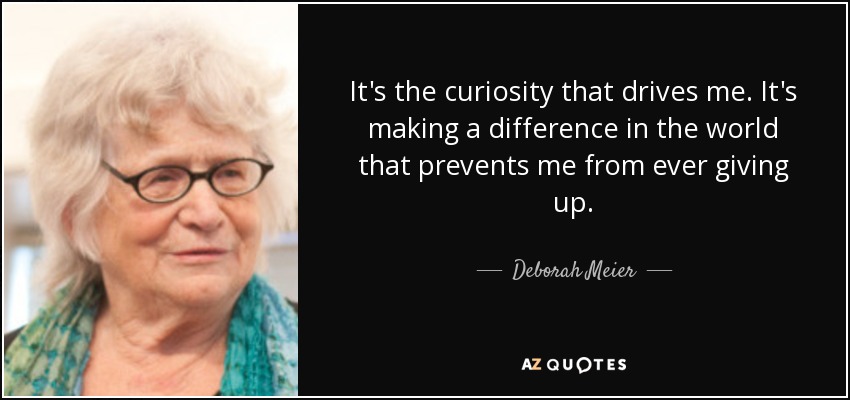
Deborah Meier continues her conversation with Harry Boyte. To read their full exchange, please visit here.
Dear Harry and friends,
This is good practice for us both precisely because we agree on so much and yet use language in ways that sometimes obscure the agreement. Sometimes that's actually good because it opens up interesting differences—however nuanced—that are worth widening before too quickly coming to a happy resolution.
My list of four values were pretty tame (inclusive participation, empathy, solidarity, and hopefulness) and it would be fun to imagine why someone might object to one or the other. Objecting is different than just preferring a different four or an additional fifth. Mission Hill adopted a slogan ("Work Hard and Be Kind") that annoyed me. Of course I believe in both, although I'm equally a fan of leisure.
It's our priorities we often argue about, and these priorities are often very important and lead us into quite different ends.
Compromise is essential; sometimes it helps soften the otherwise sharp edges, and rewording allows us to "go along." Sometimes that too bothers me! I enjoy a good argument. But in the end, "depending on," I like to find a meeting place "until next time."
It depends on what the issue is, how deep the disagreement as well as how important it is to live together afterwards. Sometimes a split is a step forward, not backward. But it's not a good habit. At Mission Hill it means that there's almost always a way to find a meeting place when a parent has a serious concern even if it takes time to find it. Some are "easy," like homework. We were opposed to it, at least until 4th or 5th grade and only if we thought kids would not be stuck if parents were too busy doing something else. Some parents wanted homework very much. So we shifted to sending suggested activities home to all parents and mandated reading or being read to.
We had a few parents who were upset that a teacher told her 3rd graders that Langston Hughes was homosexual. We took her worry seriously and helped her see that aside from respecting our own values we had to acknowledge the view of many other parents about what was right. Not introducing Hughes to students was not an alternative. But we thought more about when to bring up a famous person's sexual preferences and when not—and why. The parent appreciated the conversations and remained a stalwart ally.
It helps that teachers have two years to get to know parents well, and time is set aside for family and school/teacher conversation, the staff has built-in time to talk together, that the school itself is diverse and thus we don't have to do all the talking!
I call these "structural" issues that allow a school—in many different ways—to respect each other and listen to each other without getting burnout.
I appreciate your account of some of IAFs projects. I'd love to read more about which efforts were sustainable beyond an immediate victory. It seems reasonable to assume that we cannot spread ourselves too thin. Michael Walzer wrote a wonderful essay, "A Day in the Life of a Socialist Citizen" (Dissent, May 1968) on what life would be like if everything was subjected to democratic decisionmaking and we were morally obliged to vote on everything. There would be no time left to go to concerts whose offerings we had chosen or make dinner.
The arts of democratic discourse that bring us closer together may not even be "natural." The arts of irreconcilable disagreements—at least for now—need to be treasured too! It's easier if there is the hope that a day will come when new events will enable us to join hands and, meanwhile, we might be even be friends.


Public Good or Private Gain – the story behind the Corporate Education Reform Industry’s Data Mining Effort - Wait What?

Public Good or Private Gain – the story behind the Corporate Education Reform Industry’s Data Mining Effort - Wait What?:
Public Good or Private Gain – the story behind the Corporate Education Reform Industry’s Data Mining Effort


[A long but extremely important read]
While most of the attention surrounding the Corporate Education Reform Industry has been on the implementation of the Common Core, the Common Core testing scheme, the inappropriate teacher evaluation systems and the privatization of public education via charter schools, one of the most disturbing elements of the effort to “transform” public education has been an associated program to create a massive database and corresponding data mining activities.
For additional background read the April 2015 Wait, What? Post –  They have your child’s data and they aren’t afraid to use it.  Connecticut parents who want to know more about this issue should follow the FB Page Student Data Privacy: A Voice for the Connecticut Children of P20 WIN 
Called the P20 WIN (Preschool through Twenty and Workforce Information Network) in Connecticut and housed under the Board of Regents, the publicly funded program seems simple enough;
To improve education and employment opportunities for students, Connecticut needs a system that links data between agencies as students progress from early childhood into jobs and careers.
Connecticut’s Preschool through Twenty and Workforce Information Network (P20 WIN) provides a way for agencies to share and match data securely while protecting student, worker and employer privacy. Education and workforce leaders can then have information to make decisions for improving our students and the state.
However, the issues associated with control and use of the data makes the program much Public Good or Private Gain – the story behind the Corporate Education Reform Industry’s Data Mining Effort - Wait What?:

Congress Prepares to Replace 'No Child Left Behind' - The Atlantic

Congress Prepares to Replace 'No Child Left Behind' - The Atlantic:

Congress Prepares to Launch a New Era in Education Policy

A bipartisan agreement to replace George W. Bush’s signature No Child Left Behind law could pass next month.


In the next few weeks, a bipartisan majority in Congress is likely to pass a law that, in various ways, repudiates the education legacies of both the Bush and Obama presidencies.
House and Senate negotiators last week agreed to a legislative frameworkreplacing George W. Bush’s signature No Child Left Behind law, a landmark reform of K-12 education placing strict federal requirements on states and schools that proved unworkable over time and led to a culture of testing that drew criticism from liberals and conservatives alike. While some federal benchmarks for accountability will remain in place, the new bill gives much more latitude to the states and restricts the ability of the secretary of education to punish or reward them based on their progress.
The overhaul is years in the making—Congress has been due to reauthorize the underlying Elementary and Secondary Education Act since 2007. And in the absence of action on Capitol Hill, the Department of Education has amassed even greater power by negotiating waivers with 42 of the 50 states to exempt them from the law’s sanctions, which included the potential closure of schools. Ultimately, the mounting frustration both with the original law and the waiver system that took its place propelled an alliance among Republicans, Democrats, and even the teachers unions that have battled the leadership of both parties over the years.
The final bill is still being drafted, but a House-Senate conference committee approved its framework in an overwhelming vote—of the 40-member panel, only Senator Rand Paul voted against it. Despite concerns about the restrictions the new law would place on the secretary of education, the White House “is pleased with the framework,” said Roberto Rodríguez, an education adviser on Obama’s Domestic Policy Council. Advisers and advocates in both parties described the bill as a genuine compromise between a bipartisan plan that passed the Senate and a more conservative House bill that would have eviscerated the federal role in education policy and shifted more resources away from needy schools.

Praise has come from unlikely corners.
“It corrects what the federal government has gotten wrong in terms of policy, but it maintains what the federal government has right in terms of policy,” Randi Weingarten, the president of the American Federation of Teachers, told me in a phone interview. “Is it perfect? Of course not. But by doing those two things simultaneously, it’s a very big step.”

Unions have railed against No Child Left Behind’s mandates for teacher evaluations as an excuse to scapegoat educators. While the new law would keep in place requirements for yearly testing of students in grades three through eight and once in high school, it scraps the federal evaluation requirement. And instead of mandating that schools demonstrate “adequate yearly progress” through test scores, the government would allow states to submit their own plan for accountability that could take into account factors beyond testing.

“Our bipartisan agreement will reduce reliance on high-stakes testing, so students and teachers can spend less time on test prep and more time on learning,” said Senator Patty Murray, the lead Democratic negotiator.

Democrats successfully pushed for what they called “federal guardrails,” or Congress Prepares to Replace 'No Child Left Behind' - The Atlantic:

Stay Union, Stay Strong: N.J. State AFL-CIO Calls for Solidarity in Face of Friedrich’s U.S. Supreme Court Case

Stay Union, Stay Strong: N.J. State AFL-CIO Calls for Solidarity in Face of Friedrich’s U.S. Supreme Court Case:

Stay Union, Stay Strong: N.J. State AFL-CIO Calls for Solidarity in Face of Friedrich’s U.S. Supreme Court Case


Strong unions empower working people to fight for justice, fairness, dignity and respect. No matter the challenges that we face, your solidarity will ensure a strong and enduring labor movement for generations to come.
In the New Jersey State AFL-CIO’s new video, "Stay Union, Stay Strong," union members Alicia Abrams, Office and Professional Employees (OPEIU) Local 153; Pat Paradiso, AFT Local 857 president; and Dave Protomastro, Plumbers and Pipe Fitters (UA) Local 24, start the conversation about the importance of unions in the face of the Friedrich’s v. California Teachers Association case, which the U.S. Supreme Court will hear this winter.
To say that the labor movement is under attack underestimates the threat that we face. The Koch brothers and their network of wealthy donors spend hundreds of millions of dollars to influence public policy, contributing heavily to the campaigns of politicians who will do their bidding. The Koch brothers will spend an estimated $889 million in 2016 alone. Their not-so-secret goal is to eliminate unions.
>>


With unions in their crosshairs, the obscenely rich Koch brothers and their allies have contributed to those behind the Friedrichs case, which could undermine public employee unions by limiting their ability to collect dues from the workers they represent. An adverse decision will hurt every sector of the labor movement.
That is why we must stand united to counter the threat of the Koch brothers and moneyed interests. While we cannot underestimate the power of the rich, we must never forget that our collective voice will prevail.
A Koch brothers’ economy would lay waste to a middle-class standard of living, creating a country of the rich for the rich. The labor movement brought us the weekend, safe working conditions, the eight-hour workday, health and retirement benefits and fair pay for a hard day’s work. These are standards we value as union members and must fight to defend.Stay Union, Stay Strong: N.J. State AFL-CIO Calls for Solidarity in Face of Friedrich’s U.S. Supreme Court Case:

Labor Voices: Online charter schools pose problems

Labor Voices: Online charter schools pose problems:

Labor Voices: Online charter schools pose problems


There is more evidence that for-profit charter schools are part of the problem, not the solution. This time, the focus is on “cyber” or online charter schools.
In “The National Study of Online Charter Schools,” Stanford University found students attending cyber charter schools lagged behind students in traditional public schools. Incredibly, the study also showed that cyber charter students received the equivalent of 180 fewer days of learning in math and 72 fewer days of instruction in reading than their peers in traditional schools.
In 2009, Michigan began a small pilot program with for-profit, cyber charters. In 2012, long before sufficient data was available to assess the pilot’s success, Gov. Rick Snyder and the Legislature expanded the number of cyber charters. This follows their pattern for other charter schools, where the cap on charters was lifted without proof that they increased student achievement.
Now, after years of experience and investment, charter schools have, with a few exceptions, proven to be a failed experiment. For-profit cyber charters take that failure to a whole new level.
Prior to the advent of cyber charters, online learning had been incorporated into traditional education. Public schools used “distance learning” technologies to increase academic options for students, especially in smaller, remote districts where courses like Advanced Placement, foreign languages and career-technical classes were not available.
However, study after study shows that sitting a student in front of a computer screen all day decreases student achievement. Prior to the Stanford research, a 2010 University of Colorado study found that only 30 percent of virtual schools run by for-profit companies met minimum progress standards under No Child Left Behind. In 2015, the National Education Policy Center showed only 41 percent of for-profit cybers were deemed “academically acceptable.” That same study showed the on-time graduation rate for cyber charter students was half the national average, while the student-to-teacher ratio was twice that of public schools.
In the latest state rankings, the Michigan Virtual Academy was at the 3rd percentile — 97 percent of Michigan schools performed better. Michigan Virtual Academy is Labor Voices: Online charter schools pose problems:

Segregation and Desegregation, TUSD Schools and Tucson Charter Schools | The Range: The Tucson Weekly's Daily Dispatch | Tucson Weekly

Segregation and Desegregation, TUSD Schools and Tucson Charter Schools | The Range: The Tucson Weekly's Daily Dispatch | Tucson Weekly:

Segregation and Desegregation, TUSD Schools and Tucson Charter Schools

ethnic-racial-word-cloud.jpg


Segregation and desegregation in Tucson schools has become such a hot topic recently, I decided to do a little research to see how the ethnic and racial numbers break down in TUSD schools. As I looked over the numbers, I began to be curious about what they look like in Tucson's charter schools as well. I've read often that charters tend to be more segregated than district schools, and I wanted to see if that was true here. I found that all the data I needed is on the Arizona Department of Education and TUSD websites.

I gathered together enrollment stats on 75 charters in Tucson—I believe it's a fairly complete list of the city's charter schools—using information from the Arizona Department of Education website. Then I did the same with the 85 TUSD schools listed in the enrollment stats on TUSD's website. TUSD keeps its enrollment information current, compiling each school's ethnic and racial composition on a daily basis, but the most recent numbers I could find for charters is from October, 2014, so I used the same date for TUSD to create an accurate comparison.  

Of Tucson students in publicly funded schools (I didn't include private schools in my research), 73 percent are in TUSD schools and 27 percent are in charter schools. Hispanics make up 61 percent of the total student population, 25 percent are Anglo and the remaining 14 percent are divided among African American, Native American, Asian American and Multi-Racial students.

Here is a graph showing the overall ethnic and racial compositions in TUSD and Tuscon's charter schools.


_-ethnic-tusd-charter.jpg

    There's a large difference between student populations in TUSD and in Tucson charter schools. Charters have 11 percent fewer Hispanic student and 16 percent more Anglo students than TUSD. Though the numbers of other students are far smaller, it's clear that African American, Native American and Multi-Racial students are underrepresented at charters compared to TUSD—there's a consistent one-to-two ratio—while Asian American are slightly overrepresented at charters.

    The numbers indicate there's a significant white (and Asian) flight from TUSD schools to charters, which indicates that charter schools are more segregated than TUSD schools. But the difference may be greater or smaller than the numbers imply. After all, students attend a variety of schools with unique ethnic and racial mixes, not the TUSD school district or charter schools as a whole. So my next question is, what are the ethnic and racial compositions of the schools students attend?

    The chart below shows the percentage of students in TUSD and Tucson charter 
    Segregation and Desegregation, TUSD Schools and Tucson Charter Schools | The Range: The Tucson Weekly's Daily Dispatch | Tucson Weekly:schools who 

    Massachusetts' Abandoning Common Core Test Signifies National Shift Against Education Standards | Sunshine State News | Florida Political News

    Massachusetts' Abandoning Common Core Test Signifies National Shift Against Education Standards | Sunshine State News | Florida Political News:
    Massachusetts' Abandoning Common Core Test Signifies National Shift Against Education Standards 


    Massachusetts, the state widely lauded as the leader in national education, is backing away from the controversial Common Core State Standards by dumping an assessment test closely aligned with the standards in favor of its own state-designed standardized test.
    For two years, Massachusetts administered the Partnership for Assessment of Readiness for College and Careers (PARCC), the test most commonly associated with Common Core.
    PARCC was one of the tests Florida considered using for its own assessment, but criticisms of PARCC ran rampant and the state ultimately opted to create its own assessment test instead.
    After Massachusetts’ two years with PARCC were up, the State Board of Education voted last week to abandon PARCC and instead set itself on a path where the state will develop its very own assessment test, signaling a massive shift in national opinion on high-stakes testing and on Common Core itself.
    For years, Massachusetts has been the “city on a hill” in national education, consistently scoring at the very top of the “Nation’s Report Card” from the National Assessment of Educational Progress and climbing above many countries across the world in science scores.
    Massachusetts was America’s favorite child when it came to promoting Common Core, since it seemed to be the strongest evidence the standards were working and propelling students to achieve more and excel academically.
    Florida, too, looked toward Massachusetts as a guiding light on how to model its education practices, but the Sunshine State also opted to create its own standardized test, in defiance against the Common Core State Standards.
    Massachusetts’ decision is a symbolic display of just how divisive high-stakes testing and Common Core have become across the country. When the national education standards were developed in 2009, the majority of the 50 states had no qualms about them and the standards were widely accepted by most states by 2010.
    But that tune began to change drastically as the years went on -- five years later, the majority of national politicians fervently oppose the standards, teachers have spoken out about their efficacy, parents have expressed concerns and even some students say the way they learn has become confusing, overloaded and too complicated.
    States have pushed back -- and some of them have already introduced legislation to repeal the standards, with Indiana pulling out of Common Core altogether.
    Two Republican presidential candidates -- Sens. Marco Rubio, R-Fla., and Ted Cruz, R-TX, have already pledged they’d get rid of Common Core nationwide should either of them be elected president in 2016.
    “I will instruct the secretary of education that Common Core ends,” Cruz told the crowd at the Republican Party of
    - See more at: http://www.sunshinestatenews.com/story/massachusetts-abandoning-common-core-test-signifies-national-shift-against-education-standards#sthash.2q8m2Qdr.dpuf


    How the Gates Foundation Reflects the Good and the Bad of “Hacker Philanthropy”

    How the Gates Foundation Reflects the Good and the Bad of “Hacker Philanthropy”:

    HOW THE GATES FOUNDATION REFLECTS THE GOOD AND THE BAD OF “HACKER PHILANTHROPY”


    IT’S ELECTION SEASON, and teams of journalists are avidly tracking the flow of big money into political campaigns. Sifting financial records and filings, they are laying bare the activities of Super PACs, 501(c)(4)s, and campaign committees. There’s a parallel realm of big-money activity, however, that receives much less attention: philanthropy. With the explosion of the billionaire class, the number of deep-pocketed donors and foundations has mushroomed as well. Many of the new benefactors are Wall Street and Silicon Valley moguls who are seeking to apply to social and economic problems the same zest for innovation and entrepreneurship that they showed in their business ventures.
    The creed of these new philanthropists was brashly outlined in June by Sean Parker, the co-founder of Napster and founding president of Facebook, in anarticle appearing in the Wall Street Journal under the headline, “Philanthropy for Hackers.” Traditional philanthropy, he declared, is “a strange and alien world made up of largely antiquated institutions.” These old-timers have long favored “safe” gifts to well-established institutions, “resulting in a never-ending competition to name buildings at major universities, medical centers, performing arts centers and other such public places.” The new breed, by contrast, has a hacker mindset: It is anti-establishment, believes in “radical transparency,” is given to problem solving, and has an ability to identify weaknesses in long-established systems and to disrupt them. With this “hacker elite” now seeking to upend philanthropy, Parker exhorted them to resist the urge to institutionalize and instead treat philanthropy as “a series of calculated risks” and “big bets.” In a bid to put these principles into practice, Parker launched a foundation bearing his name, with an endowment of $600 million and a commitment to finding new ways to fight allergies, malaria, and cancer.
    Interestingly, there are two members of the hacker elite who for 15 years now have practiced this style of philanthropy in a big way: Bill and Melinda Gates. The Bill and Melinda Gates Foundation is by far the largest such institution in the world. Its assets of $41 billion are more than double the combined assets of the “Big Three” foundations — Ford ($12 billion), Rockefeller ($4 billion), and Carnegie ($3 billion). The Gates Foundation has all the traits Parker extols, and its work has served as a sort of grand experiment in the new “venture philanthropy,” as it’s sometimes called.
    Gates is the largest philanthropic supporter of primary and secondary education in the United States. Together with the Walton Family Foundation and the Eli and Edythe Broad Foundation, it has helped reshape national education policy. Gates has been no less influential in international public health. Over the last 15 years, it has spent billions of dollars to fight polio, malaria, tuberculosis, HIV/AIDS, and other diseases. Though the World Health Organization spends more than Gates does on health, the foundation, by virtue of its high profile and skillful marketing, has played a key part in setting the global health agenda. On top of it all, the foundation in recent years has invested heavily in agricultural development in Africa, joining with the Rockefeller Foundation to build on the “Green Revolution” that Rockefeller helped launch after World War II. Not since that earlier initiative has a foundation left such a large imprint on the world as the Gates Foundation.
    Despite its impact, few book-length assessments of the foundation’s work have appeared. Now Linsey McGoey, a sociologist at the University of Essex, is seeking to fill the gap. “Just how efficient is Gates’s philanthropic spending?” she asks in No Such Thing as a Free Gift. “Are the billions he has spent on U.S. primary and secondary schools improving education outcomes? Are global health grants directed at the largest health killers? Is the Gates Foundation improving access to affordable medicines, or are patent rights How the Gates Foundation Reflects the Good and the Bad of “Hacker Philanthropy”: