Latest News and Comment from Education

Friday, July 31, 2015

Oregon Save Our Schools: Get the Scoop! What You Need to Know About Kindergarten Testing and Opting Out

Oregon Save Our Schools: Get the Scoop! What You Need to Know About Kindergarten Testing and Opting Out:

Get the Scoop! What You Need to Know About Kindergarten Testing and Opting Out


Please join Oregon Save Our Schools for an important parent information session  particularly designed for parents of incoming kindergarteners. While geared toward this specific audience, all parents and community members are welcome. The sessions are free and open to the public.

This is information you will NOT be getting from your school district or teachers prior to the first week of school when most kindergarteners in Oregon are administered the state mandated OKA (Oregon Kindergarten Assessment) also sometimes referred to as the KRA (Kindergarten Readiness Assessment) at all publicly funded schools (including charters). 

That’s right- these days in Oregon children are introduced to their first high-stakes standardized test in kindergarten-often on the first day or within the first week of school. Most parents don’t know anything about it as it’s presented as being part of a “meet-n-greet” get to know you time. 

Come find out what this assessment is and isn’t, how its data is and isn’t used, and hear first-hand from actual kindergarten teachers what they think about it and how it informs their work. Learn about how the Common Core standards that the test is based on have quickly changed the way kindergarten is being taught. Get information on the origin and history of these changes and better understand sweeping “education reforms” are impacting our publicly funded schools and how. Information on how to “opt-out” will be available as well.  One shorter session will provide information and time to answer questions.  The two hour sessions will also include the viewing of the documentaryEducation Inc. with a discussion to follow.

“KINDERGARTEN IS NOT WHAT IT USED TO BE”

3 DATES/2 LOCATIONS/THREE TIMES- all at Multnomah County Library locales

1)             August 20th THURSDAY                 
                MIDLAND LIBRARY          
                805 SE 122nd Ave Portland                           
                Large Meeting Room    
                6:30-7:30 pm

This event will provide important information about kindergarten assessments and opting out.

2)             August 21st FRIDAY                         
                North Portland Library   
                512 N. Killingsworth St.  Portland              
                Upstairs Large Room    
                10:30 am - 12:30 pm


This session will provide important information about kindergarten assessments and opting out as well as a showing of Education Inc., a documentary that examines broadly and deeply how corporate interests are impacting public education. Kindergarten information session will be held for the first hour. Movie showing and discussion will follow.  

3)             August 23rd SUNDAY                     
                North Portland Library   
                512 N. Killingsworth St. Portland                
                Upstairs Large Room    
                2:30-4:30 pm


This session will provide important information about kindergarten assessments and opting out as well as a showing of Education Inc., a documentary that examines broadly and deeply how corporate interests are impacting public education. Kindergarten information session will be held for the first hour. Movie showing and discussion will follow.  

We hope to see you there!

Criticize Common Core in AZ, and Dept of Ed Official Might Call You a “F***tard” | deutsch29

Criticize Common Core in AZ, and Dept of Ed Official Might Call You a “F***tard” | deutsch29:

Criticize Common Core in AZ, and Dept of Ed Official Might Call You a “F***tard”


AZ Common Core


In September 2013, the Arizona Daily Star noted that then-Governor Jan Brewer “ordered state agencies to stop using the term ‘Common Core’ when referring to the new education standards, in response to hostility from critics over what they see as a federal intrusion.”
The Daily Star article continues:
In an executive order, the governor said she was “reaffirming Arizona’s right to set education policy.” Her order spells out “no standards or curriculum shall be imposed on Arizona by the federal government.”
But it concedes the standards adopted by the state Board of Education in 2010 already are being implemented. And Brewer herself referred to them as Common Core in her State of the State speech and her budget request to the Legislature.
Press aide Andrew Wilder said the order changes nothing except the name, which going forward will be “Arizona’s College and Career Ready Standards.’’
Brewer’s decision was arguably a sleight-o-name intended to fool the Arizona public into accepting Common Core.
Still, there were critics in Arizona, vocal critics like teacher Brad McQueen.
If anyone insists that Common Core is not politically loaded, send that person this June 2014 story out of Arizona:
By Brad McQueen
Ever wonder why more public classroom teachers don’t speak out against the Common Core and their Superintendents of Instruction and Governors who support it?
I am a Tucson teacher who wrote my first anti-Common Core op-ed this past February in the Arizona Daily Independent and it was subsequently reprinted 
Criticize Common Core in AZ, and Dept of Ed Official Might Call You a “F***tard” | deutsch29:

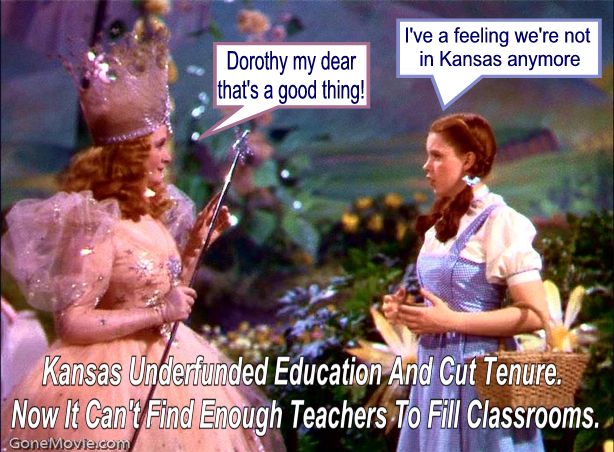
Kansas Underfunded Education And Cut Tenure. Now It Can't Find Enough Teachers To Fill Classrooms.

Kansas Underfunded Education And Cut Tenure. Now It Can't Find Enough Teachers To Fill Classrooms.:

Kansas Underfunded Education And Cut Tenure. Now It Can't Find Enough Teachers To Fill Classrooms.

“In the next three years I think we’ll have maybe the worst teacher shortage in the country -- I think most of that is self-inflicted.”


Kansas school superintendent Alan Cunningham has been involved with hiring teachers for the past 35 years. In that time, he has never had a harder time filling positions than this year.
Qualified applicants for job openings in elementary schools or physical education “used to be a dime a dozen,” Cunningham said. Now Cunningham’s school district, Dodge City School District, is starting the school year with teachers in those positions who are not fully certified.
“We’ve had to go to substitute teachers,” said Cunningham.
Cunningham’s predicament is one superintendents throughout his state are facing. In Kansas, where teacher pay is low and schools are underfunded, hundreds of teaching positions throughout the state are still vacant just a few weeks before the start of the school year.
“This is the first year we’ve experienced a shortage as significantly as we are this year,” said Cunningham, referring specifically to his district. “We’ve had to combine some classrooms where we weren’t able to find a teacher and made class sizes significantly higher than we’d like them to be.”
Considering the conditions facing educators in Kansas, it is not an unlikely spot for a teacher shortage. Teachers in Kansas have some of the lowest average pay in the country. In 2014, the legislature voted to cut back on job protections for teachers that gave them certain due process rights if they faced dismissal. In June 2015, a three-judge district court panel said that the state’s school funding system is unconstitutional, in a ruling that was soon kicked up to the state Supreme Court. As a result of this funding system and pervasive tax cuts throughout the state that led to extreme revenue losses, several districts throughout the state had to end the 2014-2015 school year early because they did not have the money to stay open.
Capitalizing on the unrest among teachers, one school district in the neighboring state of Missouri even put up billboards in Kansas attempting to recruit dissatisfied teachers. Amid all this, an aging workforce has led to an increase in teacher retirements.Data from the state department of education shows that 2,326 educators retired after the 2014-2015 school year, compared to 1,260 in the 2011-2012 school year. Last year, 740 teachers decided to leave the profession and 654 teachers decided to leave the state; those numbers for 2011-2012 were 491 and 399 respectively. 
In this July 8, 2015 photo, a billboard on Interstate 70 near Lawrence, Kan. advertises for teaching jobs in the Independence, Mo. school district. (AP Photo/Orlin Wagner)

BustED Pencils Trending News: 400 miles achieved; 12 year old gets it right; Live at Michelangelo's; | BustED Pencils

BustED Pencils Trending News: 400 miles achieved; 12 year old gets it right; Live at Michelangelo's; | BustED Pencils:
BustED Pencils
 BustED Pencils Trending News: 400 miles achieved; 12 year old gets it right; Live at Michelangelo’s;

newsboy_bustedpencils-logo_full color

400 Miles Achieved all in the name of children!  Congratulations Jesse!  Find Jesse Turner in satirical mock trial as Arne Duncan. (44.01 minutes into the trial)

Mock Trial LIVE STREAM

Children are more than test scores


BustEDstretchLacey wrote a research paper about standardized testing. We had no idea she was doing this until she asked Tim for some advise. She felt very strongly about sharing her findings with the school board. Her teachers encouraged her to read it, so she did. Wow, very proud of our BustED Pencils Student Correspondent.
Lacey Slekar Addresses School Board
BustEDstretch
On the capitol at Michelangelo’s coffee house live!  It was fun and interactive.  We even got to engage with elected officials and get their views for public education.
Live from MICHELANGELO’S! Wisconsin Public Education Advocates.

Want BustED Pencils Trending News to come right to your in-box?
Enter your email on the right under “SUBSCRIBE” on our Home or Trending News page at bustedpencils.com

I am Retiring | Taking Note

I am Retiring | Taking Note:

I am Retiring


I have some news: I am retiring from the PBS NewsHour and Learning Matters.
For the past 41 years I have been covering public education mostly here in the USA but also in China, Hong Kong, France and Spain. I began at NPR in 1974 (when it was still known as National Public Radio), and I’ve reported for the MacNeil/Lehrer NewsHour, the NewsHour with Jim Lehrer and the PBS NewsHour [1].
I look forward to traveling with my wife and catching up with other areas of my life in the coming months, but retiring from Learning Matters is not a hard stop for me. I have one more report to finish for the NewsHour, and our new film, “School Sleuth: The Case of the Wired Classroom,” will be on most PBS stations in November.
My passion and desire for engagement remain strong. Rather than putting myself out to pasture, I hope to keep active as a moderator, an activity I love, and seize other opportunities and adventures that await, out of sight around the corner. I’ll be weighing in on critical issues in education in Raleigh-Durham in August; DC in September; and Chicago in October.
There’s certainly plenty to talk about:
****Will we hold charter schools, both for-profit and not-for-profit, accountable for their spending and their educational outcomes?
****If the resistance to over-testing continues to grow, how will that change what happens in schools on a daily basis?
****Will technology be used to let students soar and explore, or will educators harness it to improve management of information and fact-based learning?
****Will leadership emerge that will help develop sensible ways of assessing schools, students and teachers–and in so doing drive a stake through the heart of ‘test-based accountability’ that is playing gotcha with teachers?
****How will the new Elementary and Secondary Education Act, when it eventually replaces the much-detested No Child Left Behind, change the power dynamics between Washington, DC, and the states?
Friends have asked me what I will miss most. That’s easy: the challenges of reporting and the joys of teamwork. Television is truly a team sport, and I have been blessed with wonderful teammates. Because it’s my face and voice that have been in your faces and ears, I’ve received more credit and attention than I deserve. I hope that I am, at 74, mature enough to cope without the attention.
By now, blogging has become second nature to me, and I will continue to post at least weekly. I invite you to take a look at my new blog, The Merrow Report. (Fun fact: This was the name of my original television series back in the 1990’s.) You will find it at themerrowreport.com.
Please consider subscribing.
My departure is not a hard stop (or any sort of stop at all) for Learning Matters and its reporting for the NewsHour. Within a few days, expect an announcement. I’m thrilled that my talented colleagues will continue to do the work they love, and I am extremely grateful that a number of leading foundations are supporting this enterprise.
In later posts I will weigh in on current issues and trends, while also reflecting on the past 41 years of interviewing teachers, students, Secretaries of Education and others in America’s most important venture.
As I sign off, please know that it has been a rare privilege to report for you. I appreciate your trust, and I pledge to do my best to preserve it, whenever our worlds connect.
An Italian friend once cautioned me, “Never say arrivederci to people you care about. Say addio per ora instead, because that means ‘goodbye for now.’”
Addio per ora. I look forward to hearing from you.
John
(john.merrow@gmail.com) I am Retiring | Taking Note:

What Did the Senate Just Give Us? Looking at Every Child Achieves (Part II) | Truth in American Education

What Did the Senate Just Give Us? Looking at Every Child Achieves (Part II) | Truth in American Education:

What Did the Senate Just Give Us? Looking at Every Child Achieves (Part II)


Photo credit: Rob Crawley (CC-By-2.0)


 Here is a recap of some of the other important amendments proposed for S.1177, the Every Child Achieves Act, and votes that were largely disappointing for those wanting educational freedom in this now approximately 1000 page bill based on category (Please see the Congress.gov website for all of the amendments offered with links to language and a list of status, the Senate website for specific roll call votes on the amendments and S 1177 itself, andEducation Week  for other summaries.)

TESTING:
Cruz amendment (SA 2180) to get rid of federal testing mandates – This failed by a vote of 40-58. Presidential candidates Paul and Rubio joined Senator Cruz in voting for this important amendment.  Sanders voted against this great amendment favored by many Democrat teachers and Graham did not vote. All Democrats voted against this amendment and all Republicans voted for it except: Alexander, Ayotte, Capito (WV), Cochrane (MS), Corker (TN), Flake (AZ), Gardner (CO), Kirk, Portman, Rounds (SD), and Thune.  It is very sad that Republicans who say they are for smaller government voted against this effort to send control of testing back to the states and districts.
Lee amendment (SA 2162) to allow written parental testing opt out  –  Sadly, this also failed by a vote of 32-64. Every single Democrat and nineteen Republicans voted against this fundamental right of parents to direct the education of their children. Of the presidential candidates, Cruz and Paul correctly voted for this important amendment while Sanders voted against it, and Graham and Rubio did not vote.
Paul amendment (SA 2218) to permit parental opt out without being counted against the 95% participation mandate – This is quite similar to the Salmon amendment that was one of the few really strong pieces of language to pass in HR 5, The Student Success Act, the House version of the NCLB rewrite. Senator Alexander did not allow this amendment to the floor.
Tester amendment (SA 2129) to reduce testing mandate to three times in grades 3-12 for English and math instead of annually – This was never allowed to the floor for debate.
Isakson amendment (SA 2194) “to require local educational agencies to inform parents of any State or local educational agency policy, procedure, or parental right regarding student participation in any mandated assessments for that school year” – This largely symbolic amendment will be basically useless for protecting parental opt-out rights due to the 95% participation and other mandates in the main bill, but it is all the administration, leadership of both parties, and the corporate interests were willing to accept.  It passed by a vote of 97-0 with Graham and Rubio not voting.
Murphy amendment (SA 2241) to reinstate the high stakes testing accountability of NCLB – Fortunately, this failed by a complete party line vote of 43-54, with Democrats and Sanders supporting, Republicans opposing, and Cruz and Graham not voting. Teachers are appalled that What Did the Senate Just Give Us? Looking at Every Child Achieves (Part II) | Truth in American Education:

For-Profit Colleges: Marketing to the Desperate, Supported by Our Taxes | janresseger

For-Profit Colleges: Marketing to the Desperate, Supported by Our Taxes | janresseger:

For-Profit Colleges: Marketing to the Desperate, Supported by Our Taxes


In the summer issue of The American Prospect, Mark Huelsman profiles the for-profit colleges he calls Betrayers of the Dream.  “The students targeted and affected most by fraudulent operators are disproportionately black, “explains Huelsman.  “The story of predatory for-profit colleges is not unlike that of subprime lending or the proliferation of payday loans.  Wider economic unease was used by the cynical to bring further distress to people of color.”
Huelsman lists the trail of  investigations that finally resulted in the closure of Corinthian Colleges—a for-profit that had “enrolled more students than the Ohio State University and the University of Texas combined.” Corinthian had been flagged by attorneys general in several states, Tom Harkin and the U.S. Senate,  lawsuits from the federal government, and an investigation by the SEC: “These found a broad pattern of deception in recruiting students, bogus reporting of job placement data, and a strategy of combining high tuition and debt levels with a substandard educational product.”  “Corinthian’s story,” writes Huelsman, “is a microcosm of the for-profit college sector….”
Huelsman reports that what finally brought down Corinthian was a relatively simple action by the Obama Department of Education—a  decision to force Corinthian to fulfill the Department’s reporting requirements by withholding federal funds—student loans, Pell Grants, and G.I Bill Benefits—until the college submitted reports. Corinthian was unable to comply with regulations before its cash flow ran out. Like other publicly-traded, for-profit colleges that depend on federal financial aid for 86 percent of their funding, Corinthian was unable to survive the freeze on access to federal dollars.  (Holding the college, not its vulnerable students accountable, U.S. Secretary of Education, Arne Duncan later announced debt relief for 40,000 of Corinthian’s former students and a chance for 300,000 others to apply for relief for student loans that had paid for their Corinthian tuition.)
Huelsman describes explosive enrollment growth at for-profit colleges—an increase of 225 percent from 1998-2008 compared to growth during the same period of only 31 percent in the total college-going population.  “This enrollment growth included a massive targeting of students of color.  The University of Phoenix, for example, was spending as much as $400,000 a day on advertising.  Ads for these colleges were ubiquitous in communities of color, on commercials for day-time television programs, at bus stops and subways…. They enlisted leaders in the black community to advertise on their behalf…”  Recruiters for a St. Louis for-profit, Vatterott College, told recruiters to ‘target the welfare mom with kids’ and ‘pregnant ladies,’ as well as those with records of ‘recent incarceration’ and ‘drug rehabilitation.’  Other colleges had recruiters drop off information at Section 8 housing and and unemployment offices….”
Huelsman quotes Johns Hopkins sociologist, Stefanie DeLuca  describing the young people targeted with such advertising: “These are students often without the benefit of college For-Profit Colleges: Marketing to the Desperate, Supported by Our Taxes | janresseger:

Next Move? Parsing What Bill and Melinda Said About Education Funding

Next Move? Parsing What Bill and Melinda Said About Education Funding - Inside Philanthropy: Fundraising Intelligence - Inside Philanthropy:

Next Move? Parsing What Bill and Melinda Said About Education Funding


Bill and Melinda Gates are obsessed with impactful grantmaking and evaluating the outcomes of their foundation's giving. Recently, the heads of the world's largest foundation discussed the impact of their funding activity with New York Times columnist Nicolas Kristof.
The couple highlighted a number of accomplishments in the areas of global health and child mortality, but acknowledged that the billions they have poured into education reform haven't had quite the same impact.
"There's no dramatic change," Bill Gates told the columnist. "It’s not like under-five mortality, where you see this dramatic improvement.” However, Bill and Melinda Gates say they are not discouraged by this inertia and that they remain committed to sweeping change in the nation's K-12 and higher education systems.
This is significant for a bunch of reasons, not the least of which is that the Gateses still have not tapped the bulk of their personal fortune for philanthropy, as we've discussed in the past. While the Gates Foundation lists assets of $43 billion, Forbes pegs Bill Gates' personal fortune at nearly $80 billion—most of which will likely go to philanthropy eventually. 
In other words, assuming that they stick with education as a major focus of their giving, Bill and Melinda Gates could have an even larger impact on U.S. education in coming decades than they have had to date. But what might that look like? 
As we know all, the Gates Foundation has been pivotal in the battle over education reform for many years. Less clear, though, is the long-term trajectory of its efforts going forward. Most recently, Gates has placed an early emphasis on college- and career-ready standards, pouring tens of millions of dollars into the development of the Common Core State Standards. Despite the controversy surrounding the standards, the Common Core has been adopted in the majority of states, as well as the District of Columbia.
The funder also paid attention to years of education research showing that effective teachers are the single-most important factor in student success. Gates funded the Measures of Effective Teaching (MET) project, studying best practices in classroom instruction in school districts across the country. Gates also provided millions to nonprofit organizations and individual school districts to support professional development for teachers and the development of teacher evaluation systems. (Here's abreakdown of Gates giving on teaching since 2008, which totaled nearly $700 million as of late 2013.)
In the past few years, Gates has largely moved away from grants to individual school systems, preferring instead to focus its grantmaking among large nonprofits with a national reach. 
Assessing their mistakes in grantmaking, Bill and Melinda Gates said some of their early grantmaking activities — in all areas, not just education — were too technology-focused. This is understandable, given that Gates Next Move? Parsing What Bill and Melinda Said About Education Funding - Inside Philanthropy: Fundraising Intelligence - Inside Philanthropy:

College Board bows to critics, revises AP U.S. History course - The Washington Post

College Board bows to critics, revises AP U.S. History course - The Washington Post:

College Board bows to critics, revises AP U.S. History course


After a year of defending its 2014 framework for the AP U.S. History course against conservative criticism that it was presenting a negatively biased view of American history, the College Board just released a new “clearer and more balanced” course guide and framework that includes many of the subjects the critics had complained were missing from the previous one.
The College Board, which owns the Advanced Placement program, said in statement published on its Web site that “feedback gathered over the last year” has guided the changes. The statement, published a day after College Board President David Coleman met with a chief framework critic, said in part:
Every statement in the 2015 edition has been examined with great care based on the historical record and the principled feedback the College Board received. The result is a clearer and more balanced approach to the teaching of American history that remains faithful to the requirements that colleges and universities set for academic credit. The new edition has been embraced by educators, including AP U.S. History teachers who reviewed it at the recent AP Annual Conference.
The 2014 framework was created after AP U.S. History teachers complained that the old version forced them to race through topics without time to immerse students in major ideas.  The 2014 document took a view of U.S. History as a series of conflicts over power, and did not mention important American historical figures by name, including Benjamin Franklin and Martin Luther King, Jr.
Just as soon as it was released, it was savaged by conservatives, including the Republican National Committee, which passed a resolution last summer saying that the framework “emphasizes negative aspects of our nation’s history while omitting or minimizing positive aspects.” They called for a congressional investigation. Ben Carson, a pediatric neurosurgeon who is a candidate for the 2016 Republican presidential nomination, said that “most people” who complete the course would then be “ready to sign up for ISIS.” (Yes, he really said that.)
And last month, a group of historians from a wide range of schools, including Harvard, Stanford, Yale and Princeton universities, as well Lynne Cheney, former chair of the National Endowment for the Humanities and the wife of College Board bows to critics, revises AP U.S. History course - The Washington Post:

Smarter Balanced (SBAC) Race to the Top Application and 15 of Its State MOUs | deutsch29

Smarter Balanced (SBAC) Race to the Top Application and 15 of Its State MOUs | deutsch29:

Smarter Balanced (SBAC) Race to the Top Application and 15 of Its State MOUs


On July 29, 2015, I posted the 1,609-page Partnership for Assessment of Readiness for College and Career (PARCC) Race to the Top (RTTT) application.
Here is an excerpt from the SBAC executive summary (page 4):
Following the principle of “responsible flexibility,” SBAC will provide options for customizable system components while also ensuring comparability of high-stakes summative test results across States. In addition, the Consortium is committed to creating a policy environment that fosters innovation while supporting the development of accountability systems that incentivize the right behaviors for students, teachers, and administrators and avoid inadvertently incentivizing behaviors that run counter to SBAC goals.
If a behavior supports SBAC goals, it is “right.”
If not, it is wrong.
If you stare at that paragraph long enough, you’ll see Skinner offering an approving nod.
Like PARCC, SBAC holds technology in high regard– and assumes it is reliable and readily available:
SBAC’s system capitalizes on the precision and efficiency of computer adaptive testing. …
In summary, SBAC’s proposed learning and assessment system is grounded in a sound Theory of Action. 
I’m not sure how many hours these “theory grounders” have spent wrangling with obstinate or otherwise state-of-the-art-challenged public school technology– or of considering what (or who) schools and districts will have to cut in order to pump dollars into test-intended technological upgrades.
Test-score-driven behavior modification can be pricey.
The State of Washington is running this SBAC show. See pages 6 and 7 for signatures of WA Governor Christine Gregoire (June 09, 2010), School Chief Randy Dorn (June 10, 2010), and State Board of Ed Chair, Jeff Vincent (June 15, 2010). The same signature page is repeated on page 10.
Page 11 lists the 31 SBAC member states, 17 of which are “governing states” and are marked with asterisks (click image to enlarge):
SBAC 06-10
Below the above list is the note, “Washington State (#1) is a Governing State in addition to serving in the unique role of lead Procurement State/Lead State for the Consortium.”
Notice that California was not on the SBAC membership roster in June 2010. At that time, California was with PARCC and was the first state to leave PARCC in June 2011– and the PARCC profit potential dropped notably with the anticipated loss of at least a few million CA students who would have otherwise taken PARCC.
California joined SBAC in June 2011. SBAC was of course happy about this.
Now, to the memoranda of understanding (MOU’s) included as part of the SBAC Smarter Balanced (SBAC) Race to the Top Application and 15 of Its State MOUs | deutsch29:

Chicago Public Schools budget cuts hit special education students | WBEZ 91.5 Chicago

Chicago Public Schools budget cuts hit special education students | WBEZ 91.5 Chicago:


CPS budget cuts hit special education students

July 29, 2015

WBEZ/Becky Vevea
Parents, teachers and students gather in Logan Square to protest the latest round of budget cuts at Chicago Public Schools
Phillip Cantor got called into an emergency meeting last week at the school where he teaches—North-Grand High School on Chicago’s West Side. The district’s central office had just sent over the budget for the coming school year.
“We had some cuts at our school, but seemed to be doing better than other schools in our area,” Cantor, who's chair of the Science Department, said. “And then we realized when we got further into the budget, we were losing $318,000 specifically for special ed services.”
It would mean the school would have to cut about three special education teachers or six full-time aides.
Cantor said there’s no way it would work.
“We’re barely meeting the kids’ requirements now,” he said.
Earlier this month, Jesse Ruiz, the vice president of the School Board who at the time was leading the district interim CPS CEO, announced that more than 500 special education teachers would be laid off districtwide. Chicago Mayor Rahm Emanuel called the cuts, which included special ed, “unconscionable and intolerable.”
The move, he said, came after Chicago Public Schools conducted an 18-month review of services and staffing for students with special needs and found that even as enrollment in special ed was declining, the number of staff was increasing.
“The long-term goal is for more students with unique learning needs to be able to receive services at their neighborhood schools,” he said.
But the district has kept pretty quiet about how it’s going about making changes to how special education is delivered.
“When we looked more closely, there was a line in the budget that said All Means All pilot,” Cantorsaid.  
If you haven’t heard of All Means All, you’re not alone. The district made no formal announcement about it and some of the 102 schools now in the pilot didn’t know they would be part of it until their budgets came. Last year, about two dozen schools were part of the program.
Internal district documents provided to WBEZ outline how the All Means All program is designed, and it’s complicated, but boils down to what some call “student-based budgeting for special education.”
Principals get a lump sum amount for special needs students instead of specific staff positions. If that sounds familiar, it’s because that’s the way the rest of Chicago schools have been funded for the last few years.  Principals get a lump sum for each student and then they decide what to do with it.
The internal document about All Means All did not list the actual per pupil amounts for students with special needs. CPS spokeswoman Emily Bittner provided the following chart to WBEZ.
*CPS refers to students with special needs as “diverse learners”. They get a base amount under Chicago Public Schools budget cuts hit special education students | WBEZ 91.5 Chicago:


Why I Kept Firing Teachers in No Pineapple Left Behind - Yahoo Games

Why I Kept Firing Teachers in No Pineapple Left Behind - Yahoo Games:

Why I Kept Firing Teachers in No Pineapple Left Behind


I was starting my second semester of first grade when the No Child Left Behind Act went into effect. Passed in 2002, the act required states to develop standardized tests for its schools. To receive federal funding, a school had to administer the assessment to its students--and students must perform at or above certain levels for schools to avoid corrective action from state governments. In effect, school funding became based on student performance on those exams.
All I know of the American education system comes from a post-NCLB world, which means I have grown up with state-wide benchmarks and standardized tests. Each year, when Colorado's exams rolled around, teaching came to a screeching halt. Instead of lessons, our school days were filled with exams of wildly varying levels of quality and relevance.
I was lucky to live in an area with very good public schools, but my elementary school still struggled to conform to NCLB. Teachers were moved around and let go, and high-achieving students often had to find out-of-school ways to continue learning. I also had to deal with some pretty odd experiments in grading, including an incomprehensible four-point scale which granted the same grade to every test score between 75 percent and 95 percent. Written at the top of every one of my tests was: "3--Satisfactory."
That's why I've been interested in No Pineapple Left Behind. The game has about as much subtlety as a cruise missile, but it poses a scathing critique of the education system built in the wake of NCLB. It puts you in control of a school as it desperately tries to secure funding. You have to hire the teachers, determine how much energy they put into their classes, and monitor students to make sure they're learning. The better your students perform, the more money your school will be given.
As students concentrate more and do better, you're presented with a haunting tradeoff: the higher their grades, the lower their humanity. Over time, as they perform better, they'll lose humanity and, eventually, they'll turn into pineapples.
Pineapples are simple and single-minded, which means they are advantageous. Children, on the other hand, are complex; they are constantly preoccupied with thoughts and emotions. As I played the game, I found myself wishing more and more that my student body would turn completely into pineapples. In other words, I wanted them all to reach total uniformity--the mark that they were all satisfactory, and my school was making money.
The only way you can get students to earn better grades is by providing them with competent teachers. No Pineapple Left Behind gamifies teaching to the point of absurdity. Teachers are equipped with different "spells" which cost certain amounts of "energy." A spell that takes up more energy will increase grades faster, but at the risk of exhausting the teacher. Each spell has a certain probability of succeeding, which pushes grades up and humanity down. As a teacher's energy decreases, his or her chances of succeeding with a spell also decrease. Each day, a little bit of energy recharges.
View gallery
.
At first, the obtuse presentation and extreme gamification of this system nearly dissuaded me from playing the game. But as I completed each day at the school, the system started influencing the way I made decisions. I'd force the teachers to cast the most energy-intensive spells possible to try and save struggling classes. This would, in turn, cause the instructors to burn out. They'd begin to fail during each class period, and the grades would plummet. I'd start to lose money.
It's something I've seen several times before in real life: good teachers, assigned to under-performing classes, are pressured with the responsibility to get them up to a satisfactory level. They reach their breaking point and become exhausted. Thankfully, I've never seen a teacher laid off for Why I Kept Firing Teachers in No Pineapple Left Behind - Yahoo Games: