Latest News and Comment from Education

Sunday, November 15, 2020

Watch As Kevin Welner and I discuss His New Book “Potential Grizzlies” | Diane Ravitch's blog

Watch As Kevin Welner and I discuss His New Book “Potential Grizzlies” | Diane Ravitch's blog
Watch As Kevin Welner and I discuss His New Book “Potential Grizzlies”


I enjoyed reading Kevin Welner’s new book “Potential Grizzles.” There are many hilarious short pieces about education fads, absurd federal laws, Duncan, DeVos and more.

You will enjoy reading about the innovative Ammocentric Charter School in Arizona. Or the discovery that when the bottom 5% of teachers are fired, another bottom 5% pops up the next year. Or the insight that teachers can be fairly evaluated by their height. Or what happened when a promising student got a growth on her mindset.

Kevin and I discussed the book on a Zoom sponsored by the Network for Public education. We had a lot of laughs thinking about the absurd disconnect between research and policy.

Kevin has pledged any royalties he earns to NPE. I hope you will watch, listen, then buy the book.


CAPITAL & MAIN: Why did the Schools and Communities First initiative lose when other progressive measures passed in California?

Proposition 15 Goes Down Swinging |
Proposition 15 Goes Down Swinging
Why did the Schools and Communities First initiative lose when other progressive measures passed in California?


The 2020 presidential election outcome was a nail-biter, but in California there was another drawn-out, high-stakes contest. On November 10, with more than 90% of the vote tabulated, the contest was called against Proposition 15, which was losing by 3.6 percentage points after a months-long campaign and a week-long ballot count.

The Schools and Communities First initiative, Prop. 15, was launched by a coalition of community organizations, the Service Employees International Union’s California State Council and the California Teachers Association to create more resources for schools and local amenities by changing the commercial and industrial properties tax structure. (Disclosure: The two unions are financial supporters of this website.)

“The anti-15 people did as the pro-13 people did—they hit the right buttons. Tax increases, housing supply—all of that resonates with the California electorate.”

— Sherry Bebitch Jeffe

Prop. 15 would have reset the assessment of California corporate property tax rates that were established by 1978’s landmark Proposition 13, assessing them at present market value. Today most annual corporate property bills are based on rates that have gone un-reassessed for decades. With Prop. 15, Disney Studios’ million-plus-square-foot lot in Burbank would no longer be assessed at $5 and change per foot while some local businesses pay around $200 for the same space.

The California Legislative Analyst estimated that the Prop. 15 reform measure could have raised between $6.5 billion and $11.5 billion a year for local governments and schools. Why then, with a $56-million-plus campaign war chest, did it lose—especially when other progressive measures passed?

“The anti-15 people did as the pro-13 people did—they hit the right buttons,” says Sherry Bebitch Jeffe, a senior fellow at the University of Southern California’s Sol Price School of CONTINUE READING: Proposition 15 Goes Down Swinging |

Public Schools. Public. | Teacher in a strange land

Public Schools. Public. | Teacher in a strange land
Public Schools. Public.


[Many years ago, at my husband’s class reunion]: Inebriated classmate starts rhapsodizing about the extreme superiority of the education they all got at their well-regarded co-ed Catholic high school in the suburbs of Detroit, back in the day. His monologue derails (did I mentioned he was sloshed?) and he turns to yammering at ME (a public school teacher) about how terrible schools are today (he has no children) and that the public schools—well, they’re the worst of all. Everybody knows that.

I bite my tongue.

I’m used to people assuming that private and religious schools are, somehow, automatically better than public schools. On the face of it, if ‘you get what you pay for’ is a truism, private schools ought to be better than public schools. Depending on your definition of ‘better,’ of course.

Part of the cachet of privately funded education is exclusion. You’re paying for the privilege (a carefully chosen word) of sending your child to a school that other people can’t afford, and having them taught using a set of values (religious and otherwise) that your family has chosen, not been assigned to by location.

You are making the decisions, finding a school with a socio-economic level close  CONTINUE READING: Public Schools. Public. | Teacher in a strange land


CURMUDGUCATION: There's Only One Reason Districts Should Be Doing Teacher Evaluations This Year

CURMUDGUCATION: There's Only One Reason Districts Should Be Doing Teacher Evaluations This Year
There's Only One Reason Districts Should Be Doing Teacher Evaluations This Year


Word keeps popping up on line from here and there that some schools are going ahead with teacher evaluations this year, even this fall. 

Which is nuts. Teachers are reeling, scrambling, doing their damnedest to stay upright on constantly shifting ground, trying to maintain some semblance of education in the midst of chaos and uncertainty that is marked by a widespread lack of leadership and direction on all levels. Even in schools that are open for face-to-face, teachers work wondering at what instant things will change. And of course, underneath all the rest, anxiety about the possibility of debilitating illness and death.

But sure-- now is an awesome time to make sure that teachers are checking off all the items on the Madeline Hunter checklist and are keeping their classroom spic and span. The Big Standardized Test, previously almost completely useless for truly measuring teacher performance, will be double-plus-useless this year. The whole standard array of teacher evaluation techniques will be pointless this year, like judging a round of Dancing with the Stars on the deck of a ship knocked to and fro on CONTINUE READING: CURMUDGUCATION: There's Only One Reason Districts Should Be Doing Teacher Evaluations This Year

The pendulum was swinging toward reopening schools — then came the COVID-19 surge – Raw Story

The pendulum was swinging toward reopening schools — then came the COVID-19 surge – Raw Story
The pendulum was swinging toward reopening schools — then came the COVID-19 surge


Since the summer, the simmering state and local debate over reopening K-12 public schools has reflected the nation’s deep partisan divide on the coronavirus, with Republicans favoring openings and Democrats more likely to support a cautious approach.

But new scientific evidence showing that in-person learning has resulted in relatively few outbreaks of COVID-19 — combined with growing concerns about learning and social development setbacks for kids — may be closing that chasm.

For now, the national COVID-19 surge that is overwhelming hospitals in some states has stalled any further movement toward opening classrooms. Scores of schools are closing in hard-hit states, and major cities are shelving plans to reopen schools for the first time.

Still, large school systems in liberal cities and counties are coming under increasing pressure from mayors, governors, educators and public health experts to provide in-person learning as soon as the current COVID-19 spike abates.

The presidential election and coming departure of President Donald Trump also may affect Americans’ attitudes toward reopening schools, said Michael Hartney, Read More:  The pendulum was swinging toward reopening schools — then came the COVID-19 surge – Raw Story

Sam Wineburg and Nadav Ziv: We Must Teach Students to Recognize Misinformation | Diane Ravitch's blog

Sam Wineburg and Nadav Ziv: We Must Teach Students to Recognize Misinformation | Diane Ravitch's blog
Sam Wineburg and Nadav Ziv: We Must Teach Students to Recognize Misinformation


Sam Wineburg and Nadav Ziv, professor and student at Stanford University, maintain that it is crucial to teach students how to recognize misinformation, a point that the recent election made clear. The Republican Party repeatedly called Democratic candidates “radical socialists” and smeared any proposal to improve the lives of people as “socialism.”

They wrote in the Los Angeles Times:

The 2020 election has once again demonstrated how easy it is to spread misinformation online. And universities across the U.S. are failing in teaching students how to identify it. Many colleges offer students guides to evaluate the trustworthiness of websites. But too many of them base their advice on a report from 1998. That’s nine years before the first iPhone, and 18 years before Russian interference sparked an urgent discussion on how we interpret information online.

There’s something deeply wrong with using advice on the internet of 20 years ago to teach students how they CONTINUE READING: Sam Wineburg and Nadav Ziv: We Must Teach Students to Recognize Misinformation | Diane Ravitch's blog

NANCY BAILEY: Business Terms Used to Privatize Public Schools

Business Terms Used to Privatize Public Schools


Privatizing public schools involves changing school words to reflect a business-like environment. There’s nothing wrong with these words in general, but when applied to schools, they change the nature of schooling and the way we look at teachers and students.

Business-like terms used with schools increased during the 1980s and 1990s. They are so frequent now they’re taken for granted.

Phi Delta Kappan’s October issue is called School for Sale. They discuss the role of business in schools. Did you put the For Sale sign in the front yard of your democratic public school? Probably not, and neither did I.

Privatizing public schools has not worked well, but business words and their meanings have reshaped how we look at public education.

1. Accountability

Accountability is considered critical for the high performance of an organization. It leads to student expectations and a definition of success.

Accountability applied to schools means that teachers and school officials are responsible for the child’s learning. Standards in the form of test objectives become the CONTINUE READING: Business Terms Used to Privatize Public Schools

NYC Educator: UFT Resolution in Support of Black Lives Matter at School

NYC Educator: UFT Resolution in Support of Black Lives Matter at School
UFT Resolution in Support of Black Lives Matter at School


I voted yes. I expect this will come to the Delegate Assembly this Wednesday night. Resolution is below:


WHEREAS, the United Federation of Teachers reaffirms Black Lives Matter, and


WHEREAS, the statement Black Lives Matter means that until people of African descent are treated with dignity, humanity, and respect in all areas of our society and the barriers to their safety and health and full participation in the economy and wealth creation are dismantled, all lives do not matter, and


WHEREAS, our work is grounded in the fight for fairness so that every person we serve achieves their highest good, and


WHEREAS, throughout our history, our union has demonstrated that belief, time and time again, through our collaboration with and support for local and national organizations working toward the equity, access, and empowerment of every student and family we serve, and


WHEREAS, representation of and participation in heterogeneous communities allow each of us to grow in our understanding of the human condition and establish our role in the improvement of our society, and 


WHEREAS, anti-Black police violence continues to take place in the United States without accountability; and


WHEREAS New York City represents nearly 60% of NY state’s total population of Black students, and


WHEREAS, we recognize that our students are harmed in our schools as the result of ongoing systemic problems, including segregation, funding disparities, and lack of equal access to academic, artistic, professional and cultural opportunities, and


WHEREAS, we know that these systemic barriers consistently, disproportionately impact Black students; and


WHEREAS, the UFT supports culturally responsive educational practices, including but not limited to, efforts to diversify New York City’s educational staff so that it more closely reflects its student population, and the expansion of Black studies as well as Asian, Latinx, Native American studies programs and LGBTQ history in our Pre-K-12 classrooms, and

WHEREAS, the UFT has supported recruitment, training and retention initiatives including, but not limited to, NYC Men Teach, the NYC Teaching Fellows, the Success via Apprenticeship Program, Today’s Students, Tomorrow’s Teachers, and the Young Men’s Initiative; and

WHEREAS, we are personally and professionally committed to the health and well-being of every student and staff member in our schools; therefore, be it


RESOLVED, the UFT reaffirms our commitment to policies, initiatives and movements that promote respect for and inclusion of Black students and educators and move affirmatively to make it a reality, and, be it further


RESOLVED, that the UFT continues to urge its members to amplify our demand for justice, change and equity by supporting Black Lives Matter at School Week of Action scheduled for February 2021 and other activities in the schools throughout the year and, be it further


RESOLVED, that the UFT will bring the 13 Guiding Principles of the Black Lives Matter Movement* to the entire school year by participating in and sharing resources from the National Black Lives Matter at School Steering Committee’s new initiative, its Year of Purpose; and be it further

RESOLVED, that the UFT will join annually with the AFT, NEA and NYSUT and proactively encourage its members to invest in critical reflection and honest conversation in school communities, for people of all ages to engage with issues of racial justice; and be it further

RESOLVED, that the UFT will call for members to: participate in the planning of community forums and the creation and implementation of age-appropriate Pre-K-12 curricular resources; utilize the Culturally Responsive-Sustaining Education Framework (CRSE); and initiate school and community discussions around the actions needed to affirm racial justice; and be it further

RESOLVED, that the UFT continues to recruit, develop and retain a membership that reflects the demographics of the city in which we work and, be it further

RESOLVED, that the UFT will call for members to: use tools such as the AFT “Share My Lesson” website, including titles such as, Teaching About Bias, Diversity and Social Justice; exchange lesson ideas, instructional materials and resources about these socially relevant topics with one another; use the tools of the NYSUT Civil and Human Rights Committee and of the BLM at School Curriculum at www.blacklivesmatteratschool.com (in the public domain); and share resources from Teaching Tolerance, NEA Ed Justice during Black History Month and beyond, and be it further


RESOLVED, that the UFT reaffirms its past, present and future commitment to providing inclusive educational opportunities including, but not limited to scholarships, community partnerships and events that support the advancement of students of color, and be it further


RESOLVED, that the UFT seeks reapportionment of city and state funds to bring resources into Black communities to foster self-determination and awareness through education, entrepreneurship, home ownership and the means to reverse generational economic disparities and, be it further


RESOLVED, that the UFT proactively engage in the necessary work to dismantle inequities in our systems through its coalition partners so that our students and families have access to employment, affordable housing and quality healthcare and, be it further


RESOLVED, that the UFT will continue to work with local, state and federal elected officials to secure permanent housing for our homeless students and students in temporary housing, and be it further

RESOLVED, the UFT stands in solidarity with Black students and educators as well as all communities of conscience, in the struggle for a more supportive, equitable and fair school system and society, and be it further


RESOLVED, that the UFT will commit to making demands along with student groups such as IntegrateNYC and Teens Take Charge and call on the NYC Department of Education and City Council to work towards undoing systemic racism and in so doing to:

1. End Zero Tolerance discipline in schools

2. Mandate Black and Ethnic Studies in schools

3. Hire more Black educators

4. Fund more counselors, social workers, and mental health specialists

5. Fully integrate our schools with proper and equitable funding for librarians, PSAL sports, and access to technology.


*The 13 Guiding Principles of the Black Lives Matter Movement  CONTINUE READING:  NYC Educator: UFT Resolution in Support of Black Lives Matter at School

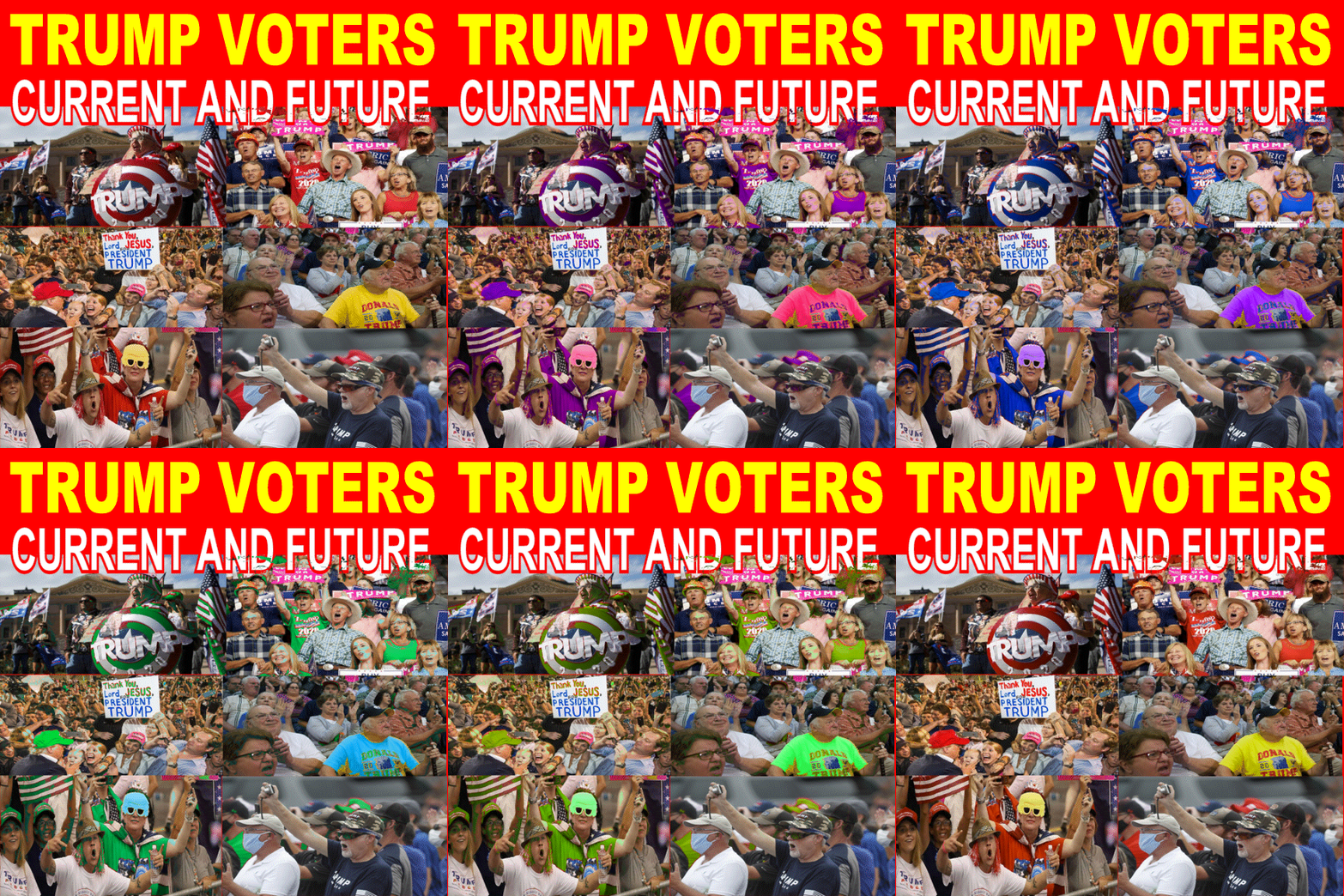
Trump Voters, Current and Future | The Merrow Report

Trump Voters, Current and Future | The Merrow Report
Trump Voters, Current and Future


Three Big Questions: 1) How many of the nearly 73 million Americans who voted for President Donald J. Trump can be persuaded to support President Joe Biden? 2) How can Democrats connect with them? 3) Can we (not just Democrats) fix our schools so they don’t keep turning out angry and disaffected graduates who eagerly support demagogues?

I suspect that the hard core racists, the white nationalists, the anti-semites, the misogynists, and other close-minded bigots who voted for Trump aren’t persuadable, nor are greedy, selfish voters who care only about their finances.

But, as I see it, that leaves many millions of Trump voters who might be open to change. Let’s not scorn or mock them but rather try to understand their position.

To change the minds of adults who voted for Trump, we have to persuade them that their government works for them. Because actions speak louder than words, a call for ‘healing’ won’t cut it. Instead, we need drastic action, a modern-day GI Bill that includes action on at least these four fronts:

1) A National Service program that employs people to help distribute COVID vaccines and perform contact tracing, in addition to rebuilding parks and national forests and working in difficult jobs in remote places. These jobs must pay a living wage and CONTINUE READING: Trump Voters, Current and Future | The Merrow Report

A VERY BUSY DAY Larry Ferlazzo's Websites of the Day... The latest news and resources in education since 2007

Larry Ferlazzo's Websites of the Day... | The latest news and resources in education since 2007

A VERY BUSY DAY
Larry Ferlazzo's Websites of the Day...
The latest news and resources in education since 2007


Big Education Ape: THIS WEEK IN EDUCATION Larry Ferlazzo's Websites of the Day... The latest news and resources in education since 2007 - http://bigeducationape.blogspot.com/2020/11/this-week-in-education-larry-ferlazzos_14.html


Useful Teaching Video: “U.S. Presidential Election Results (1789-2020)”
AnnaliseArt / Pixabay I’m adding this new video to: THE BEST RESOURCES FOR TEACHING ABOUT THE 2020 PRESIDENTIAL ELECTION The Best Sites To Learn About U.S. Presidents
My Latest BAM! Radio Show Is On “Using Education Data: What Works, What Doesn’t”
Using Education Data: What Works, What Doesn’t is the topic of my latest ten-minute BAM! Radio show. I’m joined by Cindy Garcia, Lauren Nifong and Deedy Camarena, who have all contributed written commentaries to my Education Week Teacher column. I’m adding it to All My BAM Radio Shows – Linked With Descriptions .

Sunday’s Must-Read Articles & Must-Watch Videos About School Reopenings
stux / Pixabay Here are new additions to THE BEST POSTS PREDICTING WHAT SCHOOLS WILL LOOK LIKE IN THE FALL : ‘Please Turn Your Microphone Off’: Hybrid Learning From The Classroom is from an NPR affiliate. To Combat Learning Loss, New Project Hopes to Test and Scale ‘High Impact’ Tutoring is from Ed Week. ‘Don’t Get Gaggled’: Minneapolis School District Spends Big on Student Surveillance Tool, Rai
Google Doodle Video Collection Can Provide Good Lesson Introductions
Everybody knows about Google Doodles. You can see a collection of all of them here , and many of their images would work as nice introductions to lessons, asking questions like “What do you notice? What do you wonder?” What I didn’t know, though, was that there is a collection of Google Doodle videos on YouTube, and many would serve as great introductions for lessons. There aren’t a huge number o
A Look Back: The Difference Between “Good” Teaching & “Successful” Teaching – And What This Means For The This School Year
I thought that new – and veteran – readers might find it interesting if I began sharing my best posts from over the years. You can see the entire collection here . I’m starting with posts from earlier this year. Ted Appel, our school’s former – and great – principal, talked about the importance of looking at teacher “input” instead of student “output” when considering if a teacher is doing good w
Classroom Instruction Resources Of The Week
Each week, I publish a post or two containing three or four particularly useful resources on classroom instruction, and you can see them all here. Of course, this is a crazy time for “classroom” instruction…. You might also be interested in THE BEST RESOURCES ON INSTRUCTION IN 2020 – PART ONE. Here are this week’s picks: The National Museum of the American Indian has a collection of lessons and m
Saturday’s Must-Read Articles & Must-Watch Videos On School Reopenings
geralt / Pixabay Here are new additions to THE BEST POSTS PREDICTING WHAT SCHOOLS WILL LOOK LIKE IN THE FALL : Schools start closing — or delay reopening — as covid-19 cases jump across the country is from The Washington Post. A group of Philadelphia researchers sees ‘no-win situation’ when it comes to schools. is from The NY Times. Surges in COVID cases are upending school reopening plans across
Ruby Bridges Integrated An All-White School In Louisiana On This Day In 1960 – Here Are Teaching & Learning Resources
viarami / Pixabay Ruby Bridges is famous for, as a first-grader, integrating an all-white school in Louisiana on this day in 1960. You might be interested in THE BEST RESOURCES FOR LEARNING ABOUT RUBY BRIDGES .