Latest News and Comment from Education

Saturday, November 16, 2019

The Family Friendly Schools Act: A Set Up For “Soft Policing” Schools To Profit Impact Investors? – Wrench in the Gears

The Family Friendly Schools Act: A Set Up For “Soft Policing” Schools To Profit Impact Investors? – Wrench in the Gears

The Family Friendly Schools Act: A Set Up For “Soft Policing” Schools To Profit Impact Investors?


On November 6, 2019, former San Francisco District Attorney, California Attorney General, Senator, and presidential candidate Kamala Harris introduced the Family Friendly Schools Act. If passed, the bill would create a five-year grant program to restructure 500 elementary schools to “better align” schedules to the work day. The legislation authorizes $1,300,000,000 per year from 2020 to 2024 to pay for the program.
Co-sponsors include five Democratic senators: Kirsten Gillibrand (NY); Richard Blumenthal (CT); Jeff Merkley (OR); Sherrod Brown (OH); and Michael Bennet (CO). Ostensibly this legislation is to aid  working families by extending the school day with support from community partners. It is being presented as an “economic growth and child development strategy.” In my assessment, child development = human capital management for impact investment purposes.
While it is true that families struggle with child care before and after school, the motivation behind this bill has less to do with taking care of vulnerable communities and more to do with the planned expansion of pay for success finance and “cradle to career” pipelines for impact investors.
The collection of data and the monitoring of students and families this entails will require an expansive system of what I am calling “soft” policing. We may replace school police officers with social workers, but control of Black and Brown populations is still the primary goal. This shift will be justified as fiscally prudent, “what works” public policy, though it is predicated on predictive profiling.
Harris’s bill will usher in a new era of privatization, one in which CONTINUE READING: The Family Friendly Schools Act: A Set Up For “Soft Policing” Schools To Profit Impact Investors? – Wrench in the Gears

Educator Unions Stand Together Grieving Saugus School Shooting

Educator Unions Stand Together Grieving Saugus School Shooting

Educator Unions Stand Together
Deeply Saddened by Another Tragic School Shooting and Deaths Leaders Demand an End to Gun Violence and Quick Action by Lawmakers


Four state and national education union leaders issued the following statement in the wake of the early morning shooting at Saugus High School in Santa Clarita, California that has already claimed the lives of two students and critically wounded others.
The following can be attributed to California Teachers Association President E. Toby Boyd, California Federation of Teachers President Jeff FreitasNational Education Association President  Lily Eskelsen García and American Federation of Teachers President  Randi Weingarten:
“We are once again rocked to our core by another senseless and cowardly shooting that has taken two of our precious students, left several students fighting for their lives today and the community of Saugus terrorized by the violence they hoped and prayed would never happen to them. We stand together during these difficult moments, sending love and healing thoughts to the victims and their families, our fellow educators and school employees who without a doubt did everything possible to protect their students, and the community that has been wounded today. 

“More than five million educators and school employees from California and across the country are standing strong with Saugus as they pick up the pieces and try to make sense of this tragedy. We dream of the day when these acts of gun violence no longer threaten our students’ safety and well-being. Our children cannot wait any longer for this dream to come true. We owe it to our students and our educators to make our schools and communities safe and welcome spaces, and we will do everything we can to make that happen. We call on all federal and state lawmakers to take quick action to put an end to these tragic shootings by passing meaningful and sensible gun reform. Our students and our communities are counting on you.”
The 310,000-member California Teachers Association is affiliated with the 3 million-member National Education Association, the nation’s largest professional employee organization, representing elementary and secondary teachers, higher education faculty, education support professionals, school administrators, retired educators and students preparing to become teachers.
The California Federation of Teachers represents 120,000 faculty and school employees in public and private schools and colleges, from early childhood through higher education. It is the statewide affiliate of the American Federation of Teachers, a union of 1.7 million professionals that champions fairness; democracy; economic opportunity; and high-quality public education, healthcare and public services for our students, their families and our communities.
Sonoma County Gazette
Educator Unions Stand Together Grieving Saugus School Shooting

Pennsylvania: Protect Your Public Schools and Their Funding! Say NO to Vouchers! | Diane Ravitch's blog

Pennsylvania: Protect Your Public Schools and Their Funding! Say NO to Vouchers! | Diane Ravitch's blog

Pennsylvania: Protect Your Public Schools and Their Funding! Say NO to Vouchers!


If you live in Pennsylvania, please let your legislators know that you oppose the diversion of public funds to private and religious schools. Stop the DeVos agenda now! Vouchers do not help students or schools or districts! Multiple studies have shown that vouchers divert funding from public schools and reduce services to most students, and that the students who use vouchers actually lose ground compared to their peers who stay in public schools


Dear Carol,

On Monday, November 18,The House Education Committee is scheduled to vote on voucher legislation under House Bill 1800 (Rep. Turzai, R-Allegheny). House Bill 1800 establishes a voucher program for students in the Harrisburg School District, which entered state receivership in June.  Adding tuition and transportation outlays, House Bill 1800 is estimated to cost the Harrisburg School District $5.5 million to $8.5 million. Could your district be next?
SEND YOUR EMAIL NOW BY CLICKING HERE.
Then call your representatives and ask them to vote NO on HB 1800.
You can find their number below, along with a sample script for your call:
House member contact info:

Sample Script
My name is (your name) and I am calling to let (your representative’s name) know that I am opposed to House Bill 1800 and any attempt to give public money to private schools with vouchers. Let’s support our public schools, not private schools with vouchers. Thank you.

Thanks for all you do!
Carol Burris


Teachers at D.C.’s only unionized charter school sign a contract, a first for the city - The Washington Post

Teachers at D.C.’s only unionized charter school sign a contract, a first for the city - The Washington Post

Teachers at D.C.’s only unionized charter school sign a contract, a first for the city


Teachers and staff members at Mundo Verde Bilingual Public Charter School are nearing a historic moment: They’re a vote away from settling with their bosses on a union contract, the first time that has happened at a D.C. charter school.
Workers at the popular language immersion charter school in Northwest Washington formed the D.C. charter sector’s only union in July. Another school, Chavez Prep Middle, formed a union in 2018, but negotiations stalled and school leaders shut down the campus before reaching a labor agreement with educators.


Charter schools are publicly funded and privately run, and unlike the traditional public school system, their teachers are not typically unionized. But across the country, teachers at a relatively small but growing number of charter campuses are organizing.
Many leaders of the charter school movement oppose unionization, believing it results in the same bureaucratic thicket that charter schools were created to escape.
But union leaders view the Mundo Verde contract as a significant win and hope it serves as a model for educators at other schools who hope to unionize.
“D.C. has been a petri dish for all of the different kinds of structures of educating children,” said Randi Weingarten, president of the American Federation of Teachers. “You now not only have a blueprint for D.C. schools, but for thousands of schools around the country.”
The American Federation of Teachers, the nation’s second-largest teachers union, represents the union CONTINUE READING: Teachers at D.C.’s only unionized charter school sign a contract, a first for the city - The Washington Post

CURMUDGUCATION: Betsy DeVos Accuses FBI Of Ignorance, Blames Public Education (And More)

CURMUDGUCATION: Betsy DeVos Accuses FBI Of Ignorance, Blames Public Education (And More)

Betsy DeVos Accuses FBI Of Ignorance, Blames Public Education (And More)

Never let it be said that Betsy DeVos won't go out of her way to blame US public education for all the ills of the country, real or imagined. In retrospect, it seems like an oversight that she hadn't had a "Kids These Days" moment, but now that omission has been corrected. The young FBI agents are ignorant, and public education is to blame. That's been the headline from this speech, but there's so much more to see.

DeVos was accepting another award, this time from the Independent Women's Forum, an organization founded to provide an alternative to feminism. They actually grew out of the collection of women who formed the "Women for Judge Thomas" committee, a group that got together to defend nominee Clarence Thomas from that scurrilous hussy, Anita Hill. They've been active in opposing various forms of feminism, though they do seem to support the Violence Against Women Act. One of the banners on their website announces that "recognizing progressive privilege is the first step to ending it."

Last week, at their annual awards gala, they handed out three awards. Larry Kudlow was a conservative tv talker picked by Trump to head the National Economic Council. Dana Milbank said Kudlow "may have been more wrong about the economy than anyone alive," but the IWF dubbed him a "Gentleman of Distinction." Kristy Swanson, who was in the Buffy the Vampire Slayer movie, got a CONTINUE READING: 
CURMUDGUCATION: Betsy DeVos Accuses FBI Of Ignorance, Blames Public Education (And More)


Chicago’s teachers approve their contract. – Fred Klonsky

Chicago’s teachers approve their contract. – Fred Klonsky

CHICAGO’S TEACHERS APPROVE THEIR CONTRACT


Chicago teachers, members of the Chicago Teachers Union bargaining unit numbering 25,000, have approved the agreement negotiated between the CTU bargaining team and the Chicago Public Schools board of education.
The vote came two weeks after an eleven day strike that put thousands of teachers on the picket lines and in the streets for nearly daily mass protests.
Late Friday night, with 80% of the vote counted from 80% of the schools, votes for approval were running at 81%.
I found no information on what schools the vote was coming from or whether that information will be made available later.
79% approved the deal after the seven-day 2012 strike. The 2016 CBA received a 72% vote of approval.
Teachers have reason to be proud of their unity and militancy during the bargaining.
Members will receive a 16 percent hike over the five year length of the agreement. That is a long time compared to most contracts, and to the 3-year deal that the CTU CONTINUE READING: Chicago’s teachers approve their contract. – Fred Klonsky
Screen Shot 2019-11-16 at 7.32.27 AM

Schools, Education Issues in DC’s Ward 8 – Education Town Hall Forum

Schools, Education Issues in DC’s Ward 8 – Education Town Hall Forum

SCHOOLS, EDUCATION ISSUES IN DC’S WARD 8

Our November 14, 2019 featured a discussion of issues in Ward 8 schools with the DC council member for the ward, Trayon White, along with Anacostia high school social worker Nathan Luecking and DCPS community engagement officer and Ward 8 parent Sharona Robinson.


DC’s eastern- and southernmost ward, Ward 8 has the most children in the city–and some of its poorest residents. The discussion featured some of the most pressing issues in Ward 8 schools, including basic funding (many had severe budget cuts this year alone, on top of decades of inequitable funding in both budgets and modernizations) as well as public safety issues.
Guests agreed that more resources are needed, but they also have to be targeted and aligned better, so that it is not just the available students who benefit, but all students in need. Guests also noted that the lack of a systemic, sustained approach to school support—community schools; wrap-around services; parent resource centers—has harmed the ward’s provision of public education, as it prevents policies and approaches from bearing fruit.
The ward also lacks a trauma center and hospital, which puts pressure on schools to function in that place—or to have students travel far (sometimes with school staff) to get the services they need.
Recognizing the depth of those needs, schools in Ward 8 do provide a number of peer-to-peer CONTINUE READING: Schools, Education Issues in DC’s Ward 8 – Education Town Hall Forum

Do NYS Graduation Measures Adequately Prepare Students for Career and/or College? | Ed In The Apple

Do NYS Graduation Measures Adequately Prepare Students for Career and/or College? | Ed In The Apple

Do NYS Graduation Measures Adequately Prepare Students for Career and/or College?


We all know that the primary purpose of high school is to keep teenagers and parents apart to reduce patricide, matricide and infanticide, that being said …
Over the past month I have blogged a number of times over the current year-long process to review graduate measures, commonly known as high school graduation requirements.
The elephant in the room, the topic that will not be discussed is equity.
Educational funding in New York State is dramatically inequitable,
Despite New York’s equalizing State aid system, there remain tremendous disparities between New York State school districts in fiscal resources available to support education. In 2015-16, approved operating expenditure per pupil ranged from $11,072 for the district at the 10th percentile to $21,135 for the district at the 90th percentile, a 91 percent difference.
 In a class of thirty students the difference between the 10th percentile and the 90th percentile of $300,000 per class!
This deeply corrupt system is embedded in state law. Most funding comes from property taxes (local budgets in the Big Five cities), the differences across the state, as described above, are enormous. The Foundation Aid formula is CONTINUE READING: Do NYS Graduation Measures Adequately Prepare Students for Career and/or College? | Ed In The Apple

The Wrong “Scientific” for Education | radical eyes for equity

The Wrong “Scientific” for Education | radical eyes for equity

The Wrong “Scientific” for Education

The release of National Assessment of Educational Progress (NAEP) 2019 scores in math and reading, announced as an “emergency” and “devastating,” has thrown gasoline on the rhetorical fire that has already been sweeping across media—a call for “scientific” research to save public education in the U.S.:
While the media and the public seem historically and currently convinced by the rhetoric of “scientific,” there is a significant irony to the lack of scientific evidence backing claims about the causes of NAEP scores; for example, some have rushed to argue that intensive phonics instruction and grade retention legislation have caused Mississippi’s NAEP reading gains while many have used 2019 NAEP scores to declare the entire accountability era a failure.
Yet, none of these claims have the necessary scientific evidence to make any of these arguments. There simply has not been the time or the efforts to construct scientific studies (experimental or quasi-experimental) to identify causal factors in NAEP score changes.
Another problem with the rhetoric of “scientific” is that coinciding with that CONTINUE READING: The Wrong “Scientific” for Education | radical eyes for equity

Seattle Schools Community Forum: Watch Out for Talking with the Times on HCC

Seattle Schools Community Forum: Watch Out for Talking with the Times on HCC

Watch Out for Talking with the Times on HCC


HCC or probably any other topic.

The last several years have seen the Times skew their writing on public education.  Whether it's because part of their writing is funded by the Gates Foundation (and the Times clutches its pearls if you even suggest that the Foundation gives them guidance on what to write and how to write) and/or input from the Editorial Board, I don't know.

What I do see is a steady decline of balanced reporting and it's troubling.


Now I see there is a call out from the Times asking parents with HCC experience to contact a reporter.  But let's see how it's phrased:


As we continue to explore this topic, we want to hear from you and we want your perspective and questions to improve our coverage: What are the hoops students must jump through to be admitted to gifted programs in your school district? What does gifted learning look like in your school’s classrooms? What stories do you have of racial segregation in these programs?
Hoops and segregation? Where is the "what do you like and what don't you like" in seeking out parents and their experience?

I find the survey kind of odd.

What options does your district offer for advanced learning? How are they delivered, and how do they differ from what you think is normally offered?  

I'm not sure I understand what this means? Are asking about "normally CONTINUE READING: 
Seattle Schools Community Forum: Watch Out for Talking with the Times on HCC


Some Questions for the Ohio House of Representatives | Live Long and Prosper

Some Questions for the Ohio House of Representatives | Live Long and Prosper

Some Questions for the Ohio House of Representatives

The Ohio House of Representatives has passed a bill that would prevent public school students from being penalized for their religious beliefs in science (and, I presume any other) class. In other words, a student in a geology class could assert that the Earth was 6,000 years old…a student taking astronomy could claim that the stars are simply luminous elements that move above the flat surface of the Earth above the sun, the moon, and the planets…and not be penalized on their research papers or tests.
So…I have some questions…
WOULD A TEACHER HAVE TO ACCEPT ALL RELIGIOUS BELIEFS?
If one student claims that both male and female humans were created after all the other creatures (Genesis 1:1 through 2:3) and another one claims that male humans were created before plants and animals, and female human beings were created after (Genesis 2:4-2:25) would they both be entitled to a correct grade?
How about a student who claimed that the Universe (and the Earth) was created by the god Ptah, who brought things into existence just by imagining them? Or that the Earth was created by the god Atum, who had sex with his [sic] own feminine energy and brought forth other gods…who then had sex and gave birth to the air, water, humans and everything else?
The Ohio House on Wednesday passed the “Student Religious Liberties Act.” Under the law, students can’t be penalized if their work is scientifically wrong as long as the reasoning is because of their religious beliefs.

Instead, students are graded on substance and relevance.

Every Republican in the House supported the bill. It now moves to the Republican-controlled Senate.
WHAT IS THE POINT OF HAVING ANY SCIENTIFIC CURRICULUM?
Do we accept answers from students who variously claim that the Universe/Earth is 41,000 years old, 24 trillion years old, or 6,000 years old? If CONTINUE READING: Some Questions for the Ohio House of Representatives | Live Long and Prosper

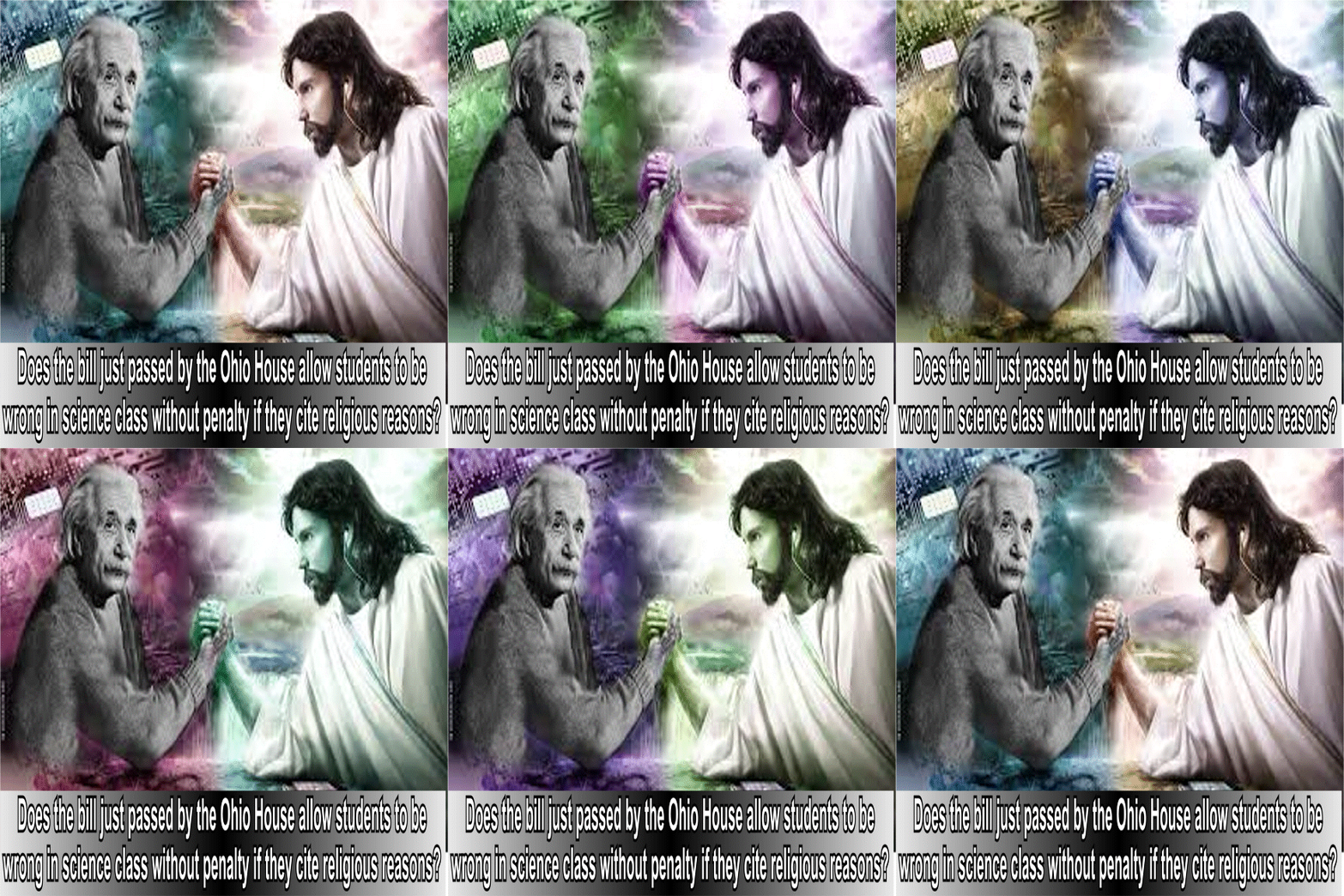
Does the bill just passed by the Ohio House allow students to be wrong in science class without penalty if they cite religious reasons? - The Washington Post

Does the bill just passed by the Ohio House allow students to be wrong in science class without penalty if they cite religious reasons? - The Washington Post

Does the bill just passed by the Ohio House allow students to be wrong in science class without penalty if they cite religious reasons?


(Update: Interview with bill sponsor, more detail)
Did lawmakers in Ohio’s House pass legislation that says it’s okay for students to be wrong in science class as long as their reasoning is based on religious beliefs?
That’s what critics in the state are saying is allowed in the “Ohio Student Religious Liberties Act of 2019” (see text below), which passed this week 61 to 31 in the Republican-dominated legislative chamber and will move on to the GOP-controlled Senate.


But the bill’s sponsor, state Rep. Timothy Ginter (R), says that’s not so. So does Charles Haynes, founding director of the Religious Freedom Center at the Freedom Forum Institute, which is the the education and outreach partner of the Freedom Forum and the Newseum in Washington D.C.
The legislation, HB 164, would do the following if it became law, according to an analysis from the Ohio Legislative Service Commission, a bipartisan agency that provides the Ohio General Assembly with budget and fiscal analysis:
  • Allow students to engage in religious expression in the completion of homework, artwork or other assignments
  • Prohibit public schools from rewarding or penalizing a student based on the religious content of a student’s homework, artwork or other assignments
This is the specific language in HB 164:
Sec. 3320.03. No school district board of education, governing authority of a community school established under Chapter 3314. of the Revised Code, governing body of a Sec. STEM school established under Chapter 3326. of the Revised Code, or board of trustees of a college-preparatory boarding school established under Chapter 3328. of the Revised Code shall prohibit a student from engaging in religious expression in the completion of homework, artwork, or other written or oral assignments. Assignment grades and scores shall be calculated using ordinary academic standards of substance and relevance, including any legitimate pedagogical concerns, and shall not penalize or reward a student based on the religious content of a student’s work.
Ginter was quoted by WKRC as saying: “Under House Bill 164, a Christian or Jewish student would not be able to say my religious texts teach me that the world is 6,000 years old, so I don’t have to answer this question. They’re still going to be tested in the class and they cannot ignore the class material."
But Gary Daniels, chief lobbyist for the American Civil Liberties Union of Ohio, said the measure does in fact allow students to answer homework questions and other assignments incorrectly, based on religious doctrine rather than science — and not be marked wrong. Cleveland.com quoted him as saying: “Under HB 164, the answer is ‘no,’ as this legislation clearly states the instructor ‘shall not penalize or reward a student based on the religious content of a student’s work.' ”
It also quoted Amber Epling, spokeswoman for Ohio House Democrats, as saying that based on the analysis from the Ohio Legislative Service Commission, she believes students can be scientifically incorrect based on religion and not be penalized.
Numerous states in recent years have considered scores of anti-science bills — usually aimed at affecting classroom discussion on evolution and climate change. Those measures typically take one of two approaches, according to the nonprofit National Center for Science Education, which seeks to CONTINUE READING: Does the bill just passed by the Ohio House allow students to be wrong in science class without penalty if they cite religious reasons? - The Washington Post

CURMUDGUCATION: OH: Outlawing Facts

CURMUDGUCATION: OH: Outlawing Facts

OH: Outlawing Facts


The Ohio House of Representatives is ready to help students take a bold step forward into the post-fact world. Wednesday they passed (and when I say "they," I mean the solid vote-as-a-bloc GOPHB 164.

It's called the "Ohio Student Religious Liberties Act of 2019" and it sets out to accomplish a few things:

It removes the limits on exercising expression of student religious beliefs. The old, struck-out language  said the board of education could limit said expression to lunch period or other noninstructional time. That's the piddly stuff.


Under the new language, "religious expression" (the stuff no longer limited to non-instructional time) includes prayer, gatherings (clubs, prayer groups, etc), distribution of written materials, and, well, anything religious, actually, including wearing religious gear or "expression of a religious viewpoint" (as long as it's not obscene or indecent or vulgar). Cue the Church of the Flying Spagetti Monster and the local Satanic Temple; if a student offers a prayer to Satan in the middle of English class and some Christians in the class find that indecent and vulgar, can it be suppressed? Congratulations to the first batch of lawyers and judges that are going to have to sort this out. Double congratulations to whatever government body ends up being responsible for determining which religions are state-certified to be protected under this law.

Students hall have access to school facilities before, during and after school that school hours to the same extent that secular activities may do so. Place your bets now on how many schools will simply CONTINUE READING: 
CURMUDGUCATION: OH: Outlawing Facts


THIS WEEK Education Research Report

Education Research Report


THIS WEEK 
Education Research Report


Recent trends in adult literacy in the United States

Between 2012/14 and 2017, the average scores for U.S. adults with less than a high school education increased in literacy, while, for adults with a high school education, they decreased in both literacy and numeracy. The National Center for Education Statistics released a new web-based first look report today November 15, 2019, entitled “ U.S. PIAAC 2017 First Look Web Report. ” This web-based fi

NOV 14


A Complete Guide to Video Production Management
Degrees from private nonprofit colleges provide the best returns

A a new report uses data from the expanded College Scorecard to rank 4,500 colleges and universities by return on investment. A First Try at ROI: Ranking 4,500 Colleges finds that bachelor's degrees from private colleges, on average, have higher returns on investment than degrees from public colleges 40 years after enrollment. Community colleges and many certificate programs have the highest retu
New study dispels myths about what makes youth sports fun for kids

A new study looks at what makes organized sports fun for kids, and some of the findings might surprise you. The new study, published today, dispels the popular myth that what makes sports the most fun for girls are the social aspects, like friendships, while for boys the fun factor has to do with competition. "Our data indicate girls and boys are more similar than different when it comes to what
New Study on the Role of Social Identities in Children's Lives

As children grow, building a positive sense of identity – informed in part by social categories like race, gender, religion, social class, and more – is critical to healthy development and, ultimately, to their life outcomes and success. Most often, children learn about and explore their identities through open conversations and experiences with the nurturing adults in their lives. However, based
Report About Charters Being a “Rising Tide” Sinks Under Weight of Flawed Data

A recent report from the Thomas B. Fordham Institute examines whether average achievement in a school district increases as the “market share” of charter schools rises. The report argues that there is a positive competition effect. Yongmei Ni of the University of Utah reviewed Rising Tide: Charter School Market Share and Student Achievement , and determined that its findings have limited use in g

NOV 13

Teaching group work to students with autism S

Autism spectrum disorder (ASD) is the fastest growing developmental disability in the United States. According to the American Psychiatric Association, this disability is characterized by "persistent deficits in social communication and social interactions across multiple contexts". Children with autism have an obvious disadvantage in starting and carrying meaningful conversations with their peer
In the 2017-18 academic year, the states awarded about $13.6 billion in total state funded student financial aid

This report provides data regarding state-funded expenditures for student financial aid and illustrates the extent of efforts made by the states to assist postsecondary students. Information in this report is based on academic year 2017-18 data from the 49th Annual NASSGAP survey. Data Highlights •, an increase of about 6.6 percent in nominal terms and about 4.8 percent in constant dollar terms f
REPORT GRADES STATES ON FAIR SCHOOL FUNDING x

Far Too Many States Get Failing Grades Making the Grade 2019: How Fair Is School Funding in Your State? , released by Education Law Center (ELC) today, provides compelling evidence that K-12 public school funding continues to be deeply unfair in many states and a major factor contributing to disparities in education resources, opportunities and outcomes for the 50 million public school children a

NOV 12

Brains of girls and boys are similar, producing equal math ability

In 1992, Teen Talk Barbie was released with the controversial voice fragment, "Math class is hard." While the toy's release met with public backlash, this underlying assumption persists, propagating the myth that women do not thrive in science, technology, engineering and mathematic (STEM) fields due to biological deficiencies in math aptitude. Jessica Cantlon at Carnegie Mellon University led a
New What Works Clearinghouse Report: InsideTrack© Coaching

The What Works Clearinghouse recently reviewed research on the impacts of InsideTrack © Coaching on four-year college students. The results are summarized in an intervention report released today . InsideTrack © Coaching provides proactive, personalized coaching to help students identify and overcome academic and non-academic barriers to college persistence and graduation. InsideTrack © partners

NOV 11

Summer Credit Recovery Impact on Newcomer English Learners

Prior research shows that English learners (ELs) lag behind their peers in academic achievement and education attainment. The persisting gap is partly attributed to ELs’ limited exposure to academic content. This article investigates the efficacy of a summer credit recovery program aimed at expanding high school newcomer ELs’ access to academic subjects. Leveraging student-level data from a large
Improving Indicators of College Readiness

Over half of community college students place into developmental education, resulting in significant financial costs. This study extends previous research demonstrating that using placement tests to assign students into developmental courses results in frequent misplacement, using Florida data to explore the extent to which students are misplaced into their first college course by more than one l

NOV 08

High numbers of youth report using prescription opioids in the past year

A new analysis of data from the National Survey on Drug Use and Health finds a surprisingly high prevalence of prescription opioid use among youth. As recently as 2015-2016, 21 percent of adolescents and 32 percent of young adults said they had used these drugs in the past year. Nearly 4 percent and 8 percent, respectively, reported misusing opioids. Findings were published this week in PLoS Medi


U.S. Secret Service Analysis of Targeted School Violence

[no content]


Education Research Report